

Enhancing service-learning through Generative AI: a mixed-methods study on educational Game design in a finance course
Open accessThe DOI matches its Crossref record; 32 of the 32 references it cites were found in a registry or an index; 9 of the 20 sources its claims cite were checked for support.
Abstract
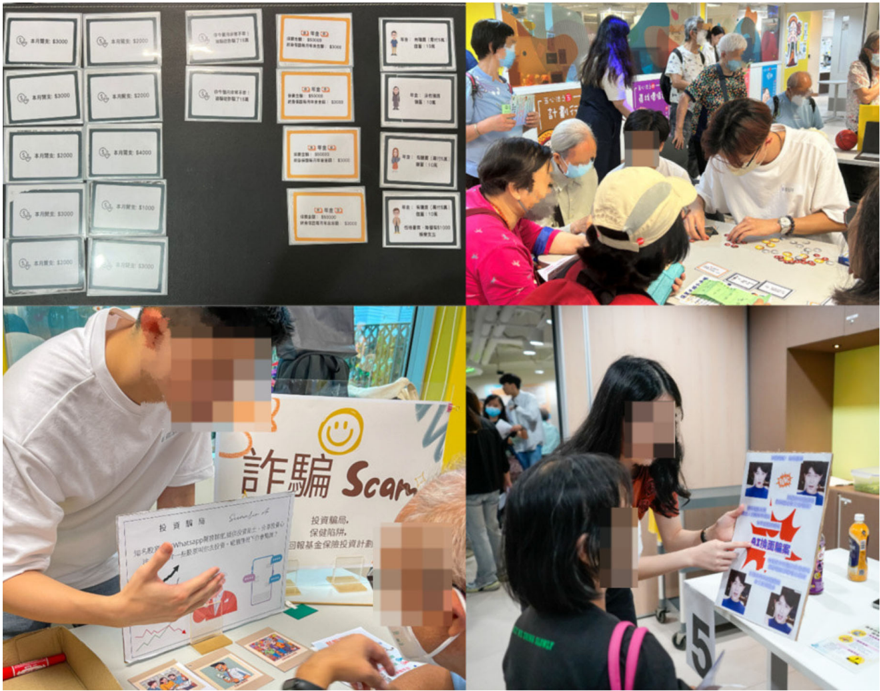
Since the release of ChatGPT in late 2022, the integration of Generative Artificial Intelligence (GenAI) in higher education has posed both opportunities and challenges, especially around critical thinking and assessment integrity. This study explores how GenAI can be ethically and effectively integrated into a service-learning course on personal finance at a Hong Kong university. Students in the GenAI-supported class designed educational games for elderly participants in community centres, applying financial concepts through AI-assisted content generation and game development. Adopting a sequential explanatory mixed-methods design, we compared two student groups (GenAI-supported vs. non-GenAI) using a modified Service-Learning Outcomes Measurement Scale (S-LOMS). Quantitative results revealed significantly higher gains in Knowledge Application, Critical Thinking, and Self-Efficacy among the GenAI group. Qualitative thematic analysis of student reflections supported these findings and highlighted four key themes: enhanced knowledge transfer, increased self-efficacy, critical engagement with AI, and ethical awareness. Contrary to concerns about over-reliance, students used GenAI critically, supplementing and challenging AI outputs. These results suggest that GenAI, when scaffolded by ethical and reflective pedagogies, can enhance cognitive and metacognitive outcomes in service-learning. Implications for integrating GenAI into experiential learning and practical guidelines for ethical use are discussed.
Overview
CoChat Summary
TL;DR
This mixed-methods study integrated Generative AI into an undergraduate service-learning finance course where students designed educational games for elderly participants. Compared with a non-GenAI class, the GenAI-supported class showed significantly greater gains in Knowledge Application, Critical Thinking, and Self-Efficacy, with qualitative reflections highlighting critical and ethical engagement with AI.
Key findings
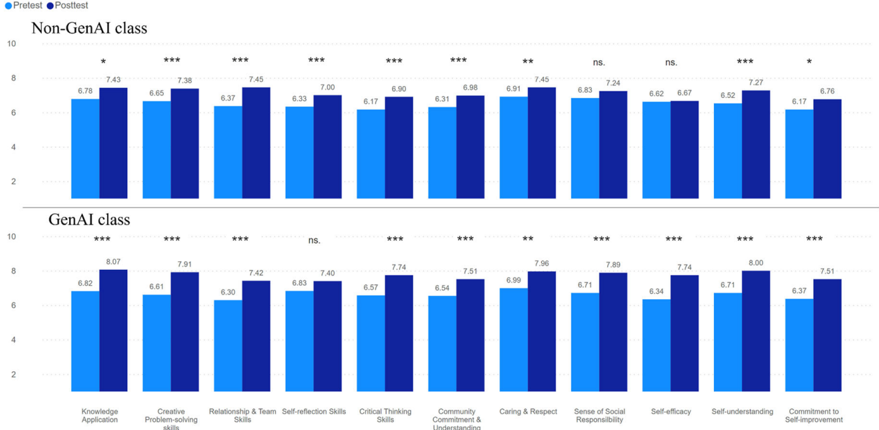
- On post-test S-LOMS scores, the GenAI class scored higher than the non-GenAI class in Knowledge Application (M = 8.07 vs. 7.43; t(75) = 2.10, p = .04), Critical Thinking Skills (t(75) = 2.17, p = .03, d = 0.50), and Self-Efficacy (M = 7.74 vs. 6.67; mean difference = 1.07; t(75) = 2.37, p = .02, d = 0.54).
- Paired-sample results showed larger gains in the GenAI class for Knowledge Application (mean difference = 1.25, SD = 1.78; t(34) = 4.16, p < .001, d = 0.70 vs. non-GenAI d = 0.37) and Self-Efficacy (mean difference = 1.40, SD = 2.23; t(34) = 3.72, p < .001, d = 0.63 vs. non-GenAI d = 0.04).
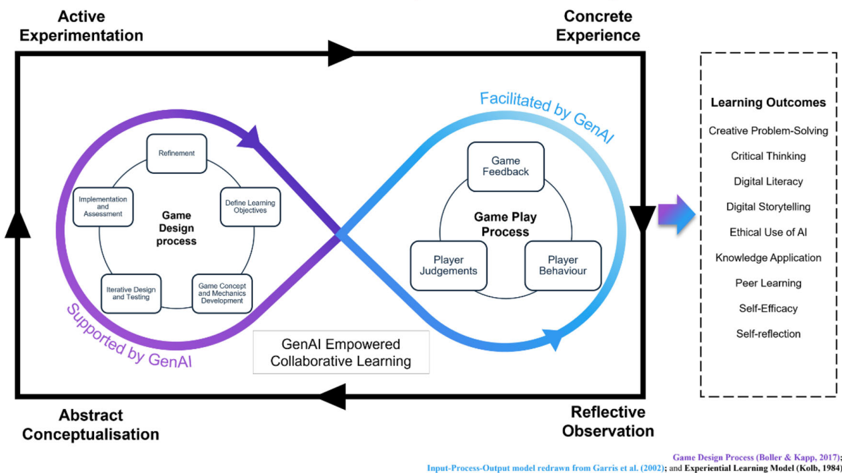
- Thematic analysis of GenAI-class reflections identified four themes: enhanced knowledge transfer/knowledge application, increased self-efficacy and creative problem-solving, critical engagement with AI, and ethical awareness/responsible AI use.
- Students reported verifying AI-generated content, noticing outdated or incorrect information, and emphasizing human oversight; the paper concludes GenAI acted as a pedagogical partner when scaffolded by ethical and reflective pedagogies.
Methods
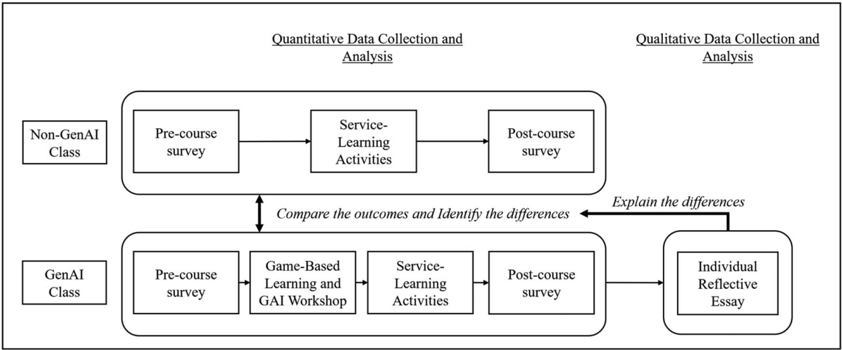
- Sequential explanatory mixed-methods design comparing two offerings of a 14-week undergraduate “Personal Finance and Society” service-learning course at a private Hong Kong university in Academic Year 2023/24: GenAI class (n = 36) and non-GenAI class (n = 41), with convenience sampling.
- The GenAI class received a two-hour Game-Based Learning and GenAI workshop in Week 7 using ChatGPT 3.5 via the university’s in-house version; the non-GenAI class followed the same syllabus and project format without GenAI or the workshop.
- Quantitative data used the S-LOMS across 11 domains and 4 categories on a 10-point Likert scale (Cronbach’s α = 0.96), analyzed with paired-sample and independent-sample t-tests in IBM SPSS 28; qualitative data were individual reflective essays from the GenAI class, analyzed using Braun and Clarke’s six-step thematic analysis with two independent coders.
Limitations
- The paper states limitations including small sample size, single-institution scope, focus on one financial literacy course, reliance on self-reported data and reflections subject to bias, and use of ChatGPT-3.5 with known accuracy and contextual-depth limitations.
- The paper notes that self-reported critical thinking and self-efficacy may not fully align with actual performance and calls for objective data such as peer assessments, behavioral analytics, or AI usage logs.
- Evident from the text: the design used two intact classes with convenience sampling and no randomization, and the paper acknowledges possible context-specific factors such as instructor style or student motivation; qualitative reflections came only from the GenAI class.
Model-written summary. Check it against the paper before relying on it.
Integrity signals
Registry
Cites
Statistics
Figures


Verification
Claims the paper makes
7 Valid · 0 Not valid · 10 Not checked · 86 Own results and interpretations
A result the paper reports from its own data — it cites no other source for it, so there is none to check. The quote shows it is in the paper.
In the paper
“However, the paired-sample t-test results indicate that GenAI classes exhibited greater improvements in most of the S-LOMS areas compared to non-GenAI classes.”
§ Enhancing service-learning through Generative AI: a mixed-methods study on educational Game design in a finance course > 4.2. Paired-sample t-test of the 11 domains
hedgedstates an association- Asserted: passes — The authors put it forward as true.
- Checkable: passes — It can be checked against evidence.
- Load-bearing: passes — The paper’s conclusions depend on it.
- Based: passes — The paper gives a reason why it holds.
A result the paper reports from its own data — it cites no other source for it, so there is none to check. The quote shows it is in the paper.
In the paper
“A notable improvement was observed in the domain of Self-efficacy, where the GenAI class showed a mean difference of 1.40 (SD ¼ 2.23), compared to the non-GenAI class with a mean difference of only 0.05 (SD ¼ 1.36).”
§ Enhancing service-learning through Generative AI: a mixed-methods study on educational Game design in a finance course > 4.2.2. Self-efficacy
plain- Asserted: passes — The authors put it forward as true.
- Checkable: passes — It can be checked against evidence.
- Load-bearing: passes — The paper’s conclusions depend on it.
- Based: passes — The paper gives a reason why it holds.
A result the paper reports from its own data — it cites no other source for it, so there is none to check. The quote shows it is in the paper.
In the paper
“A subsequent independent t-test determined statistically significant differences in S-L outcomes across the 11 domains between GenAI and Non-GenAI classes.”
§ Enhancing service-learning through Generative AI: a mixed-methods study on educational Game design in a finance course > 3.5. Quantitative approach
plainstates an association- Asserted: passes — The authors put it forward as true.
- Checkable: passes — It can be checked against evidence.
- Load-bearing: passes — The paper’s conclusions depend on it.
- Based: passes — The paper gives a reason why it holds.
A result the paper reports from its own data — it cites no other source for it, so there is none to check. The quote shows it is in the paper.
In the paper
“Four key themes were identified, corresponding to the domains in which GenAI students showed the most significant improvements: Knowledge Application, Critical Thinking, and Self-Efficacy.A fourth theme concerning Ethical Awareness also emerged, illustrating how students engaged with the boundaries and responsibilities of AI use.”
§ Enhancing service-learning through Generative AI: a mixed-methods study on educational Game design in a finance course > 4.5. Thematic analysis
plain- Asserted: passes — The authors put it forward as true.
- Checkable: passes — It can be checked against evidence.
- Load-bearing: passes — The paper’s conclusions depend on it.
- Based: passes — The paper gives a reason why it holds.
A result the paper reports from its own data — it cites no other source for it, so there is none to check. The quote shows it is in the paper.
In the paper
“Quantitative analyses showed that students in the GenAI class reported larger gains in key domains such as Knowledge Application, Critical Thinking, and Self-Efficacy, with moderate to large effect sizes (d ¼ 0.56 to 0.70).”
§ Enhancing service-learning through Generative AI: a mixed-methods study on educational Game design in a finance course > 4.6. Summary of findings
plainstates an association- Asserted: passes — The authors put it forward as true.
- Checkable: passes — It can be checked against evidence.
- Load-bearing: passes — The paper’s conclusions depend on it.
- Based: passes — The paper gives a reason why it holds.
45 more claims
Create a free account to see all 103 claims and every source verdict.
- It may state two separate claims as one. 37
- Probably not a substantial claim. 23
- The quote only partly states this claim. 1
Self-check
Percentages, sums and reported differences re-computed from the paper’s own numbers.
Each contradiction between two passages listed here was confirmed by an independent check.
Rated major: it would touch a result — a value a result rests on, reported and recomputed p-values on opposite sides of the significance level, two passages that conflict with no sign which is right, or a cited work retracted before this paper was published.
In the paper
“| S-LOMS (Overall) | 7.25 | 7.78 | 1.25 (0.30) | 1.12 | 0.06 | -1.79 | 75 | 0.08 0.41 | |”
§ Enhancing service-learning through Generative AI: a mixed-methods study on educational Game design in a finance course > Disclosure statement
Reported 1.25 · recomputed 0.53
Rated minor: it would not touch a result — a value no result rests on, a p-value that stays on the same side of the significance level, or a conflict that is clerical, resolved elsewhere in the paper, or outside its own findings.
In the paper
§ Enhancing service-learning through Generative AI: a mixed-methods study on educational Game design in a finance course > 3.3. Research design and participants
“The GenAI group (n ¼ 36) and the non-GenAI group (n ¼ 41) were comparable in gender, year of study, and disciplinary background (see Table 1).”
§ Enhancing service-learning through Generative AI: a mixed-methods study on educational Game design in a finance course > Disclosure statement
“| Male | 24 (57.1%) | 20 (57.1%) | | Female | 18 (42.9%) | 15 (42.9%) |”
Rated minor: it would not touch a result — a value no result rests on, a p-value that stays on the same side of the significance level, or a conflict that is clerical, resolved elsewhere in the paper, or outside its own findings.
In the paper
§ Enhancing service-learning through Generative AI: a mixed-methods study on educational Game design in a finance course > Disclosure statement
“| Domains | class | class | differences (SD) | CI lower | CI upper | t | d f | p | d |”
§ Enhancing service-learning through Generative AI: a mixed-methods study on educational Game design in a finance course > Disclosure statement
“| Knowledge Application | 7.43 | 8.07 | 0.64 (0.30) | 1.24 | 0.03 | 2.10 | 75 | 0.04 0.48 | |”
Rated minor: it would not touch a result — a value no result rests on, a p-value that stays on the same side of the significance level, or a conflict that is clerical, resolved elsewhere in the paper, or outside its own findings.
In the paper
§ Enhancing service-learning through Generative AI: a mixed-methods study on educational Game design in a finance course > Disclosure statement
“| S-LOMS (Overall) | 7.25 | 7.78 | 1.25 (0.30) | 1.12 | 0.06 | -1.79 | 75 | 0.08 0.41 | |”
§ Enhancing service-learning through Generative AI: a mixed-methods study on educational Game design in a finance course > Disclosure statement
“| S-LOMS (Overall) | 7.25 | 7.78 | 1.25 (0.30) | 1.12 | 0.06 | 1.79 | 75 | 0.08 | 0.41 |”
Cited works that were retracted
Works this paper cites that were later retracted, from the retraction notices publishers deposit. Major when the notice came out before this paper was published.
A note, not an issue: for example, a cited work that was retracted only after this paper was published, which its authors could not have known.
In the paper
“These findings align with recent research emphasising that GenAI fosters critical thinking when students are guided to question it (Fan et al., 2025; Wang & Fan, 2025).”
Cited work 10.1057/s41599-025-04787-y · retracted 2026-04-22 · notice 10.1057/s41599-026-07310-z · this paper published 2025-11-25
Citations
Cites
1 retracted
Wang, J., & Fan, W. (2025) · Humanities and Social Sciences Communications · doi:10.1057/s41599-025-04787-y · Cited by 322 · cited 6×
“These findings align with recent research emphasising that GenAI fosters critical thinking when students are guided to question it (Fan et al., 2025; Wang & Fan, 2025).”
InfluentialRetractedUsing thematic analysis in psychology
Braun, V., & Clarke, V. (2006) · Qualitative Research in Psychology · doi:10.1191/1478088706qp063oa · Cited by 194,414
Games, Motivation, and Learning: A Research and Practice Model
Garris, R., Ahlers, R., & Driskell, J. E. (2002) · Simulation & Gaming · doi:10.1177/1046878102238607 · Cited by 3,201
Chatting and cheating: Ensuring academic integrity in the era of ChatGPT
Cotton, D. R. E., Cotton, P. A., & Shipway, J. R. (2024) · Innovations in Education and Teaching International · doi:10.1080/14703297.2023.2190148 · Cited by 3,087 · cited 1×
“This theme resonates with Kolb ’ s Reflective Observation and Active Experimentation stages, as well as with broader calls in the literature for integrating AI literacy and ethical use into GenAI-based education (Cotton et al., 2024; Ng et al., 2021).”
Conceptualizing AI literacy: An exploratory review
Ng, D. T. K., Leung, J. K. L., Chu, S. K. W., & Qiao, M. S. (2021) · Computers and Education: Artificial Intelligence · doi:10.1016/j.caeai.2021.100041 · Cited by 2,205 · cited 2×
“Similarly, Ng et al. (2021) introduced an AI Literacy Framework based on Bloom ’ s Taxonomy, which emphasises higher-order thinking and ethical AI use.”
Formative assessment: a critical review
Bennett, R. E. (2011) · Assessment in Education: Principles, Policy & Practice · doi:10.1080/0969594x.2010.513678 · Cited by 1,498 · cited 1×
“Education 4.0 also advocates for authentic, formative assessments that go beyond rote learning (Bennett, 2011).”
InfluentialFan, Y., Tang, L., Le, H., Shen, K., Tan, S., Zhao, Y., Shen, Y., Li, X., & Gašević, D. (2025) · British Journal of Educational Technology · doi:10.1111/bjet.13544 · Cited by 805 · cited 4×
“On the other, it may erode students ’ critical thinking and reflection if used uncritically, leading to what scholars have termed ‘ metacognitive lazi-ness ’ (Fan et al., 2025; Smolansky et al., 2023).”
InfluentialAI literacy in K-12: a systematic literature review
Casal-Otero, L., Catala, A., Fernández-Morante, C., Taboada, M., Cebreiro, B., & Barro, S. (2023) · International Journal of STEM Education · doi:10.1186/s40594-023-00418-7 · Cited by 724
Use of ChatGPT in academia: Academic integrity hangs in the balance
Bin-Nashwan, S. A., Sadallah, M., & Bouteraa, M. (2023) · Technology in Society · doi:10.1016/j.techsoc.2023.102370 · Cited by 394
Kong, S.-C., Man-Yin Cheung, W., & Zhang, G. (2021) · Computers and Education: Artificial Intelligence · doi:10.1016/j.caeai.2021.100026 · Cited by 332
Educator and Student Perspectives on the Impact of Generative AI on Assessments in Higher Education
Smolansky, A., Cram, A., Raduescu, C., Zeivots, S., Huber, E., & Kizilcec, R. F. (2023) · Proceedings of the Tenth ACM Conference on Learning @ Scale · doi:10.1145/3573051.3596191 · Cited by 275 · cited 2×
“On the other, it may erode students ’ critical thinking and reflection if used uncritically, leading to what scholars have termed ‘ metacognitive lazi-ness ’ (Fan et al., 2025; Smolansky et al., 2023).”
Generative AI in Higher Education: The ChatGPT Effect
Chan, C. K. Y., & Colloton, T. (2024) · Routledge · doi:10.4324/9781003459026 · Cited by 203 · cited 2×
“However, the emergence of GenAI adds complexity: AI tools can support process-based learning but also challenge the authenticity of assessment unless scaffolded appropriately (Chan & Colloton, 2024).”
Salinas-Navarro, D. E., Vilalta-Perdomo, E., Michel-Villarreal, R., & Montesinos, L. (2024) · Education Sciences · doi:10.3390/educsci14010083 · Cited by 193 · cited 2×
“Recent studies suggest that GenAI may complement experiential learning by supporting authentic assessment, personalised learning, and project-based applications (Cacicio & Riggs, 2023; Salinas-Navarro et al., 2024a).”
May the Fourth Be with you: Creating Education 4.0
Salmon, G. (2019) · Journal of Learning for Development · doi:10.56059/jl4d.v6i2.352 · Cited by 164 · cited 2×
“These include not only digital literacy and adaptability, but also self-direction, critical thinking, and ethical reasoning (Pel (cid:1) aez-S (cid:1) anchez et al., 2024; Salmon, 2019).”
Peláez-Sánchez, I. C., Velarde-Camaqui, D., & Glasserman-Morales, L. D. (2024) · Frontiers in Education · doi:10.3389/feduc.2024.1392091 · Cited by 146
Generative artificial intelligence and engineering education
Johri, A., Katz, A. S., Qadir, J., & Hingle, A. (2023) · Journal of Engineering Education · doi:10.1002/jee.20537 · Cited by 121 · cited 1×
“On one hand, GenAI can facilitate personalised learning, provide instant feedback, and support creativity in writing and problem-solving (Johri et al., 2023).”
ChatGPT Promises and Challenges in Education: Computational and Ethical Perspectives
Adel, A., Ahsan, A., & Davison, C. (2024) · Education Sciences · doi:10.3390/educsci14080814 · Cited by 108
Salinas-Navarro, D. E., Vilalta-Perdomo, E., Michel-Villarreal, R., & Montesinos, L. (2024) · Interactive Technology and Smart Education · doi:10.1108/itse-12-2023-0236 · Cited by 84 · cited 2×
“Recent studies suggest that GenAI may complement experiential learning by supporting authentic assessment, personalised learning, and project-based applications (Cacicio & Riggs, 2023; Salinas-Navarro et al., 2024a).”
Technology integration in service-learning pedagogy: A holistic framework
Salam, M., Awang Iskandar, D. N., Ibrahim, D. H. A., & Farooq, M. S. (2019) · Telematics and Informatics · doi:10.1016/j.tele.2019.02.002 · Cited by 76 · cited 3×
“Recent work has begun to explore how S-L can be enhanced by digital technologies (Ngai et al., 2024; Salam et al., 2019), yet few studies have examined how GenAI might interact with the reflective and ethical components central to S-L.”
Hsu, T.-C., Abelson, H., & Van Brummelen, J. (2022) · The International Review of Research in Open and Distributed Learning · doi:10.19173/irrodl.v22i4.5474 · Cited by 65 · cited 1×
“Hsu et al. (2022) found that combining GenAI with experiential learning improved computational thinking and engagement among secondary students.”
Waiting for the revolution: how higher education institutions initially responded to ChatGPT
Korseberg, L., & Elken, M. (2025) · Higher Education · doi:10.1007/s10734-024-01256-4 · Cited by 49 · cited 1×
“Institutions initially responded with caution or paralysis, as they struggled to understand the pedagogical implications of tools that can generate coherent, seemingly credible content with minimal effort (Korseberg & Elken, 2025).”
AI to Support Guided Experiential Learning
Goldberg, B., & Robson, R. (2023) · Communications in Computer and Information Science · doi:10.1007/978-3-031-36336-8_16 · Cited by 36 · cited 1×
“As Goldberg and Robson (2023) argue, GenAI works best when embedded in guided experiential frameworks that include human oversight and reflection.”
A Large-Scale Study of Students’ E-Service-Learning Experiences and Outcomes During the Pandemic
Ngai, G., Lau, K.-H., & Kwan, K.-P. (2024) · Journal of Experiential Education · doi:10.1177/10538259231171852 · Cited by 25 · cited 2×
“Recent work has begun to explore how S-L can be enhanced by digital technologies (Ngai et al., 2024; Salam et al., 2019), yet few studies have examined how GenAI might interact with the reflective and ethical components central to S-L.”
Kapasheva, Z., Mirza, N. V., Шеститко, И. В., Gelmanova, Z., Makouchyk, A., & Umbetova, A. (2024) · Frontiers in Education · doi:10.3389/feduc.2024.1360712 · Cited by 22
Taylor, A., Yochim, L., & Raykov, M. (2019) · Journal of Experiential Education · doi:10.1177/1053825919863452 · Cited by 18 · cited 1×
“However, challenges persist, including uneven engagement, lack of personalisation, and difficulty sustaining reflective depth (Taylor et al., 2019).”
Khiatani, P. V., She, M. H. C., Ho, O. Y. Y., & Liu, J. K. K. (2023) · International Journal of Educational Development · doi:10.1016/j.ijedudev.2023.102813 · Cited by 15 · cited 1×
“Technology-assisted S-L has become increasingly common, especially in the wake of the COVID-19 pandemic (Khiatani et al., 2023; Ngai et al., 2024; Salam et al., 2019; Xiao et al., 2022).”
Bridging Resource Gaps in Adult Education: The Role of Generative AI
Cacicio, S., & Riggs, R. (2023) · Adult Literacy Education: The International Journal of Literacy, Language, and Numeracy · doi:10.35847/scacicio.rriggs.5.3.80 · Cited by 15 · cited 2×
“Prior studies have suggested that GenAI can support learning by providing feedback, generating content drafts, and accelerating ideation (e.g. Cacicio & Riggs, 2023; Chan & Colloton, 2024).”
Ensuring the Effectiveness of EService-Learning in Holistic Education Under Social Distancing
Xiao, C., Wan, K., & Chan, W. F. C. (2022) · Journal of Experiential Education · doi:10.1177/10538259221077184 · Cited by 14 · cited 1×
“Technology-assisted S-L has become increasingly common, especially in the wake of the COVID-19 pandemic (Khiatani et al., 2023; Ngai et al., 2024; Salam et al., 2019; Xiao et al., 2022).”
Self-citationBringle, R. G., & Clayton, P. H. (2023) · International Encyclopedia of Education(Fourth Edition) · doi:10.1016/b978-0-12-818630-5.02125-4 · Cited by 10
Service-learning outcomes measurement scale (S-LOMS) : the user manual
Lingnan University, LAU, K. H., SNELL, R. S., & Lingnan University (2020) · doi:10.14793/9789887522201 · Cited by 9 · cited 3×
“In the other hand, Table 3 presents the paired-sample t-test results comparing the pre-and post-test scores of the S-LOMS categories between the non-GenAI class and the GenAI class.”
InfluentialSamala, A. D., & Rawas, S. (2026) · Interactive Learning Environments · doi:10.1080/10494820.2025.2554987 · Cited by 5 · cited 1×
“This trajectory is echoed by Samala and Rawas (2025), who highlight how the integration of AI with other technologies — such as Augmented Reality (AR) and Natural Language Processing (NLP) — can foster immersive, conversational, and experiential learning environments that deepen student engagement.”
Identifying Key Learning Factors in Service-Leaning Programs Using Machine Learning
Wang, K., Fu, E. Y., Ngai, G., et al. (2022) · IEEE Annual Computers, Software, and Applications Conference (COMPSAC) · doi:10.1109/compsac54236.2022.00207 · Cited by 2
Research works printed but not linked: 2
- 4. Bloom, B. S., Engelhart, M. D., Furst, E. J., Hill, W. H., & Krathwohl, D. R. (1956). Taxonomy of educational objectives: The classification of educational goals. In Handbook 1: Cognitive domain (pp. 1103-1133). Longman.
- 20. Kolb, D. A. (1984). Experiential learning: Experience as the source of learning and development. Prentice-Hall.
Cited by
Song, R., Alias, A. B., & Jamaludin, K. A. (2026) · Frontiers in Education · doi:10.3389/feduc.2026.1760298 · Cited by 6
Rodríguez-Rivera, P., León, A. M., & Rodríguez-Ferrer, J. M. (2026) · Advances in computational intelligence and robotics book series · doi:10.4018/979-8-3373-7472-7.ch005
Sangurima, W. E. J. (2026) · ASCE MAGAZINE · doi:10.70577/asce.v5i2.902
Metadata
- Authors
- Wan, K., Woo, Y. Y., & Ho, G. T. S.
- Affiliations
- Hang Seng University of Hong Kong (HK)
- Corresponding author
- Woo, Yan Yin
- Venue
- Cogent Education
- Publisher
- Informa UK Limited
- Published
- 2025-11-25
- Volume
- 12
- Issue
- 1
- ISSN
- 2331-186X (ISSN-L)
- OpenAlex
- W4416649532
- Cited by
- 10
- References
- 31
- Citations by year
- 2026: 10
- FWCI
- 8.29
- Type
- journal article
- Language
- en
- Open access
- gold
- doi.org
- Licence
- Locations
- Cogent Education (publishedVersion, cc-by)
- DOAJ (DOAJ: Directory of Open Access Journals) (submittedVersion)
- Topics
- Social Sciences › Education › Service-Learning and Community Engagement
- Social Sciences › Education › Artificial Intelligence in Education
- Social Sciences › Psychology › Developmental and Educational Psychology › Educational Games and Gamification
- Keywords
- generative AI, service-learning, educational game design, personal finance education, ChatGPT, critical thinking, self-efficacy, knowledge application, ethical use of AI, older adults, experiential learning, higher education
About these checks
Registry, retraction, Cites and statistics results are computed, not judged, with one exception: a printed reference that no index lists is read once by a model before it counts as a citation error. Claims are extracted by a model and kept only when their quote appears verbatim in the text; each cited source is then checked, with a model’s help, for whether it says what the claim relies on. Those verdicts can be wrong — read the claim’s quote and the cited source before relying on one.
The claim verdicts this report counts are experimental: their accuracy is not yet measured.
A language model drew the claims from the paper on 2026-10-05, under version 3 of the claim definition (model deepseek-v4.1-flash, prompt extract-v3).
A second model labelled each claim on 2026-10-05 (model jev-1.13-20260917, definition revision gold-guideline-v0.2).
Statistics and arithmetic are recomputed, not judged.
Confidence bands are shown only for fields calibrated on our annotated test set. None is calibrated yet, so no band is shown.
What counts as a claim ›How we measure confidence ›How we check this ›
Are you an author, or do you see a problem with this page? Request a review
Data sources
Bibliographic data: Semantic Scholar, OpenAlex, Crossref.
Contains information from the Semantic Scholar Academic Graph Datasets, made available under the ODC Attribution License (ODC-BY 1.0).
Semantic Scholar’s data is described in: Kinney, R., et al. (2023). The Semantic Scholar Open Data Platform. arXiv:2301.10140.
