

Systematic literature review of Critical success factors on enterprise resource planning post implementation
Open accessThe DOI matches its Crossref record; 64 of the 65 references it cites were found in a registry or an index.
Abstract
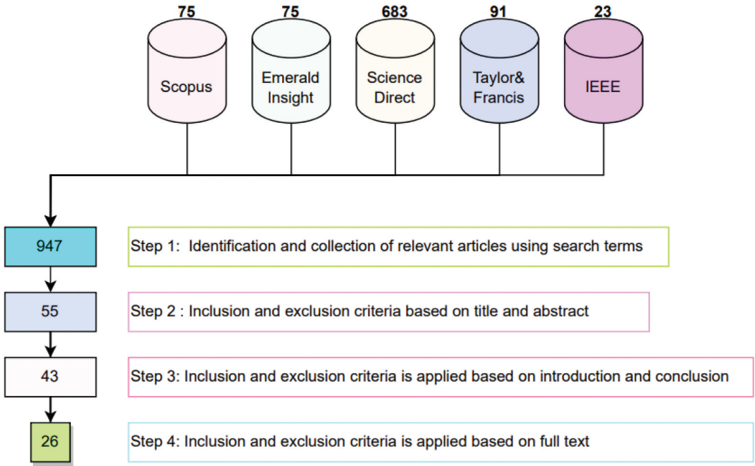
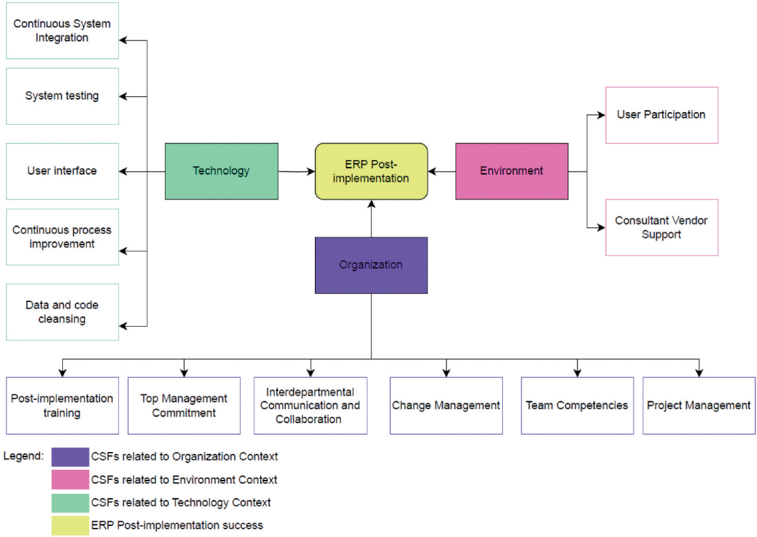
Following the implementation of Enterprise Resource Planning (ERP) systems, a myriad of challenges and issues may manifest, leading to inefficiencies and resistance from users, thereby impeding the anticipated benefits. While previous researchers have predominantly directed their attention toward the implementation phase, it is imperative to recognize the significance of the post-implementation phase in the ERP adoption process. This study aims to ascertain the critical success factors (CSFs) that contribute to the seamless integration of an ERP system into an organization’s operational processes post-implementation. To achieve this objective, a systematic literature review (SLR) was conducted between September and December 2022, employing the Kitchenham approach (2007) as the guiding methodology. The SLR was meticulously structured and comprised three principal phases: planning, execution, and reporting. After thoroughly assessing 26 articles from reputable sources, we successfully pinpointed 13 CSFs relevant to ERP post-implementation and grouped into the Technology-Organization-Environment (TOE) framework. The three most pivotal CSFs emerged as continuous system integration, post-implementation training, and active user participation. Among these CSFs, a remarkable discovery surfaced, highlighting the predominance of environmental and organizational factors over technological ones. Consequently, this research offers both practical and theoretical implications for organizations, enabling them to proactively address potential challenges that may arise after ERP implementation.
Overview
The claims and statistics of this paper haven’t been checked yet.
Free: it reads the open-access text and checks the first 5 claims that cite a source we can check. Create a free account to check every claim.
Integrity signals
Registry
Cites
Statistics
Figures






























Verification
Claims the paper makes
The claims and statistics of this paper haven’t been checked yet.
Free: it reads the open-access text and checks the first 5 claims that cite a source we can check. Create a free account to check every claim.
Claims other papers make about this one
Each is checked against this paper’s own text: does it say what the citing paper says it does?
The source backs part of the claim, not all of it — or backs it for a different population, condition or comparison.
In the citing paper
“Individual-level resistance emerges from fear of job displacement, competency concerns, and comfort with existing workflows.”
From Overcoming Resistance to SAP ERP Adoption Among Professionals - A Change Management Perspective (2025) · cites this paper as [2]
Experimental — accuracy not yet measuredThe source backs part of the claim, not all of it — or backs it for a different population, condition or comparison.
In the citing paper
“Resistance patterns in ERP implementation manifest across multiple organizational levels, creating compound effects that amplify implementation challenges [2].”
From Overcoming Resistance to SAP ERP Adoption Among Professionals - A Change Management Perspective (2025) · cites this paper as [2]
Experimental — accuracy not yet measuredThe source backs part of the claim, not all of it — or backs it for a different population, condition or comparison.
In the citing paper
“Organizational-level resistance stems from cultural factors, inadequate training infrastructure, and insufficient leadership commitment to change initiatives.”
From Overcoming Resistance to SAP ERP Adoption Among Professionals - A Change Management Perspective (2025) · cites this paper as [2]
Experimental — accuracy not yet measuredThe source backs part of the claim, not all of it — or backs it for a different population, condition or comparison.
In the citing paper
“Technical-level resistance occurs when system capabilities fail to align with user expectations or when integration complexities disrupt established operational procedures.”
From Overcoming Resistance to SAP ERP Adoption Among Professionals - A Change Management Perspective (2025) · cites this paper as [2]
Experimental — accuracy not yet measured
Self-check
Percentages, sums and reported differences re-computed from the paper’s own numbers.
The self-check needs the paper’s full text.
Citations
Cites
Brereton, P., Kitchenham, B. A., Budgen, D., Turner, M., & Khalil, M. (2007) · Journal of Systems and Software · doi:10.1016/j.jss.2006.07.009 · Cited by 2,394 · cited 5×
“…the first stage, which is planning, the review protocol was formulated using the Population, Intervention, Comparison, Results, and Context formula (Kitchenham, 2007) as demonstrated below: ● Population: enterprise resource planning, ERP system The next step is to determine the research questions…”
BackgroundMethodInfluentialDrazin, R. (1991) · The Journal of Technology Transfer · doi:10.1007/bf02371446 · Cited by 2,122 · cited 1×
“The TOE theory proposed by Tornatzky and Fleischer in 1990, aims to explain how organizations adopt, implement, and use information systems (IS) (Abu Ghazaleh et al., 2019; Louis, 1990).”
Backgroundprocesses of technological innovation
Tornatzky, L. G., Fleischer, M., & Chakrabarti, A. (1990) · Cited by 1,834
ERP implementation: a compilation and analysis of critical success factors
Finney, S., & Corbett, M. (2007) · Business Process Management Journal · doi:10.1108/14637150710752272 · Cited by 647 · cited 10×
“…phrases like “Executive support” and “Management support” fall under the category “Top management com-mitment”, which is deemed the most suitable and conveys the researcher’s interpretation, similar to what was undertaken in previous studies (Dezdar & Sulaiman, 2009; Finney & Corbett, 2007).”
BackgroundMethodResultInfluentialA systematic review of search-based testing for non-functional system properties
Afzal, W., Torkar, R., & Feldt, R. (2009) · Information and Software Technology · doi:10.1016/j.infsof.2008.12.005 · Cited by 447 · cited 1×
“The tollgate method recommended by prior scholars is employed to revisit the research articles identified during the primary collection phase of the study (Afzal et al., 2009; Khan et al., 2022).”
The implementation factors that influence the ERP (enterprise resource planning) benefits
Chou, S.-W., & Chang, Y.-C. (2008) · Decision Support Systems · doi:10.1016/j.dss.2008.06.003 · Cited by 340
Management Information Systems, Managing The Digital Firm, 12th Ed.
Kenneth, C., & Jane, P. L. (2012) · Cited by 293
Using T-O-E theoretical framework to study the adoption of ERP solution
Awa, H. O., Ukoha, O., & Emecheta, B. C. (2016) · Cogent Business & Management · doi:10.1080/23311975.2016.1196571 · Cited by 272 · cited 3×
“Earlier studies have effectively employed the TOE framework to pinpoint critical success factors (CSFs), albeit primarily within the context of adoption rather than the subsequent post-adoption phase (Awa et al., 2016).”
BackgroundMethodCritical success factors in enterprise resource planning systems: Review of the last decade
Shaul, L., & Tauber, D. (2013) · ACM Computing Surveys · doi:10.1145/2501654.2501669 · Cited by 271 · cited 2×
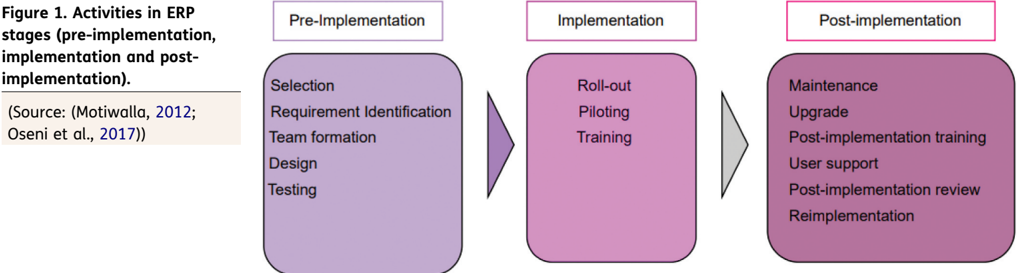
“There are three main phases in the ERP project life cycle as shown in Figure 1: Pre-implementation, Implementation, and Post-Implementation phase (Motiwalla, 2012; Shaul & Tauber, 2013; Xie et al., 2022).”
MethodWhat leads to post-implementation success of ERP? An empirical study of the Chinese retail industry
Zhu, Y., Li, Y., Wang, W., & Chen, J. (2010) · International Journal of Information Management · doi:10.1016/j.ijinfomgt.2009.09.007 · Cited by 261
Research works printed but not linked: 6
- 32. Kitchenham, B. (2004). Procedures for Undertaking Systematic Reviews (TR/SE-0401). Keele University. https://www.researchgate.net/publication/ 228756057
- 34. Kitchenham, B.: Guidelines for performing systematic literature reviews in software engineering. https://www.researchgate.net/publica tion/258968007
- 36. Laudon, K. C., & Laudon, J. P. (2018). Management infor- mation systems : Managing the digital firm (15th ed.) (15th ed.). Pearson.
- 40. Louis, G. T. (1990). The processes of technological inno- vation. Lexington Books.
- 45. Motiwalla, L. F. (2012). Enterprise system for manage- ment. Pearson Education.
- 62. Sommerville, I. (2016). Software engineering (10th ed.). Pearson Education Limited.
Cited by
Gupta, A. K., & Agarwal, P. (2024) · International Conference on Artificial Intelligence for Internet of Things (AIIoT) · doi:10.1109/aiiot58432.2024.10574785 · Cited by 45
“It encompasses tools for enterprise planning, financial integration, and hazard management [13].”
Model to explain use of E-Government service change
Mphahlele, N. S., Kekwaletswe, R. M., & Seaba, T. R. (2025) · Telematics and Informatics Reports · doi:10.1016/j.teler.2025.100190 · Cited by 34
Stages and critical success factors in ERP implementation: Insights from five case studies
Gilabert, S. F., Forés, B., & Alcamí, R. L. (2025) · Computer Science and Information Systems · doi:10.2298/csis240229030f · Cited by 4
Mphahlele, N. S., Kekwaletswe, R. M., & Seaba, T. R. (2024) · International Journal of Research in Business and Social Science (2147-4478) · doi:10.20525/ijrbs.v13i1.3044 · Cited by 5
“The SR method takes a form of structured approach for identification, sorting, evaluation, and synthesizes previous literature to arrive at answers to the research questions (Rjab et al., 2023; Butarbutar et al., 2023).”
BackgroundMethodInfluentialPrimadasa, R., Kusrini, E., Mansur, A., & Aziz, M. (2026) · Process Integration and Optimization for Sustainability · doi:10.1007/s41660-026-00717-w · Cited by 4
“The identification of CSFs followed a two-phase process designed to ensure transparency and reduce subjectivity (Butarbutar et al. 2023).”
Chen, Y.-T., Yang, P.-Y., & Ko, C. (2026) · Journal of Cleaner Production · doi:10.1016/j.jclepro.2026.148373 · Cited by 2
Ragin-Skorecka, K., Kmieć, H., & Żurawik, A. (2025) · Lecture notes in mechanical engineering · doi:10.1007/978-3-032-09806-1_24 · Cited by 3
Sholeh, M. B., Samodra, R. F., & Widodo, A. P. (2024) · JURNAL SISTEM INFORMASI BISNIS · doi:10.14710/vol15iss1pp21-33 · Cited by 9
“This research adopts the systematic literature review (SLR) method, which consists of three main stages: planning, execution, and reporting (Butarbutar et al. , 2023).”
Роль ERP-систем у підвищенні продуктивного потенціалу підприємств галузевої економіки
Кириченко, С. О., & Тетерев, Д. (2025) · ЕКОНОМІКА І РЕГІОН Науковий вісник · doi:10.26906/eir.2025.4(99).4157 · Cited by 2
Önden, A. (2026) · Management Science Advances. · doi:10.31181/msa31202643 · Cited by 10
A Multidimensional Matrix Model for the Study of Organisational Improvisation
Rodríguez-Escobar, J. A., Lissillour, R., & Sahut, J. (2022) · Management & Prospective · doi:10.3917/e.g12000.425.0147 · Cited by 1
Mphahlele, N. S., Kekwaletswe, R. M., & Seaba, T. R. (2024) · International Journal of Research in Business and Social Science (2147-4478) · doi:10.20525/ijrbs.v13i2.3090 · Cited by 3
“The IS implementation life cycle involves pre-implementation, implementation, post-implementation phases (Butarbutar et al., 2023; Xei et al., 2022).”
Mphahlele, N. S., Kekwaletswe, R. M., & Seaba, T. R. (2024) · Journal of Information Systems and Informatics · doi:10.51519/journalisi.v6i1.658 · Cited by 1
“The information systems implementation life cycle involves pre-implementation, implementation, post-implementation phases [31], [32].”
A Literature Review of Hindering Factors in Digital Transformation Processes
Widera, A.-P., Ploder, C., Dilger, T., & Bernsteiner, R. C. (2025) · Communications in computer and information science · doi:10.1007/978-3-031-95898-4_23 · Cited by 1
Overcoming Resistance to SAP ERP Adoption Among Professionals - A Change Management Perspective
Pulluru, S. R. (2025) · European Modern Studies Journal · doi:10.59573/emsj.9(4).2025.68
“Resistance patterns in ERP implementation manifest across multiple organizational levels, creating compound effects that amplify implementation challenges [2].”
Aspects of Accounting Cost for Development of Customized Software Products
Bădicu, G., Cojocaru, V. P., & Nancu, D. (2024) · Ovidius University Annals Economic Sciences Series · doi:10.61801/ouaess.2023.2.75
Sušac, L., Vukšić, V. B., & Glavan, L. M. (2024) · Zbornik Veleučilišta u Rijeci · doi:10.31784/zvr.12.1.4
Faisal, A. (2025) · International Journal Of Humanities Education and Social Sciences (IJHESS) · doi:10.55227/ijhess.v4i5.1163
Mphahlele, N. S., Kekwaletswe, R. M., & Seaba, T. R. (2025) · The Electronic Journal of Information Systems in Developing Countries · doi:10.1002/isd2.70024
“This study revelation is not surprising as there is support for findings by essayists such as Butarbutar et al. (2023), who through a literature review study found that training is one of the critical interventions that induce success in post implementation phases (e.g., use) of representational…”
Redon, M., Séran, T., Translations, C. A., Calandre, C., Burden, M., & Mellor, M. (2025) · Comptabilité - Contrôle - Audit · doi:10.3917/cca.313.0065
Integrating Balanced Scorecard and Enterprise Management for ERP Readiness Assessment
Wijaya, S. F., Wiratama, J., & Sutomo, R. (2025) · International Conference on New Media Studies (CONMEDIA) · doi:10.1109/conmedia67140.2025.11290307
“3 Business Process Changes '[7], [34], [39] Business process changes are the core to achieving successful ERP implementation 4 Integration process of standard ERP software [11], [13], [23], [29], [47] Integrating technology with business strategy to achieve the company's strategic goals.”
Mamoghli, S. (2025) · Systems · doi:10.3390/systems14010022 · Cited by 4
Wijetunge, A. T. D. S., & Du, H. (2026) · Transforming Government People Process and Policy · doi:10.1108/tg-12-2025-0430
A Data-Driven Framework for Phased User Migration in Enterprise System Modernization
Penumatcha, A. K., & Duraisingh, I. (2026) · International Conference on Mobile Computing and Sustainable Informatics (ICMCSI) · doi:10.1109/icmcsi67283.2026.11412918
“…readiness and organizational change management and environmental support which prove that system success requires ongoing user education and system enhancement and organizational learning through step-by-step implementation to achieve better knowledge sharing between different user groups[11].”
Ferjani, M. (2026) · Management Research Review · doi:10.1108/mrr-08-2024-0613
Perspective Chapter: Factors Influencing Digitalisation in Small and Medium-Sized Enterprises
Dvořáková, L., & Segeč, M. (2026) · IntechOpen eBooks · doi:10.5772/intechopen.1013638
Thuy, L. D. T., Minh, H. N., Ngoc, O. N. T., My, D. L. H., Kim, C. N. T., Thanh, C. N. T., & Nguyen, D. T. (2026) · Discover Sustainability · doi:10.1007/s43621-026-03450-z
“…& training, and user involvement represent the level of readiness, resource prioritization, and the degree of fit between the system and management processes/needs; As a result, businesses can transform ERP into more sophisticated MAPs instead of just operating in a “formal” way [9, 26, 48].”
Jatmiko, C., & Tricahyono, D. (2026) · Studies in systems, decision and control · doi:10.1007/978-3-032-23645-6_10
Soma, R. (2026) · Engineering Technology & Applied Science Research · doi:10.48084/etasr.18471
Modèle matriciel multidimensionnel pour l’étude de l’improvisation organisationnelle
Rodríguez-Escobar, J. A., Lissillour, R., & Sahut, J. (2026) · Management & Prospective · doi:10.3917/g12000.425.0167
Meskaoui, A., Nasaoui, H., REJJAOUI, R., Amri, A. E., & EDDINE, A. S. (2026) · Logistics · doi:10.3390/logistics10070156
“Change resistance and organisational inertia appeared in 56% of papers [57,59].”
Assidiqi, M. H., Alghazzawi, D., Alarifi, S., & Cheng, L. (2026) · Applied Artificial Intelligence · doi:10.1080/08839514.2026.2700868
Safaralikhonov, A. (2026) · Universal Library of business and economics. · doi:10.70315/uloap.ulbec.2026.0303003
ERP Usage and Firm Performance: Evidence from Chinese SMEs
Babar, M., Guang-qi, M., Yasir, N., Aamir, M., Samad, S., & Braithwaite, R. R. (2026) · Sustainability · doi:10.3390/su18147368
López‐Nores, M., de Arriba-Pérez, F., & García-Méndez, S. (2026) · Systems · doi:10.3390/systems14080992 · Cited by 1
López-Toro, A. A., Almadana-Abón, S., & Sánchez-Lara, D. (2026) · International Journal of Information Management Data Insights · doi:10.1016/j.jjimei.2026.100443
Putri, H. Y. P., Suryasari, & Faza, A. (2026) · IEEE International Conference on Instrumentation, Networks, Future Sustainability, Information Theory, Transportation, and Systems (INFINITYS) · doi:10.1109/infinitys69204.2026.11665993
“Based on these studies, the gap remains in integrating governance frameworks with automation solutions specifically for post-implementation hybrid ERP environments [28]-[30].”
Stakeholder Involvement and ERP Implementation Success Among Humanitarian INGOs in Aden, Yemen
Shamsan, A. H., & Aboada, H. (2026) · International Conference on Digital Transformation, Innovation & Sustainable Development (DTISD) · doi:10.1109/dtisd69661.2026.11668108
“Prior ERP and information systems success studies have established the relevance of system quality, information quality, service quality, user satisfaction, training, and participation for realizing ERP value [29], [30].”
FURDUESCU, E. N., & Dina, R. (2026) · Proceeding Papers · doi:10.24818/basiq/2026/12/084
Paramasivam, K. A. (2025) · International Journal of Computational and Experimental Science and Engineering · doi:10.22399/ijcesen.5504
Cuellar-Fernandez, R., Chaname-Salazar, J., & Cornejo, J. (2026) · Information · doi:10.3390/info17100947
Enterprise Systems, Data Management, and Enterprise Resource Planning (ERP): Conceptual Foundations
ÇIRAY, K., & Taymaz, H. A. (2026) · Özgür Yayınları eBooks · doi:10.58830/ozgur.pub1473.c5887
Metadata
- Authors
- Butarbutar, Z. T., Handayani, P. W., Suryono, R. R., & Wibowo, W. S.
- Affiliations
- University of Indonesia (ID)
- Universitas Teknokrat Indonesia (ID)
- Corresponding author
- Butarbutar, Zenfrison Tuah
- Venue
- Cogent Business & Management
- Publisher
- Informa UK Limited
- Published
- 2023-10-08
- Volume
- 10
- Issue
- 3
- ISSN
- 2331-1975 (ISSN-L)
- OpenAlex
- W4387456820
- Cited by
- 42
- References
- 65
- Citations by year
- 2026: 22 · 2025: 12 · 2024: 7
- FWCI
- 3.75
- Type
- journal article
- Language
- en
- Open access
- gold
- doi.org
- Licence
- Locations
- Cogent Business & Management (publishedVersion, cc-by)
- Econstor (Econstor) (submittedVersion, cc-by)
- RePEc: Research Papers in Economics (submittedVersion)
- DOAJ (DOAJ: Directory of Open Access Journals) (submittedVersion, cc-by-sa)
- Funders
- Ministry of Communication and Informatics (B-301/BLSDM.1/LT.02.03/2/2023)
- Topics
- Social Sciences › Business, Management and Accounting › Management Information Systems › ERP Systems Implementation and Impact
- Social Sciences › Decision Sciences › Information Systems and Management › Technology Adoption and User Behaviour
- Social Sciences › Business, Management and Accounting › Strategy and Management › Corporate Governance and Management
- Keywords
- enterprise resource planning, success factors, post-implementation phase, ERP adoption, technology-organization-environment framework, user participation, user resistance, ERP implementation challenges
About these checks
Registry, retraction, Cites and statistics results are computed, not judged, with one exception: a printed reference that no index lists is read once by a model before it counts as a citation error. Claims are extracted by a model and kept only when their quote appears verbatim in the text; each cited source is then checked, with a model’s help, for whether it says what the claim relies on. Those verdicts can be wrong — read the claim’s quote and the cited source before relying on one.
Statistics and arithmetic are recomputed, not judged.
Confidence bands are shown only for fields calibrated on our annotated test set. None is calibrated yet, so no band is shown.
What counts as a claim ›How we measure confidence ›How we check this ›
Are you an author, or do you see a problem with this page? Request a review
Data sources
Bibliographic data: Semantic Scholar, OpenAlex, Crossref.
Contains information from the Semantic Scholar Academic Graph Datasets, made available under the ODC Attribution License (ODC-BY 1.0).
Semantic Scholar’s data is described in: Kinney, R., et al. (2023). The Semantic Scholar Open Data Platform. arXiv:2301.10140.
