

In Candida albicans , the Nim1 kinases Gin4 and Hsl1 negatively regulate pseudohypha formation and Gin4 also controls septin organization
Open accessThe DOI matches its Crossref record; 35 of the 35 references it cites were found in a registry or an index.
Abstract
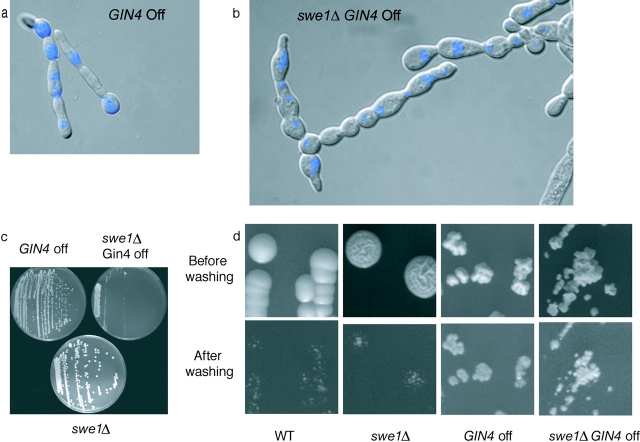
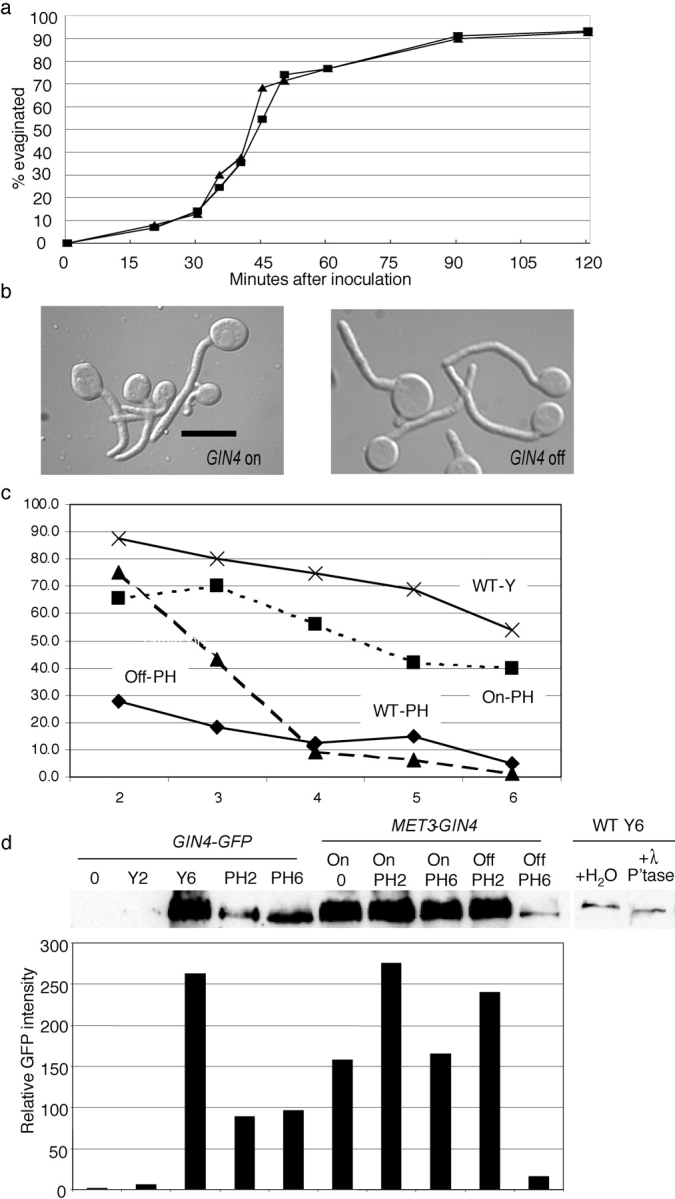
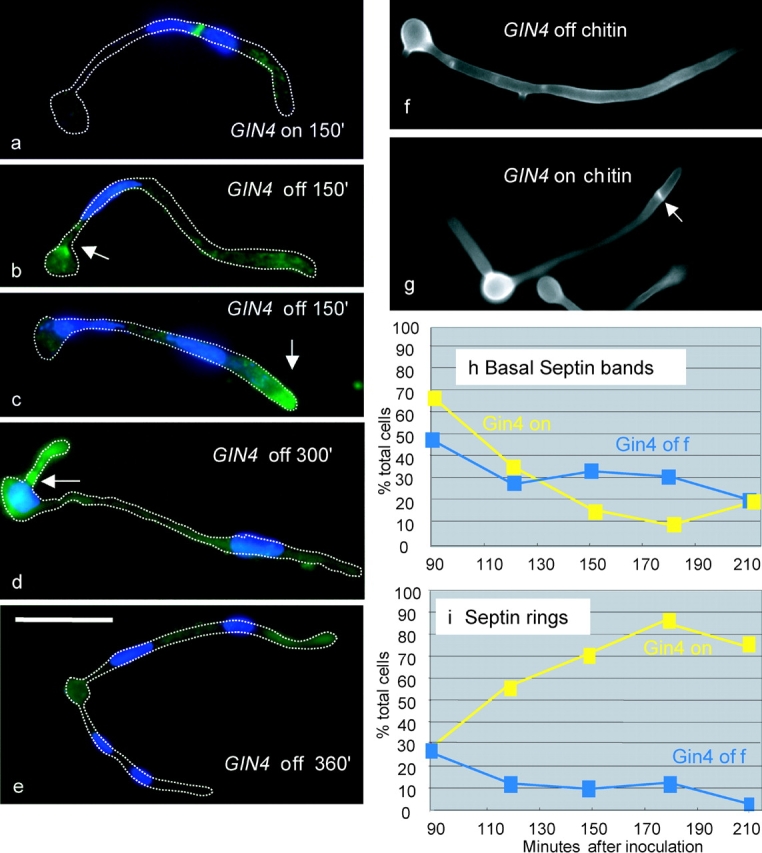
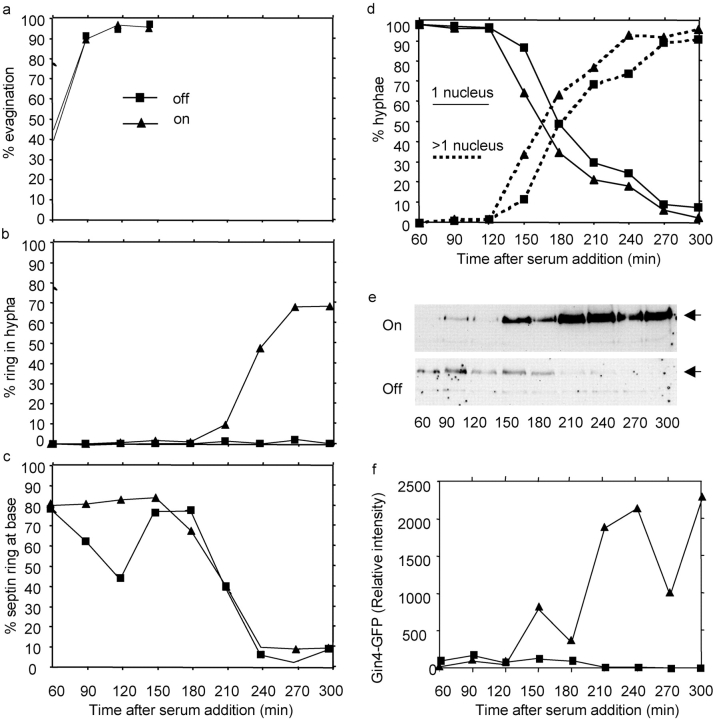
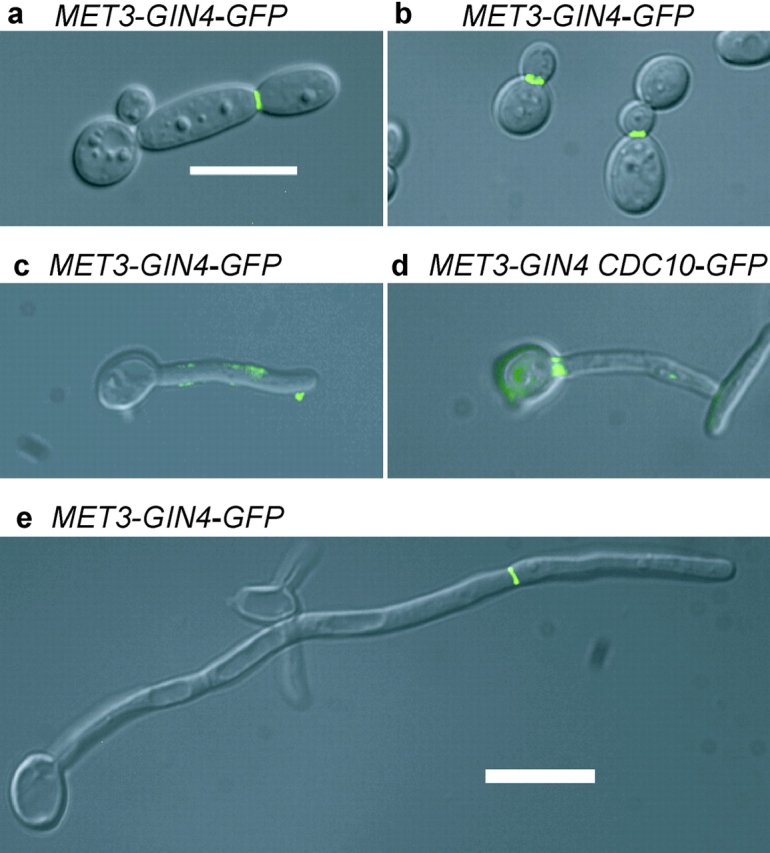
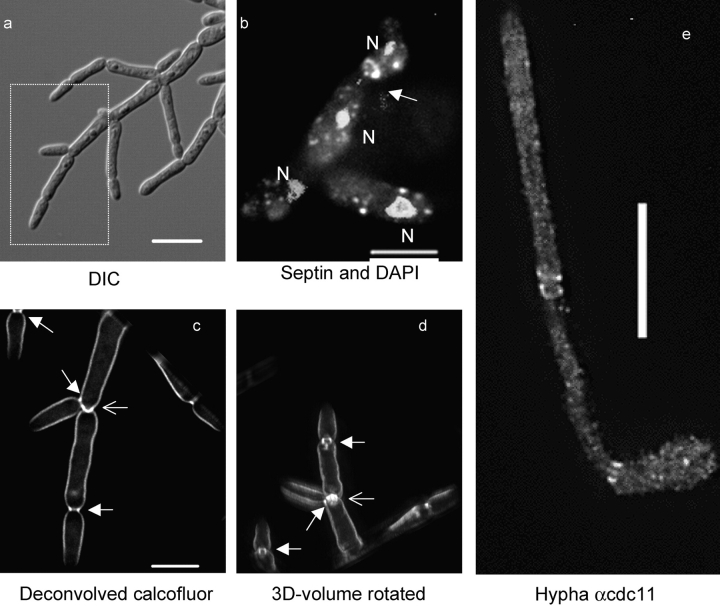
In the development of hyphal germ tubes of Candida albicans, a band of septin forms at the base of the germ tube (basal septin band). Later, a septin ring forms, which organizes the first septum within the germ tube (septin ring). We have investigated the role of the Nim1 kinases, Gin4 and Hsl1, in the formation of these septin structures. We show that during germ tube formation, Gin4 is required for the organization of the septin ring but not the basal septin band. Hsl1 is not required for the formation of either septin rings or basal bands. Unexpectedly, we found that both gin4Δ and hsl1Δ mutants form pseudohyphae constitutively, in a fashion that in the case of gin4Δ, is partly independent of Swe1. Gin4-depleted pseudohyphae are unable to form hyphae when challenged with serum, but this can be overcome by ectopic expression of Gin4 from the MET3 promoter. Thus, Gin4 may regulate the developmental switch from pseudohyphae to hyphae.
Overview
The claims and statistics of this paper haven’t been checked yet.
Free: it reads the open-access text and checks the first 5 claims that cite a source we can check. Create a free account to check every claim.
Integrity signals
Registry
Cites
Statistics
Figures
Verification
Claims the paper makes
The claims and statistics of this paper haven’t been checked yet.
Free: it reads the open-access text and checks the first 5 claims that cite a source we can check. Create a free account to check every claim.
Self-check
Percentages, sums and reported differences re-computed from the paper’s own numbers.
The self-check needs the paper’s full text.
Citations
Cites
Longtine, M. S., Mckenzie III, A., Demarini, D. J., Shah, N. G., Wach, A., Brachat, A., Philippsen, P., & Pringle, J. R. (1998) · Yeast · doi:10.1002/(sici)1097-0061(199807)14:10<953::aid-yea293>3.0.co;2-u · Cited by 5,345
Nonfilamentous C. albicans Mutants Are Avirulent
Lo, H.-J., Köhler, J. R., DiDomenico, B., Loebenberg, D., Cacciapuoti, A., & Fink, G. R. (1997) · Cell · doi:10.1016/s0092-8674(00)80358-x · Cited by 1,809
Calderone, R. (2012) · ASM Press eBooks · Cited by 912
Rapid Hypothesis Testing with Candida albicans through Gene Disruption with Short Homology Regions
Wilson, R. B., Davis, D., & Mitchell, A. P. (1999) · Journal of Bacteriology · doi:10.1128/jb.181.6.1868-1874.1999 · Cited by 762
Candida albicans: A molecular revolution built on lessons from budding yeast
Berman, J., & Sudbery, P. E. (2002) · Nature Reviews Genetics · doi:10.1038/nrg948 · Cited by 578 · cited 2×
“It is thought that the ability to switch between the different morphological forms may be required for virulence because the different morphological forms are found in infected tissue and environmental signals that induce hyphae also coordinately induce a variety of known virulence factors such as the SAP family of as…”
Self-citationMorphogenesis in the yeast cell cycle: regulation by Cdc28 and cyclins.
Lew, D. J., & Reed, S. I. (1993) · The Journal of cell biology · doi:10.1083/jcb.120.6.1305 · Cited by 494
Booher, R. N., Deshaies, R. J., & Kirschner, M. W. (1993) · The EMBO Journal · doi:10.1002/j.1460-2075.1993.tb06016.x · Cited by 342
Russell, P., & Nurse, P. (1987) · Cell · doi:10.1016/0092-8674(87)90459-4 · Cited by 331
Barral, Y., Parra, M., Bidlingmaier, S., & Snyder, M. (1999) · Genes & Development · doi:10.1101/gad.13.2.176 · Cited by 313
Regulatory networks controlling Candida albicans morphogenesis
Brown, A. J. P., & Gow, N. A. R. (1999) · Trends in Microbiology · doi:10.1016/s0966-842x(99)01556-5 · Cited by 301
Cited by
Items 101–122 of 122
New aspects of septin assembly and cell cycle control in multinucleated "A. gossypii"
Helfer, H. (2007) · edoc (University of Basel) · doi:10.5451/unibas-004228192 · Cited by 1
Capilla, B. H. (2016) · Tesis Doctorals en Xarxa (Consorci de Serveis Universitaris de Catalunya) · Cited by 1
ACE2 y la regulación de la separación celular en Candida albicans
Calderón-Noreña, D. (2013) · Gredos (University of Salamanca) · doi:10.14201/gredos.121344
A protein–protein interaction inhibitor arrests the cell cycle in Aspergillus fumigatus
Storer, I. S. R., Thornton, B. P., Hackett, A. S., Tabernero, L., & Bromley, M. (2026) · mBio · doi:10.1128/mbio.03563-25
Global transcriptional responses of Candida albicans to histone acetyltranferases deletion
Ghalehnoo, Z. R. (2009) · Gredos (University of Salamanca) · doi:10.14201/gredos.76304
The role of APC activators Cdc20p and Cdh1p in regulating mitosis and morphogenesis in C. albicans
Chou, H.-I. (2008) · Spectrum Research Repository (Concordia University)
(2004) · Yeast · doi:10.1002/yea.1092
Interaction between Candida albicans and Pseudomonas aeruginosa
Konstantinidou, N. (2016) · Arrow@dit (Dublin Institute of Technology)
The role of SEPT2 on neuronal development
Kim, H. J. (2009) · Rutgers University Community Repository (Rutgers University) · doi:10.7282/t3tx3fk0
Insights into Candida world : the extracellular milieu
Martins, M. I. B. C., Henriques, M., & Oliveira, R. (2010) · Portuguese National Funding Agency for Science, Research and Technology (RCAAP Project by FCT)
Functional Genomic Analysis of Protein Kinases in the Human Fungal Pathogen Candida albicans
Lee, Y. (2023) · TSpace (University of Toronto)
Rôle des petites protéines G de type Arf dans la morphogenèse et la virulence de Candida albicans
Labbaoui, H. (2017) · theses.fr (ABES) · doi:10.70675/a82268dcz2e38z4662z8c8bz5fc4853980cc
Bar-Yosef, H., Gildor, T., Ramírez-Zavala, B., Schmauch, C., Weissman, Z., Pinsky, M., Naddaf, R., Morschhäuser, J., Arkowitz, R. A., & Kornitzer, D. (2018) · doi:10.3389/fcimb.2018.00017.s002
Studio dei meccanismi molecolari coinvolti nella transizione dimorfica in Pichia fermentans
Sanna, M. L. (2012) · UnissResearch (Università degli Studi di Sassari)
Identification of novel factors regulating Candida albicans stress-induced genome instability
Rizzo, M. (2022) · Kent Academic Repository (University of Kent) · doi:10.22024/unikent/01.02.95760
Transcriptional regulation of iron and copper homeostasis in Candida albicans
Wig, G. (2014) · Figshare
The Role of Septins in Hyphal Morphogenesis of Candida albicans
Zhang, C. (2009) · Academic Commons (Stony Brook University)
Understanding the role of Hxc-Type II secretion system of Pseudomonas aeruginosa in pathogenesis
Gyasi-Antwi, P. (2019) · Nottingham ePrints (University of Nottingham)
Cardoso, F. G. (2022) · LA Referencia (Red Federada de Repositorios Institucionales de Publicaciones Científicas)
Carneiro, E. R. D. (2015) · Portuguese National Funding Agency for Science, Research and Technology (RCAAP Project by FCT)
Metadata
- Authors
- Wightman, R., Bates, S., Amornrrattanapan, P., & Sudbery, P.
- Affiliations
- University of Sheffield (GB)
- Department of Molecular Biology and Biotechnology, University of Sheffield, Western Bank, Sheffield, S10 2TN UK
- Corresponding author
- Sudbery, Peter
- Venue
- The Journal of Cell Biology
- Publisher
- Rockefeller University Press
- Published
- 2004-02-09
- Volume
- 164
- Issue
- 4
- Pages
- 581-591
- ISSN
- 0021-9525 (ISSN-L)
- 1540-8140
- PMC
- PMC2171991
- OpenAlex
- W2122764079
- Cited by
- 100
- References
- 35
- Citations by year
- 2026: 1 · 2025: 1 · 2024: 1 · 2023: 3 · 2022: 3 · 2021: 3 · 2020: 1 · 2019: 2 · 2018: 4 · 2017: 3 · 2016: 7 · 2015: 3 · 2014: 6 · 2013: 2 · 2012: 8
- FWCI
- 3.43
- Type
- journal article
- Language
- en
- Open access
- green
- www.ncbi.nlm.nih.gov
- Licence
- cc-by-nc-sa
- Locations
- The Journal of Cell Biology (publishedVersion)
- PubMed Central (publishedVersion, cc-by-nc-sa)
- PubMed (publishedVersion)
- Research Explorer (The University of Manchester) (submittedVersion)
- Apollo (University of Cambridge) (submittedVersion)
- Apollo
- Funders
- Wellcome Trust
- Topics
- Life Sciences › Biochemistry, Genetics and Molecular Biology › Molecular Biology › Fungal and yeast genetics research
- Health Sciences › Medicine › Infectious Diseases › Antifungal resistance and susceptibility
- Life Sciences › Immunology and Microbiology › Microbiology › Yeasts and Rust Fungi Studies
- Keywords
- Candida albicans, germ tube formation, septin ring, Swe1, hyphal development, developmental switch
- MeSH terms
- Candida albicans, Cell Division, Cytoskeletal Proteins, Fungal Proteins, Humans, Phenotype, Protein-Tyrosine Kinases, Recombinant Fusion Proteins, Protein Serine-Threonine Kinases, Cell Cycle Proteins, Cyclin-Dependent Kinases, GTP Phosphohydrolases, Hyphae, Saccharomyces cerevisiae Proteins, Schizosaccharomyces pombe Proteins
About these checks
Registry, retraction, Cites and statistics results are computed, not judged, with one exception: a printed reference that no index lists is read once by a model before it counts as a citation error. Claims are extracted by a model and kept only when their quote appears verbatim in the text; each cited source is then checked, with a model’s help, for whether it says what the claim relies on. Those verdicts can be wrong — read the claim’s quote and the cited source before relying on one.
Statistics and arithmetic are recomputed, not judged.
Confidence bands are shown only for fields calibrated on our annotated test set. None is calibrated yet, so no band is shown.
What counts as a claim ›How we measure confidence ›How we check this ›
Are you an author, or do you see a problem with this page? Request a review
Data sources
Bibliographic data: Semantic Scholar, OpenAlex, Crossref.
Contains information from the Semantic Scholar Academic Graph Datasets, made available under the ODC Attribution License (ODC-BY 1.0).
Semantic Scholar’s data is described in: Kinney, R., et al. (2023). The Semantic Scholar Open Data Platform. arXiv:2301.10140.
