

In Candida albicans , the Nim1 kinases Gin4 and Hsl1 negatively regulate pseudohypha formation and Gin4 also controls septin organization
Open accessThe DOI matches its Crossref record; 35 of the 35 references it cites were found in a registry or an index.
Abstract
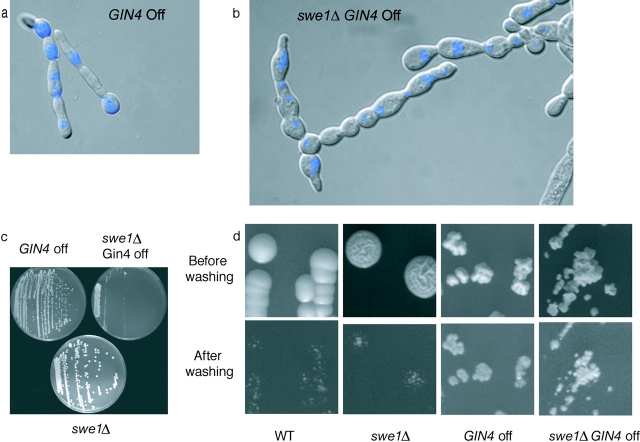
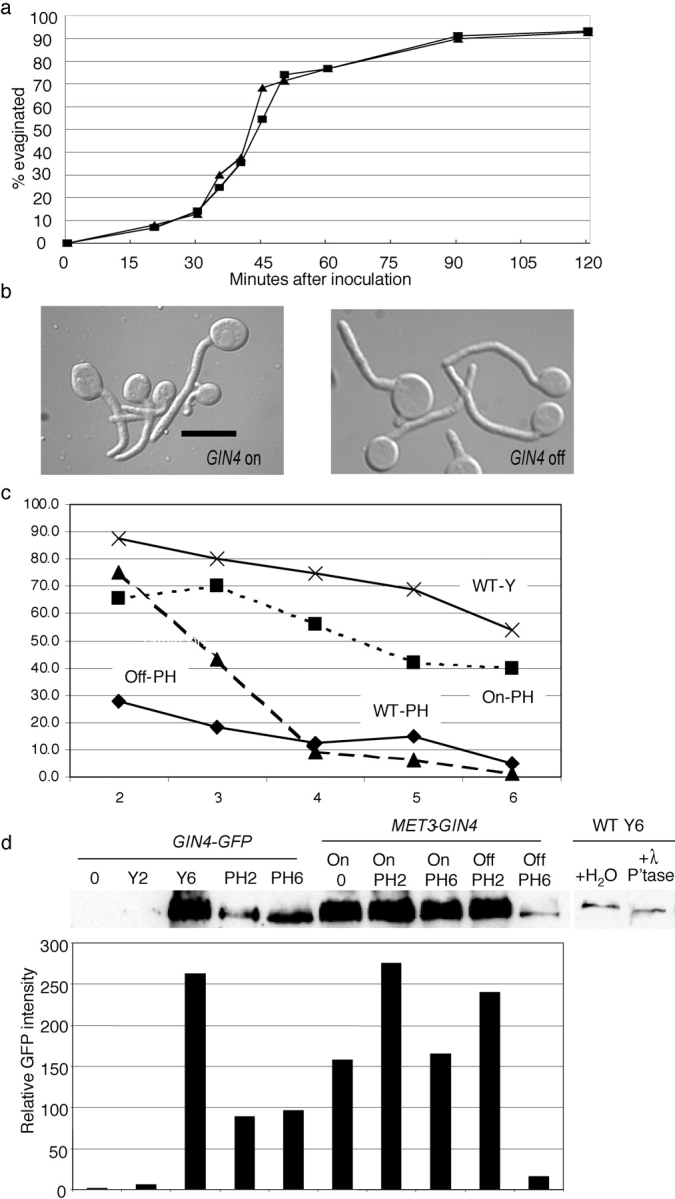
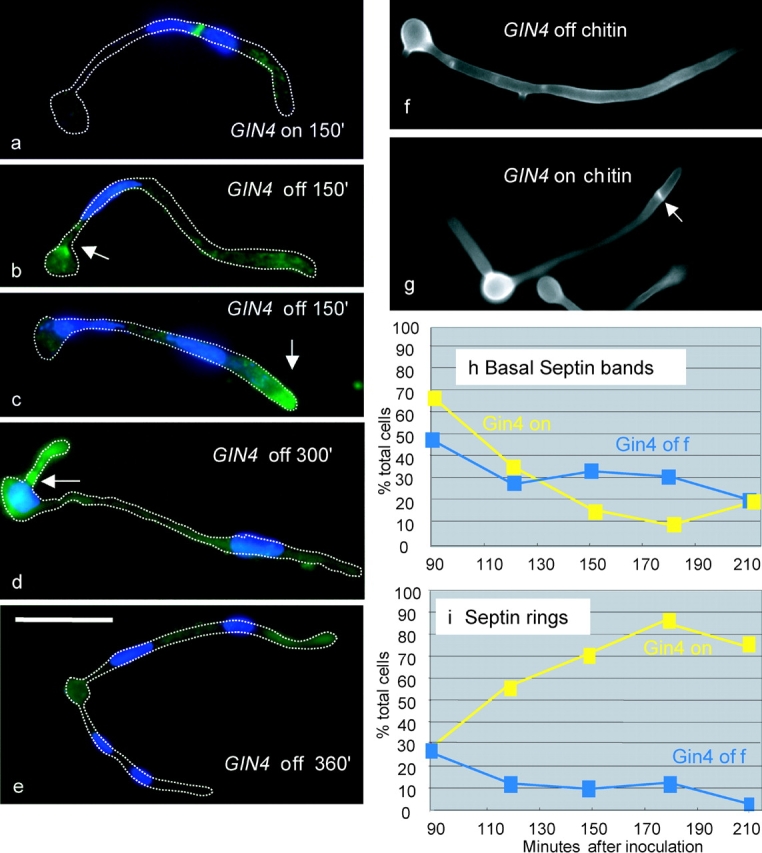
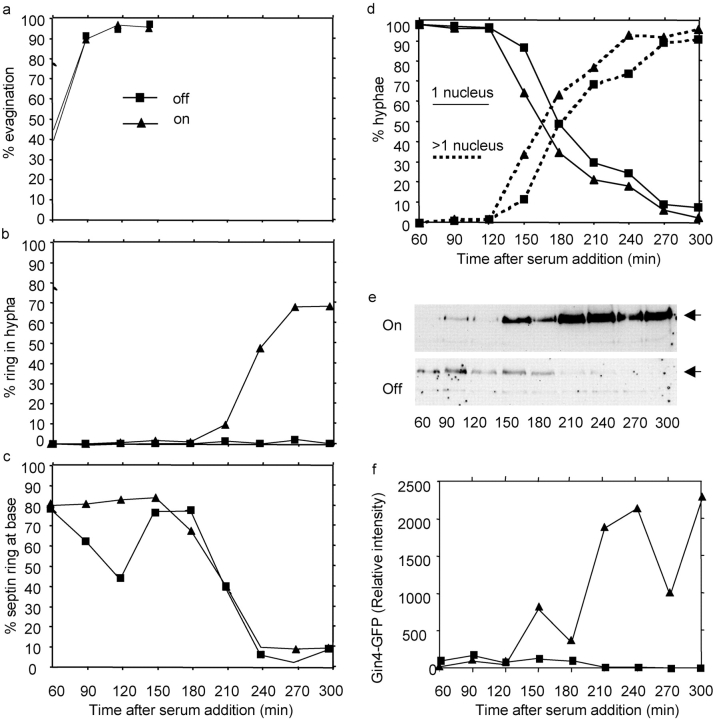
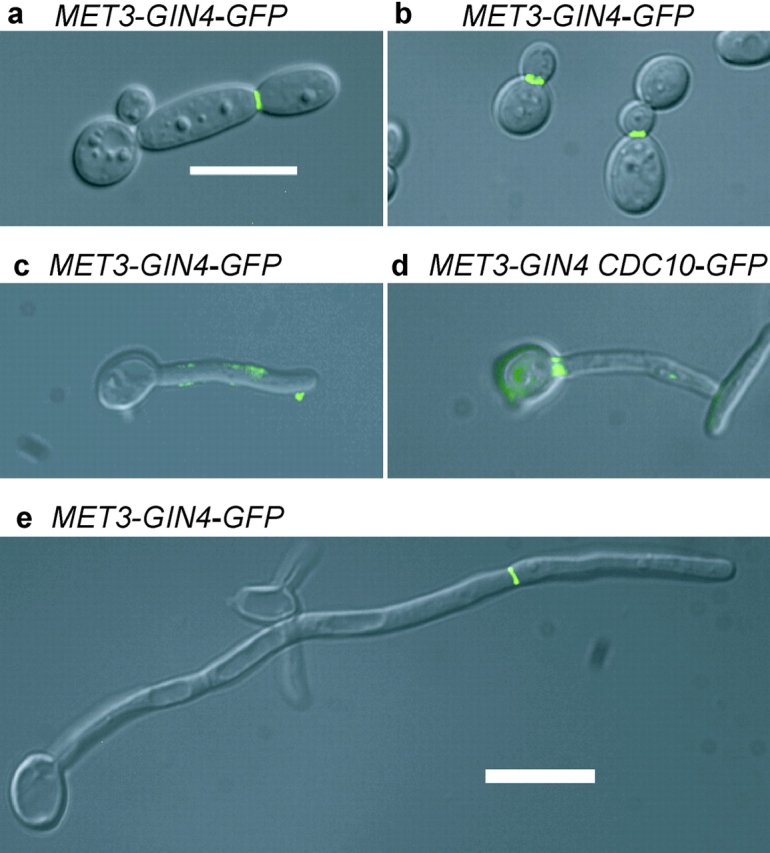
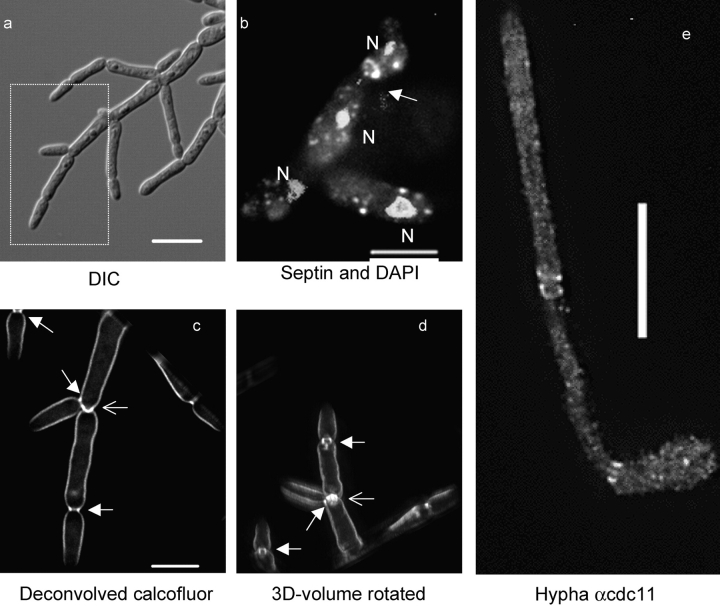
In the development of hyphal germ tubes of Candida albicans, a band of septin forms at the base of the germ tube (basal septin band). Later, a septin ring forms, which organizes the first septum within the germ tube (septin ring). We have investigated the role of the Nim1 kinases, Gin4 and Hsl1, in the formation of these septin structures. We show that during germ tube formation, Gin4 is required for the organization of the septin ring but not the basal septin band. Hsl1 is not required for the formation of either septin rings or basal bands. Unexpectedly, we found that both gin4Δ and hsl1Δ mutants form pseudohyphae constitutively, in a fashion that in the case of gin4Δ, is partly independent of Swe1. Gin4-depleted pseudohyphae are unable to form hyphae when challenged with serum, but this can be overcome by ectopic expression of Gin4 from the MET3 promoter. Thus, Gin4 may regulate the developmental switch from pseudohyphae to hyphae.
Overview
The claims and statistics of this paper haven’t been checked yet.
Free: it reads the open-access text and checks the first 5 claims that cite a source we can check. Create a free account to check every claim.
Integrity signals
Registry
Cites
Statistics
Figures
Verification
Claims the paper makes
The claims and statistics of this paper haven’t been checked yet.
Free: it reads the open-access text and checks the first 5 claims that cite a source we can check. Create a free account to check every claim.
Self-check
Percentages, sums and reported differences re-computed from the paper’s own numbers.
The self-check needs the paper’s full text.
Citations
Cites
Longtine, M. S., Mckenzie III, A., Demarini, D. J., Shah, N. G., Wach, A., Brachat, A., Philippsen, P., & Pringle, J. R. (1998) · Yeast · doi:10.1002/(sici)1097-0061(199807)14:10<953::aid-yea293>3.0.co;2-u · Cited by 5,345
Nonfilamentous C. albicans Mutants Are Avirulent
Lo, H.-J., Köhler, J. R., DiDomenico, B., Loebenberg, D., Cacciapuoti, A., & Fink, G. R. (1997) · Cell · doi:10.1016/s0092-8674(00)80358-x · Cited by 1,809
Calderone, R. (2012) · ASM Press eBooks · Cited by 912
Rapid Hypothesis Testing with Candida albicans through Gene Disruption with Short Homology Regions
Wilson, R. B., Davis, D., & Mitchell, A. P. (1999) · Journal of Bacteriology · doi:10.1128/jb.181.6.1868-1874.1999 · Cited by 762
Candida albicans: A molecular revolution built on lessons from budding yeast
Berman, J., & Sudbery, P. E. (2002) · Nature Reviews Genetics · doi:10.1038/nrg948 · Cited by 578 · cited 2×
“It is thought that the ability to switch between the different morphological forms may be required for virulence because the different morphological forms are found in infected tissue and environmental signals that induce hyphae also coordinately induce a variety of known virulence factors such as the SAP family of as…”
Self-citationMorphogenesis in the yeast cell cycle: regulation by Cdc28 and cyclins.
Lew, D. J., & Reed, S. I. (1993) · The Journal of cell biology · doi:10.1083/jcb.120.6.1305 · Cited by 494
Booher, R. N., Deshaies, R. J., & Kirschner, M. W. (1993) · The EMBO Journal · doi:10.1002/j.1460-2075.1993.tb06016.x · Cited by 342
Russell, P., & Nurse, P. (1987) · Cell · doi:10.1016/0092-8674(87)90459-4 · Cited by 331
Barral, Y., Parra, M., Bidlingmaier, S., & Snyder, M. (1999) · Genes & Development · doi:10.1101/gad.13.2.176 · Cited by 313
Regulatory networks controlling Candida albicans morphogenesis
Brown, A. J. P., & Gow, N. A. R. (1999) · Trends in Microbiology · doi:10.1016/s0966-842x(99)01556-5 · Cited by 301
Septin-Dependent Assembly of a Cell Cycle-Regulatory Module in Saccharomyces cerevisiae
Longtine, M. S., Theesfeld, C. L., McMillan, J. N., Weaver, E., Pringle, J. R., & Lew, D. J. (2000) · Molecular and Cellular Biology · doi:10.1128/mcb.20.11.4049-4061.2000 · Cited by 269
A cell cycle checkpoint monitors cell morphogenesis in budding yeast.
Lew, D. J., & Reed, S. I. (1995) · The Journal of cell biology · doi:10.1083/jcb.129.3.739 · Cited by 262
The MET3 promoter: a new tool for Candida albicans molecular genetics
Care, R. S., Trevethick, J., Binley, K. M., & Sudbery, P. E. (1999) · Molecular Microbiology · doi:10.1046/j.1365-2958.1999.01641.x · Cited by 250
Self-citationTranscriptional control of dimorphism in Candida albicans
Liu, H. (2001) · Current Opinion in Microbiology · doi:10.1016/s1369-5274(01)00275-2 · Cited by 244
Morphogenesis in Candida Albicans
Odds, F. C., & Kerridge, D. (1985) · CRC Critical Reviews in Microbiology · doi:10.3109/10408418509104425 · Cited by 240
Cell cycle control of morphogenesis in budding yeast
Lew, D. J., & Reed, S. I. (1995) · Current Opinion in Genetics & Development · doi:10.1016/s0959-437x(95)90048-9 · Cited by 233
Regulation of septin organization and function in yeast
Longtine, M. S., & Bi, E. (2003) · Trends in Cell Biology · doi:10.1016/s0962-8924(03)00151-x · Cited by 222
Longtine, M. S., Fares, H., & Pringle, J. R. (1998) · The Journal of Cell Biology · doi:10.1083/jcb.143.3.719 · Cited by 220
Genes which control cell proliferation in the yeast Saccharomyces cerevisiae
Sudbery, P. E., Goodey, A. R., & Carter, B. L. A. (1980) · Nature · doi:10.1038/288401a0 · Cited by 207
Self-citationGerami‐Nejad, M., Berman, J., & Gale, C. A. (2001) · Yeast · doi:10.1002/yea.738 · Cited by 199
Septin Function in Candida albicans Morphogenesis
Warenda, A. J., & Konopka, J. B. (2002) · Molecular Biology of the Cell · doi:10.1091/mbc.e02-01-0013 · Cited by 186
Cdc28 tyrosine phosphorylation and the morphogenesis checkpoint in budding yeast.
Sia, R. A. L., Herald, H. A., & Lew, D. J. (1996) · Molecular Biology of the Cell · doi:10.1091/mbc.7.11.1657 · Cited by 182
McMillan, J. N., Longtine, M. S., Sia, R. A. L., Theesfeld, C. L., Bardes, E. S. G., Pringle, J. R., & Lew, D. J. (1999) · Molecular and Cellular Biology · doi:10.1128/mcb.19.10.6929 · Cited by 168
Sudbery, P. E. (2001) · Molecular Microbiology · doi:10.1046/j.1365-2958.2001.02459.x · Cited by 161
Self-citationControl of Mitotic Events by Nap1 and the Gin4 Kinase
Altman, R., & Kellogg, D. (1997) · The Journal of Cell Biology · doi:10.1083/jcb.138.1.119 · Cited by 161
Conservation of Mechanisms Controlling Entry into Mitosis
Harvey, S. L., & Kellogg, D. R. (2003) · Current Biology · doi:10.1016/s0960-9822(03)00049-6 · Cited by 138
Budding yeast morphogenesis: signalling, cytoskeleton and cell cycle
Kron, S. J., & Gow, N. A. R. (1995) · Current Opinion in Cell Biology · doi:10.1016/0955-0674(95)80069-7 · Cited by 135
Germ tube growth of Candida albicans.
Gow, N. A. R. (1997) · PubMed · Cited by 130
Genomic Scale Mutant Hunt Identifies Cell Size Homeostasis Genes in S. cerevisiae
Zhang, J., Schneider, C., Ottmers, L., Rodriguez, R., Day, A., Markwardt, J., & Schneider, B. L. (2002) · Current Biology · doi:10.1016/s0960-9822(02)01305-2 · Cited by 130
Hyphal Elongation Is Regulated Independently of Cell Cycle in Candida albicans
Hazan, I., Sepulveda-Becerra, M., & Liu, H. (2002) · Molecular Biology of the Cell · doi:10.1091/mbc.01-03-0116 · Cited by 111
A Morphology Index for Characterization of Cell Shape in Candida albicans
Merson-Davies, L. A., & Odds, F. C. (1989) · Microbiology · doi:10.1099/00221287-135-11-3143 · Cited by 102
Ahn, S.-H., Acurio, A., & Kron, S. J. (1999) · Molecular Biology of the Cell · doi:10.1091/mbc.10.10.3301 · Cited by 71
Martínez-Anaya, C., Dickinson, J. R., & Sudbery, P. E. (2003) · Journal of Cell Science · doi:10.1242/jcs.00634 · Cited by 49
Self-citationGin4 of S. cerevisiae is a bud neck protein that interacts with the Cdc28 complex
Okuzaki, D., Tanaka, S., Kanazawa, H., & Nojima, H. (1997) · Genes to Cells · doi:10.1046/j.1365-2443.1997.1590358.x · Cited by 34
Okuzaki, D., Watanabe, T., Tanaka, S., & Nojima, H. (2003) · Genes & Genetic Systems · doi:10.1266/ggs.78.113 · Cited by 25
Cited by
Growth of Candida albicans hyphae
Sudbery, P. E. (2011) · Nature Reviews Microbiology · doi:10.1038/nrmicro2636 · Cited by 1,110
“Consistent with this observation, deletion of Swe1 does not abolish hyphal growt”
BackgroundSelf-citationThe distinct morphogenic states of Candida albicans
Sudbery, P., Gow, N., & Berman, J. (2004) · Trends in Microbiology · doi:10.1016/j.tim.2004.05.008 · Cited by 876
Self-citationBiswas, S., Van Dijck, P., & Datta, A. (2007) · Microbiology and Molecular Biology Reviews · doi:10.1128/mmbr.00009-06 · Cited by 516
Morphogenesis in Candida albicans
Whiteway, M., & Bachewich, C. (2007) · Annual Review of Microbiology · doi:10.1146/annurev.micro.61.080706.093341 · Cited by 388
Hohmann, S. (2003) · Springer eBooks · Cited by 357
Metadata
- Authors
- Wightman, R., Bates, S., Amornrrattanapan, P., & Sudbery, P.
- Affiliations
- University of Sheffield (GB)
- Department of Molecular Biology and Biotechnology, University of Sheffield, Western Bank, Sheffield, S10 2TN UK
- Corresponding author
- Sudbery, Peter
- Venue
- The Journal of Cell Biology
- Publisher
- Rockefeller University Press
- Published
- 2004-02-09
- Volume
- 164
- Issue
- 4
- Pages
- 581-591
- ISSN
- 0021-9525 (ISSN-L)
- 1540-8140
- PMC
- PMC2171991
- OpenAlex
- W2122764079
- Cited by
- 100
- References
- 35
- Citations by year
- 2026: 1 · 2025: 1 · 2024: 1 · 2023: 3 · 2022: 3 · 2021: 3 · 2020: 1 · 2019: 2 · 2018: 4 · 2017: 3 · 2016: 7 · 2015: 3 · 2014: 6 · 2013: 2 · 2012: 8
- FWCI
- 3.43
- Type
- journal article
- Language
- en
- Open access
- green
- www.ncbi.nlm.nih.gov
- Licence
- cc-by-nc-sa
- Locations
- The Journal of Cell Biology (publishedVersion)
- PubMed Central (publishedVersion, cc-by-nc-sa)
- PubMed (publishedVersion)
- Research Explorer (The University of Manchester) (submittedVersion)
- Apollo (University of Cambridge) (submittedVersion)
- Apollo
- Funders
- Wellcome Trust
- Topics
- Life Sciences › Biochemistry, Genetics and Molecular Biology › Molecular Biology › Fungal and yeast genetics research
- Health Sciences › Medicine › Infectious Diseases › Antifungal resistance and susceptibility
- Life Sciences › Immunology and Microbiology › Microbiology › Yeasts and Rust Fungi Studies
- Keywords
- Candida albicans, germ tube formation, septin ring, Swe1, hyphal development, developmental switch
- MeSH terms
- Candida albicans, Cell Division, Cytoskeletal Proteins, Fungal Proteins, Humans, Phenotype, Protein-Tyrosine Kinases, Recombinant Fusion Proteins, Protein Serine-Threonine Kinases, Cell Cycle Proteins, Cyclin-Dependent Kinases, GTP Phosphohydrolases, Hyphae, Saccharomyces cerevisiae Proteins, Schizosaccharomyces pombe Proteins
About these checks
Registry, retraction, Cites and statistics results are computed, not judged, with one exception: a printed reference that no index lists is read once by a model before it counts as a citation error. Claims are extracted by a model and kept only when their quote appears verbatim in the text; each cited source is then checked, with a model’s help, for whether it says what the claim relies on. Those verdicts can be wrong — read the claim’s quote and the cited source before relying on one.
Statistics and arithmetic are recomputed, not judged.
Confidence bands are shown only for fields calibrated on our annotated test set. None is calibrated yet, so no band is shown.
What counts as a claim ›How we measure confidence ›How we check this ›
Are you an author, or do you see a problem with this page? Request a review
Data sources
Bibliographic data: Semantic Scholar, OpenAlex, Crossref.
Contains information from the Semantic Scholar Academic Graph Datasets, made available under the ODC Attribution License (ODC-BY 1.0).
Semantic Scholar’s data is described in: Kinney, R., et al. (2023). The Semantic Scholar Open Data Platform. arXiv:2301.10140.
