

Pro-BDNF–induced synaptic depression and retraction at developing neuromuscular synapses
Open accessThe DOI matches its Crossref record; 52 of the 52 references it cites were found in a registry or an index.
Abstract
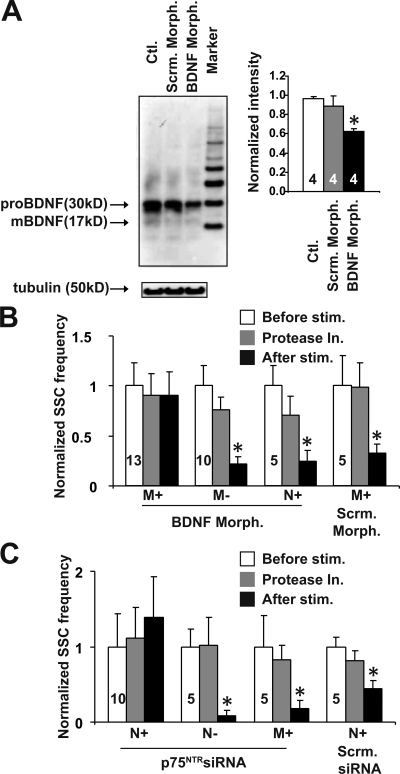
Postsynaptic cells generate positive and negative signals that retrogradely modulate presynaptic function. At developing neuromuscular synapses, prolonged stimulation of muscle cells induces sustained synaptic depression. We provide evidence that pro–brain-derived neurotrophic factor (BDNF) is a negative retrograde signal that can be converted into a positive signal by metalloproteases at the synaptic junctions. Application of pro-BDNF induces a dramatic decrease in synaptic efficacy followed by a retraction of presynaptic terminals, and these effects are mediated by presynaptic pan-neurotrophin receptor p75 (p75NTR), the pro-BDNF receptor. A brief stimulation of myocytes expressing cleavable or uncleavable pro-BDNF elicits synaptic potentiation or depression, respectively. Extracellular application of metalloprotease inhibitors, which inhibits the cleavage of endogenous pro-BDNF, facilitates the muscle stimulation–induced synaptic depression. Inhibition of presynaptic p75NTR or postsynaptic BDNF expression also blocks the activity-dependent synaptic depression and retraction. These results support a model in which postsynaptic secretion of a single molecule, pro-BDNF, may stabilize or eliminate presynaptic terminals depending on its proteolytic conversion at the synapses.
Overview
The claims and statistics of this paper haven’t been checked yet.
Free: it reads the open-access text and checks the first 5 claims that cite a source we can check. Create a free account to check every claim.
Integrity signals
Registry
Cites
Statistics
Figures



Verification
Claims the paper makes
The claims and statistics of this paper haven’t been checked yet.
Free: it reads the open-access text and checks the first 5 claims that cite a source we can check. Create a free account to check every claim.
Claims other papers make about this one
Each is checked against this paper’s own text: does it say what the citing paper says it does?
The source backs part of the claim, not all of it — or backs it for a different population, condition or comparison.
In the citing paper
“Pro-BDNF binding to p75NTR has also been shown to induce pruning of axons and dendrites85,88–91 and promote long-term depression (LTD)92–94.”
From Neuronal plasticity and neurotrophic factors in drug responses (2017) · cites this paper as [91]
Experimental — accuracy not yet measured
Self-check
Percentages, sums and reported differences re-computed from the paper’s own numbers.
The self-check needs the paper’s full text.
Citations
Cites
Egan, M. F., Kojima, M., Callicott, J. H., Goldberg, T. E., Kolachana, B. S., Bertolino, A., Zaitsev, E., Gold, B., Goldman, D., Dean, M., et al. (2003) · Cell · doi:10.1016/s0092-8674(03)00035-7 · Cited by 3,888 · cited 2×
“DNA constructs, embryo injection, and Xenopus nerve–muscle coculture EGFP–pro-BDNF and AA–pro-BDNF–GFP cDNA constructs were made as previously described (Egan et al., 2003).”
Self-citationSynaptic Activity and the Construction of Cortical Circuits
Katz, L. C., & Shatz, C. J. (1996) · Science · doi:10.1126/science.274.5290.1133 · Cited by 3,048 · cited 2×
“JCB: ARTICLE”
Critical period plasticity in local cortical circuits
Hensch, T. K. (2005) · Nature Reviews Neuroscience · doi:10.1038/nrn1787 · Cited by 2,323 · cited 2×
“Activity-dependent synaptic stabilization and elimination play a critical role in shaping patterns of neuronal connections during brain development (Constantine-Paton et al., 1990; Lichtman and Colman, 2000; Debski and Cline, 2002; Goda and Davis, 2003; Hensch, 2005; Taha and Stryker, 2005).”
Neurotrophins as synaptic modulators
Poo, M.-M. (2001) · Nature Reviews Neuroscience · doi:10.1038/35049004 · Cited by 1,775 · cited 5×
“JCB: ARTICLE”
InfluentialRegulation of Cell Survival by Secreted Proneurotrophins
Lee, R., Kermani, P., Teng, K. K., & Hempstead, B. L. (2001) · Science · doi:10.1126/science.1065057 · Cited by 1,670 · cited 7×
“The discovery that pro-BDNF preferentially binds and activates p75NTR (Lee et al., 2001) suggests that pro-BDNF is not a biologically inactive precursor but could elicit through its own receptor physiological functions distinct from mBDNF.”
InfluentialSelf-citationHippocampal long-term potentiation is impaired in mice lacking brain-derived neurotrophic factor.
Korte, M., Carroll, P., Wolf, E., Brem, G., Thoenen, H., & Bonhoeffer, T. (1995) · Proceedings of the National Academy of Sciences · doi:10.1073/pnas.92.19.8856 · Cited by 1,426 · cited 1×
“In contrast, mBDNF-TrkB signaling is essential for the early phase of longterm potentiation (LTP; Korte et al., 1995; Figurov et al., 1996; Patterson et al., 1996).”
The yin and yang of neurotrophin action
Lu, B., Pang, P. T., & Woo, N. H. (2005) · Nature Reviews Neuroscience · doi:10.1038/nrn1726 · Cited by 1,356 · cited 3×
“…neurons (Lee et al., 2001) and facilitates hippocampal long-term depression (Woo et al., 2005), provides further support for the yin-yang hypothesis (Lu et al., 2005): proneurotrophins and mature neurotrophins elicit opposite effects through activation of p75NTR and Trk receptors, respectively.”
Self-citationPatterson, S. L., Abel, T., Deuel, T. A. S., Martin, K. C., Rose, J. C., & Kandel, E. R. (1996) · Neuron · doi:10.1016/s0896-6273(00)80140-3 · Cited by 1,233 · cited 2×
“…system; COM, center of mass; ESC, evoked synaptic current; LTP, long-term potentiation; mBDNF, mature BDNF; MMP, matrix metalloprotease; NMJ, neuromuscular junction; p75NTR, pan-neurotrophin receptor p75; ROI, region of interest; SSC, spontaneous synaptic current; Trk, tropomyosin-related kinase.”
Cleavage of proBDNF by tPA/Plasmin Is Essential for Long-Term Hippocampal Plasticity
Pang, P. T., Teng, H. K., Zaitsev, E., Woo, N. T., Sakata, K., Zhen, S., Teng, K. K., Yung, W.-H., Hempstead, B. L., & Lu, B. (2004) · Science · doi:10.1126/science.1100135 · Cited by 1,136 · cited 8×
“…system; COM, center of mass; ESC, evoked synaptic current; LTP, long-term potentiation; mBDNF, mature BDNF; MMP, matrix metalloprotease; NMJ, neuromuscular junction; p75NTR, pan-neurotrophin receptor p75; ROI, region of interest; SSC, spontaneous synaptic current; Trk, tropomyosin-related kinase.”
InfluentialSelf-citationFigurov, A., Pozzo-Miller, L. D., Olafsson, P., Wang, T., & Lu, B. (1996) · Nature · doi:10.1038/381706a0 · Cited by 1,106 · cited 4×
“…system; COM, center of mass; ESC, evoked synaptic current; LTP, long-term potentiation; mBDNF, mature BDNF; MMP, matrix metalloprotease; NMJ, neuromuscular junction; p75NTR, pan-neurotrophin receptor p75; ROI, region of interest; SSC, spontaneous synaptic current; Trk, tropomyosin-related kinase.”
InfluentialSelf-citation
Cited by
Neurotrophin regulation of neural circuit development and function
Park, H., & Poo, M.-M. (2013) · Nature Reviews Neuroscience · doi:10.1038/nrn3379 · Cited by 2,060
BDNF and synaptic plasticity, cognitive function, and dysfunction
Lu, B., Nagappan, G., & Lu, Y. (2014) · Handbook of Experimental Pharmacology · doi:10.1007/978-3-642-45106-5_9 · Cited by 1,043
Self-citationCastrén, E., & Rantamäki, T. (2010) · Developmental Neurobiology · doi:10.1002/dneu.20758 · Cited by 864
“These data suggest that under conditions whereby pro-BDNF is secreted, its extracellular cleavage is of critical importance for its functional response (Lu et al., 2005; Martinowich et al., 2007; Yang et al., 2009a).”
BackgroundBDNF and Hippocampal Synaptic Plasticity
Leal, G., Bramham, C. R., & Duarte, C. B. (2017) · Vitamins and Hormones · doi:10.1016/bs.vh.2016.10.004 · Cited by 425
Neuromuscular Junction Formation, Aging, and Disorders
Li, L., Xiong, W.-C., & Mei, L. (2018) · Annual Review of Physiology · doi:10.1146/annurev-physiol-022516-034255 · Cited by 370
Metadata
- Authors
- Yang, F., Je, H.-S., Ji, Y., Nagappan, G., Hempstead, B., & Lu, B.
- Affiliations
- National Institutes of Health (US)
- Section on Neural Development and Plasticity, National Institute of Child Health and Human Development 1 and 2
- Cornell University (US)
- Corresponding author
- Lu, Bai
- Venue
- Journal of Cell Biology
- Publisher
- Rockefeller University Press
- Published
- 2009-05-18
- Volume
- 185
- Issue
- 4
- Pages
- 727-741
- ISSN
- 0021-9525 (ISSN-L)
- 1540-8140
- PMC
- PMC2711569
- OpenAlex
- W2091428840
- Cited by
- 130
- References
- 50
- Citations by year
- 2026: 4 · 2025: 1 · 2024: 5 · 2022: 6 · 2021: 7 · 2020: 10 · 2019: 10 · 2018: 8 · 2017: 12 · 2016: 7 · 2015: 5 · 2014: 10 · 2013: 9 · 2012: 13
- FWCI
- 4.97
- Type
- journal article
- Language
- en
- Open access
- hybrid
- doi.org
- Licence
- cc-by-nc-sa
- Locations
- The Journal of Cell Biology (publishedVersion, cc-by-nc-sa)
- PubMed Central (publishedVersion, cc-by-nc-sa)
- PubMed (publishedVersion)
- Funders
- National Institutes of Health
- Topics
- Life Sciences › Neuroscience › Cellular and Molecular Neuroscience › Nerve injury and regeneration
- Life Sciences › Neuroscience › Cellular and Molecular Neuroscience › Neuroscience and Neuropharmacology Research
- Life Sciences › Biochemistry, Genetics and Molecular Biology › Molecular Biology › Muscle Physiology and Disorders
- Keywords
- synaptic depression, p75 neurotrophin receptor, metalloprotease cleavage, retrograde signaling, presynaptic terminals, synaptic potentiation, muscle stimulation, activity-dependent synaptic plasticity
- MeSH terms
- Animals, Synaptic Transmission, Neuromuscular Junction, Protein Precursors, Synapses, Xenopus, Presynaptic Terminals, Brain-Derived Neurotrophic Factor, Receptor, Nerve Growth Factor, Muscle Cells
About these checks
Registry, retraction, Cites and statistics results are computed, not judged, with one exception: a printed reference that no index lists is read once by a model before it counts as a citation error. Claims are extracted by a model and kept only when their quote appears verbatim in the text; each cited source is then checked, with a model’s help, for whether it says what the claim relies on. Those verdicts can be wrong — read the claim’s quote and the cited source before relying on one.
Statistics and arithmetic are recomputed, not judged.
Confidence bands are shown only for fields calibrated on our annotated test set. None is calibrated yet, so no band is shown.
What counts as a claim ›How we measure confidence ›How we check this ›
Are you an author, or do you see a problem with this page? Request a review
How to cite
Cite CoChat for the checks on this page, and the paper for its own findings.
- This page
- CoChat. (2026). Citation check: Pro-BDNF–induced synaptic depression and retraction at developing neuromuscular synapses. https://app.cochat.ai/papers/10.1083/jcb.200811147
- The paper
- Yang, F., Je, H.-S., Ji, Y., Nagappan, G., Hempstead, B., & Lu, B. (2009). Pro-BDNF–induced synaptic depression and retraction at developing neuromuscular synapses. Journal of Cell Biology. https://doi.org/10.1083/jcb.200811147
Data sources
Bibliographic data: Semantic Scholar, OpenAlex, Crossref.
Contains information from the Semantic Scholar Academic Graph Datasets, made available under the ODC Attribution License (ODC-BY 1.0).
Semantic Scholar’s data is described in: Kinney, R., et al. (2023). The Semantic Scholar Open Data Platform. arXiv:2301.10140.
