

Pro-BDNF–induced synaptic depression and retraction at developing neuromuscular synapses
Open accessThe DOI matches its Crossref record; 52 of the 52 references it cites were found in a registry or an index.
Abstract
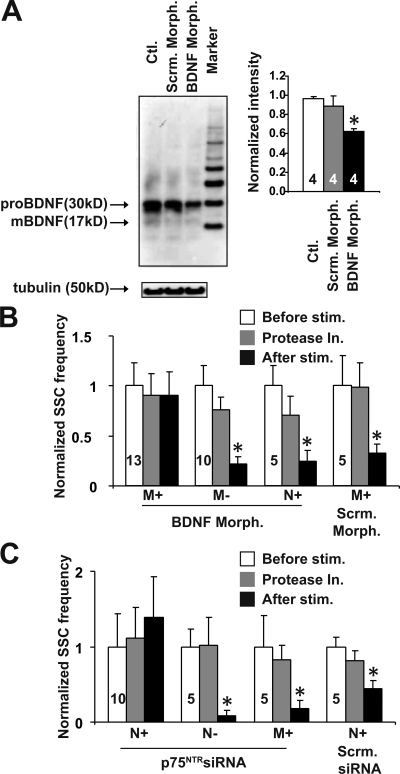
Postsynaptic cells generate positive and negative signals that retrogradely modulate presynaptic function. At developing neuromuscular synapses, prolonged stimulation of muscle cells induces sustained synaptic depression. We provide evidence that pro–brain-derived neurotrophic factor (BDNF) is a negative retrograde signal that can be converted into a positive signal by metalloproteases at the synaptic junctions. Application of pro-BDNF induces a dramatic decrease in synaptic efficacy followed by a retraction of presynaptic terminals, and these effects are mediated by presynaptic pan-neurotrophin receptor p75 (p75NTR), the pro-BDNF receptor. A brief stimulation of myocytes expressing cleavable or uncleavable pro-BDNF elicits synaptic potentiation or depression, respectively. Extracellular application of metalloprotease inhibitors, which inhibits the cleavage of endogenous pro-BDNF, facilitates the muscle stimulation–induced synaptic depression. Inhibition of presynaptic p75NTR or postsynaptic BDNF expression also blocks the activity-dependent synaptic depression and retraction. These results support a model in which postsynaptic secretion of a single molecule, pro-BDNF, may stabilize or eliminate presynaptic terminals depending on its proteolytic conversion at the synapses.
Overview
The claims and statistics of this paper haven’t been checked yet.
Free: it reads the open-access text and checks the first 5 claims that cite a source we can check. Create a free account to check every claim.
Integrity signals
Registry
Cites
Statistics
Figures



Verification
Claims the paper makes
The claims and statistics of this paper haven’t been checked yet.
Free: it reads the open-access text and checks the first 5 claims that cite a source we can check. Create a free account to check every claim.
Claims other papers make about this one
Each is checked against this paper’s own text: does it say what the citing paper says it does?
The source backs part of the claim, not all of it — or backs it for a different population, condition or comparison.
In the citing paper
“Pro-BDNF binding to p75NTR has also been shown to induce pruning of axons and dendrites85,88–91 and promote long-term depression (LTD)92–94.”
From Neuronal plasticity and neurotrophic factors in drug responses (2017) · cites this paper as [91]
Experimental — accuracy not yet measured
Self-check
Percentages, sums and reported differences re-computed from the paper’s own numbers.
The self-check needs the paper’s full text.
Citations
Cites
Egan, M. F., Kojima, M., Callicott, J. H., Goldberg, T. E., Kolachana, B. S., Bertolino, A., Zaitsev, E., Gold, B., Goldman, D., Dean, M., et al. (2003) · Cell · doi:10.1016/s0092-8674(03)00035-7 · Cited by 3,888 · cited 2×
“DNA constructs, embryo injection, and Xenopus nerve–muscle coculture EGFP–pro-BDNF and AA–pro-BDNF–GFP cDNA constructs were made as previously described (Egan et al., 2003).”
Self-citationSynaptic Activity and the Construction of Cortical Circuits
Katz, L. C., & Shatz, C. J. (1996) · Science · doi:10.1126/science.274.5290.1133 · Cited by 3,048 · cited 2×
“JCB: ARTICLE”
Critical period plasticity in local cortical circuits
Hensch, T. K. (2005) · Nature Reviews Neuroscience · doi:10.1038/nrn1787 · Cited by 2,323 · cited 2×
“Activity-dependent synaptic stabilization and elimination play a critical role in shaping patterns of neuronal connections during brain development (Constantine-Paton et al., 1990; Lichtman and Colman, 2000; Debski and Cline, 2002; Goda and Davis, 2003; Hensch, 2005; Taha and Stryker, 2005).”
Neurotrophins as synaptic modulators
Poo, M.-M. (2001) · Nature Reviews Neuroscience · doi:10.1038/35049004 · Cited by 1,775 · cited 5×
“JCB: ARTICLE”
InfluentialRegulation of Cell Survival by Secreted Proneurotrophins
Lee, R., Kermani, P., Teng, K. K., & Hempstead, B. L. (2001) · Science · doi:10.1126/science.1065057 · Cited by 1,670 · cited 7×
“The discovery that pro-BDNF preferentially binds and activates p75NTR (Lee et al., 2001) suggests that pro-BDNF is not a biologically inactive precursor but could elicit through its own receptor physiological functions distinct from mBDNF.”
InfluentialSelf-citationHippocampal long-term potentiation is impaired in mice lacking brain-derived neurotrophic factor.
Korte, M., Carroll, P., Wolf, E., Brem, G., Thoenen, H., & Bonhoeffer, T. (1995) · Proceedings of the National Academy of Sciences · doi:10.1073/pnas.92.19.8856 · Cited by 1,426 · cited 1×
“In contrast, mBDNF-TrkB signaling is essential for the early phase of longterm potentiation (LTP; Korte et al., 1995; Figurov et al., 1996; Patterson et al., 1996).”
The yin and yang of neurotrophin action
Lu, B., Pang, P. T., & Woo, N. H. (2005) · Nature Reviews Neuroscience · doi:10.1038/nrn1726 · Cited by 1,356 · cited 3×
“…neurons (Lee et al., 2001) and facilitates hippocampal long-term depression (Woo et al., 2005), provides further support for the yin-yang hypothesis (Lu et al., 2005): proneurotrophins and mature neurotrophins elicit opposite effects through activation of p75NTR and Trk receptors, respectively.”
Self-citationPatterson, S. L., Abel, T., Deuel, T. A. S., Martin, K. C., Rose, J. C., & Kandel, E. R. (1996) · Neuron · doi:10.1016/s0896-6273(00)80140-3 · Cited by 1,233 · cited 2×
“…system; COM, center of mass; ESC, evoked synaptic current; LTP, long-term potentiation; mBDNF, mature BDNF; MMP, matrix metalloprotease; NMJ, neuromuscular junction; p75NTR, pan-neurotrophin receptor p75; ROI, region of interest; SSC, spontaneous synaptic current; Trk, tropomyosin-related kinase.”
Cleavage of proBDNF by tPA/Plasmin Is Essential for Long-Term Hippocampal Plasticity
Pang, P. T., Teng, H. K., Zaitsev, E., Woo, N. T., Sakata, K., Zhen, S., Teng, K. K., Yung, W.-H., Hempstead, B. L., & Lu, B. (2004) · Science · doi:10.1126/science.1100135 · Cited by 1,136 · cited 8×
“…system; COM, center of mass; ESC, evoked synaptic current; LTP, long-term potentiation; mBDNF, mature BDNF; MMP, matrix metalloprotease; NMJ, neuromuscular junction; p75NTR, pan-neurotrophin receptor p75; ROI, region of interest; SSC, spontaneous synaptic current; Trk, tropomyosin-related kinase.”
InfluentialSelf-citationFigurov, A., Pozzo-Miller, L. D., Olafsson, P., Wang, T., & Lu, B. (1996) · Nature · doi:10.1038/381706a0 · Cited by 1,106 · cited 4×
“…system; COM, center of mass; ESC, evoked synaptic current; LTP, long-term potentiation; mBDNF, mature BDNF; MMP, matrix metalloprotease; NMJ, neuromuscular junction; p75NTR, pan-neurotrophin receptor p75; ROI, region of interest; SSC, spontaneous synaptic current; Trk, tropomyosin-related kinase.”
InfluentialSelf-citation
Cited by
Neurotrophin regulation of neural circuit development and function
Park, H., & Poo, M.-M. (2013) · Nature Reviews Neuroscience · doi:10.1038/nrn3379 · Cited by 2,060
BDNF and synaptic plasticity, cognitive function, and dysfunction
Lu, B., Nagappan, G., & Lu, Y. (2014) · Handbook of Experimental Pharmacology · doi:10.1007/978-3-642-45106-5_9 · Cited by 1,043
Self-citationCastrén, E., & Rantamäki, T. (2010) · Developmental Neurobiology · doi:10.1002/dneu.20758 · Cited by 864
“These data suggest that under conditions whereby pro-BDNF is secreted, its extracellular cleavage is of critical importance for its functional response (Lu et al., 2005; Martinowich et al., 2007; Yang et al., 2009a).”
BackgroundBDNF and Hippocampal Synaptic Plasticity
Leal, G., Bramham, C. R., & Duarte, C. B. (2017) · Vitamins and Hormones · doi:10.1016/bs.vh.2016.10.004 · Cited by 425
Neuromuscular Junction Formation, Aging, and Disorders
Li, L., Xiong, W.-C., & Mei, L. (2018) · Annual Review of Physiology · doi:10.1146/annurev-physiol-022516-034255 · Cited by 370
Yang, J., Harte-Hargrove, L. C., Siao, C.-J., Marinic, T., Clarke, R., Ma, Q., Jing, D., LaFrancois, J. J., Bath, K. G., Mark, W., et al. (2014) · Cell Reports · doi:10.1016/j.celrep.2014.03.040 · Cited by 334
“Immunoprecipitation and Western blot analysis Tissues were lysed in lysis buffer and resolved by SDS-PAGE or subjected to immunoprecipitation and western blot analysis as previously published (Yang et al., 2009b).”
BackgroundMethodResultInfluentialSelf-citationMicroRNA Loss Enhances Learning and Memory in Mice
Konopka, W., Kiryk, A., Novak, M., Herwerth, M., Parkitna, J. R., Wawrzyniak, M., Kowarsch, A., Michaluk, P., Dzwonek, J., Arnsperger, T., et al. (2010) · The Journal of Neuroscience · doi:10.1523/jneurosci.3030-10.2010 · Cited by 306
“It is also of note that there is an intimate link between BDNF and MMP-9, because the latter was shown to be one of the metalloproteinases responsible for proBDNF cleavage in neuromuscular synapses (Yang et al., 2009).”
BackgroundNeuronal plasticity and neurotrophic factors in drug responses
Castrén, E., & Antila, H. (2017) · Molecular Psychiatry · doi:10.1038/mp.2017.61 · Cited by 284
Zoladz, J. A., & Pilc, A. (2010) · PubMed · Cited by 317
Pre- and postsynaptic twists in BDNF secretion and action in synaptic plasticity.
Edelmann, E., Leßmann, V., & Brigadski, T. (2014) · Neuropharmacology · doi:10.1016/j.neuropharm.2013.05.043 · Cited by 248
Ibáñez, C. F., & Simi, A. (2012) · Trends in Neurosciences · doi:10.1016/j.tins.2012.03.007 · Cited by 238
Rodríguez Cruz, P. M., Cossins, J., Beeson, D., & Vincent, A. (2020) · Frontiers in Molecular Neuroscience · doi:10.3389/fnmol.2020.610964 · Cited by 202
Koshimizu, H., Kiyosue, K., Hara, T., Hazama, S., Suzuki, S., Uegaki, K., Nagappan, G., Zaitsev, E., Hirokawa, T., Tatsu, Y., et al. (2009) · Molecular Brain · doi:10.1186/1756-6606-2-27 · Cited by 195
“Very recently, it has been demonstrated that proBDNF eliminated presynaptic terminals using Xenopus nerve-muscle co-cultures [ 48 ].”
BackgroundSelf-citationJe, H. S., Yang, F., Ji, Y., Nagappan, G., Hempstead, B. L., & Lu, B. (2012) · Proceedings of the National Academy of Sciences · doi:10.1073/pnas.1207767109 · Cited by 188
“Xenopus nerve–muscle cocultures were immunostained, maintained, and analyzed as described previously (35).”
BackgroundMethodSelf-citationThe Role of BDNF in Peripheral Nerve Regeneration: Activity-Dependent Treatments and Val66Met
McGregor, C. E., & English, A. W. (2019) · Frontiers in Cellular Neuroscience · doi:10.3389/fncel.2018.00522 · Cited by 180
“However, not all actions of trkB happen at the level of the soma—BDNF-trkB activation has been shown to affect local protein synthesis in the growth cone as well (Yao et al., 2006).”
BackgroundSpontaneous Activity Drives Local Synaptic Plasticity In Vivo
Winnubst, J., Cheyne, J. E., Niculescu, D., & Lohmann, C. (2015) · Neuron · doi:10.1016/j.neuron.2015.06.029 · Cited by 180
“Furthermore, it is highly expressed during development in the hippocampus (Yang et al., 2009b), and it is known to be involved in synaptic competition and elimination (Je et al., 2012).”
InfluentialUnderstanding proneurotrophin actions: Recent advances and challenges
Teng, K. K., Felice, S., Kim, T., & Hempstead, B. L. (2010) · Developmental Neurobiology · doi:10.1002/dneu.20768 · Cited by 179
“…can escape intracellular processing and be secreted from neurons (Lee et al., 2001; Pang et al., 2004; Woo et al., 2005; Bruno and Cuello, 2006; Yang et al., 2009b), although the efficiency of intracellular processing remains a point of controversy (Matsumoto et al., 2008; Yang et al., 2009b).”
BackgroundMethodInfluentialSelf-citationSidhu, H., Dansie, L. E., Hickmott, P. W., Ethell, D. W., & Ethell, I. M. (2014) · Journal of Neuroscience · doi:10.1523/jneurosci.1162-14.2014 · Cited by 155
“Notably, MMP-9 has been shown to cleave pro-BDNF (Hwang et al., 2005; Yang et al., 2009).”
BackgroundProBDNF Collapses Neurite Outgrowth of Primary Neurons by Activating RhoA
Sun, Y., Lim, Y., Li, F., Liu, S., Lu, J.-J., Haberberger, R., Zhong, J.-H., & Zhou, X.-F. (2012) · PLoS ONE · doi:10.1371/journal.pone.0035883 · Cited by 145
Upregulation of blood proBDNF and its receptors in major depression
Zhou, L., Xiong, J., Lim, Y. P., Ruan, Y., Huang, C., Zhu, Y., Zhong, J., Xiao, Z., & Zhou, X. (2013) · Journal of Affective Disorders · doi:10.1016/j.jad.2013.03.002 · Cited by 159
The effect of depression, BDNF gene val66met polymorphism and gender on serum BDNF levels
Ozan, E., Okur, H., Eker, M. C., Eker, Ö. D., Gönül, A. S., & Akarsu, N. A. (2009) · Brain Research Bulletin · doi:10.1016/j.brainresbull.2009.06.022 · Cited by 143
Je, H. S., Yang, F., Ji, Y., Potluri, S., Fu, X.-Q., Luo, Z.-G., Nagappan, G., Chan, J. P., Hempstead, B., Son, Y.-J., et al. (2013) · Journal of Neuroscience · doi:10.1523/jneurosci.0163-13.2013 · Cited by 128
“DOI:10.1523/JNEUROSCI.0163-13.2013 Copyright © 2013 the authors 0270-6474/13/339957-06$15.00/0 proBDNF suppresses synaptic transmission and causes axonal retraction by activating presynaptic p75 NTR(Yang et al., 2009a).”
BackgroundResultSelf-citationStress-primed secretory autophagy promotes extracellular BDNF maturation by enhancing MMP9 secretion
Martinelli, S., Anderzhanova, E. A., Bajaj, T., Wiechmann, S., Dethloff, F., Weckmann, K., Heinz, D. E., Ebert, T., Hartmann, J., Geiger, T. M., et al. (2021) · Nature Communications · doi:10.1038/s41467-021-24810-5 · Cited by 126
Begni, V., Riva, M. A., & Cattaneo, A. (2017) · Clinical Science · doi:10.1042/cs20160009 · Cited by 125
Human Immunodeficiency Virus Type 1 Alters Brain-Derived Neurotrophic Factor Processing in Neurons
Bachis, A., Avdoshina, V., Zecca, L., Parsadanian, M., & Mocchetti, I. (2012) · Journal of Neuroscience · doi:10.1523/jneurosci.0865-12.2012 · Cited by 118
“ProBDNF was detected in the medium of rodent neurons, consistent with the notion that mature neurons are capable of producing and releasing proBDNF (Peng et al., 2005; Yang et al., 2009b).”
BackgroundNeurotrophins and Proneurotrophins: Focus on Synaptic Activity and Plasticity in the Brain
Gibon, J., & Barker, P. A. (2017) · The Neuroscientist · doi:10.1177/1073858417697037 · Cited by 115
A BDNF-Mediated Push-Pull Plasticity Mechanism for Synaptic Clustering
Niculescu, D., Michaelsen-Preusse, K., Güner, Ü., van Dorland, R., Wierenga, C. J., & Lohmann, C. (2018) · Cell Reports · doi:10.1016/j.celrep.2018.07.073 · Cited by 111
Deciphering Proneurotrophin Actions
Hempstead, B. L. (2014) · Handbook of Experimental Pharmacology · doi:10.1007/978-3-642-45106-5_2 · Cited by 106
“One study has used hippocampal neurons from a knock-in mouse expressing HA-epitope-tagged BDNF (Yang et al. 2009b) to quantitatively detect secreted proBDNF and mature BDNF using antibodies to the HA-tag, rather than relying on antibodies that recognize either proBDNF or mature BDNF.”
BackgroundMethodInfluentialSelf-citationHarte-Hargrove, L. C., MacLusky, N. J., & Scharfman, H. E. (2013) · Neuroscience · doi:10.1016/j.neuroscience.2012.12.029 · Cited by 101
Kuczewski, N., Porcher, C., & Gaiarsa, J. (2010) · European Journal of Neuroscience · doi:10.1111/j.1460-9568.2010.07378.x · Cited by 98
Brain‐derived neurotrophic factor expression is repressed during myogenic differentiation by miR‐206
Miura, P., Amirouche, A., Clow, C., Bélanger, G., & Jasmin, B. J. (2012) · Journal of Neurochemistry · doi:10.1111/j.1471-4159.2011.07583.x · Cited by 92
“In this form, BDNF is a negative retrograde signal that elicits synaptic depression. pro-BDNF is converted from a negative to a positive retrograde signal by proteolytic cleavage to mature BDNF (Yang et al. 2009).”
InfluentialLovelace, J. W., Rais, M., Palacios, A. R., Shuai, X. S., Bishay, S., Popa, O., Pirbhoy, P. S., Binder, D. K., Nelson, D. L., Ethell, I. M., et al. (2020) · Cerebral Cortex · doi:10.1093/cercor/bhz141 · Cited by 82
“MMP-9 can also regulate mTOR and Akt activation (Sidhu et al. 2014), potentially through integrins or BDNF/TrkB signaling (Hwang et al. 2005; Yang et al. 2009).”
BackgroundRegulation of ECM degradation and axon guidance by growth cone invadosomes
Santiago‐Medina, M., Gregus, K. A., Nichol, R. H., O'Toole, S. M., & Gómez, T. M. (2015) · Development · doi:10.1242/dev.108266 · Cited by 94
“Future studies will examine candidate morphogens, such as BDNF or pro-BDNF, that might be released by myocytes (Yang et al., 2009) to regulate peripheral sprouting of invadosomes.”
BackgroundSiao, C.-J., Lorentz, C. U., Kermani, P., Marinic, T. E., Carter, J., McGrath, K., Padow, V. A., Mark, W. H., Falcone, D. J., Cohen‐Gould, L., et al. (2012) · The Journal of Experimental Medicine · doi:10.1084/jem.20111749 · Cited by 78
“, 2011) and proBDNF, a related proneurotrophin ligand, induces retraction of p75NTR-expressing neuronal processes (Koshimizu et al., 2009; Yang et al., 2009).”
BackgroundResultInfluentialSelf-citationSensory neuronal P2RX4 receptors controls BDNF signaling in inflammatory pain
Lalisse, S., Hua, J., Lenoir, M., Linck, N., Rassendren, F., & Ulmann, L. (2018) · Scientific Reports · doi:10.1038/s41598-018-19301-5 · Cited by 83
Neeley, E. W., Berger, R., Koenig, J. I., & Leonard, S. (2011) · Neuroscience · doi:10.1016/j.neuroscience.2011.03.065 · Cited by 71
“BDNF can also nduce either synaptic enhancement or synaptic depresion (Yang et al., 2009; Zagrebelsky et al., 2005; Ghosh et l., 1994; Soule et al., 2006), just as low levels of glucoorticoids can increase synaptic plasticity (Komatsuzaki et l.”
Proneurotrophin-3 Is a Neuronal Apoptotic Ligand: Evidence for Retrograde-Directed Cell Killing
Yano, H., Torkin, R., Martin, L. A., Chao, M. V., & Teng, K. K. (2009) · The Journal of Neuroscience · doi:10.1523/jneurosci.2059-09.2009 · Cited by 65
“Initially, we surveyed several different published protocols for neurotrophin extraction from tissues (Katoh-Semba et al., 1996; Zhang et al., 2001; Yang et al., 2009b) but have found great variability in how well proNT-3 and mature NT-3 can be extracted.”
BackgroundMethodResultInfluentialIncreased Hippocampal ProBDNF Contributes to Memory Impairments in Aged Mice
Buhusi, M. C., Etheredge, C., Granholm, A., & Buhusi, C. V. (2017) · Frontiers in Aging Neuroscience · doi:10.3389/fnagi.2017.00284 · Cited by 68
Ohja, K., Gozal, E., Fahnestock, M. L., Cai, L., Cai, J., Freedman, J. H., Switala, A., El-Baz, A. S., & Barnes, G. N. (2018) · NeuroMolecular Medicine · doi:10.1007/s12017-018-8488-8 · Cited by 71
“Mature BDNF potentiates synaptic proliferation and stabilization, synapse maturation and synaptic transmission through binding to TrkB, and subsequent stimulation of downstream pathways such as PI3 K-Rac, whereas proBDNF causes axonal retraction, suppresses synaptic transmission and promotes synapse elimination throug…”
BackgroundTom, V. J., Sandrow-Feinberg, H. R., Miller, K., Domitrovich, C., Bouyer, J., Zhukareva, V. A., Klaw, M. C., Lemay, M. A., & Houlé, J. D. (2012) · Experimental Neurology · doi:10.1016/j.expneurol.2012.09.011 · Cited by 71
“Interestingly, pro-BDNF, which is also elevated in the animals that were injected with BDNF-lentivirus, has been linked to synaptic depression (Lu, 2003; Woo et al., 2005; Yang et al., 2009).”
ProBDNF inhibits infiltration of ED1+ macrophages after spinal cord injury
Wong, I., Liao, H., Bai, X., Zaknic, A., Zhong, J., Guan, Y., Li, H.-Y., Wang, Y.-J., & Zhou, X.-F. (2010) · Brain, Behavior, and Immunity · doi:10.1016/j.bbi.2010.01.001 · Cited by 55
“, 2005) and in the neuromuscular synapse (Yang et al., 2009).”
BackgroundAlboni, S., Benatti, C., Capone, G., Corsini, D., Caggia, F., Tascedda, F., Mendlewicz, J., & Brunello, N. (2010) · European Journal of Pharmacology · doi:10.1016/j.ejphar.2010.06.028 · Cited by 61
“Recent studies have demonstrated that CNS neurons primarily secrete Pro-BDNF in response to depolarization (Bergami et al., 2008; Nagappan et al., 2009; Yang et al., 2009).”
BackgroundDistinct roles of prelimbic and infralimbic proBDNF in extinction of conditioned fear
Sun, W., Li, X., & An, L. (2017) · Neuropharmacology · doi:10.1016/j.neuropharm.2017.12.018 · Cited by 58
“, 2012), axonal retraction (Yang et al., 2009), and facilitate long-term depression (Woo et al.”
InfluentialMotoneuron programmed cell death in response to proBDNF
Taylor, A. R., Gifondorwa, D. J., Robinson, M. B., Strupe, J. L., Prevette, D., Johnson, J. E., Hempstead, B., Oppenheim, R. W., & Milligan, C. E. (2012) · Developmental Neurobiology · doi:10.1002/dneu.20964 · Cited by 54
“…that neuronal activity may regulate the diametrically opposed actions of proBDNF and mBDNF. Additionally, proBDNF may also directly regulate neuronal activity because it has been shown to induce synaptic depression and terminal retraction in Xenopus nerve-muscle co-culture (Yang et al., 2009).”
BackgroundSelf-citationproBDNF and p75NTR Control Excitability and Persistent Firing of Cortical Pyramidal Neurons
Gibon, J., Buckley, S. M., Unsain, N., Kaartinen, V., Seguela, P., & Barker, P. A. (2015) · Journal of Neuroscience · doi:10.1523/jneurosci.4655-14.2015 · Cited by 52
BDNF G196A (Val66Met) polymorphism associated with cognitive impairment in Parkinson's disease
Białecka, M. A., Kurzawski, M., Roszmann, A., Robowski, P., Sitek, E. J., Honczarenko, K., Mak, M., Deptuła-Jarosz, M., Gołąb-Janowska, M., Droździk, M., et al. (2014) · Neuroscience Letters · doi:10.1016/j.neulet.2013.12.051 · Cited by 54
PROneurotrophins and CONSequences
Costa, R. O., Perestrelo, T., & Almeida, R. D. (2017) · Molecular Neurobiology · doi:10.1007/s12035-017-0505-7 · Cited by 52
Wei, S.-M., Eisenberg, D. P., Kohn, P. D., Kippenhan, J. S., Kolachana, B. S., Weinberger, D. R., & Berman, K. F. (2012) · Journal of Neuroscience · doi:10.1523/jneurosci.5375-11.2012 · Cited by 51
“In addition, because BDNF mediates synaptic plasticity (Yang et al., 2009; Ninan et al., 2010) and dendritic arborization (Tyler and Pozzo-Miller, 2003; Ji et al.”
BackgroundThe MicroRNA Contribution to Learning and Memory
Konopka, W., Schütz, G., & Kaczmarek, L. (2011) · The Neuroscientist · doi:10.1177/1073858411411721 · Cited by 46
Activity-Dependent Transcription of BDNF Enhances Visual Acuity during Development
Schwartz, N., Schohl, A., & Ruthazer, E. S. (2011) · Neuron · doi:10.1016/j.neuron.2011.02.055 · Cited by 50
“Neurons are able to release both the precursor and mature forms of BDNF; however, the site of release may be a critical determinant of what form the released protein takes (Matsuda et al., 2009; Yang et al., 2009).”
Sex differences in brain‐derived neurotrophic factor signaling: Functions and implications
Wei, Y., Wang, S.-R., & Xu, X. (2016) · Journal of Neuroscience Research · doi:10.1002/jnr.23897 · Cited by 51
“In contrast, BDNF and pro-BDNF (which is secreted at low amounts) also bind to the lowaffinity p75 receptor and exert effects that are often distinct from or even opposite to those of the TrkB signaling pathways (Dechant and Barde, 2002; Woo et al., 2005; Yang et al., 2009).”
BackgroundGarcía, N., Santafé, M. M., Tomàs, M., Lanuza, M. A., Besalduch, N., & Tomàs, J. M. (2009) · Journal of Neuroscience Research · doi:10.1002/jnr.22320 · Cited by 49
“In frog NMJs in culture, a single molecule, pro-BDNF, may produce synaptic potentiation or depression, and contributes to stabilize or eliminate presynaptic terminals depending on its proteolitic conversion at the synapses (Yang et al., 2009).”
BackgroundPerisynaptic schwann cells - The multitasking cells at the developing neuromuscular junctions
Álvarez-Suárez, P., Gawor, M., & Prószyński, T. J. (2020) · Seminars in Cell and Developmental Biology · doi:10.1016/j.semcdb.2020.02.011 · Cited by 55
Ng, T. R. D., Lee, Y. Y., Chae, J., Yeo, A. H. L., Shwe, M., Gan, Y. X., Ng, R. C. H., Chu, P. P. Y., Khor, C. C., Ho, H. K., et al. (2017) · BMC Cancer · doi:10.1186/s12885-017-3861-9 · Cited by 47
“Biologically, BDNF is synthesized as a precursor known as proBDNF prior to cleavage into the mature BDNF (mBDNF) via furin intracellularly or matrix metalloproteinases (MMP) and plasmin extracellularly [26, 27, 29] (Fig.”
BackgroundToledo, R. S., Stein, D. J., Sanches, P. R. S., da Silva, L. S., Medeiros, H. R., Fregni, F., Caumo, W., & Torres, I. L. D. S. (2021) · Brain Research · doi:10.1016/j.brainres.2021.147427 · Cited by 45
Avdoshina, V., Bachis, A., & Mocchetti, I. (2013) · Journal of Internal Medicine · doi:10.1111/joim.12050 · Cited by 41
Lanuza, M. A., Just‐Borràs, L., Hurtado, E., Cilleros‐Mañé, V., Tomàs, M., García, N., & Tomàs, J. M. (2019) · Cells · doi:10.3390/cells8121578 · Cited by 44
Cui, Y., Zhou, S.-F., Liu, Y., Wang, S., Li, F., Dai, R., Hu, Z., & Li, C.-Q. (2021) · Frontiers in Neuroscience · doi:10.3389/fnins.2021.665757 · Cited by 35
Wei, S.-M., Baller, E. B., Kohn, P. D., Kippenhan, J. S., Kolachana, B. S., Soldin, S. J., Rubinow, D. R., Schmidt, P. J., & Berman, K. F. (2017) · Molecular Psychiatry · doi:10.1038/mp.2017.72 · Cited by 37
Sun, W., Li, J., Cui, S., Luo, L., Huang, P., Tang, C., & An, L. (2019) · eNeuro · doi:10.1523/eneuro.0165-19.2019 · Cited by 35
“, 2014), synaptic transmission (Yang et al., 2009), and cell survival (Je et al.”
BackgroundInhibiting proBDNF to mature BDNF conversion leads to ASD-like phenotypes in vivo
Yang, F., You, H., Mizui, T., Ishikawa, Y., Takao, K., Miyakawa, T., Li, X., Bai, T., Xia, K., Zhang, L., et al. (2024) · Molecular Psychiatry · doi:10.1038/s41380-024-02595-5 · Cited by 41
“There is suf fi cient evidence suggesting that extracellular cleavage of proBDNF plays an important role in late phase long-term potentiation (LTP) and activity-dependent synaptic competition [21, 29 – 32].”
Self-citationEgashira, Y., Tanaka, T., Soni, P., Sakuragi, S., Tominaga‐Yoshino, K., & Ogura, A. (2010) · Journal of Neuroscience Research · doi:10.1002/jnr.22505 · Cited by 30
“Among many candidates, we focused on proneurotrophins, especially pro-BDNF and its potential receptor p75NTR, because recent findings have revealed proBDNF-dependent synaptic elimination in the peripheral nervous system (Singh et al., 2008; F. Yang et al., 2009).”
BackgroundInfluentialSun, W., Li, J., Li, X., Chen, X., Mei, Y., Yang, Y., & An, L. (2022) · Particle and Fibre Toxicology · doi:10.1186/s12989-022-00477-8 · Cited by 25
Hippocampal proBDNF facilitates place learning strategy associated with neural activity in rats
An, L., Li, X., Tang, C., Xu, N., & Sun, W. (2018) · Brain Structure and Function · doi:10.1007/s00429-018-1742-x · Cited by 25
Bachis, A., Forcelli, P. A., Masliah, E., Campbell, L. A., & Mocchetti, I. (2016) · Brain Behavior and Immunity · doi:10.1016/j.bbi.2016.01.020 · Cited by 28
“These include neuronal apoptosis (Lee et al., 2001), axonal degeneration in the developing as well as mature nervous system (Kaplan and Miller, 2003; Park et al., 2010; Singh et al., 2008), presynaptic terminal retraction (Yang et al., 2009) and long term depression (Woo et al., 2005).”
Morphine Withdrawal Increases Brain-Derived Neurotrophic Factor Precursor
Bachis, A., Campbell, L. A., Jenkins, K., Wenzel, E. D., & Mocchetti, I. (2017) · Neurotoxicity Research · doi:10.1007/s12640-017-9788-8 · Cited by 29
“2005), presynaptic terminal retraction (Yang et al. 2009), long-term”
The Proform of Glia Cell Line-Derived Neurotrophic Factor: a Potentially Biologically Active Protein
Sun, X., Chen, B., Duan, L. N., Xia, Y., Luo, Z.-J., Wang, J., Rao, Z., & Chen, L.-W. (2013) · Molecular Neurobiology · doi:10.1007/s12035-013-8515-6 · Cited by 25
Sun, W., Che, H., Li, J., Tang, D., Liu, X., Liu, W., & An, L. (2020) · Molecular Neurobiology · doi:10.1007/s12035-020-02051-9 · Cited by 24
Sun, W., Cheng, H., Yang, Y., Tang, D., Li, X., & An, L. (2021) · Frontiers in Cell and Developmental Biology · doi:10.3389/fcell.2021.678182 · Cited by 26
Pérez, V., Bermedo‐García, F., Zelada, D., Court, F. A., Pérez, M. Á., Fuenzalida, M., Ábrigo, J., Cabello‐Verrugio, C., Moya‐Alvarado, G., Tapia, J. C., et al. (2019) · Acta Neuropathologica Communications · doi:10.1186/s40478-019-0802-7 · Cited by 28
“Although Schwann cell-derived p75 plays a major role on the perinatal elimination of muscle fiber poly-innervation [37, 92], NMJs of P14 p75−/− mice showed no evident alterations regarding AChR clustering and their innervation profile [37], suggesting a minor”
BackgroundMetabolic regulation of aging and age-related disease
Hamrick, M. W., & Stranahan, A. M. (2020) · Ageing Research Reviews · doi:10.1016/j.arr.2020.101175 · Cited by 28
Bogacheva, P. O., Molchanova, А. I., Pravdivceva, E., Miteva, A. S., Balezina, O. P., & Gaydukov, A. E. (2022) · Frontiers in Cellular Neuroscience · doi:10.3389/fncel.2022.866802 · Cited by 26
Blocking p75NTR receptors alters polyinnervationz of neuromuscular synapses during development
García, N., Tomàs, M., Santafé, M. M., Lanuza, M. A., Besalduch, N., & Tomàs, J. M. (2011) · Journal of Neuroscience Research · doi:10.1002/jnr.22620 · Cited by 24
“This observation is consistent with the previous studies in cell culture models: in sensory neurons, the p75NTR activation inhibited neurite outgrowth (Kimpinski et al., 1999) and promoted axonal retraction in Xenopus neuromuscular cultures (Yang et al., 2009).”
BackgroundResultInfluentialWilloughby, C. L., Fleuriet, J., Walton, M. M. G., Mustari, M. J., & McLoon, L. K. (2015) · Investigative Ophthalmology & Visual Science · doi:10.1167/iovs.15-16852 · Cited by 24
Irradiation increases brain-derived neurotrophic factor precursor signaling in the mouse hippocampus
Wang, Z., Zhong, X., Xu, Y., He, J., Liu, Z. H., Nai, A., Niu, L., Luo, S. S., Yang, H., Zeng, J. Y., et al. (2020) · Neurobiology of Learning and Memory · doi:10.1016/j.nlm.2020.107186 · Cited by 21
Glial cells maintain synapses by inhibiting an activity-dependent retrograde protease signal
Gould, T. W., Dominguez, B., de Winter, F., Yeo, G. W.-M., Liu, P., Sundararaman, B., Stark, T., Vu, A. Q., Degen, J. L., Lin, W., et al. (2019) · PLoS Genetics · doi:10.1371/journal.pgen.1007948 · Cited by 22
NMDA-Dependent Switch of proBDNF Actions on Developing GABAergic Synapses
Langlois, A., Diabira, D., Ferrand, N., Porcher, C., & Gaïarsa, J. (2012) · Cerebral Cortex · doi:10.1093/cercor/bhs071 · Cited by 23
Recent Advances in the Molecular and Cellular Mechanisms of gp120-Mediated Neurotoxicity
Avdoshina, V., & Mocchetti, I. (2022) · Cells · doi:10.3390/cells11101599 · Cited by 23
Sevoflurane leads to learning and memory dysfunction via breaking the balance of tPA/PAI-1
Dong, Y., Hong, W., Tang, Z., Gao, Y., Wu, X., & Liu, H. (2020) · Neurochemistry International · doi:10.1016/j.neuint.2020.104789 · Cited by 20
5-HT2A Receptors and BDNF Regulation: Implications for Psychopathology
Jaggar, M., & Vaidya, V. A. (2018) · Springer eBooks · doi:10.1007/978-3-319-70474-6_17 · Cited by 19
Wu, Z., Bai, L., Tu, R., Zhang, L., Ba, Y., Zhang, H., Li, X., Cheng, X., Li, W., & Huang, H. (2020) · Environmental Toxicology and Pharmacology · doi:10.1016/j.etap.2020.103350 · Cited by 15
Running and Swimming Differently Adapt the BDNF/TrkB Pathway to a Slow Molecular Pattern at the NMJ
Just‐Borràs, L., Cilleros‐Mañé, V., Hurtado, E., Biondi, O., Charbonnier, F., Tomàs, M., García, N., Tomàs, J. M., & Lanuza, M. A. (2021) · International Journal of Molecular Sciences · doi:10.3390/ijms22094577 · Cited by 17
“During the development and after muscle stimulation, proBDNF promotes synaptic plasticity and refinement through p75NTR [39,40,69].”
BackgroundHan, C., Bae, H., Won, S.-D., Roh, S., & Kim, D. (2015) · Annals of General Psychiatry · doi:10.1186/s12991-015-0065-z · Cited by 14
“ProBDNF suppressed synaptic transmission and induced hippocampal depression [40, 41].”
BackgroundFang, Y., Hsieh, J., Vidyanti, A. N., Yang, C., Jan, J., Chang, K., Hu, C., & Tu, Y. (2021) · Journal of Cellular and Molecular Medicine · doi:10.1111/jcmm.16770 · Cited by 13
Barman, B., Kushwaha, A., & Thakur, M. K. (2021) · Neurochemistry International · doi:10.1016/j.neuint.2021.105181 · Cited by 15
Bottasso, E. (2019) · Frontiers in Endocrinology · doi:10.3389/fendo.2019.00632 · Cited by 14
“terminals, this effect being mediated by p75NTR (75).”
BackgroundMei, F., Zhao, C. F., Li, S., Xue, Z., Zhao, Y., Xu, Y., Ye, R., You, H., Yu, P., Han, X., et al. (2024) · Nature Communications · doi:10.1038/s41467-024-51707-w · Cited by 13
Self-citationSun, W., Chen, X., Mei, Y., Yang, Y., Li, X., & An, L. (2022) · Molecular Neurobiology · doi:10.1007/s12035-022-02849-9 · Cited by 12
“Previously, a strong NMDAR-mediated EPSCs was induced by the current threshold LFS protocol, leading calcium influx through NMDAR with GluN2B subunits was sufficient for reaching the threshold for LTD induction in infant (PD11–PD14) rats [86] and in hippocampal slices infused with proBDNF [87].”
BackgroundInfluentialMale rats exhibit higher pro-BDNF, c-Fos and dendritic tree changes after chronic acoustic stress
Fernández-Quezada, D., García-Zamudio, A., Ruvalcaba-Delgadillo, Y., Luquín, S., García‐Estrada, J., & Huerta, F. J. (2019) · BioScience Trends · doi:10.5582/bst.2019.01288 · Cited by 11
“While BDNF promotes plasticity by enhancing survival, differentiation or dendrite growing, its precursor pro-BDNF has been associated with debranching of dendritic arbors (30-32).”
BackgroundMizui, T., Tanima, Y., Komatsu, H., Kumanogoh, H., & Kojima, M. (2014) · Neuroscience & Medicine · doi:10.4236/nm.2014.54021 · Cited by 14
“Two leading groups of Professors Barde and Hempstead recently carried out extensive studies into the effect of the presence and absence of endogenous proBDNF [90] [91].”
BackgroundNeurotrophic Factors in Development and Regulation of Respiratory Control
Ogier, M., Kron, M., & Katz, D. M. (2013) · Comprehensive physiology · doi:10.1002/cphy.c120029 · Cited by 12
Sun, W., Mei, Y., Li, X., Yang, Y., & An, L. (2022) · Frontiers in Cell and Developmental Biology · doi:10.3389/fcell.2022.1018586 · Cited by 11
Balanyà-Segura, M., Polishchuk, A., Just‐Borràs, L., Cilleros‐Mañé, V., Silvera-Simón, C., Ardèvol, A., Tomàs, M., Lanuza, M. A., Hurtado, E., & Tomàs, J. M. (2024) · International Journal of Molecular Sciences · doi:10.3390/ijms25158018 · Cited by 13
“Muscarinic receptors have a functional link to TrkB receptors performing a cooperative mechanism controlling ACh release in the presynaptic compartment [68].”
BackgroundCui, T., Liu, Z., Li, Z., Han, Y., Xiong, W., Qu, Z., & Zhang, X. (2024) · Journal of Psychiatric Research · doi:10.1016/j.jpsychires.2024.01.001 · Cited by 10
Of Proneurotrophins and Their Antineurotrophic Effects
Kotlyanskaya, L., McLinden, K. A., & Giniger, E. (2013) · Science Signaling · doi:10.1126/scisignal.2003824 · Cited by 10
“Could their interaction be overlayed on regulation by the pro-proteins for these two neurotrophins? Similarly, given the opposing effects of pro- and mature neurotrophins on LTD versus LTP (long-term potentiation) (13, 14), it seems likely that the switch between these forms of plasticity is regulated in part by the p…”
Synthesis, Trafficking and Release of BDNF
Lu, J., Yang, M., Sun, Y., & Zhou, X. (2014) · Springer eBooks · doi:10.1007/978-1-4614-5836-4_24 · Cited by 12
E, M. J. M. R. (2014) · Journal of Alcoholism and Drug Dependence · doi:10.4172/2329-6488.1000180 · Cited by 7
Molecular markers for corneal epithelial cells in larval vs. adult Xenopus frogs
Sonam, S., Srnak, J. A., Perry, K. J., & Henry, J. J. (2019) · Experimental Eye Research · doi:10.1016/j.exer.2019.04.010 · Cited by 8
“S1I), which corresponds to other reports involving Xenopus tissue (Kanning et al., 2003; Yang et al., 2009).”
Resultp75NTR Processing and Signaling: Functional Role
Almeida, R. D., & Duarte, C. B. (2014) · Springer eBooks · doi:10.1007/978-1-4614-5836-4_25 · Cited by 13
Gaub, P., de León, A., Gibon, J., Soubannier, V., Dorval, G., Séguéla, P., & Barker, P. A. (2016) · PLoS ONE · doi:10.1371/journal.pone.0150601 · Cited by 8
“Further, several groups have reported that proBDNF functions as an important modulator of synaptic structure and function [16, 17].”
Background
Metadata
- Authors
- Yang, F., Je, H.-S., Ji, Y., Nagappan, G., Hempstead, B., & Lu, B.
- Affiliations
- National Institutes of Health (US)
- Section on Neural Development and Plasticity, National Institute of Child Health and Human Development 1 and 2
- Cornell University (US)
- Corresponding author
- Lu, Bai
- Venue
- Journal of Cell Biology
- Publisher
- Rockefeller University Press
- Published
- 2009-05-18
- Volume
- 185
- Issue
- 4
- Pages
- 727-741
- ISSN
- 0021-9525 (ISSN-L)
- 1540-8140
- PMC
- PMC2711569
- OpenAlex
- W2091428840
- Cited by
- 130
- References
- 50
- Citations by year
- 2026: 4 · 2025: 1 · 2024: 5 · 2022: 6 · 2021: 7 · 2020: 10 · 2019: 10 · 2018: 8 · 2017: 12 · 2016: 7 · 2015: 5 · 2014: 10 · 2013: 9 · 2012: 13
- FWCI
- 4.97
- Type
- journal article
- Language
- en
- Open access
- hybrid
- doi.org
- Licence
- cc-by-nc-sa
- Locations
- The Journal of Cell Biology (publishedVersion, cc-by-nc-sa)
- PubMed Central (publishedVersion, cc-by-nc-sa)
- PubMed (publishedVersion)
- Funders
- National Institutes of Health
- Topics
- Life Sciences › Neuroscience › Cellular and Molecular Neuroscience › Nerve injury and regeneration
- Life Sciences › Neuroscience › Cellular and Molecular Neuroscience › Neuroscience and Neuropharmacology Research
- Life Sciences › Biochemistry, Genetics and Molecular Biology › Molecular Biology › Muscle Physiology and Disorders
- Keywords
- synaptic depression, p75 neurotrophin receptor, metalloprotease cleavage, retrograde signaling, presynaptic terminals, synaptic potentiation, muscle stimulation, activity-dependent synaptic plasticity
- MeSH terms
- Animals, Synaptic Transmission, Neuromuscular Junction, Protein Precursors, Synapses, Xenopus, Presynaptic Terminals, Brain-Derived Neurotrophic Factor, Receptor, Nerve Growth Factor, Muscle Cells
About these checks
Registry, retraction, Cites and statistics results are computed, not judged, with one exception: a printed reference that no index lists is read once by a model before it counts as a citation error. Claims are extracted by a model and kept only when their quote appears verbatim in the text; each cited source is then checked, with a model’s help, for whether it says what the claim relies on. Those verdicts can be wrong — read the claim’s quote and the cited source before relying on one.
Statistics and arithmetic are recomputed, not judged.
Confidence bands are shown only for fields calibrated on our annotated test set. None is calibrated yet, so no band is shown.
What counts as a claim ›How we measure confidence ›How we check this ›
Are you an author, or do you see a problem with this page? Request a review
Data sources
Bibliographic data: Semantic Scholar, OpenAlex, Crossref.
Contains information from the Semantic Scholar Academic Graph Datasets, made available under the ODC Attribution License (ODC-BY 1.0).
Semantic Scholar’s data is described in: Kinney, R., et al. (2023). The Semantic Scholar Open Data Platform. arXiv:2301.10140.
