

The DOI matches its Crossref record; 224 of the 224 references it cites were found in a registry or an index.
The cell biology of systemic insulin function
Open accessAbstract
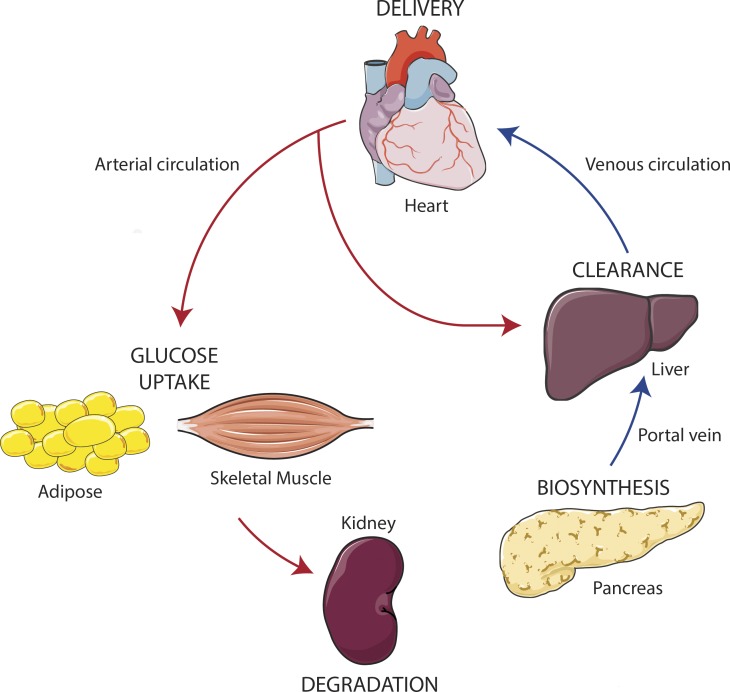
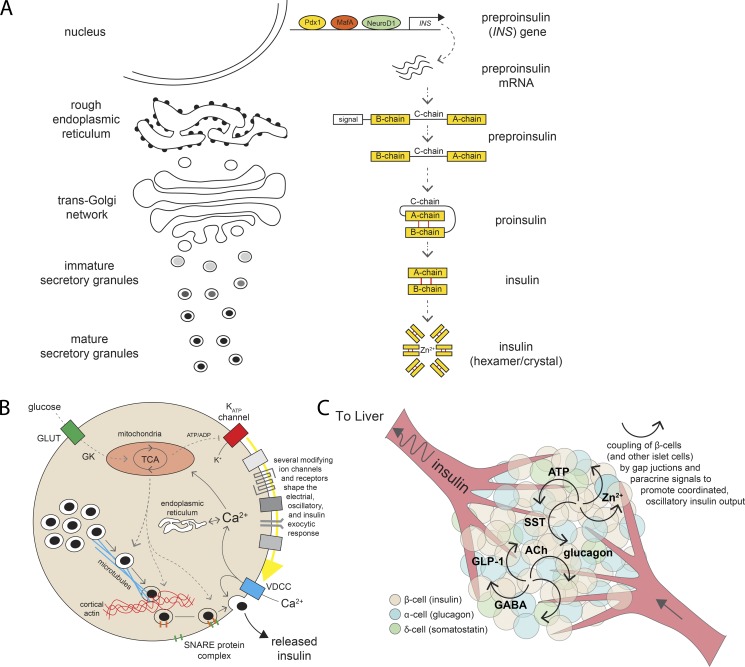
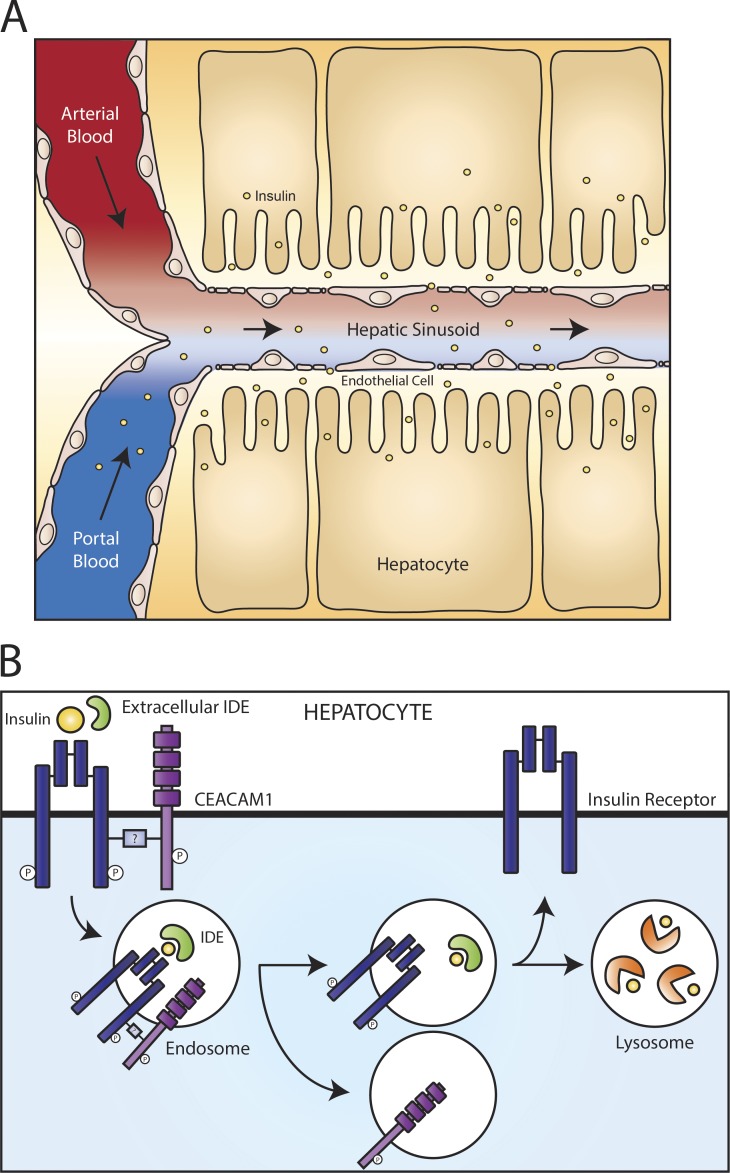
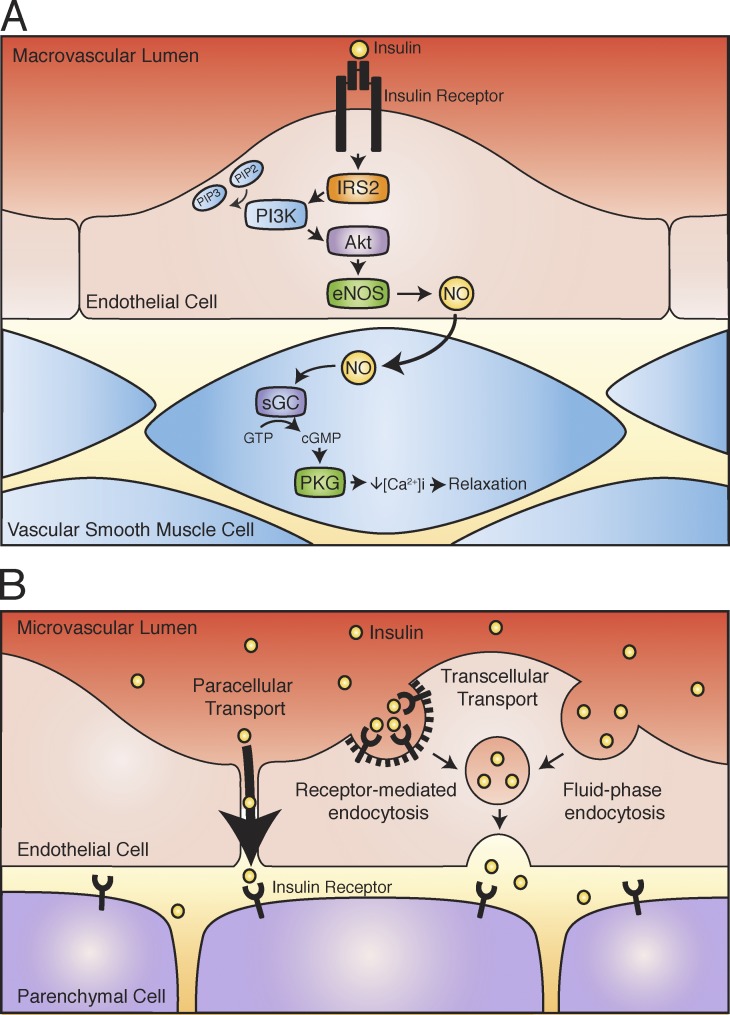
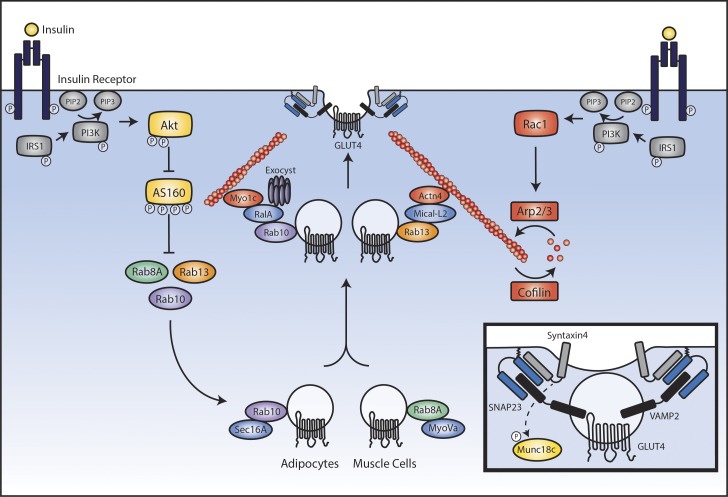
Insulin is the paramount anabolic hormone, promoting carbon energy deposition in the body. Its synthesis, quality control, delivery, and action are exquisitely regulated by highly orchestrated intracellular mechanisms in different organs or “stations” of its bodily journey. In this Beyond the Cell review, we focus on these five stages of the journey of insulin through the body and the captivating cell biology that underlies the interaction of insulin with each organ. We first analyze insulin’s biosynthesis in and export from the β-cells of the pancreas. Next, we focus on its first pass and partial clearance in the liver with its temporality and periodicity linked to secretion. Continuing the journey, we briefly describe insulin’s action on the blood vasculature and its still-debated mechanisms of exit from the capillary beds. Once in the parenchymal interstitium of muscle and adipose tissue, insulin promotes glucose uptake into myofibers and adipocytes, and we elaborate on the intricate signaling and vesicle traffic mechanisms that underlie this fundamental function. Finally, we touch upon the renal degradation of insulin to end its action. Cellular discernment of insulin’s availability and action should prove critical to understanding its pivotal physiological functions and how their failure leads to diabetes.
Overview
The claims and statistics of this paper haven’t been checked yet.
Run the check — free, no account needed. It reads the open-access text and checks the sources it cites.
Integrity signals
Registry
Cites
Statistics
Figures
Verification
Claims the paper makes
The claims and statistics of this paper haven’t been checked yet.
Run the check — free, no account needed. It reads the open-access text and checks the sources it cites.
Claims other papers make about this one
Each is checked against this paper’s own text: does it say what the citing paper says it does?
In the citing paper
“An increase in circulating glucose levels is sensed by pancreatic β‐cells through the glucose transporter GLUT2.”
From Inter‐organ communication: a gatekeeper for metabolic health (2019) · cites this paper as [24]
Self-check
Percentages, sums and reported differences re-computed from the paper’s own numbers.
The self-check needs the paper’s full text.
Citations
Cites
Central nervous system control of food intake
Schwartz, M. W., Woods, S. C., Porte, D., Seeley, R. J., & Baskin, D. G. (2000) · Nature · doi:10.1038/35007534 · Cited by 6,451 · cited 1×
“Insulin regulates appetite by reducing expression of neuropeptide Y and Agouti-related peptide (orexigenic) and, conversely, elevating expression of pro-opiomelanocortin (anorexigenic; Schwartz et al., 2000).”
BackgroundVascular endothelial cells synthesize nitric oxide from L-arginine
Palmer, R. M. J., Ashton, D., & Moncada, S. (1988) · Nature · doi:10.1038/333664a0 · Cited by 4,786 · cited 1×
“In turn, Akt activates endothelial NO synthase to catalyze the conversion of l-arginine to NO (Palmer et al., 1988; Zeng et al., 2000).”
BackgroundCritical nodes in signalling pathways: insights into insulin action
Taniguchi, C. M., Emanuelli, B., & Kahn, C. R. (2006) · Nature Reviews Molecular Cell Biology · doi:10.1038/nrm1837 · Cited by 2,760 · cited 1×
“…of the hormone’s journey in the body have been correlated and often causally related to insulin resistance, hypertension, and type 2 diabetes (Taniguchi et al., 2006; Hoehn et al., 2008; Odegaard and Chawla, 2013; Boucher et al., 2014; DeFronzo et al., 2015; Samuel and Shulman, 2016;…”
BackgroundDeFronzo, R. A., Ferrannini, E., Groop, L., Henry, R. R., Herman, W. H., Holst, J. J., Hu, F. B., Kahn, C. R., Raz, I., Shulman, G. I., et al. (2015) · Nature Reviews Disease Primers · doi:10.1038/nrdp.2015.19 · Cited by 2,611 · cited 1×
“…2018) and CEA CAM1 expression (Lee, 2011) in obesity • Impaired vasoactive effects of insulin during insulin resistance, including capillary recruitment (de Jongh et al., 2004; Clerk et al., 2006; Keske et al., 2009); reduced insulin delivery to muscle in obesity and diabetes (Broussard et al.,…”
BackgroundMechanisms for Insulin Resistance: Common Threads and Missing Links
Samuel, V. T., & Shulman, G. I. (2012) · Cell · doi:10.1016/j.cell.2012.02.017 · Cited by 2,294 · cited 1×
“, 2013) as well as a number of proteins of the GLUT4 vesicle fusion machinery (Aslamy and Thurmond, 2017); the underlying defects include alterations in the maintenance of the storage compartment (Foley et al., 2011; Samuel and Shulman, 2012) and in the insulin-derived signals that trigger GLUT4 vesicle release from s…”
BackgroundRole of Brain Insulin Receptor in Control of Body Weight and Reproduction
Brüning, J. C., Gautam, D., Burks, D. J., Gillette, J., Schubert, M., Orban, P. C., Klein, R., Krone, W., Müller-Wieland, D., & Kahn, C. R. (2000) · Science · doi:10.1126/science.289.5487.2122 · Cited by 2,235
Insulin Receptor Signaling in Normal and Insulin-Resistant StatesPreprint
Boucher, J., Kleinridders, A., & Kahn, C. R. (2014) · Cold Spring Harbor Perspectives in Biology · doi:10.1101/cshperspect.a009191 · Cited by 1,550 · cited 1×
“…often causally related to insulin resistance, hypertension, and type 2 diabetes (Taniguchi et al., 2006; Hoehn et al., 2008; Odegaard and Chawla, 2013; Boucher et al., 2014; DeFronzo et al., 2015; Samuel and Shulman, 2016; Haeusler et al., 2018; also see other important highlights in the text box).”
BackgroundFarris, W., Mansourian, S., Chang, Y., Lindsley, L., Eckman, E. A., Frosch, M. P., Eckman, C. B., Tanzi, R. E., Selkoe, D. J., & Guénette, S. Y. (2003) · Proceedings of the National Academy of Sciences · doi:10.1073/pnas.0230450100 · Cited by 1,526 · cited 1×
“…the role of IDE in hepatic insulin clearance in vivo is controversial, as some studies report that loss of IDE results in hyperinsulinemia (Farris et al., 2003; Abdul-Hay et al., 2011), whereas others observed no changes in systemic circulating insulin in the absence of the enzyme…”
BackgroundThe pathogenesis of insulin resistance: integrating signaling pathways and substrate flux
Samuel, V. T., & Shulman, G. I. (2016) · Journal of Clinical Investigation · doi:10.1172/jci77812 · Cited by 1,484 · cited 1×
“…often causally related to insulin resistance, hypertension, and type 2 diabetes (Taniguchi et al., 2006; Hoehn et al., 2008; Odegaard and Chawla, 2013; Boucher et al., 2014; DeFronzo et al., 2015; Samuel and Shulman, 2016; Haeusler et al., 2018; also see other important highlights in the text box).”
BackgroundArnold, W. P., Mittal, C. K., Katsuki, S., & Murad, F. (1977) · Proceedings of the National Academy of Sciences · doi:10.1073/pnas.74.8.3203 · Cited by 1,459 · cited 1×
“NO is a potent vasodilator that rapidly diffuses to the vessels’ outer layer of smooth muscle cells, where it activates intracellular guanylate cyclase to increase cyclic guanosine monophosphate production (Arnold et al., 1977).”
Background
Cited by
Sorted by citations
Molecular Mechanisms Linking Oxidative Stress and Diabetes Mellitus
Yaribeygi, H., Sathyapalan, T., Atkin, S. L., & Sahebkar, A. (2020) · Oxidative Medicine and Cellular Longevity · doi:10.1155/2020/8609213 · Cited by 749
“The normal process of glucose uptake via GLUT-4 is closely dependent on the physiological functioning of healthy mitochondria [134] that produce the energy needed for glucose uptake in peripheral tissues [134].”
BackgroundSchalkwijk, C., & Stehouwer, C. D. A. (2019) · Physiological Reviews · doi:10.1152/physrev.00001.2019 · Cited by 649
The Short-Chain Fatty Acid Acetate in Body Weight Control and Insulin Sensitivity
Hernández, M. A. G., Canfora, E. E., Jocken, J. W. E., & Blaak, E. E. (2019) · Nutrients · doi:10.3390/nu11081943 · Cited by 650
“Other acetate mediated signals may indirectly contribute to insulin secretion, such as via gut-derived GLP-1 and vagal activation of the parasympathetic nervous system [176].”
BackgroundSarcopenia – Molecular mechanisms and open questions
Wiedmer, P., Jung, T., Castro, J. P., Pomatto, L. C. D., Sun, P. Y., Davies, K. J. A., & Grune, T. (2020) · Ageing Research Reviews · doi:10.1016/j.arr.2020.101200 · Cited by 524
“Insulin is another anabolic hormone acting on myocytes (Tokarz et al., 2018).”
The many actions of insulin in skeletal muscle, the paramount tissue determining glycemia
Sylow, L., Tokarz, V. L., Richter, E. A., & Klip, A. (2021) · Cell Metabolism · doi:10.1016/j.cmet.2021.03.020 · Cited by 366
Self-citation
Metadata
- Authors
- Tokarz, V. L., MacDonald, P. E., & Klip, A.
- Affiliations
- University of Toronto (CA)
- University of Alberta (CA)
- Corresponding author
- Klip, Amira
- Venue
- Journal of Cell Biology
- Publisher
- Rockefeller University Press
- Published
- 2018-04-05
- Volume
- 217
- Issue
- 7
- Pages
- 2273-2289
- ISSN
- 0021-9525 (ISSN-L)
- 1540-8140
- PMC
- PMC6028526
- OpenAlex
- W2796003794
- Cited by
- 471
- References
- 223
- Citations by year
- 2026: 37 · 2025: 63 · 2024: 46 · 2023: 64 · 2022: 80 · 2021: 88 · 2020: 41 · 2019: 41 · 2018: 10
- FWCI
- 4.41
- Type
- journal article
- Language
- en
- Open access
- hybrid
- doi.org
- Licence
- Locations
- The Journal of Cell Biology (publishedVersion, cc-by-nc-sa)
- Europe PMC (PubMed Central) (publishedVersion, cc-by-nc-sa)
- PubMed Central (publishedVersion, cc-by-nc-sa)
- PubMed (publishedVersion)
- Funders
- Canadian Institutes of Health Research (FRN 148451, FRN: FND-143203)
- University of Toronto
- The Hospital for Sick Children
- Topics
- Life Sciences › Biochemistry, Genetics and Molecular Biology › Molecular Biology › Metabolism, Diabetes, and Cancer
- Health Sciences › Medicine › Endocrinology, Diabetes and Metabolism › Pancreatic function and diabetes
- Life Sciences › Biochemistry, Genetics and Molecular Biology › Cell Biology › Cellular transport and secretion
- Keywords
- insulin, insulin biosynthesis, pancreatic beta cells, insulin secretion, hepatic insulin clearance, muscle glucose uptake, adipocyte glucose uptake, insulin signaling, vesicle trafficking, diabetes mellitus
- MeSH terms
- Adipose Tissue, Diabetes Mellitus, Glucose, Humans, Insulin, Insulin Resistance, Adipocytes, Muscle, Skeletal, Testosterone Congeners, Insulin-Secreting Cells
About these checks
Registry, retraction, Cites and statistics results are computed, not judged, with one exception: a printed reference that no index lists is read once by a model before it counts as a citation error. Claims are extracted by a model and kept only when their quote appears verbatim in the text; each cited source is then checked, with a model’s help, for whether it says what the claim relies on. Those verdicts can be wrong — read the claim’s quote and the cited source before relying on one.
Statistics and arithmetic are recomputed, not judged.
Confidence bands are shown only for fields calibrated on our annotated test set. None is calibrated yet, so no band is shown.
What counts as a claim ›How we measure confidence ›How we check this ›
Are you an author, or do you see a problem with this page? Request a review
