Cited by 190

The DOI matches its Crossref record.

Regulation of cellular zinc balance as a potential mechanism of EVER-mediated protection against pathogenesis by cutaneous oncogenic human papillomaviruses

Lazarczyk, Maciej, Pons, Christian, Mendoza, José-Andrès, Cassonnet, Patricia, Jacob, Yves, Favre, Michel·2008·The Journal of Experimental Medicine

Abstract

Epidermodysplasia verruciformis (EV) is a genodermatosis associated with skin cancers that results from a selective susceptibility to related human papillomaviruses (EV HPV). Invalidating mutations in either of two genes (EVER1 and EVER2) with unknown functions cause most EV cases. We report that EVER1 and EVER2 proteins form a complex and interact with the zinc transporter 1 (ZnT-1), as shown by yeast two-hybrid screening, GST pull-down, and immunoprecipitation experiments. In keratinocytes, EVER and ZnT-1 proteins do not influence intracellular zinc concentration, but do affect intracellular zinc distribution. EVER2 was found to inhibit free zinc influx to nucleoli. Keratinocytes with a mutated EVER2 grew faster than wild-type keratinocytes. In transiently and stably transfected HaCaT cells, EVER and ZnT-1 down-regulated transcription factors stimulated by zinc (MTF-1) or cytokines (c-Jun and Elk), as detected with luciferase assays. To get some insight into the control of EV HPV infection, we searched for interaction between EVER and ZnT-1 and oncoproteins of cutaneous (HPV5) and genital (HPV16) genotypes. HPV16 E5 protein binds to EVER and ZnT-1 and blocks their negative regulation. The lack of a functional E5 protein encoded by EV HPV genome may account for host restriction of these viruses.

Overview

The claims and statistics of this paper haven’t been checked yet.

Run the check — free, no account needed. It reads the open-access text and checks the sources it cites.

A few free checks a day · papers already verified open instantly · results are public

Integrity signals

Registry

Crossref · 10.1084/jem.20071311

Cites

Statistics

Figures

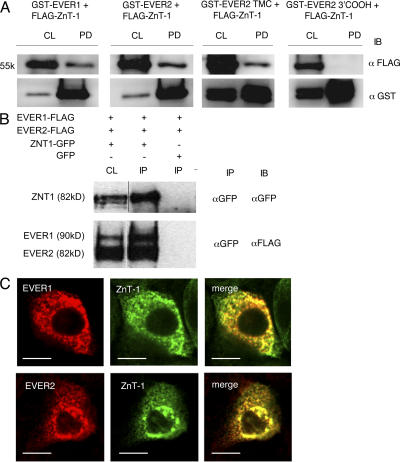
Figure 1. EVER proteins form a complex with ZnT-1. (A) BHK21 cells were transfected with plasmids encoding FLAG-tagged ZnT-1 and GST-tagged EVER proteins or truncated GST-EVER2 corresponding to the TMC or C-terminal region. Crude lysates (CL) or pulled down (PD) proteins were immunoblotted (IB) with the indicated antibodies. (B) BHK21 cells were transfected with plasmids encoding FLAG-EVER proteins and GFP-ZnT-1 or GFP alone. Crude lysates (CL) were immunoprecipitated by anti-GFP antibody (IP) and immunoblotted (IB) with indicated antibodies. Lines indicate where the original gel was spliced. (C) HaCaT cells transiently coexpressing FLAG-EVER proteins and GFP-ZnT-1 were incubated with mouse monoclonal anti-FLAG antibodies and, subsequently, with anti–mouse CY-3–conjugated secondary antibodies. Colocalization of EVERs (red) and ZnT-1 (green) is presented on merged images (yellow). Bars, 5 μm.
Figure 1. EVER proteins form a complex with ZnT-1. (A) BHK21 cells were transfected with plasmids encoding FLAG-tagged ZnT-1 and GST-tagged EVER proteins or truncated GST-EVER2 corresponding to the TMC or C-terminal region. Crude lysates (CL) or pulled down (PD) proteins were immunoblotted (IB) with the indicated antibodies. (B) BHK21 cells were transfected with plasmids encoding FLAG-EVER proteins and GFP-ZnT-1 or GFP alone. Crude lysates (CL) were immunoprecipitated by anti-GFP antibody (IP) and immunoblotted (IB) with indicated antibodies. Lines indicate where the original gel was spliced. (C) HaCaT cells transiently coexpressing FLAG-EVER proteins and GFP-ZnT-1 were incubated with mouse monoclonal anti-FLAG antibodies and, subsequently, with anti–mouse CY-3–conjugated secondary antibodies. Colocalization of EVERs (red) and ZnT-1 (green) is presented on merged images (yellow). Bars, 5 μm.CC BY-NC-SA · PubMed Central
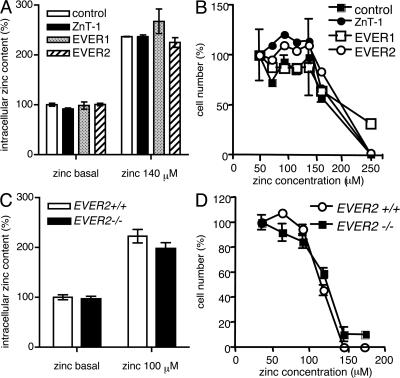
Figure 2. EVERs and ZnT-1 do not influence intracellular zinc accumulation and cell resistance to zinc. HaCaT cells (A and B) were transiently transfected with plasmid encoding ZnT-1, EVER1, EVER2, or control empty plasmid. Keratinocytes (C and D) were isolated from a patient suffering from EV (EVER2−/−) and from a healthy subject (EVER2+ /+). The cells were incubated for 24 h in a standard culture medium (5 μM basal zinc) or in the medium supplemented with indicated concentrations of zinc. The total intracellular zinc content was determined by flame absorption spectrometry (A and C) (29) and the cell number was determined by measurement of DNA (B) or protein (D) content in cell lysates. All the experiments were performed in triplicate. Error bars represent ± the SD.
Figure 2. EVERs and ZnT-1 do not influence intracellular zinc accumulation and cell resistance to zinc. HaCaT cells (A and B) were transiently transfected with plasmid encoding ZnT-1, EVER1, EVER2, or control empty plasmid. Keratinocytes (C and D) were isolated from a patient suffering from EV (EVER2−/−) and from a healthy subject (EVER2+ /+). The cells were incubated for 24 h in a standard culture medium (5 μM basal zinc) or in the medium supplemented with indicated concentrations of zinc. The total intracellular zinc content was determined by flame absorption spectrometry (A and C) (29) and the cell number was determined by measurement of DNA (B) or protein (D) content in cell lysates. All the experiments were performed in triplicate. Error bars represent ± the SD.CC BY-NC-SA · PubMed Central
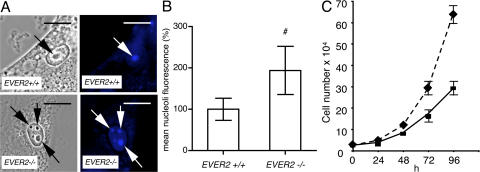
Figure 3. EVER2 influences intracellular distribution of free zinc and cell growth. (A) Keratinocytes with wild-type (EVER2+ /+) or mutated (EVER2−/−) gene were loaded with free zinc-specific indicator (Zinquin), incubated for 15 min in 140 μM zinc, and analyzed by phase-contrast microscopy (left) or fluorescence (right). A strong fluorescence is visible in nucleoli in both cell lines (arrows). Bars, 10 μm. (B) The fluorescence intensity in nucleoli was measured in 90 cells and presented as a percentage of fluorescence of EVER2+/+ cells. (C) EVER2−/− and EVER2+/+ keratinocytes were grown in triplicate in standard culture medium, and cell numbers were determined at different times as indicated. P < 0.01, as determined by Students' t test. Error bars represent ± the SD.
Figure 3. EVER2 influences intracellular distribution of free zinc and cell growth. (A) Keratinocytes with wild-type (EVER2+ /+) or mutated (EVER2−/−) gene were loaded with free zinc-specific indicator (Zinquin), incubated for 15 min in 140 μM zinc, and analyzed by phase-contrast microscopy (left) or fluorescence (right). A strong fluorescence is visible in nucleoli in both cell lines (arrows). Bars, 10 μm. (B) The fluorescence intensity in nucleoli was measured in 90 cells and presented as a percentage of fluorescence of EVER2+/+ cells. (C) EVER2−/− and EVER2+/+ keratinocytes were grown in triplicate in standard culture medium, and cell numbers were determined at different times as indicated. P < 0.01, as determined by Students' t test. Error bars represent ± the SD.CC BY-NC-SA · PubMed Central
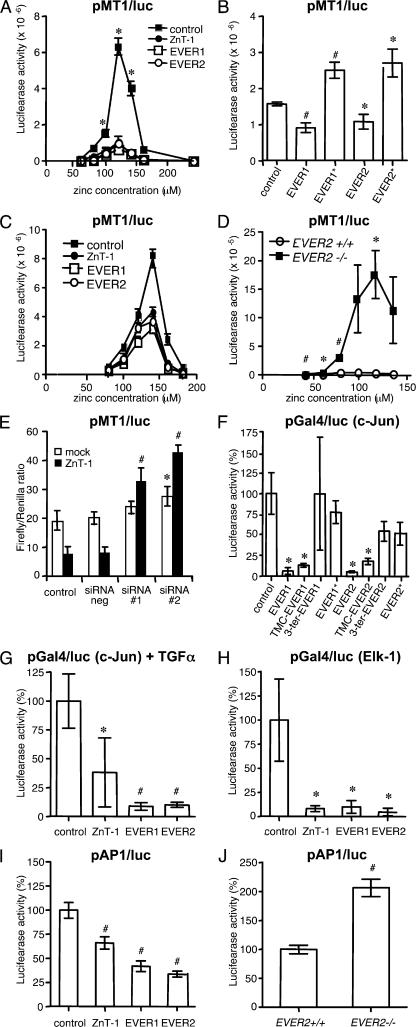
Figure 4. EVERs and ZnT-1 down-regulate transcription factor activity. (A–D) EVER and ZnT-1 inhibit zinc-induced transcription factor MTF-1. HaCaT cells were transiently (A and B) or stably (C) transfected with control plasmid (pCINeo) or plasmids expressing full-length ZnT-1, EVER1, and EVER2 proteins, mutant EVER1* (R94X) (13) and EVER2* (T150fsX3) proteins or TMC and 3′COOH regions of EVER1 and EVER2. HaCaT cells, as well as keratinocytes with a wild-type (+/+) or mutant (−/−) EVER2 gene (D), were transfected with a luciferase reporter plasmid (pMT1/luc) under the control of transcription factor MTF-1 and grown for 24 h at different ZnSO4 concentrations (A, C, and D) or at 120 μM ZnSO4 (B). (E) HaCaT cells stably expressing the control pCiNeo plasmid (mock) or ZnT-1 were transfected with pMT1/luc and Renilla luciferase plasmids in the presence of control negative siRNA or two different siRNAs specific for ZnT-1 (siRNA#1 and siRNA#2). After 24 h, cells were harvested for luciferase activities. The results were scored as the ratio of firefly luciferase activity normalized to Renilla luciferase activity. (F–J) EVER and ZnT-1 inhibit transcription factors. HaCaT cells expressing the indicated plasmids were transfected with a mixture of plasmids encoding the transactivation domain of c-Jun (F and G) and Elk-1 (H) fused to the Gal4 DNA binding domain and a reporter luciferase plasmid containing binding sites for Gal4 (Gal4/luc). HaCaT cells (I) and keratinocytes with a wild-type (+/+) or mutant (−/−) EVER2 gene (J) were also transfected with a luciferase reporter gene under the control of AP-1 transcription factors (pAP-1/luc). The cells were grown without fetal calf serum and supplemented with 50 ng/ml EGF (F and H–J) or 10 ng/ml TGFα (G). Luciferase activities and cell number were determined as described in the Materials and methods. Values ± the SD obtained with c-Jun, Elk, and AP-1 expression plasmids in the presence of control pCiNeo plasmid were taken as 100%. *, P < 0.05; #, P < 0.01.
Figure 4. EVERs and ZnT-1 down-regulate transcription factor activity. (A–D) EVER and ZnT-1 inhibit zinc-induced transcription factor MTF-1. HaCaT cells were transiently (A and B) or stably (C) transfected with control plasmid (pCINeo) or plasmids expressing full-length ZnT-1, EVER1, and EVER2 proteins, mutant EVER1* (R94X) (13) and EVER2* (T150fsX3) proteins or TMC and 3′COOH regions of EVER1 and EVER2. HaCaT cells, as well as keratinocytes with a wild-type (+/+) or mutant (−/−) EVER2 gene (D), were transfected with a luciferase reporter plasmid (pMT1/luc) under the control of transcription factor MTF-1 and grown for 24 h at different ZnSO4 concentrations (A, C, and D) or at 120 μM ZnSO4 (B). (E) HaCaT cells stably expressing the control pCiNeo plasmid (mock) or ZnT-1 were transfected with pMT1/luc and Renilla luciferase plasmids in the presence of control negative siRNA or two different siRNAs specific for ZnT-1 (siRNA#1 and siRNA#2). After 24 h, cells were harvested for luciferase activities. The results were scored as the ratio of firefly luciferase activity normalized to Renilla luciferase activity. (F–J) EVER and ZnT-1 inhibit transcription factors. HaCaT cells expressing the indicated plasmids were transfected with a mixture of plasmids encoding the transactivation domain of c-Jun (F and G) and Elk-1 (H) fused to the Gal4 DNA binding domain and a reporter luciferase plasmid containing binding sites for Gal4 (Gal4/luc). HaCaT cells (I) and keratinocytes with a wild-type (+/+) or mutant (−/−) EVER2 gene (J) were also transfected with a luciferase reporter gene under the control of AP-1 transcription factors (pAP-1/luc). The cells were grown without fetal calf serum and supplemented with 50 ng/ml EGF (F and H–J) or 10 ng/ml TGFα (G). Luciferase activities and cell number were determined as described in the Materials and methods. Values ± the SD obtained with c-Jun, Elk, and AP-1 expression plasmids in the presence of control pCiNeo plasmid were taken as 100%. *, P < 0.05; #, P < 0.01.CC BY-NC-SA · PubMed Central
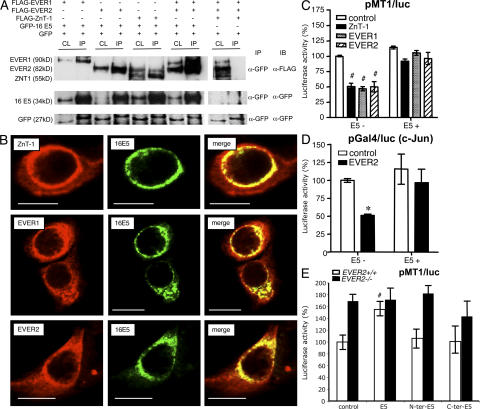
Figure 5. HPV16 E5 protein binds to EVER1, EVER2, and ZnT-1 and interferes with their activity. (A) Clear lysates (CL) from HaCaT cells expressing FLAG-EVER and/or FLAG-ZnT-1, together with GFP-16 E5 or GFP alone, were immunoprecipitated (IP) with anti-GFP antibody and subsequently immunoblotted (IB) with the indicated antibodies. Immunoprecipitation experiments with ZnT-1 and HPV16 E5 gave a band of unknown origin with a migration pattern similar to that of EVER2. (B) HaCaT cells were transiently transfected with plasmids encoding FLAG-EVERs or ZnT-1 and GFP-16 E5 and stained with anti-FLAG monoclonal antibodies, followed by incubation with CY-3–conjugated secondary antibodies. Colocalization of EVER/ZnT-1 (red) and 16 E5 (green) is presented on merged images (yellow). Bars, 10 μm. (C) HaCaT cells were transiently transfected with pMT1/luc and plasmids expressing EVER or ZnT-1 or control empty plasmid in the absence (E5-) or presence (E5 + ) of a plasmid encoding 16 E5. Cells were cultured for 24 h in medium with 140 μM zinc, and luciferase activity was measured. (D) HaCaT cells stably expressing control pCiNeo plasmid or EVER2 were starvated and transfected with a plasmid encoding 16 E5 (or control plasmid) and with a mixture of plasmids expressing the luciferase reporter gene (pGal4/luc) and chimeric Gal4/c-Jun protein. Cells were incubated for 24 h in a culture medium supplemented with 50 ng/ml EGF, and luciferase activity was determined. (E) Keratinocytes with a wild-type (+/+) or mutant (−/−) EVER2 gene were transiently transfected with pMT1/luc, together with the control empty plasmid (control) or plasmids expressing 16 E5 or truncated 16 E5 corresponding to the N-terminal (M1 to I51) and C-terminal (I51 to T83) parts of the viral protein. Cells were cultured for 24 h in medium with 40 μM zinc, and luciferase activity was measured. *, P < 0.05; #, P < 0.01.
Figure 5. HPV16 E5 protein binds to EVER1, EVER2, and ZnT-1 and interferes with their activity. (A) Clear lysates (CL) from HaCaT cells expressing FLAG-EVER and/or FLAG-ZnT-1, together with GFP-16 E5 or GFP alone, were immunoprecipitated (IP) with anti-GFP antibody and subsequently immunoblotted (IB) with the indicated antibodies. Immunoprecipitation experiments with ZnT-1 and HPV16 E5 gave a band of unknown origin with a migration pattern similar to that of EVER2. (B) HaCaT cells were transiently transfected with plasmids encoding FLAG-EVERs or ZnT-1 and GFP-16 E5 and stained with anti-FLAG monoclonal antibodies, followed by incubation with CY-3–conjugated secondary antibodies. Colocalization of EVER/ZnT-1 (red) and 16 E5 (green) is presented on merged images (yellow). Bars, 10 μm. (C) HaCaT cells were transiently transfected with pMT1/luc and plasmids expressing EVER or ZnT-1 or control empty plasmid in the absence (E5-) or presence (E5 + ) of a plasmid encoding 16 E5. Cells were cultured for 24 h in medium with 140 μM zinc, and luciferase activity was measured. (D) HaCaT cells stably expressing control pCiNeo plasmid or EVER2 were starvated and transfected with a plasmid encoding 16 E5 (or control plasmid) and with a mixture of plasmids expressing the luciferase reporter gene (pGal4/luc) and chimeric Gal4/c-Jun protein. Cells were incubated for 24 h in a culture medium supplemented with 50 ng/ml EGF, and luciferase activity was determined. (E) Keratinocytes with a wild-type (+/+) or mutant (−/−) EVER2 gene were transiently transfected with pMT1/luc, together with the control empty plasmid (control) or plasmids expressing 16 E5 or truncated 16 E5 corresponding to the N-terminal (M1 to I51) and C-terminal (I51 to T83) parts of the viral protein. Cells were cultured for 24 h in medium with 40 μM zinc, and luciferase activity was measured. *, P < 0.05; #, P < 0.01.CC BY-NC-SA · PubMed Central

Verification

Claims the paper makes

The claims and statistics of this paper haven’t been checked yet.

Run the check — free, no account needed. It reads the open-access text and checks the sources it cites.

A few free checks a day · papers already verified open instantly · results are public

Claims other papers make about this one

Each is checked against this paper’s own text: does it say what the citing paper says it does?

Self-check

Percentages, sums and reported differences re-computed from the paper’s own numbers.

The self-check needs the paper’s full text.

Citations

Cites

No references could be resolved yet.

Research works printed but not linked: 27

  1. 2002, Nat. Rev. Cancer., 2, 342, 10.1038/nrc798 · DOI
  2. 1997, Clin. Dermatol., 15, 321, 10.1016/S0738-081X(96)00169-1 · DOI
  3. 2000, J. Virol., 74, 11636, 10.1128/JVI.74.24.11636-11641.2000 · DOI
  4. 2003, J. Invest. Dermatol., 121, 1531, 10.1046/j.1523-1747.2003.12632.x · DOI
  5. 1998, J. Invest. Dermatol., 110, 311, 10.1046/j.1523-1747.1998.00164.x · DOI
  6. 2000, J. Invest. Dermatol., 114, 403, 10.1046/j.1523-1747.2000.00892.x · DOI
  7. 2003, J. Natl. Cancer Inst., 31, 52
  8. 2005, J. Invest. Dermatol., 125, xii
  9. 2000, J. Invest. Dermatol., 114, 1148, 10.1046/j.1523-1747.2000.00996.x · DOI · Paper page
  10. 2002, Nat. Genet., 32, 579, 10.1038/ng1044 · DOI
  11. 2003, BMC Genomics., 4, 24, 10.1186/1471-2164-4-24 · DOI
  12. 1989, Nature., 340, 245, 10.1038/340245a0 · DOI
  13. 2004, J. Virol., 78, 13613, 10.1128/JVI.78.24.13613-13626.2004 · DOI · Paper page
  14. 2006, J. Virol., 80, 12420, 10.1128/JVI.02576-05 · DOI
  15. 1995, EMBO J., 14, 639, 10.1002/j.1460-2075.1995.tb07042.x · DOI
  16. 2006, J. Biol. Chem., 281, 24085, 10.1074/jbc.R600011200 · DOI
  17. 2004, Proc. Natl. Acad. Sci. USA., 101, 14355, 10.1073/pnas.0406216101 · DOI
  18. 2004, Biochem. J., 380, 695, 10.1042/bj20031677 · DOI
  19. 1997, FEBS Lett., 405, 37, 10.1016/S0014-5793(97)00150-6 · DOI
  20. 2002, Biochem. Biophys. Res. Commun., 296, 923, 10.1016/S0006-291X(02)02017-X · DOI
  21. 2005, J. Cell Sci., 118, 1335, 10.1242/jcs.01736 · DOI
  22. 2007, J. Cell Biol., 177, 637, 10.1083/jcb.200702081 · DOI
  23. 2001, Mol. Pharmacol., 59, 981, 10.1124/mol.59.5.981 · DOI
  24. 2006, J. Virol., 80, 4890, 10.1128/JVI.80.10.4890-4900.2006 · DOI
  25. 2006, Semin. Immunol., 18, 362, 10.1016/j.smim.2006.07.008 · DOI · Paper page
  26. 2001, Exp. Dermatol., 10, 264, 10.1034/j.1600-0625.2001.100406.x · DOI
  27. 2004, Proc. Natl. Acad. Sci. USA., 101, 4918, 10.1073/pnas.0401022101 · DOI

Cited by

Metadata

Authors
Lazarczyk, M., Pons, C., Mendoza, J.-A., Cassonnet, P., Jacob, Y., & Favre, M.
Affiliations
1Unité de Génétique, Papillomavirus et Cancer Humain, Institut Pasteur, 75015 Paris, France
Venue
The Journal of Experimental Medicine
Published
2007-12-24
Volume
205
Issue
1
Pages
35-42
ISSN
  • 1540-9538
  • 0022-1007
Cited by
190
References
0
Language
en

About these checks

Registry, retraction, Cites and statistics results are computed, not judged, with one exception: a printed reference that no index lists is read once by a model before it counts as a citation error. Claims are extracted by a model and kept only when their quote appears verbatim in the text; each cited source is then checked, with a model’s help, for whether it says what the claim relies on. Those verdicts can be wrong — read the claim’s quote and the cited source before relying on one.

Statistics and arithmetic are recomputed, not judged.

Confidence bands are shown only for fields calibrated on our annotated test set. None is calibrated yet, so no band is shown.

What counts as a claim ›How we measure confidence ›How we check this ›

Are you an author, or do you see a problem with this page? Request a review