

A novel subset of CD4+ TH2 memory/effector cells that produce inflammatory IL-17 cytokine and promote the exacerbation of chronic allergic asthma
Open accessThe DOI matches its Crossref record; 62 of the 63 references it cites were found in a registry or an index.
Abstract
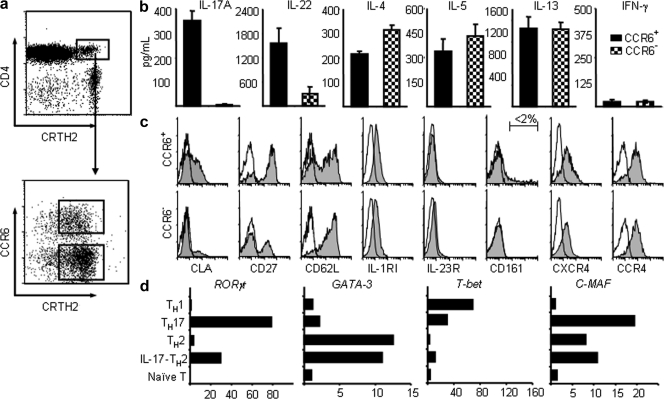
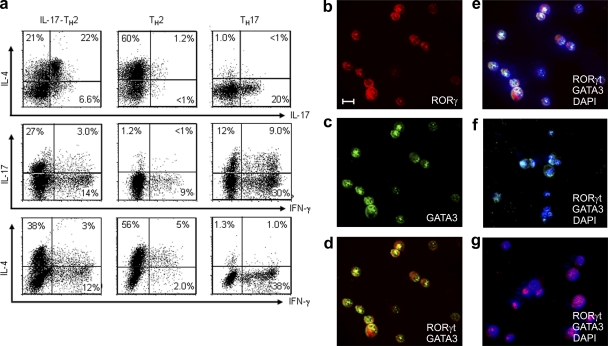
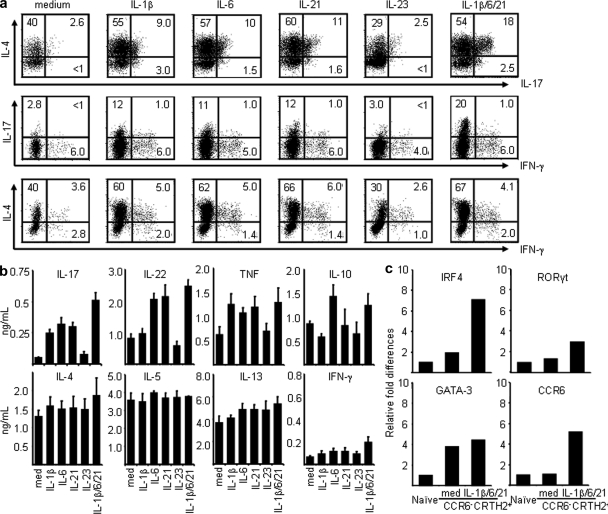
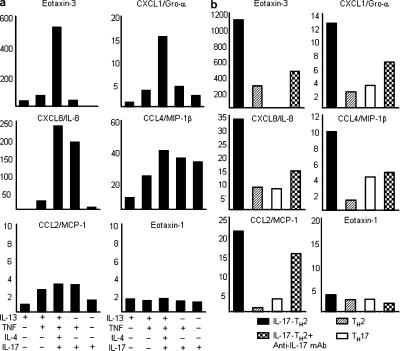
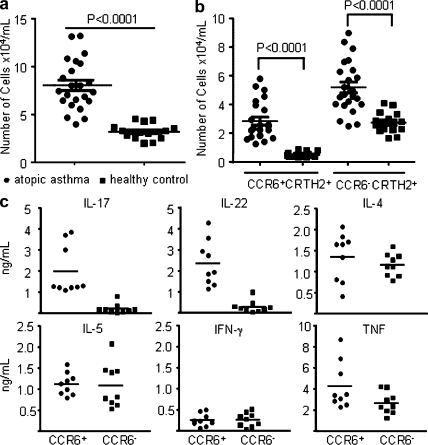
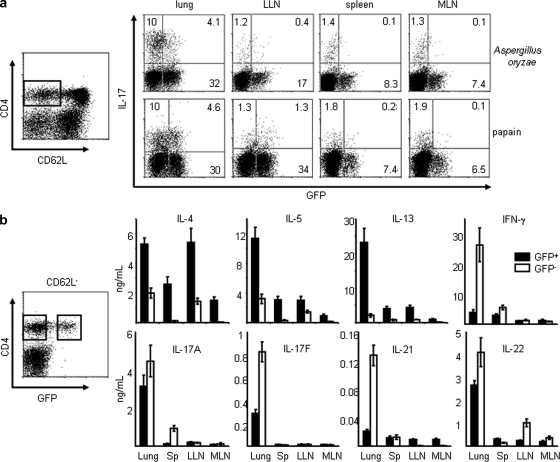
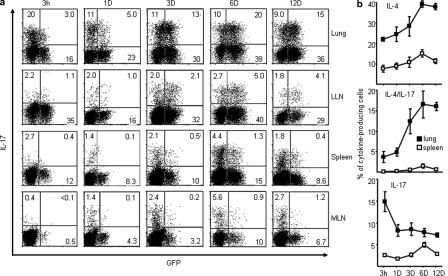
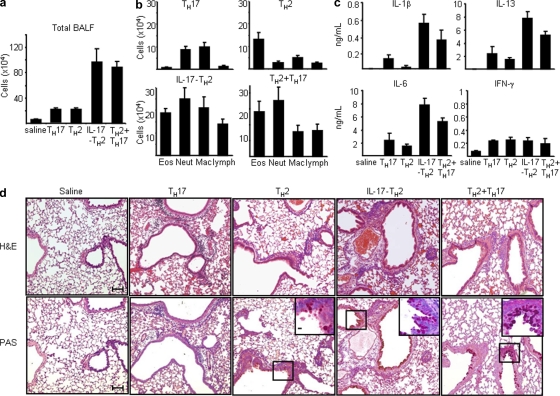
The inflammatory cytokine interleukin (IL)-17 is involved in the pathogenesis of allergic diseases. However, the identity and functions of IL-17–producing T cells during the pathogenesis of allergic diseases remain unclear. Here, we report a novel subset of TH2 memory/effector cells that coexpress the transcription factors GATA3 and RORγt and coproduce TH17 and TH2 cytokines. Classical TH2 memory/effector cells had the potential to produce IL-17 after stimulation with proinflammatory cytokines IL-1β, IL-6, and IL-21. The number of IL-17-TH2 cells was significantly increased in blood of patients with atopic asthma. In a mouse model of allergic lung diseases, IL-17–producing CD4+ TH2 cells were induced in the inflamed lung and persisted as the dominant IL-17–producing T cell population during the chronic stage of asthma. Treating cultured bronchial epithelial cells with IL-17 plus TH2 cytokines induced strong up-regulation of chemokine eotaxin-3, Il8, Mip1b, and Groa gene expression. Compared with classical TH17 and TH2 cells, antigen-specific IL-17–producing TH2 cells induced a profound influx of heterogeneous inflammatory leukocytes and exacerbated asthma. Our findings highlight the plasticity of TH2 memory cells and suggest that IL-17–producing TH2 cells may represent the key pathogenic TH2 cells promoting the exacerbation of allergic asthma.
Overview
The claims and statistics of this paper haven’t been checked yet.
Free: it reads the open-access text and checks the first 5 claims that cite a source we can check. Create a free account to check every claim.
Integrity signals
Registry
Cites
Statistics
Figures
Verification
Claims the paper makes
The claims and statistics of this paper haven’t been checked yet.
Free: it reads the open-access text and checks the first 5 claims that cite a source we can check. Create a free account to check every claim.
Claims other papers make about this one
Each is checked against this paper’s own text: does it say what the citing paper says it does?
In the citing paper
“Furthermore, IL-17-producing Th2 cell subsets participate in exacerbation of allergic asthma induced by Aspergillus (328).”
From Aspergillus fumigatus and Aspergillosis in 2019 (2019) · cites this paper as [328]
Self-check
Percentages, sums and reported differences re-computed from the paper’s own numbers.
The self-check needs the paper’s full text.
Citations
Cites
Ivanov, I. I., McKenzie, B. S., Zhou, L., Tadokoro, C. E., Lepelley, A., Lafaille, J. J., Cua, D. J., & Littman, D. R. (2006) · Cell · doi:10.1016/j.cell.2006.07.035 · Cited by 5,145
Harrington, L. E., Hatton, R. D., Mangan, P. R., Turner, H., Murphy, T. L., Murphy, K. M., & Weaver, C. T. (2005) · Nature Immunology · doi:10.1038/ni1254 · Cited by 4,742 · cited 2×
“The TH17 cell lineage possesses a unique genetic program and is described as an additional branch of the T helper cell subsets (Harrington et al., 2005; Park et al., 2005b; Ivanov et al., 2006).”
BackgroundA distinct lineage of CD4 T cells regulates tissue inflammation by producing interleukin 17
Park, H., Li, Z., Yang, X. O., Chang, S. H., Nurieva, R., Wang, Y.-H., Wang, Y., Hood, L., Zhu, Z., Tian, Q., et al. (2005) · Nature Immunology · doi:10.1038/ni1261 · Cited by 4,265 · cited 6×
“However, recent findings suggest that some cytokines, such as IL-1 (Tillie-Leblond et al., 1999; Nakae et al., 2003; Chung et al., 2009) and IL-21 (Fröhlich et al., 2007; Nurieva et al., 2007; Leonard et al., 2008; Yang et al., 2008), and the transcription factor IRF4 (Rengarajan et al., 2002; Brüstle et al., 2007; Ho…”
BackgroundInfluentialSelf-citationVeldhoen, M., Hocking, R. J., Atkins, C. J., Locksley, R. M., & Stockinger, B. (2006) · Immunity · doi:10.1016/j.immuni.2006.01.001 · Cited by 3,605 · cited 6×
“Studies in vitro demonstrated that the absence of TH2 and TH1 cytokines is the prerequisite for TH17 cell differentiation from naive T cells (Veldhoen et al., 2006) and producing TH2, classical TH2, classical TH17, or classical TH2 and TH17 cells generated in vitro, as described in Materials and…”
BackgroundInfluentialTransforming growth factor-β induces development of the TH17 lineage
Mangan, P. R., Harrington, L. E., O'Quinn, D. B., Helms, W. S., Bullard, D. C., Elson, C. O., Hatton, R. D., Wahl, S. M., Schoeb, T. R., & Weaver, C. T. (2006) · Nature · doi:10.1038/nature04754 · Cited by 3,087
Cua, D. J., Sherlock, J., Chen, Y., Murphy, C. A., Joyce, B., Seymour, B., Lucian, L., To, W., Kwan, S., Churakova, T., et al. (2003) · Nature · doi:10.1038/nature01355 · Cited by 2,906 · cited 2×
“…cells of the IL-17 cytokine family and the analysis of IL-23– mediated immune pathogenesis have led to the delineation of a new CD4+ T helper cell population termed TH17 (Yao et al., 1995b; Aarvak et al., 1999; Cua et al., 2003; Murphy et al., 2003; Harrington et al., 2005; Park et al., 2005a).”
BackgroundPredominant TH2-like Bronchoalveolar T-Lymphocyte Population in Atopic Asthma
Robinson, D. S., Hamid, Q., Ying, S., Tsicopoulos, A., Barkans, J., Bentley, A. M., Corrigan, C., Durham, S. R., & Kay, A. B. (1992) · New England Journal of Medicine · doi:10.1056/nejm199201303260504 · Cited by 2,768 · cited 1×
“The temporal recruitments and interplay between these two T helper subsets have been suggested as the cause of the heterogeneity in the pathology of severe asthma (Larché et al., 2003; Schmidt-Weber et al., 2007).”
BackgroundDevelopment, cytokine profile and function of human interleukin 17-producing helper T cells
Wilson, N. J., Boniface, K., Chan, J. R., McKenzie, B. S., Blumenschein, W. M., Mattson, J. D., Basham, B., Smith, K., Chen, T., Morel, F., et al. (2007) · Nature Immunology · doi:10.1038/ni1497 · Cited by 2,035 · cited 4×
“…25, 2010 Article 2487 that the TGF-, IL-21, or IL-23, as well as the proinflammatory cytokines IL-1 or IL-6, are important for the induction of IL-17 cytokine production (Mangan et al., 2006; Veldhoen et al., 2006; Wilson et al., 2007; Manel et al., 2008; Volpe et al., 2008; Yang et al., 2008).”
BackgroundInfluentialPhenotypic and functional features of human Th17 cells
Annunziato, F., Cosmi, L., Santarlasci, V., Maggi, L., Liotta, F., Mazzinghi, B., Parente, E., Filì, L., Ferri, S., Frosali, F., et al. (2007) · The Journal of Experimental Medicine · doi:10.1084/jem.20070663 · Cited by 1,861 · cited 2×
“1 c; Acosta-Rodriguez et al., 2007; Annunziato et al., 2007; Cosmi et al., 2008).”
BackgroundSurface phenotype and antigenic specificity of human interleukin 17–producing T helper memory cells
Acosta-Rodriguez, E. V., Rivino, L., Geginat, J., Jarrossay, D., Gattorno, M., Lanzavecchia, A., Sallusto, F., & Napolitani, G. (2007) · Nature Immunology · doi:10.1038/ni1467 · Cited by 1,828 · cited 4×
“1 c; Acosta-Rodriguez et al., 2007; Annunziato et al., 2007; Cosmi et al., 2008).”
BackgroundInfluential
Research works printed but not linked: 1
- Park H. Li Z. Yang X.O. Chang S.H. Nurieva R. Wang Y.H. Wang Y. Hood L. Zhu Z. Tian Q. Dong C. 2005b A distinct lineage of CD4 T cells regulates tissue inflammation by producing interleukin 17. Nat. Immunol. 6: 1133– 1141 10.1038/ni1261 16200068 PMC1618871 · DOI · Paper page
Cited by
Lambrecht, B. N., & Hammad, H. (2015) · Nature Immunology · doi:10.1038/ni.3049 · Cited by 1,673
Aspergillus fumigatus and Aspergillosis in 2019
Latgé, J.-P., & Chamilos, G. (2019) · Clinical Microbiology Reviews · doi:10.1128/cmr.00140-18 · Cited by 1,400
Functional Specialization of Interleukin-17 Family Members
Iwakura, Y., Ishigame, H., Saijo, S., & Nakae, S. (2011) · Immunity · doi:10.1016/j.immuni.2011.02.012 · Cited by 1,289
Understanding Asthma Phenotypes, Endotypes, and Mechanisms of Disease
Kuruvilla, M. E., Lee, F. E.-H., & Lee, G. B. (2019) · Clinical Reviews in Allergy & Immunology · doi:10.1007/s12016-018-8712-1 · Cited by 1,228
“The AECs respond rapidly to stimuli with release of cytokines termed alarmins, which then propagate ensuing adaptive type 2 immune pathways.”
BackgroundInfluentialThe airway epithelium in asthma
Lambrecht, B. N., & Hammad, H. (2012) · Nature Medicine · doi:10.1038/nm.2737 · Cited by 921
Metadata
- Authors
- Wang, Y.-H., Voo, K. S., Liu, B., Chen, C.-Y., Uygungil, B., Spoede, W., Bernstein, J. A., Huston, D. P., & Liu, Y.-J.
- Affiliations
- Cincinnati Children's Hospital Medical Center (US)
- The University of Texas MD Anderson Cancer Center (US)
- University of Cincinnati (US)
- Texas A&M Health Science Center (US)
- Corresponding author
- Wang, Yui-Hsi
- Liu, Yong-Jun
- Venue
- Journal of Experimental Medicine
- Publisher
- Rockefeller University Press
- Published
- 2010-10-04
- Volume
- 207
- Issue
- 11
- Pages
- 2479-2491
- ISSN
- 0022-1007 (ISSN-L)
- 1540-9538
- PMC
- PMC2964570
- OpenAlex
- W2119636028
- Cited by
- 431
- References
- 63
- Citations by year
- 2026: 8 · 2025: 8 · 2024: 18 · 2023: 12 · 2022: 16 · 2021: 31 · 2020: 30 · 2019: 24 · 2018: 30 · 2017: 32 · 2016: 35 · 2015: 40 · 2014: 37 · 2013: 44 · 2012: 27
- FWCI
- 23.83
- Type
- journal article
- Language
- en
- Open access
- bronze
- doi.org
- Locations
- The Journal of Experimental Medicine (publishedVersion)
- Europe PMC (PubMed Central) (publishedVersion, cc-by-nc-sa)
- PubMed Central (publishedVersion, cc-by-nc-sa)
- PubMed (publishedVersion)
- OakTrust (Texas A&M University Libraries) (submittedVersion)
- Funders
- Sandler Foundation
- National Institutes of Health (5u19ai071130-05)
- National Institute of Allergy and Infectious Diseases (U19 AI071130-01, U19-AI071130, R01AI090129, R01AI061645)
- Topics
- Health Sciences › Medicine › Pulmonary and Respiratory Medicine › Asthma and respiratory diseases
- Life Sciences › Immunology and Microbiology › Immunology › T-cell and B-cell Immunology
- Life Sciences › Immunology and Microbiology › Immunology › IL-33, ST2, and ILC Pathways
- Keywords
- IL-17, Th2 cells, allergic asthma, asthma exacerbations, T cell plasticity, GATA3, RORγt, memory T cells, eotaxin-3, chemokine expression, bronchial epithelial cells
- MeSH terms
- Animals, Asthma, Chronic Disease, Gene Expression Regulation, Humans, Immunologic Memory, Mice, Inbred BALB C, Lymphocyte Subsets, Cytokines, Th2 Cells, Interleukin-17, GATA3 Transcription Factor, Mice, Nuclear Receptor Subfamily 1, Group F, Member 3
About these checks
Registry, retraction, Cites and statistics results are computed, not judged, with one exception: a printed reference that no index lists is read once by a model before it counts as a citation error. Claims are extracted by a model and kept only when their quote appears verbatim in the text; each cited source is then checked, with a model’s help, for whether it says what the claim relies on. Those verdicts can be wrong — read the claim’s quote and the cited source before relying on one.
Statistics and arithmetic are recomputed, not judged.
Confidence bands are shown only for fields calibrated on our annotated test set. None is calibrated yet, so no band is shown.
What counts as a claim ›How we measure confidence ›How we check this ›
Are you an author, or do you see a problem with this page? Request a review
How to cite
Cite CoChat for the checks on this page, and the paper for its own findings.
- This page
- CoChat. (2026). Citation check: A novel subset of CD4+ TH2 memory/effector cells that produce inflammatory IL-17 cytokine and promote the exacerbation of chronic allergic asthma. https://app.cochat.ai/papers/10.1084/jem.20101376
- The paper
- Wang, Y.-H., Voo, K. S., Liu, B., Chen, C.-Y., Uygungil, B., Spoede, W., Bernstein, J. A., Huston, D. P., & Liu, Y.-J. (2010). A novel subset of CD4+ TH2 memory/effector cells that produce inflammatory IL-17 cytokine and promote the exacerbation of chronic allergic asthma. Journal of Experimental Medicine. https://doi.org/10.1084/jem.20101376
Data sources
Bibliographic data: Semantic Scholar, OpenAlex, Crossref.
Contains information from the Semantic Scholar Academic Graph Datasets, made available under the ODC Attribution License (ODC-BY 1.0).
Semantic Scholar’s data is described in: Kinney, R., et al. (2023). The Semantic Scholar Open Data Platform. arXiv:2301.10140.
