

Leptin-dependent serotonin control of appetite: temporal specificity, transcriptional regulation, and therapeutic implications
Open accessThe DOI matches its Crossref record; 36 of the 36 references it cites were found in a registry or an index.
Abstract
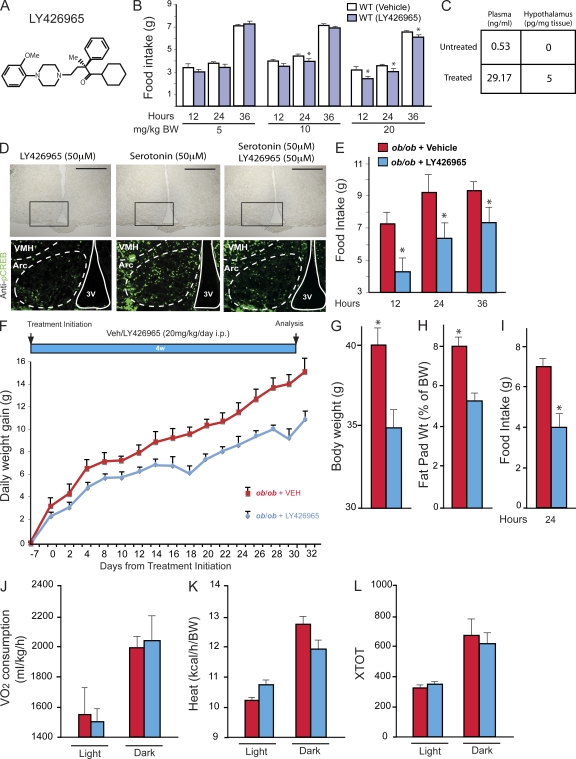
Recent evidence indicates that leptin regulates appetite and energy expenditure, at least in part by inhibiting serotonin synthesis and release from brainstem neurons. To demonstrate that this pathway works postnatally, we used a conditional, brainstem-specific mouse CreER(T2) driver to show that leptin signals in brainstem neurons after birth to decrease appetite by inhibiting serotonin synthesis. Cell-specific gene deletion experiments and intracerebroventricular leptin infusions reveal that serotonin signals in arcuate nuclei of the hypothalamus through the Htr1a receptor to favor food intake and that this serotonin function requires the expression of Creb, which regulates the expression of several genes affecting appetite. Accordingly, a specific antagonist of the Htr1a receptor decreases food intake in leptin-deficient but not in Htr1a(-/-) mice. Collectively, these results establish that leptin inhibition of serotonin is necessary to inhibit appetite postnatally and provide a proof of principle that selective inhibition of this pathway may be a viable option to treat appetite disorders.
Overview
The claims and statistics of this paper haven’t been checked yet.
Free: it reads the open-access text and checks the first 5 claims that cite a source we can check. Create a free account to check every claim.
Integrity signals
Registry
Cites
Statistics
Figures
Verification
Claims the paper makes
The claims and statistics of this paper haven’t been checked yet.
Free: it reads the open-access text and checks the first 5 claims that cite a source we can check. Create a free account to check every claim.
Claims other papers make about this one
Each is checked against this paper’s own text: does it say what the citing paper says it does?
The source backs part of the claim, not all of it — or backs it for a different population, condition or comparison.
In the citing paper
“Therefore, centrally leptin appears to exert an indirect osteogenic action through the suppression of serotonergic signaling to the ventromedial hypothalamus, but efferent pathways are needed for this signal to be relayed to bone cells.”
From Effects of Leptin on the Skeleton (2018) · cites this paper as [108]
Experimental — accuracy not yet measured
Self-check
Percentages, sums and reported differences re-computed from the paper’s own numbers.
The self-check needs the paper’s full text.
Citations
Cites
Leptin and the regulation of body weight in mammals
Friedman, J. M., & Halaas, J. L. (1998) · Nature · doi:10.1038/27376 · Cited by 5,405 · cited 1×
“20101940 41 Leptin is a vertebrate-specific, adipocyte-derived hormone regulating, among other functions, appetite and energy expenditure after its signaling in the brain (Flier and Elmquist, 1997; Friedman and Halaas, 1998; Spiegelman and Flier, 2001).”
BackgroundGeneralized lacZ expression with the ROSA26 Cre reporter strain
Soriano, P. (1999) · Nature Genetics · doi:10.1038/5007 · Cited by 4,859
Targeted disruption of the melanocortin-4 receptor results in obesity in mice
Huszar, D., Lynch, C. A., Fairchild-Huntress, V., Dunmore, J. H., Fang, Q., Berkemeier, L. R., Gu, W., Kesterson, R. A., Boston, B. A., Cone, R. D., et al. (1997) · Cell · doi:10.1016/s0092-8674(00)81865-6 · Cited by 3,030 · cited 2×
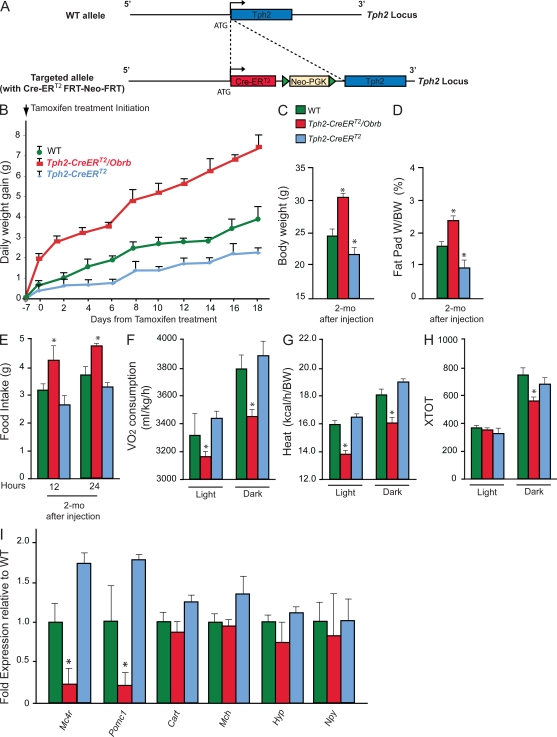
“To demonstrate molecularly that the deletion of Obrb selectively in Tph2-expressing neurons after birth could affect appetite, we measured expression of genes such as proopiomelanocortin- (Pomc-1) and melanocortin receptor 4 (Mc4r) that contribute to the regulation of appetite (Huszar et al., 1997; Cowley et al., 200…”
BackgroundObesity and the regulation of energy balance
Spiegelman, B. M., & Flier, J. S. (2001) · Cell · doi:10.1016/s0092-8674(01)00240-9 · Cited by 2,398
Leptin activates anorexigenic POMC neurons through a neural network in the arcuate nucleus
Cowley, M. A., Smart, J. L., Rubinstein, M., Cerdán, M. G., Diano, S., Horvath, T. L., Cone, R. D., & Low, M. J. (2001) · Nature · doi:10.1038/35078085 · Cited by 2,356 · cited 4×
“To demonstrate molecularly that the deletion of Obrb selectively in Tph2-expressing neurons after birth could affect appetite, we measured expression of genes such as proopiomelanocortin- (Pomc-1) and melanocortin receptor 4 (Mc4r) that contribute to the regulation of appetite (Huszar et al., 1997; Cowley et al., 200…”
BackgroundInfluentialLeptin Inhibits Bone Formation through a Hypothalamic Relay
Ducy, P., Amling, M., Takeda, S., Priemel, M., Schilling, A. F., Beil, F. T., Shen, J., Vinson, C., Rueger, J. M., & Karsenty, G. (2000) · Cell · doi:10.1016/s0092-8674(00)81558-5 · Cited by 2,077 · cited 1×
“Leptin infusions were made according to (Ducy et al., 2000).”
Self-citationLeptin Regulates Bone Formation via the Sympathetic Nervous System
Takeda, S., Elefteriou, F., Levasseur, R., Liu, X., Zhao, L., Parker, K. L., Armstrong, D., Ducy, P., & Karsenty, G. (2002) · Cell · doi:10.1016/s0092-8674(02)01049-8 · Cited by 1,735 · cited 1×
“Numerous studies in the last 16 yr aimed at drawing a precise map of the circuitry used by leptin signaling in the brain to fulfill its functions (Elmquist et al., 1997; Takeda et al., 2002; Balthasar et al., 2004, 2005; Gao and Horvath, 2008; Scott et al., 2009; Yadav et al., 2009; Grill, 2010).”
BackgroundSelf-citationInteracting Appetite-Regulating Pathways in the Hypothalamic Regulation of Body Weight
Kalra, S. P. (1999) · Endocrine Reviews · doi:10.1210/er.20.1.68 · Cited by 1,554
Interacting Appetite-Regulating Pathways in the Hypothalamic Regulation of Body Weight*
Kalra, S. P., Dube, M. G., Pu, S., Xu, B., Horvath, T. L., & Kalra, P. S. (1999) · Endocrine Reviews · doi:10.1210/edrv.20.1.0357 · Cited by 1,552
Divergence of Melanocortin Pathways in the Control of Food Intake and Energy Expenditure
Balthasar, N., Dalgaard, L. T., Lee, C. E., Yu, J., Funahashi, H., Williams, T., Ferreira, M., Tang, V., McGovern, R. A., Kenny, C. D., et al. (2005) · Cell · doi:10.1016/j.cell.2005.08.035 · Cited by 1,120
Cited by
The contribution of bone to whole-organism physiology
Karsenty, G., & Ferron, M. (2012) · Nature · doi:10.1038/nature10763 · Cited by 537
Self-citationSerotonin controlling feeding and satiety
Voigt, J.-P., & Fink, H. (2015) · Behavioural Brain Research · doi:10.1016/j.bbr.2014.08.065 · Cited by 312
The Ca 2+ /Calmodulin/CaMKK2 Axis: Nature's Metabolic CaMshaft
Marcelo, K. L., Means, A. R., & York, B. (2016) · Trends in Endocrinology & Metabolism · doi:10.1016/j.tem.2016.06.001 · Cited by 225
Effects of Leptin on the Skeleton
Reid, I. R., Baldock, P. A., & Cornish, J. (2018) · Endocrine Reviews · doi:10.1210/er.2017-00226 · Cited by 215
Serotonin, food intake, and obesity
van Galen, K. A., ter Horst, K. W., & Serlie, M. J. (2021) · Obesity Reviews · doi:10.1111/obr.13210 · Cited by 197
Metadata
- Authors
- Yadav, V. K., Oury, F., Tanaka, K. F., Thomas, T., Wang, Y., Cremers, S., Hen, R., Krust, A., Chambon, P., & Karsenty, G.
- Affiliations
- Institut de génétique et de biologie moléculaire et cellulaire (FR)
- Department of Genetics and Development 1 , 2 , 3 , and 4
- Institut de Genetique et de Biologie Moleculaire et Cellulaire, 67404 Illkirch, France 5
- Venue
- Journal of Experimental Medicine
- Publisher
- Rockefeller University Press
- Published
- 2010-12-27
- Volume
- 208
- Issue
- 1
- Pages
- 41-52
- ISSN
- 0022-1007 (ISSN-L)
- 1540-9538
- PMC
- PMC3023132
- OpenAlex
- W2012868809
- Cited by
- 96
- References
- 35
- Citations by year
- 2026: 1 · 2025: 4 · 2024: 4 · 2023: 2 · 2022: 3 · 2021: 6 · 2020: 5 · 2019: 5 · 2018: 6 · 2017: 2 · 2016: 5 · 2015: 6 · 2014: 15 · 2013: 10 · 2012: 15
- FWCI
- 4.62
- Type
- journal article
- Language
- en
- Open access
- bronze
- doi.org
- Locations
- The Journal of Experimental Medicine (publishedVersion)
- PubMed Central (publishedVersion, cc-by-nc-sa)
- PubMed (publishedVersion)
- HAL (submittedVersion)
- Funders
- March of Dimes Foundation
- Eli Lilly and Company
- National Institutes of Health (RR024156)
- National Center for Research Resources (UL1RR024156)
- Topics
- Life Sciences › Neuroscience › Endocrine and Autonomic Systems › Regulation of Appetite and Obesity
- Health Sciences › Medicine › Reproductive Medicine › Hypothalamic control of reproductive hormones
- Life Sciences › Neuroscience › Cellular and Molecular Neuroscience › Neurotransmitter Receptor Influence on Behavior
- Keywords
- leptin, serotonin, appetite regulation, brainstem neurons, hypothalamic arcuate nucleus, CREB, dietary intake, energy expenditure, postnatal development, leptin deficiency, appetite disorders, intracerebroventricular infusion
- MeSH terms
- Animals, Gene Expression Regulation, Mice, Inbred C57BL, Serotonin, Transcription, Genetic, Signal Transduction, Leptin, Receptor, Serotonin, 5-HT1B, Microarray Analysis, Mice
About these checks
Registry, retraction, Cites and statistics results are computed, not judged, with one exception: a printed reference that no index lists is read once by a model before it counts as a citation error. Claims are extracted by a model and kept only when their quote appears verbatim in the text; each cited source is then checked, with a model’s help, for whether it says what the claim relies on. Those verdicts can be wrong — read the claim’s quote and the cited source before relying on one.
Statistics and arithmetic are recomputed, not judged.
Confidence bands are shown only for fields calibrated on our annotated test set. None is calibrated yet, so no band is shown.
What counts as a claim ›How we measure confidence ›How we check this ›
Are you an author, or do you see a problem with this page? Request a review
Data sources
Bibliographic data: Semantic Scholar, OpenAlex, Crossref.
Contains information from the Semantic Scholar Academic Graph Datasets, made available under the ODC Attribution License (ODC-BY 1.0).
Semantic Scholar’s data is described in: Kinney, R., et al. (2023). The Semantic Scholar Open Data Platform. arXiv:2301.10140.
