

The 1965 Penrose singularity theorem
Open accessThe DOI matches its Crossref record; 382 of the 382 references it cites were found in a registry or an index; none of the 288 sources its claims cite is checked for support yet.
Abstract
We review the first modern singularity theorem, published by Penrose in 1965. This is the first genuine post-Einsteinian result in general relativity, where the fundamental and fruitful concept of the closed trapped surface was introduced. We include historical remarks, an appraisal of the theorem's impact, and relevant current and future work that belongs to its legacy.
Overview
CoChat Summary
TL;DR
This review argues that Penrose’s 1965 theorem was the first modern singularity theorem in general relativity, introducing closed trapped surfaces and geodesic incompleteness as central ideas. It surveys the theorem’s historical context, immediate impact, and long-term legacy across black holes, cosmology, numerical relativity, and mathematical relativity.
Key findings
- Penrose’s theorem, in the modern form given in the review, states that if spacetime contains a non-compact Cauchy hypersurface and a closed future-trapped surface, and the null convergence condition holds, then there are future incomplete null geodesics.
- The paper identifies the closed trapped surface as the theorem’s key conceptual innovation: a compact 2-dimensional surface whose two future-directed orthogonal null expansions are negative, equivalently characterized by a timelike future-directed mean curvature vector.
- The review traces the theorem’s legacy through Hawking’s past-trapped surfaces in expanding universes, the Hawking–Penrose theorem, cosmic censorship, critical collapse, BKL singularities, trapped submanifolds, the Penrose inequality, and the hoop conjecture.
- It reports that numerical simulations indicate cosmic censorship holds in 4 spacetime dimensions but is violated in 5 spacetime dimensions by unstable black strings, which pinch off and form naked singularities.
Methods
- Review article: historical and conceptual survey of Penrose’s 1965 singularity theorem, with sections on pre-1955 and 1955–1965 work, the theorem itself, its impact, and XXI-century developments.
- No primary data or sample; the analysis synthesizes published theorems, proofs, examples, and literature references.
- Main approach is narrative and thematic synthesis rather than empirical or statistical analysis.
Limitations
- The paper states that the weakest point of the singularity theorems is their conclusions: they usually prove only the existence of at least one incomplete causal geodesic and say little about the singularity’s location, strength, extension, or character.
- The paper states that the differentiability assumption—metric twice differentiable with continuity—is restrictive and often ignored, and that physically realistic matched models may not satisfy it.
- The paper states that curvature/energy conditions can be violated by Λ > 0, inflation, and scalar fields, and that whether the initial/boundary condition is satisfied by actual physical systems is debatable; as a review, it also presents no new original results or data.
Model-written summary. Check it against the paper before relying on it.
Integrity signals
Registry
Cites
Statistics
Figures
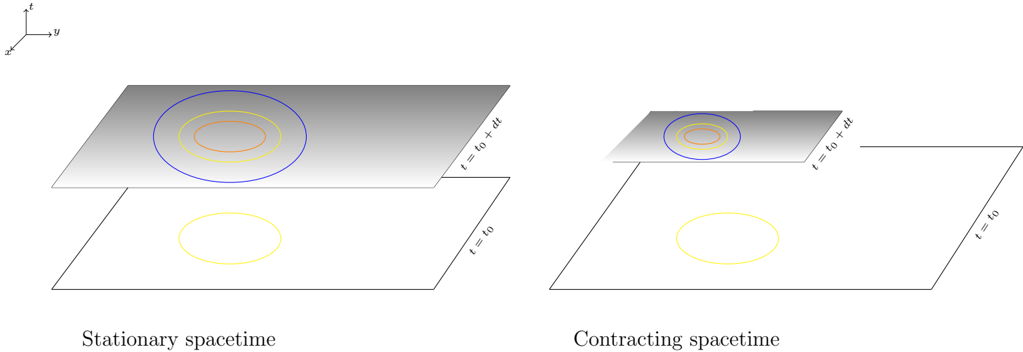

Verification
Claims the paper makes
0 Valid · 18 Not valid · 158 Not checked · 112 Own results and interpretations
A result the paper states — it cites no source for it, so there is none to check. The quote shows it is in the paper.
In the paper
“if θ is negative (positive) at some point and R ρν u ρ u ν ≥ 0 it follows that θ will reach an infinite negative value in finite affine parameter to the future (past)”
plainstates a cause- Asserted: passes — The authors put it forward as true.
- Checkable: passes — It can be checked against evidence.
- Load-bearing: passes — The paper’s conclusions depend on it.
- Based: passes — The paper gives a reason why it holds.
In the paper
“This is the first genuine post-Einstenian result in General Relativity”
- Also stated in: § 1. Introduction · p. 2 · plain
“the singularity theorems constitute the first genuine post-Einstenian content of classical GR”
What the sources say
- Not matchedcites [288]
The reference list we hold has no entry [288].
plain- Asserted: passes — The authors put it forward as true.
- Checkable: passes — It can be checked against evidence.
- Load-bearing: unclear — It is unclear whether the paper’s conclusions depend on it.
- Based: passes — The paper gives a reason why it holds.
- Also stated in: § 1. Introduction · p. 2 · plain
In the paper
“We review the first modern singularity theorem, published by Penrose in 1965.”
- Also stated in: § 1. Introduction · p. 1 · plain
“the first modern singularity theorem [248] were published in 1965”
What the sources say
- Not matchedcites [248]
The reference list we hold has no entry [248].
plain- Asserted: passes — The authors put it forward as true.
- Checkable: passes — It can be checked against evidence.
- Load-bearing: passes — The paper’s conclusions depend on it.
- Based: passes — The paper gives a reason why it holds.
- Also stated in: § 1. Introduction · p. 1 · plain
In the paper
“Penrose introduced geodesic incompleteness to characterize singularities (see subsection 4.1)”
What the sources say
- Not matchedcites [248]
The reference list we hold has no entry [248].
plainstates a cause- Asserted: passes — The authors put it forward as true.
- Checkable: passes — It can be checked against evidence.
- Load-bearing: unclear — It is unclear whether the paper’s conclusions depend on it.
- Based: passes — The paper gives a reason why it holds.
- Not matched
In the paper
“where the fundamental and fruitful concept of closed trapped surface was introduced.”
- Also stated in: § 1. Introduction · p. 2 · plain
“he presented the gravitational community with a precious gift in the form of a novel concept: closed trapped surfaces”
What the sources say
- Not matchedcites [248]
The reference list we hold has no entry [248].
plainstates a cause- Asserted: passes — The authors put it forward as true.
- Checkable: passes — It can be checked against evidence.
- Load-bearing: passes — The paper’s conclusions depend on it.
- Based: passes — The paper gives a reason why it holds.
- Also stated in: § 1. Introduction · p. 2 · plain
93 more claims
Create a free account to see all 288 claims and every source verdict.
- Probably not a substantial claim. 143
- It may state two separate claims as one. 97
Claims other papers make about this one
Each is checked against this paper’s own text: does it say what the citing paper says it does?
The source backs part of the claim, not all of it — or backs it for a different population, condition or comparison.
In the citing paper
“These theorems preclude singularity-free 'bounce' from occurring in the presence of any type of matter source with stress-energy tensor satisfying a very general condition of local energy non-negativity.”
From Weyl Curvature Hypothesis in Light of Quantum Backreaction at Cosmological Singularities or Bounces (2021) · cites this paper as [56]
Experimental — accuracy not yet measured
Citations
Cites
The Large Scale Structure of Space-Time
Hawking, S. W., & Ellis, G. F. R. (1973) · doi:10.1017/cbo9780511524646 · Cited by 10,624
Wald, R. M. (1984) · doi:10.7208/chicago/9780226870373.001.0001 · Cited by 7,188
Wald, R. M. (1984) · Cited by 6,274
Oppenheimer, J. R., & Volkoff, G. M. (1939) · Physical Review · doi:10.1103/physrev.55.374 · Cited by 4,030
Gravitational Field of a Spinning Mass as an Example of Algebraically Special Metrics
Kerr, R. P. (1963) · Physical Review Letters · doi:10.1103/physrevlett.11.237 · Cited by 3,551
Quantum Theory of Gravity. I. The Canonical Theory
DeWitt, B. S. (1967) · Physical Review · doi:10.1103/physrev.160.1113 · Cited by 3,385
Gravitational Collapse and Space-Time Singularities
Penrose, R. (1965) · Physical Review Letters · doi:10.1103/physrevlett.14.57 · Cited by 2,977
Cosmic Strings and Other Topological Defects
Vilenkin, A., & Shellard, E. P. S. (1985) · CERN Document Server (European Organization for Nuclear Research) · Cited by 2,816
Bondi, S. H. (1974) · Journal of the Franklin Institute · doi:10.1016/0016-0032(74)90062-3 · Cited by 2,797
An Approach to Gravitational Radiation by a Method of Spin Coefficients
Newman, E., & Penrose, R. (1962) · Journal of Mathematical Physics · doi:10.1063/1.1724257 · Cited by 2,702 · cited 1×
“¶ Penrose used an equation from [234] and did not refer to Raychaudhuri’s equation.”
Method
Research works printed but not linked: 10
- Belinskii, 1972, On a general cosmological solution of the Einstein equations with a time singularity, Zh. Eksp. Teoret. Fiz., 62, 1606
- de Sitter, 1917, On the relativity of inertia: remarks concerning Einstein's latest hypothesis, Proc. K. Ak. Amsterdam, 19, 1217
- Einstein, 1941, Demostración de la no existencia de campos gravitacionales sin singularidades de masa total no nula, Rev. Univ. Nac. de Tucumán, A2, 5
- Einstein, 1941, Rev. Univ. Nac. de Tucumán, A2, 11
- Friedman, 1999, Gen. Relativ. Gravit., 31, 2001, 10.1023/A:1026751225741 · DOI · Paper page
- Lanczos, 1922, Bemerkungen zur de Sitterschen Welt, Phys. Z., 23, 539
- Lemaître, 1927, Un Universe homogène de masse constante et de rayon croissant, rendant compte de la vittese radiale des nébuleuses extragalactiques, Ann. Soc. Sci. Brux. A, 47, 49
- Novikov, 1964, R- i T-oblasti v prostranstve-vremeni so sphericheski symmetrichnim prostranstvom (communications of the state Shternberg Astronomical Institute), Soobshch. GAISh, 132, 3
- Tipler, 1980, Singularities and horizons—a review article
- Weyl, 1923, On the general relativity theory, Phys. Z., 24, 230
Cited by
Born–Infeld inspired modifications of gravity
Beltrán Jiménez, J., Heisenberg, L., Olmo, G. J., & Rubiera-Garcia, D. (2018) · Physics Reports · doi:10.1016/j.physrep.2017.11.001 · Cited by 292
Revisiting the mechanical properties of the nucleon
Lorcé, C., Moutarde, H., & Trawiński, A. P. (2019) · The European Physical Journal C · doi:10.1140/epjc/s10052-019-6572-3 · Cited by 226
Energy conditions in general relativity and quantum field theory
Kontou, E.-A., & Sanders, K. (2020) · Classical and Quantum Gravity · doi:10.1088/1361-6382/ab8fcf · Cited by 223
“For rigorous proofs of the theorems, apart from the original manuscripts, see [32] and [148].”
BackgroundStellar structure models in modified theories of gravity: lessons and challenges.
Olmo, G. J., Rubiera-García, D., & Wojnar, A. (2020) · Library Open Repository (Universidad Complutense Madrid) · Cited by 206
Geodesically complete black holes
Carballo-Rubio, R., Di Filippo, F., Liberati, S., & Visser, M. (2020) · Physical Review D · doi:10.1103/physrevd.101.084047 · Cited by 165
“Penrose’s singularity theorem [2], and its modern variants and extensions (see for instance [18]), demonstrates that once a closed trapped surface S 2 is formed, then in some region of spacetime contained in the causal future J(S (2)) of S (2), one of the following must hold in order to avoid a spacetime singularity (…”
BackgroundNumerical methods for finding stationary gravitational solutions
Dias, Ó. J. C., Santos, J. E., & Way, B. (2016) · Classical and Quantum Gravity · doi:10.1088/0264-9381/33/13/133001 · Cited by 165
“The reader can find a recent review on these theorems in [142].”
BackgroundInfluentialNumerical methods for finding stationary gravitational solutions
Dias, Ó. J. C., Santos, J. E., & Way, B. (2016) · Apollo (University of Cambridge) · doi:10.17863/cam.17249 · Cited by 160
Key Science Goals for the Next-Generation Event Horizon Telescope
Johnson, M. D., Akiyama, K., Blackburn, L., Bouman, K. L., Broderick, A. E., Cardoso, V., Fender, R. P., Fromm, C. M., Galison, P. L., Gómez, J. L., et al. (2023) · Galaxies · doi:10.3390/galaxies11030061 · Cited by 216
Wormholes and nonsingular spacetimes in Palatini f ( R ) gravity
Bambi, C., Cárdenas-Avendaño, A., Olmo, G. J., & Rubiera-García, D. (2016) · Physical review. D/Physical review. D. · doi:10.1103/physrevd.93.064016 · Cited by 136
Classical Collapse to Black Holes and Quantum Bounces: A Review
Malafarina, D. (2017) · Universe · doi:10.3390/universe3020048 · Cited by 147
Minguzzi, E. (2019) · Living Reviews in Relativity · doi:10.1007/s41114-019-0019-x · Cited by 195
Festina lente:1 EFT constraints from charged black hole evaporation in de Sitter
Montero, M., Riet, T. V., & Venken, G. (2020) · Journal of High Energy Physics · doi:10.1007/jhep01(2020)039 · Cited by 129
Shadows and photon rings of regular black holes and geonic horizonless compact objects
Olmo, G. J., Rosa, J. L., Rubiera-García, D., & Gómez, D. S.-C. (2023) · Classical and Quantum Gravity · doi:10.1088/1361-6382/aceacd · Cited by 129
Light ring images of double photon spheres in black hole and wormhole spacetimes
Guerrero, M., Olmo, G. J., Rubiera-García, D., & Gómez, D. S.-C. (2022) · Physical review. D/Physical review. D. · doi:10.1103/physrevd.105.084057 · Cited by 101
What is a singular black hole beyond general relativity?
Bejarano, C., Olmo, G. J., & Rubiera-García, D. (2017) · Physical review. D/Physical review. D. · doi:10.1103/physrevd.95.064043 · Cited by 81
The energy–momentum tensor(s) in classical gauge theories
Blaschke, D. N., Gieres, F., Reboud, M., & Schweda, M. (2016) · Nuclear Physics B · doi:10.1016/j.nuclphysb.2016.07.001 · Cited by 93
Classical double copy of nonsingular black holes
Easson, D. A., Keeler, C. A., & Manton, T. (2020) · Physical review. D/Physical review. D. · doi:10.1103/physrevd.102.086015 · Cited by 73
Where Does the Physics of Extreme Gravitational Collapse Reside?
Barceló, C., Carballo-Rubio, R., & Garay, L. (2016) · Universe · doi:10.3390/universe2020007 · Cited by 61
Quasinormal modes-shadow correspondence for rotating regular black holes
Pedrotti, D., & Vagnozzi, S. (2024) · Physical review. D/Physical review. D. · doi:10.1103/physrevd.110.084075 · Cited by 100
Nonsingular black holes, wormholes, and de Sitter cores from anisotropic fluids
Menchon, C. C., Olmo, G. J., & Rubiera-García, D. (2017) · Physical review. D/Physical review. D. · doi:10.1103/physrevd.96.104028 · Cited by 62
Constraints on singularity resolution by nonlinear electrodynamics
Bokulić, A., Smolić, I., & Jurić, T. (2022) · Physical review. D/Physical review. D. · doi:10.1103/physrevd.106.064020 · Cited by 61
Minimum main sequence mass in quadratic Palatini f(R) gravity
Olmo, G. J., Rubiera-García, D., & Wojnar, A. (2019) · Physical review. D/Physical review. D. · doi:10.1103/physrevd.100.044020 · Cited by 54
Fundamental physics opportunities with the next-generation Event Horizon Telescope
Ayzenberg, D., Blackburn, L., Brito, R., Britzen, S., Broderick, A. E., Carballo-Rubio, R., Cardoso, V., Chael, A., Chatterjee, K., Chen, Y., et al. (2025) · Living Reviews in Relativity · doi:10.1007/s41114-025-00057-0 · Cited by 142
Space–time singularities and cosmic censorship conjecture: A Review with some thoughts
Ong, Y. C. (2020) · International Journal of Modern Physics A · doi:10.1142/s0217751x20300070 · Cited by 54
Cañate, P. (2022) · Physical review. D/Physical review. D. · doi:10.1103/physrevd.106.024031 · Cited by 60
A connection between regular black holes and horizonless ultracompact stars
Carballo-Rubio, R., Filippo, F. D., Liberati, S., & Visser, M. (2023) · Journal of High Energy Physics · doi:10.1007/jhep08(2023)046 · Cited by 66
Hawking’s singularity theorem for C 1,1 -metrics
Kunzinger, M., Steinbauer, R., Stojkovic, М., & Vickers, J. A. (2015) · Classical and Quantum Gravity · doi:10.1088/0264-9381/32/7/075012 · Cited by 62
Nonsingular black holes in nonlinear gravity coupled to Euler-Heisenberg electrodynamics
Guerrero, M., & Rubiera-García, D. (2020) · Physical review. D/Physical review. D. · doi:10.1103/physrevd.102.024005 · Cited by 56
Perkins, S., & Yunes, N. (2022) · Physical review. D/Physical review. D. · doi:10.1103/physrevd.105.124047 · Cited by 53
The Penrose singularity theorem in regularity C 1,1
Kunzinger, M., Steinbauer, R., & Vickers, J. A. (2015) · Classical and Quantum Gravity · doi:10.1088/0264-9381/32/15/155010 · Cited by 55
Yang, Y. (2022) · Classical and Quantum Gravity · doi:10.1088/1361-6382/ac840b · Cited by 48
NASHED, G. G. L. (2023) · The European Physical Journal C · doi:10.1140/epjc/s10052-023-11882-4 · Cited by 41
Cosmological future singularities in interacting dark energy models
Jiménez, J. B., Rubiera-García, D., Gómez, D. S.-C., & Salzano, V. (2016) · Physical review. D/Physical review. D. · doi:10.1103/physrevd.94.123520 · Cited by 41
Lower Bound on the Energy Density in Classical and Quantum Field Theories
Wall, A. C. (2017) · Physical Review Letters · doi:10.1103/physrevlett.118.151601 · Cited by 36
The Hawking–Penrose Singularity Theorem for C 1,1-Lorentzian Metrics
Graf, M., Grant, J. D. E., Kunzinger, M., & Steinbauer, R. (2017) · Communications in Mathematical Physics · doi:10.1007/s00220-017-3047-y · Cited by 50
Singularities, Black Holes, and Cosmic Censorship: A Tribute to Roger Penrose
Landsman, K. (2021) · Foundations of Physics · doi:10.1007/s10701-021-00432-1 · Cited by 46
Where Does the Physics of Extreme Gravitational Collapse Reside?
Barceló, C., Carballo-Rubio, R., & Garay Elizondo, L. J. (2016) · Library Open Repository (Universidad Complutense Madrid) · Cited by 32
The Smeared Null Energy Condition
Freivogel, B., & Krommydas, D. (2018) · Journal of High Energy Physics · doi:10.1007/jhep12(2018)067 · Cited by 45
Black holes and their horizons in semiclassical and modified theories of gravity
Mann, R. B., Murk, S., & Terno, D. R. (2022) · International Journal of Modern Physics D · doi:10.1142/s0218271822300154 · Cited by 40
Hyperboloidal approach to quasinormal modes
Macedo, R. P., & Zenginoğlu, A. (2025) · Frontiers in Physics · doi:10.3389/fphy.2024.1497601 · Cited by 56
Early evolutionary tracks of low-mass stellar objects in modified gravity
Wojnar, A. (2020) · Physical review. D/Physical review. D. · doi:10.1103/physrevd.102.124045 · Cited by 32
Space-time singularities in Weyl manifolds
Lobo, I. P., Barreto, A. B., & Romero, C. (2015) · The European Physical Journal C · doi:10.1140/epjc/s10052-015-3671-7 · Cited by 32
Penrose’s 1965 singularity theorem: from geodesic incompleteness to cosmic censorship
Landsman, K. (2022) · General Relativity and Gravitation · doi:10.1007/s10714-022-02973-w · Cited by 43
Scalar geons in Born-Infeld gravity
Afonso, V. I., Olmo, G. J., & Rubiera-García, D. (2017) · Journal of Cosmology and Astroparticle Physics · doi:10.1088/1475-7516/2017/08/031 · Cited by 31
Geometric inequivalence of metric and Palatini formulations of General Relativity
Bejarano, C., Delhom, A., Jiménez-Cano, A., Olmo, G. J., & Rubiera-García, D. (2020) · Physics Letters B · doi:10.1016/j.physletb.2020.135275 · Cited by 36
Geometrical inequalities bounding angular momentum and charges in General Relativity
Dain, S., & Clément, M. E. G. (2018) · Living Reviews in Relativity · doi:10.1007/s41114-018-0014-7 · Cited by 29
Lithium abundance is a gravitational model dependent quantity
Wojnar, A. (2021) · Physical review. D/Physical review. D. · doi:10.1103/physrevd.103.044037 · Cited by 31
Fermi gas and modified gravity
Wojnar, A. (2023) · Physical review. D/Physical review. D. · doi:10.1103/physrevd.107.044025 · Cited by 29
Charged particle production rate from cosmic censorship in dilaton black hole spacetimes
Ong, Y. C., & Yao, Y. (2019) · Journal of High Energy Physics · doi:10.1007/jhep10(2019)129 · Cited by 28
Regular black hole interior spacetime supported by three-form field
Bouhmadi-López, M., Chen, C.-Y., Chew, X. Y., Ong, Y. C., & Yeom, D.-H. (2021) · The European Physical Journal C · doi:10.1140/epjc/s10052-021-09080-1 · Cited by 31
Quantum Gravity in 30 Questions
Loll, R., Fabiano, G., Frattulillo, D., & Wagner, F. (2022) · Corfu Summer Institute School and Workshops on Elementary Particle Physics and Gravity (CORFU) · doi:10.22323/1.406.0316 · Cited by 59
Metric-affine gravity effects on terrestrial exoplanet profiles
Kozak, A., & Wojnar, A. (2021) · Physical review. D/Physical review. D. · doi:10.1103/physrevd.104.084097 · Cited by 24
Black hole solutions in functional extensions of Born-Infeld gravity
Bambi, C., Rubiera-García, D., & Wang, Y. (2016) · Physical review. D/Physical review. D. · doi:10.1103/physrevd.94.064002 · Cited by 22
The Singularity Theorems of General Relativity and Their Low Regularity Extensions
Steinbauer, R. (2022) · Jahresbericht der Deutschen Mathematiker-Vereinigung · doi:10.1365/s13291-022-00263-7 · Cited by 42
Hawking radiation as the cosmic censor
Düztaş, K., & Semiz, İ. (2016) · General Relativity and Gravitation · doi:10.1007/s10714-016-2070-1 · Cited by 23
Nonsingular Black Holes in Palatini Extensions of General Relativity
Olmo, G. J. (2016) · Springer proceedings in physics · doi:10.1007/978-3-319-31352-8_5 · Cited by 23
Closed Timelike Curves, Singularities and Causality: A Survey from Gödel to Chronological Protection
Luminet, J. (2021) · Universe · doi:10.3390/universe7010012 · Cited by 31
Raychaudhuri Equation, Geometrical Flows and Geometrical Entropy
Horwitz, L. P., Namboothiri, V. S., Gautham Varma, K., Asher Yahalom, A., Strauss, Y., & Levitan, J. (2021) · Symmetry · doi:10.3390/sym13060957 · Cited by 20
Jupiter and jovian exoplanets in Palatini f(R¯) gravity
Wojnar, A. (2021) · Physical review. D/Physical review. D. · doi:10.1103/physrevd.104.104058 · Cited by 22
Pappas, T. D., Posada, C., & Stuchlík, Z. (2022) · Physical review. D/Physical review. D. · doi:10.1103/physrevd.106.124014 · Cited by 23
On the initial singularity and extendibility of flat quasi-de Sitter spacetimes
Geshnizjani, G., Ling, E., & Quintin, J. (2023) · Journal of High Energy Physics · doi:10.1007/jhep10(2023)182 · Cited by 32
Martino, I. D., Monica, R. D., & Rubiera-García, D. (2023) · Physical review. D/Physical review. D. · doi:10.1103/physrevd.108.124054 · Cited by 23
New black-to-white hole solutions with improved geometry and energy conditions
Feng, Z.-W., Ling, Y., Wu, X., & Jiang, Q.-Q. (2024) · Science China Physics Mechanics and Astronomy · doi:10.1007/s11433-023-2373-0 · Cited by 19
The Hawking–Penrose Singularity Theorem for $$C^1$$-Lorentzian Metrics
Kunzinger, M., Ohanyan, A., Schinnerl, B., & Steinbauer, R. (2022) · Communications in Mathematical Physics · doi:10.1007/s00220-022-04335-8 · Cited by 36
A Survey of Black Hole ThermodynamicsPreprint
Wall, A. C. (2018) · arXiv (Cornell University) · doi:10.48550/arxiv.1804.10610 · Cited by 95
Borissova, J. N., Liberati, S., & Visser, M. (2025) · Physical review. D/Physical review. D. · doi:10.1103/physrevd.111.104054 · Cited by 31
Black bounces in Cotton gravity
Ednaldo, L. B., S., J. T. S., Lobo, F. S. N., Rodrigues, M. E., Rubiera-García, D., da Silva, L. F. D., & Vieira, H. A. (2024) · The European Physical Journal C · doi:10.1140/epjc/s10052-024-13568-x · Cited by 18
Aspects of $$C^0$$ causal theory
Ling, E. (2020) · General Relativity and Gravitation · doi:10.1007/s10714-020-02708-9 · Cited by 18
A critical appraisal of the singularity theorems
Senovilla, J. M. M. (2022) · Philosophical Transactions of the Royal Society A Mathematical Physical and Engineering Sciences · doi:10.1098/rsta.2021.0174 · Cited by 30
Self-citationRegular electric black holes from Einstein-Maxwell-scalar gravity
Li, Z.-C., & Lü, H. (2024) · Physical review. D/Physical review. D. · doi:10.1103/physrevd.110.104046 · Cited by 16
Birth of baby universes from gravitational collapse in a modified-gravity scenario
Masó-Ferrando, A., Sanchis-Gual, N., Font, J. A., & Olmo, G. J. (2023) · Journal of Cosmology and Astroparticle Physics · doi:10.1088/1475-7516/2023/06/028 · Cited by 18
Junction conditions of Palatini f(R,T) gravity
Rosa, J. L., & Rubiera-García, D. (2022) · Physical review. D/Physical review. D. · doi:10.1103/physrevd.106.064007 · Cited by 19
Mathematical general relativity
Coley, A. A. (2019) · General Relativity and Gravitation · doi:10.1007/s10714-019-2559-5 · Cited by 19
The sounds of science - A symphony for many instruments and voices
Alexander, G. M., Allen, R. E., Atala, A., Bowen, W. P., Coley, A. A., Goodenough, J. B., Katsnelson, M. I., Koonin, E. V., Krenn, M., Madsen, L. S., et al. (2020) · Institutional Repository of Leibniz Universität Hannover (Leibniz Universität Hannover) · doi:10.15488/10597 · Cited by 16
Geometrical Theory On Combinatorial Manifolds
Mao, L. (2006) · INFM-OAR (INFN Catania) · doi:10.5281/zenodo.32312 · Cited by 16
Diverse regular spacetimes using a parametrised density profile
Kar, A., & Kar, S. (2025) · The European Physical Journal C · doi:10.1140/epjc/s10052-025-14483-5 · Cited by 20
Decoupling of anisotropic wormholes via MGD in the presence of dark matter haloes
Almatroud, O. A., Rizwan, M., Alshammari, M., Bhatti, M. Z. U. H., Alshammari, S., & Yousaf, Z. (2025) · The European Physical Journal C · doi:10.1140/epjc/s10052-025-15034-8 · Cited by 15
How much null-energy-condition breaking can the Universe endure?
Moghtaderi, E., Hull, B. R., Quintin, J., & Geshnizjani, G. (2025) · Physical review. D/Physical review. D. · doi:10.1103/j6hp-p8hs · Cited by 24
Singularities and n-dimensional black holes in torsion theories
Cembranos, J. A. R., Valcárcel, J. G., & Torralba, F. J. M. (2017) · Journal of Cosmology and Astroparticle Physics · doi:10.1088/1475-7516/2017/04/021 · Cited by 25
Quantum kinetic theory of Jeans instability in non-minimal matter-curvature coupling gravity
Gomes, C., & Ourabah, K. (2023) · The European Physical Journal C · doi:10.1140/epjc/s10052-023-11184-9 · Cited by 16
Quasinormal modes and echoes of generalized black hole bounces and their correspondence with shadows
Duran-Cabacés, A., Rubiera-García, D., & Gómez, D. S.-C. (2025) · Physical review. D/Physical review. D. · doi:10.1103/3v89-z8rf · Cited by 13
Giant planet formation in Palatini gravity
Wojnar, A. (2022) · Physical review. D/Physical review. D. · doi:10.1103/physrevd.105.124053 · Cited by 13
Nomen non est omen: Why it is too soon to identify ultra-compact objects as black holes
Murk, S. (2023) · International Journal of Modern Physics D · doi:10.1142/s0218271823420129 · Cited by 19
General spherically symmetric black bounces within nonlinear electrodynamics
Alencar, G., Duran-Cabacés, A., Rubiera-García, D., & Gómez, D. S.-C. (2025) · Physical review. D/Physical review. D. · doi:10.1103/physrevd.111.104020 · Cited by 24
Horizon quantum fuzziness for non-singular black holes
Giugno, A., Giusti, A., & Helou, A. (2018) · The European Physical Journal C · doi:10.1140/epjc/s10052-018-5715-2 · Cited by 16
Singularities and n-dimensional black holes in torsion theories
Cembranos, J. A. R., Valcárcel, J. G., & Torralba, F. J. M. (2017) · LA Referencia (Red Federada de Repositorios Institucionales de Publicaciones Científicas) · Cited by 13
Non-homogeneous exoplanets in metric-affine gravity
Kozak, A., & Wojnar, A. (2022) · International Journal of Geometric Methods in Modern Physics · doi:10.1142/s0219887822501572 · Cited by 17
Regular black holes from analytic $$f(F^2)$$
Li, Z., & Lü, H. (2023) · The European Physical Journal C · doi:10.1140/epjc/s10052-023-11908-x · Cited by 17
Semiclassical black holes and horizon singularities
Dahal, P. K., Murk, S., & Terno, D. R. (2022) · AVS Quantum Science · doi:10.1116/5.0073598 · Cited by 14
Is “dark energy” a quantum vacuum energy?
Adler, S. L. (2021) · Modern Physics Letters A · doi:10.1142/s0217732321300275 · Cited by 14
A gravitational collapse singularity theorem consistent with black hole evaporation
Minguzzi, E. (2020) · Letters in Mathematical Physics · doi:10.1007/s11005-020-01295-9 · Cited by 15
Pre-main sequence evolution of low-mass stars in Eddington-inspired Born-Infeld gravity
Guerrero, M., Rubiera-García, D., & Wojnar, A. (2022) · Docta Complutense (Universidad Complutense de Madrid) · Cited by 11
On black hole thermodynamics, singularity, and gravitational entropy
Ong, Y. C. (2022) · General Relativity and Gravitation · doi:10.1007/s10714-022-03008-0 · Cited by 16
Raychaudhuri equation and the dynamics of cosmic evolution
Chakraborty, M., & Chakraborty, S. (2024) · Physica Scripta · doi:10.1088/1402-4896/ad2c4c · Cited by 11
Xie, Y., Chatterjee, D., Narayan, G., & Yunes, N. (2024) · Physical review. D/Physical review. D. · doi:10.1103/physrevd.110.024036 · Cited by 23
Could planck star remnants be dark matter?
Trivedi, O., & Loeb, A. (2025) · Physics of the Dark Universe · doi:10.1016/j.dark.2025.102003 · Cited by 23
Singularity theorems and the inclusion of torsion in affine theories of gravity
Luz, P., & Mena, F. C. (2020) · Journal of Mathematical Physics · doi:10.1063/1.5126220 · Cited by 17
Cordeiro, D. S. J., Ednaldo, L. B., S., J. T. S., Lobo, F. S. N., Rodrigues, M. E., Rubiera-García, D., da Silva, L. F. D., & Vieira, H. A. (2025) · Physical review. D/Physical review. D. · doi:10.1103/ztlm-v4lx · Cited by 19
Singularity-Free Gravitational Collapse: From Regular Black Holes to Horizonless Objects
Carballo-Rubio, R., Filippo, F. D., Liberati, S., & Visser, M. (2023) · Springer Series in Astrophysics and Cosmology · doi:10.1007/978-981-99-1596-5_9 · Cited by 42
The Synge G-Method: cosmology, wormholes, firewalls, geometry
Ellis, G., & Garfinkle, D. (2024) · Classical and Quantum Gravity · doi:10.1088/1361-6382/ad2f14 · Cited by 15
Self-citation
Metadata
- Authors
- Senovilla, J. M. M., & Garfinkle, D.
- Affiliations
- University of the Basque Country (ES)
- Oakland University (US)
- Corresponding author
- Senovilla, José M M
- Garfinkle, David
- Venue
- Classical and Quantum Gravity
- Publisher
- IOP Publishing
- Published
- 2015-06-01
- Volume
- 32
- Issue
- 12
- Pages
- 124008
- ISSN
- 0264-9381 (ISSN-L)
- 1361-6382
- OpenAlex
- W2098149415
- Semantic Scholar
- ad6c465792ee37b0f53d35cdc19bf9fe09e9aebc
- Cited by
- 248
- References
- 381
- Citations by year
- 2026: 14 · 2025: 35 · 2024: 23 · 2023: 47 · 2022: 26 · 2021: 22 · 2020: 18 · 2019: 12 · 2018: 9 · 2017: 19 · 2016: 13 · 2015: 9
- FWCI
- 9.28
- Type
- journal article
- Language
- en
- Open access
- green
- arxiv.org
- Licence
- publishingsupport.iopscience.iop.org/iop-standard/v1 (vor)
- iopscience.iop.org/info/page/text-and-data-mining (tdm)
- Locations
- Classical and Quantum Gravity (publishedVersion)
- arXiv (Cornell University) (publishedVersion)
- arXiv (Cornell University)
- Topics
- Physical Sciences › Physics and Astronomy › Astronomy and Astrophysics › Relativity and Gravitational Theory
- Physical Sciences › Physics and Astronomy › Nuclear and High Energy Physics › Black Holes and Theoretical Physics
- Physical Sciences › Physics and Astronomy › Astronomy and Astrophysics › Cosmology and Gravitation Theories
- Keywords
- Penrose singularity theorem, singularity theorems, general relativity, cosmic censorship, black holes, history of general relativity
About these checks
Registry, retraction, Cites and statistics results are computed, not judged, with one exception: a printed reference that no index lists is read once by a model before it counts as a citation error. Claims are extracted by a model and kept only when their quote appears verbatim in the text; each cited source is then checked, with a model’s help, for whether it says what the claim relies on. Those verdicts can be wrong — read the claim’s quote and the cited source before relying on one.
A language model drew the claims from the paper on 2026-10-30, under version 3 of the claim definition (model deepseek-v4.1-flash, prompt extract-v3).
A second model labelled each claim on 2026-10-30 (model jev-1.13-20260917, definition revision gold-guideline-v0.2).
Statistics and arithmetic are recomputed, not judged.
Confidence bands are shown only for fields calibrated on our annotated test set. None is calibrated yet, so no band is shown.
What counts as a claim ›How we measure confidence ›How we check this ›
Are you an author, or do you see a problem with this page? Request a review
Data sources
Bibliographic data: Semantic Scholar, OpenAlex, Crossref.
Contains information from the Semantic Scholar Academic Graph Datasets, made available under the ODC Attribution License (ODC-BY 1.0).
Semantic Scholar’s data is described in: Kinney, R., et al. (2023). The Semantic Scholar Open Data Platform. arXiv:2301.10140.
