

The 1965 Penrose singularity theorem
Open accessThe DOI matches its Crossref record; 382 of the 382 references it cites were found in a registry or an index; none of the 288 sources its claims cite is checked for support yet.
Abstract
We review the first modern singularity theorem, published by Penrose in 1965. This is the first genuine post-Einsteinian result in general relativity, where the fundamental and fruitful concept of the closed trapped surface was introduced. We include historical remarks, an appraisal of the theorem's impact, and relevant current and future work that belongs to its legacy.
Overview
CoChat Summary
TL;DR
This review argues that Penrose’s 1965 theorem was the first modern singularity theorem in general relativity, introducing closed trapped surfaces and geodesic incompleteness as central ideas. It surveys the theorem’s historical context, immediate impact, and long-term legacy across black holes, cosmology, numerical relativity, and mathematical relativity.
Key findings
- Penrose’s theorem, in the modern form given in the review, states that if spacetime contains a non-compact Cauchy hypersurface and a closed future-trapped surface, and the null convergence condition holds, then there are future incomplete null geodesics.
- The paper identifies the closed trapped surface as the theorem’s key conceptual innovation: a compact 2-dimensional surface whose two future-directed orthogonal null expansions are negative, equivalently characterized by a timelike future-directed mean curvature vector.
- The review traces the theorem’s legacy through Hawking’s past-trapped surfaces in expanding universes, the Hawking–Penrose theorem, cosmic censorship, critical collapse, BKL singularities, trapped submanifolds, the Penrose inequality, and the hoop conjecture.
- It reports that numerical simulations indicate cosmic censorship holds in 4 spacetime dimensions but is violated in 5 spacetime dimensions by unstable black strings, which pinch off and form naked singularities.
Methods
- Review article: historical and conceptual survey of Penrose’s 1965 singularity theorem, with sections on pre-1955 and 1955–1965 work, the theorem itself, its impact, and XXI-century developments.
- No primary data or sample; the analysis synthesizes published theorems, proofs, examples, and literature references.
- Main approach is narrative and thematic synthesis rather than empirical or statistical analysis.
Limitations
- The paper states that the weakest point of the singularity theorems is their conclusions: they usually prove only the existence of at least one incomplete causal geodesic and say little about the singularity’s location, strength, extension, or character.
- The paper states that the differentiability assumption—metric twice differentiable with continuity—is restrictive and often ignored, and that physically realistic matched models may not satisfy it.
- The paper states that curvature/energy conditions can be violated by Λ > 0, inflation, and scalar fields, and that whether the initial/boundary condition is satisfied by actual physical systems is debatable; as a review, it also presents no new original results or data.
Model-written summary. Check it against the paper before relying on it.
Integrity signals
Registry
Cites
Statistics
Figures
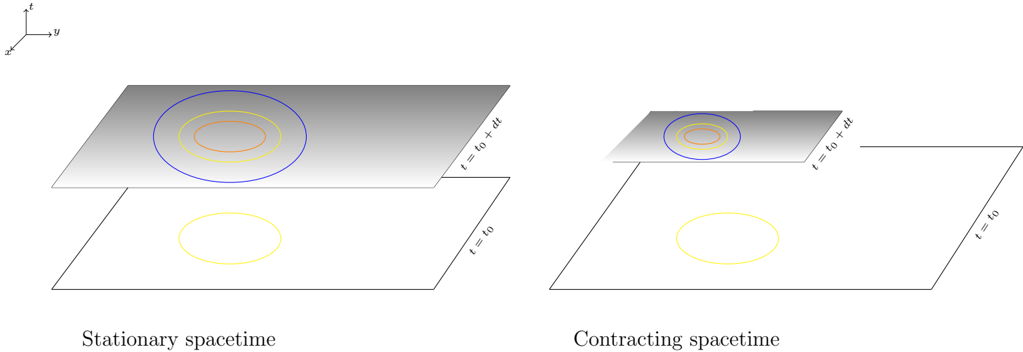

Verification
Claims the paper makes
0 Valid · 18 Not valid · 158 Not checked · 112 Own results and interpretations
A result the paper states — it cites no source for it, so there is none to check. The quote shows it is in the paper.
In the paper
“if θ is negative (positive) at some point and R ρν u ρ u ν ≥ 0 it follows that θ will reach an infinite negative value in finite affine parameter to the future (past)”
plainstates a cause- Asserted: passes — The authors put it forward as true.
- Checkable: passes — It can be checked against evidence.
- Load-bearing: passes — The paper’s conclusions depend on it.
- Based: passes — The paper gives a reason why it holds.
In the paper
“This is the first genuine post-Einstenian result in General Relativity”
- Also stated in: § 1. Introduction · p. 2 · plain
“the singularity theorems constitute the first genuine post-Einstenian content of classical GR”
What the sources say
- Not matchedcites [288]
The reference list we hold has no entry [288].
plain- Asserted: passes — The authors put it forward as true.
- Checkable: passes — It can be checked against evidence.
- Load-bearing: unclear — It is unclear whether the paper’s conclusions depend on it.
- Based: passes — The paper gives a reason why it holds.
- Also stated in: § 1. Introduction · p. 2 · plain
In the paper
“We review the first modern singularity theorem, published by Penrose in 1965.”
- Also stated in: § 1. Introduction · p. 1 · plain
“the first modern singularity theorem [248] were published in 1965”
What the sources say
- Not matchedcites [248]
The reference list we hold has no entry [248].
plain- Asserted: passes — The authors put it forward as true.
- Checkable: passes — It can be checked against evidence.
- Load-bearing: passes — The paper’s conclusions depend on it.
- Based: passes — The paper gives a reason why it holds.
- Also stated in: § 1. Introduction · p. 1 · plain
In the paper
“Penrose introduced geodesic incompleteness to characterize singularities (see subsection 4.1)”
What the sources say
- Not matchedcites [248]
The reference list we hold has no entry [248].
plainstates a cause- Asserted: passes — The authors put it forward as true.
- Checkable: passes — It can be checked against evidence.
- Load-bearing: unclear — It is unclear whether the paper’s conclusions depend on it.
- Based: passes — The paper gives a reason why it holds.
- Not matched
In the paper
“where the fundamental and fruitful concept of closed trapped surface was introduced.”
- Also stated in: § 1. Introduction · p. 2 · plain
“he presented the gravitational community with a precious gift in the form of a novel concept: closed trapped surfaces”
What the sources say
- Not matchedcites [248]
The reference list we hold has no entry [248].
plainstates a cause- Asserted: passes — The authors put it forward as true.
- Checkable: passes — It can be checked against evidence.
- Load-bearing: passes — The paper’s conclusions depend on it.
- Based: passes — The paper gives a reason why it holds.
- Also stated in: § 1. Introduction · p. 2 · plain
93 more claims
Create a free account to see all 288 claims and every source verdict.
- Probably not a substantial claim. 143
- It may state two separate claims as one. 97
Claims other papers make about this one
Each is checked against this paper’s own text: does it say what the citing paper says it does?
The source backs part of the claim, not all of it — or backs it for a different population, condition or comparison.
In the citing paper
“These theorems preclude singularity-free 'bounce' from occurring in the presence of any type of matter source with stress-energy tensor satisfying a very general condition of local energy non-negativity.”
From Weyl Curvature Hypothesis in Light of Quantum Backreaction at Cosmological Singularities or Bounces (2021) · cites this paper as [56]
Experimental — accuracy not yet measured
Citations
Cites
The Large Scale Structure of Space-Time
Hawking, S. W., & Ellis, G. F. R. (1973) · doi:10.1017/cbo9780511524646 · Cited by 10,624
Wald, R. M. (1984) · doi:10.7208/chicago/9780226870373.001.0001 · Cited by 7,188
Wald, R. M. (1984) · Cited by 6,274
Oppenheimer, J. R., & Volkoff, G. M. (1939) · Physical Review · doi:10.1103/physrev.55.374 · Cited by 4,030
Gravitational Field of a Spinning Mass as an Example of Algebraically Special Metrics
Kerr, R. P. (1963) · Physical Review Letters · doi:10.1103/physrevlett.11.237 · Cited by 3,551
Quantum Theory of Gravity. I. The Canonical Theory
DeWitt, B. S. (1967) · Physical Review · doi:10.1103/physrev.160.1113 · Cited by 3,385
Gravitational Collapse and Space-Time Singularities
Penrose, R. (1965) · Physical Review Letters · doi:10.1103/physrevlett.14.57 · Cited by 2,977
Cosmic Strings and Other Topological Defects
Vilenkin, A., & Shellard, E. P. S. (1985) · CERN Document Server (European Organization for Nuclear Research) · Cited by 2,816
Bondi, S. H. (1974) · Journal of the Franklin Institute · doi:10.1016/0016-0032(74)90062-3 · Cited by 2,797
An Approach to Gravitational Radiation by a Method of Spin Coefficients
Newman, E., & Penrose, R. (1962) · Journal of Mathematical Physics · doi:10.1063/1.1724257 · Cited by 2,702 · cited 1×
“¶ Penrose used an equation from [234] and did not refer to Raychaudhuri’s equation.”
MethodGeneral Relativity – An Einstein Centenary Survey
Irvine, J. M. (1980) · Physics Bulletin · doi:10.1088/0031-9112/31/4/029 · Cited by 2,620
A Measurement of Excess Antenna Temperature at 4080 Mc/s.
Penzias, A. A., & Wilson, R. W. (1965) · The Astrophysical Journal · doi:10.1086/148307 · Cited by 2,604
Eisenhart, L. P. (1950) · Princeton University Press eBooks · doi:10.1515/9781400884216 · Cited by 2,506
Gravitational waves in general relativity, VII. Waves from axi-symmetric isolated system
Bondi, H., Van der Burg, M. G. J., & Metzner, A. W. K. (1962) · Proceedings of the Royal Society of London. Series A. Mathematical and Physical Sciences · doi:10.1098/rspa.1962.0161 · Cited by 2,426 · cited 1×
“One can also use similar arguments if the initial data set Σ is not asymptotically flat but rather intersects future null infinity (asymptotically hyperbolic data) by using the non-decreasing [36, 269] Bondi mass for M .”
MethodSemi-Riemannian Geometry With Applications to Relativity
O’Neill, B. (2011) · Cited by 2,236
Exact Solutions of Einstein's Field Equations
Stephani, H., Kramer, D., MacCallum, M., Hoenselaers, C., & Herlt, E. (2003) · doi:10.1017/cbo9780511535185 · Cited by 2,184
Penrose, R., & Rindler, W. (1984) · doi:10.1017/cbo9780511564048 · Cited by 2,172
The singularities of gravitational collapse and cosmology
Hawking, S. W., & Penrose, R. (1970) · Proceedings of the Royal Society of London. A. Mathematical and Physical Sciences · doi:10.1098/rspa.1970.0021 · Cited by 2,100 · cited 3×
“Eventually, a considerable improvement in the understanding of the conditions under which a space–time must be singular was accomplished by Hawking and Penrose [174] in what is still considered the preeminent singularity theorem.”
BackgroundOn Continued Gravitational Contraction
Oppenheimer, J. R., & Snyder, H. (1939) · Physical Review · doi:10.1103/physrev.56.455 · Cited by 2,008
Experimental Black-Hole Evaporation?
Unruh, W. G. (1981) · Physical Review Letters · doi:10.1103/physrevlett.46.1351 · Cited by 1,774
SEMI-RIEMANNIAN GEOMETRY With Applications to Relativity
MacCallum, M. A. H. (1984) · Bulletin of the London Mathematical Society · doi:10.1112/blms/16.3.328 · Cited by 1,692
An Example of a New Type of Cosmological Solutions of Einstein's Field Equations of Gravitation
Gödel, K. (1949) · Reviews of Modern Physics · doi:10.1103/revmodphys.21.447 · Cited by 1,615
(1979) · CERN Document Server (European Organization for Nuclear Research) · Cited by 1,590
Black holes in general relativity
Hawking, S. W. (1972) · Communications in Mathematical Physics · doi:10.1007/bf01877517 · Cited by 1,561
Friedman, A. (1922) · Zeitschrift f�r Physik · doi:10.1007/bf01332580 · Cited by 1,465
Universality and scaling in gravitational collapse of a massless scalar field
Choptuik, M. W. (1993) · Physical Review Letters · doi:10.1103/physrevlett.70.9 · Cited by 1,439 · cited 4×
“These questions were addressed in [61, 62] and nicely answered by Choptuik [56] in his numerical simulations of spherically symmetric scalar field collapse.”
BackgroundInfluentialOscillatory approach to a singular point in the relativistic cosmology
Belinskii, V. A., Khalatnikov, I. M., & Lifshitz, E. M. (1970) · Advances in Physics · doi:10.1080/00018737000101171 · Cited by 1,341
Raychaudhuri, A. (1955) · Physical Review · doi:10.1103/physrev.98.1123 · Cited by 1,335
Lorentzian Wormholes: From Einstein to Hawking
(1996) · Choice Reviews Online · doi:10.5860/choice.33-5168 · Cited by 1,319
Christensen, S. M. (1984) · Cited by 1,187
“Golden Oldie”: Gravitational Collapse: The Role of General Relativity
Penrose, R. (2002) · General Relativity and Gravitation · doi:10.1023/a:1016578408204 · Cited by 1,178
Beem, J. K., Ehrlich, P. E., & Easley, K. L. (2017) · Routledge eBooks · doi:10.1201/9780203753125 · Cited by 1,173
Barceló, C., Liberati, S., & Visser, M. (2005) · Living Reviews in Relativity · doi:10.12942/lrr-2005-12 · Cited by 1,163
The Maximum Mass of Ideal White Dwarfs
Chandrasekhar, S. (1931) · The Astrophysical Journal · doi:10.1086/143324 · Cited by 1,146
Black strings and p -branes are unstable
Gregory, R., & Laflamme, R. (1993) · Physical Review Letters · doi:10.1103/physrevlett.70.2837 · Cited by 1,097
Relativity, groups and topology
L.R. (1965) · Nuclear Physics · doi:10.1016/0029-5582(65)90020-9 · Cited by 1,053
Relativity, Groups and Topology
DeWitt, C., & DeWitt, B. S. (1964) · Cited by 1,005
Maximal Extension of Schwarzschild Metric
Kruskal, M. D. (1960) · Physical Review · doi:10.1103/physrev.119.1743 · Cited by 979
Penrose, R., & Rindler, W. (1986) · Cambridge University Press eBooks · doi:10.1017/cbo9780511524486 · Cited by 920
Investigations in relativistic cosmology
Lifshitz, E. M., & Khalatnikov, I. M. (1963) · Advances in Physics · doi:10.1080/00018736300101283 · Cited by 912
On the proof of the positive mass conjecture in general relativity
Schoen, R., & Yau, S.-T. (1979) · Communications in Mathematical Physics · doi:10.1007/bf01940959 · Cited by 870
Isolated and Dynamical Horizons and Their Applications
Ashtekar, A., & Krishnan, B. (2004) · Living Reviews in Relativity · doi:10.12942/lrr-2004-10 · Cited by 826
Acoustic black holes: horizons, ergospheres and Hawking radiation
Visser, M. (1998) · Classical and Quantum Gravity · doi:10.1088/0264-9381/15/6/024 · Cited by 806
Asymptotic Properties of Fields and Space-Times
Penrose, R. (1963) · Physical Review Letters · doi:10.1103/physrevlett.10.66 · Cited by 802
Dicke, R. H., Peebles, P. J. E., Roll, P. G., & Wilkinson, D. T. (1965) · The Astrophysical Journal · doi:10.1086/148306 · Cited by 741
Friedman, A. (1999) · General Relativity and Gravitation · doi:10.1023/a:1026751225741 · Cited by 740
General laws of black-hole dynamics
Hayward, S. A. (1994) · Physical Review D · doi:10.1103/physrevd.49.6467 · Cited by 736
Numerical Relativity: Solving Einstein's Equations on the Computer
Baumgarte, T. W., & Shapiro, S. L. (2010) · Cambridge University Press eBooks · doi:10.1017/cbo9781139193344 · Cited by 727
Inhomogeneous Cosmological Models
Krasiński, A. (1997) · Cambridge University Press eBooks · doi:10.1017/cbo9780511721694 · Cited by 704
Gravitational waves in general relativity. VI. The outgoing radiation condition
Sachs, R. (1961) · Proceedings of the Royal Society of London. Series A. Mathematical and Physical Sciences · doi:10.1098/rspa.1961.0202 · Cited by 695
�ber die M�glichkeit einer Welt mit konstanter negativer Kr�mmung des Raumes
Friedmann, A. (1924) · Zeitschrift f�r Physik · doi:10.1007/bf01328280 · Cited by 671
Homogeneous Relativistic Cosmologies
Ryan, M. P., & Shepley, L. C. (2015) · Princeton University Press eBooks · doi:10.1515/9781400868568 · Cited by 623
Geroch, R. (1970) · Journal of Mathematical Physics · doi:10.1063/1.1665157 · Cited by 622
Barceló, C., Liberati, S., & Visser, M. (2011) · Living Reviews in Relativity · doi:10.12942/lrr-2011-3 · Cited by 598
Inflationary spacetimes are not past-complete
Borde, A., Guth, A. H., & Vilenkin, A. (2001) · arXiv · doi:10.48550/arxiv.gr-qc/0110012 · Cited by 594
Gravitational Waves in General Relativity
BONDI, H. (1960) · Nature · doi:10.1038/186535a0 · Cited by 586
General Relativity and Cosmology
(2006) · General Relativity · doi:10.1007/0-387-27406-5_9 · Cited by 584
Inflationary Spacetimes Are Incomplete in Past Directions
Borde, A., Guth, A. H., & Vilenkin, A. (2003) · Physical Review Letters · doi:10.1103/physrevlett.90.151301 · Cited by 582
The Flatter Regions of Newman, Unti, and Tamburino's Generalized Schwarzschild Space
Misner, C. W. (1963) · Journal of Mathematical Physics · doi:10.1063/1.1704019 · Cited by 572
Black Hole Uniqueness Theorems
Heusler, M. (1996) · Cambridge University Press eBooks · doi:10.1017/cbo9780511661396 · Cited by 563
Techniques in Differential Topology in Relativity
Penrose, R. (1972) · Society for Industrial and Applied Mathematics eBooks · doi:10.1137/1.9781611970609 · Cited by 561
Past-Future Asymmetry of the Gravitational Field of a Point Particle
Finkelstein, D. (1958) · Physical Review · doi:10.1103/physrev.110.965 · Cited by 537
Proof of the positive mass theorem. II
Schoen, R., & Yau, S.-T. (1981) · Communications in Mathematical Physics · doi:10.1007/bf01942062 · Cited by 533
Über das Gravitationsfeld eines Massenpunktes nach der EINSTEINschen Theorie
Schwarzschild, K. (1992) · Gesammelte Werke/Collected Works · doi:10.1007/978-3-642-58084-0_21 · Cited by 528
Homogeneous Relativistic Cosmologies
Roxburgh, I. W. (1975) · Physics Bulletin · doi:10.1088/0031-9112/26/8/030 · Cited by 522
Gravitational energy in spherical symmetry
Hayward, S. A. (1996) · Physical Review D · doi:10.1103/physrevd.53.1938 · Cited by 493
Lemaître, A. G. (1997) · General Relativity and Gravitation · doi:10.1023/a:1018855621348 · Cited by 466
The Inverse Mean Curvature Flow and the Riemannian Penrose Inequality
Huisken, G., & Ilmanen, T. (2001) · Journal of Differential Geometry · doi:10.4310/jdg/1090349447 · Cited by 463
The Influence of the Expansion of Space on the Gravitation Fields Surrounding the Individual Stars
Einstein, A., & Straus, E. G. (1945) · Reviews of Modern Physics · doi:10.1103/revmodphys.17.120 · Cited by 463
Penrose, R. (1973) · Annals of the New York Academy of Sciences · doi:10.1111/j.1749-6632.1973.tb41447.x · Cited by 427
Kosmologische Betrachtungen zur allgemeinen Relativitätstheorie
Einstein, A. (1923) · Das Relativitätsprinzip · doi:10.1007/978-3-663-19510-8_9 · Cited by 423
On a Stationary System With Spherical Symmetry Consisting of Many Gravitating Masses
Einstein, A. (1939) · The Annals of Mathematics · doi:10.2307/1968902 · Cited by 387
The occurrence of singularities in cosmology. ɪɪɪ. Causality and singularities
Hawking, S. W. (1967) · Proceedings of the Royal Society of London. Series A. Mathematical and Physical Sciences · doi:10.1098/rspa.1967.0164 · Cited by 360
Eternal inflation and the initial singularity
Borde, A., & Vilenkin, A. (1994) · Physical Review Letters · doi:10.1103/physrevlett.72.3305 · Cited by 356
Ellis, G. F. R., & Schmidt, B. G. (1977) · General Relativity and Gravitation · doi:10.1007/bf00759240 · Cited by 355
General relativity and gravitation : one hundred years after the birth of Albert Einstein
Held, A. (1980) · CERN Document Server (European Organization for Nuclear Research) · Cited by 354
Über die physikalischen Grundlagen der Einsteinschen Gravitationstheorie
Kottler, F. (1918) · Annalen der Physik · doi:10.1002/andp.19183611402 · Cited by 354
Quasi-Local Energy-Momentum and Angular Momentum in General Relativity
Szabados, L. B. (2009) · Living Reviews in Relativity · doi:10.12942/lrr-2009-4 · Cited by 351
Stewart, J. M. (1993) · Cited by 348
HYPERBOLIC DIFFERENTIAL EQUATIONS
(2008) · A-to-Z Guide to Thermodynamics, Heat and Mass Transfer, and Fluids Engineering · doi:10.1615/atoz.h.hyperbolic_differential_equations · Cited by 347
Colliding plane waves in general relativity
Griffiths, J. B. (1991) · CERN Document Server (European Organization for Nuclear Research) · Cited by 347
Topology in General Relativity
Geroch, R. P. (1967) · Journal of Mathematical Physics · doi:10.1063/1.1705276 · Cited by 346
Inner-horizon instability and mass inflation in black holes
Poisson, E., & Israel, W. (1989) · Physical Review Letters · doi:10.1103/physrevlett.63.1663 · Cited by 333
The Instability of Naked Singularities in the Gravitational Collapse of a Scalar Field
Christodoulou, D. (1999) · The Annals of Mathematics · doi:10.2307/121023 · Cited by 329
Penrose, R. (1968) · OSTI OAI (U.S. Department of Energy Office of Scientific and Technical Information) · Cited by 322
Lemaître, G. (1933) · Cited by 321
Quasi-Local Energy-Momentum and Angular Momentum in GR: A Review Article
Szabados, L. B. (2004) · Living Reviews in Relativity · doi:10.12942/lrr-2004-4 · Cited by 318
Critical phenomena and self-similarity in the gravitational collapse of radiation fluid
Evans, C. R., & Coleman, J. S. (1994) · Physical Review Letters · doi:10.1103/physrevlett.72.1782 · Cited by 314
Hawking, S. W., Israel, W., & Unruh, W. G. (1988) · Physics Today · doi:10.1063/1.2811500 · Cited by 311
Examples of Naked Singularity Formation in the Gravitational Collapse of a Scalar Field
Christodoulou, D. (1994) · The Annals of Mathematics · doi:10.2307/2118619 · Cited by 304 · cited 1×
“Is there such a configuration of matter? In his mathematical studies of the collapse of a spherically symmetric self-gravitating scalar field [60] Christodoulou proved the existence of just such a configuration of matter.”
BackgroundCritical Phenomena in Gravitational Collapse
Gundlach, C., & Martín-García, J. M. (2007) · Living Reviews in Relativity · doi:10.12942/lrr-2007-5 · Cited by 297
OSCILLATORY APPROACH TO THE SINGULAR POINT IN RELATIVISTIC COSMOLOGY
Belinskiĭ, V. A., Lifshitz, E. M., & Khalatnikov, I. M. (1971) · Soviet Physics Uspekhi · doi:10.1070/pu1971v013n06abeh004279 · Cited by 295
The Formation of Black Holes in General Relativity
Christodoulou, D. (2009) · EMS Monographs in Mathematics · doi:10.4171/068 · Cited by 293
A Remarkable Property of Plane Waves in General Relativity
PENROSE, R. (1965) · Reviews of Modern Physics · doi:10.1103/revmodphys.37.215 · Cited by 291
On the structure of causal spaces
Kronheimer, E. H., & Penrose, R. (1967) · Mathematical Proceedings of the Cambridge Philosophical Society · doi:10.1017/s030500410004144x · Cited by 289
Numerical relativity: solving Einstein's equations on the computer
(2011) · Choice Reviews Online · doi:10.5860/choice.48-3931 · Cited by 289
What is a singularity in general relativity?
Geroch, R. (1968) · Annals of Physics · doi:10.1016/0003-4916(68)90144-9 · Cited by 287
Singularity Theorems and Their Consequences
Senovilla, J. M. M. (1998) · General Relativity and Gravitation · doi:10.1023/a:1018801101244 · Cited by 283
Self-citationA Comparison of Whitehead's and Einstein's Formulæ
EDDINGTON, A. S. (1924) · Nature · doi:10.1038/113192a0 · Cited by 281
Critical behavior and scaling in vacuum axisymmetric gravitational collapse
Abrahams, A. M., & Evans, C. R. (1993) · Physical Review Letters · doi:10.1103/physrevlett.70.2980 · Cited by 279
The occurrence of singularities in cosmology
Hawking, S. W. (1966) · Proceedings of the Royal Society of London. Series A. Mathematical and Physical Sciences · doi:10.1098/rspa.1966.0221 · Cited by 269
Booth, I. (2005) · Canadian Journal of Physics · doi:10.1139/p05-063 · Cited by 266
The interior of charged black holes and the problem of uniqueness in general relativity
Dafermos, M. (2005) · Communications on Pure and Applied Mathematics · doi:10.1002/cpa.20071 · Cited by 261
Nonspherical Gravitational Collapse--A Short Review
Thorne, K. S. (1972) · Cited by 260
Geroch, R., Kronheimer, E. H., & Penrose, R. (1972) · Proceedings of the Royal Society of London. A. Mathematical and Physical Sciences · doi:10.1098/rspa.1972.0062 · Cited by 248
Local Existence of Dynamical and Trapping Horizons
Andersson, L., Mars, M., & Simon, W. (2005) · Physical Review Letters · doi:10.1103/physrevlett.95.111102 · Cited by 245
Gravitational waves in closed universes
Gowdy, R. H. (1971) · Physical Review Letters · doi:10.1103/physrevlett.27.826 · Cited by 241 · cited 1×
“Berger and Moncrief started with the Gowdy spacetimes [160], which have two spacelike Killing vectors.”
BackgroundEnergy conditions and spacetime singularities
Tipler, F. J. (1978) · Physical Review D · doi:10.1103/physrevd.17.2521 · Cited by 239
A new definition of singular points in general relativity
Schmidt, B. G. (1971) · General Relativity and Gravitation · doi:10.1007/bf00759538 · Cited by 238
Positive mass theorems for black holes
Gibbons, G. W., Hawking, S. W., Horowitz, G. T., & Perry, M. J. (1983) · Communications in Mathematical Physics · doi:10.1007/bf01213209 · Cited by 229
Black Strings, Low Viscosity Fluids, and Violation of Cosmic Censorship
Lehner, L., & Pretorius, F. (2010) · Physical Review Letters · doi:10.1103/physrevlett.105.101102 · Cited by 228
Stewart, J. (1991) · Cambridge University Press eBooks · doi:10.1017/cbo9780511608179 · Cited by 227
Curiel, E. (2017) · Einstein Studies · doi:10.1007/978-1-4939-3210-8_3 · Cited by 226
Proof of the Riemannian Penrose Inequality Using the Positive Mass Theorem
Bray, H. L. (2001) · Journal of Differential Geometry · doi:10.4310/jdg/1090349428 · Cited by 222
Republication of: Conformal treatment of infinity
Penrose, R. (2011) · General Relativity and Gravitation · doi:10.1007/s10714-010-1110-5 · Cited by 217
The causal hierarchy of spacetimes
Minguzzi, E., & Sánchez Caja, M. (2008) · ESI Lectures in Mathematics and Physics · doi:10.4171/051-1/9 · Cited by 215
A Generalization of Hawking’s Black Hole Topology Theorem to Higher Dimensions
Galloway, G. J., & Schoen, R. (2006) · Communications in Mathematical Physics · doi:10.1007/s00220-006-0019-z · Cited by 213
A proof of Price’s law for the collapse of a self-gravitating scalar field
Dafermos, M., & Rodnianski, I. (2005) · Inventiones mathematicae · doi:10.1007/s00222-005-0450-3 · Cited by 207
Frauendiener, J. (2004) · Living Reviews in Relativity · doi:10.12942/lrr-2004-1 · Cited by 205
Wiltshire, D. L., Visser, M., & Scott, S. M. (2009) · CERN Document Server (European Organization for Nuclear Research) · Cited by 204
Fate of the Black String Instability
Horowitz, G. T., & Maeda, K. (2001) · Physical Review Letters · doi:10.1103/physrevlett.87.131301 · Cited by 204
Singularities and causality violation
Tipler, F. J. (1977) · Annals of Physics · doi:10.1016/0003-4916(77)90348-7 · Cited by 197
Asymptotic behavior of the gravitational field and the nature of singularities in gowdy spacetimes
Isenberg, J., & Moncrief, V. (1990) · Annals of Physics · doi:10.1016/0003-4916(90)90369-y · Cited by 196
Friedrich, H. (2002) · Lecture notes in physics · doi:10.1007/3-540-45818-2_1 · Cited by 194
Black Holes, Gravitational Radiation and the Universe: Essays in Honor of C.V. Vishveshwara
Vishveshwara, C. V., Bhawal, B., & Bhawal, B. (1999) · Springer eBooks · doi:10.1007/978-94-017-0934-7 · Cited by 194
Numerical investigation of cosmological singularities
Berger, B. K., & Moncrief, V. (1993) · Physical Review D · doi:10.1103/physrevd.48.4676 · Cited by 192
Stability of marginally outer trapped surfaces and existence of marginally outer trapped tubes
Andersson, L., Mars, M., & Simon, W. (2008) · Advances in Theoretical and Mathematical Physics · doi:10.4310/atmp.2008.v12.n4.a5 · Cited by 189
The existence of a black hole due to condensation of matter
Schoen, R., & Yau, S. T. (1983) · Communications in Mathematical Physics · doi:10.1007/bf01216187 · Cited by 189
Characteristic Evolution and Matching
Winicour, J. (2012) · Living Reviews in Relativity · doi:10.12942/lrr-2012-2 · Cited by 187
Booth, I. (2005) · CERN Document Server (European Organization for Nuclear Research) · Cited by 186
Errata: An Approach to Gravitational Radiation by a Method of Spin Coefficients
Newman, E., & Penrose, R. (1963) · Journal of Mathematical Physics · doi:10.1063/1.1704025 · Cited by 182
A generalization of Hawking's black hole topology theorem to higher dimensions
Galloway, G. J., & Schön, R. (2005) · CERN Document Server (European Organization for Nuclear Research) · Cited by 181
On the global initial value problem and the issue of singularities
Christodoulou, D. (1999) · Classical and Quantum Gravity · doi:10.1088/0264-9381/16/12a/302 · Cited by 180
Some uniqueness results for dynamical horizons
Ashtekar, A., & Galloway, G. J. (2005) · Advances in Theoretical and Mathematical Physics · doi:10.4310/atmp.2005.v9.n1.a1 · Cited by 178
Open and closed universes, initial singularities, and inflation
Borde, A. (1994) · Physical Review D · doi:10.1103/physrevd.50.3692 · Cited by 175
Black Hole Singularities: A Numerical Approach
Brady, P. R., & Smith, J. D. (1995) · Physical Review Letters · doi:10.1103/physrevlett.75.1256 · Cited by 174
Complete Analytic Extension of the Symmetry Axis of Kerr's Solution of Einstein's Equations
Carter, B. (1966) · Physical Review · doi:10.1103/physrev.141.1242 · Cited by 171
Numerical Approaches to Spacetime Singularities
Berger, B. K. (2002) · Living Reviews in Relativity · doi:10.12942/lrr-2002-1 · Cited by 171
Geodesic focusing, energy conditions and singularities
Borde, A. (1987) · Classical and Quantum Gravity · doi:10.1088/0264-9381/4/2/015 · Cited by 166
Friedrich, H. (1986) · Journal of Geometry and Physics · doi:10.1016/0393-0440(86)90004-5 · Cited by 164
Event and Apparent Horizon Finders for 3 + 1 Numerical Relativity
Thornburg, J. (2007) · Living Reviews in Relativity · doi:10.12942/lrr-2007-3 · Cited by 164
Further Results on the Smoothability of Cauchy Hypersurfaces and Cauchy Time Functions
Bernal, A. N., & Sánchez, M. (2006) · Letters in Mathematical Physics · doi:10.1007/s11005-006-0091-5 · Cited by 163
Occurrence of Singularities in Open Universes
Hawking, S. W. (1965) · Physical Review Letters · doi:10.1103/physrevlett.15.689 · Cited by 159
Hawking, S. W. (1966) · Physical Review Letters · doi:10.1103/physrevlett.17.444 · Cited by 159
Local Characterization of Singularities in General Relativity
Geroch, R. (1968) · Journal of Mathematical Physics · doi:10.1063/1.1664599 · Cited by 159
Asymptotic Structure of Space-Time
(1977) · Springer eBooks · doi:10.1007/978-1-4684-2343-3 · Cited by 159
Analogue Models of and for Gravity
Visser, M., Barceló, C., & Liberati, S. (2002) · General Relativity and Gravitation · doi:10.1023/a:1020180409214 · Cited by 156
Einstein, A., & Straus, E. G. (1946) · Reviews of Modern Physics · doi:10.1103/revmodphys.18.148 · Cited by 156
The Analysis of Space-Time Singularities
Clarke, C. J. (1994) · Cambridge University Press eBooks · doi:10.1017/cbo9780511608155 · Cited by 154
New class of inhomogeneous cosmological perfect-fluid solutions without big-bang singularity
Senovilla, J. M. M. (1990) · Physical Review Letters · doi:10.1103/physrevlett.64.2219 · Cited by 151
Self-citationCritical Behavior in Gravitational Collapse of a Yang-Mills Field
Choptuik, M. W., Chmaj, T., & Bizoń, P. (1996) · Physical Review Letters · doi:10.1103/physrevlett.77.424 · Cited by 142 · cited 1×
“Critical collapse has been studied for many forms of matter in spherical symmetry: perfect fluids [107], complex scalar fields [181], Yang-Mills fields [57] etc.”
BackgroundPast attractor in inhomogeneous cosmology
Uggla, C., van Elst, H., Wainwright, J., & Ellis, G. F. R. (2003) · Physical Review D · doi:10.1103/physrevd.68.103502 · Cited by 139
Trapped surfaces in the Schwarzschild geometry and cosmic censorship
Wald, R. M., & Iyer, V. (1991) · Physical review. D. Particles, fields, gravitation, and cosmology/Physical review. D. Particles and fields · doi:10.1103/physrevd.44.r3719 · Cited by 139
The Cosmic Black-Body Radiation and the Existence of Singularities in Our Universe
Hawking, S. W., & Ellis, G. F. R. (1968) · The Astrophysical Journal · doi:10.1086/149520 · Cited by 138
On the Non-Existence of Regular Stationary Solutions of Relativistic Field Equations
Einstein, A., & Pauli, W. (1943) · Annals of Mathematics · doi:10.2307/1968759 · Cited by 134
The Future of Theoretical Physics and Cosmology
Gibbons, G. W., Shellard, E. P. S., & Rankin, S. J. (2003) · Cited by 132
Numerical simulations of generic singularities
Garfinkle, D. (2004) · Physical Review Letters · doi:10.1103/physrevlett.93.161101 · Cited by 130
Self-citationFurther results on the smoothability of Cauchy hypersurfaces and Cauchy time functions
Bernal, A., & Sánchez, M. (2005) · CERN Document Server (European Organization for Nuclear Research) · Cited by 130
The positive energy conjecture and the cosmic censor hypothesis
Jang, P. S., & Wald, R. M. (1977) · Journal of Mathematical Physics · doi:10.1063/1.523134 · Cited by 129
Gravitational Collapse and Cosmic Censorship
Wald, R. M. (1999) · Black Holes, Gravitational Radiation and the Universe · doi:10.1007/978-94-017-0934-7_5 · Cited by 128
Towards the final fate of an unstable black string
Choptuik, M. W., Lehner, L., Olabarrieta, I. I., Petryk, R., Pretorius, F., & Villegas, H. (2003) · Physical review. D. Particles, fields, gravitation, and cosmology/Physical review. D. Particles and fields · doi:10.1103/physrevd.68.044001 · Cited by 128
On the topology and area of higher-dimensional black holes
Cai, M., & Galloway, G. J. (2001) · Classical and Quantum Gravity · doi:10.1088/0264-9381/18/14/308 · Cited by 125
Droste, J. (1917) · KNAB · Cited by 116
General matching of two spherically symmetric spacetimes
Fayos, F., Senovilla, J. M. M., & Torres, R. (1996) · Physical review. D. Particles, fields, gravitation, and cosmology/Physical review. D. Particles and fields · doi:10.1103/physrevd.54.4862 · Cited by 115
Self-citationThe existence of cosmic time functions
Hawking, S. W. (1969) · Proceedings of the Royal Society of London A Mathematical and Physical Sciences · doi:10.1098/rspa.1969.0018 · Cited by 115
Singularities in Closed Universes
Geroch, R. (1966) · Physical Review Letters · doi:10.1103/physrevlett.17.445 · Cited by 114
The occurrence of singularities in cosmology. II
Hawking, S. W. (1966) · Proceedings of the Royal Society of London. Series A. Mathematical and Physical Sciences · doi:10.1098/rspa.1966.0255 · Cited by 114
On the Possibility of a World with Constant Negative Curvature of Space
Friedmann, A. (1999) · General Relativity and Gravitation · doi:10.1023/a:1026755309811 · Cited by 112
Booth, I., & Fairhurst, S. (2007) · Physical review. D. Particles, fields, gravitation, and cosmology/Physical review. D. Particles and fields · doi:10.1103/physrevd.75.084019 · Cited by 111
Spherically symmetric spacetimes with a trapped surface
Dafermos, M. (2005) · Classical and Quantum Gravity · doi:10.1088/0264-9381/22/11/019 · Cited by 109
Present Status of the Penrose InequalityPreprint
Mars, M., & Ciencias, F. D. (2009) · Cited by 109
Problems of relativistic cosmology
LIFSHITZ, E. M., & Khalatnikov, I. M. (1963) · Uspekhi Fizicheskih Nauk · doi:10.3367/ufnr.0080.196307d.0391 · Cited by 109
The causal hierarchy of spacetimesPreprint
Minguzzi, E., & Sánchez, M. (2006) · arXiv (Cornell University) · doi:10.48550/arxiv.gr-qc/0609119 · Cited by 108
Present status of the Penrose inequality
Mars, M. (2009) · Classical and Quantum Gravity · doi:10.1088/0264-9381/26/19/193001 · Cited by 108
Critical collapse of the massless scalar field in axisymmetry
Choptuik, M. W., Hirschmann, E., Liebling, S. L., & Pretorius, F. (2003) · Physical review. D. Particles, fields, gravitation, and cosmology/Physical review. D. Particles and fields · doi:10.1103/physrevd.68.044007 · Cited by 107
The generalized second law implies a quantum singularity theorem
Wall, A. C. (2013) · Classical and Quantum Gravity · doi:10.1088/0264-9381/30/16/165003 · Cited by 106 · cited 1×
“also be generalized and adapted to quantum situations [319].”
BackgroundSINGULARITIES IN INFLATIONARY COSMOLOGY: A REVIEW
BORDE, A., & VILENKIN, A. (1996) · International Journal of Modern Physics D · doi:10.1142/s0218271896000497 · Cited by 105
The area of horizons and the trapped regionPreprint
Andersson, L., & Metzger, J. (2007) · Cited by 105
The time symmetric initial value problem for black holes
Gibbons, G. W. (1972) · Communications in Mathematical Physics · doi:10.1007/bf01645614 · Cited by 104
Singularities in nonsimply connected space–times
Gannon, D. (1975) · Journal of Mathematical Physics · doi:10.1063/1.522498 · Cited by 103
PROBLEMS OF RELATIVISTIC COSMOLOGY
Lifshitz, E. M., & Khalatnikov, I. M. (1964) · Soviet Physics Uspekhi · doi:10.1070/pu1964v006n04abeh003585 · Cited by 102
Evidence for an oscillatory singularity in generic U(1) symmetric cosmologies onT3×R
Berger, B. K., & Moncrief, V. (1998) · Physical Review D · doi:10.1103/physrevd.58.064023 · Cited by 101
Recent Developments in Pseudo-Riemannian Geometry
Alekseevsky, D. V., & Baum, H. (2008) · ESI lectures in mathematics and physics · doi:10.4171/051 · Cited by 99
Isoperimetric inequalities for quermassintegrals
Trudinger, N. S. (1994) · Annales de l Institut Henri Poincaré C Analyse Non Linéaire · doi:10.1016/s0294-1449(16)30181-0 · Cited by 99
Quantum stress-energy tensors and the weak energy condition
Roman, T. A. (1986) · Physical Review D · doi:10.1103/physrevd.33.3526 · Cited by 98
Causality Violation in Asymptotically Flat Space-Times
Tipler, F. J. (1976) · Physical Review Letters · doi:10.1103/physrevlett.37.879 · Cited by 96
Violation of the weak energy condition in inflating spacetimes
Borde, A., & Vilenkin, A. (1997) · Physical Review D · doi:10.1103/physrevd.56.717 · Cited by 94
Convex neighborhoods for Lipschitz connections and sprays
Minguzzi, E. (2014) · Monatshefte für Mathematik · doi:10.1007/s00605-014-0699-y · Cited by 94
The attraction of gravitation: New studies in the history of general relativity
Earman, J., Michel Janssen, B., & Norton, J. D. (1993) · D-Scholarship@Pitt (University of Pittsburgh) · Cited by 92
Spin coefficient form of the new laws of black hole dynamics
Hayward, S. A. (1994) · Classical and Quantum Gravity · doi:10.1088/0264-9381/11/12/016 · Cited by 92
Null energy conditions in quantum field theory
Fewster, C. J., & Roman, T. A. (2003) · Physical Review D · doi:10.1103/physrevd.67.044003 · Cited by 91
Region with trapped surfaces in spherical symmetry, its core, and their boundaries
Bengtsson, I., & Senovilla, J. M. M. (2011) · Physical review. D. Particles, fields, gravitation, and cosmology/Physical review. D. Particles and fields · doi:10.1103/physrevd.83.044012 · Cited by 91
Self-citationThe Area of Horizons and the Trapped Region
Andersson, L., & Metzger, J. (2009) · Communications in Mathematical Physics · doi:10.1007/s00220-008-0723-y · Cited by 90
Bergshoeff, E., & van der Schaar, J. P. (1999) · Classical and Quantum Gravity · doi:10.1088/0264-9381/16/1/002 · Cited by 89
THE SINGULARITY IN GENERIC GRAVITATIONAL COLLAPSE IS SPACELIKE, LOCAL AND OSCILLATORY
BERGER, B. K., GARFINKLE, D., ISENBERG, J., MONCRIEF, V., & WEAVER, M. (1998) · Modern Physics Letters A · doi:10.1142/s0217732398001649 · Cited by 85
Self-citationOn the ‘‘averaged weak energy condition’’ and Penrose’s singularity theorem
Roman, T. A. (1988) · Physical Review D · doi:10.1103/physrevd.37.546 · Cited by 83
Causal structures and causal boundaries
García-Parrado, A., & Senovilla, J. M. M. (2005) · Classical and Quantum Gravity · doi:10.1088/0264-9381/22/9/r01 · Cited by 83
Self-citationNew conformally flat initial data for spinning black holes
Dain, S., Loustó, C. O., & Takahashi, R. (2002) · Physical review. D. Particles, fields, gravitation, and cosmology/Physical review. D. Particles and fields · doi:10.1103/physrevd.65.104038 · Cited by 82
Singularities and Quantum Gravity
Bojowald, M. (2007) · AIP Conference Proceedings · doi:10.1063/1.2752483 · Cited by 81
Research works printed but not linked: 10
- Belinskii, 1972, On a general cosmological solution of the Einstein equations with a time singularity, Zh. Eksp. Teoret. Fiz., 62, 1606
- de Sitter, 1917, On the relativity of inertia: remarks concerning Einstein's latest hypothesis, Proc. K. Ak. Amsterdam, 19, 1217
- Einstein, 1941, Demostración de la no existencia de campos gravitacionales sin singularidades de masa total no nula, Rev. Univ. Nac. de Tucumán, A2, 5
- Einstein, 1941, Rev. Univ. Nac. de Tucumán, A2, 11
- Friedman, 1999, Gen. Relativ. Gravit., 31, 2001, 10.1023/A:1026751225741 · DOI · Paper page
- Lanczos, 1922, Bemerkungen zur de Sitterschen Welt, Phys. Z., 23, 539
- Lemaître, 1927, Un Universe homogène de masse constante et de rayon croissant, rendant compte de la vittese radiale des nébuleuses extragalactiques, Ann. Soc. Sci. Brux. A, 47, 49
- Novikov, 1964, R- i T-oblasti v prostranstve-vremeni so sphericheski symmetrichnim prostranstvom (communications of the state Shternberg Astronomical Institute), Soobshch. GAISh, 132, 3
- Tipler, 1980, Singularities and horizons—a review article
- Weyl, 1923, On the general relativity theory, Phys. Z., 24, 230
Cited by
Born–Infeld inspired modifications of gravity
Beltrán Jiménez, J., Heisenberg, L., Olmo, G. J., & Rubiera-Garcia, D. (2018) · Physics Reports · doi:10.1016/j.physrep.2017.11.001 · Cited by 292
Revisiting the mechanical properties of the nucleon
Lorcé, C., Moutarde, H., & Trawiński, A. P. (2019) · The European Physical Journal C · doi:10.1140/epjc/s10052-019-6572-3 · Cited by 226
Energy conditions in general relativity and quantum field theory
Kontou, E.-A., & Sanders, K. (2020) · Classical and Quantum Gravity · doi:10.1088/1361-6382/ab8fcf · Cited by 223
“For rigorous proofs of the theorems, apart from the original manuscripts, see [32] and [148].”
BackgroundStellar structure models in modified theories of gravity: lessons and challenges.
Olmo, G. J., Rubiera-García, D., & Wojnar, A. (2020) · Library Open Repository (Universidad Complutense Madrid) · Cited by 206
Geodesically complete black holes
Carballo-Rubio, R., Di Filippo, F., Liberati, S., & Visser, M. (2020) · Physical Review D · doi:10.1103/physrevd.101.084047 · Cited by 165
“Penrose’s singularity theorem [2], and its modern variants and extensions (see for instance [18]), demonstrates that once a closed trapped surface S 2 is formed, then in some region of spacetime contained in the causal future J(S (2)) of S (2), one of the following must hold in order to avoid a spacetime singularity (…”
Background
Metadata
- Authors
- Senovilla, J. M. M., & Garfinkle, D.
- Affiliations
- University of the Basque Country (ES)
- Oakland University (US)
- Corresponding author
- Senovilla, José M M
- Garfinkle, David
- Venue
- Classical and Quantum Gravity
- Publisher
- IOP Publishing
- Published
- 2015-06-01
- Volume
- 32
- Issue
- 12
- Pages
- 124008
- ISSN
- 0264-9381 (ISSN-L)
- 1361-6382
- OpenAlex
- W2098149415
- Semantic Scholar
- ad6c465792ee37b0f53d35cdc19bf9fe09e9aebc
- Cited by
- 248
- References
- 381
- Citations by year
- 2026: 14 · 2025: 35 · 2024: 23 · 2023: 47 · 2022: 26 · 2021: 22 · 2020: 18 · 2019: 12 · 2018: 9 · 2017: 19 · 2016: 13 · 2015: 9
- FWCI
- 9.28
- Type
- journal article
- Language
- en
- Open access
- green
- arxiv.org
- Licence
- publishingsupport.iopscience.iop.org/iop-standard/v1 (vor)
- iopscience.iop.org/info/page/text-and-data-mining (tdm)
- Locations
- Classical and Quantum Gravity (publishedVersion)
- arXiv (Cornell University) (publishedVersion)
- arXiv (Cornell University)
- Topics
- Physical Sciences › Physics and Astronomy › Astronomy and Astrophysics › Relativity and Gravitational Theory
- Physical Sciences › Physics and Astronomy › Nuclear and High Energy Physics › Black Holes and Theoretical Physics
- Physical Sciences › Physics and Astronomy › Astronomy and Astrophysics › Cosmology and Gravitation Theories
- Keywords
- Penrose singularity theorem, singularity theorems, general relativity, cosmic censorship, black holes, history of general relativity
About these checks
Registry, retraction, Cites and statistics results are computed, not judged, with one exception: a printed reference that no index lists is read once by a model before it counts as a citation error. Claims are extracted by a model and kept only when their quote appears verbatim in the text; each cited source is then checked, with a model’s help, for whether it says what the claim relies on. Those verdicts can be wrong — read the claim’s quote and the cited source before relying on one.
A language model drew the claims from the paper on 2026-10-30, under version 3 of the claim definition (model deepseek-v4.1-flash, prompt extract-v3).
A second model labelled each claim on 2026-10-30 (model jev-1.13-20260917, definition revision gold-guideline-v0.2).
Statistics and arithmetic are recomputed, not judged.
Confidence bands are shown only for fields calibrated on our annotated test set. None is calibrated yet, so no band is shown.
What counts as a claim ›How we measure confidence ›How we check this ›
Are you an author, or do you see a problem with this page? Request a review
Data sources
Bibliographic data: Semantic Scholar, OpenAlex, Crossref.
Contains information from the Semantic Scholar Academic Graph Datasets, made available under the ODC Attribution License (ODC-BY 1.0).
Semantic Scholar’s data is described in: Kinney, R., et al. (2023). The Semantic Scholar Open Data Platform. arXiv:2301.10140.
