

The 1965 Penrose singularity theorem
Open accessThe DOI matches its Crossref record; 382 of the 382 references it cites were found in a registry or an index; none of the 288 sources its claims cite is checked for support yet.
Abstract
We review the first modern singularity theorem, published by Penrose in 1965. This is the first genuine post-Einsteinian result in general relativity, where the fundamental and fruitful concept of the closed trapped surface was introduced. We include historical remarks, an appraisal of the theorem's impact, and relevant current and future work that belongs to its legacy.
Overview
CoChat Summary
TL;DR
This review argues that Penrose’s 1965 theorem was the first modern singularity theorem in general relativity, introducing closed trapped surfaces and geodesic incompleteness as central ideas. It surveys the theorem’s historical context, immediate impact, and long-term legacy across black holes, cosmology, numerical relativity, and mathematical relativity.
Key findings
- Penrose’s theorem, in the modern form given in the review, states that if spacetime contains a non-compact Cauchy hypersurface and a closed future-trapped surface, and the null convergence condition holds, then there are future incomplete null geodesics.
- The paper identifies the closed trapped surface as the theorem’s key conceptual innovation: a compact 2-dimensional surface whose two future-directed orthogonal null expansions are negative, equivalently characterized by a timelike future-directed mean curvature vector.
- The review traces the theorem’s legacy through Hawking’s past-trapped surfaces in expanding universes, the Hawking–Penrose theorem, cosmic censorship, critical collapse, BKL singularities, trapped submanifolds, the Penrose inequality, and the hoop conjecture.
- It reports that numerical simulations indicate cosmic censorship holds in 4 spacetime dimensions but is violated in 5 spacetime dimensions by unstable black strings, which pinch off and form naked singularities.
Methods
- Review article: historical and conceptual survey of Penrose’s 1965 singularity theorem, with sections on pre-1955 and 1955–1965 work, the theorem itself, its impact, and XXI-century developments.
- No primary data or sample; the analysis synthesizes published theorems, proofs, examples, and literature references.
- Main approach is narrative and thematic synthesis rather than empirical or statistical analysis.
Limitations
- The paper states that the weakest point of the singularity theorems is their conclusions: they usually prove only the existence of at least one incomplete causal geodesic and say little about the singularity’s location, strength, extension, or character.
- The paper states that the differentiability assumption—metric twice differentiable with continuity—is restrictive and often ignored, and that physically realistic matched models may not satisfy it.
- The paper states that curvature/energy conditions can be violated by Λ > 0, inflation, and scalar fields, and that whether the initial/boundary condition is satisfied by actual physical systems is debatable; as a review, it also presents no new original results or data.
Model-written summary. Check it against the paper before relying on it.
Integrity signals
Registry
Cites
Statistics
Figures
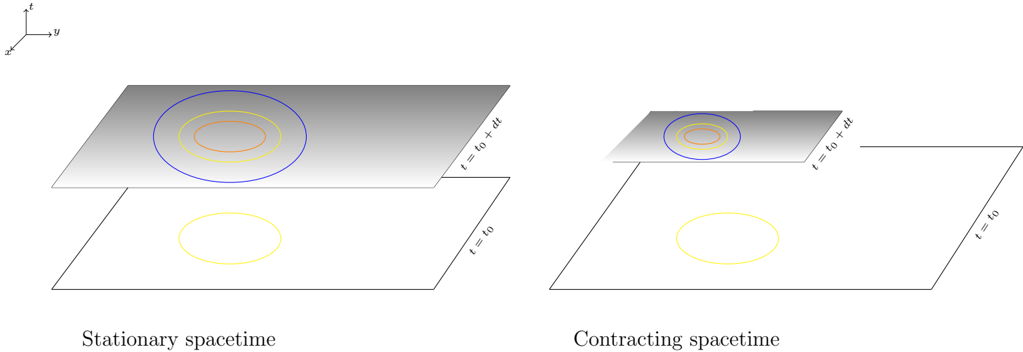

Verification
Claims the paper makes
0 Valid · 18 Not valid · 158 Not checked · 112 Own results and interpretations
A result the paper states — it cites no source for it, so there is none to check. The quote shows it is in the paper.
In the paper
“if θ is negative (positive) at some point and R ρν u ρ u ν ≥ 0 it follows that θ will reach an infinite negative value in finite affine parameter to the future (past)”
plainstates a cause- Asserted: passes — The authors put it forward as true.
- Checkable: passes — It can be checked against evidence.
- Load-bearing: passes — The paper’s conclusions depend on it.
- Based: passes — The paper gives a reason why it holds.
In the paper
“This is the first genuine post-Einstenian result in General Relativity”
- Also stated in: § 1. Introduction · p. 2 · plain
“the singularity theorems constitute the first genuine post-Einstenian content of classical GR”
What the sources say
- Not matchedcites [288]
The reference list we hold has no entry [288].
plain- Asserted: passes — The authors put it forward as true.
- Checkable: passes — It can be checked against evidence.
- Load-bearing: unclear — It is unclear whether the paper’s conclusions depend on it.
- Based: passes — The paper gives a reason why it holds.
- Also stated in: § 1. Introduction · p. 2 · plain
In the paper
“We review the first modern singularity theorem, published by Penrose in 1965.”
- Also stated in: § 1. Introduction · p. 1 · plain
“the first modern singularity theorem [248] were published in 1965”
What the sources say
- Not matchedcites [248]
The reference list we hold has no entry [248].
plain- Asserted: passes — The authors put it forward as true.
- Checkable: passes — It can be checked against evidence.
- Load-bearing: passes — The paper’s conclusions depend on it.
- Based: passes — The paper gives a reason why it holds.
- Also stated in: § 1. Introduction · p. 1 · plain
In the paper
“Penrose introduced geodesic incompleteness to characterize singularities (see subsection 4.1)”
What the sources say
- Not matchedcites [248]
The reference list we hold has no entry [248].
plainstates a cause- Asserted: passes — The authors put it forward as true.
- Checkable: passes — It can be checked against evidence.
- Load-bearing: unclear — It is unclear whether the paper’s conclusions depend on it.
- Based: passes — The paper gives a reason why it holds.
- Not matched
In the paper
“where the fundamental and fruitful concept of closed trapped surface was introduced.”
- Also stated in: § 1. Introduction · p. 2 · plain
“he presented the gravitational community with a precious gift in the form of a novel concept: closed trapped surfaces”
What the sources say
- Not matchedcites [248]
The reference list we hold has no entry [248].
plainstates a cause- Asserted: passes — The authors put it forward as true.
- Checkable: passes — It can be checked against evidence.
- Load-bearing: passes — The paper’s conclusions depend on it.
- Based: passes — The paper gives a reason why it holds.
- Also stated in: § 1. Introduction · p. 2 · plain
93 more claims
Create a free account to see all 288 claims and every source verdict.
- Probably not a substantial claim. 143
- It may state two separate claims as one. 97
Claims other papers make about this one
Each is checked against this paper’s own text: does it say what the citing paper says it does?
The source backs part of the claim, not all of it — or backs it for a different population, condition or comparison.
In the citing paper
“These theorems preclude singularity-free 'bounce' from occurring in the presence of any type of matter source with stress-energy tensor satisfying a very general condition of local energy non-negativity.”
From Weyl Curvature Hypothesis in Light of Quantum Backreaction at Cosmological Singularities or Bounces (2021) · cites this paper as [56]
Experimental — accuracy not yet measured
Citations
Cites
The Large Scale Structure of Space-Time
Hawking, S. W., & Ellis, G. F. R. (1973) · doi:10.1017/cbo9780511524646 · Cited by 10,624
Wald, R. M. (1984) · doi:10.7208/chicago/9780226870373.001.0001 · Cited by 7,188
Wald, R. M. (1984) · Cited by 6,274
Oppenheimer, J. R., & Volkoff, G. M. (1939) · Physical Review · doi:10.1103/physrev.55.374 · Cited by 4,030
Gravitational Field of a Spinning Mass as an Example of Algebraically Special Metrics
Kerr, R. P. (1963) · Physical Review Letters · doi:10.1103/physrevlett.11.237 · Cited by 3,551
Quantum Theory of Gravity. I. The Canonical Theory
DeWitt, B. S. (1967) · Physical Review · doi:10.1103/physrev.160.1113 · Cited by 3,385
Gravitational Collapse and Space-Time Singularities
Penrose, R. (1965) · Physical Review Letters · doi:10.1103/physrevlett.14.57 · Cited by 2,977
Cosmic Strings and Other Topological Defects
Vilenkin, A., & Shellard, E. P. S. (1985) · CERN Document Server (European Organization for Nuclear Research) · Cited by 2,816
Bondi, S. H. (1974) · Journal of the Franklin Institute · doi:10.1016/0016-0032(74)90062-3 · Cited by 2,797
An Approach to Gravitational Radiation by a Method of Spin Coefficients
Newman, E., & Penrose, R. (1962) · Journal of Mathematical Physics · doi:10.1063/1.1724257 · Cited by 2,702 · cited 1×
“¶ Penrose used an equation from [234] and did not refer to Raychaudhuri’s equation.”
Method
Research works printed but not linked: 10
- Belinskii, 1972, On a general cosmological solution of the Einstein equations with a time singularity, Zh. Eksp. Teoret. Fiz., 62, 1606
- de Sitter, 1917, On the relativity of inertia: remarks concerning Einstein's latest hypothesis, Proc. K. Ak. Amsterdam, 19, 1217
- Einstein, 1941, Demostración de la no existencia de campos gravitacionales sin singularidades de masa total no nula, Rev. Univ. Nac. de Tucumán, A2, 5
- Einstein, 1941, Rev. Univ. Nac. de Tucumán, A2, 11
- Friedman, 1999, Gen. Relativ. Gravit., 31, 2001, 10.1023/A:1026751225741 · DOI · Paper page
- Lanczos, 1922, Bemerkungen zur de Sitterschen Welt, Phys. Z., 23, 539
- Lemaître, 1927, Un Universe homogène de masse constante et de rayon croissant, rendant compte de la vittese radiale des nébuleuses extragalactiques, Ann. Soc. Sci. Brux. A, 47, 49
- Novikov, 1964, R- i T-oblasti v prostranstve-vremeni so sphericheski symmetrichnim prostranstvom (communications of the state Shternberg Astronomical Institute), Soobshch. GAISh, 132, 3
- Tipler, 1980, Singularities and horizons—a review article
- Weyl, 1923, On the general relativity theory, Phys. Z., 24, 230
Cited by
Items 201–243 of 243
Bohémier, K. (2021) · Science & Technology Libraries · doi:10.1080/0194262x.2021.1872464
Senovilla, J. M. M. (2021) · Europhysics news · doi:10.1051/epn/2021105
Self-citationCharged BTZ-type solutions in Eddington-inspired Born-Infeld gravity
Guerrero, M., Mora-Pérez, G., Olmo, G. J., Orazi, E., & Rubiera-García, D. (2021) · Journal of Cosmology and Astroparticle Physics · doi:10.1088/1475-7516/2021/11/025 · Cited by 12
Pre-main sequence evolution of low-mass stars in Eddington-inspired Born–Infeld gravity
Guerrero, M., Rubiera-García, D., & Wojnar, A. (2022) · The European Physical Journal C · doi:10.1140/epjc/s10052-022-10624-2
Schwarze Löcher sind reine Geometrie
Camenzind, M. (2021) · Springer eBooks · doi:10.1007/978-3-662-62882-9_7
Paolis, F. D., Hussain, I., MacCallum, M. A. H., & Qadir, A. (2019) · International Journal of Modern Physics D · doi:10.1142/s0218271820020010
Null Geodesics, Raychaudhuri Equation, Trapped Surfaces, and Penrose Singularity Theorem
Socolovsky, M. (2022) · Journal of High Energy Physics Gravitation and Cosmology · doi:10.4236/jhepgc.2022.83039
Efectos locales de la expansión cosmológica
Combi, L. (2022) · El Servicio de Difusión de la Creación Intelectual (National University of La Plata) · doi:10.35537/10915/146017
Using “Graviton Gas”, Suggesting Onset of Gravitational Quantum Pressure Using Very Simple Arguments
Beckwith, A. W. (2023) · Journal of High Energy Physics Gravitation and Cosmology · doi:10.4236/jhepgc.2023.92027
Beckwith, A. W. (2023) · Journal of High Energy Physics Gravitation and Cosmology · doi:10.4236/jhepgc.2023.92046
Teoremas de singularidade e condições de energia
Orselli, R. D. A. (2023) · Digital Library of Theses and Dissertations (Universidade de São Paulo) · doi:10.11606/d.43.2023.tde-25042023-144329
Yang, Y. (2023) · Oxford University Press eBooks · doi:10.1093/oso/9780192872616.003.0006
Schrödinger equation and quantum mechanics
Yang, Y. (2023) · Oxford University Press eBooks · doi:10.1093/oso/9780192872616.003.0002
(2023) · Oxford University Press eBooks · doi:10.1093/oso/9780192872616.002.0007
Yang, Y. (2023) · Oxford University Press eBooks · doi:10.1093/oso/9780192872616.003.0013
Yang, Y. (2023) · Oxford University Press eBooks · doi:10.1093/oso/9780192872616.003.0004
Canonical quantization of fields
Yang, Y. (2023) · Oxford University Press eBooks · doi:10.1093/oso/9780192872616.003.0015
Magnetic vortices in Abelian Higgs theory
Yang, Y. (2023) · Oxford University Press eBooks · doi:10.1093/oso/9780192872616.003.0008
Yang, Y. (2023) · Oxford University Press eBooks · doi:10.1093/oso/9780192872616.005.0001
(2023) · Oxford University Press eBooks · doi:10.1093/oso/9780192872616.002.0003
Non-Abelian gauge field equations
Yang, Y. (2023) · Oxford University Press eBooks · doi:10.1093/oso/9780192872616.003.0009
(2023) · Oxford University Press eBooks · doi:10.1093/oso/9780192872616.002.0004
Charged vortices and Chern–Simons equations
Yang, Y. (2023) · Oxford University Press eBooks · doi:10.1093/oso/9780192872616.003.0011
(2023) · Oxford University Press eBooks · doi:10.1093/oso/9780192872616.002.0006
Maxwell equations, Dirac monopole, and gauge fields
Yang, Y. (2023) · Oxford University Press eBooks · doi:10.1093/oso/9780192872616.003.0003
Yang, Y. (2023) · Oxford University Press eBooks · doi:10.1093/oso/9780192872616.003.0005
Skyrme model and related topics
Yang, Y. (2023) · Oxford University Press eBooks · doi:10.1093/oso/9780192872616.003.0012
Einstein equations and related topics
Yang, Y. (2023) · Oxford University Press eBooks · doi:10.1093/oso/9780192872616.003.0010
Averaged energy conditions for vector fields
Torralba, F. J. M. (2023) · Physics Letters B · doi:10.1016/j.physletb.2023.138211
How Much Cosmic Time Does It Take for a Star to Collapse Forming a Black Hole?Preprint
de Haro, J. (2024) · Preprints.org · doi:10.20944/preprints202401.1963.v2
Liu, T., & Zhang, R. (2025) · International Journal of Modern Physics A · doi:10.1142/s0217751x25500241 · Cited by 1
Born-Infeld inspired gravity in covariant canonical formalism
Klusoň, J. (2025) · Journal of Cosmology and Astroparticle Physics · doi:10.1088/1475-7516/2025/04/046
Bouncing completion of eternal inflation
Ferreira, A. L., Pinto-Neto, N., & Xavier, V. N. (2025) · Physical review. D/Physical review. D. · doi:10.1103/rl3f-v3p3 · Cited by 3
Non-singular bounce scenario of Higher dimensional dark energy cosmological model in Lyra geometry
Singh, K. P., & Meitei, A. J. (2025) · New Astronomy · doi:10.1016/j.newast.2025.102464
From geometry to observation: Gravitational waves and the Raychaudhuri equation
Bhunia, S., Dutta, A., Gangopadhyay, D., & Manna, G. (2025) · Physics of the Dark Universe · doi:10.1016/j.dark.2025.102089
Thermodynamic split conjecture and an observational test for cosmological entropy
Trivedi, O. (2026) · Physics of the Dark Universe · doi:10.1016/j.dark.2026.102255 · Cited by 6
Topological big bangs: reflection, itty-bitty blenders, and eternal trumpets
Bray, H. L., & Wheeler, J. C. (2025) · Classical and Quantum Gravity · doi:10.1088/1361-6382/ae20eb
Gaussian Planck relics are ruled-out as dark matter by LIGO
Trivedi, O., & Loeb, A. (2025) · Physics of the Dark Universe · doi:10.1016/j.dark.2025.102174 · Cited by 7
Probing Penrose-type singularities inside sonic black holes
Datta, S., & Fischer, U. R. (2025) · Classical and Quantum Gravity · doi:10.1088/1361-6382/ae2412 · Cited by 3
Quantum dust cores of rotating black holes
Bambagiotti, T., & Casadio, R. (2026) · Journal of Cosmology and Astroparticle Physics · doi:10.1088/1475-7516/2026/08/061
Cosmological implications of thermodynamic split conjecture
Trivedi, O. (2026) · Journal of Cosmology and Astroparticle Physics · doi:10.1088/1475-7516/2026/01/046 · Cited by 4
Bin-Asfour, M., Fayyaz, A., Abbas, G., & Alomar, M. (2026) · Nuclear Physics B · doi:10.1016/j.nuclphysb.2026.117346
Yao, J.-T., & Li, X. (2026) · Physical review. D/Physical review. D. · doi:10.1103/688k-qg81 · Cited by 4
Metadata
- Authors
- Senovilla, J. M. M., & Garfinkle, D.
- Affiliations
- University of the Basque Country (ES)
- Oakland University (US)
- Corresponding author
- Senovilla, José M M
- Garfinkle, David
- Venue
- Classical and Quantum Gravity
- Publisher
- IOP Publishing
- Published
- 2015-06-01
- Volume
- 32
- Issue
- 12
- Pages
- 124008
- ISSN
- 0264-9381 (ISSN-L)
- 1361-6382
- OpenAlex
- W2098149415
- Semantic Scholar
- ad6c465792ee37b0f53d35cdc19bf9fe09e9aebc
- Cited by
- 248
- References
- 381
- Citations by year
- 2026: 14 · 2025: 35 · 2024: 23 · 2023: 47 · 2022: 26 · 2021: 22 · 2020: 18 · 2019: 12 · 2018: 9 · 2017: 19 · 2016: 13 · 2015: 9
- FWCI
- 9.28
- Type
- journal article
- Language
- en
- Open access
- green
- arxiv.org
- Licence
- publishingsupport.iopscience.iop.org/iop-standard/v1 (vor)
- iopscience.iop.org/info/page/text-and-data-mining (tdm)
- Locations
- Classical and Quantum Gravity (publishedVersion)
- arXiv (Cornell University) (publishedVersion)
- arXiv (Cornell University)
- Topics
- Physical Sciences › Physics and Astronomy › Astronomy and Astrophysics › Relativity and Gravitational Theory
- Physical Sciences › Physics and Astronomy › Nuclear and High Energy Physics › Black Holes and Theoretical Physics
- Physical Sciences › Physics and Astronomy › Astronomy and Astrophysics › Cosmology and Gravitation Theories
- Keywords
- Penrose singularity theorem, singularity theorems, general relativity, cosmic censorship, black holes, history of general relativity
About these checks
Registry, retraction, Cites and statistics results are computed, not judged, with one exception: a printed reference that no index lists is read once by a model before it counts as a citation error. Claims are extracted by a model and kept only when their quote appears verbatim in the text; each cited source is then checked, with a model’s help, for whether it says what the claim relies on. Those verdicts can be wrong — read the claim’s quote and the cited source before relying on one.
A language model drew the claims from the paper on 2026-10-30, under version 3 of the claim definition (model deepseek-v4.1-flash, prompt extract-v3).
A second model labelled each claim on 2026-10-30 (model jev-1.13-20260917, definition revision gold-guideline-v0.2).
Statistics and arithmetic are recomputed, not judged.
Confidence bands are shown only for fields calibrated on our annotated test set. None is calibrated yet, so no band is shown.
What counts as a claim ›How we measure confidence ›How we check this ›
Are you an author, or do you see a problem with this page? Request a review
Data sources
Bibliographic data: Semantic Scholar, OpenAlex, Crossref.
Contains information from the Semantic Scholar Academic Graph Datasets, made available under the ODC Attribution License (ODC-BY 1.0).
Semantic Scholar’s data is described in: Kinney, R., et al. (2023). The Semantic Scholar Open Data Platform. arXiv:2301.10140.
