

The 1965 Penrose singularity theorem
Open accessThe DOI matches its Crossref record; 382 of the 382 references it cites were found in a registry or an index; none of the 288 sources its claims cite is checked for support yet.
Abstract
We review the first modern singularity theorem, published by Penrose in 1965. This is the first genuine post-Einsteinian result in general relativity, where the fundamental and fruitful concept of the closed trapped surface was introduced. We include historical remarks, an appraisal of the theorem's impact, and relevant current and future work that belongs to its legacy.
Overview
CoChat Summary
TL;DR
This review argues that Penrose’s 1965 theorem was the first modern singularity theorem in general relativity, introducing closed trapped surfaces and geodesic incompleteness as central ideas. It surveys the theorem’s historical context, immediate impact, and long-term legacy across black holes, cosmology, numerical relativity, and mathematical relativity.
Key findings
- Penrose’s theorem, in the modern form given in the review, states that if spacetime contains a non-compact Cauchy hypersurface and a closed future-trapped surface, and the null convergence condition holds, then there are future incomplete null geodesics.
- The paper identifies the closed trapped surface as the theorem’s key conceptual innovation: a compact 2-dimensional surface whose two future-directed orthogonal null expansions are negative, equivalently characterized by a timelike future-directed mean curvature vector.
- The review traces the theorem’s legacy through Hawking’s past-trapped surfaces in expanding universes, the Hawking–Penrose theorem, cosmic censorship, critical collapse, BKL singularities, trapped submanifolds, the Penrose inequality, and the hoop conjecture.
- It reports that numerical simulations indicate cosmic censorship holds in 4 spacetime dimensions but is violated in 5 spacetime dimensions by unstable black strings, which pinch off and form naked singularities.
Methods
- Review article: historical and conceptual survey of Penrose’s 1965 singularity theorem, with sections on pre-1955 and 1955–1965 work, the theorem itself, its impact, and XXI-century developments.
- No primary data or sample; the analysis synthesizes published theorems, proofs, examples, and literature references.
- Main approach is narrative and thematic synthesis rather than empirical or statistical analysis.
Limitations
- The paper states that the weakest point of the singularity theorems is their conclusions: they usually prove only the existence of at least one incomplete causal geodesic and say little about the singularity’s location, strength, extension, or character.
- The paper states that the differentiability assumption—metric twice differentiable with continuity—is restrictive and often ignored, and that physically realistic matched models may not satisfy it.
- The paper states that curvature/energy conditions can be violated by Λ > 0, inflation, and scalar fields, and that whether the initial/boundary condition is satisfied by actual physical systems is debatable; as a review, it also presents no new original results or data.
Model-written summary. Check it against the paper before relying on it.
Integrity signals
Registry
Cites
Statistics
Figures
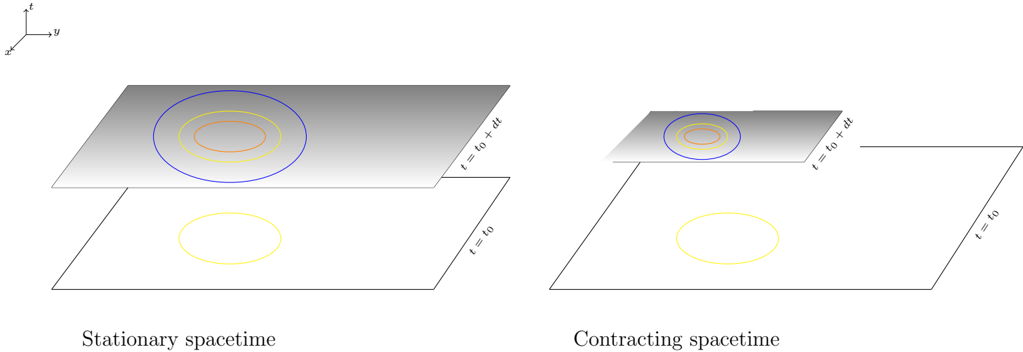

Verification
Claims the paper makes
0 Valid · 18 Not valid · 158 Not checked · 112 Own results and interpretations
A result the paper states — it cites no source for it, so there is none to check. The quote shows it is in the paper.
In the paper
“if θ is negative (positive) at some point and R ρν u ρ u ν ≥ 0 it follows that θ will reach an infinite negative value in finite affine parameter to the future (past)”
plainstates a cause- Asserted: passes — The authors put it forward as true.
- Checkable: passes — It can be checked against evidence.
- Load-bearing: passes — The paper’s conclusions depend on it.
- Based: passes — The paper gives a reason why it holds.
In the paper
“This is the first genuine post-Einstenian result in General Relativity”
- Also stated in: § 1. Introduction · p. 2 · plain
“the singularity theorems constitute the first genuine post-Einstenian content of classical GR”
What the sources say
- Not matchedcites [288]
The reference list we hold has no entry [288].
plain- Asserted: passes — The authors put it forward as true.
- Checkable: passes — It can be checked against evidence.
- Load-bearing: unclear — It is unclear whether the paper’s conclusions depend on it.
- Based: passes — The paper gives a reason why it holds.
- Also stated in: § 1. Introduction · p. 2 · plain
In the paper
“We review the first modern singularity theorem, published by Penrose in 1965.”
- Also stated in: § 1. Introduction · p. 1 · plain
“the first modern singularity theorem [248] were published in 1965”
What the sources say
- Not matchedcites [248]
The reference list we hold has no entry [248].
plain- Asserted: passes — The authors put it forward as true.
- Checkable: passes — It can be checked against evidence.
- Load-bearing: passes — The paper’s conclusions depend on it.
- Based: passes — The paper gives a reason why it holds.
- Also stated in: § 1. Introduction · p. 1 · plain
In the paper
“Penrose introduced geodesic incompleteness to characterize singularities (see subsection 4.1)”
What the sources say
- Not matchedcites [248]
The reference list we hold has no entry [248].
plainstates a cause- Asserted: passes — The authors put it forward as true.
- Checkable: passes — It can be checked against evidence.
- Load-bearing: unclear — It is unclear whether the paper’s conclusions depend on it.
- Based: passes — The paper gives a reason why it holds.
- Not matched
In the paper
“where the fundamental and fruitful concept of closed trapped surface was introduced.”
- Also stated in: § 1. Introduction · p. 2 · plain
“he presented the gravitational community with a precious gift in the form of a novel concept: closed trapped surfaces”
What the sources say
- Not matchedcites [248]
The reference list we hold has no entry [248].
plainstates a cause- Asserted: passes — The authors put it forward as true.
- Checkable: passes — It can be checked against evidence.
- Load-bearing: passes — The paper’s conclusions depend on it.
- Based: passes — The paper gives a reason why it holds.
- Also stated in: § 1. Introduction · p. 2 · plain
93 more claims
Create a free account to see all 288 claims and every source verdict.
- Probably not a substantial claim. 143
- It may state two separate claims as one. 97
Claims other papers make about this one
Each is checked against this paper’s own text: does it say what the citing paper says it does?
The source backs part of the claim, not all of it — or backs it for a different population, condition or comparison.
In the citing paper
“These theorems preclude singularity-free 'bounce' from occurring in the presence of any type of matter source with stress-energy tensor satisfying a very general condition of local energy non-negativity.”
From Weyl Curvature Hypothesis in Light of Quantum Backreaction at Cosmological Singularities or Bounces (2021) · cites this paper as [56]
Experimental — accuracy not yet measured
Citations
Cites
The Large Scale Structure of Space-Time
Hawking, S. W., & Ellis, G. F. R. (1973) · doi:10.1017/cbo9780511524646 · Cited by 10,624
Wald, R. M. (1984) · doi:10.7208/chicago/9780226870373.001.0001 · Cited by 7,188
Wald, R. M. (1984) · Cited by 6,274
Oppenheimer, J. R., & Volkoff, G. M. (1939) · Physical Review · doi:10.1103/physrev.55.374 · Cited by 4,030
Gravitational Field of a Spinning Mass as an Example of Algebraically Special Metrics
Kerr, R. P. (1963) · Physical Review Letters · doi:10.1103/physrevlett.11.237 · Cited by 3,551
Quantum Theory of Gravity. I. The Canonical Theory
DeWitt, B. S. (1967) · Physical Review · doi:10.1103/physrev.160.1113 · Cited by 3,385
Gravitational Collapse and Space-Time Singularities
Penrose, R. (1965) · Physical Review Letters · doi:10.1103/physrevlett.14.57 · Cited by 2,977
Cosmic Strings and Other Topological Defects
Vilenkin, A., & Shellard, E. P. S. (1985) · CERN Document Server (European Organization for Nuclear Research) · Cited by 2,816
Bondi, S. H. (1974) · Journal of the Franklin Institute · doi:10.1016/0016-0032(74)90062-3 · Cited by 2,797
An Approach to Gravitational Radiation by a Method of Spin Coefficients
Newman, E., & Penrose, R. (1962) · Journal of Mathematical Physics · doi:10.1063/1.1724257 · Cited by 2,702 · cited 1×
“¶ Penrose used an equation from [234] and did not refer to Raychaudhuri’s equation.”
Method
Research works printed but not linked: 10
- Belinskii, 1972, On a general cosmological solution of the Einstein equations with a time singularity, Zh. Eksp. Teoret. Fiz., 62, 1606
- de Sitter, 1917, On the relativity of inertia: remarks concerning Einstein's latest hypothesis, Proc. K. Ak. Amsterdam, 19, 1217
- Einstein, 1941, Demostración de la no existencia de campos gravitacionales sin singularidades de masa total no nula, Rev. Univ. Nac. de Tucumán, A2, 5
- Einstein, 1941, Rev. Univ. Nac. de Tucumán, A2, 11
- Friedman, 1999, Gen. Relativ. Gravit., 31, 2001, 10.1023/A:1026751225741 · DOI · Paper page
- Lanczos, 1922, Bemerkungen zur de Sitterschen Welt, Phys. Z., 23, 539
- Lemaître, 1927, Un Universe homogène de masse constante et de rayon croissant, rendant compte de la vittese radiale des nébuleuses extragalactiques, Ann. Soc. Sci. Brux. A, 47, 49
- Novikov, 1964, R- i T-oblasti v prostranstve-vremeni so sphericheski symmetrichnim prostranstvom (communications of the state Shternberg Astronomical Institute), Soobshch. GAISh, 132, 3
- Tipler, 1980, Singularities and horizons—a review article
- Weyl, 1923, On the general relativity theory, Phys. Z., 24, 230
Cited by
Items 101–200 of 243
Gravitational collapse of baryonic and dark matter
Dey, D., & Joshi, P. S. (2019) · Arabian Journal of Mathematics · doi:10.1007/s40065-019-0252-x · Cited by 15
Charged BTZ-type solutions in Eddington-inspired Born-Infeld gravity
Guerrero, M., Mora-Pérez, G., Olmo, G. J., Orazi, E., & Rubiera-García, D. (2021) · Docta Complutense (Universidad Complutense de Madrid) · Cited by 10
Gravitational collapse without singularity formation in Brans–Dicke theory
Ziaie, A. H., Shabani, H., & Moradpour, H. (2024) · The European Physical Journal Plus · doi:10.1140/epjp/s13360-024-04904-x · Cited by 11
Chakraborty, M., & Chakraborty, S. (2024) · Physics of the Dark Universe · doi:10.1016/j.dark.2024.101607 · Cited by 9
Spectroscopy of bumpy BHs: The nonrotating case
Weller, C. M., Li, D., & Chen, Y. (2025) · Physical review. D/Physical review. D. · doi:10.1103/physrevd.111.024064 · Cited by 11
Umbilical Properties of Spacelike Co-dimension Two Submanifolds
Cipriani, N., Senovilla, J. M. M., & der Veken, J. V. (2017) · Results in Mathematics · doi:10.1007/s00025-016-0640-x · Cited by 9
Self-citationYang, Y. (2023) · Physical review. D/Physical review. D. · doi:10.1103/physrevd.107.085007 · Cited by 12
Constraints on metric-affine gravity black holes from the stellar motion at the Galactic Center
Martino, I. D., Monica, R. D., & Rubiera-García, D. (2024) · Physical review. D/Physical review. D. · doi:10.1103/physrevd.109.024016 · Cited by 13
From fundamental physics to tests with compact objects in metric-affine theories of gravity
Rubiera-García, D. (2020) · International Journal of Modern Physics D · doi:10.1142/s0218271820410072 · Cited by 11
Weyl Curvature Hypothesis in Light of Quantum Backreaction at Cosmological Singularities or Bounces
Hu, B.-L. (2021) · Universe · doi:10.3390/universe7110424 · Cited by 8
Curvature form of Raychaudhuri equation and its consequences: A geometric approach
Chakraborty, M., & Chakraborty, S. (2024) · Annals of Physics · doi:10.1016/j.aop.2024.169818 · Cited by 8
Generalizations of the abstract boundary singularity theorem
Whale, B. E., Ashley, M. J. S. L., & Scott, S. M. (2015) · Classical and Quantum Gravity · doi:10.1088/0264-9381/32/13/135001 · Cited by 8
Twisted black hole is Taub-NUT
Ong, Y. C. (2017) · Journal of Cosmology and Astroparticle Physics · doi:10.1088/1475-7516/2017/01/001 · Cited by 8
Bonus properties of states of low energy
Banerjee, R., & Niedermaier, M. R. (2020) · Journal of Mathematical Physics · doi:10.1063/5.0019311 · Cited by 11
Dynamics of the four kinds of Trapping Horizons and Existence of Hawking RadiationPreprint
Helou, A. (2015) · arXiv (Cornell University) · doi:10.48550/arxiv.1505.07371 · Cited by 8
The backreaction problem for black holes in semiclassical gravity
del Río, A. (2025) · General Relativity and Gravitation · doi:10.1007/s10714-025-03352-x · Cited by 9
Timelike convergence condition in regular black-hole spacetimes with (anti–)de Sitter core
Borissova, J. N., Liberati, S., & Visser, M. (2025) · Physical review. D/Physical review. D. · doi:10.1103/rrc9-g1sv · Cited by 14
Can Quantum Particles Cross a Horizon?
Gogberashvili, M. (2019) · International Journal of Theoretical Physics · doi:10.1007/s10773-019-04242-0 · Cited by 10
Mathematical Physics with Differential Equations
Yang, Y. (2023) · doi:10.1093/oso/9780192872616.001.0001 · Cited by 14
Non-singular collapse scenario from matter–curvature coupling
Ziaie, A. H., Moradpour, H., & Sabet, M. T. M. (2021) · The European Physical Journal Plus · doi:10.1140/epjp/s13360-021-02082-8 · Cited by 6
The influence of Penrose’s singularity theorem in general relativity
Senovilla, J. M. M. (2022) · General Relativity and Gravitation · doi:10.1007/s10714-022-03038-8 · Cited by 10
Self-citationBeyond black holes: universal properties of ‘ultra-massive’ spacetimes
Senovilla, J. M. M. (2023) · Classical and Quantum Gravity · doi:10.1088/1361-6382/acdc00 · Cited by 6
Self-citationGeodesically complete universes
Carballo-Rubio, R., Liberati, S., & Vellucci, V. (2024) · Physical review. D/Physical review. D. · doi:10.1103/physrevd.110.044055 · Cited by 8
Physical black holes in semiclassical gravity
Murk, S., & Terno, D. R. (2023) · The Ninth Marcel Grossmann Meeting · doi:10.1142/9789811269776_0095 · Cited by 10
Form Invariance of Raychaudhuri Equation in the Presence of Inflaton‐Type Fields
Panda, A., Gangopadhyay, D., & Manna, G. (2024) · Fortschritte der Physik · doi:10.1002/prop.202400134 · Cited by 10
Singular space-times with bounded algebraic curvature scalars
Magalhães, R. B., Ribeiro, G. P., Lima, H. C. D., Olmo, G. J., & Crispino, L. C. B. (2024) · Journal of Cosmology and Astroparticle Physics · doi:10.1088/1475-7516/2024/05/114 · Cited by 9
A diffeomorphism invariant family of metric-affine actions for loop cosmologies
Delhom, A., Olmo, G. J., & Singh, P. (2023) · Journal of Cosmology and Astroparticle Physics · doi:10.1088/1475-7516/2023/06/059 · Cited by 10
Lima, H. C. D., Magalhães, R. B., Olmo, G. J., & Rubiera-García, D. (2025) · Classical and Quantum Gravity · doi:10.1088/1361-6382/ae1880 · Cited by 16
Priyobarta, N., Singh, K. N., Maurya, S. K., & Mishra, B. (2025) · Chinese Journal of Physics · doi:10.1016/j.cjph.2025.12.004 · Cited by 5
Quasi-normal modes and shadows of scale-dependent regular black holes
Koch, B., Olmo, G. J., Riahinia, A., Rincón, Á., & Rubiera-García, D. (2026) · Journal of Cosmology and Astroparticle Physics · doi:10.1088/1475-7516/2026/03/048 · Cited by 18
Panda, A., Gangopadhyay, D., & Manna, G. (2024) · Astroparticle Physics · doi:10.1016/j.astropartphys.2024.103059 · Cited by 10
Bridging time across null horizons
Zenginoğlu, A. (2025) · General Relativity and Gravitation · doi:10.1007/s10714-025-03410-4 · Cited by 5
Singularity theorems for warped products and the stability of spatial extra dimensions
Cipriani, N., & Senovilla, J. M. M. (2019) · Journal of High Energy Physics · doi:10.1007/jhep04(2019)175 · Cited by 6
Self-citationGeodesic completeness of a ring wormhole
Águila, J. C. D., & Matos, T. (2023) · Physical review. D/Physical review. D. · doi:10.1103/physrevd.107.064047 · Cited by 5
Guerrero, M., Olmo, G. J., & Rubiera-García, D. (2023) · The European Physical Journal C · doi:10.1140/epjc/s10052-023-11969-y · Cited by 5
Adler, S. L. (2024) · Physical review. D/Physical review. D. · doi:10.1103/physrevd.109.024020 · Cited by 5
On the structure of black bounces sourced by anisotropic fluids
Lessa, L. A., & Olmo, G. J. (2025) · Journal of Cosmology and Astroparticle Physics · doi:10.1088/1475-7516/2025/03/019 · Cited by 5
“All that Matter … in One Big Bang …”, &Other Cosmological Singularities
Elizalde, E. (2018) · Galaxies · doi:10.3390/galaxies6010025 · Cited by 6
Singularity-Free and Cosmologically Viable Born-Infeld Gravity with Scalar Matter
Benisty, D., Olmo, G. J., & Rubiera-García, D. (2021) · Symmetry · doi:10.3390/sym13112108 · Cited by 8
Báez, C. (2021) · Cambridge University Press eBooks · doi:10.1017/9781108854399.010 · Cited by 5
Comment on “Quantum Raychaudhuri equation”
Lashin, E. I., & Djamel Dou, A. (2017) · Physical review. D/Physical review. D. · doi:10.1103/physrevd.95.068501 · Cited by 4
Singularity theorems in Schwarzschild spacetimes
Vargas-Serdio, S., & Quevedo, H. (2020) · The European Physical Journal Plus · doi:10.1140/epjp/s13360-020-00636-w · Cited by 5
Dynamics of the General Bianchi IX Model near a Cosmological Singularity
Parnovsky, S. L. (2022) · Ukrainian Journal of Physics · doi:10.15407/ujpe67.2.93 · Cited by 5
Eternal versus singular observers in interacting dark-energy–dark-matter models
Álvarez-Ortega, D., Olmo, G. J., Rubiera-García, D., & Gómez, D. S.-C. (2022) · Physical review. D/Physical review. D. · doi:10.1103/physrevd.106.023523 · Cited by 5
Quantum Propagators for Geodesic Congruences
Instituto de Ciencias Nucleares, U. N. A. D. M., & Socolovsky, M. (2021) · Theoretical Physics · doi:10.22606/tp.2021.62001 · Cited by 4
Geometric aspects of Raychaudhuri equation and implications in nonsingular universe
Chakraborty, M., & Chakraborty, S. (2025) · International Journal of Modern Physics A · doi:10.1142/s0217751x25500393 · Cited by 3
Beckwith, A. W. (2026) · Journal of High Energy Physics Gravitation and Cosmology · doi:10.4236/jhepgc.2026.121028 · Cited by 3
Scott, S. M., & Whale, B. E. (2021) · Classical and Quantum Gravity · doi:10.1088/1361-6382/abe1fe · Cited by 5
From disformal electrodynamics to exotic spacetime singularities
Bittencourt, E., Fernandes, R., Goulart, É., & Ottoni, J. E. (2023) · Classical and Quantum Gravity · doi:10.1088/1361-6382/acf9d7 · Cited by 5
Nojiri, S., & NASHED, G. G. L. (2024) · Physical review. D/Physical review. D. · doi:10.1103/physrevd.110.084073 · Cited by 4
Spacetimes as Topological Spaces, and the Need to Take Methods of General Topology More Seriously
Papadopoulos, K., & Scardigli, F. (2019) · Springer eBooks · doi:10.1007/978-3-030-15242-0_6 · Cited by 6
Interiors of Terrestrial Planets in Metric-Affine Gravity
Kozak, A., & Wojnar, A. (2021) · Universe · doi:10.3390/universe8010003 · Cited by 22
Myers and Hawking Theorems: Geometry for the Limits of the Universe
Morales-Álvarez, P., & Sánchez, M. (2015) · Milan Journal of Mathematics · doi:10.1007/s00032-015-0241-2 · Cited by 3
How not to extract information from black holes: Cosmic censorship as a guiding principle
Gennaro, S. D., & Ong, Y. C. (2022) · Physics Letters B · doi:10.1016/j.physletb.2022.137112 · Cited by 6
Violations of the Null Energy Condition in QFT and their Implications
Krommydas, D. (2018) · arXiv · doi:10.48550/arxiv.1806.00107
Instability of marginally outer trapped surfaces from initial data set symmetry
Sherif, A. M. (2025) · Classical and Quantum Gravity · doi:10.1088/1361-6382/ade58b · Cited by 2
Trivedi, O., & Venkatasubramanian, V. (2026) · Physics of the Dark Universe · doi:10.1016/j.dark.2026.102277 · Cited by 4
Multiphoton ring structure of reflection-asymmetric traversable thin-shell wormholes
Macedo, C. F. B., Rosa, J. L., Rubiera-García, D., & Rueda, A. (2026) · Physical review. D/Physical review. D. · doi:10.1103/wzxv-9wk1 · Cited by 14
Regular black holes in general relativity from nonlinear electrodynamics with de Sitter cores
Filho, A. A. A., Ednaldo, L. B., S., J. T. S., Lobo, F. S. N., Ramos, J. S., Rodrigues, M. E., Rubiera-García, D., da Silva, L. F. D., & Vieira, H. A. (2026) · Physics of the Dark Universe · doi:10.1016/j.dark.2026.102396 · Cited by 2
Regular Black Holes in Palatini Gravity
Olmo, G. J., & Rubiera-García, D. (2023) · Springer Series in Astrophysics and Cosmology · doi:10.1007/978-981-99-1596-5_6 · Cited by 17
Nonsingular, Lump-like, Scalar Compact Objects in (2 + 1)-Dimensional Einstein Gravity
Maluf, R. V., Mora-Pérez, G., Olmo, G. J., & Rubiera-García, D. (2024) · Universe · doi:10.3390/universe10060258 · Cited by 2
Aspects of a novel nonlinear electrodynamics in flat spacetime and in a gravity-coupled scenario
Kar, A. (2024) · The European Physical Journal C · doi:10.1140/epjc/s10052-024-13603-x · Cited by 2
Short-hair black holes and the strong cosmic censorship conjecture
Tu, Z., Tang, M., & Xu, Z. (2024) · The European Physical Journal C · doi:10.1140/epjc/s10052-024-13653-1 · Cited by 3
Analog charged black hole formation via percolation: Exploring cosmic censorship and Hoop conjecture
Jaiswal, N., & Shankaranarayanan, S. (2025) · Physical review. D/Physical review. D. · doi:10.1103/physrevd.111.l101502 · Cited by 2
An analytic model for gravitational collapse of spherical matter under mixed pressure
Yokoyama, S. (2023) · International Journal of Modern Physics D · doi:10.1142/s0218271823500189 · Cited by 3
Horizonless, singularity-free, compact shells satisfying NEC
Shankar, K. H. (2017) · General Relativity and Gravitation · doi:10.1007/s10714-017-2196-9 · Cited by 2
NONSINGULAR BLACK HOLES IN PALATINI EXTENSIONS OF GENERAL RELATIVITY
Olmo, G. J., & Rubiera-García, D. (2015) · The Ninth Marcel Grossmann Meeting · doi:10.1142/9789814623995_0133 · Cited by 5
Cosmic censorship hypothesis and entropy bound on black holes in a canonical ensemble
Yang, R.-Q. (2021) · Physical review. D/Physical review. D. · doi:10.1103/physrevd.103.024050 · Cited by 2
Black hole evaporation as a Cosmic CensorPreprint
Düztaş, K., & Semiz, İ. (2015) · arXiv (Cornell University) · Cited by 2
The classical double copy of regular non-singular black holes.Preprint
Easson, D. A., Keeler, C. A., & Manton, T. (2020) · arXiv (Cornell University) · Cited by 2
Born–Infeld theory of electromagnetism
Yang, Y. (2023) · Oxford University Press eBooks · doi:10.1093/oso/9780192872616.003.0014 · Cited by 4
Anisotropies and modified gravity theories in stellar and substellar objects
Chowdhury, S. (2023) · International Journal of Geometric Methods in Modern Physics · doi:10.1142/s0219887824300022 · Cited by 1
After Collapse: On How a Physical Vacuum Can Change the Black Hole Paradigm
Arrechea, J., Barceló, C., & Boyanov, V. (2024) · Springer Series in Astrophysics and Cosmology · doi:10.1007/978-981-97-1172-7_1 · Cited by 8
Singular bounce in the theory of gravity with nonminimal derivative coupling
Sushkov, S. V., & Galeev, R. (2025) · Physical review. D/Physical review. D. · doi:10.1103/physrevd.111.083554 · Cited by 3
Perfect fluids and cosmological expansion arising from Born–Infeld type theory
Liu, T., & Zhang, R. (2025) · Journal of Mathematical Physics · doi:10.1063/5.0274320 · Cited by 1
Pyknons: A Suggestion for Rebranding Black Holes
Iorio, L. (2025) · Universe · doi:10.3390/universe11080251 · Cited by 2
Lehmkuhl, D. (2025) · Physics in Perspective · doi:10.1007/s00016-025-00331-2 · Cited by 15
Regular black holes and complete monotonicity
Almasi, A., Moradpouri, A., & Shahbazi, M. (2025) · Journal of High Energy Physics · doi:10.1007/jhep09(2025)208 · Cited by 2
Xie, Y., Narayan, G., & Yunes, N. (2026) · Physical Review Letters · doi:10.1103/n1pb-jt1n · Cited by 10
Kasner singularity of black holes in Einstein-scalar gravity
Xiong, Z.-X., & Lü, H. (2026) · Physical review. D/Physical review. D. · doi:10.1103/rs6w-vgwm · Cited by 5
Observational appearance and photon rings of nonsingular black holes from anisotropic fluids
Díaz-Guerra, D., Rincón, Á., & Rubiera-García, D. (2026) · Physical review. D/Physical review. D. · doi:10.1103/z7mw-d6hl · Cited by 1
Lazarev, S. V. (2026) · Journal of High Energy Physics Gravitation and Cosmology · doi:10.4236/jhepgc.2026.124102 · Cited by 1
Beckwith, A. W. (2017) · Journal of High Energy Physics Gravitation and Cosmology · doi:10.4236/jhepgc.2017.34041 · Cited by 1
On the Trapped Surface Characterization of Black Hole Region in Vaidya Spacetime
Kumah, M., & Oduro, F. T. (2018) · Journal of Mathematics Research · doi:10.5539/jmr.v10n1p59 · Cited by 1
Hamiltonian systems and applications
Yang, Y. (2023) · Oxford University Press eBooks · doi:10.1093/oso/9780192872616.003.0001 · Cited by 1
A finite dimensional approach to light rays in General Relativity
Giambò, R., Giannoni, F., & Piccione, P. (2017) · Nonlinear Analysis · doi:10.1016/j.na.2017.11.014 · Cited by 1
Constraints on generalized Eddington-inspired Born-Infeld branes
Lin, Z.-C., Yang, K., Zhang, Y., Wang, J., & Liu, Y.-X. (2019) · Physical review. D/Physical review. D. · doi:10.1103/physrevd.99.084020 · Cited by 1
Beckwith, A. W. (2021) · Journal of High Energy Physics Gravitation and Cosmology · doi:10.4236/jhepgc.2021.71008 · Cited by 1
Initial data and black holes for matter modelsPreprint
Burtscher, A. (2019) · arXiv (Cornell University) · doi:10.48550/arxiv.1901.08346 · Cited by 1
Ginzburg–Landau equations for superconductivity
Yang, Y. (2023) · Oxford University Press eBooks · doi:10.1093/oso/9780192872616.003.0007 · Cited by 1
Modified gravity theories at different curvature scales
Mandal, S., & Shankaranarayanan, S. (2025) · Elsevier eBooks · doi:10.1016/b978-0-443-21439-4.00106-1 · Cited by 4
Schwarze Löcher sind reine Geometrie
Camenzind, M. (2016) · Springer eBooks · doi:10.1007/978-3-662-47839-4_7
Pérez, D. (2016) · El Servicio de Difusión de la Creación Intelectual (National University of La Plata) · doi:10.35537/10915/54723 · Cited by 1
Time and Spacetime in General Relativity (GR)
Anderson, E. J. (2017) · Fundamental theories of physics · doi:10.1007/978-3-319-58848-3_7
Anderson, E. J. (2017) · Fundamental theories of physics · doi:10.1007/978-3-319-58848-3_8
On the Trapped Surface Characterization of the Black Hole Region in Kerr Spacetime
Kumah, M., & Oduro, F. T. (2018) · Journal of Mathematics Research · doi:10.5539/jmr.v10n4p24
On the singular coordinate transformations of the Schwarzschild metricPreprint
Gogberashvili, M. (2018) · arXiv (Cornell University) · doi:10.48550/arxiv.1809.07173
Geodesics near a curvature singularity of stationary and axially symmetric space–times
Águila, J. C. D., & Matos, T. (2020) · Classical and Quantum Gravity · doi:10.1088/1361-6382/abd595
Metadata
- Authors
- Senovilla, J. M. M., & Garfinkle, D.
- Affiliations
- University of the Basque Country (ES)
- Oakland University (US)
- Corresponding author
- Senovilla, José M M
- Garfinkle, David
- Venue
- Classical and Quantum Gravity
- Publisher
- IOP Publishing
- Published
- 2015-06-01
- Volume
- 32
- Issue
- 12
- Pages
- 124008
- ISSN
- 0264-9381 (ISSN-L)
- 1361-6382
- OpenAlex
- W2098149415
- Semantic Scholar
- ad6c465792ee37b0f53d35cdc19bf9fe09e9aebc
- Cited by
- 248
- References
- 381
- Citations by year
- 2026: 14 · 2025: 35 · 2024: 23 · 2023: 47 · 2022: 26 · 2021: 22 · 2020: 18 · 2019: 12 · 2018: 9 · 2017: 19 · 2016: 13 · 2015: 9
- FWCI
- 9.28
- Type
- journal article
- Language
- en
- Open access
- green
- arxiv.org
- Licence
- publishingsupport.iopscience.iop.org/iop-standard/v1 (vor)
- iopscience.iop.org/info/page/text-and-data-mining (tdm)
- Locations
- Classical and Quantum Gravity (publishedVersion)
- arXiv (Cornell University) (publishedVersion)
- arXiv (Cornell University)
- Topics
- Physical Sciences › Physics and Astronomy › Astronomy and Astrophysics › Relativity and Gravitational Theory
- Physical Sciences › Physics and Astronomy › Nuclear and High Energy Physics › Black Holes and Theoretical Physics
- Physical Sciences › Physics and Astronomy › Astronomy and Astrophysics › Cosmology and Gravitation Theories
- Keywords
- Penrose singularity theorem, singularity theorems, general relativity, cosmic censorship, black holes, history of general relativity
About these checks
Registry, retraction, Cites and statistics results are computed, not judged, with one exception: a printed reference that no index lists is read once by a model before it counts as a citation error. Claims are extracted by a model and kept only when their quote appears verbatim in the text; each cited source is then checked, with a model’s help, for whether it says what the claim relies on. Those verdicts can be wrong — read the claim’s quote and the cited source before relying on one.
A language model drew the claims from the paper on 2026-10-30, under version 3 of the claim definition (model deepseek-v4.1-flash, prompt extract-v3).
A second model labelled each claim on 2026-10-30 (model jev-1.13-20260917, definition revision gold-guideline-v0.2).
Statistics and arithmetic are recomputed, not judged.
Confidence bands are shown only for fields calibrated on our annotated test set. None is calibrated yet, so no band is shown.
What counts as a claim ›How we measure confidence ›How we check this ›
Are you an author, or do you see a problem with this page? Request a review
Data sources
Bibliographic data: Semantic Scholar, OpenAlex, Crossref.
Contains information from the Semantic Scholar Academic Graph Datasets, made available under the ODC Attribution License (ODC-BY 1.0).
Semantic Scholar’s data is described in: Kinney, R., et al. (2023). The Semantic Scholar Open Data Platform. arXiv:2301.10140.
