

The 1965 Penrose singularity theorem
Open accessThe DOI matches its Crossref record; 382 of the 382 references it cites were found in a registry or an index; none of the 288 sources its claims cite is checked for support yet.
Abstract
We review the first modern singularity theorem, published by Penrose in 1965. This is the first genuine post-Einsteinian result in general relativity, where the fundamental and fruitful concept of the closed trapped surface was introduced. We include historical remarks, an appraisal of the theorem's impact, and relevant current and future work that belongs to its legacy.
Overview
CoChat Summary
TL;DR
This review argues that Penrose’s 1965 theorem was the first modern singularity theorem in general relativity, introducing closed trapped surfaces and geodesic incompleteness as central ideas. It surveys the theorem’s historical context, immediate impact, and long-term legacy across black holes, cosmology, numerical relativity, and mathematical relativity.
Key findings
- Penrose’s theorem, in the modern form given in the review, states that if spacetime contains a non-compact Cauchy hypersurface and a closed future-trapped surface, and the null convergence condition holds, then there are future incomplete null geodesics.
- The paper identifies the closed trapped surface as the theorem’s key conceptual innovation: a compact 2-dimensional surface whose two future-directed orthogonal null expansions are negative, equivalently characterized by a timelike future-directed mean curvature vector.
- The review traces the theorem’s legacy through Hawking’s past-trapped surfaces in expanding universes, the Hawking–Penrose theorem, cosmic censorship, critical collapse, BKL singularities, trapped submanifolds, the Penrose inequality, and the hoop conjecture.
- It reports that numerical simulations indicate cosmic censorship holds in 4 spacetime dimensions but is violated in 5 spacetime dimensions by unstable black strings, which pinch off and form naked singularities.
Methods
- Review article: historical and conceptual survey of Penrose’s 1965 singularity theorem, with sections on pre-1955 and 1955–1965 work, the theorem itself, its impact, and XXI-century developments.
- No primary data or sample; the analysis synthesizes published theorems, proofs, examples, and literature references.
- Main approach is narrative and thematic synthesis rather than empirical or statistical analysis.
Limitations
- The paper states that the weakest point of the singularity theorems is their conclusions: they usually prove only the existence of at least one incomplete causal geodesic and say little about the singularity’s location, strength, extension, or character.
- The paper states that the differentiability assumption—metric twice differentiable with continuity—is restrictive and often ignored, and that physically realistic matched models may not satisfy it.
- The paper states that curvature/energy conditions can be violated by Λ > 0, inflation, and scalar fields, and that whether the initial/boundary condition is satisfied by actual physical systems is debatable; as a review, it also presents no new original results or data.
Model-written summary. Check it against the paper before relying on it.
Integrity signals
Registry
Cites
Statistics
Figures
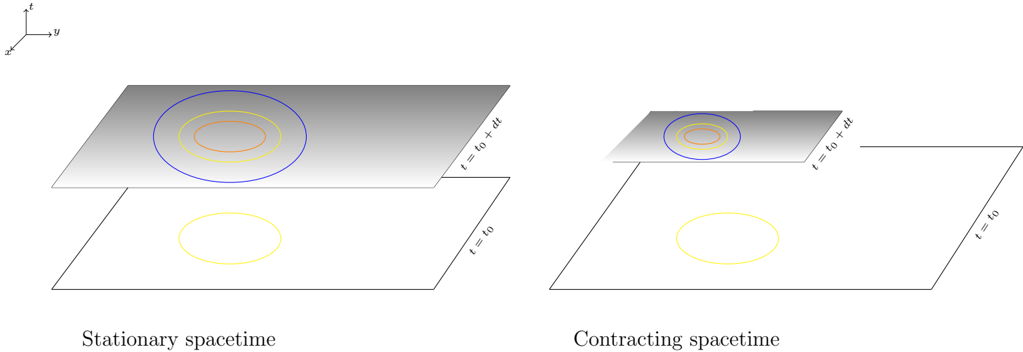

Verification
Claims the paper makes
0 Valid · 18 Not valid · 158 Not checked · 112 Own results and interpretations
A result the paper states — it cites no source for it, so there is none to check. The quote shows it is in the paper.
In the paper
“if θ is negative (positive) at some point and R ρν u ρ u ν ≥ 0 it follows that θ will reach an infinite negative value in finite affine parameter to the future (past)”
plainstates a cause- Asserted: passes — The authors put it forward as true.
- Checkable: passes — It can be checked against evidence.
- Load-bearing: passes — The paper’s conclusions depend on it.
- Based: passes — The paper gives a reason why it holds.
In the paper
“This is the first genuine post-Einstenian result in General Relativity”
- Also stated in: § 1. Introduction · p. 2 · plain
“the singularity theorems constitute the first genuine post-Einstenian content of classical GR”
What the sources say
- Not matchedcites [288]
The reference list we hold has no entry [288].
plain- Asserted: passes — The authors put it forward as true.
- Checkable: passes — It can be checked against evidence.
- Load-bearing: unclear — It is unclear whether the paper’s conclusions depend on it.
- Based: passes — The paper gives a reason why it holds.
- Also stated in: § 1. Introduction · p. 2 · plain
In the paper
“We review the first modern singularity theorem, published by Penrose in 1965.”
- Also stated in: § 1. Introduction · p. 1 · plain
“the first modern singularity theorem [248] were published in 1965”
What the sources say
- Not matchedcites [248]
The reference list we hold has no entry [248].
plain- Asserted: passes — The authors put it forward as true.
- Checkable: passes — It can be checked against evidence.
- Load-bearing: passes — The paper’s conclusions depend on it.
- Based: passes — The paper gives a reason why it holds.
- Also stated in: § 1. Introduction · p. 1 · plain
In the paper
“Penrose introduced geodesic incompleteness to characterize singularities (see subsection 4.1)”
What the sources say
- Not matchedcites [248]
The reference list we hold has no entry [248].
plainstates a cause- Asserted: passes — The authors put it forward as true.
- Checkable: passes — It can be checked against evidence.
- Load-bearing: unclear — It is unclear whether the paper’s conclusions depend on it.
- Based: passes — The paper gives a reason why it holds.
- Not matched
In the paper
“where the fundamental and fruitful concept of closed trapped surface was introduced.”
- Also stated in: § 1. Introduction · p. 2 · plain
“he presented the gravitational community with a precious gift in the form of a novel concept: closed trapped surfaces”
What the sources say
- Not matchedcites [248]
The reference list we hold has no entry [248].
plainstates a cause- Asserted: passes — The authors put it forward as true.
- Checkable: passes — It can be checked against evidence.
- Load-bearing: passes — The paper’s conclusions depend on it.
- Based: passes — The paper gives a reason why it holds.
- Also stated in: § 1. Introduction · p. 2 · plain
93 more claims
Create a free account to see all 288 claims and every source verdict.
- Probably not a substantial claim. 143
- It may state two separate claims as one. 97
Claims other papers make about this one
Each is checked against this paper’s own text: does it say what the citing paper says it does?
The source backs part of the claim, not all of it — or backs it for a different population, condition or comparison.
In the citing paper
“These theorems preclude singularity-free 'bounce' from occurring in the presence of any type of matter source with stress-energy tensor satisfying a very general condition of local energy non-negativity.”
From Weyl Curvature Hypothesis in Light of Quantum Backreaction at Cosmological Singularities or Bounces (2021) · cites this paper as [56]
Experimental — accuracy not yet measured
Citations
Cites
Items 201–382 of 382
“Golden Oldie”: On the Gravitational Field of a Mass Point According to Einstein's Theory
Schwarzschild, K. (2003) · General Relativity and Gravitation · doi:10.1023/a:1022971926521 · Cited by 80
Dark stars: the evolution of an idea.
Israel, W. (1987) · Cited by 80
General class of inhomogeneous perfect-fluid solutions
Ruiz, E., & Senovilla, J. M. M. (1992) · Physical review. D. Particles, fields, gravitation, and cosmology/Physical review. D. Particles and fields · doi:10.1103/physrevd.45.1995 · Cited by 80
Self-citationThe Lorentzian splitting theorem without the completeness assumption
Galloway, G. J. (1989) · Journal of Differential Geometry · doi:10.4310/jdg/1214442881 · Cited by 79
Rigidity of marginally trapped surfaces and the topology of black holes
Galloway, G. J. (2008) · Communications in Analysis and Geometry · doi:10.4310/cag.2008.v16.n1.a7 · Cited by 78
Trapped surfaces and symmetries
Mars, M., & Senovilla, J. M. M. (2003) · Classical and Quantum Gravity · doi:10.1088/0264-9381/20/24/l03 · Cited by 78
Self-citationCritical phenomena in gravitational collapse - Living Reviews
Gundlach, C. (2000) · arXiv (Cornell University) · doi:10.48550/arxiv.gr-qc/0001046 · Cited by 77
Scaling of curvature in subcritical gravitational collapse
Garfinkle, D., & Duncan, G. C. (1998) · Physical Review D · doi:10.1103/physrevd.58.064024 · Cited by 77
Self-citationProof of the angular momentum-mass inequality for axisymmetric black hole
Dain, S. (2008) · Journal of Differential Geometry · doi:10.4310/jdg/1207834657 · Cited by 77
Clarke, C. J. (1976) · Communications in Mathematical Physics · doi:10.1007/bf01608632 · Cited by 76
The Plateau problem for marginally outer trapped surfaces
Eichmair, M. (2009) · Journal of Differential Geometry · doi:10.4310/jdg/1264601035 · Cited by 75
Lemaître, G. (2013) · General Relativity and Gravitation · doi:10.1007/s10714-013-1548-3 · Cited by 75
Collapsing shells and the isoperimetric inequality for black holes
Gibbons, G. W. (1997) · Classical and Quantum Gravity · doi:10.1088/0264-9381/14/10/016 · Cited by 74
Singularities in globally hyperbolic space-time
Clarke, C. J. (1975) · Communications in Mathematical Physics · doi:10.1007/bf01608548 · Cited by 74
Trapped surfaces, horizons and exact solutions in higher dimensions
Senovilla, J. M. M. (2002) · Classical and Quantum Gravity · doi:10.1088/0264-9381/19/12/101 · Cited by 74
Self-citationCritical behavior and universality in gravitational collapse of a charged scalar field
Hod, S., & Piran, T. (1997) · Physical Review D · doi:10.1103/physrevd.55.3485 · Cited by 73
Bray, H. L., & Chruściel, P. T. (2004) · Birkhäuser Basel eBooks · doi:10.1007/978-3-0348-7953-8_2 · Cited by 71
Directional singularities in Weyl gravitational fields
Gautreau, R., & Anderson, J. L. (1967) · Physics Letters A · doi:10.1016/0375-9601(67)90655-x · Cited by 71
Area—Angular-Momentum Inequality for Axisymmetric Black Holes
Dain, S., & Reiris, M. (2011) · Physical Review Letters · doi:10.1103/physrevlett.107.051101 · Cited by 70
Causal structure in space-time
Carter, B. (1971) · General Relativity and Gravitation · doi:10.1007/bf00759217 · Cited by 70
Geometric inequalities for axially symmetric black holes
Dain, S. (2012) · Classical and Quantum Gravity · doi:10.1088/0264-9381/29/7/073001 · Cited by 70
The Singularity in Generic Gravitational Collapse Is Spacelike, Local, and Oscillatory
Berger, B. K., Garfinkle, D., Isenberg, J., Moncrief, V, & Weaver, M. (1998) · CERN Document Server (European Organization for Nuclear Research) · Cited by 68
Self-citationMass and angular-momentum inequalities for axi-symmetric initial data sets. II. Angular momentum
Chruściel, P. T., Li, Y., & Weinstein, G. (2008) · Annals of Physics · doi:10.1016/j.aop.2007.12.011 · Cited by 68
On Israel–Wilson–Perjés black holes
Chruściel, P. T., Reall, H. S., & Tod, P. (2006) · Classical and Quantum Gravity · doi:10.1088/0264-9381/23/7/018 · Cited by 68
Smoothness at Null Infinity and the Structure of Initial Data
Friedrich, H. (2004) · Birkhäuser Basel eBooks · doi:10.1007/978-3-0348-7953-8_4 · Cited by 67
On the formation of trapped surfaces
Klainerman, S., & Rodnianski, I. (2012) · Acta Mathematica · doi:10.1007/s11511-012-0077-3 · Cited by 67
$\mathrm{dS}$/$\mathrm{CFT}$ and spacetime topology
Andersson, L., & Galloway, G. J. (2002) · Advances in Theoretical and Mathematical Physics · doi:10.4310/atmp.2002.v6.n2.a4 · Cited by 67
Trapped surfaces due to concentration of gravitational radiation
Beig, R., & Murchadha, N. Ó. (1991) · Physical Review Letters · doi:10.1103/physrevlett.66.2421 · Cited by 65
Penrose inequality and apparent horizons
Ben-Dov, I. (2004) · Physical review. D. Particles, fields, gravitation, and cosmology/Physical review. D. Particles and fields · doi:10.1103/physrevd.70.124031 · Cited by 64
The causal boundary of space-times
Seifert, H. J. (1971) · General Relativity and Gravitation · doi:10.1007/bf00759536 · Cited by 63
The time evolution of marginally trapped surfaces
Andersson, L., Mars, M., Metzger, J., & Simon, W. (2009) · Classical and Quantum Gravity · doi:10.1088/0264-9381/26/8/085018 · Cited by 63
Necessity of Singularities in the Solution of the Field Equations of General Relativity
Komar, A. B. (1956) · Physical Review · doi:10.1103/physrev.104.544 · Cited by 63
Cosmic Censorship for Gowdy Spacetimes
Ringström, H. (2010) · Living Reviews in Relativity · doi:10.12942/lrr-2010-2 · Cited by 63
Singular State in Relativistic Cosmology
Raychaudhuri, A. (1957) · Physical Review · doi:10.1103/physrev.106.172.2 · Cited by 62
On the topology of spacelike hypersurfaces, singularities, and black holes
Gannon, D. (1976) · General Relativity and Gravitation · doi:10.1007/bf00763437 · Cited by 62
Causal relationship: a new tool for the causal characterization of Lorentzian manifolds
a-Parrado, A. G., & Senovilla, J. M. M. (2003) · Classical and Quantum Gravity · doi:10.1088/0264-9381/20/4/305 · Cited by 60
Self-citationSpin-Coefficient Form of the New Laws of Black-Hole Dynamics
Hayward, S. A. (1994) · CERN Document Server (European Organization for Nuclear Research) · Cited by 60
Geometric inequalities for axially symmetric black holes
Dain, S. (2012) · Conicet · Cited by 60
Trapped surfaces due to concentration of matter in spherically symmetric geometries
Bizoń, P., Malec, E. J., & Murchadha, N. Ó. (1989) · Classical and Quantum Gravity · doi:10.1088/0264-9381/6/7/004 · Cited by 59
Singularities in homogeneous world models
Hawkins, S., & Ellis, G. (1965) · Physics Letters · doi:10.1016/0031-9163(65)90510-x · Cited by 59
Jozsa, R. (1998) · Oxford University Press eBooks · Cited by 59
Causal structures and causal boundariesPreprint
García-parrado, A., & Senovilla, J. M. M. (2005) · Cited by 58
Self-citationThe Curzon singularity. I: Spatial sections
Scott, S. M., & Szekeres, P. (1986) · General Relativity and Gravitation · doi:10.1007/bf00769924 · Cited by 58
Black hole area–angular-momentum inequality in nonvacuum spacetimes
Jaramillo, J. L., Reiris, M., & Dain, S. (2011) · Physical review. D. Particles, fields, gravitation, and cosmology/Physical review. D. Particles and fields · doi:10.1103/physrevd.84.121503 · Cited by 58
Trapped Surfaces in Vacuum Spacetimes
Beig, R., & Murchadha, N. Ó. (1993) · CERN Document Server (European Organization for Nuclear Research) · Cited by 57
Singularity theorems from weakened energy conditions
Fewster, C. J., & Galloway, G. J. (2011) · Classical and Quantum Gravity · doi:10.1088/0264-9381/28/12/125009 · Cited by 56
Singularity theorems based on trapped submanifolds of arbitrary co-dimension
Galloway, G. J., & Senovilla, J. M. M. (2010) · Classical and Quantum Gravity · doi:10.1088/0264-9381/27/15/152002 · Cited by 56
Self-citationTrapped surfaces and symmetriesPreprint
Mars, M., & Senovilla, J. M. M. (2003) · Cited by 56
Self-citationRecent advances in general relativity
Janis, A. I., & Porter, J. R. (1992) · OSTI OAI (U.S. Department of Energy Office of Scientific and Technical Information) · Cited by 55
On the final definition of the causal boundary and its relation with the conformal boundary
Flores, J. L., Herrera, J., & Sánchez, M. (2011) · Advances in Theoretical and Mathematical Physics · doi:10.4310/atmp.2011.v15.n4.a3 · Cited by 55
de Sitter, W. (1918) · Koninklijke Nederlandse Akademie van Wetenschappen Proceedings Series B Physical Sciences · Cited by 54
Smoothing and extending cosmic time functions
Seifert, H. J. (1977) · General Relativity and Gravitation · doi:10.1007/bf00759586 · Cited by 54
Area evolution, bulk viscosity, and entropy principles for dynamical horizons
Gourgoulhon, É., & Jaramillo, J. L. (2006) · Physical review. D. Particles, fields, gravitation, and cosmology/Physical review. D. Particles and fields · doi:10.1103/physrevd.74.087502 · Cited by 53
Outer trapped surfaces and their apparent horizon
Kriele, M., & Hayward, S. A. (1997) · Journal of Mathematical Physics · doi:10.1063/1.532010 · Cited by 52
From geometry to numerics: interdisciplinary aspects in mathematical and numerical relativity
Jaramillo, J. L., Kroon, J. A. V., & Gourgoulhon, E. (2008) · Classical and Quantum Gravity · doi:10.1088/0264-9381/25/9/093001 · Cited by 52
The abstract boundary---a new approach to singularities of manifolds
Scott, S. M., & Szekeres, P. (1994) · CERN Document Server (European Organization for Nuclear Research) · Cited by 51
The Conformal Structure of Space-Time
Frauendiener, J., & Friedrich, H. (2002) · Lecture notes in physics · doi:10.1007/3-540-45818-2 · Cited by 50
On the Formation of Trapped Surfaces
Klainerman, S. (2012) · Abel symposia · doi:10.1007/978-3-642-25361-4_10 · Cited by 50
Hoop conjecture for black-hole horizon formation
Flanagan, É. É. (1991) · Physical review. D. Particles, fields, gravitation, and cosmology/Physical review. D. Particles and fields · doi:10.1103/physrevd.44.2409 · Cited by 50
Trapped surfaces in vacuum spacetimes
Beig, R., & Murchadha, N. Ó. (1994) · Classical and Quantum Gravity · doi:10.1088/0264-9381/11/2/013 · Cited by 50
On the nature of singularities in general relativity
Tipler, F. J. (1977) · Physical review. D. Particles, fields, gravitation, and cosmology/Physical review. D. Particles and fields · doi:10.1103/physrevd.15.942 · Cited by 50
The abstract boundary—a new approach to singularities of manifolds
Scott, S. M., & Szekeres, P. (1994) · Journal of Geometry and Physics · doi:10.1016/0393-0440(94)90032-9 · Cited by 47
A new recipe for causal completions
Marolf, D. M., & Ross, S. F. (2003) · Classical and Quantum Gravity · doi:10.1088/0264-9381/20/18/314 · Cited by 47
Note on trapped surfaces in the Vaidya solution
Bengtsson, I., & Senovilla, J. M. M. (2009) · Physical review. D. Particles, fields, gravitation, and cosmology/Physical review. D. Particles and fields · doi:10.1103/physrevd.79.024027 · Cited by 47
Self-citationAn inequality relating total mass and the area of a trapped surface in general relativity
Ludvigsen, M., & Vickers, J. A. (1983) · Journal of Physics A Mathematical and General · doi:10.1088/0305-4470/16/14/025 · Cited by 46
Singularities from colliding plane gravitational waves
Tipler, F. J. (1980) · Physical review. D. Particles, fields, gravitation, and cosmology/Physical review. D. Particles and fields · doi:10.1103/physrevd.22.2929 · Cited by 46
Chinea, F. J., Fernández-Jambrina, L., & Senovilla, J. M. M. (1992) · Physical review. D. Particles, fields, gravitation, and cosmology/Physical review. D. Particles and fields · doi:10.1103/physrevd.45.481 · Cited by 46
Self-citationTopology and stability of marginal 2-surfaces
Newman, R. P. A. C. (1987) · Classical and Quantum Gravity · doi:10.1088/0264-9381/4/2/011 · Cited by 46
Area-charge inequality for black holes
Dain, S., Jaramillo, J. L., & Reiris, M. (2012) · Classical and Quantum Gravity · doi:10.1088/0264-9381/29/3/035013 · Cited by 46
How generic are null spacetime singularities?
Ori, A., & Flanagan, É. É. (1996) · Physical Review D · doi:10.1103/physrevd.53.r1754 · Cited by 44
Angular-Momentum–Mass Inequality for Axisymmetric Black Holes
Dain, S. (2006) · Physical Review Letters · doi:10.1103/physrevlett.96.101101 · Cited by 44
Line integration of Ricci curvature and conjugate points in Lorentzian and Riemannian manifolds
Chicone, C. C., & Ehrlich, P. E. (1980) · manuscripta mathematica · doi:10.1007/bf01303279 · Cited by 44
Proof of the area–angular momentum–charge inequality for axisymmetric black holes
Clement, M. E. G., Jaramillo, J. L., & Reiris, M. (2013) · Classical and Quantum Gravity · doi:10.1088/0264-9381/30/6/065017 · Cited by 43
Ansorg, M., & Pfister, H. (2008) · Classical and Quantum Gravity · doi:10.1088/0264-9381/25/3/035009 · Cited by 42
Topological censorship from the initial data point of view
Eichmair, M., Galloway, G. J., & Pollack, D. (2013) · Journal of Differential Geometry · doi:10.4310/jdg/1381931733 · Cited by 41
A reformulation of the hoop conjecture
Senovilla, J. M. M. (2007) · Europhysics Letters (EPL) · doi:10.1209/0295-5075/81/20004 · Cited by 41
Self-citationGromov, Cauchy and causal boundaries for Riemannian, Finslerian and Lorentzian manifolds
Flores, J. L., Herrera, J., & Sánchez, M. (2013) · Memoirs of the American Mathematical Society · doi:10.1090/s0065-9266-2013-00680-6 · Cited by 41
Singularity Theorems in General Relativity: Achievements and Open Questions
Senovilla, J. M. M. (2011) · Birkhäuser Boston eBooks · doi:10.1007/978-0-8176-4940-1_15 · Cited by 40
Self-citationThe hoop conjecture and the Gibbons-Penrose construction of trapped surfaces
Tod, K. P. (1992) · Classical and Quantum Gravity · doi:10.1088/0264-9381/9/6/014 · Cited by 40
Vacuum spacetimes with future trapped surfaces
Beig, R., & Murchadha, N. Ó. (1996) · Classical and Quantum Gravity · doi:10.1088/0264-9381/13/4/014 · Cited by 39
�ber die Rotverschiebung in der de Sitterschen Welt
Lanczos, K. (1923) · The European Physical Journal A · doi:10.1007/bf01328677 · Cited by 39
A regularisation approach to causality theory for $$C^{1,1}$$ C 1 , 1 -Lorentzian metrics
Kunzinger, M., Steinbauer, R., Stojković, M., & Vickers, J. A. (2014) · General Relativity and Gravitation · doi:10.1007/s10714-014-1738-7 · Cited by 39
A restriction on the topology of Cauchy surfaces in general relativity
Lee, C. W. (1976) · Communications in Mathematical Physics · doi:10.1007/bf01609346 · Cited by 38
The Classical Singularity Theorems and Their Quantum Loopholes
Ford, L. H. (2003) · International Journal of Theoretical Physics · doi:10.1023/a:1025754515197 · Cited by 38
Singularity theorems from weakened energy conditionsPreprint
Fewster, C. J., & Galloway, G. J. (2015) · Cited by 38
Lerner, D. E. (1973) · Communications in Mathematical Physics · doi:10.1007/bf01646426 · Cited by 38
Singularities: The state of the art
Clarke, C. J., & Schmidt, B. G. (1977) · General Relativity and Gravitation · doi:10.1007/bf00770732 · Cited by 36
The Causal Boundary of Spacetimes Revisited
Flores, J. L. (2007) · Communications in Mathematical Physics · doi:10.1007/s00220-007-0345-9 · Cited by 35
The Cosmic Blackbody Radiation
Dautcourt, G., & Wallis, G. (1968) · Fortschritte der Physik · doi:10.1002/prop.19680161002 · Cited by 34
Must nonspherical collapse produce black holes? A gravitational confinement theorem
Israel, W. (1986) · Physical Review Letters · doi:10.1103/physrevlett.56.789 · Cited by 34
Critical collapse of scalar fields beyond axisymmetry
Healy, J., & Laguna, P. (2014) · General Relativity and Gravitation · doi:10.1007/s10714-014-1722-2 · Cited by 34
The localb-completeness of space-times
Schmidt, B. G. (1973) · Communications in Mathematical Physics · doi:10.1007/bf01661151 · Cited by 33
O3/O7 orientifold truncations and very special quaternionic-Kähler geometry
Smet, G., & den Bergh, J. V. (2004) · Classical and Quantum Gravity · doi:10.1088/0264-9381/22/1/001 · Cited by 33
Proof of the area-angular momentum-charge inequality for axisymmetric black holes
Clément, M. E. G., Jaramillo, J. L., & Reiris, M. (2013) · MPG.PuRe (Max Planck Society) · Cited by 33
The Causal Boundary of Spacetimes RevisitedPreprint
Flores, J. L. (2006) · Cited by 33
Birkhoff's invariant and Thorne's Hoop ConjecturePreprint
Gibbons, G. W. (2009) · arXiv (Cornell University) · doi:10.48550/arxiv.0903.1580 · Cited by 32
Singularities in the collisions of almost-plane gravitational waves
Yurtsever, U. (1988) · Physical review. D. Particles, fields, gravitation, and cosmology/Physical review. D. Particles and fields · doi:10.1103/physrevd.38.1731 · Cited by 32
Stability of MOTS in totally geodesic null horizons
Mars, M. (2012) · Classical and Quantum Gravity · doi:10.1088/0264-9381/29/14/145019 · Cited by 32
Classification of spacelike surfaces in spacetime
Senovilla, J. M. M. (2007) · Classical and Quantum Gravity · doi:10.1088/0264-9381/24/11/020 · Cited by 31
Self-citationEinstein’s Equation and Conformal Structure
Friedrich, H. (1998) · Oxford University Press eBooks · doi:10.1093/oso/9780198500599.003.0005 · Cited by 30
Penrose's quasi-local mass and the isoperimetric inequality for static black holes
Tod, K. P. (1985) · Classical and Quantum Gravity · doi:10.1088/0264-9381/2/4/001 · Cited by 30
Binding energy for spherical stars
Bizoń, P., Malec, E. J., & Murchadha, N. Ó. (1990) · Classical and Quantum Gravity · doi:10.1088/0264-9381/7/11/008 · Cited by 30
The positive energy theorem and its extensions
Horowitz, G. T. (2006) · Springer eBooks · doi:10.1007/bfb0048063 · Cited by 28
Structure of the Curzon metric
Stachel, J. J. (1968) · Physics Letters A · doi:10.1016/0375-9601(68)91338-8 · Cited by 28
Cosmological spacetimes with Λ&𝑔𝑡;0
Galloway, G. J. (2004) · Contemporary mathematics - American Mathematical Society · doi:10.1090/conm/359/06557 · Cited by 28
SPACE--TIME STRUCTURE FROM A GLOBAL VIEWPOINT.
Geroch, R. (1971) · Cited by 27
Erratum: Null energy conditions in quantum field theory [Phys. Rev. D67, 044003 (2003)]
Fewster, C. J., & Roman, T. A. (2009) · Physical review. D. Particles, fields, gravitation, and cosmology/Physical review. D. Particles and fields · doi:10.1103/physrevd.80.069903 · Cited by 27
Cosmological singularity theorems and black holes
Vilenkin, A., & Wall, A. C. (2014) · Physical review. D. Particles, fields, gravitation, and cosmology/Physical review. D. Particles and fields · doi:10.1103/physrevd.89.064035 · Cited by 27
Trapped surfaces in prolate collapse in the Gibbons - Penrose construction
Pelath, M. A., Tod, K. P., & Wald, R. M. (1998) · Classical and Quantum Gravity · doi:10.1088/0264-9381/15/12/018 · Cited by 26
Hayward, S. A. (2002) · The Ninth Marcel Grossmann Meeting · doi:10.1142/9789812777386_0040 · Cited by 26
Black holes without singularities
Newman, R. P. A. C. (1989) · General Relativity and Gravitation · doi:10.1007/bf00774083 · Cited by 25
More about Birkhoff's invariant and Thorne's hoop conjecture for horizons
Mirjam Cvetič, B., Gibbons, G. W., & Pope, C. N. (2011) · Classical and Quantum Gravity · doi:10.1088/0264-9381/28/19/195001 · Cited by 24
Topology of the causal boundary for standard static spacetimes
Flores, J. L., & Harris, S. G. (2007) · Classical and Quantum Gravity · doi:10.1088/0264-9381/24/5/010 · Cited by 24
Curvature invariants and space–time singularities
Thorpe, J. A. (1977) · Journal of Mathematical Physics · doi:10.1063/1.523377 · Cited by 24
Some examples of incomplete space-times
Beem, J. K. (1976) · General Relativity and Gravitation · doi:10.1007/bf00766409 · Cited by 24
R- and T-Regions in Space-Time with Spherically Symmetric Space
Novikov, I. D. (2001) · General Relativity and Gravitation · doi:10.1023/a:1015398610011 · Cited by 24
Bounds on area and charge for marginally trapped surfaces with a cosmological constant
Simon, W. (2012) · Classical and Quantum Gravity · doi:10.1088/0264-9381/29/6/062001 · Cited by 24
Droste, J. (2002) · General Relativity and Gravitation · doi:10.1023/a:1020747322668 · Cited by 23
Contributions of K. Gödel to Relativity and Cosmology
Ellis, G. (1996) · Cambridge University Press eBooks · doi:10.1007/978-3-662-21963-8_3 · Cited by 23
A singularity theorem based on spatial averages
Senovilla, J. M. M. (2007) · Pramana · doi:10.1007/s12043-007-0109-2 · Cited by 23
Self-citationSpace-times of low differentiability and singularities
Clarke, C. J. (1982) · Journal of Mathematical Analysis and Applications · doi:10.1016/0022-247x(82)90193-7 · Cited by 23
Mars, M., Mena, F. C., & Vera, R. (2013) · General Relativity and Gravitation · doi:10.1007/s10714-013-1574-1 · Cited by 23
Gravitational Collapse of Nonsymmetric and Rotating Masses
Doroshkevich, А. G., Zel’dovich, Y. B., & Novikov, I. D. (1966) · Journal of Experimental and Theoretical Physics · Cited by 23
Theorem for Nonrotating Singularity-Free Universes
Raychaudhuri, A. K. (1998) · Physical Review Letters · doi:10.1103/physrevlett.80.654 · Cited by 22
Topology of the Causal Boundary for Standard Static Spacetimes
Flores, J. L., & Harris, S. G. (2006) · CERN Document Server (European Organization for Nuclear Research) · Cited by 21
Einstein and the Changing Worldviews of Physics
Lehner, C., Renn, J., & Schemmel, M. (2011) · Birkhäuser Boston eBooks · doi:10.1007/978-0-8176-4940-1 · Cited by 20
On the Penrose inequality and the role of auxiliary spinor fields
Bergqvist, G. (1997) · Classical and Quantum Gravity · doi:10.1088/0264-9381/14/9/013 · Cited by 20
The structure of chronology violating sets with compact closure
Kriele, M. (1989) · Classical and Quantum Gravity · doi:10.1088/0264-9381/6/11/014 · Cited by 20
Achronal Limits, Lorentzian Spheres, and Splitting
Galloway, G. J., & Vega, C. (2014) · Annales Henri Poincaré · doi:10.1007/s00023-013-0305-1 · Cited by 20
Classification of spacelike surfaces in spacetimePreprint
Senovilla, J. M. M. (2007) · Cited by 20
Self-citationStability of marginally outer trapped surfaces and symmetries
Carrasco, A., & Mars, M. (2009) · Classical and Quantum Gravity · doi:10.1088/0264-9381/26/17/175002 · Cited by 18
Volume comparison for hypersurfaces in Lorentzian manifolds and singularity theorems
Treude, J.-H., & Grant, J. D. E. (2012) · Annals of Global Analysis and Geometry · doi:10.1007/s10455-012-9343-z · Cited by 18
Isoperimetric inequalities in the physics of black holes
Malec, E. J. (1991) · Jagiellonian University Repository (Jagiellonian University) · Cited by 17
Persistent curvature and cosmic censorship
Newman, R. P. A. C. (1984) · General Relativity and Gravitation · doi:10.1007/bf00760240 · Cited by 17
Ricci fall-off in static and stationary, globally hyperbolic, non-singular spacetimes
Garfinkle, D., & Harris, S. G. (1997) · Classical and Quantum Gravity · doi:10.1088/0264-9381/14/1/015 · Cited by 17
Self-citationTrapped surfaces in Oppenheimer-Snyder black holes
Bengtsson, I., Jakobsson, E., & Senovilla, J. M. M. (2013) · Physical review. D. Particles, fields, gravitation, and cosmology/Physical review. D. Particles and fields · doi:10.1103/physrevd.88.064012 · Cited by 16
Self-citationAnother gravitational solution found
Maddox, J. (1990) · Nature · doi:10.1038/345201a0 · Cited by 15
The characteristic development of trapped surfaces
Demmie, P. N., & Janis, A. I. (1973) · Journal of Mathematical Physics · doi:10.1063/1.1666397 · Cited by 15
The Singularity Problem of Gravitation
Fuchs, H., Kasper, U., Liebscher, D. E., Müller, V., & Schmidt, H. (1988) · Fortschritte der Physik/Progress of Physics · doi:10.1002/prop.2190360603 · Cited by 15
Plane waves and spacelike infinity
Marolf, D. M., & Ross, S. F. (2003) · Classical and Quantum Gravity · doi:10.1088/0264-9381/20/18/315 · Cited by 15
Trapped surfaces in prolate collapse in the Gibbons-Penrose construction
Pelath, M. A., Tod, K. P., & Wald, R. M. (1998) · CERN Document Server (European Organization for Nuclear Research) · Cited by 14
A poor man's positive energy theorem
Chruściel, P. T., & Galloway, G. J. (2004) · Classical and Quantum Gravity · doi:10.1088/0264-9381/21/9/l01 · Cited by 13
SINGULARITIES IN SPATIALLY HOMOGENEOUS, DUST-FILLED COSMOLOGICAL MODELS
Shepley, L. C. (1964) · Proceedings of the National Academy of Sciences · doi:10.1073/pnas.52.6.1403 · Cited by 13
Generic singularity studies revisited
Barrow, J. D., & Tipler, F. J. (1981) · Physics Letters A · doi:10.1016/0375-9601(81)90275-9 · Cited by 13
On the strength of space-time singularities
Kánnár, J., & Rácz, I. (1992) · Journal of Mathematical Physics · doi:10.1063/1.529967 · Cited by 12
Aston, F. W. (1924) · Nature · doi:10.1038/113192b0 · Cited by 12
Comment on “Theorem for Nonrotating Singularity-Free Universes”
Senovilla, J. M. M. (1998) · Physical Review Letters · doi:10.1103/physrevlett.81.5032 · Cited by 12
Self-citationIsocausal spacetimes may have different causal boundariesPreprint
Flores, J. L., & Herrera, J. (2016) · Cited by 12
On the Gannon–Lee singularity theorem in higher dimensions
Silva, I. P. C. E. (2010) · Classical and Quantum Gravity · doi:10.1088/0264-9381/27/15/155016 · Cited by 11
Curvature singularities and abstract boundary singularity theorems for space-time
Ashley, M. J. S. L., & Scott, S. M. (2003) · Contemporary mathematics - American Mathematical Society · doi:10.1090/conm/337/06048 · Cited by 10
Isocausal spacetimes may have different causal boundaries
Flores, J. L., Herrera, J., & Sánchez, M. (2011) · Classical and Quantum Gravity · doi:10.1088/0264-9381/28/17/175016 · Cited by 10
Supercharge and background perturbations of multi-black-hole systems
Aichelburg, P. C., & Embacher, F. (1985) · Classical and Quantum Gravity · doi:10.1088/0264-9381/2/1/007 · Cited by 9
Comment on “Theorem for Nonrotating Singularity-Free Universes”
Saa, A. (1998) · Physical Review Letters · doi:10.1103/physrevlett.81.5031 · Cited by 9
Causality violation and singularities
Maeda, K., & Ishibashi, A. (1996) · Classical and Quantum Gravity · doi:10.1088/0264-9381/13/9/020 · Cited by 9
Energy conditions and space-time singularities
Tipler, F. J. (1979) · General Relativity and Gravitation · doi:10.1007/bf00776517 · Cited by 9
Hayward, S. A. (2012) · WORLD SCIENTIFIC eBooks · doi:10.1142/8604 · Cited by 9
Causality violations and singularities
Kriele, M. (1990) · General Relativity and Gravitation · doi:10.1007/bf00755982 · Cited by 8
On the geodesic incompleteness of spacetimes containing marginally (outer) trapped surfaces
Silva, I. P. C. E. (2012) · Classical and Quantum Gravity · doi:10.1088/0264-9381/29/23/235008 · Cited by 8
A condition for forming trapped surfaces
Clarke, C. J. (1988) · Classical and Quantum Gravity · doi:10.1088/0264-9381/5/7/010 · Cited by 8
On singularity theorems and curvature growth
Szabados, L. B. (1987) · Journal of Mathematical Physics · doi:10.1063/1.527796 · Cited by 8
Some Examples of Trapped Surfaces
Bengtsson, I. (2013) · WORLD SCIENTIFIC eBooks · doi:10.1142/9789814425704_0009 · Cited by 7
Null cut loci of spacelike surfaces
Küpeli, D. N. (1988) · General Relativity and Gravitation · doi:10.1007/bf00758117 · Cited by 7
Recent Advances in Riemannian and Lorentzian Geometries
Duggal, K. L., & Sharma, R. (2003) · Contemporary mathematics - American Mathematical Society · doi:10.1090/conm/337 · Cited by 6
Sirousse-Zia, H. (1994) · General Relativity and Gravitation · doi:10.1007/bf02108000 · Cited by 6
Hayward, S. A. (2013) · doi:10.1142/8604#t=toc · Cited by 6
Comments to Friedman, A. (1922). "Uber die Krummung des Raumes"Preprint
Veaceslav, G. (2012) · viXra · Cited by 5
Advances in Differential Geometry and General Relativity
Dostoglou, S., & Ehrlich, P. (2004) · Contemporary mathematics - American Mathematical Society · doi:10.1090/conm/359 · Cited by 5
Black Holes and Trapped Surfaces
Senovilla, J. M. M., Macı́as, A., & Maceda, M. (2010) · AIP conference proceedings · doi:10.1063/1.3531621 · Cited by 5
Self-citationHorizons in the Near-Equilibrium Regime
Booth, I. (2013) · WORLD SCIENTIFIC eBooks · doi:10.1142/9789814425704_0004 · Cited by 5
Directional Singularities Reexamined
Hoenselaers, C. (1978) · Progress of Theoretical Physics · doi:10.1143/ptp.59.1170 · Cited by 4
Lightlike sets with applications to the rigidity of null geodesic incompletenessPreprint
Silva, I. P. C. E., & Flores, J. L. (2014) · arXiv (Cornell University) · doi:10.48550/arxiv.1408.4358 · Cited by 4
An Introduction to Local Black Hole Horizons in the 3+1 Approach to General Relativity
Jaramillo, J. L. (2013) · WORLD SCIENTIFIC eBooks · doi:10.1142/9789814425704_0001 · Cited by 4
Numerical simulation of generic singularities
Garfinkle, D. (2001) · APS April Meeting Abstracts · Cited by 4
Self-citationSpherically symmetric event horizons and trapped surfaces developing from innocuous data
Alfes, U., & Hagen, H. M. Z. (1994) · Classical and Quantum Gravity · doi:10.1088/0264-9381/11/11/012 · Cited by 3
Low, R. J. (1995) · General Relativity and Gravitation · doi:10.1007/bf02113078 · Cited by 2
Caporaloni, M., & Vitullo, C. (2004) · European Journal of Physics · doi:10.1088/0143-0807/26/1/011 · Cited by 2
Taub-NUT space as a counterexample to almost anything Technical report no. 529
Misner, C. W. (1965) · NASA Technical Reports Server (NASA) · Cited by 2
Physical Aspects of Quasi-Local Black Hole Horizons
Nielsen, A. B. (2013) · WORLD SCIENTIFIC eBooks · doi:10.1142/9789814425704_0002 · Cited by 2
THE PARTICLE PROBLEM IN CLASSICAL GRAVITY A HISTORICAL NOTE ON 1941Preprint
Galvagno, M., & Giribet, G. E. (2004) · Cited by 2
The particle problem in classical gravity: a historical note on 1941
Galvagno, M., & Giribet, G. E. (2005) · European Journal of Physics · doi:10.1088/0143-0807/26/6/s03 · Cited by 1
Cosmological perturbations and singularities
Ellis, G. (2003) · Cited by 1
Kosmologische Betrachtungen zur allgemeinen Relativitätstheorie
Einstein, A. (1917) · e-rara.ch · doi:10.3931/e-rara-154542
Research works printed but not linked: 10
- Belinskii, 1972, On a general cosmological solution of the Einstein equations with a time singularity, Zh. Eksp. Teoret. Fiz., 62, 1606
- de Sitter, 1917, On the relativity of inertia: remarks concerning Einstein's latest hypothesis, Proc. K. Ak. Amsterdam, 19, 1217
- Einstein, 1941, Demostración de la no existencia de campos gravitacionales sin singularidades de masa total no nula, Rev. Univ. Nac. de Tucumán, A2, 5
- Einstein, 1941, Rev. Univ. Nac. de Tucumán, A2, 11
- Friedman, 1999, Gen. Relativ. Gravit., 31, 2001, 10.1023/A:1026751225741 · DOI · Paper page
- Lanczos, 1922, Bemerkungen zur de Sitterschen Welt, Phys. Z., 23, 539
- Lemaître, 1927, Un Universe homogène de masse constante et de rayon croissant, rendant compte de la vittese radiale des nébuleuses extragalactiques, Ann. Soc. Sci. Brux. A, 47, 49
- Novikov, 1964, R- i T-oblasti v prostranstve-vremeni so sphericheski symmetrichnim prostranstvom (communications of the state Shternberg Astronomical Institute), Soobshch. GAISh, 132, 3
- Tipler, 1980, Singularities and horizons—a review article
- Weyl, 1923, On the general relativity theory, Phys. Z., 24, 230
Cited by
Born–Infeld inspired modifications of gravity
Beltrán Jiménez, J., Heisenberg, L., Olmo, G. J., & Rubiera-Garcia, D. (2018) · Physics Reports · doi:10.1016/j.physrep.2017.11.001 · Cited by 292
Revisiting the mechanical properties of the nucleon
Lorcé, C., Moutarde, H., & Trawiński, A. P. (2019) · The European Physical Journal C · doi:10.1140/epjc/s10052-019-6572-3 · Cited by 226
Energy conditions in general relativity and quantum field theory
Kontou, E.-A., & Sanders, K. (2020) · Classical and Quantum Gravity · doi:10.1088/1361-6382/ab8fcf · Cited by 223
“For rigorous proofs of the theorems, apart from the original manuscripts, see [32] and [148].”
BackgroundStellar structure models in modified theories of gravity: lessons and challenges.
Olmo, G. J., Rubiera-García, D., & Wojnar, A. (2020) · Library Open Repository (Universidad Complutense Madrid) · Cited by 206
Geodesically complete black holes
Carballo-Rubio, R., Di Filippo, F., Liberati, S., & Visser, M. (2020) · Physical Review D · doi:10.1103/physrevd.101.084047 · Cited by 165
“Penrose’s singularity theorem [2], and its modern variants and extensions (see for instance [18]), demonstrates that once a closed trapped surface S 2 is formed, then in some region of spacetime contained in the causal future J(S (2)) of S (2), one of the following must hold in order to avoid a spacetime singularity (…”
Background
Metadata
- Authors
- Senovilla, J. M. M., & Garfinkle, D.
- Affiliations
- University of the Basque Country (ES)
- Oakland University (US)
- Corresponding author
- Senovilla, José M M
- Garfinkle, David
- Venue
- Classical and Quantum Gravity
- Publisher
- IOP Publishing
- Published
- 2015-06-01
- Volume
- 32
- Issue
- 12
- Pages
- 124008
- ISSN
- 0264-9381 (ISSN-L)
- 1361-6382
- OpenAlex
- W2098149415
- Semantic Scholar
- ad6c465792ee37b0f53d35cdc19bf9fe09e9aebc
- Cited by
- 248
- References
- 381
- Citations by year
- 2026: 14 · 2025: 35 · 2024: 23 · 2023: 47 · 2022: 26 · 2021: 22 · 2020: 18 · 2019: 12 · 2018: 9 · 2017: 19 · 2016: 13 · 2015: 9
- FWCI
- 9.28
- Type
- journal article
- Language
- en
- Open access
- green
- arxiv.org
- Licence
- publishingsupport.iopscience.iop.org/iop-standard/v1 (vor)
- iopscience.iop.org/info/page/text-and-data-mining (tdm)
- Locations
- Classical and Quantum Gravity (publishedVersion)
- arXiv (Cornell University) (publishedVersion)
- arXiv (Cornell University)
- Topics
- Physical Sciences › Physics and Astronomy › Astronomy and Astrophysics › Relativity and Gravitational Theory
- Physical Sciences › Physics and Astronomy › Nuclear and High Energy Physics › Black Holes and Theoretical Physics
- Physical Sciences › Physics and Astronomy › Astronomy and Astrophysics › Cosmology and Gravitation Theories
- Keywords
- Penrose singularity theorem, singularity theorems, general relativity, cosmic censorship, black holes, history of general relativity
About these checks
Registry, retraction, Cites and statistics results are computed, not judged, with one exception: a printed reference that no index lists is read once by a model before it counts as a citation error. Claims are extracted by a model and kept only when their quote appears verbatim in the text; each cited source is then checked, with a model’s help, for whether it says what the claim relies on. Those verdicts can be wrong — read the claim’s quote and the cited source before relying on one.
A language model drew the claims from the paper on 2026-10-30, under version 3 of the claim definition (model deepseek-v4.1-flash, prompt extract-v3).
A second model labelled each claim on 2026-10-30 (model jev-1.13-20260917, definition revision gold-guideline-v0.2).
Statistics and arithmetic are recomputed, not judged.
Confidence bands are shown only for fields calibrated on our annotated test set. None is calibrated yet, so no band is shown.
What counts as a claim ›How we measure confidence ›How we check this ›
Are you an author, or do you see a problem with this page? Request a review
Data sources
Bibliographic data: Semantic Scholar, OpenAlex, Crossref.
Contains information from the Semantic Scholar Academic Graph Datasets, made available under the ODC Attribution License (ODC-BY 1.0).
Semantic Scholar’s data is described in: Kinney, R., et al. (2023). The Semantic Scholar Open Data Platform. arXiv:2301.10140.
