

Breaking the warp barrier: hyper-fast solitons in Einstein–Maxwell-plasma theory
Open accessThe DOI matches its Crossref record; 25 of the 26 references it cites were found in a registry or an index; 8 of the 9 sources its claims cite were checked for support.
Abstract
Abstract Solitons in space-time capable of transporting time-like observers at superluminal speeds have long been tied to violations of the weak, strong, and dominant energy conditions of general relativity. The negative-energy sources required for these solitons must be created through energy-intensive uncertainty principle processes as no such classical source is known in particle physics. This paper overcomes this barrier by constructing a class of soliton solutions that are capable of superluminal motion and sourced by purely positive energy densities. The solitons are also shown to be capable of being sourced from the stress–energy of a conducting plasma and classical electromagnetic fields. This is the first example of hyper-fast solitons resulting from known and familiar sources, reopening the discussion of superluminal mechanisms rooted in conventional physics.
Overview
CoChat Summary
TL;DR
Lentz constructs a class of hyper-fast soliton solutions in general relativity that are sourced by positive energy densities and can be sourced by a conducting plasma plus classical electromagnetic fields, avoiding the negative-energy requirement of earlier warp-drive solitons. The solutions use a hyperbolic relation among shift-vector components and satisfy the weak energy condition and momentum conditions, though a full plasma configuration and horizon behavior remain uncomputed.
Key findings
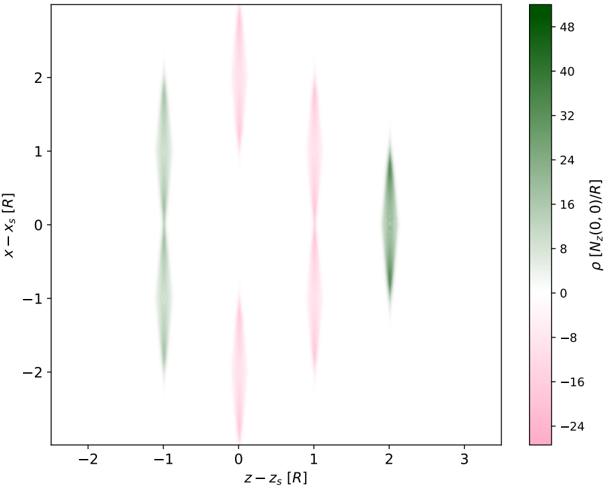
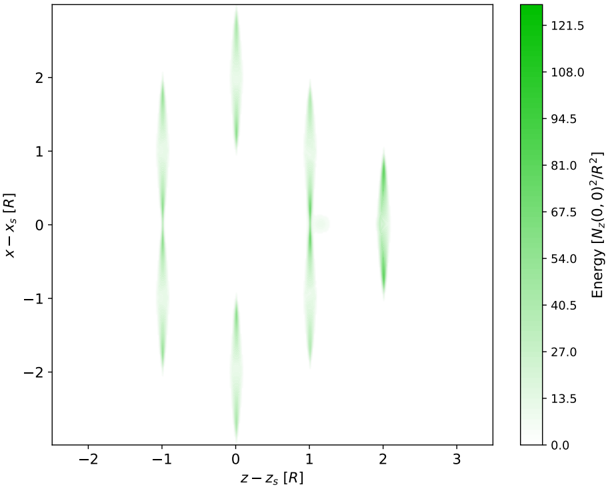
- A class of superluminal solitons is constructed with everywhere non-negative local Eulerian energy density, satisfying the weak energy condition and momentum conditions; the source can be a conducting plasma and classical electromagnetic fields, with zero net momentum flux.
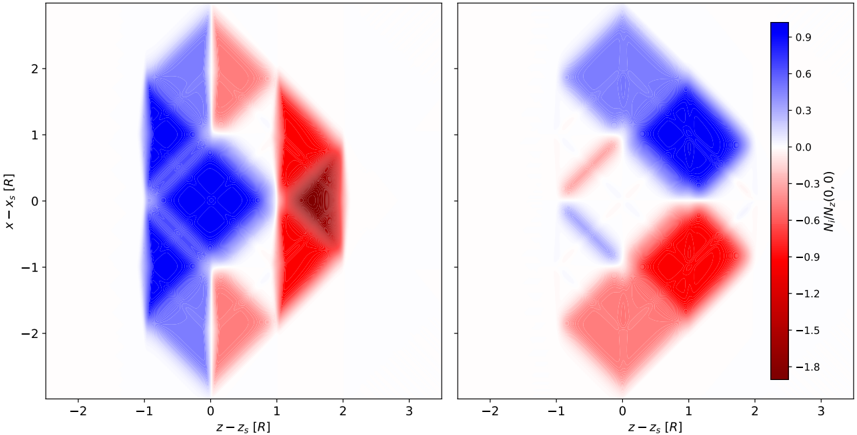
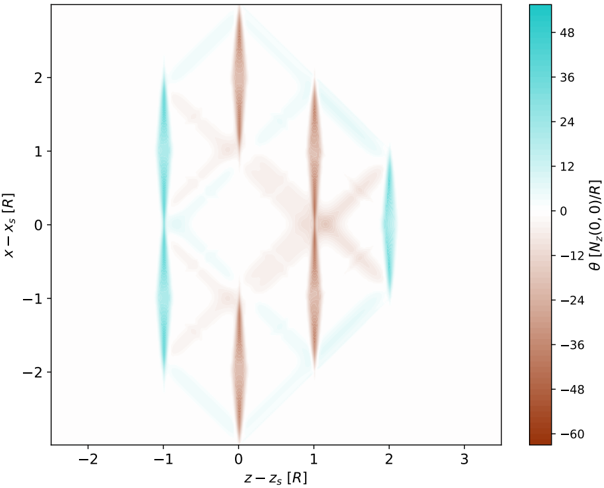
- The geometry uses a hyperbolic shift-vector potential satisfying a spatial wave equation, departing from linear (Alcubierre) or elliptic (Natário) relations; the example pentagonal rhomboid source configuration has net hyperbolic source, net shift vector, and net expansion all zero.
- For a soliton with central-region radius \(R=100\) m and boundary shell thickness \(w=1\) m, the estimated total energy is \(E_{\rm tot}\sim(\text{few})\times10^{-1}M_\odot v_s/c\), comparable to the original Alcubierre estimate under the same shell-thickness-to-diameter conditions; the earlier Alcubierre natural-Casimir estimate is cited as \(\sim -6\times10^{62}v_s\) kg.
- The Einstein-trace condition is consistent with a plasma equation of state \(p\le\rho\); the dominant energy condition is respected by sub-luminal solitons when \(N_iN^i<1\), while higher speeds begin to form horizons.
Methods
- Analytical construction in the 3+1 ADM formalism with flat spatial metric \(h_{ij}=\delta_{ij}\), unit lapse \(N=1\), and shift vector derived from a potential \(\phi\) obeying a linear wave equation on the hypersurface; steady-state motion with constant velocity along the \(z\)-axis.
- Energy and momentum conditions are evaluated from projections of the Einstein tensor; the dynamical trace equation is used to constrain a plasma stress-energy tensor containing a massive fluid and electromagnetic fields.
- A pentagonal configuration of rhomboid source elements is used as an illustrative positive-energy solution; Green’s-function representations of \(\phi\) and the shift vectors are given, and positivity is checked via an inequality on source gradients.
Limitations
- The paper states that identifying a full plasma solution among its more than a dozen degrees of freedom and investigating horizon problems endemic to superluminal solitons would require computation beyond its scope.
- The paper states that the geometric conditions cannot in general dictate the state of the plasma without overconstraining it, because there is only one geometric field and multiple independent geometric conditions.
- Evident from the text: the work is theoretical and illustrative, with no experimental detection or self-consistent simulation of soliton creation, propagation, and dismantlement; the required energy remains immense, and horizon formation at higher speeds is not resolved.
Model-written summary. Check it against the paper before relying on it.
Integrity signals
Registry
Cites
Statistics
Figures
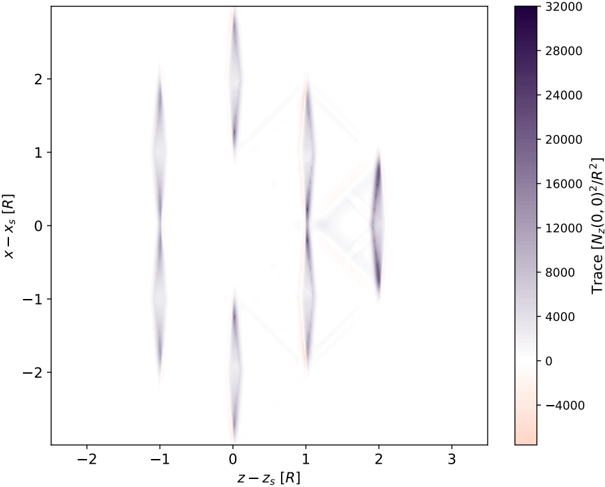
Verification
Claims the paper makes
6 Valid · 3 Not valid · 1 Not checked · 30 Own results and interpretations
The cited sources support only part of this claim — read each source’s verdict below.
In the paper
“The total energy requirements of the positive-energy solitons appear to be of the same order as the original Alcubierre soliton under the same shell-thickness-to-diameter conditions”
- Also stated in: § 3. Constructing Positive-Energy Solutions Using a Hyperbolic Shift Vector Potential · p. 6 · hedged
“The total energy requirements of the positiveenergy solitons closely follow that of Ref. [3] as applied to the Alcubierre solution”
What the sources say
- Partly supportedcites [3] [3] Pfenning M J and Ford L H 1997 Classical and Quantum Gravity 14 1743-1751 URL https: //doi.org/10.1088%2F0264-9381%2F14%2F7%2F011 - sourceExperimental — accuracy not yet measured
Section 4 (pp. 9–10) estimates the total negative energy required for an Alcubierre warp bubble at specified radius and wall thickness. It does not discuss positive-energy solitons or compare their energy requirements with Alcubierre’s under matching shell-thickness-to-diameter conditions. (LLM, conf=0.84)
hedgedstates an association- Asserted: passes — The authors put it forward as true.
- Checkable: passes — It can be checked against evidence.
- Load-bearing: passes — The paper’s conclusions depend on it.
- Based: passes — The paper gives a reason why it holds.
- Also stated in: § 3. Constructing Positive-Energy Solutions Using a Hyperbolic Shift Vector Potential · p. 6 · hedged
The cited sources support only part of this claim — read each source’s verdict below.
In the paper
“Beyond being the first positive energy solutions of their kind, the presented solitons appear to be a counter example to claims in the literature that superluminal spacetimes must violate the weak energy condition [6, 13].”
- Also stated in: § 5. Conclusions · p. 11 · hedged
“The positive energy soliton therefore appears to circumvent the criteria of [6] and [13].”
What the sources say
- Partly supportedcites [6] [6] Olum K D 1998 Phys. Rev. Lett. 81 (17) 3567-3570 URL https://link.aps.org/doi/10.1103/ PhysRevLett.81.3567 - sourceExperimental — accuracy not yet measured
Olum states that superluminal travel requires weak-energy-condition violation, supporting the citing sentence’s description of a claim in the literature (Abstract, p. 1; p. 5). The result applies to travel under his specific definition and assumes the generic condition along the path; it does not establish the unqualified claim for all superluminal spacetimes. The solitons are the citing authors’ proposed counterexample, not a finding attributed to Olum. (LLM, conf=0.86)
- Partly supportedcites [13] [13] Lobo F and Crawford P 2003 Weak Energy Condition Violation and Superluminal Travel vol 617 p 277 - sourceExperimental — accuracy not yet measured
Section 4 (p. 12) states that superluminal travel requires WEC violation under Olum’s definition and when the generic condition holds. The citing sentence accurately identifies this as a claim in the literature, but omits those conditions and makes it sound applicable to all superluminal spacetimes. The paper does not assess the citing authors’ solitons. (LLM, conf=0.86)
hedged- Asserted: passes — The authors put it forward as true.
- Checkable: passes — It can be checked against evidence.
- Load-bearing: passes — The paper’s conclusions depend on it.
- Based: passes — The paper gives a reason why it holds.
- Also stated in: § 5. Conclusions · p. 11 · hedged
The cited sources support only part of this claim — read each source’s verdict below.
In the paper
“The transport logistics of the presented positive-energy solitons are similar to the solitons of the Alcubierre solution.”
- Also stated in: § 3. Constructing Positive-Energy Solutions Using a Hyperbolic Shift Vector Potential · p. 6 · plain
“In this case, the logistics of soliton travel for observers in the central region reflect those in [1].”
What the sources say
- Partly supportedcites [1] [1] Alcubierre M 1994 Classical and Quantum Gravity 11 L73-L77 URL https://doi.org/10.1088% 2F0264-9381%2F11%2F5%2F001 - sourceExperimental — accuracy not yet measured
The passages labeled L74 and L77 describe Alcubierre’s transport mechanism: a spaceship is carried by a local spacetime distortion, with expansion behind it and contraction ahead. They do not discuss the citing paper’s positive-energy solitons or establish the claimed similarity. L77 also says Alcubierre’s metric requires negative energy density. (LLM, conf=0.82)
plainstates an association- Asserted: passes — The authors put it forward as true.
- Checkable: passes — It can be checked against evidence.
- Load-bearing: unclear — It is unclear whether the paper’s conclusions depend on it.
- Based: passes — The paper gives a reason why it holds.
- Also stated in: § 3. Constructing Positive-Energy Solutions Using a Hyperbolic Shift Vector Potential · p. 6 · plain
The cited sources support only part of this claim — read each source’s verdict below.
In the paper
“The multi-compartment structure is a distinct departure from the single top-hat soliton fond in [1] and [11].”
What the sources say
- Supportedcites [1] [1] Alcubierre M 1994 Classical and Quantum Gravity 11 L73-L77 URL https://doi.org/10.1088% 2F0264-9381%2F11%2F5%2F001 - source
In section L77, Alcubierre says the metric’s profile function approaches a “top hat” function. Section U 5 describes one localized region centred on the spaceship. The multi-compartment comparison is the citing authors’ own framing, not a finding attributed to Alcubierre. (LLM, conf=0.85)
- Partly supportedcites [11] [11] Nat´ ario J 2002 Classical and Quantum Gravity 19 1157-1165 URL https://doi.org/10.1088% 2F0264-9381%2F19%2F6%2F308 - sourceExperimental — accuracy not yet measured
Section 2 describes one warp bubble with an interior and exterior, which supports the single-bubble part of the comparison. The paper does not describe that bubble as a “top-hat soliton,” so it does not establish that more specific characterization. No page number is available in our copy. (LLM, conf=0.76)
plain- Asserted: passes — The authors put it forward as true.
- Checkable: passes — It can be checked against evidence.
- Load-bearing: unclear — It is unclear whether the paper’s conclusions depend on it.
- Based: passes — The paper gives a reason why it holds.
- Supported
A result the paper states — it cites no source for it, so there is none to check. The quote shows it is in the paper.
In the paper
“The net shift vector of the soliton is found to be zero.”
plain- Asserted: passes — The authors put it forward as true.
- Checkable: passes — It can be checked against evidence.
- Load-bearing: unclear — It is unclear whether the paper’s conclusions depend on it.
- Based: passes — The paper gives a reason why it holds.
21 more claims
Create a free account to see all 40 claims and every source verdict.
- It may state two separate claims as one. 8
- Probably not a substantial claim. 6
Claims other papers make about this one
Each is checked against this paper’s own text: does it say what the citing paper says it does?
The cited source doesn’t support the claim as written.
In the citing paper
“A more careful analysis shows that the situation is actually much grimmer than advertised - within the framework adopted by those three papers all physically reasonable warp drives will certainly violate the WEC, and both the strong and dominant energy conditions.”
From Generic warp drives violate the null energy condition (2022) · cites this paper as [1]
Checked by a reasoning model — may be wrong.
Experimental — accuracy not yet measuredThe cited source doesn’t support the claim as written.
In the citing paper
“The author, however, imposes not only the metric, but also an energy momentum tensor - therefore imposing both sides of the Einstein equations without ever verifying if they are indeed an equation or not.”
From Generic warp drives violate the null energy condition (2022) · cites this paper as [1]
Checked by a reasoning model — may be wrong.
Experimental — accuracy not yet measuredThe cited source doesn’t support the claim as written.
In the citing paper
“This is not enough to obtain a valid solution of the Einstein equations - the author would also need to consider the remaining trace-free part T ij -1 3 ( T kl δ kl ) g ij of the stress tensor.”
From Generic warp drives violate the null energy condition (2022) · cites this paper as [1]
Checked by a reasoning model — may be wrong.
Experimental — accuracy not yet measuredThe cited source doesn’t support the claim as written.
In the citing paper
“Hence, they haven't only not found a solution which satisfies the WEC, they haven't found a solution at all.”
From Generic warp drives violate the null energy condition (2022) · cites this paper as [1]
Checked by a reasoning model — may be wrong.
Experimental — accuracy not yet measuredThe source backs part of the claim, not all of it — or backs it for a different population, condition or comparison.
In the citing paper
“Under plausible subsidiary conditions the null energy condition is also violated.”
From Generic warp drives violate the null energy condition (2022) · cites this paper as [1]
Experimental — accuracy not yet measured
14 more claims about this paper
Create a free account to see every claim other papers make about this one.
Citations
Cites
Dynamical Structure and Definition of Energy in General Relativity
Arnowitt, R., Deser, S., & Misner, C. W. (1959) · Physical Review · doi:10.1103/physrev.116.1322 · Cited by 894
The warp drive: hyper-fast travel within general relativity
Alcubierre, M. (1994) · Classical and Quantum Gravity · doi:10.1088/0264-9381/11/5/001 · Cited by 569
Exotic solutions in General Relativity: Traversable wormholes and 'warp drive' spacetimesPreprint
Lobo, F. S. N. (2007) · arXiv (Cornell University) · doi:10.48550/arxiv.0710.4474 · Cited by 276
Misner, C. W., Thorne, K. S., Wheeler, J. A., & Chandrasekhar, S. (1974) · Physics Today · doi:10.1063/1.3128805 · Cited by 154
Hyperfast travel in general relativity
Krasnikov, S. V. (1998) · Physical Review D · doi:10.1103/physrevd.57.4760 · Cited by 138
Superluminal Travel Requires Negative Energies
Olum, K. D. (1998) · Physical Review Letters · doi:10.1103/physrevlett.81.3567 · Cited by 126
Fundamental limitations on ‘warp drive’ spacetimes
Lobo, F. S. N., & Visser, M. (2004) · Classical and Quantum Gravity · doi:10.1088/0264-9381/21/24/011 · Cited by 117
The unphysical nature of `warp drive'
Pfenning, M. J., & Ford, L. H. (1997) · Classical and Quantum Gravity · doi:10.1088/0264-9381/14/7/011 · Cited by 117
General relativistic axisymmetric rotating systems: Coordinates and equations
Bardeen, J. M., & Piran, T. (1983) · Physics Reports · doi:10.1016/0370-1573(83)90069-8 · Cited by 114
Everett, A. E. (1996) · Physical Review D · doi:10.1103/physrevd.53.7365 · Cited by 105
Research works printed but not linked: 3
- [11] Nat´ ario J 2002 Classical and Quantum Gravity 19 1157-1165 URL https://doi.org/10.1088% 2F0264-9381%2F19%2F6%2F308 -
- [16] Obousy R K and Cleaver G 2008 Journal of the British Interplanetary Society 61 364-369 ( Preprint 0712.1649 ) -
- [17] White H 2013 Journal of the British Interplanetary Society 66 242-247 -
Cited by
Generic warp drives violate the null energy condition
Santiago, J., Schuster, S., & Visser, M. (2022) · Physical Review D · doi:10.1103/physrevd.105.064038 · Cited by 42
“As a cautionary example regarding application of the energy conditions, note that all three of the recent Lentz [1], Bobrick–Martire [2], and Fell–Heisenberg [3] articles merely assert the existence of one sub-class of timelike observers for which the energy density is positive.”
BackgroundMethodInfluentialQuantum Otto engines at relativistic energies
Deffner, S. (2021) · LA Referencia (Red Federada de Repositorios Institucionales de Publicaciones Científicas) · Cited by 33
Positive energy warp drive from hidden geometric structures
Fell, S. D. B., & Heisenberg, L. (2021) · Classical and Quantum Gravity · doi:10.1088/1361-6382/ac0e47 · Cited by 22
Field equations for incompressible non-viscous fluids using artificial intelligence
Karthik, P. C., Sasikumar, J., Baskar, M., et al. (2021) · The Journal of Supercomputing · doi:10.1007/s11227-021-03917-y · Cited by 16
Positive Energy Driven CTCs In ADM 3+1 Space – Time of Unprotected ChronologyPreprint
Bhattacharjee, D. (2021) · Preprints.org · doi:10.20944/preprints202104.0277.v1 · Cited by 19
“Reverting back to the (3+1) ADM-Formalism [4,5,6], the line element of the space-time foliation could be given as, ds(2) = −(N(2) − NNi)dt 2 − 2Nidx dt + hdxdx Where the contravariant form of the shift vector components N at time t provides the 3-velocity (purely coordinates) as to the hypersurfaces normal.”
InfluentialPerfect fluid warp drive solutions with the cosmological constant
Santos-Pereira, O. L., Abreu, E. M. C., & Ribeiro, M. B. (2021) · The European Physical Journal Plus · doi:10.1140/epjp/s13360-021-01899-7 · Cited by 15
“Lentz [22] and Fell and Heisenberg [23] advanced superluminal capable soliton solutions with positive energy warp drives.”
BackgroundConstant velocity physical warp drive solution
Fuchs, J., Helmerich, C., Bobrick, A., Sellers, L., Melcher, B., & Martire, G. (2024) · Classical and Quantum Gravity · doi:10.1088/1361-6382/ad26aa · Cited by 11
“Lentz [12, 13], Fell and Heisenberg [9] and the more general Natario class [14] warp metrics all use several shift vector components but follow in essence the same dynamics as described here.”
BackgroundAlcubierre warp drive in spherical coordinates with some matter configurations
Abellán, G., Bolivar, N., & Vasilev, I. (2023) · The European Physical Journal C · doi:10.1140/epjc/s10052-022-11091-5 · Cited by 8
ADM mass in warp drive spacetimes
Schuster, S., Santiago, J., & Visser, M. (2023) · General Relativity and Gravitation · doi:10.1007/s10714-022-03061-9 · Cited by 8
'Fringe Science'—A Tautology, Not Pariah
Houran, J., & Bauer, H. H. (2022) · Journal of Scientific Exploration · doi:10.31275/20222527 · Cited by 12
Warp drives and closed timelike curves
Shoshany, B., & Snodgrass, B. (2024) · Classical and Quantum Gravity · doi:10.1088/1361-6382/ad74d1 · Cited by 6
Warp drive dynamic solutions considering different fluid sources
Santos-Pereira, O. L., Abreu, E. M. C., & Ribeiro, M. B. (2021) · arXiv · doi:10.48550/arxiv.2111.01298 · Cited by 6
Exploring the Alcubierre Warp Drive Ship
Qiao, B. (2025) · Journal of Modern Physics · doi:10.4236/jmp.2025.164025 · Cited by 5
Warp drive dynamic solutions considering different fluid sources
Santos-Pereira, O. L., Abreu, É. M. C., & Ribeiro, M. B. (2023) · The Ninth Marcel Grossmann Meeting · doi:10.1142/9789811269776_0066 · Cited by 9
Obstacles from interstellar matters and distortion in warp drive superluminal travel scenario
Bian, S., Wang, Y., Wang, Z., & Zhu, M. (2022) · The European Physical Journal C · doi:10.1140/epjc/s10052-022-10840-w · Cited by 5
Escape from a black hole with spherical warp drive
Eroshenko, Y. N. (2023) · International Journal of Modern Physics A · doi:10.1142/s0217751x23500161 · Cited by 5
Analyzing warp drive spacetimes with warp factory
Helmerich, C., Fuchs, J., Bobrick, A., Sellers, L., Melcher, B., & Martire, G. (2024) · Classical and Quantum Gravity · doi:10.1088/1361-6382/ad2e42 · Cited by 4
Spherical warp-based bubble with non–trivial lapse function and its consequences on matter content
Abellán, G., Bolivar, N. E., & Vasilev, I. T. (2024) · Classical and Quantum Gravity · doi:10.1088/1361-6382/ad3ed9 · Cited by 9
Toward the stars: Technological, ethical, and sociopolitical dimensions of interstellar exploration
Neukart, F. (2025) · Space Policy · doi:10.1016/j.spacepol.2024.101676 · Cited by 4
A Transformation Factor for Superluminal Motion That Preserves Symmetrically the Spacetime Intervals
Roldán, D., & Roldán-Aráuz, F. (2023) · Symmetry · doi:10.3390/sym15061177 · Cited by 3
“However, it is not a ruled-out issue and various references can be found in the scientific literature, usually from a theoretical perspective [13, 14, 15] as in our case.”
Newtonian Forces Exerted by Electromagnetic Waves Traveling into Matter
Funaro, D. (2023) · International Journal of Theoretical Physics · doi:10.1007/s10773-023-05491-w · Cited by 2
“More sophisticated approaches rely upon the Unruh effect [13–15] or the concept of warped space-time [16–18].”
BackgroundHuey, G. (2024) · Classical and Quantum Gravity · doi:10.1088/1361-6382/ad4e00 · Cited by 7
Warp bubble geometries with anisotropic fluids: A piecewise analytical approach
Bolivar, N. E., Abellán, G., & Vasilev, I. T. (2025) · Annals of Physics · doi:10.1016/j.aop.2025.170147 · Cited by 6
On the total energy conservation of the Alcubierre spacetime
Carneiro, F. L., Ulhoa, S. C., Maluf, J. W., & da Rocha-Neto, J. F. (2022) · Journal of Cosmology and Astroparticle Physics · doi:10.1088/1475-7516/2022/07/030 · Cited by 8
“Several authors have proposed Alcubierre spacetime models that do not violate some energy conditions [30, 31], and Bobrick introduced an algorithm to construct such spacetimes [16].”
BackgroundVisualization and analysis of the curvature invariants in the Alcubierre warp-drive spacetime
Rodal, J. J. A. (2023) · General Relativity and Gravitation · doi:10.1007/s10714-023-03182-9 · Cited by 3
“This has led to further investigations into geometries that might permit effective superluminal motion, even if the energy conditions for the Alcubierre drive prove insurmountable [17–19].”
Warping Effects in Strongly Perturbed Metrics
Frasca, M., Liberati, R. M., & Rossi, M. (2020) · Physics · doi:10.3390/physics2040039 · Cited by 2
A Closer Look at Natário’s Zero-Expansion Warp Drive
Rodal, J. J. A. (2024) · International Journal of Theoretical Physics · doi:10.1007/s10773-024-05700-0 · Cited by 4
Tractor Beams, Pressor Beams and Stressor Beams in General Relativity
Santiago, J., Schuster, S., & Visser, M. (2021) · Universe · doi:10.3390/universe7080271 · Cited by 21
Häuser, J., & Dröscher, W. (2021) · Zeitschrift für Naturforschung A · doi:10.1515/zna-2021-0147 · Cited by 1
Exotic Fluids Matching the Stress-Energy Tensor of Alcubierre Warp Drive SpacetimesPreprint
Béatrix-Drouhet, W. (2020) · arXiv (Cornell University) · doi:10.48550/arxiv.2012.09941 · Cited by 2
Adm Mass in Warp Drive SpacetimesPreprint
Visser, M., Schuster, S., & Santiago, J. (2022) · SSRN Electronic Journal · doi:10.2139/ssrn.4164341 · Cited by 1
Warp drives: Physicists give chances of faster-than-light space travel a boost
Borunda, M. F. (2021) · The Conversation · doi:10.64628/aai.5s4fjpd56 · Cited by 1
JSE 36:2 Summer 2022 Whole Issue PDF
Erickson, K. E. (2022) · Journal of Scientific Exploration · doi:10.31275/20222713
GRAVITATIONAL DRIVING: GEODESICS WARPED BY SOLITONS OF ACCELERATION
Serpa, N. (2021) · CALIBRE - Revista Brasiliense de Engenharia e Física Aplicada · doi:10.17648/calibre.v6i1.1550
Quantum Otto engines at relativistic energies
Myers, N. M., Abah, O., & Deffner, S. (2021) · New Journal of Physics · doi:10.1088/1367-2630/ac2756 · Cited by 37
Pickrell, M. (2021) · AIAA Accelerating Space Commerce, Exploration, and New Discovery Conference (ASCEND) · doi:10.2514/6.2021-4111
Svozil, K. (2021) · Axioms · doi:10.3390/axioms10040300
“This is different from breaking the intradimensional warp barrier by hyper-fast solitons in Einstein-Maxwell-plasma theory [22] as it employs dimensional capacities that are not bound by intradimensional motion.”
BackgroundWarp Drive – Surfen auf den Wellen der Raumzeit
Tajmar, M., & Zitt, H. (2022) · Springer eBooks · doi:10.1007/978-3-662-63730-2_16
Warping Spacetime: When Theoretical Physics Meets Science Fiction
Quinalha, L. V., & Rice, S. (2023) · Journal of Student Research · doi:10.47611/jsrhs.v11i1.2234
UFO Perception in the USA and Elsewhere
Svozil, K. (2023) · Springer eBooks · doi:10.1007/978-3-031-34398-8_6
Anderson, M. G., Walters, J. K., Anaya, E., et al. (2023) · IEEE Pulsed Power Conference (PPC) · doi:10.1109/ppc47928.2023.10310793
“…Density (RHED) Physics regimes for probing the intersection between General Relativity and Quantum Field Theory (i.e. Warp/Unruh/Casimir effects) [3-6] along with game-changing direct applications from rep-rated Magnetized Liner Inertial Fusion (MagLIF) devices for energy production and advanced…”
BackgroundGeneral relativistic faster-than-light propulsion for interstellar flight
Davis, E. W. (2024) · Elsevier eBooks · doi:10.1016/b978-0-323-91280-8.09999-8
Degrowth, Green Growth oder No Growth?
Bogaschewsky, R. (2024) · Springer eBooks · doi:10.1007/978-3-658-45093-9_13
Astrophysical Signatures of Warp-Drive Activity in the Nearby Galactic VolumePreprint
Bhattacharjee, D. (2025) · SSRN Electronic Journal · doi:10.2139/ssrn.5341129 · Cited by 7
Interior-flat cylindrical nacelle warp bubbles: derivation and comparison with Alcubierre model
White, H. G., Vera, J., Sylvester, A. J., & Dudzinski, L. (2025) · Classical and Quantum Gravity · doi:10.1088/1361-6382/ae237a · Cited by 3
“…studies have explored the physical plausibility of warp bubbles from the perspective of exotic matter and negative energy [ 11, 12], while more recent work has introduced physically motivated warp drives that seek to embed these concepts into more realistic stress-energy frameworks [13, 14].”
A warp drive with predominantly positive invariant energy density and global Hawking–Ellis Type I
Rodal, J. J. A. (2025) · General Relativity and Gravitation · doi:10.1007/s10714-025-03495-x · Cited by 5
Ansari, M. B. (2026) · SSRN Electronic Journal · doi:10.2139/ssrn.6104466
Alcubierre bubble average speed
Tegai, S. P., & Gerasimov, K. V. (2026) · International Journal of Modern Physics A · doi:10.1142/s0217751x26500880
Zejli, H. (2026) · The European Physical Journal Plus · doi:10.1140/epjp/s13360-026-07538-3
Statistical Soliton on Statistical Perfect Fluid Space‐Time
Asali, F., & Balgeshir, M. B. K. (2026) · Mathematical Methods in the Applied Sciences · doi:10.1002/mma.70791
Santos-Pereira, O. L., Abreu, É. M. C., & Ribeiro, M. B. (2026) · The European Physical Journal Plus · doi:10.1140/epjp/s13360-026-08079-5 · Cited by 2
“The work of Lentz [42] promotes the idea of a WD as the result of a soliton wave as a solution of the Einstein equations with WD spacetime, which is closely related to the Burgers equation.”
Metadata
- Authors
- Lentz, E. W.
- Affiliations
- University of Göttingen (DE)
- Corresponding author
- Lentz, Erik W
- ORCID
- Lentz, Erik W
- Venue
- Classical and Quantum Gravity
- Publisher
- IOP Publishing
- Published
- 2021-03-09
- Volume
- 38
- Issue
- 7
- Pages
- 075015
- ISSN
- 0264-9381 (ISSN-L)
- 1361-6382
- OpenAlex
- W3034886373
- Semantic Scholar
- 1ff0646e467c2ad0c8eed483b29768a5ffc5349e
- Cited by
- 50
- References
- 19
- Citations by year
- 2026: 5 · 2025: 6 · 2024: 9 · 2023: 10 · 2022: 7 · 2021: 11
- FWCI
- 4.97
- Type
- journal article
- Language
- en
- Open access
- bronze
- doi.org
- Licence
- publishingsupport.iopscience.iop.org/iop-standard/v1 (vor)
- iopscience.iop.org/info/page/text-and-data-mining (tdm)
- Locations
- Classical and Quantum Gravity (publishedVersion)
- arXiv (Cornell University) (submittedVersion)
- arXiv (Cornell University)
- Funders
- Alexander von Humboldt-Stiftung
- Topics
- Physical Sciences › Physics and Astronomy › Astronomy and Astrophysics › Relativity and Gravitational Theory
- Physical Sciences › Physics and Astronomy › Nuclear and High Energy Physics › Black Holes and Theoretical Physics
- Physical Sciences › Physics and Astronomy › Astronomy and Astrophysics › Cosmology and Gravitation Theories
- Keywords
- solitons, superluminal motion, Einstein-Maxwell theory, energy conditions, negative energy, energy-momentum tensor, electromagnetic fields, soliton solutions
About these checks
Registry, retraction, Cites and statistics results are computed, not judged, with one exception: a printed reference that no index lists is read once by a model before it counts as a citation error. Claims are extracted by a model and kept only when their quote appears verbatim in the text; each cited source is then checked, with a model’s help, for whether it says what the claim relies on. Those verdicts can be wrong — read the claim’s quote and the cited source before relying on one.
The claim verdicts this report counts are experimental: their accuracy is not yet measured.
A language model drew the claims from the paper on 2026-10-12, under version 3 of the claim definition (model deepseek-v4.1-flash, prompt extract-v3).
A second model labelled each claim on 2026-10-12 (model jev-1.13-20260917, definition revision gold-guideline-v0.2).
Cited sources are checked with a language model’s help (gpt-6-sol).
Statistics and arithmetic are recomputed, not judged.
Confidence bands are shown only for fields calibrated on our annotated test set. None is calibrated yet, so no band is shown.
What counts as a claim ›How we measure confidence ›How we check this ›
Are you an author, or do you see a problem with this page? Request a review
Data sources
Bibliographic data: Semantic Scholar, OpenAlex, Crossref.
Contains information from the Semantic Scholar Academic Graph Datasets, made available under the ODC Attribution License (ODC-BY 1.0).
Semantic Scholar’s data is described in: Kinney, R., et al. (2023). The Semantic Scholar Open Data Platform. arXiv:2301.10140.
