

First benchmarking of the BIANCA model for cell survival prediction in a clinical hadron therapy scenario
Open accessThe DOI matches its Crossref record; 47 of the 47 references it cites were found in a registry or an index.
Abstract
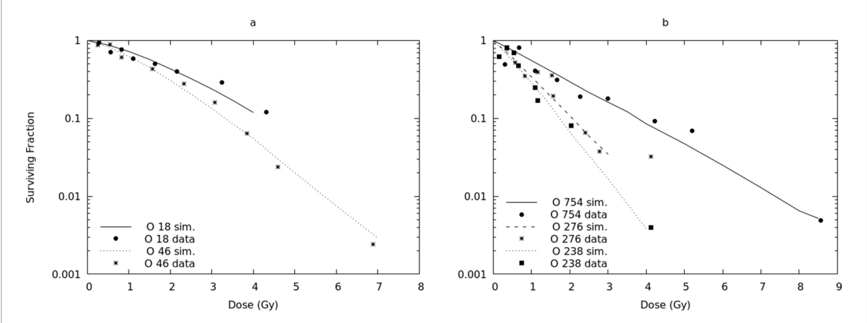
In the framework of RBE modelling for hadron therapy, the BIANCA biophysical model was extended to O-ions and was used to construct a radiobiological database describing the survival of V79 cells as a function of ion type (1 ⩽ Z ⩽ 8) and energy. This database allowed performing RBE predictions in very good agreement with experimental data. A method was then developed to construct analogous databases for different cell lines, starting from the V79 database as a reference. Following interface to the FLUKA Monte Carlo radiation transport code, BIANCA was then applied for the first time to predict cell survival in a typical patient treatment scenario, consisting of two opposing fields of range-equivalent protons or C-ions. The model predictions were found to be in good agreement with CHO cell survival data obtained at the Heidelberg ion-beam therapy (HIT) centre, as well as predictions performed by the local effect model (version LEM IV). This work shows that BIANCA can be used to predict cell survival and RBE not only for V79 and AG01522 cells, as shown previously, but also, in principle, for any cell line of interest. Furthermore, following interface to a transport code like FLUKA, BIANCA can provide predictions of 3D biological dose distributions for hadron therapy treatments, thus laying the foundations for future applications in clinics.
Overview
The claims and statistics of this paper haven’t been checked yet.
Free: it reads the open-access text and checks the first 5 claims that cite a source we can check. Create a free account to check every claim.
Integrity signals
Registry
Cites
Statistics
Figures
Verification
Claims the paper makes
The claims and statistics of this paper haven’t been checked yet.
Free: it reads the open-access text and checks the first 5 claims that cite a source we can check. Create a free account to check every claim.
Self-check
Percentages, sums and reported differences re-computed from the paper’s own numbers.
The self-check needs the paper’s full text.
Citations
Cites
FLUKA: A Multi-Particle Transport Code
Ferrari, A., Sala, P. R., Fasso, A., & Ranft, J. (2005) · doi:10.2172/877507 · Cited by 2,536 · cited 1×
“Afterwards, BIANCA was interfaced to the FLUKA Monte Carlo radiation transport code (Ferrari et al 2005, Bohlen et al 2014, Battistoni et al 2016, Kozlowska et al 2019), which is currently used at HIT and at CNAO for treatment planning verification and re-calculation.”
MethodSelf-citationThe FLUKA Code: Developments and Challenges for High Energy and Medical Applications
Böhlen, T. T., Cerutti, F., Chin, M. P. W., Fassò, A., Ferrari, A., Ortega, P. G., Mairani, A., Sala, P. R., Smirnov, G., & Vlachoudis, V. (2014) · Nuclear Data Sheets · doi:10.1016/j.nds.2014.07.049 · Cited by 1,758
Self-citationRelative biological effectiveness (RBE) values for proton beam therapy
Paganetti, H., Niemierko, A., Ancukiewicz, M., Gerweck, L. E., Goitein, M., Loeffler, J. S., & Suit, H. D. (2002) · International Journal of Radiation Oncology*Biology*Physics · doi:10.1016/s0360-3016(02)02754-2 · Cited by 1,364 · cited 1×
“Since these variations are much more pronounced for C-ions than for protons, a constant RBE value of 1.1 is currently adopted in proton therapy (e.g. Paganetti et al (2002)), whereas more detailed RBE models are required for carbon and possibly other heavy ions of interest like He- and O-ions…”
BackgroundInfluentialFurusawa, Y., Fukutsu, K., Aoki, M., Itsukaichi, H., Eguchi-Kasai, K., Ohara, H., Yatagai, F., Kanai, T., & Ando, K. (2000) · Radiation Research · doi:10.1667/0033-7587(2000)154[0485:ioaahc]2.0.co;2 · Cited by 474 · cited 7×
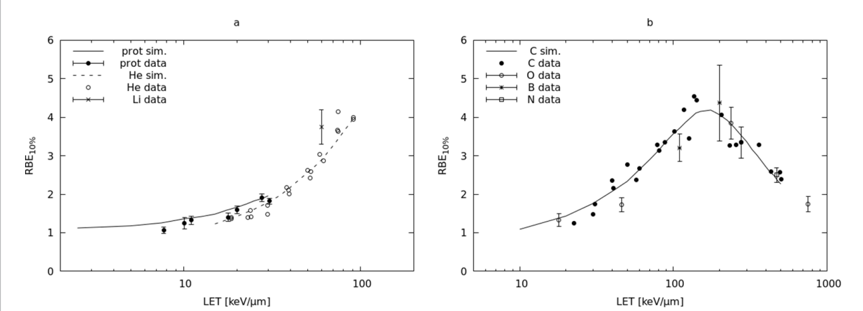
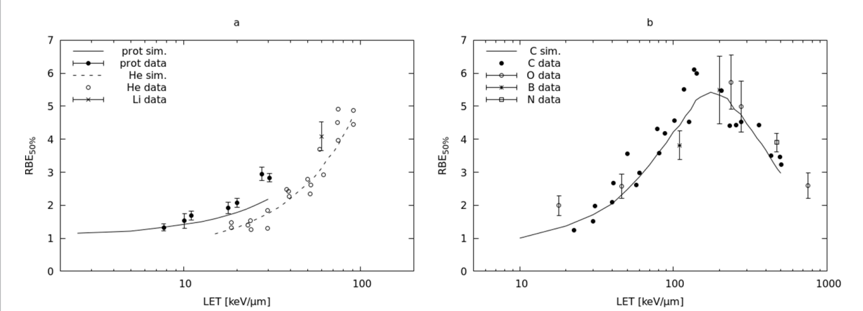
“…protons (solid line) and He-ions (dashed line); the points are V79 experimental data for protons (full circles, taken from Folkard et al (1996) and Belli et al (1998)) and He-ions (empty circles, from Furusawa et al (2000)), as well as a Li-ion point at 60 keV μm−1 (taken from Pathak et al (2007)).”
MethodResultInfluentialComputation of cell survival in heavy ion beams for therapy
Scholz, M., Kellerer, A. M., Kraft-Weyrather, W., & Kraft, G. (1997) · Radiation and Environmental Biophysics · doi:10.1007/s004110050055 · Cited by 464 · cited 1×
“Detailed descriptions of the different model versions can be found in the literature (e.g. Scholz et al (1997), Elsässer and Scholz (2007), Elsässer et al (2008) and Friedrich et al (2012)).”
MethodSorge, H., Stöcker, H., & Greiner, W. (1989) · Annals of Physics · doi:10.1016/0003-4916(89)90136-x · Cited by 458
Krämer, M., & Scholz, M. (2000) · Physics in Medicine and Biology · doi:10.1088/0031-9155/45/11/314 · Cited by 453
Irradiation of Mixed Beam and Design of Spread-Out Bragg Peak for Heavy-Ion Radiotherapy
Kanai, T., Furusawa, Y., Fukutsu, K., Itsukaichi, H., Eguchi-Kasai, K., & Ohara, H. (1997) · Radiation Research · doi:10.2307/3579446 · Cited by 422 · cited 1×
“On the other hand, a phenomenological model was first developed and used at NIRS in Japan (Kanai et al 1997).”
MethodElsässer, T., Weyrather, W. K., Friedrich, T., Durante, M., Iancu, G., Krämer, M., Kragl, G., Brons, S., Winter, M., Weber, K.-J., et al. (2010) · International Journal of Radiation Oncology*Biology*Physics · doi:10.1016/j.ijrobp.2010.05.014 · Cited by 351 · cited 8×
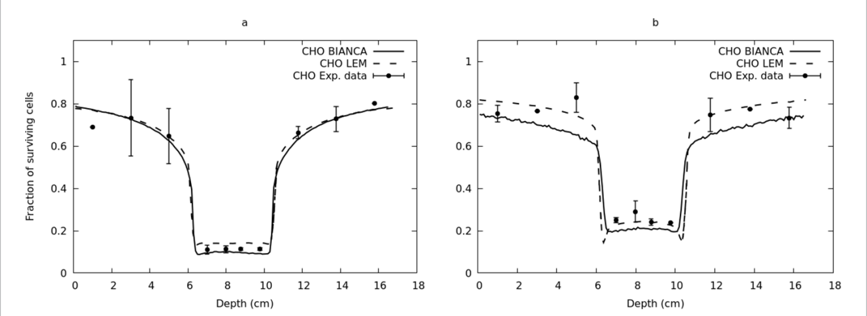
“…bars, where available, represent one s.d. nal beam energies available at HIT (e.g. Parodi et al (2012)) for carbon ions in the range 175–230 MeV/u, and for protons in the range 90–120 MeV/u (as in the experiment reported in Elsässer et al (2010)) were used in FLUKA to model the irradiation field.”
MethodResultInfluentialCornforth, M. N., & Bedford, J. S. (1987) · Radiation Research · doi:10.2307/3576926 · Cited by 332 · cited 1×
“…cell death and chromosome aberrations is derived from experimental observations indicating a one-to-one relationship between the logarithm of the surviving fraction and the mean number of dicentrics, rings and deletions visible in metaphase (e.g. Carrano (1973) and Cornforth and Bedford (1987)).”
Background
Cited by
Dose Calculation Algorithms for External Radiation Therapy: An Overview for Practitioners
Martino, F. D., Clemente, S., Graeff, C., Palma, G., & Cella, L. (2021) · Applied Sciences · doi:10.3390/app11156806 · Cited by 82
Challenges in Monte Carlo Simulations as Clinical and Research Tool in Particle Therapy: A Review
Muraro, S., Battistoni, G., & Kraan, A. C. (2020) · Frontiers in Physics · doi:10.3389/fphy.2020.567800 · Cited by 61
A Mission to Mars: Prediction of GCR Doses and Comparison with Astronaut Dose Limits
Ramos, R. L., Carante, M. P., FERRARI, A., SALA, P. R., Vercesi, V. I., & Ballarini, F. (2023) · International Journal of Molecular Sciences · doi:10.3390/ijms24032328 · Cited by 37
Self-citationFukui, R., Saga, R., Matsuya, Y., Tomita, K., Kuwahara, Y., Ohuchi, K., Sato, T., Okumura, K., Date, H., Fukumoto, M., et al. (2022) · Scientific Reports · doi:10.1038/s41598-022-05172-4 · Cited by 34
In vivo validation of the BIANCA biophysical model: benchmarking against rat spinal cord RBE data
Carante, M. P., Aricò, G., Ferrari, A., Karger, C. P., Kozlowska, W., Mairani, A., Sala, P., & Ballarini, F. (2020) · International Journal of Molecular Sciences · doi:10.3390/ijms21113973 · Cited by 21
Self-citationTechnological Developments and Future Perspectives in Particle Therapy: A Topical Review
Kraan, A. C., & Guerra, A. D. (2024) · IEEE Transactions on Radiation and Plasma Medical Sciences · doi:10.1109/trpms.2024.3372189 · Cited by 27
“Recently, the BIANCA code was coupled with FLUKA, allowing to calculate RBE and D RBE voxel-by-voxel [120].”
MethodRamos, R. L., Embriaco, A., Carante, M. P., Ferrari, A., Sala, P., Vercesi, V., & Ballarini, F. (2022) · Journal of Radiological Protection · doi:10.1088/1361-6498/ac6991 · Cited by 17
“In a previous study, a radiobiological database describing the induction of PBL dicentrics as a function of dose, ion type and energy up to C-ions has been constructed by BIANCA [22].”
InfluentialSelf-citationCarante, M. P., Embriaco, A., Aricò, G., Ferrari, A., Mairani, A., Mein, S., Ramos, R., Sala, P., & Ballarini, F. (2021) · Physics in Medicine & Biology · doi:10.1088/1361-6560/ac25d4 · Cited by 15
Self-citationEmbriaco, A., Ramos, R., Carante, M., Ferrari, A., Sala, P., Vercesi, V., & Ballarini, F. (2021) · International Journal of Molecular Sciences · doi:10.3390/ijms221910877 · Cited by 13
Self-citationFirst application of the BIANCA biophysical model to carbon-ion patient cases
Kozłowska, W., Carante, M. P., Aricò, G., Embriaco, A., FERRARI, A., Magro, G., Mairani, A., Ramos, R. L., SALA, P. R., Georg, D., et al. (2022) · Physics in Medicine and Biology · doi:10.1088/1361-6560/ac702b · Cited by 13
Self-citationWarmenhoven, J.-W., Henthorn, N. T., McNamara, A. L., Ingram, S., Merchant, M. J., Kirkby, K. J., Schuemann, J., Paganetti, H., Prise, K. M., & McMahon, S. J. (2023) · Radiation Research · doi:10.1667/rade-21-00147.1 · Cited by 8
“The BIANCA model has shown good capability to be fit to specific cell lines by scaling the number of critical lesions induced ( 37 ).”
MethodRadiation Damage in Biomolecules and Cells 2.0
Carante, M. P., Ramos, R. L., & Ballarini, F. (2023) · International Journal of Molecular Sciences · doi:10.3390/ijms24043238 · Cited by 11
Self-citationRadiation Damage in Biomolecules and Cells
Carante, M. P., & Ballarini, F. (2020) · International Journal of Molecular Sciences · doi:10.3390/ijms21218188 · Cited by 9
Self-citationRamos, R. L., Bernardini, E., Carante, M. P., FERRARI, A., SALA, P. R., Vercesi, V. I., & Ballarini, F. (2024) · Journal of Radiological Protection · doi:10.1088/1361-6498/ad7ff6 · Cited by 5
“…of the linear and quadratic coefficients describing the survival of V79 cells (chosen as a reference cell line) as a function of dose, ion type and energy has been produced [16]; afterwards, an algorithm has been developed to predict survival curves for, in principle, any other cell type [21].”
Self-citationCasali, A., Carante, M. P., Ramos, R. L., & Ballarini, F. (2024) · Physics in Medicine and Biology · doi:10.1088/1361-6560/ad98e1 · Cited by 3
“Afterwards, the aforementioned algorithm was applied to predict α and β values for each considered ion type and energy (and thus LET), only based on the CL and f parameters of photons (Carante et al 2019, 2020).”
Self-citationFlint, D. B., Bright, S. J., McFadden, C. H., Konishi, T., Martinus, D. K. J., Manandhar, M., Kacem, M. B., Bronk, L. F., & Sawakuchi, G. O. (2024) · Physics in Medicine and Biology · doi:10.1088/1361-6560/ad918e · Cited by 4
“…other mechanistic models have been proposed to account for biophysical considerations that drive cell response to heavy ions, including the induction of complex DNA damage (Carante et al 2019) and oxidative stress (Cunha et al 2017), currently only the MKM and LEM have been implemented clinically.”
Canay, E. I., Carante, M. P., Casali, A., Bernardini, E., Dondi, D., Vadivel, D., Cansolino, L., Delgrosso, E., Ferrari, C., Pullia, M. G., et al. (2025) · Life Sciences in Space Research · doi:10.1016/j.lssr.2025.09.002 · Cited by 3
Self-citationAfify, A., Ali, H. M., & Sayed, R. M. (2024) · Entomological News · doi:10.3157/021.131.0104 · Cited by 2
“…occupational and environmental exposure increased radiation protection problems, meanwhile, the initial DNA and chromosome damage leads to cell death, with subsequent tissue damage, that may be converted to cancer (Ballarini et al. 2014; Ballarini and Ottolenghi 2004; Carante et al. 2015; 2019).”
BackgroundCarante, M. P., Madonnini, A., Casali, A., Canay, E. I., Ramos, R. L., & Ballarini, F. (2026) · Biomedicines · doi:10.3390/biomedicines14030542 · Cited by 1
“In particular, in vitro cell survival has been predicted along SOBP profiles for protons, C-ions and He-ions [15,16]; RBE distributions for side effects in the rat spinal cord have been calculated for C-ion and proton irradiation [17]; distributions of Gy-Eq doses have been (re-)calculated for…”
Self-citationBarati, R., Attili, A., Hosseinzadeh, S. A., & Nazmabadi, M. (2023) · Radiation Physics and Chemistry · doi:10.1016/j.radphyschem.2023.111013
Casali, A., Ramos, R. L., Ballarini, F., & Carante, M. P. (2024) · SSRN Electronic Journal · doi:10.2139/ssrn.4815608
Self-citationCasali, A., Madonnini, A., Ramos, R. L., Canay, E. I., Ballarini, F., & Carante, M. P. (2026) · The European Physical Journal Special Topics · doi:10.1140/epjs/s11734-026-02396-7
Self-citationModeling the biological effects of combined radiation exposures
Parousis-Paraskevas, O., Gkikoudi, A., Wójcik, A., & Georgakilas, A. G. (2026) · International Journal of Radiation Biology · doi:10.1080/09553002.2026.2699720 · Cited by 1
“In this context, FLUKA–BIANCA– based frameworks have been used for benchmarking against experimental and in vivo normal-tissue data (Carante et al. 2019, 2020), and for lymphocyte-based normal-tissue risk assessment (Embriaco et al. 2021).”
Metadata
- Authors
- Carante, M. P., Aricò, G., Ferrari, A., Kozlowska, W., Mairani, A., & Ballarini, F.
- Affiliations
- Istituto Nazionale di Fisica Nucleare (IT)
- European Organization for Nuclear Research (CH)
- National Center for Oncological Hadrontherapy (IT)
- Corresponding author
- Ballarini, F
- Venue
- Physics in Medicine & Biology
- Publisher
- IOP Publishing
- Published
- 2019-10-31
- Volume
- 64
- Issue
- 21
- Pages
- 215008
- ISSN
- 0031-9155 (ISSN-L)
- 1361-6560
- OpenAlex
- W2978013742
- Semantic Scholar
- f1728523465f20d4ef0c463137ab8fa60199c6cd
- Cited by
- 23
- References
- 47
- Citations by year
- 2026: 3 · 2025: 1 · 2024: 6 · 2023: 4 · 2022: 3 · 2021: 3 · 2020: 3
- FWCI
- 1.65
- Type
- journal article
- Language
- en
- Open access
- hybrid
- doi.org
- Licence
- cc-by
- creativecommons.org/licenses/by/3.0/ (vor)
- iopscience.iop.org/info/page/text-and-data-mining (tdm)
- Locations
- Physics in Medicine and Biology (publishedVersion, cc-by)
- PubMed (publishedVersion)
- International Linear Collider (submittedVersion, cc-by)
- Funders
- European Commission (675265)
- Nuclear Physics
- Topics
- Physical Sciences › Physics and Astronomy › Radiation › Radiation Therapy and Dosimetry
- Physical Sciences › Physics and Astronomy › Radiation › Advanced Radiotherapy Techniques
- Health Sciences › Medicine › Radiology, Nuclear Medicine and Imaging › Effects of Radiation Exposure
- Keywords
- relative biological effectiveness, particle therapy, carbon ion radiotherapy, oxygen ions, V79 cells, CHO cells, FLUKA, local effect model, ion beam therapy
- MeSH terms
- Animals, Cell Survival, Cricetulus, Elementary Particles, Cricetinae, Humans, Monte Carlo Method, Radiotherapy Planning, Computer-Assisted, Relative Biological Effectiveness, CHO Cells, Benchmarking, Heavy Ion Radiotherapy
About these checks
Registry, retraction, Cites and statistics results are computed, not judged, with one exception: a printed reference that no index lists is read once by a model before it counts as a citation error. Claims are extracted by a model and kept only when their quote appears verbatim in the text; each cited source is then checked, with a model’s help, for whether it says what the claim relies on. Those verdicts can be wrong — read the claim’s quote and the cited source before relying on one.
Statistics and arithmetic are recomputed, not judged.
Confidence bands are shown only for fields calibrated on our annotated test set. None is calibrated yet, so no band is shown.
What counts as a claim ›How we measure confidence ›How we check this ›
Are you an author, or do you see a problem with this page? Request a review
Data sources
Bibliographic data: Semantic Scholar, OpenAlex, Crossref.
Contains information from the Semantic Scholar Academic Graph Datasets, made available under the ODC Attribution License (ODC-BY 1.0).
Semantic Scholar’s data is described in: Kinney, R., et al. (2023). The Semantic Scholar Open Data Platform. arXiv:2301.10140.
