

The influence of adipose tissue on spatially resolved near-infrared spectroscopy derived skeletal muscle oxygenation: the extent of the problem
Open accessThe DOI matches its Crossref record; 46 of the 46 references it cites were found in a registry or an index.
Abstract
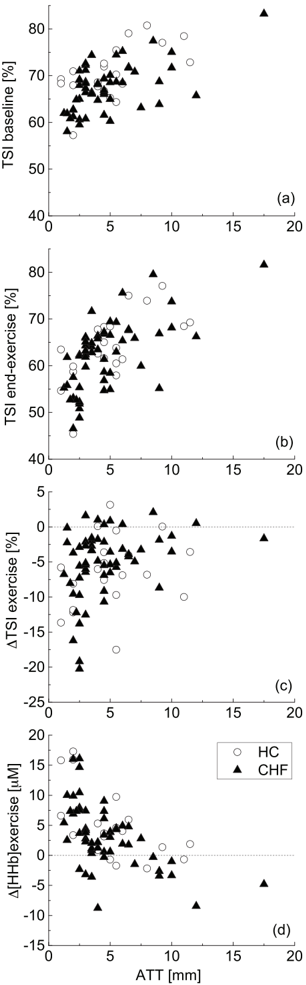
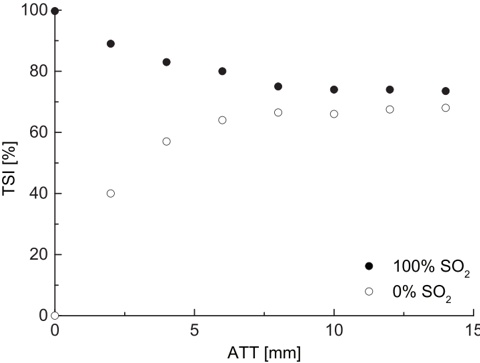
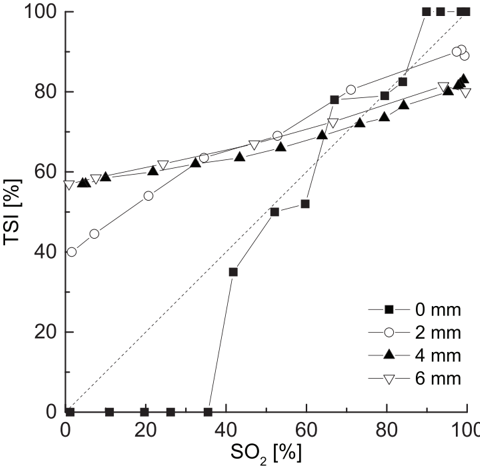
Objective . Near-infrared spectroscopy (NIRS) measurements of tissue oxygen saturation (StO 2 ) are useful for the assessment of skeletal muscle perfusion and function during exercise, however, they are influenced by overlying skin and adipose tissue. This study explored the extent and nature of the influence of adipose tissue thickness (ATT) on StO 2 . Approach . NIR spatially resolved spectroscopy (SRS) derived oxygenation was measured on vastus lateralis in 56 patients with chronic heart failure (CHF) and 20 healthy control (HC) subjects during rest and moderate intensity exercise with simultaneous assessment of oxygen uptake kinetics ( τ ). In vitro measurements were performed on a flow cell with a blood mixture with full oxygen saturation (100%), which was gradually decreased to 0% by adding sodium metabisulfite. Experiments were repeated with 2 mm increments of porcine fat layer between the NIRS device and flow cell up to 14 mm. Main results . Lower ATT, higher τ , and CHF were independently associated with lower in vivo StO 2 in multiple regression analysis, whereas age and gender showed no independent relationship. With greater ATT, in vitro StO 2 was reduced from 100% to 74% for fully oxygenated blood and increased from 0% to 68% for deoxygenated blood. Significance . This study shows that ATT independently confounds NIR-SRS derived StO 2 by overestimating actual skeletal muscle oxygenation and by decreasing its sensitivity for deoxygenation. Because physiological properties (e.g. presence of disease and slowing of τ ) also influence NIR-SRS, a correction based on optical properties is needed to interpret calculated values as absolute StO 2 .
Overview
The claims and statistics of this paper haven’t been checked yet.
Free: it reads the open-access text and checks the first 5 claims that cite a source we can check. Create a free account to check every claim.
Integrity signals
Registry
Cites
Statistics
Figures
Verification
Claims the paper makes
The claims and statistics of this paper haven’t been checked yet.
Free: it reads the open-access text and checks the first 5 claims that cite a source we can check. Create a free account to check every claim.
Claims other papers make about this one
Each is checked against this paper’s own text: does it say what the citing paper says it does?
The source backs part of the claim, not all of it — or backs it for a different population, condition or comparison.
In the citing paper
“However, some studies explored other regions during cycling which could affect the determination of the threshold17,47, although the rectus femoris is also a power output producer in this area where there could be a higher proportion of adipose tissue52 or because its neuromuscular activation is not affected by the increase in workload during the test (e.g., gastrocnemius)53.”
From Reliability of threshold determination using portable muscle oxygenation monitors during exercise testing: a systematic review and meta-analysis (2023) · cites this paper as [52]
Experimental — accuracy not yet measured
Self-check
Percentages, sums and reported differences re-computed from the paper’s own numbers.
The self-check needs the paper’s full text.
Citations
Cites
A new method for detecting anaerobic threshold by gas exchange
Beaver, W. L., Wasserman, K., & Whipp, B. J. (1986) · Journal of Applied Physiology · doi:10.1152/jappl.1986.60.6.2020 · Cited by 4,103 · cited 1×
“The gas exchange threshold (GET) was determined by the mean of the independent assessments of two experienced physicians using the V-slope method (Beaver et al 1986).”
Fletcher, G. F., Ades, P. A., Kligfield, P., Arena, R., Balady, G. J., Bittner, V. A., Coke, L. A., Fleg, J. L., Forman, D. E., Gerber, T. C., et al. (2013) · Circulation · doi:10.1161/cir.0b013e31829b5b44 · Cited by 2,235 · cited 1×
“The maximal exercise protocol started with a 1 min resting period and 4 min of unloaded pedaling before work rate started to increase with an individualized ramp rate aiming to reach exhaustion within 8 – 12 min (Fletcher et al 2013).”
Poole, D. C., & Jones, A. M. (2012) · Comprehensive Physiology · doi:10.1002/cphy.c100072 · Cited by 514 · cited 1×
“…muscle regions found by Koga et al (2015a), a greater proportion of oxidative muscle fibers in subjects with faster oxygen uptake kinetics can also explain the relation between the degree of measured deoxygenation and speed of pulmonary oxygen uptake kinetics in this study (Poole and Jones 2012).”
Anthropometric measurements in the elderly: age and gender differences
Perissinotto, E., Pisent, C., Sergi, G., Grigoletto, F., Enzi, G., & ILSA Working Group (2002) · British Journal of Nutrition · doi:10.1079/bjn2001487 · Cited by 462 · cited 1×
“However, all of these StO 2 -related parameters may in turn be associated with ATT, which has previously been demonstrated for age and gender (Perissinotto et al 2002).”
Ferrari, M., Muthalib, M., & Quaresima, V. (2011) · Philosophical Transactions of the Royal Society A: Mathematical, Physical and Engineering Sciences · doi:10.1098/rsta.2011.0230 · Cited by 450 · cited 2×
“…(TD) and frequency-domain (FD) instruments that allow quantification of the actual tissue optical properties to calculate absolute oxygenated and deoxygenated hemoglobin concentrations, the signal-to-noise ratio and temporal resolution are not as high as for the SRS technique (Ferrari et al 2011).”
Adipose tissue thickness affects in vivo quantitative near-IR spectroscopy in human skeletal muscle
VAN BEEKVELT, M. C. P., BORGHUIS, M. S., VAN ENGELEN, B. G. M., WEVERS, R. A., & COLIER, W. N. J. M. (2001) · Clinical Science · doi:10.1042/cs1010021 · Cited by 369 · cited 4×
“…al 2009, Cooper et al 2010, Grieger et al 2013), reducing optical density (Homma et al 1996, Lin et al 2000), and decreasing sensitivity for deoxygenation with greater ATT (Niwayama et al 2000, Feng et al 2001, van Beekvelt et al 2001, Koga et al 2011, Ohmae et al 2014, van der Zwaard et al 2016).”
InfluentialGrassi, B., & Quaresima, V. (2016) · Journal of Biomedical Optics · doi:10.1117/1.jbo.21.9.091313 · Cited by 345 · cited 1×
“Deeper muscle regions commonly have a greater proportion of oxidative fibers compared to superficial regions, leading to a greater degree of oxidative energy metabolism and a concomitantly greater sensitivity for vascular control (Grassi and Quaresima 2016).”
BackgroundGoossens, G. H., Bizzarri, A., Venteclef, N., Essers, Y., Cleutjens, J. P., Konings, E., Jocken, J. W. E., Čajlaković, M., Ribitsch, V., Clément, K., et al. (2011) · Circulation · doi:10.1161/circulationaha.111.027813 · Cited by 324 · cited 1×
“Second, Goossens et al (2011) demonstrated that subjects with greater ATT have even higher hemoglobin oxygenation in adipose tissue than lean subjects, at least in fasting conditions, amplifying the aforementioned effect.”
Ryan, T. E., Erickson, M. L., Brizendine, J. T., Young, H.-J., & McCully, K. K. (2012) · Journal of Applied Physiology · doi:10.1152/japplphysiol.00319.2012 · Cited by 233 · cited 1×
“Conventional methods to correct for ATT are based on the assumption of constant tissue properties among measured subjects (e.g. hemoglobin content, oxygen consumption, and oxygen saturation) (Niwayama et al 2000, Ryan et al 2012, Bowen et al 2013).”
Richardson, T. E., Kindig, C. A., Musch, T. I., & Poole, D. C. (2003) · Journal of Applied Physiology · doi:10.1152/japplphysiol.00308.2003 · Cited by 131 · cited 1×
“…present results of a lower TSI baseline for CHF, and an independent association of CHF with StO 2 , may be explained on the basis of pathophysiological consequences of the disease, as for example reduced skin blood flow (Andreassen et al 1998), and compromised vascularity (Richardson et al 2003).”
Cited by
Muscle Oximetry in Sports Science: A Systematic Review
Perrey, S., & Ferrari, M. (2018) · Sports Medicine · doi:10.1007/s40279-017-0820-1 · Cited by 220
“[86] confirmed that adipose tissue thickness independently confounds by either overestimating actual skeletal muscle oxygenation or decreasing its sensitivity for deoxygenation.”
BackgroundHamaoka, T., & McCully, K. K. (2019) · The Journal of Physiological Sciences · doi:10.1007/s12576-019-00697-2 · Cited by 92
Lutz, J., Memmert, D., Raabe, D., Dornberger, R., & Donath, L. (2019) · International Journal of Environmental Research and Public Health · doi:10.3390/ijerph17010059 · Cited by 114
“Another issue is the adipose tissue thickness influences the reflection of infrared lights [83].”
BackgroundSendra-Pérez, C., Sanchez-Jimenez, J. L., Marzano-Felisatti, J. M., Encarnación-Martínez, A., Salvador-Palmer, R., & Priego-Quesada, J. I. (2023) · Scientific Reports · doi:10.1038/s41598-023-39651-z · Cited by 52
Keller, J. L., & Kennedy, K. G. (2021) · European Journal of Applied Physiology · doi:10.1007/s00421-021-04810-5 · Cited by 36
Age and sex differences in microvascular responses during reactive hyperaemia
Citherlet, T., Raberin, A., Manferdelli, G., da Mota, G. R., & Millet, G. P. (2024) · Experimental Physiology · doi:10.1113/ep091652 · Cited by 28
“The higher TSI baseline and TSI min in women can be explained by higher adipose tissue thickness in women as it affects NIRS’ light penetration and leads to higher TSI values (Barstow, 2019; Niemeijer et al., 2017).”
Backgroundvan Hooff, M., Meijer, E. J., Scheltinga, M. R. M., Savelberg, H. H. C. M., & Schep, G. (2022) · Clinical Physiology and Functional Imaging · doi:10.1111/cpf.12738 · Cited by 20
Self-citationSlower Skeletal Muscle Oxygenation Kinetics in Adults With Complex Congenital Heart Disease
Sandberg, C., Crenshaw, A. G., Elçadi, G. H., Christersson, C., Hlebowicz, J., Thilén, U. J., & Johansson, B. H. (2019) · Canadian Journal of Cardiology · doi:10.1016/j.cjca.2019.05.001 · Cited by 23
Sendra‐Pérez, C., Priego‐Quesada, J. I., Palmer, R. S., Murias, J. M., & Martínez, A. E. (2023) · Journal of Applied Physiology · doi:10.1152/japplphysiol.00420.2023 · Cited by 24
Amendola, C., Contini, D., Re, R., Spinelli, L., Frabasile, L., Levoni, P., & Torricelli, A. M. (2023) · Journal of Biomedical Optics · doi:10.1117/1.jbo.28.7.075002 · Cited by 23
Niemeijer, V. M., Snijders, T., Verdijk, L. B., van Kranenburg, J. M. X., Groen, B. B. L., Holwerda, A. M., Spee, R. F., Wijn, P. F. F., van Loon, L. J. C., & Kemps, H. (2018) · Journal of Applied Physiology · doi:10.1152/japplphysiol.00057.2018 · Cited by 20
Self-citationMuscle oxygenation maintained during repeated-sprints despite inspiratory muscle loading
Rodriguez, R. F., Townsend, N., Aughey, R. J., & Billaut, F. (2019) · PLoS ONE · doi:10.1371/journal.pone.0222487 · Cited by 20
“In fact, spatially-resolved spectroscopy methods are less susceptible to be influenced by underlying adipose tissue thickness then modified BeerLambert law methods [33].”
Miles, M., Rodrigues, A., Tajali, S., Xiong, Y., Orchanian‐Cheff, A., Reid, W. D., & Rozenberg, D. (2021) · Chronic Respiratory Disease · doi:10.1177/1479973121993494 · Cited by 16
PIPERI, A., Warnier, G., de ten Ryen, S. V. D., Benoît, N., Antoine, N., Copine, S., Francaux, M., & Deldicque, L. (2024) · Medicine & Science in Sports & Exercise · doi:10.1249/mss.0000000000003485 · Cited by 17
“In addition, adipose tissue thickness, which is generally higher in females, is known to overestimate actual skeletal muscle oxygenation (54).”
Vasquez-Bonilla, A. A., Tomás-Carús, P., Brazo‐Sayavera, J., Malta, J., Folgado, H., & Olcina, G. J. (2023) · Science & Sports · doi:10.1016/j.scispo.2022.03.014 · Cited by 13
Fleitas‐Paniagua, P. R., Azevedo, R. D. A., Trpcic, M., Murias, J. M., & Rogers, B. (2023) · The Journal of Strength and Conditioning Research · doi:10.1519/jsc.0000000000004597 · Cited by 15
“The NIRS signal may be negatively affected by subcutaneous fat tissue and probe movement (4,39).”
BackgroundVasquez-Bonilla, A. A., Rojas‐Valverde, D., Timón, R., & Olcina, G. J. (2022) · Apunts Sports Medicine · doi:10.1016/j.apunsm.2022.100395 · Cited by 18
Sendra-Pérez, C., Encarnación-Martínez, A., Oficial-Casado, F., Salvador-Palmer, R., & Priego-Quesada, J. I. (2023) · Physiological Measurement · doi:10.1088/1361-6579/ad1457 · Cited by 9
Arnold, J. I., Yogev, A., Nelson, H., van Hooff, M., & Koehle, M. S. (2024) · Frontiers in Physiology · doi:10.3389/fphys.2024.1449384 · Cited by 8
Perlet, M. R., Traylor, M. K., Ransom, K. V., Batman, G. B., Hill, E. C., Weir, J. P., & Keller, J. L. (2024) · Applied Physiology, Nutrition, and Metabolism · doi:10.1139/apnm-2024-0320 · Cited by 8
Acute Fatigue Impairs Heart Rate Variability and Resting Muscle Oxygen Consumption Kinetics
Vasquez-Bonilla, A. A., Sepulveda, R. A. Y., Tuesta, M., Martín, E. B.-S., Monsalves‐Álvarez, M., Arancibia, J. E. O., Bastías, D. M. D., Recabarren-Dueñas, C., & Alacid, F. (2024) · Applied Sciences · doi:10.3390/app14209166 · Cited by 10
van Hooff, M., Schep, G., Meijer, E., Bender, M. H., & Savelberg, H. H. C. M. (2018) · Journal of Sports Medicine · doi:10.1155/2018/8965858 · Cited by 11
Self-citationXie, F., Huang, S., Miao, T., He, S., Lin, Z., & Xie, L. (2022) · IEEE Sensors Journal · doi:10.1109/jsen.2022.3216351 · Cited by 8
“This will suffice for most situations when the ATT is thick.”
BackgroundFernandez, C. M., Blaney, G. P., Frias, J., Tavakoli, F., Sassaroli, A., & Fantini, S. (2023) · Journal of Biomedical Optics · doi:10.1117/1.jbo.28.12.125004 · Cited by 9
“6,12,13 To this aim, TD-NIRS data were used either to generate correction curves derived from the ratio of partial optical pathlength in muscle to the total optical pathlength, 8 or to yield separate measurements for the top layer (adipose tissue) and bottom layer (muscle) by modeling the tissue as…”
BackgroundMethodMuscle Oxygenation During Hypoxic Exercise in Children and Adults
Ušaj, A., Mekjavić, I. B., Kapus, J., McDonnell, A. C., Mekjavič, P. J., & Debevec, T. (2019) · Frontiers in Physiology · doi:10.3389/fphys.2019.01385 · Cited by 10
Endo, T., Kime, R., Fuse, S., Murase, N., Kurosawa, Y., & Hamaoka, T. (2020) · Medicine & Science in Sports & Exercise · doi:10.1249/mss.0000000000002530 · Cited by 8
Langenfeld, A., Wirth, B., Vrana, A., Riner, F., Gaehwiler, K., Valdivieso, P., Humphreys, B. K., Scholkmann, F., Flueck, M., & Schweinhardt, P. (2022) · Scientific Reports · doi:10.1038/s41598-022-11683-x · Cited by 10
Diagnosing Sport-Related Flow Limitations in the Iliac Arteries Using Near-Infrared Spectroscopy
van Hooff, M., Arnold, J. I., Meijer, E., Schreuder, P., Regis, M., Xu, L., Scheltinga, M. R., Savelberg, H. H. C. M., & Schep, G. (2022) · Journal of Clinical Medicine · doi:10.3390/jcm11247462 · Cited by 11
“High levels of adipose tissue thickness (ATT) are known to influence the accuracy of NIRS measurements of underlying muscular tissue [12,22,23].”
BackgroundSelf-citationCornelis, N., Chatzinikolaou, P. N., Buys, R., Wilde, C. D., Fourneau, I., Claes, J., Goetschalckx, K., & Cornelissen, V. (2022) · Journal of Sports Sciences · doi:10.1080/02640414.2022.2045062 · Cited by 7
“This is especially true in the present heterogenous group of LEAD patients characterized by increased fat mass (e.g., sarcopenia) which reduces the penetration depth of NIRS at the site of interest (Niemeijer et al., 2017).”
BackgroundReference values for triceps surae tissue oxygen saturation by near-infrared spectroscopy
de Faria, V. C., de Oliveira, L. F. L., Ferreira, A. P., Cunha, T. E. D. O., Fernandes, J. S. A., Pussieldi, G. D. A., & Pereira, D. A. G. (2022) · Physiological Measurement · doi:10.1088/1361-6579/ac9452 · Cited by 5
Bu, L., Xu, N., Wang, Y., & Liu, H. (2020) · Physiological Measurement · doi:10.1088/1361-6579/abad13 · Cited by 6
Ušaj, A., Sotiridis, A., & Debevec, T. (2023) · Biology · doi:10.3390/biology12030457 · Cited by 5
“It is also worth mentioning that the continuous wave NIRS technique is very sensitive to the thickness of the subcutaneous fat layer, which may elicit errors in the results of muscle oxygenation [37,38].”
BackgroundExploring the limits of exercise capacity in adults with type II diabetes
Michielsen, M., Bekhuis, Y., Claes, J., Decorte, E., Wilde, C. D., Gojevic, T., Costalunga, L., Amyay, S., Lazarou, V., Daraki, D., et al. (2025) · PLoS ONE · doi:10.1371/journal.pone.0331737 · Cited by 3
“These insufficient-quality NIRS-data were more prevalent among those with greater adipose tissue thickness, a factor known to affect NIRS-derived data [50,51].”
Stanford, D. M., Park, J., & Jessee, M. B. (2021) · European Journal of Applied Physiology · doi:10.1007/s00421-021-04757-7 · Cited by 3
Oxygen delivery is not a limiting factor during post-exercise recovery in healthy young adults
Mankowski, R. T., Niemeijer, V. M., Jansen, J. P., Spraakman, L., Stam, H. J., & Praet, S. (2017) · Journal of Exercise Science & Fitness · doi:10.1016/j.jesf.2017.07.001 · Cited by 4
Self-citationEvaluation of Functional Hyperemia Using NIRTRS Without the Influence of Fat Layer Thickness
Endo, T., Kime, R., Fuse, S., Watanabe, T., Murase, N., Kurosawa, Y., & Hamaoka, T. (2018) · Advances in experimental medicine and biology · doi:10.1007/978-3-319-91287-5_16 · Cited by 3
Sendra‐Pérez, C., Martínez, A. E., & Priego‐Quesada, J. I. (2025) · Sensors · doi:10.3390/s25216798 · Cited by 5
Cantieni, T., da Silva-Kress, O., & Wolf, U. (2022) · Biomedical Optics Express · doi:10.1364/boe.473563 · Cited by 3
Induced blood flow oscillations at 0.1 Hz protects oxygenation of severely ischemic tissue in humans
Davis, K. A., Bhuiyan, N. I., McIntyre, B. J., Dinh, V. Q., & Rickards, C. A. (2024) · Journal of Applied Physiology · doi:10.1152/japplphysiol.00438.2024 · Cited by 2
de Faria, V. C., Fernandes, J. S. D. A., Cunha, T. E. D. O., Pussieldi, G. D. A., & Pereira, D. A. G. (2025) · Jornal Vascular Brasileiro · doi:10.1590/1677-5449.202301062 · Cited by 3
“This is probably because the thickness of the adipose tissue, especially that which is associated with NIRS positioning, can result in overestimated StO 2 values ,37 which can be extrapolated to the body fat percentage value.”
Romanelli, M., Allois, R., & Roatta, S. (2025) · Applied Sciences · doi:10.3390/app15126675 · Cited by 2
Muscle Oxygen Saturation to Determine Lactate Thresholds in Spinal Cord Injury Population
Sánchez‐Jiménez, J. L., Sendra‐Pérez, C., de Anda, R. M. C.-O., Vazquez-Fariñas, M., Priego‐Quesada, J. I., & Aparicio, I. (2025) · International Journal of Sports Medicine · doi:10.1055/a-2637-7212 · Cited by 1
Regional oximetry for diagnosing compartment syndrome: a scoping review
Tang, L. Y., Duru, D. O., Browne, A., Zhou, A., Nandra, S., & Krkovič, M. (2026) · Journal of Orthopaedic Surgery and Research · doi:10.1186/s13018-026-06763-x · Cited by 1
“Studies suggest that even modest increases in adipose tissue layer thickness can significantly attenuate NIRS signal [37, 38], and a layer > 4 cm may serve as an exclusion criterion for NIRS [15].”
RELATIONSHIP BETWEEN UNBALANCED CORE STRENGTHENING AND INJURIES IN DANCESPORT ATHLETES
Huang, H. (2022) · Revista Brasileira de Medicina do Esporte · doi:10.1590/1517-8692202228022021_0445 · Cited by 2
Effects of Moderate Altitude Training Combined with Moderate or High-altitude Residence
Ušaj, A., Kapus, J., Štrumbelj, B., Debevec, T., & Vodičar, J. (2022) · International Journal of Sports Medicine · doi:10.1055/a-1885-4053 · Cited by 1
Porcelli, S., Pilotto, A., & Rossiter, H. B. (2023) · Medicine & Science in Sports & Exercise · doi:10.1249/mss.0000000000003239 · Cited by 2
“Finally, skin and adipose tissue thickness strongly affects NIRS signals and may cause an overestimation of muscle oxygenation (24,25).”
Acute Effects of a Practical Blood Flow Restriction Device During Swimming Exercise
Lisbôa, F. D., de Aguiar, R. A., Pereira, G. S., & Caputo, F. (2023) · Research Quarterly for Exercise and Sport · doi:10.1080/02701367.2023.2263050 · Cited by 1
“Females were not recruited because they have usually twice the triceps subcutaneous adipose tissue thickness compared to their counterpart males (Leahy et al., 2012) which directly impacts the NIRS measurement (Nasseri et al., 2016; Niemeijer et al., 2017).”
BackgroundSchamne, J. C., SANTOS, P. D. S. D., Cavalcante, V. H. V., GONÇALVES, F., Bertuzzi, R., Pereira, G., Paiva, E. D. S., Okuno, N. M., & Lima‐Silva, A. E. (2024) · Medicine & Science in Sports & Exercise · doi:10.1249/mss.0000000000003466 · Cited by 1
“In addition, the amount of regional adipose tissue has been suggested to influence the measurement of local SmO 2 (65).”
Optical bone densitometry insensitive to skin thickness
Miura, K., Khantachawana, A., Wakamori, T., Matsubara, H., & Tanaka, S. M. (2022) · Biomedizinische Technik/Biomedical Engineering · doi:10.1515/bmt-2021-0314 · Cited by 1
de Faria, V. C., Fernandes, J. S. D. A., Cunha, T. E. D. O., Pussieldi, G. D. A., & Pereira, D. A. G. (2022) · Research Square · doi:10.21203/rs.3.rs-2198110/v1
Hutchison, R. E., Smith, S. E., Caudell, C. W., Biddle, S., Gluck, W. L., & Trilk, J. L. (2025) · PLoS ONE · doi:10.1371/journal.pone.0315351
“Additional assumptions from Foulkes [38] and Beever [37] include the random slope is assumed to follow a normal distribution with an extrapolated standard deviation, as well as a normal distribution of the error with standard deviation of 5.54 [39,40].”
InfluentialIshida, H., Suehiro, T., & Kurozumi, C. (2025) · Journal of Manipulative and Physiological Therapeutics · doi:10.1016/j.jmpt.2025.10.012
Sensing changes in triglyceride concentration in blood solution using diffuse optical spectroscopy
Liang, S., Wan, N., Chen, G., Chen, S.-L., & Seong, M. (2026) · Optics & Laser Technology · doi:10.1016/j.optlastec.2026.114767
Impaired peripheral oxygen delivery during submaximal exercise in adults with long COVID
Thomas, C., Ashton, R. E. M., Owen, R., McNeil‐Angopa, E., Carr, J., Bewick, T. A., & Faghy, M. A. (2026) · Physiological Reports · doi:10.14814/phy2.70873 · Cited by 1
“This occurs because the signal becomes more reflective of the adipose tissue, which typically has a higher TSI% compared to skeletal muscle due to its lower metabolic rate (Niemeijer et al., 2017).”
Sendra‐Pérez, C., Carrión‐González, C., Wessling-Intriago, P., Marzano‐Felisatti, J. M., Priego‐Quesada, J. I., & Aparicio, I. (2026) · Applied Sciences · doi:10.3390/app16105009
Feldmann, A., Quaresima, V., Perrey, S., & Ferrari, M. (2026) · Sports Medicine - Open · doi:10.1186/s40798-026-01033-w · Cited by 2
“Using CW SRS, Niemeijer et al. [21] reinforced this with a phantom blood study, showing that as ATT increased, StO ₂ readings became increasingly inaccurate, overestimating both oxygenated and deoxygenated states.”
da Silva, W., Sendra‐Pérez, C., Marzano‐Felisatti, J. M., Aparicio, I., Carpes, F. P., & Priego‐Quesada, J. I. (2026) · PLoS ONE · doi:10.1371/journal.pone.0349644
Investigation of muscle oxygen saturation response according to quadriceps muscle strength levels
Pündük, Z., Nizam, S., Demirci, S., & Atik, A. (2026) · Isokinetics and Exercise Science · doi:10.1177/09593020261480974
Pécheux, O., Dumas, M., Ghesquière, L., Skrobala, E., Hureau, M., & Estevez, M. G. (2026) · International Journal of Obstetric Anesthesia · doi:10.1016/j.ijoa.2026.105285
Side differences in NIRS-derived muscle oxygen saturation during treadmill running
Zwiener, L., Richrath, O., Skotzke, P., Volkamer-Kien, B., Schwindling, S., & Meyer, T. (2026) · European Journal of Applied Physiology · doi:10.1007/s00421-026-06469-2
Metadata
- Authors
- Niemeijer, V. M., Jansen, J. P., van Dijk, T., Spee, R. F., Meijer, E. J., Kemps, H. M. C., & Wijn, P. F. F.
- Affiliations
- Máxima Medisch Centrum (NL)
- Eindhoven University of Technology (NL)
- Corresponding author
- Niemeijer, Victor M
- Meijer, Eduard J
- Venue
- Physiological Measurement
- Publisher
- IOP Publishing
- Published
- 2017-02-16
- Volume
- 38
- Issue
- 3
- Pages
- 539-554
- ISSN
- 0967-3334 (ISSN-L)
- 1361-6579
- OpenAlex
- W2584254667
- Semantic Scholar
- 7dc7f6574734882068cf9811e33e1573501bbe1b
- Cited by
- 61
- References
- 46
- Citations by year
- 2026: 9 · 2025: 7 · 2024: 7 · 2023: 10 · 2022: 12 · 2021: 3 · 2020: 2 · 2019: 6 · 2018: 3 · 2017: 2
- FWCI
- 2.74
- Type
- journal article
- Language
- en
- Open access
- hybrid
- doi.org
- Licence
- cc-by
- iopscience.iop.org/info/page/text-and-data-mining (tdm)
- creativecommons.org/licenses/by/3.0/ (vor)
- Locations
- Physiological Measurement (publishedVersion, cc-by)
- PubMed (publishedVersion)
- TU/e Research Portal (submittedVersion, other-oa)
- TU/e Research Portal (submittedVersion)
- Funders
- Foundation ‘Friends of the Heart’, Eindhoven, The Netherlands
- Scientific Foundation of Máxima Medical Centre, Veldhoven, The Netherlands
- Topics
- Health Sciences › Medicine › Radiology, Nuclear Medicine and Imaging › Optical Imaging and Spectroscopy Techniques
- Health Sciences › Medicine › Physiology (medical) › Cardiovascular and exercise physiology
- Life Sciences › Biochemistry, Genetics and Molecular Biology › Biophysics › Spectroscopy Techniques in Biomedical and Chemical Research
- Keywords
- adipose tissue thickness, skeletal muscle oxygenation, tissue oxygen saturation, vastus lateralis, chronic heart failure
- MeSH terms
- Adipose Tissue, Adult, Aged, Aged, 80 and over, Chronic Disease, Female, Heart Failure, Humans, Male, Middle Aged, Oxygen, Case-Control Studies, Muscle, Skeletal, Spectroscopy, Near-Infrared
About these checks
Registry, retraction, Cites and statistics results are computed, not judged, with one exception: a printed reference that no index lists is read once by a model before it counts as a citation error. Claims are extracted by a model and kept only when their quote appears verbatim in the text; each cited source is then checked, with a model’s help, for whether it says what the claim relies on. Those verdicts can be wrong — read the claim’s quote and the cited source before relying on one.
Statistics and arithmetic are recomputed, not judged.
Confidence bands are shown only for fields calibrated on our annotated test set. None is calibrated yet, so no band is shown.
What counts as a claim ›How we measure confidence ›How we check this ›
Are you an author, or do you see a problem with this page? Request a review
Data sources
Bibliographic data: Semantic Scholar, OpenAlex, Crossref.
Contains information from the Semantic Scholar Academic Graph Datasets, made available under the ODC Attribution License (ODC-BY 1.0).
Semantic Scholar’s data is described in: Kinney, R., et al. (2023). The Semantic Scholar Open Data Platform. arXiv:2301.10140.
