

Faster quantum chemistry simulation on fault-tolerant quantum computers
Open accessThe DOI matches its Crossref record; 99 of the 99 references it cites were found in a registry or an index.
Abstract
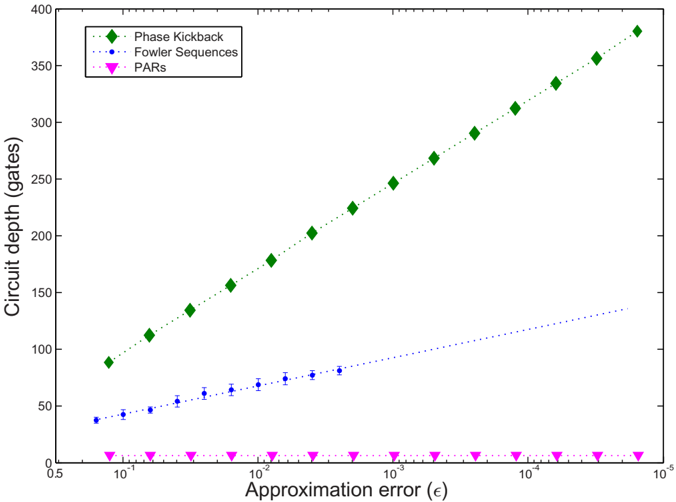
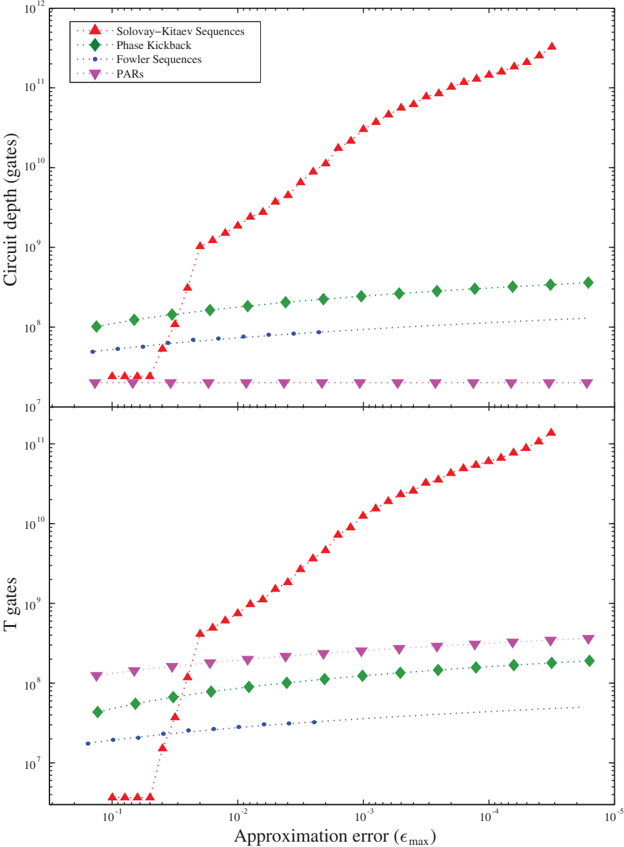
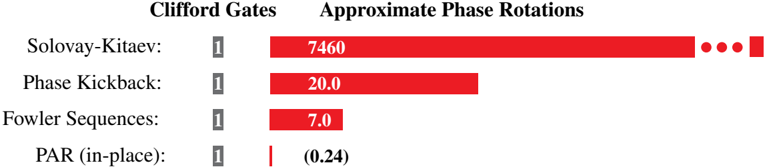
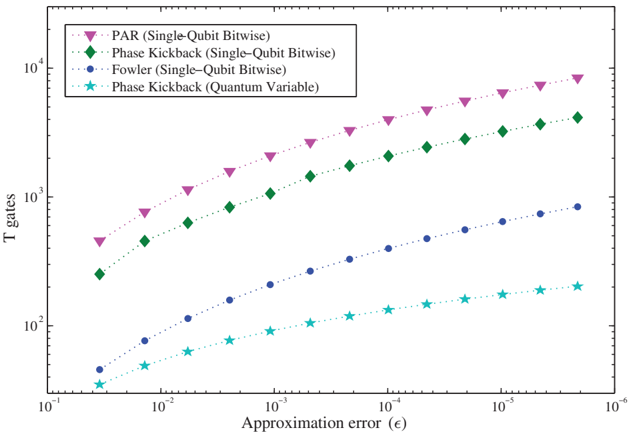
Quantum computers can in principle simulate quantum physics exponentially faster than their classical counterparts, but some technical hurdles remain.We propose methods which substantially improve the performance of a particular form of simulation, ab initio quantum chemistry, on faulttolerant quantum computers; these methods generalize readily to other quantum simulation problems.Quantum teleportation plays a key role in these improvements and is used extensively as a computing resource.To improve execution time, we examine techniques for constructing arbitrary gates which perform substantially faster than circuits based on the conventional Solovay-Kitaev algorithm (Dawson and Nielsen 2006 Quantum Inform.Comput.6 81).For a given approximation error , arbitrary single-qubit gates can be 7
Overview
The claims and statistics of this paper haven’t been checked yet.
Free: it reads the open-access text and checks the first 5 claims that cite a source we can check. Create a free account to check every claim.
Integrity signals
Registry
Cites
Statistics
Figures








Verification
Claims the paper makes
The claims and statistics of this paper haven’t been checked yet.
Free: it reads the open-access text and checks the first 5 claims that cite a source we can check. Create a free account to check every claim.
Claims other papers make about this one
Each is checked against this paper’s own text: does it say what the citing paper says it does?
The source backs part of the claim, not all of it — or backs it for a different population, condition or comparison.
In the citing paper
“The time the quantum computer must remain coherent is determined by the necessity of O(p−1) successive applications of , each of which can require on the order of millions or billions of quantum gates for practical applications1719, as compared to the tens to hundreds of gates achievable in the short term.”
From A variational eigenvalue solver on a photonic quantum processor (2014) · cites this paper as [19]
Experimental — accuracy not yet measuredThe check wasn’t confident either way, so it gives no verdict — never disputed.
In the citing paper
“UCCSD has been implemented in combination with different basis set representations of the chemistry Hamiltonian, including the particle/hole basis 327 and the Bogoliubov basis 326 .”
From Quantum Chemistry in the Age of Quantum Computing (2019) · cites this paper as [326]
Experimental — accuracy not yet measuredThe check wasn’t confident either way, so it gives no verdict — never disputed.
In the citing paper
“Given the inherent advantage in implementing the ansatz as well as the high accuracies of CC methods, the application of the UCC ansatz truncated up to single and double excitations (UCCSD) has been investigated both theoretically and experimentally 52,53,59,325-330 .”
From Quantum Chemistry in the Age of Quantum Computing (2019) · cites this paper as [326]
Experimental — accuracy not yet measuredThe check wasn’t confident either way, so it gives no verdict — never disputed.
In the citing paper
“Methods for preparing Slater determinants and general FGSs employ a quadratic number of gates 302,326,335,336 .”
From Quantum Chemistry in the Age of Quantum Computing (2019) · cites this paper as [326]
Experimental — accuracy not yet measuredThe check wasn’t confident either way, so it gives no verdict — never disputed.
In the citing paper
“Dallaire-Demers et al. 326 suggest that a similar circuit template could be used to create a variational ansatz by complementing the list of matchgates with neighboring ZZ interactions, allowing for the preparation of non-Gaussian fermionic states.”
From Quantum Chemistry in the Age of Quantum Computing (2019) · cites this paper as [326]
Experimental — accuracy not yet measured
8 more claims about this paper
Create a free account to see every claim other papers make about this one.
Self-check
Percentages, sums and reported differences re-computed from the paper’s own numbers.
The self-check needs the paper’s full text.
Citations
Cites
Quantum Computation and Quantum Information
Nielsen, M. A., Chuang, I., & Grover, L. K. (2002) · American Journal of Physics · doi:10.1119/1.1463744 · Cited by 21,895
General atomic and molecular electronic structure system
Schmidt, M. W., Baldridge, K. K., Boatz, J. A., Elbert, S. T., Gordon, M. S., Jensen, J. H., Koseki, S., Matsunaga, N., Nguyen, K. A., Su, S., et al. (1993) · Journal of Computational Chemistry · doi:10.1002/jcc.540141112 · Cited by 20,204 · cited 1×
“We performed calculations in the minimal basis and in a triple-zeta basis, using the GAMESS quantum chemistry package [55, 56], at a bond distance of 1.63 ˚A, with an integral term cutoff of 10 − 10 in atomic units.”
MethodInfluentialQuantum computation and quantum information
Law, J. (2001) · ACM SIGSOFT Software Engineering Notes · doi:10.1145/505482.505499 · Cited by 18,842
Quantum Computation and Quantum Information: 10th Anniversary Edition
Nielsen, M. A., & Chuang, I. L. (2012) · doi:10.1017/cbo9780511976667 · Cited by 8,436
Simulating physics with computers
Feynman, R. P. (1982) · International Journal of Theoretical Physics · doi:10.1007/bf02650179 · Cited by 7,691 · cited 1×
“Simulating quantum physics is arguably one of the most important applications of a quantum computer—a problem whose solution is both intractable for classical computers and valuable to science [1].”
BackgroundDunning, T. H. (1970) · The Journal of Chemical Physics · doi:10.1063/1.1674408 · Cited by 5,032 · cited 1×
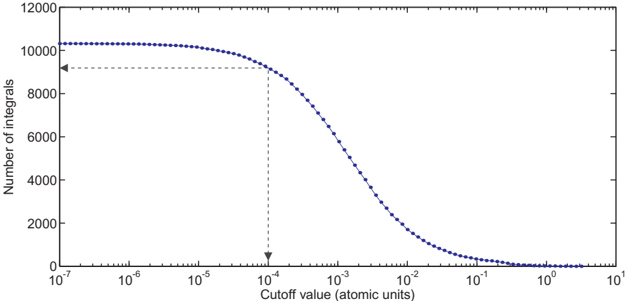
“We computed the number of integrals above cutoff using the STO-3G basis [57] containing 12 spin-orbitals (6 spatial orbitals) and the TZVP basis [58] containing 40 spin orbitals (20 spatial orbitals).”
MethodHehre, W. J., Stewart, R. F., & Pople, J. A. (1969) · The Journal of Chemical Physics · doi:10.1063/1.1672392 · Cited by 4,204 · cited 1×
“We computed the number of integrals above cutoff using the STO-3G basis [57] containing 12 spin-orbitals (6 spatial orbitals) and the TZVP basis [58] containing 40 spin orbitals (20 spatial orbitals).”
MethodLloyd, S. (1996) · Science · doi:10.1126/science.273.5278.1073 · Cited by 3,088 · cited 5×
“Several possible simulators have been proposed and studied [12, 17–20], but we focus on fault-tolerant circuit-model quantum simulation in this investigation [2, 4, 7, 13,21–24].”
BackgroundMethodInfluentialMolecular Electronic‐Structure Theory
Helgaker, T., Jørgensen, P., & Olsen, J. (2000) · doi:10.1002/9781119019572 · Cited by 2,594
Dunning, T. H. (1971) · The Journal of Chemical Physics · doi:10.1063/1.1676139 · Cited by 2,191
Cited by
Items 101–149 of 149
Akahoshi, Y., Toshio, R., Fujisaki, J., Oshima, H., Sato, S., & Fujii, K. (2025) · PRX Quantum · doi:10.1103/93zr-1ykb · Cited by 49
Kosugi, T., Nishi, H., & Matsushita, Y. (2023) · npj Quantum Information · doi:10.1038/s41534-023-00778-6 · Cited by 27
Implementation of a Toffoli gate using an array of coupled cavities in a single step
Cao, Y., Wang, G., Liu, H. D., & Sun, C. (2018) · Scientific Reports · doi:10.1038/s41598-018-24214-4 · Cited by 11
“1038/s41598-018-24214-4 ρ ρ ρ ρ ρ ≡ F t t ( , ( )) Tr ( ) , (19) id id id 1 2 1 2 where ρ(t) is the mixed output system state (obtained from the joint system-bath evolution after a partial trace over the bath) and ρ id is the density operator for target state.”
BackgroundKosugi, T., Nishi, H., & Matsushita, Y. (2023) · Japanese Journal of Applied Physics · doi:10.35848/1347-4065/acddc0 · Cited by 12
High-fidelity Trotter formulas for digital quantum simulation
Liu, Y.-X., Hines, J., Li, Z., Ajoy, A., & Cappellaro, P. (2020) · Physical Review A · doi:10.1103/physreva.102.010601 · Cited by 10
Accelerating Quantum Algorithms with Precomputation
Huggins, W. J., & McClean, J. R. (2024) · Quantum · doi:10.22331/q-2024-02-22-1264 · Cited by 16
“Going beyond the prototypical use of magic state distillation to implement a T gate, state distillation schemes have been proposed for a variety of other few-qubit operations [2, 3, 10–12].”
Sumeet, Prasannaa, V. S., Das, B. P., & Sahoo, B. K. (2022) · Quantum Reports · doi:10.3390/quantum4020012 · Cited by 9
“On the other hand, the UCCSD energy obtained from qiskit simulators (where we have a compact circuit representation for exponentials, after Trotterization), E = 〈Φ0|e−ΘHeΘ|Φ0〉, have their own sources of errors, which we have studied in detail in our work.”
MethodNishiya, Y., Nishi, H., Couzinié, Y., Kosugi, T., & Matsushita, Y. (2024) · Physical Review A · doi:10.1103/physreva.109.022423 · Cited by 9
Efficient approximation of diagonal unitaries over the Clifford+T basis
Welch, J., Bocharov, A., & Svore, K. M. (2016) · Quantum Information and Computation · doi:10.26421/qic16.1-2-6 · Cited by 23
Computational Chemistry on Quantum Computers: Ground state estimationPreprint
Armaos, V., Badounas, D. A., & Deligiannis, P. (2019) · arXiv (Cornell University) · doi:10.48550/arxiv.1907.00362 · Cited by 7
Ancilla-Free Quantum Adder with Sublinear Depth
Remaud, M., & Vandaele, V. (2025) · Lecture notes in computer science · doi:10.1007/978-3-031-97063-4_11 · Cited by 33
“These arithmetic subroutines have also found applications in various quantum algorithms for solving other problems [7, 8, 9].”
Quantum Federated Learning: A Comprehensive Survey
Uddin, M. R., Shaon, S., Rahman, R., Nguyen, D. C., Dobre, O. A., & Niyato, D. (2025) · IEEE Communications Surveys & Tutorials · doi:10.1109/comst.2025.3644750 · Cited by 49
“These applications often require hundreds or even thousands of qubits to represent complex molecular systems accurately, as demonstrated in recent studies [1], [2], far exceeding the capabilities of existing NISQ systems.”
Puri, S., McMahon, P. L., & Yamamoto, Y. (2017) · Physical review. B./Physical review. B · doi:10.1103/physrevb.95.125410 · Cited by 8
Self-citationQubit encoding for a mixture of localized functions
Kosugi, T., Daimon, S., Nishi, H., Tsuneyuki, S., & Matsushita, Y. (2024) · Physical Review A · doi:10.1103/physreva.110.062407 · Cited by 10
Model-free distortion canceling and control of quantum devices
Fouad, A., Youssry, A., El-Rafei, A., & Hammad, S. (2024) · Quantum Science and Technology · doi:10.1088/2058-9565/ad80c1 · Cited by 5
Distillation protocols for Fourier states in quantum computing
Jones, C. (2014) · Quantum Information and Computation · doi:10.26421/qic14.7-8-2 · Cited by 25
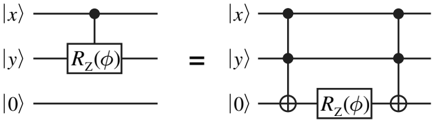
“One of the main reasons to distill Fourier states is that they facilitate faulttolerant phase rotations with phase kickback [14], so we determine the resource costs of this method and compare it to alternatives.”
BackgroundMethodInfluentialResource optimization for fault-tolerant quantum computingPreprint
Paetznick, A. (2014) · arXiv (Cornell University) · doi:10.48550/arxiv.1410.5124 · Cited by 8
Hybrid Quantum-Classical Algorithm for an Integrated Feature Selection and Logistic Regression Model
Ye, L., Wen, M., Zhang, F., Xu, Y., Zhang, Y., Ma, Y., & Wen, K. (2026) · IEEE Transactions on Engineering Management · doi:10.1109/tem.2026.3657976 · Cited by 3
“Despite significant strides in quantum computing, current quantum computers are still in the early stages of development and have not yet achieved widespread commercial application [36].”
Ancilla-approximable quantum state transformations
Blass, A., & Gurevich, Y. (2015) · Journal of Mathematical Physics · doi:10.1063/1.4917056 · Cited by 3
Quantum algorithms for simulation of quantum chemistry problems by quantum computers: an appraisal
Sharma, S. (2022) · Foundations of Chemistry · doi:10.1007/s10698-022-09428-9 · Cited by 4
Assertion-based optimization of Quantum programs
Häner, T., Hoefler, T., & Troyer, M. (2020) · Repository for Publications and Research Data (ETH Zurich) · doi:10.3929/ethz-b-000457964 · Cited by 5
New methods for Quantum Compiling
Kliuchnikov, V. (2014) · UWSpace (University of Waterloo) · Cited by 6
Zha, X., Zhang, C., Fan, D., Xu, P., Du, S., Zhang, R. Q., & Chen, F. (2020) · arXiv (Cornell University) · doi:10.48550/arxiv.2006.15852 · Cited by 6
“Although various improvements have been proposed to reduce the quantum resources[14-17], QPE generally requires fully coherent evolution[18, 19] that impedes its application in the near-term quantum devices.”
BackgroundKosugi, T., Huang, X., Nishi, H., & Matsushita, Y. (2025) · Physical Review A · doi:10.1103/physreva.111.052615 · Cited by 5
Huang, X., Kosugi, T., Nishi, H., & Matsushita, Y. (2025) · Quantum Information Processing · doi:10.1007/s11128-025-04697-7 · Cited by 7
No-go theorem and a universal decomposition strategy for quantum channel compilation
Gong, W., Jiang, S., & Deng, D.-L. (2023) · Physical Review Research · doi:10.1103/physrevresearch.5.013060 · Cited by 5
Clifford+T-based Fault-Tolerant Quantum Implementation of Code Converter Circuit
Biswal, L., Bandyopadhyay, C., & Rahaman, H. (2020) · Advances in intelligent systems and computing · doi:10.1007/978-981-15-4032-5_58 · Cited by 2
Using Hoare logic for quantum circuit optimization.Preprint
Häner, T., Hoefler, T., & Troyer, M. (2018) · arXiv (Cornell University) · Cited by 4
ANCILLA APPROXIMABLE QUANTUM STATE TRANSFORMATIONSPreprint
Blass, A. R., & Gurevich, Y. G. (2016) · Cited by 2
Hierarchical Synthesis of Quantum and Reversible Architectures
Pavlidis, A., & Gizopoulos, D. (2016) · International Journal of Parallel Programming · doi:10.1007/s10766-016-0407-8 · Cited by 2
“Quantum systems simulations and optimization problems are other examples where quantum computation can become advantageous [11].”
BackgroundWeakly fault-tolerant computation in a quantum error-detecting code
Gerhard, C., & Brun, T. A. (2026) · Physical Review A · doi:10.1103/7pv5-46nd · Cited by 9
“We will make use of a simple repeat-until-success circuit, where each repetition succeeds with probability 1 / 2 [61].”
Quantum Simulation of Nuclear Dynamics in First Quantization
Spagnoli, L., Lissoni, C., & Roggero, A. (2026) · Quantum · doi:10.22331/q-2026-09-02-2200 · Cited by 11
Simulating fermions with a digital quantum computer
Chien, R. W., Chiew, M., Harrison, B., Necaise, J., Wang, W., Mudassar, M., McLauchlan, C., Henderson, T. M., Scuseria, G. E., Strelchuk, S., et al. (2026) · Nature Reviews Physics · doi:10.1038/s42254-025-00914-5 · Cited by 12
Self-citationSingh, H., Mishra, S., & Majumder, S. (2023) · International Conference on Quantum Technologies, Communications, Computing, Hardware and Embedded Systems Security (iQ-CCHESS) · doi:10.1109/iq-cchess56596.2023.10391502 · Cited by 1
“There have been a bunch of theoretical [8]–[10] and experimental [11], [12] developments in the applications of quantum computing research related to quantum chemistry over the years, and work has been done to reduce the cost of circuit execution [13].”
Quantum Computation of Hydride Ion using Variational Quantum Algorithm
Kalam, A., Kumar, S., Kumar, A., & Panigrahi, P. K. (2024) · ChemistrySelect · doi:10.1002/slct.202402699 · Cited by 1
Algorithms Bridging Quantum Computation and Chemistry
McClean, J. R. (2015) · Digital Access to Scholarship at Harvard (DASH) (Harvard University) · Cited by 2
Hierarchical synthesis of quantum and reversible architectures
Pavlidis, A., & Gizopoulos, D. (2015) · ACM International Conference on Computing Frontiers (CF) · doi:10.1145/2742854.2742856 · Cited by 1
Layered Architectures for Quantum Computers and Quantum Repeaters
Jones, N. C. (2015) · Lecture notes in physics · doi:10.1007/978-4-431-55756-2_18
Two-Qubit Stabilizer Circuits with Recovery I: Existence
van Dam, W., & Wong, R. (2018) · DROPS (Schloss Dagstuhl – Leibniz Center for Informatics) · doi:10.4230/lipics.tqc.2018.7 · Cited by 2
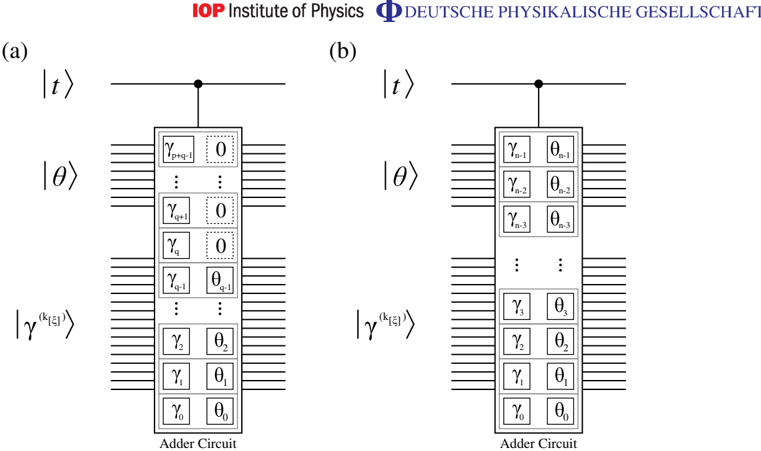
“al [15] suggest pairing |q − γ〉 with |2γ〉 as a direct line to |q+ γ〉, but we can alternatively break this down into two smaller steps if |γ〉 are the only states available.”
BackgroundInfluentialExponentially More Precise Algorithms for Quantum Simulation of Quantum Chemistry
Wei, A. Y. (2016) · Digital Access to Scholarship at Harvard (DASH) (Harvard University)
Meter, R. V. (2014) · Wiley eBooks · doi:10.1002/9781118648919.biblio
Self-citationCho, C., Su, J.-W., Yu, L.-P., Chang, C., Chen, P., Lin, T.-W., Liu, S.-H., Li, T.-H., & Lee, Y.-Y. (2024) · Industrial & Engineering Chemistry Research · doi:10.1021/acs.iecr.3c03331
Matrix Product States and First Quantization
Li, J.-W., & Waintal, X. (2026) · Physical Review Letters · doi:10.1103/5fx2-rsf8 · Cited by 5
Modelling Heterogeneous Catalysis using Quantum Computers: An academic and industry perspectivePreprint
Hariharan, S., Kinge, S., & Visscher, L. (2024) · ChemRxiv · doi:10.26434/chemrxiv-2024-d2l1k
Qubit and T-count Optimized Quantum Circuit Design for Fixed Precision Square Root
Sultana, A., & Muñoz‐Coreas, E. (2024) · IEEE Computer Society Annual Symposium on VLSI · doi:10.1109/isvlsi61997.2024.00124
“Quantum square root circuit serves as useful building block in implementing the Harrow–Hassidim–Lloyd (HHL) algorithm as well as algorithms in physics and quantum chemistry [3] [4] [5].”
MethodA Holistic Approach to Rotation Synthesis for Fault- Tolerant Quantum Computation
Chen, T.-F., Liu, C.-H. M., & Jiang, J.-H. R. (2024) · IEEE International Conference on Quantum Computing and Engineering (QCE) · doi:10.1109/qce60285.2024.00122 · Cited by 2
“Our method is mainly based on the PKAC technique [12].”
InfluentialAccelerated spin-adapted ground-state preparation with nonvariational quantum algorithms
Kobori, T., Kosugi, T., Nishi, H., Todo, S., & Matsushita, Y. (2026) · Physical Review A · doi:10.1103/lldh-d7y1 · Cited by 2
Singh, D., Mehendale, S., Arvind, & Dorai, K. (2026) · Pramana · doi:10.1007/s12043-025-03102-3
Model-based qubit noise spectroscopy
Anonymous, Watson, C. A., Murphy, A. J., Sweeney, T. M., & Quiroz, G. (2026) · Physical Review Applied · doi:10.1103/64bh-t137 · Cited by 2
Metadata
- Authors
- Cody Jones, N., Whitfield, J. D., McMahon, P. L., Yung, M.-H., Meter, R. V., Aspuru-Guzik, A., & Yamamoto, Y.
- Affiliations
- Harvard University (US)
- Stanford University (US)
- Keio University (JP)
- National Institute of Informatics (JP)
- Venue
- New Journal of Physics
- Publisher
- IOP Publishing
- Published
- 2012-11-27
- Volume
- 14
- Issue
- 11
- Pages
- 115023
- ISSN
- 1367-2630 (ISSN-L)
- OpenAlex
- W2100129648
- Cited by
- 145
- References
- 97
- Citations by year
- 2026: 8 · 2025: 6 · 2024: 12 · 2023: 9 · 2022: 10 · 2021: 5 · 2020: 11 · 2019: 14 · 2018: 15 · 2017: 4 · 2016: 11 · 2015: 15 · 2014: 12 · 2013: 10 · 2012: 3
- FWCI
- 12.60
- Type
- journal article
- Language
- en
- Open access
- gold
- doi.org
- Licence
- cc-by-nc-sa
- Locations
- New Journal of Physics (publishedVersion, cc-by-nc-sa)
- arXiv (Cornell University) (submittedVersion)
- Digital Access to Scholarship at Harvard (DASH) (Harvard University) (submittedVersion, cc-by)
- DOAJ (DOAJ: Directory of Open Access Journals) (submittedVersion)
- arXiv (Cornell University)
- Funders
- National Science Foundation (0829694, FA8721-05-C-0002, 1017244)
- Alfred P. Sloan Foundation
- Camille and Henry Dreyfus Foundation
- Japan Society for the Promotion of Science
- National Institute of Information and Communications Technology
- Topics
- Physical Sciences › Computer Science › Artificial Intelligence › Quantum Computing Algorithms and Architecture
- Physical Sciences › Physics and Astronomy › Atomic and Molecular Physics, and Optics › Quantum Information and Cryptography
- Physical Sciences › Physics and Astronomy › Atomic and Molecular Physics, and Optics › Quantum many-body systems
- Keywords
- quantum chemistry simulation, fault-tolerant quantum computing, ab initio quantum chemistry, quantum teleportation, gate construction, quantum circuit optimization, execution time
About these checks
Registry, retraction, Cites and statistics results are computed, not judged, with one exception: a printed reference that no index lists is read once by a model before it counts as a citation error. Claims are extracted by a model and kept only when their quote appears verbatim in the text; each cited source is then checked, with a model’s help, for whether it says what the claim relies on. Those verdicts can be wrong — read the claim’s quote and the cited source before relying on one.
Statistics and arithmetic are recomputed, not judged.
Confidence bands are shown only for fields calibrated on our annotated test set. None is calibrated yet, so no band is shown.
What counts as a claim ›How we measure confidence ›How we check this ›
Are you an author, or do you see a problem with this page? Request a review
Data sources
Bibliographic data: Semantic Scholar, OpenAlex, Crossref.
Contains information from the Semantic Scholar Academic Graph Datasets, made available under the ODC Attribution License (ODC-BY 1.0).
Semantic Scholar’s data is described in: Kinney, R., et al. (2023). The Semantic Scholar Open Data Platform. arXiv:2301.10140.
