

Faster quantum chemistry simulation on fault-tolerant quantum computers
Open accessThe DOI matches its Crossref record; 99 of the 99 references it cites were found in a registry or an index.
Abstract
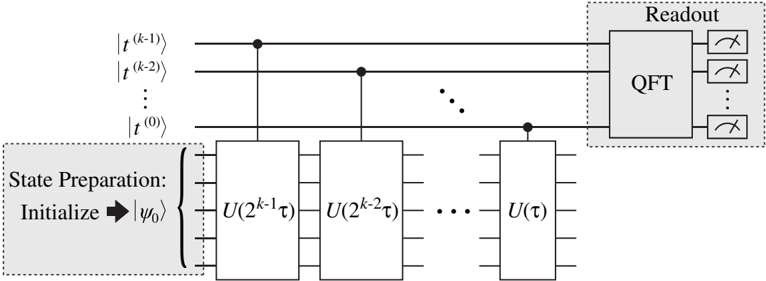
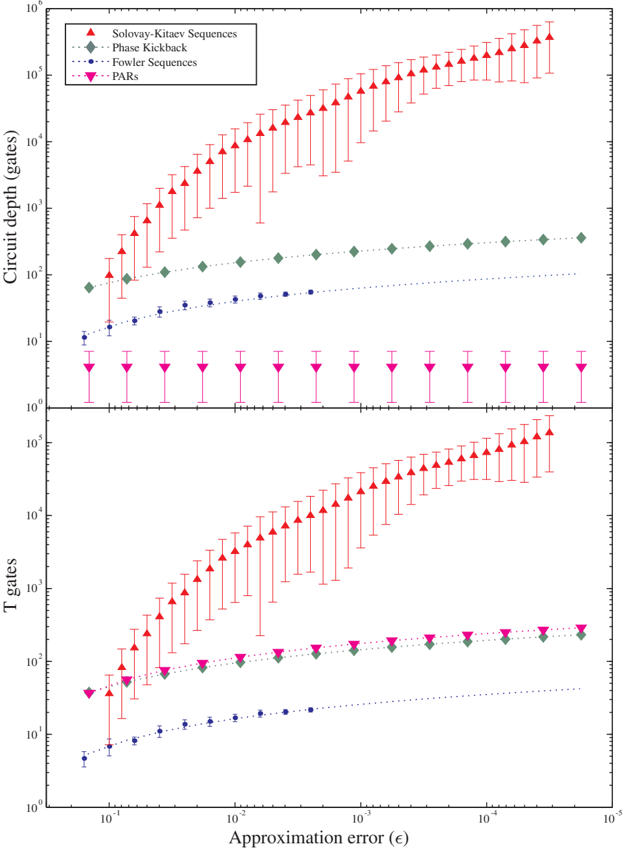
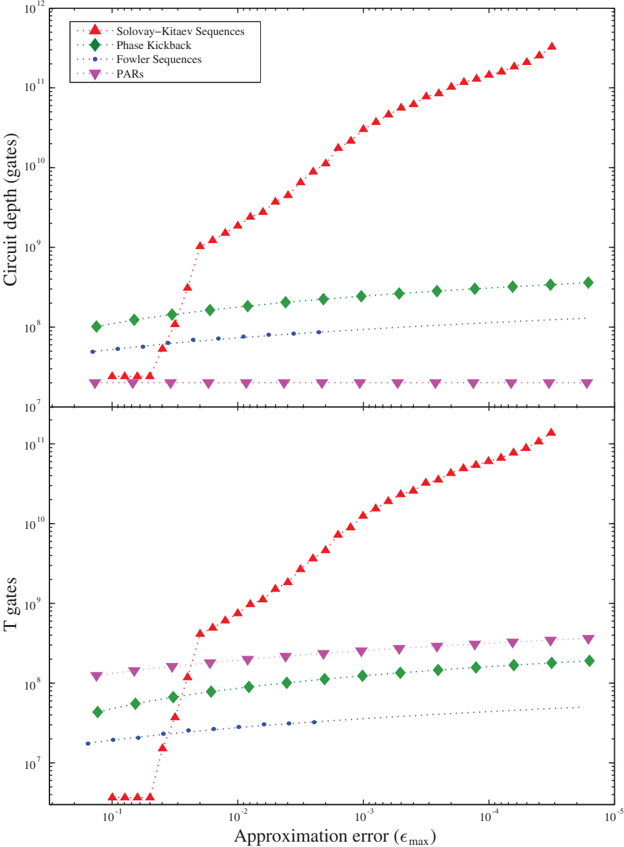
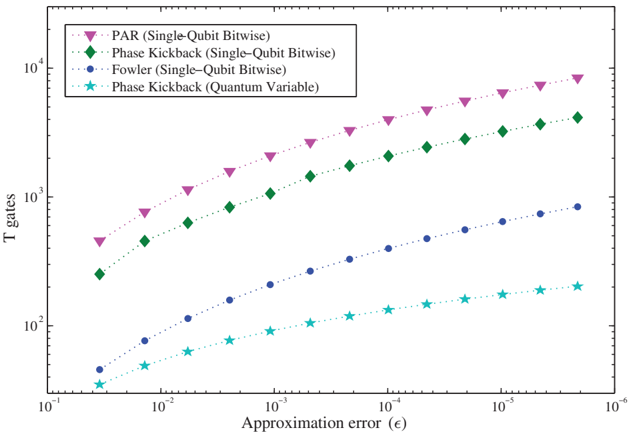
Quantum computers can in principle simulate quantum physics exponentially faster than their classical counterparts, but some technical hurdles remain.We propose methods which substantially improve the performance of a particular form of simulation, ab initio quantum chemistry, on faulttolerant quantum computers; these methods generalize readily to other quantum simulation problems.Quantum teleportation plays a key role in these improvements and is used extensively as a computing resource.To improve execution time, we examine techniques for constructing arbitrary gates which perform substantially faster than circuits based on the conventional Solovay-Kitaev algorithm (Dawson and Nielsen 2006 Quantum Inform.Comput.6 81).For a given approximation error , arbitrary single-qubit gates can be 7
Overview
The claims and statistics of this paper haven’t been checked yet.
Free: it reads the open-access text and checks the first 5 claims that cite a source we can check. Create a free account to check every claim.
Integrity signals
Registry
Cites
Statistics
Figures








Verification
Claims the paper makes
The claims and statistics of this paper haven’t been checked yet.
Free: it reads the open-access text and checks the first 5 claims that cite a source we can check. Create a free account to check every claim.
Claims other papers make about this one
Each is checked against this paper’s own text: does it say what the citing paper says it does?
The source backs part of the claim, not all of it — or backs it for a different population, condition or comparison.
In the citing paper
“The time the quantum computer must remain coherent is determined by the necessity of O(p−1) successive applications of , each of which can require on the order of millions or billions of quantum gates for practical applications1719, as compared to the tens to hundreds of gates achievable in the short term.”
From A variational eigenvalue solver on a photonic quantum processor (2014) · cites this paper as [19]
Experimental — accuracy not yet measuredThe check wasn’t confident either way, so it gives no verdict — never disputed.
In the citing paper
“UCCSD has been implemented in combination with different basis set representations of the chemistry Hamiltonian, including the particle/hole basis 327 and the Bogoliubov basis 326 .”
From Quantum Chemistry in the Age of Quantum Computing (2019) · cites this paper as [326]
Experimental — accuracy not yet measuredThe check wasn’t confident either way, so it gives no verdict — never disputed.
In the citing paper
“Given the inherent advantage in implementing the ansatz as well as the high accuracies of CC methods, the application of the UCC ansatz truncated up to single and double excitations (UCCSD) has been investigated both theoretically and experimentally 52,53,59,325-330 .”
From Quantum Chemistry in the Age of Quantum Computing (2019) · cites this paper as [326]
Experimental — accuracy not yet measuredThe check wasn’t confident either way, so it gives no verdict — never disputed.
In the citing paper
“Methods for preparing Slater determinants and general FGSs employ a quadratic number of gates 302,326,335,336 .”
From Quantum Chemistry in the Age of Quantum Computing (2019) · cites this paper as [326]
Experimental — accuracy not yet measuredThe check wasn’t confident either way, so it gives no verdict — never disputed.
In the citing paper
“Dallaire-Demers et al. 326 suggest that a similar circuit template could be used to create a variational ansatz by complementing the list of matchgates with neighboring ZZ interactions, allowing for the preparation of non-Gaussian fermionic states.”
From Quantum Chemistry in the Age of Quantum Computing (2019) · cites this paper as [326]
Experimental — accuracy not yet measured
8 more claims about this paper
Create a free account to see every claim other papers make about this one.
Self-check
Percentages, sums and reported differences re-computed from the paper’s own numbers.
The self-check needs the paper’s full text.
Citations
Cites
Quantum Computation and Quantum Information
Nielsen, M. A., Chuang, I., & Grover, L. K. (2002) · American Journal of Physics · doi:10.1119/1.1463744 · Cited by 21,895
General atomic and molecular electronic structure system
Schmidt, M. W., Baldridge, K. K., Boatz, J. A., Elbert, S. T., Gordon, M. S., Jensen, J. H., Koseki, S., Matsunaga, N., Nguyen, K. A., Su, S., et al. (1993) · Journal of Computational Chemistry · doi:10.1002/jcc.540141112 · Cited by 20,204 · cited 1×
“We performed calculations in the minimal basis and in a triple-zeta basis, using the GAMESS quantum chemistry package [55, 56], at a bond distance of 1.63 ˚A, with an integral term cutoff of 10 − 10 in atomic units.”
MethodInfluentialQuantum computation and quantum information
Law, J. (2001) · ACM SIGSOFT Software Engineering Notes · doi:10.1145/505482.505499 · Cited by 18,842
Quantum Computation and Quantum Information: 10th Anniversary Edition
Nielsen, M. A., & Chuang, I. L. (2012) · doi:10.1017/cbo9780511976667 · Cited by 8,436
Simulating physics with computers
Feynman, R. P. (1982) · International Journal of Theoretical Physics · doi:10.1007/bf02650179 · Cited by 7,691 · cited 1×
“Simulating quantum physics is arguably one of the most important applications of a quantum computer—a problem whose solution is both intractable for classical computers and valuable to science [1].”
BackgroundDunning, T. H. (1970) · The Journal of Chemical Physics · doi:10.1063/1.1674408 · Cited by 5,032 · cited 1×
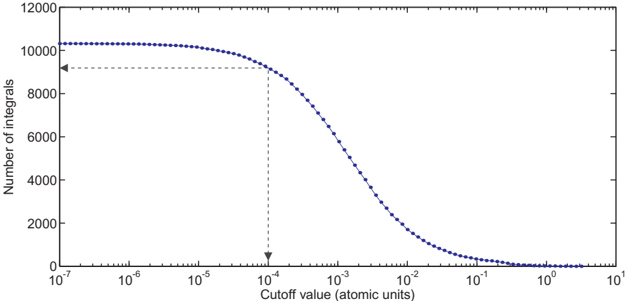
“We computed the number of integrals above cutoff using the STO-3G basis [57] containing 12 spin-orbitals (6 spatial orbitals) and the TZVP basis [58] containing 40 spin orbitals (20 spatial orbitals).”
MethodHehre, W. J., Stewart, R. F., & Pople, J. A. (1969) · The Journal of Chemical Physics · doi:10.1063/1.1672392 · Cited by 4,204 · cited 1×
“We computed the number of integrals above cutoff using the STO-3G basis [57] containing 12 spin-orbitals (6 spatial orbitals) and the TZVP basis [58] containing 40 spin orbitals (20 spatial orbitals).”
MethodLloyd, S. (1996) · Science · doi:10.1126/science.273.5278.1073 · Cited by 3,088 · cited 5×
“Several possible simulators have been proposed and studied [12, 17–20], but we focus on fault-tolerant circuit-model quantum simulation in this investigation [2, 4, 7, 13,21–24].”
BackgroundMethodInfluentialMolecular Electronic‐Structure Theory
Helgaker, T., Jørgensen, P., & Olsen, J. (2000) · doi:10.1002/9781119019572 · Cited by 2,594
Dunning, T. H. (1971) · The Journal of Chemical Physics · doi:10.1063/1.1676139 · Cited by 2,191
Gottesman, D., & Chuang, I. L. (1999) · Nature · doi:10.1038/46503 · Cited by 1,860 · cited 2×
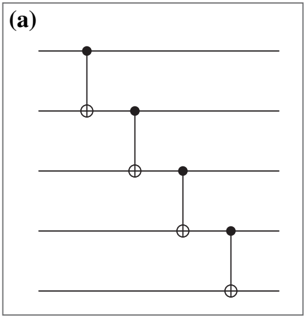
“The CNOT ladder is a sparse network of Clifford gates, so we show how it may be implemented in constant time using teleportation [46, 47].”
MethodAdvances in electronic structure theory
Gordon, M. S., & Schmidt, M. W. (2005) · Theory and Applications of Computational Chemistry · doi:10.1016/b978-044451719-7/50084-6 · Cited by 1,596 · cited 1×
“We performed calculations in the minimal basis and in a triple-zeta basis, using the GAMESS quantum chemistry package [55, 56], at a bond distance of 1.63 ˚A, with an integral term cutoff of 10 − 10 in atomic units.”
MethodInfluentialMolecular electronic-structure theory
Ratner, M. A. (2000) · Cited by 1,565
Simulated Quantum Computation of Molecular Energies
Aspuru-Guzik, A., Dutoi, A. D., Love, P. J., & Head-Gordon, M. (2005) · Science · doi:10.1126/science.1113479 · Cited by 1,418 · cited 6×
“0567v1 [ qu a n t - ph ] 3 A p r 2012 problems such as calculating the eigenvalues of a molecular Hamiltonian [4–7].”
BackgroundMethodInfluentialSelf-citationClassical and Quantum Computation
Kitaev, A., Shen, A., & Vyalyi, M. (2002) · Graduate Studies in Mathematics · doi:10.1090/gsm/047 · Cited by 1,387
Cleve, R., Ekert, A., Macchiavello, C., & Mosca, M. (1998) · Proceedings of the Royal Society of London. Series A: Mathematical, Physical and Engineering Sciences · doi:10.1098/rspa.1998.0164 · Cited by 1,299 · cited 1×
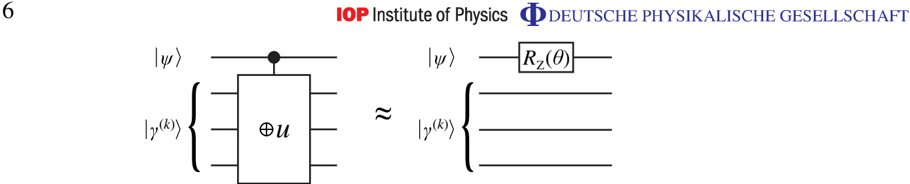
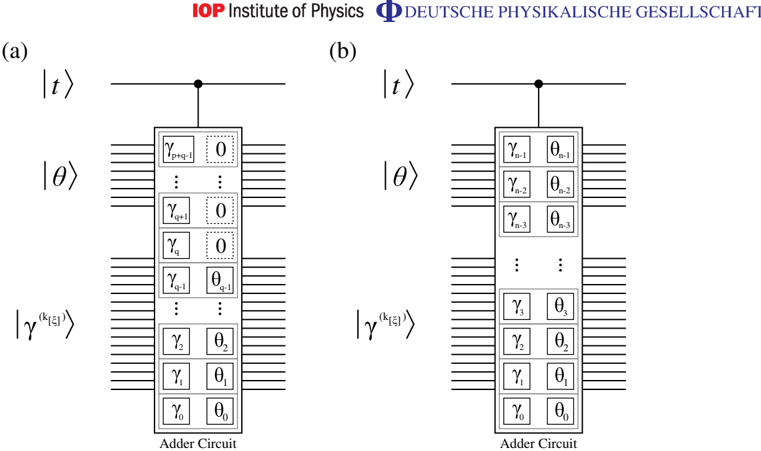
“Phase kickback [36, 37], also known as the Kitaev-Shen-Vyalyi algorithm [38], is an ancilla-based scheme that uses an addition circuit to impart a phase to a quantum register.”
MethodQuantum computing with realistically noisy devices
Knill, E. (2005) · Nature · doi:10.1038/nature03350 · Cited by 1,184 · cited 2×
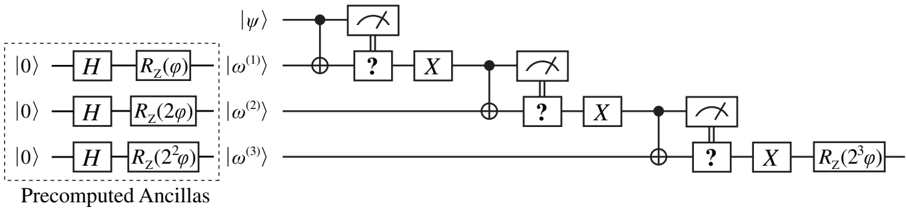
“The X gate in each round can be performed with a Pauli frame [49–51], so counting measurement as a gate, the number of gates per round is 2, and the average number of gates per PAR is 4.”
BackgroundMethodAn open-system quantum simulator with trapped ions
Barreiro, J. T., Müller, M., Schindler, P., Nigg, D., Monz, T., Chwalla, M., Hennrich, M., Roos, C. F., Zoller, P., & Blatt, R. (2011) · Nature · doi:10.1038/nature09801 · Cited by 1,100
Quantum simulation of antiferromagnetic spin chains in an optical lattice
Simon, J., Bakr, W. S., Ma, R., Tai, M. E., Preiss, P. M., & Greiner, M. (2011) · Nature · doi:10.1038/nature09994 · Cited by 898 · cited 2×
“Several possible simulators have been proposed and studied [12, 17–20], but we focus on fault-tolerant circuit-model quantum simulation in this investigation [2, 4, 7, 13,21–24].”
MethodFault-tolerant quantum computation
Shor, P. W. (2002) · Proceedings of 37th Conference on Foundations of Computer Science · doi:10.1109/sfcs.1996.548464 · Cited by 892
Buluta, I., & Nori, F. (2009) · Science · doi:10.1126/science.1177838 · Cited by 876 · cited 1×
“Several possible simulators have been proposed and studied [12, 17–20], but we focus on fault-tolerant circuit-model quantum simulation in this investigation [2,4,7, 13,21–24].”
MethodQuantum Algorithm Providing Exponential Speed Increase for Finding Eigenvalues and Eigenvectors
Abrams, D. S., & Lloyd, S. (1999) · Physical Review Letters · doi:10.1103/physrevlett.83.5162 · Cited by 817 · cited 1×
“State preparation and measurement readout are necessary steps which are not discussed here, but details can be found in references [3, 30, 37–40].”
BackgroundQuantum networks for elementary arithmetic operations
Vedral, V., Barenco, A., & Ekert, A. (1996) · Physical Review A · doi:10.1103/physreva.54.147 · Cited by 806 · cited 2×
“There are various implementations of quantum adder circuits which have tradeoffs in performance between circuit depth and circuit size [41–45].”
BackgroundMethodTowards quantum chemistry on a quantum computer
Lanyon, B. P., Whitfield, J. D., Gillett, G. G., Goggin, M. E., Almeida, M. P., Kassal, I., Biamonte, J. D., Mohseni, M., Powell, B. J., Barbieri, M., et al. (2010) · Nature Chemistry · doi:10.1038/nchem.483 · Cited by 796 · cited 2×
“For this reason, both theoretical [4, 5, 7] and experimental [22, 35] investigations in second-quantization have been performed.”
BackgroundSelf-citationQuantum Teleportation is a Universal Computational Primitive
Gottesman, D., & Chuang, I. L. (1999) · arXiv (Cornell University) · doi:10.48550/arxiv.quant-ph/9908010 · Cited by 778 · cited 2×
“The CNOT ladder is a sparse network of Clifford gates, so we show how it may be implemented in constant time using teleportation [46, 47].”
MethodQuantum error correction for beginners
Devitt, S. J., Munro, W. J., & Nemoto, K. (2013) · Reports on Progress in Physics · doi:10.1088/0034-4885/76/7/076001 · Cited by 759 · cited 1×
“Fault tolerance requires an overhead of additional work for the quantum computer; error correcting codes and the mechanisms they use to correct errors have been studied previously [25–27].”
BackgroundSimulation of Many-Body Fermi Systems on a Universal Quantum Computer
Abrams, D. S., & Lloyd, S. (1997) · Physical Review Letters · doi:10.1103/physrevlett.79.2586 · Cited by 745 · cited 2×
“State preparation and measurement readout are necessary steps which are not discussed here, but details can be found in references [3,26,30–33].”
BackgroundSimulating Physics with Computers
Feynman, R. P. (2018) · Feynman and Computation · doi:10.1201/9780429500459-11 · Cited by 731
Universal Digital Quantum Simulation with Trapped Ions
Lanyon, B. P., Hempel, C., Nigg, D., Müller, M., Gerritsma, R., Zähringer, F., Schindler, P., Barreiro, J. T., Rambach, M., Kirchmair, G., et al. (2011) · Science · doi:10.1126/science.1208001 · Cited by 613 · cited 1×
“Several possible simulators have been proposed and studied [12, 17–20], but we focus on fault-tolerant circuit-model quantum simulation in this investigation [2,4,7, 13,21–24].”
MethodDiamond-based single-photon emitters
Aharonovich, I., Castelletto, S., Simpson, D. A., Su, C.-H., Greentree, A. D., & Prawer, S. (2011) · Reports on Progress in Physics · doi:10.1088/0034-4885/74/7/076501 · Cited by 590
Quantum Algorithms for Quantum Field Theories
Jordan, S. P., Lee, K. S. M., & Preskill, J. (2012) · Science · doi:10.1126/science.1217069 · Cited by 517 · cited 1×
“More recently, Jordan et al [11] proposed a variant of this approach for simulating relativistic quantum field theories.”
Quantum measurements and the Abelian Stabilizer ProblemPreprint
Kitaev, A. (1995) · arXiv (Cornell University) · Cited by 510
High-threshold universal quantum computation on the surface code
Fowler, A. G., Stephens, A. M., & Groszkowski, P. (2009) · Physical Review A · doi:10.1103/physreva.80.052312 · Cited by 486 · cited 3×
“The quantum computer only has access to a limited set of “fundamental” gates, which are summarized in Table 1; this set of gates is typical for a fault-tolerant quantum computer [26,48,51,52].”
BackgroundMethodInfluentialSimulation of electronic structure Hamiltonians using quantum computers
Whitfield, J. D., Biamonte, J., & Aspuru-Guzik, A. (2011) · Molecular Physics · doi:10.1080/00268976.2011.552441 · Cited by 472 · cited 8×
“0567v1 [ qu a n t - ph ] 3 A p r 2012 problems such as calculating the eigenvalues of a molecular Hamiltonian [4–7].”
BackgroundMethodInfluentialSelf-citationFAULT-TOLERANT QUANTUM COMPUTATION
PRESKILL, J. (1998) · Introduction to Quantum Computation and Information · doi:10.1142/9789812385253_0008 · Cited by 466 · cited 2×
“The reasons for these constraints are straightforward: quantum computers will probably be sensitive to noise and other hardware errors, thus requiring fault tolerance [25], and fault-tolerant quantum computing has been most successfully applied in the circuit-model.”
BackgroundSimulating quantum systems on a quantum computer
Zalka, C. (1998) · Proceedings of the Royal Society of London. Series A: Mathematical, Physical and Engineering Sciences · doi:10.1098/rspa.1998.0162 · Cited by 390 · cited 3×
“State preparation and measurement readout are necessary steps which are not discussed here, but details can be found in references [3,26,30–33].”
BackgroundPolynomial-time quantum algorithm for the simulation of chemical dynamics
Kassal, I., Jordan, S. P., Love, P. J., Mohseni, M., & Aspuru-Guzik, A. (2008) · Proceedings of the National Academy of Sciences · doi:10.1073/pnas.0808245105 · Cited by 385 · cited 7×
“[13] shows how to construct quantum circuits for operators e − i ˆ V δt and e − i ˆ Tδt , and in this section, we complement that work with analysis of fault-tolerant versions of these operators.”
BackgroundMethodInfluentialSelf-citationSokolov, A. N., Atahan-Evrenk, S., Mondal, R., Akkerman, H. B., Sánchez-Carrera, R. S., Granados-Focil, S., Schrier, J., Mannsfeld, S. C. B., Zoombelt, A. P., Bao, Z., et al. (2011) · Nature Communications · doi:10.1038/ncomms1451 · Cited by 356 · cited 1×
“Despite the success of these methods, for example, in simulating the dynamics of a small protein from first principles [17] or in predicting novel materials [18], they are still approximate, and much work is carried out in developing more accurate methods.”
MethodSelf-citationMethodology for quantum logic gate construction
Zhou, X., Leung, D. W., & Chuang, I. L. (2000) · Physical Review A · doi:10.1103/physreva.62.052316 · Cited by 355 · cited 2×
“The CNOT ladder is a sparse network of Clifford gates, so we show how it may be implemented in constant time using teleportation [46, 47].”
MethodSimulating Chemistry Using Quantum Computers
Kassal, I., Whitfield, J. D., Perdomo-Ortiz, A., Yung, M.-H., & Aspuru-Guzik, A. (2011) · Annual Review of Physical Chemistry · doi:10.1146/annurev-physchem-032210-103512 · Cited by 352 · cited 8×
“[12]), an arbitrary molecular Hamiltonian in second-quantized form can be expressed as where h pq = (cid:104) p | ( ˆ T + ˆ V N ) | q (cid:105) are one-electron integrals ( ˆ T is the kinetic energy operator, and ˆ V N is the nuclear potential) and h pqrs = (cid:104) pq | ˆ V e | rs (cid:105)…”
BackgroundMethodInfluentialSelf-citationA new quantum ripple-carry addition circuit
Cuccaro, S. A., Draper, T. G., Kutin, S. A., & Moulton, D. P. (2004) · arXiv · doi:10.48550/arxiv.quant-ph/0410184 · Cited by 344 · cited 2×
“Phase kickback uses a ripple-carry adder since the addends have less than 16 bits [44].”
BackgroundMethodLayered architecture for quantum computing
Jones, N. C., Van Meter, R., Fowler, A. G., McMahon, P. L., Kim, J., Ladd, T. D., & Yamamoto, Y. (2012) · Physical Review X · doi:10.1103/physrevx.2.031007 · Cited by 332 · cited 10×
“[48,51] discuss the importance (and difficulty) of producing these gates.”
BackgroundMethodInfluentialSelf-citationDawson, C. M., & Nielsen, M. A. (2006) · Quantum Information and Computation · doi:10.26421/qic6.1-6 · Cited by 288
Implementation of the Quantum Fourier Transform
Weinstein, Y. S., Pravia, M. A., Fortunato, E. M., Lloyd, S., & Cory, D. G. (2001) · Physical Review Letters · doi:10.1103/physrevlett.86.1889 · Cited by 287 · cited 2×
“(11)), which can be efficiently implemented in a quantum computer [40].”
BackgroundQuantum computation and quantum information
Nagy, M., & Akl, S. G. (2006) · International Journal of Parallel, Emergent and Distributed Systems · doi:10.1080/17445760500355678 · Cited by 287
NMR Implementation of a Molecular Hydrogen Quantum Simulation with Adiabatic State Preparation
Du, J., Xu, N., Peng, X., Wang, P., Wu, S., & Lu, D. (2010) · Physical Review Letters · doi:10.1103/physrevlett.104.030502 · Cited by 274 · cited 2×
“For this reason, both theoretical [4, 5, 7] and experimental [22, 35] investigations in second-quantization have been performed.”
BackgroundQuantum Simulation of Time-Dependent Hamiltonians and the Convenient Illusion of Hilbert Space
Poulin, D., Qarry, A., Somma, R., & Verstraete, F. (2011) · Physical Review Letters · doi:10.1103/physrevlett.106.170501 · Cited by 265 · cited 1×
“…on a hypothetical fault-tolerant quantum computer with an execution time per error-corrected gate of 1 ms. Additionally, from an information theory perspective, it is interesting to see what quantum computational complexity is required to simulate physically-relevant Hamiltonians in general [16].”
BackgroundDawson, C. M., & Nielsen, M. A. (2005) · CERN Document Server (European Organization for Nuclear Research) · Cited by 254
General theory of higher-order decomposition of exponential operators and symplectic integrators
Suzuki, M. (1992) · Physics Letters A · doi:10.1016/0375-9601(92)90335-j · Cited by 244 · cited 1×
“This process is readily achieved using the split operator approximation, a form of Trotter-Suzuki decomposition [12, 23, 60, 61], where the kinetic and potential energy operators are simulated in alternating steps as The operators e − i ˆ V δt and e − i ˆ Tδt are diagonal in the position and…”
MethodSimulating lattice gauge theories on a quantum computer
Byrnes, T., & Yamamoto, Y. (2006) · Physical Review A · doi:10.1103/physreva.73.022328 · Cited by 222 · cited 1×
“Although we have focused on simulating quantum chemistry, these methods can be extended to simulating other Hamiltonians on quantum computers, such as spin lattice models [64], lattice gas automata [65] and lattice gauge theories [66], or quantum chaos theories [67].”
MethodSelf-citationCreating superpositions that correspond to efficiently integrable probability distributions
Grover, L. K., & Rudolph, T. (2002) · arXiv (Cornell University) · doi:10.48550/arxiv.quant-ph/0208112 · Cited by 221
Simulation of Electronic Structure Hamiltonians Using Quantum Computers
Whitfield, J. D., Biamonte, J., & Aspuru‐Guzik, A. (2011) · Digital Access to Scholarship at Harvard (DASH) (Harvard University) · Cited by 218
Self-citationFast parallel circuits for the quantum Fourier transform
Cleve, R., & Watrous, J. (2002) · Proceedings 41st Annual Symposium on Foundations of Computer Science · doi:10.1109/sfcs.2000.892140 · Cited by 215 · cited 2×
“[39] to produce a parallel circuit for the QFT.”
BackgroundHigher order decompositions of ordered operator exponentials
Wiebe, N., Berry, D., Høyer, P., & Sanders, B. C. (2010) · Journal of Physics A: Mathematical and Theoretical · doi:10.1088/1751-8113/43/6/065203 · Cited by 208 · cited 1×
“This process is readily achieved using the split operator approximation, a form of Trotter-Suzuki decomposition [12, 23, 60, 61], where the kinetic and potential energy operators are simulated in alternating steps as The operators e − i ˆ V δt and e − i ˆ Tδt are diagonal in the position and…”
MethodAddition on a Quantum Computer
Draper, T. G. (2000) · arXiv (Cornell University) · doi:10.48550/arxiv.quant-ph/0008033 · Cited by 185
Venegas-Andraca, S. E., Gómez-Muñoz, J. L., Lanzagorta, M. O., & Uhlmann, J. K. (2013) · Cited by 183
Fast quantum modular exponentiation
Van Meter, R., & Itoh, K. M. (2005) · Physical Review A · doi:10.1103/physreva.71.052320 · Cited by 181 · cited 2×
“Note that the addition operation U⊕u is readily implemented with a fault-tolerant quantum circuit [49–53].”
BackgroundApproximate quantum Fourier transform and decoherence
Barenco, A., Ekert, A., Suominen, K.-A., & Törmä, P. (1996) · Physical Review A · doi:10.1103/physreva.54.139 · Cited by 180 · cited 1×
“…uses substantially fewer T gates than an equivalent circuit where each controlled rotation in the QFT is implemented individually with techniques in Section 3.1, and the same methods can be applied to an approximate QFT [62] by simply truncating the size of the (cid:12)(cid:12) γ (1) register.”
MethodInfluentialQuantum simulation of the wavefunction to probe frustrated Heisenberg spin systems
Ma, X.-S., Dakic, B., Naylor, W., Zeilinger, A., & Walther, P. (2011) · Nature Physics · doi:10.1038/nphys1919 · Cited by 179 · cited 1×
“Several possible simulators have been proposed and studied [12, 17–20], but we focus on fault-tolerant circuit-model quantum simulation in this investigation [2,4,7, 13,21–24].”
MethodPhysical implementation of protected qubits
Douçot, B., & Ioffe, L. B. (2012) · Reports on Progress in Physics · doi:10.1088/0034-4885/75/7/072001 · Cited by 160
Direct Characterization of Quantum Dynamics
Mohseni, M., & Lidar, D. A. (2006) · Physical Review Letters · doi:10.1103/physrevlett.97.170501 · Cited by 149 · cited 1×
“State preparation and measurement readout are necessary steps which are not discussed here, but details can be found in references [3,26,30–33].”
BackgroundQuantum Circuits with Unbounded Fan-out
Høyer, P., & Špalek, R. (2005) · Theory of Computing · doi:10.4086/toc.2005.v001a005 · Cited by 146
A logarithmic-depth quantum carry-lookahead adder
Draper, T. G., Kutin, S., Rains, E. M., & Svore, K. M. (2006) · CaltechAUTHORS (California Institute of Technology) · doi:10.5555/2012086.2012090 · Cited by 138
Effective Fault-Tolerant Quantum Computation with Slow Measurements
DiVincenzo, D. P., & Aliferis, P. (2007) · Physical Review Letters · doi:10.1103/physrevlett.98.020501 · Cited by 135
Using Quantum Computers for Quantum Simulation
Brown, K. L., Munro, W. J., & Kendon, V. M. (2010) · Entropy · doi:10.3390/e12112268 · Cited by 129 · cited 1×
“This process is readily achieved using the split operator approximation, a form of Trotter-Suzuki decomposition [12, 23, 60, 61], where the kinetic and potential energy operators are simulated in alternating steps as The operators e − i ˆ V δt and e − i ˆ Tδt are diagonal in the position and…”
MethodCharge Transfer and Polarization in Solvated Proteins from Ab Initio Molecular Dynamics
Ufimtsev, I. S., Luehr, N., & Martinez, T. J. (2011) · The Journal of Physical Chemistry Letters · doi:10.1021/jz200697c · Cited by 128 · cited 1×
“Despite the success of these methods, for example, in simulating the dynamics of a small protein from first principles [10] or in predicting novel materials [11], they are still approximate, and much work is carried out in developing more accurate methods.”
MethodFault-tolerant quantum computationPreprint
Preskill, J. P. (1997) · arXiv (Cornell University) · doi:10.48550/arxiv.quant-ph/9712048 · Cited by 124 · cited 2×
“The reasons for these constraints are straightforward: quantum computers will probably be sensitive to noise and other hardware errors, thus requiring fault tolerance [25], and fault-tolerant quantum computing has been most successfully applied in the circuit-model.”
BackgroundSimulating Ising spin glasses on a quantum computer
Lidar, D. A., & Biham, O. (1997) · Physical Review E · doi:10.1103/physreve.56.3661 · Cited by 120 · cited 1×
“Although we have focused on simulating quantum chemistry, these methods can be extended to simulating other Hamiltonians on quantum computers, such as spin lattice models [64], lattice gas automata [65] and lattice gauge theories [66], or quantum chaos theories [67].”
MethodSimulating quantum mechanics on a quantum computer
Boghosian, B. M., & Taylor, W. (1998) · Physica D: Nonlinear Phenomena · doi:10.1016/s0167-2789(98)00042-6 · Cited by 120
DISTRIBUTED QUANTUM COMPUTATION ARCHITECTURE USING SEMICONDUCTOR NANOPHOTONICS
VAN METER, R., LADD, T. D., FOWLER, A. G., & YAMAMOTO, Y. (2010) · International Journal of Quantum Information · doi:10.1142/s0219749910006435 · Cited by 109 · cited 1×
“[21,48,51,63] for further details.”
Self-citationQuantum algorithm for obtaining the energy spectrum of molecular systems
Wang, H., Kais, S., Aspuru-Guzik, A., & Hoffmann, M. R. (2008) · Physical Chemistry Chemical Physics · doi:10.1039/b804804e · Cited by 109 · cited 1×
“For this reason, both theoretical [4, 5, 7] and experimental [22, 35] investigations in second-quantization have been performed.”
BackgroundSelf-citationPolynomial-Time Simulation of Pairing Models on a Quantum Computer
Wu, L.-A., Byrd, M. S., & Lidar, D. A. (2002) · Physical Review Letters · doi:10.1103/physrevlett.89.057904 · Cited by 108
A logarithmic-depth quantum carry-lookahead adder
Draper, T. G., Kutin, S. A., Rains, E. M., & Svore, K. M. (2006) · Quantum Information and Computation · doi:10.26421/qic6.4-5-4 · Cited by 101
Brown, K. R., Clark, R. J., & Chuang, I. L. (2006) · Physical Review Letters · doi:10.1103/physrevlett.97.050504 · Cited by 98 · cited 1×
“Several different applications of a quantum physics simulator have been proposed, including: spin glasses [4] and lattices [5, 6]; Bardeen–Cooper–Schrieffer Hamiltonians [7, 8]; and quantum chemistry [9, 10].”
BackgroundHuang, X., Schwenke, D. W., Tashkun, S. A., & Lee, T. J. (2012) · The Journal of Chemical Physics · doi:10.1063/1.3697540 · Cited by 98 · cited 1×
“This would open the door to high-quality ab initio data for parameterizing force fields for molecular dynamics [14] or understanding complex chemical mechanisms such as soot formation [15], where a number of different chemical species must be compared.”
BackgroundSimulating Quantum Mechanics on a Quantum Computer
Boghosian, B. M., & Taylor, W. (1997) · Cited by 98
Constructing arbitrary steane code single logical qubit fault-tolerant gates
Fowler, A. G. (2011) · Quantum Information and Computation · doi:10.5555/2230936.2230946 · Cited by 88
Fast parallel circuits for the quantum Fourier transformPreprint
Cleve, R., & Watrous, J. (2000) · arXiv (Cornell University) · doi:10.48550/arxiv.quant-ph/0006004 · Cited by 79 · cited 2×
“[39] to produce a parallel circuit for the QFT.”
BackgroundUsing quantum computers for quantum simulation
Brown, K. L., Munro, W. J., & Kendon, V. M. (2015) · Cited by 79
Quantum algorithm for obtaining the energy spectrum of molecular systems
Wang, H., Kais, S., Aspuru‐Guzik, A., & Hoffmann, M. R. (2008) · Digital Access to Scholarship at Harvard (DASH) (Harvard University) · Cited by 75
Self-citationScalability of Shor’s algorithm with a limited set of rotation gates
Fowler, A. G., & Hollenberg, L. C. L. (2004) · Physical Review A · doi:10.1103/physreva.70.032329 · Cited by 73 · cited 1×
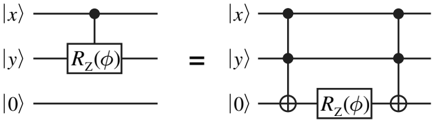
“One way to implement the controlled rotation in equation (10) is to deconstruct the operation into CNOTs and single-qubit rotations [58], as shown in figure 7.”
MethodConstructing arbitrary Steane code single logical qubit fault-tolerant gates
Fowler, A. G. (2011) · Quantum Information and Computation · doi:10.26421/qic11.9-10-10 · Cited by 72 · cited 5×
“(5) obeys the triangle inequality [29].”
BackgroundMethodInfluentialResource-Optimal Single-Qubit Quantum Circuits
Bocharov, A., & Svore, K. M. (2012) · Physical Review Letters · doi:10.1103/physrevlett.109.190501 · Cited by 71 · cited 2×
“Recently, Bocharov and Svore have presented an alternative algorithm for finding depth-optimal gate sequences which might feasibly provide high-precision rotations [69].”
BackgroundMethodHead-Gordon, M., & Artacho, E. (2008) · Physics Today · doi:10.1063/1.2911179 · Cited by 66
The open-shell coupled-cluster method in general model space: Five states of LiH
Ben-Shlomo, S., & Kaldor, U. (1988) · The Journal of Chemical Physics · doi:10.1063/1.455164 · Cited by 62 · cited 1×
“This was called the “chemist’s workbench” and is an appropriate continuation of quantum computational applications of chemistry going beyond molecular Hydrogen [7, 22, 34, 35].”
BackgroundQuantum computing applied to calculations of molecular energies: CH2 benchmark
Veis, L., & Pittner, J. (2010) · The Journal of Chemical Physics · doi:10.1063/1.3503767 · Cited by 60
Thermochemistry of Key Soot Formation Intermediates: C3H3 Isomers
Wheeler, S. E., Robertson, K. A., Allen, W. D., Schaefer, Bomble, Y. J., & Stanton, J. F. (2007) · The Journal of Physical Chemistry A · doi:10.1021/jp0684630 · Cited by 58 · cited 1×
“This would open the door to high-quality ab initio data for parameterizing force fields for molecular dynamics [14] or understanding complex chemical mechanisms such as soot formation [15], where a number of different chemical species must be compared.”
BackgroundRunning a Quantum Circuit at the Speed of Data
Isailovic, N., Whitney, M., Patel, Y., & Kubiatowicz, J. D. (2008) · ACM SIGARCH Computer Architecture News · doi:10.1145/1394608.1382137 · Cited by 57 · cited 6×
“[48,51] discuss the importance (and difficulty) of producing these gates.”
BackgroundInfluentialPreparation of many-body states for quantum simulation
Ward, N. J., Kassal, I., & Aspuru-Guzik, A. (2009) · The Journal of Chemical Physics · doi:10.1063/1.3115177 · Cited by 54 · cited 1×
“The spin degree of freedom can easily be incorporated by including an extra qubit, and to describe a many-electron state, the wavefunction has to be properly anti-symmetrized [30,59].”
BackgroundSelf-citationClark, C. R., Metodi, T. S., Gasster, S. D., & Brown, K. R. (2009) · Physical Review A · doi:10.1103/physreva.79.062314 · Cited by 51 · cited 4×
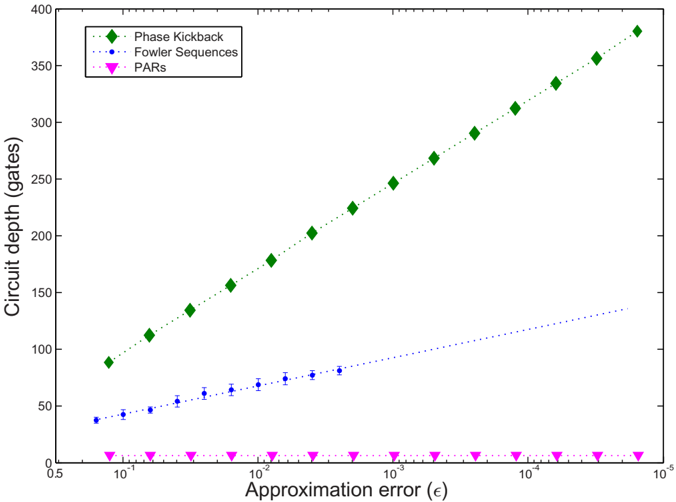
“This is an encouraging result, because it shows that previous examinations that depended on Solovay-Kitaev sequences can be improved by orders of magnitude with more efficient phase rotations [21].”
BackgroundMethodResultInfluentialHøyer, P., & Špalek, R. (2005) · Theory of Computing · Cited by 51
Quantum computing of quantum chaos in the kicked rotator model
Lévi, B., Georgeot, B., & Shepelyansky, D. L. (2003) · Physical Review E · doi:10.1103/physreve.67.046220 · Cited by 41 · cited 1×
“Although we have focused on simulating quantum chemistry, these methods can be extended to simulating other Hamiltonians on quantum computers, such as spin lattice models [64], lattice gas automata [65] and lattice gauge theories [66], or quantum chaos theories [67].”
MethodPreparation of Many-Body States for Quantum Simulation
Ward, N. J., Kassal, I., & Aspuru‐Guzik, A. (2009) · Digital Access to Scholarship at Harvard (DASH) (Harvard University) · Cited by 39
Self-citationA Layered Architecture for Quantum Computing Using Quantum DotsPreprint
Jones, N. C., Meter, R. V., Fowler, A. G., McMahon, P. L., Kim, J., Ladd, T. D., & Yamamoto, Y. (2010) · arXiv (Cornell University) · Cited by 38
Self-citationFowler, A. G., Stephens, A. M., & Groszkowski, P. (2013) · Physical Review A · doi:10.1103/physreva.87.019905 · Cited by 14
Fowler, A. G., & Hollenberg, L. C. L. (2007) · Physical Review A · doi:10.1103/physreva.75.029905 · Cited by 11
Efficiency of free-energy calculations of spin lattices by spectral quantum algorithms
Master, C. P., Yamaguchi, F., & Yamamoto, Y. (2003) · Physical Review A · doi:10.1103/physreva.67.032311 · Cited by 8 · cited 1×
“Several different applications of a quantum physics simulator have been proposed, including: spin glasses [4] and lattices [5, 6]; Bardeen–Cooper–Schrieffer Hamiltonians [7, 8]; and quantum chemistry [9, 10].”
BackgroundSelf-citationWu, L., Byrd, M., & Lidar, D. A. (2002) · Physical Review Letters · doi:10.1103/physrevlett.89.139901 · Cited by 7
(1995) · doi:10.4230/lipics.isaac.2021.31 · cited 1×
“Phase kickback [44, 45], also known as the Kitaev–Shen–Vyalyi algorithm [46], is an ancillabased scheme that uses an addition circuit to impart a phase to a quantum register.”
Cited by
A variational eigenvalue solver on a photonic quantum processor
Peruzzo, A., McClean, J., Shadbolt, P., Yung, M.-H., Zhou, X.-Q., Love, P. J., Aspuru-Guzik, A., & O’Brien, J. L. (2014) · Nature Communications · doi:10.1038/ncomms5213 · Cited by 4,552
Self-citationQuantum computational chemistry
McArdle, S., Endo, S., Aspuru-Guzik, A., Benjamin, S. C., & Yuan, X. (2020) · Reviews of Modern Physics · doi:10.1103/revmodphys.92.015003 · Cited by 1,621
Self-citationQuantum Chemistry in the Age of Quantum Computing
Cao, Y., Romero, J., Olson, J. P., Degroote, M., Johnson, P. D., Kieferová, M., Kivlichan, I. D., Menke, T., Peropadre, B., Sawaya, N. P. D., et al. (2019) · Chemical Reviews · doi:10.1021/acs.chemrev.8b00803 · Cited by 1,560
Self-citationQuantum Chemistry in the Age of Quantum Computing
Cao, Y., Romero, J., Olson, J., Degroote, M., Johnson, P., Kieferová, M., Kivlichan, I., Menke, T., Peropadre, B., Sawaya, N., et al. (n.d.) · OPUS - Open Publications of UTS Scholars (University of Technology Sydney) · Cited by 1,265
Self-citationScalable Quantum Simulation of Molecular Energies
O’Malley, P. J. J., Babbush, R., Kivlichan, I. D., Romero, J., McClean, J. R., Barends, R., Kelly, J., Roushan, P., Tranter, A., Ding, N., et al. (2016) · Physical Review X · doi:10.1103/physrevx.6.031007 · Cited by 1,059
Self-citation
Metadata
- Authors
- Cody Jones, N., Whitfield, J. D., McMahon, P. L., Yung, M.-H., Meter, R. V., Aspuru-Guzik, A., & Yamamoto, Y.
- Affiliations
- Harvard University (US)
- Stanford University (US)
- Keio University (JP)
- National Institute of Informatics (JP)
- Venue
- New Journal of Physics
- Publisher
- IOP Publishing
- Published
- 2012-11-27
- Volume
- 14
- Issue
- 11
- Pages
- 115023
- ISSN
- 1367-2630 (ISSN-L)
- OpenAlex
- W2100129648
- Cited by
- 145
- References
- 97
- Citations by year
- 2026: 8 · 2025: 6 · 2024: 12 · 2023: 9 · 2022: 10 · 2021: 5 · 2020: 11 · 2019: 14 · 2018: 15 · 2017: 4 · 2016: 11 · 2015: 15 · 2014: 12 · 2013: 10 · 2012: 3
- FWCI
- 12.60
- Type
- journal article
- Language
- en
- Open access
- gold
- doi.org
- Licence
- cc-by-nc-sa
- Locations
- New Journal of Physics (publishedVersion, cc-by-nc-sa)
- arXiv (Cornell University) (submittedVersion)
- Digital Access to Scholarship at Harvard (DASH) (Harvard University) (submittedVersion, cc-by)
- DOAJ (DOAJ: Directory of Open Access Journals) (submittedVersion)
- arXiv (Cornell University)
- Funders
- National Science Foundation (0829694, FA8721-05-C-0002, 1017244)
- Alfred P. Sloan Foundation
- Camille and Henry Dreyfus Foundation
- Japan Society for the Promotion of Science
- National Institute of Information and Communications Technology
- Topics
- Physical Sciences › Computer Science › Artificial Intelligence › Quantum Computing Algorithms and Architecture
- Physical Sciences › Physics and Astronomy › Atomic and Molecular Physics, and Optics › Quantum Information and Cryptography
- Physical Sciences › Physics and Astronomy › Atomic and Molecular Physics, and Optics › Quantum many-body systems
- Keywords
- quantum chemistry simulation, fault-tolerant quantum computing, ab initio quantum chemistry, quantum teleportation, gate construction, quantum circuit optimization, execution time
About these checks
Registry, retraction, Cites and statistics results are computed, not judged, with one exception: a printed reference that no index lists is read once by a model before it counts as a citation error. Claims are extracted by a model and kept only when their quote appears verbatim in the text; each cited source is then checked, with a model’s help, for whether it says what the claim relies on. Those verdicts can be wrong — read the claim’s quote and the cited source before relying on one.
Statistics and arithmetic are recomputed, not judged.
Confidence bands are shown only for fields calibrated on our annotated test set. None is calibrated yet, so no band is shown.
What counts as a claim ›How we measure confidence ›How we check this ›
Are you an author, or do you see a problem with this page? Request a review
Data sources
Bibliographic data: Semantic Scholar, OpenAlex, Crossref.
Contains information from the Semantic Scholar Academic Graph Datasets, made available under the ODC Attribution License (ODC-BY 1.0).
Semantic Scholar’s data is described in: Kinney, R., et al. (2023). The Semantic Scholar Open Data Platform. arXiv:2301.10140.
