

Faster quantum chemistry simulation on fault-tolerant quantum computers
Open accessThe DOI matches its Crossref record; 99 of the 99 references it cites were found in a registry or an index.
Abstract
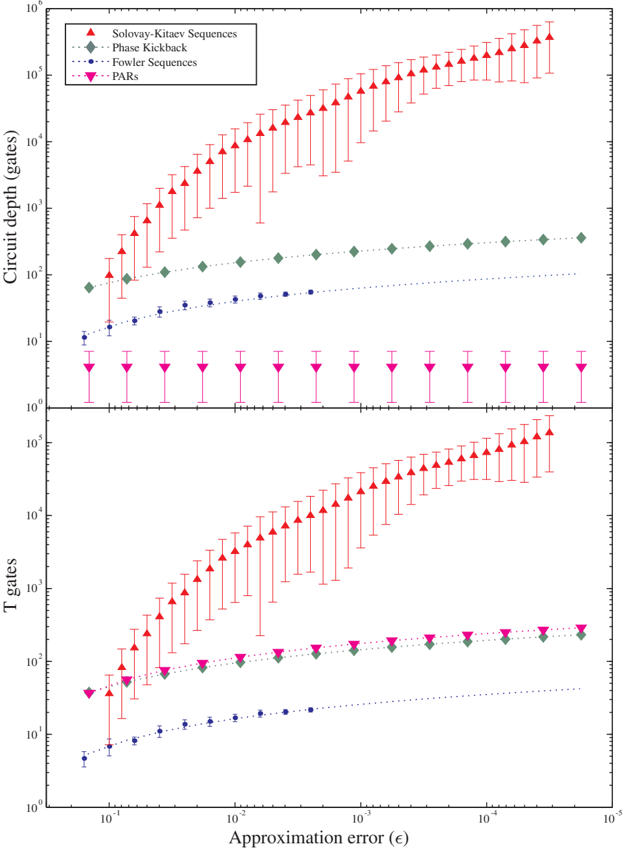
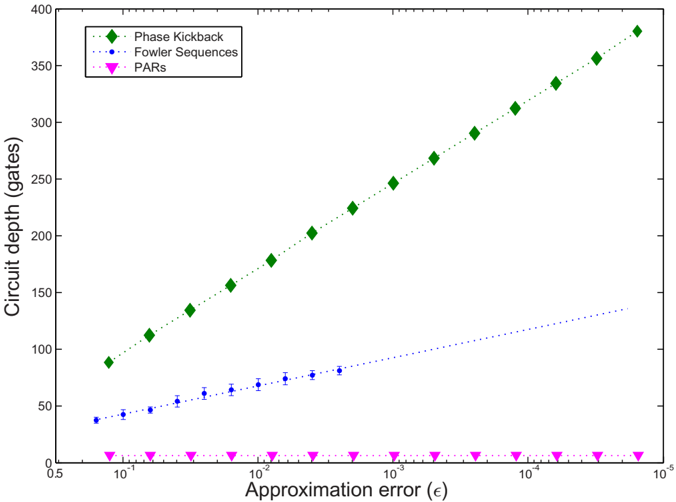
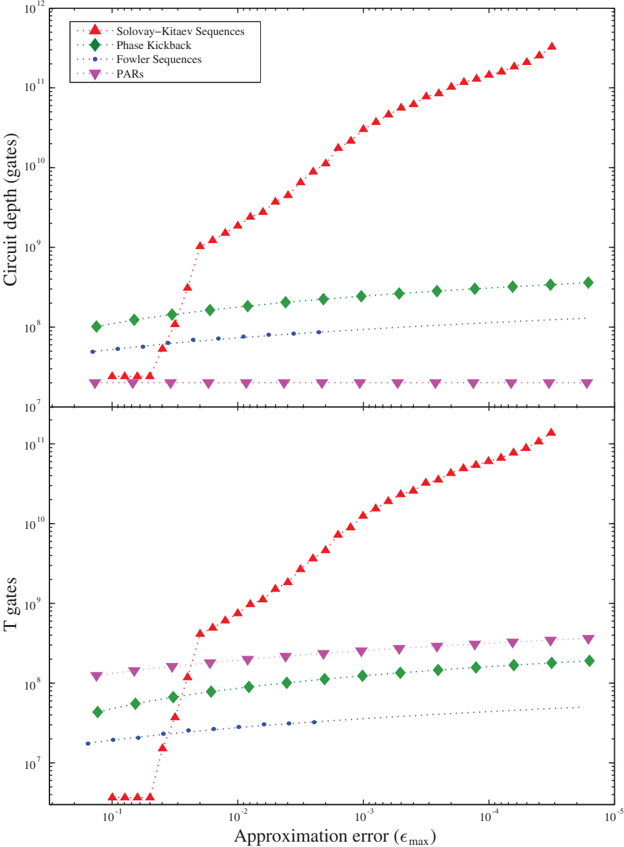
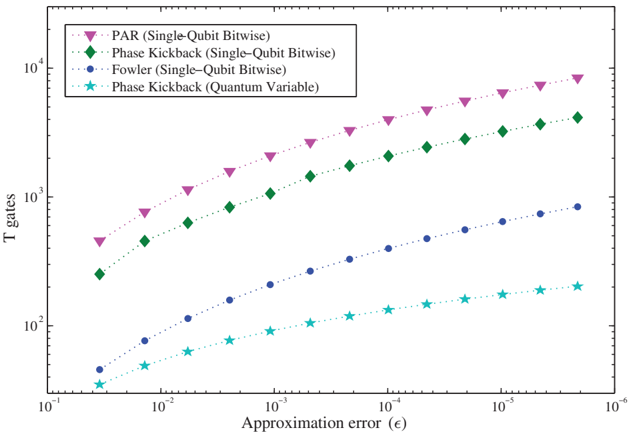
Quantum computers can in principle simulate quantum physics exponentially faster than their classical counterparts, but some technical hurdles remain.We propose methods which substantially improve the performance of a particular form of simulation, ab initio quantum chemistry, on faulttolerant quantum computers; these methods generalize readily to other quantum simulation problems.Quantum teleportation plays a key role in these improvements and is used extensively as a computing resource.To improve execution time, we examine techniques for constructing arbitrary gates which perform substantially faster than circuits based on the conventional Solovay-Kitaev algorithm (Dawson and Nielsen 2006 Quantum Inform.Comput.6 81).For a given approximation error , arbitrary single-qubit gates can be 7
Overview
The claims and statistics of this paper haven’t been checked yet.
Free: it reads the open-access text and checks the first 5 claims that cite a source we can check. Create a free account to check every claim.
Integrity signals
Registry
Cites
Statistics
Figures








Verification
Claims the paper makes
The claims and statistics of this paper haven’t been checked yet.
Free: it reads the open-access text and checks the first 5 claims that cite a source we can check. Create a free account to check every claim.
Claims other papers make about this one
Each is checked against this paper’s own text: does it say what the citing paper says it does?
The source backs part of the claim, not all of it — or backs it for a different population, condition or comparison.
In the citing paper
“The time the quantum computer must remain coherent is determined by the necessity of O(p−1) successive applications of , each of which can require on the order of millions or billions of quantum gates for practical applications1719, as compared to the tens to hundreds of gates achievable in the short term.”
From A variational eigenvalue solver on a photonic quantum processor (2014) · cites this paper as [19]
Experimental — accuracy not yet measuredThe check wasn’t confident either way, so it gives no verdict — never disputed.
In the citing paper
“UCCSD has been implemented in combination with different basis set representations of the chemistry Hamiltonian, including the particle/hole basis 327 and the Bogoliubov basis 326 .”
From Quantum Chemistry in the Age of Quantum Computing (2019) · cites this paper as [326]
Experimental — accuracy not yet measuredThe check wasn’t confident either way, so it gives no verdict — never disputed.
In the citing paper
“Given the inherent advantage in implementing the ansatz as well as the high accuracies of CC methods, the application of the UCC ansatz truncated up to single and double excitations (UCCSD) has been investigated both theoretically and experimentally 52,53,59,325-330 .”
From Quantum Chemistry in the Age of Quantum Computing (2019) · cites this paper as [326]
Experimental — accuracy not yet measuredThe check wasn’t confident either way, so it gives no verdict — never disputed.
In the citing paper
“Methods for preparing Slater determinants and general FGSs employ a quadratic number of gates 302,326,335,336 .”
From Quantum Chemistry in the Age of Quantum Computing (2019) · cites this paper as [326]
Experimental — accuracy not yet measuredThe check wasn’t confident either way, so it gives no verdict — never disputed.
In the citing paper
“Dallaire-Demers et al. 326 suggest that a similar circuit template could be used to create a variational ansatz by complementing the list of matchgates with neighboring ZZ interactions, allowing for the preparation of non-Gaussian fermionic states.”
From Quantum Chemistry in the Age of Quantum Computing (2019) · cites this paper as [326]
Experimental — accuracy not yet measured
8 more claims about this paper
Create a free account to see every claim other papers make about this one.
Self-check
Percentages, sums and reported differences re-computed from the paper’s own numbers.
The self-check needs the paper’s full text.
Citations
Cites
Quantum Computation and Quantum Information
Nielsen, M. A., Chuang, I., & Grover, L. K. (2002) · American Journal of Physics · doi:10.1119/1.1463744 · Cited by 21,895
General atomic and molecular electronic structure system
Schmidt, M. W., Baldridge, K. K., Boatz, J. A., Elbert, S. T., Gordon, M. S., Jensen, J. H., Koseki, S., Matsunaga, N., Nguyen, K. A., Su, S., et al. (1993) · Journal of Computational Chemistry · doi:10.1002/jcc.540141112 · Cited by 20,204 · cited 1×
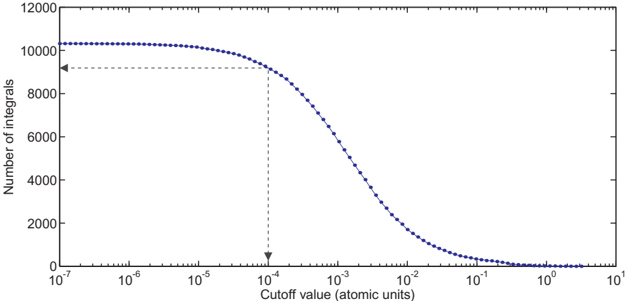
“We performed calculations in the minimal basis and in a triple-zeta basis, using the GAMESS quantum chemistry package [55, 56], at a bond distance of 1.63 ˚A, with an integral term cutoff of 10 − 10 in atomic units.”
MethodInfluentialQuantum computation and quantum information
Law, J. (2001) · ACM SIGSOFT Software Engineering Notes · doi:10.1145/505482.505499 · Cited by 18,842
Quantum Computation and Quantum Information: 10th Anniversary Edition
Nielsen, M. A., & Chuang, I. L. (2012) · doi:10.1017/cbo9780511976667 · Cited by 8,436
Simulating physics with computers
Feynman, R. P. (1982) · International Journal of Theoretical Physics · doi:10.1007/bf02650179 · Cited by 7,691 · cited 1×
“Simulating quantum physics is arguably one of the most important applications of a quantum computer—a problem whose solution is both intractable for classical computers and valuable to science [1].”
BackgroundDunning, T. H. (1970) · The Journal of Chemical Physics · doi:10.1063/1.1674408 · Cited by 5,032 · cited 1×
“We computed the number of integrals above cutoff using the STO-3G basis [57] containing 12 spin-orbitals (6 spatial orbitals) and the TZVP basis [58] containing 40 spin orbitals (20 spatial orbitals).”
MethodHehre, W. J., Stewart, R. F., & Pople, J. A. (1969) · The Journal of Chemical Physics · doi:10.1063/1.1672392 · Cited by 4,204 · cited 1×
“We computed the number of integrals above cutoff using the STO-3G basis [57] containing 12 spin-orbitals (6 spatial orbitals) and the TZVP basis [58] containing 40 spin orbitals (20 spatial orbitals).”
MethodLloyd, S. (1996) · Science · doi:10.1126/science.273.5278.1073 · Cited by 3,088 · cited 5×
“Several possible simulators have been proposed and studied [12, 17–20], but we focus on fault-tolerant circuit-model quantum simulation in this investigation [2, 4, 7, 13,21–24].”
BackgroundMethodInfluentialMolecular Electronic‐Structure Theory
Helgaker, T., Jørgensen, P., & Olsen, J. (2000) · doi:10.1002/9781119019572 · Cited by 2,594
Dunning, T. H. (1971) · The Journal of Chemical Physics · doi:10.1063/1.1676139 · Cited by 2,191
Cited by
A variational eigenvalue solver on a photonic quantum processor
Peruzzo, A., McClean, J., Shadbolt, P., Yung, M.-H., Zhou, X.-Q., Love, P. J., Aspuru-Guzik, A., & O’Brien, J. L. (2014) · Nature Communications · doi:10.1038/ncomms5213 · Cited by 4,552
Self-citationQuantum computational chemistry
McArdle, S., Endo, S., Aspuru-Guzik, A., Benjamin, S. C., & Yuan, X. (2020) · Reviews of Modern Physics · doi:10.1103/revmodphys.92.015003 · Cited by 1,621
Self-citationQuantum Chemistry in the Age of Quantum Computing
Cao, Y., Romero, J., Olson, J. P., Degroote, M., Johnson, P. D., Kieferová, M., Kivlichan, I. D., Menke, T., Peropadre, B., Sawaya, N. P. D., et al. (2019) · Chemical Reviews · doi:10.1021/acs.chemrev.8b00803 · Cited by 1,560
Self-citationQuantum Chemistry in the Age of Quantum Computing
Cao, Y., Romero, J., Olson, J., Degroote, M., Johnson, P., Kieferová, M., Kivlichan, I., Menke, T., Peropadre, B., Sawaya, N., et al. (n.d.) · OPUS - Open Publications of UTS Scholars (University of Technology Sydney) · Cited by 1,265
Self-citationScalable Quantum Simulation of Molecular Energies
O’Malley, P. J. J., Babbush, R., Kivlichan, I. D., Romero, J., McClean, J. R., Barends, R., Kelly, J., Roushan, P., Tranter, A., Ding, N., et al. (2016) · Physical Review X · doi:10.1103/physrevx.6.031007 · Cited by 1,059
Self-citationThe Variational Quantum Eigensolver: A review of methods and best practices
Tilly, J., Chen, H., Cao, S., Picozzi, D., Setia, K., Li, Y., Grant, E., Wossnig, L., Rungger, I., Booth, G. H., et al. (2022) · Physics Reports · doi:10.1016/j.physrep.2022.08.003 · Cited by 1,031
Quantum Algorithms for Quantum Chemistry and Quantum Materials Science
Bauer, B., Bravyi, S., Motta, M., & Chan, G. K.-L. (2020) · Chemical Reviews · doi:10.1021/acs.chemrev.9b00829 · Cited by 848
Elucidating reaction mechanisms on quantum computers
Reiher, M., Wiebe, N., Svore, K. M., Wecker, D., & Troyer, M. (2017) · Proceedings of the National Academy of Sciences · doi:10.1073/pnas.1619152114 · Cited by 745
Quantum optimization using variational algorithms on near-term quantum devices
Moll, N., Barkoutsos, P., Bishop, L. S., Chow, J. M., Cross, A., Egger, D. J., Filipp, S., Fuhrer, A., Gambetta, J. M., Ganzhorn, M., et al. (2018) · Quantum Science and Technology · doi:10.1088/2058-9565/aab822 · Cited by 744
A Survey on quantum computing technology
Gyongyosi, L., & Imre, S. (2019) · Computer Science Review · doi:10.1016/j.cosrev.2018.11.002 · Cited by 646
Quantum Chemistry Calculations on a Trapped-Ion Quantum Simulator
Hempel, C., Maier, C., Romero, J., McClean, J., Monz, T., Shen, H., Jurcevic, P., Lanyon, B. P., Love, P., Babbush, R., et al. (2018) · Physical Review X · doi:10.1103/physrevx.8.031022 · Cited by 446
“[42] N Cody Jones, James D Whitfield, Peter L McMahon, Man-Hong Yung, Rodney Van Meter, Alán AspuruGuzik, and Yoshihisa Yamamoto, “Faster quantum chemistry simulation on fault-tolerant quantum computers,” New Journal of Physics 14, 115023 (2012).”
BackgroundSelf-citationThe Bravyi-Kitaev transformation for quantum computation of electronic structure
Seeley, J. T., Richard, M. J., & Love, P. J. (2012) · The Journal of Chemical Physics · doi:10.1063/1.4768229 · Cited by 585
A Game of Surface Codes: Large-Scale Quantum Computing with Lattice Surgery
Litinski, D. (2019) · Quantum · doi:10.22331/q-2019-03-05-128 · Cited by 408
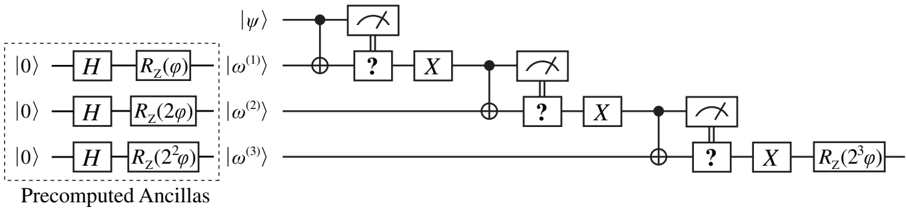
“/8 rotations. |π/2kistates are used, the cascade of measurements terminates after ksteps. This technique of cascading resource state measurements is also referred to as programmable ancilla rotations [49]. Note that the cascade of measurements can also be postponed to a later point, such that the post-corrected ϕrotat…”
MethodEncoding Electronic Spectra in Quantum Circuits with Linear T Complexity
Babbush, R., Gidney, C., Berry, D. W., Wiebe, N., McClean, J., Paler, A., Fowler, A., & Neven, H. (2018) · Physical Review X · doi:10.1103/physrevx.8.041015 · Cited by 383
Low-Depth Quantum Simulation of Materials
Babbush, R., Wiebe, N., McClean, J., McClain, J., Neven, H., & Chan, G. K.-L. (2018) · Physical Review X · doi:10.1103/physrevx.8.011044 · Cited by 335
“Nonetheless, the quadratic difference between the two complexities strongly suggests that for fault-tolerant applications, our simulation method will be competitive because most of the physical qubits required for the simulation arise from executing single-qubit rotations fault tolerantly [48,78].”
MethodGate-count estimates for performing quantum chemistry on small quantum computers
Wecker, D., Bauer, B., Clark, B. K., Hastings, M. B., & Troyer, M. (2014) · Physical Review A · doi:10.1103/physreva.90.022305 · Cited by 296
A game of surface codes: Large-scale quantum computing with lattice surgery
Litinski, D. (2019) · Refubium (Universitätsbibliothek der Freien Universität Berlin) · doi:10.17169/refubium-4067 · Cited by 252
Qubitization of Arbitrary Basis Quantum Chemistry Leveraging Sparsity and Low Rank Factorization
Berry, D. W., Gidney, C., Motta, M., McClean, J. R., & Babbush, R. (2019) · Quantum · doi:10.22331/q-2019-12-02-208 · Cited by 222
Low-overhead constructions for the fault-tolerant Toffoli gate
Jones, C. (2013) · Physical Review A · doi:10.1103/physreva.87.022328 · Cited by 204
“Unlike many quantum gates, the quantum Toffoli gate has a classical analogue, so it is favored as a building block for importing more complex classical operations, such as binary arithmetic, into quantum algorithms like Shor’s factoring al-gorithm [4, 6, 7] and quantum simulation [4, 8, 9].”
Chemical basis of Trotter-Suzuki errors in quantum chemistry simulation
Babbush, R., McClean, J., Wecker, D., Aspuru-Guzik, A., & Wiebe, N. (2015) · Physical Review A · doi:10.1103/physreva.91.022311 · Cited by 199
Self-citationAdiabatic Quantum Simulation of Quantum Chemistry
Babbush, R., Love, P. J., & Aspuru-Guzik, A. (2014) · Scientific Reports · doi:10.1038/srep06603 · Cited by 191
“[72] N.”
BackgroundSelf-citationApplication of fermionic marginal constraints to hybrid quantum algorithms
Rubin, N. C., Babbush, R., & McClean, J. (2018) · New Journal of Physics · doi:10.1088/1367-2630/aab919 · Cited by 152
Quantum Simulation of Helium Hydride Cation in a Solid-State Spin Register
Wang, Y., Dolde, F., Biamonte, J., Babbush, R., Bergholm, V., Yang, S., Jakobi, I., Neumann, P., Aspuru-Guzik, A., Whitfield, J. D., et al. (2015) · ACS Nano · doi:10.1021/acsnano.5b01651 · Cited by 152
“by using a larger, more flexible single-particle basis set, but this will require a larger quantum simulator that eventually will require error correction schemes.(18) Figure 3.”
Self-citationEfficient Synthesis of Universal Repeat-Until-Success Quantum Circuits
Bocharov, A., Roetteler, M., & Svore, K. M. (2015) · Physical Review Letters · doi:10.1103/physrevlett.114.080502 · Cited by 142
TheBravyi–Kitaev transformation: Properties and applications
Tranter, A., Sofia, S., Seeley, J., Kaicher, M., McClean, J., Babbush, R., Coveney, P. V., Mintert, F., Wilhelm, F., & Love, P. J. (2015) · International Journal of Quantum Chemistry · doi:10.1002/qua.24969 · Cited by 136
Exponentially more precise quantum simulation of fermions in second quantization
Babbush, R., Berry, D. W., Kivlichan, I. D., Wei, A. Y., Love, P. J., & Aspuru-Guzik, A. (2016) · New Journal of Physics · doi:10.1088/1367-2630/18/3/033032 · Cited by 135
Self-citationImproving quantum algorithms for quantum chemistry
Hastings, M. B., Wecker, D., Bauer, B., & Troyer, M. (2015) · Quantum Information and Computation · doi:10.26421/qic15.1-2-1 · Cited by 128
Kliuchnikov, V., Maslov, D., & Mosca, M. (2013) · Physical Review Letters · doi:10.1103/physrevlett.110.190502 · Cited by 128
Exploiting Locality in Quantum Computation for Quantum Chemistry
McClean, J. R., Babbush, R., Love, P. J., & Aspuru-Guzik, A. (2014) · The Journal of Physical Chemistry Letters · doi:10.1021/jz501649m · Cited by 125
Self-citationQuantum Computing and Simulations for Energy Applications: Review and Perspective
Paudel, H. P., Syamlal, M., Crawford, S. E., Lee, Y., Shugayev, R., Lu, P., Ohodnicki, P. R., Mollot, D., & Duan, Y. (2022) · ACS Engineering Au · doi:10.1021/acsengineeringau.1c00033 · Cited by 191
Fault-tolerant quantum simulations of chemistry in first quantization
Su, Y., Berry, D. W., Wiebe, N., Rubin, N., & Babbush, R. (2021) · PRX Quantum · doi:10.1103/prxquantum.2.040332 · Cited by 123
Scaffold: Quantum Programming Language
Javadi-Abhari, A., Faruque, A. I., Dousti, M. J., Svec, L., Catu, O., Chakrabati, A., Chiang, C.-F., Vanderwilt, S., Black, J., & Chong, F. T. (2012) · Cited by 190
Compilation of Fault-Tolerant Quantum Heuristics for Combinatorial Optimization
Sanders, Y. R., Berry, D. W., Costa, P. C. S., Tessler, L. W., Wiebe, N., Gidney, C., Neven, H., & Babbush, R. (2020) · PRX Quantum · doi:10.1103/prxquantum.1.020312 · Cited by 103
Fermion-to-qubit mappings with varying resource requirements for quantum simulation
Steudtner, M., & Wehner, S. (2018) · New Journal of Physics · doi:10.1088/1367-2630/aac54f · Cited by 104
Digital quantum simulation of molecular vibrations
McArdle, S., Mayorov, A., Shan, X., Benjamin, S., & Yuan, X. (2019) · Chemical Science · doi:10.1039/c9sc01313j · Cited by 99
Practical Approximation of Single-Qubit Unitaries by Single-Qubit Quantum Clifford and T Circuits
Kliuchnikov, V., Maslov, D., & Mosca, M. (2015) · IEEE Transactions on Computers · doi:10.1109/tc.2015.2409842 · Cited by 156
“…that a number of approaches have been developed in the literature that use additional resources in the form of ancillae, special states, classical feedback, or whose application results in a probabilistic success of having approximated a target unitary [3], [4], [5], [11], [15], [20], [24].”
BackgroundTopological Quantum Compiling with Reinforcement Learning
Zhang, Y.-H., Zheng, P.-L., Zhang, Y., & Deng, D.-L. (2020) · Physical Review Letters · doi:10.1103/physrevlett.125.170501 · Cited by 93
Sugisaki, K., Nakazawa, S., Toyota, K., Sato, K., Shiomi, D., & Takui, T. (2019) · ACS Central Science · doi:10.1021/acscentsci.8b00788 · Cited by 90
Adiabatic state preparation study of methylene
Veis, L., & Pittner, J. (2014) · The Journal of Chemical Physics · doi:10.1063/1.4880755 · Cited by 84
Repeat-Until-Success: Non-deterministic decomposition of single-qubit unitaries
Paetznick, A., & Svore, K. M. (2014) · Quantum Information and Computation · doi:10.26421/qic14.15-16-2 · Cited by 81
Babbush, R., Berry, D. W., Sanders, Y. R., Kivlichan, I. D., Scherer, A., Wei, A. Y., Love, P. J., & Aspuru-Guzik, A. (2018) · Quantum Science and Technology · doi:10.1088/2058-9565/aa9463 · Cited by 85
Self-citationRequirements for fault-tolerant factoring on an atom-optics quantum computer
Devitt, S. J., Stephens, A. M., Munro, W. J., & Nemoto, K. (2013) · Nature Communications · doi:10.1038/ncomms3524 · Cited by 80
Local spin operators for fermion simulations
Whitfield, J. D., Havlíček, V., & Troyer, M. (2016) · Physical Review A · doi:10.1103/physreva.94.030301 · Cited by 73
Self-citationEntanglement spectroscopy on a quantum computer
Johri, S., Steiger, D. S., & Troyer, M. (2017) · Physical Review B · doi:10.1103/physrevb.96.195136 · Cited by 66
Schaetz, T., Monroe, C. R., & Esslinger, T. (2013) · New Journal of Physics · doi:10.1088/1367-2630/15/8/085009 · Cited by 60
“In faster quantum chemistry on fault tolerant quantum computers by Jones et al [32], the authors investigate how quantum simulations addressing quantum chemistry could be implemented within a device that already incorporates quantum error correction and therefore provides fault-tolerance, that is, already requires the…”
BackgroundQuantum codes for quantum simulation of fermions on a square lattice of qubits
Steudtner, M., & Wehner, S. (2019) · Physical Review A · doi:10.1103/physreva.99.022308 · Cited by 59
“[15] N Cody Jones, James D Whitfield, Peter L McMahon, Man-Hong Yung, Rodney Van Meter, Alán Aspuru-Guzik, and Yoshihisa Yamamoto.”
BackgroundA framework for exact synthesisPreprint
Kliuchnikov, V., & Yard, J. (2015) · arXiv (Cornell University) · doi:10.48550/arxiv.1504.04350 · Cited by 74
“One approach involves using ancillary qubits, special states and measurements [37, 10, 17, 18, 20, 23, 4, 5].”
BackgroundSugisaki, K., Yamamoto, S., Nakazawa, S., Toyota, K., Sato, K., Shiomi, D., & Takui, T. (2016) · The Journal of Physical Chemistry A · doi:10.1021/acs.jpca.6b04932 · Cited by 55
Veis, L., Višňák, J., Nishizawa, H., Nakai, H., & Pittner, J. (2016) · International Journal of Quantum Chemistry · doi:10.1002/qua.25176 · Cited by 55
Efficient Quantum Walk Circuits for Metropolis-Hastings Algorithm
Lemieux, J., Heim, B., Poulin, D., Svore, K., & Troyer, M. (2020) · Quantum · doi:10.22331/q-2020-06-29-287 · Cited by 53
Distillation of nonstabilizer states for universal quantum computation
Duclos-Cianci, G., & Svore, K. M. (2013) · Physical Review A · doi:10.1103/physreva.88.042325 · Cited by 52
Variational Quantum Simulation for Quantum Chemistry
Li, Y., Hu, J., Zhang, X., Song, Z., & Yung, M. (2019) · Advanced Theory and Simulations · doi:10.1002/adts.201800182 · Cited by 66
Self-citationQuantum arithmetic and numerical analysis using Repeat-Until-Success circuits
Wiebe, N., & Roetteler, M. (2016) · Quantum Information and Computation · doi:10.26421/qic16.1-2-9 · Cited by 80
“The programmable ancilla rotation (PAR) circuit is proposed in [26] as a means of pre–caching rotations in single– qubit ancilla states that can then be teleported onto a target qubit on demand.”
BackgroundMethodInfluentialQuantum-Fourier-transform-based quantum arithmetic with qudits
Pavlidis, A., & Floratos, E. G. (2021) · Physical Review A · doi:10.1103/physreva.103.032417 · Cited by 61
Contextuality Test of the Nonclassicality of Variational Quantum Eigensolvers
Kirby, W. M., & Love, P. J. (2019) · Physical Review Letters · doi:10.1103/physrevlett.123.200501 · Cited by 45
Grid-based methods for chemistry simulations on a quantum computer
Chan, H. H. S., Meister, R., Jones, T., Tew, D. P., & Benjamin, S. C. (2023) · Science Advances · doi:10.1126/sciadv.abo7484 · Cited by 81
Reducing the quantum-computing overhead with complex gate distillation
Duclos-Cianci, G., & Poulin, D. (2015) · Physical Review A · doi:10.1103/physreva.91.042315 · Cited by 44
Fast quantum modular exponentiation architecture for Shor's factoring alogrithm
Pavlidis, A., & Gizopoulos, D. (2014) · Quantum Information and Computation · doi:10.26421/qic14.7-8-8 · Cited by 38
“A non exhaustive list of such work includes [33, 34, 35, 36, 37].”
BackgroundQuantum Algorithms for Scientific Computing and Approximate Optimization
Hadfield, S. (2018) · arXiv (Cornell University) · doi:10.7916/d8x650c9 · Cited by 31
Tilly, J., Jones, G. A., Chen, H., Wossnig, L., & Grant, E. (2020) · Physical Review A · doi:10.1103/physreva.102.062425 · Cited by 47
T-count and T-depth of any multi-qubit unitary
Gheorghiu, V., Mosca, M., & Mukhopadhyay, P. (2022) · npj Quantum Information · doi:10.1038/s41534-022-00651-y · Cited by 62
Babbush, R., Huggins, W. J., Berry, D. W., Ung, S. F., Zhao, A., Reichman, D. R., Neven, H., Baczewski, A. D., & Lee, J. (2023) · Nature Communications · doi:10.1038/s41467-023-39024-0 · Cited by 32
Not All SWAPs Have the Same Cost: A Case for Optimization-Aware Qubit Routing
Liu, J., Li, P., & Zhou, H. (2022) · IEEE International Symposium on High-Performance Computer Architecture (HPCA) · doi:10.1109/hpca53966.2022.00058 · Cited by 68
Fault-Tolerant Operations for Universal Blind Quantum Computation
Chien, C.-H., Meter, R. V., & Kuo, S. (2015) · ACM Journal on Emerging Technologies in Computing Systems · doi:10.1145/2700248 · Cited by 36
“However, a practical quantum computer needs to be large enough to handle sufficient numbers of delicate qubits, perhaps extending into the high millions or low billions of physical qubits [Van Meter et al. 2010; Jones et al. 2012a].”
BackgroundSelf-citationSugisaki, K., Yamamoto, S., Nakazawa, S., Toyota, K., Sato, K., Shiomi, D., & Takui, T. (2018) · Chemical Physics Letters · doi:10.1016/j.cpletx.2018.100002 · Cited by 36
Quantum computation of stopping power for inertial fusion target design
Rubin, N. C., Berry, D. W., Kononov, A., Malone, F. D., Khattar, T., White, A. F., Lee, J., Neven, H., Babbush, R., & Baczewski, A. (2024) · Proceedings of the National Academy of Sciences · doi:10.1073/pnas.2317772121 · Cited by 81
Complexity of Implementing Trotter Steps
Low, G. H., Su, Y., Tong, Y., & Tran, M. C. (2023) · PRX Quantum · doi:10.1103/prxquantum.4.020323 · Cited by 58
Fast Black-Box Quantum State Preparation
Bausch, J. (2022) · Quantum · doi:10.22331/q-2022-08-04-773 · Cited by 61
Techniques for fault-tolerant decomposition of a multicontrolled Toffoli gate
Biswal, L., Bhattacharjee, D., Chattopadhyay, A., & Rahaman, H. (2019) · Physical Review A · doi:10.1103/physreva.100.062326 · Cited by 31
“Surface code along with Clifford+T-group, has become the de-facto technology in the field of design and implementation of fault-tolerant quantum circuits [7].”
BackgroundMethodDivide and conquer approach to quantum Hamiltonian simulation
Hadfield, S., & Papageorgiou, A. (2018) · New Journal of Physics · doi:10.1088/1367-2630/aab1ef · Cited by 35
Simulation of molecular spectroscopy with circuit quantum electrodynamics
Hu, L., Ma, Y.-C., Xu, Y., Wang, W.-T., Ma, Y.-W., Liu, K., Wang, H.-Y., Song, Y.-P., Yung, M.-H., & Sun, L.-Y. (2018) · 中国科学通报:英文版 · doi:10.1016/j.scib.2018.02.001 · Cited by 33
Self-citationT-Count Optimized Quantum Circuit Designs for Single-Precision Floating-Point Division
Gayathri, S. S., Kumar, R., Dhanalakshmi, S., Dooly, G., & Duraibabu, D. B. (2021) · Electronics · doi:10.3390/electronics10060703 · Cited by 34
“QFT circuits utilize fault-tolerant T gate to propose a fault-tolerant phase rotations, which presents an additional overhead on T-count or ancillary qubits [18,20].”
BackgroundReduced space-time and time costs Ising dislocation codes and arbitrary ancillas
Hastings, M. B., & Geller, A. (2015) · Quantum Information and Computation · doi:10.26421/qic15.11-12-6 · Cited by 25
Impact of time-correlated noise on zero-noise extrapolation
Schultz, K., LaRose, R., Mari, A., Quiroz, G., Shammah, N., Clader, B. D., & Zeng, W. J. (2022) · Physical Review A · doi:10.1103/physreva.106.052406 · Cited by 40
Quantum Simulation of Tunneling in Small Systems
Sornborger, A. T. (2012) · Scientific Reports · doi:10.1038/srep00597 · Cited by 27
Composite Toffoli gate with two-round error detection
Jones, C. (2013) · Physical Review A · doi:10.1103/physreva.87.052334 · Cited by 32
Quantum variational learning for quantum error-correcting codes
Cao, C., Zhang, C., Wu, Z., Grassl, M., & Zeng, B. (2022) · Quantum · doi:10.22331/q-2022-10-06-828 · Cited by 50
Quantum algorithms for grid-based variational time evolution
Ollitrault, P. J., Jandura, S., Miessen, A., Burghardt, I., Martinazzo, R., Tacchino, F., & Tavernelli, I. (2023) · Quantum · doi:10.22331/q-2023-10-12-1139 · Cited by 37
Quantum error correction for state transfer in noisy spin chains
Kay, A. (2016) · Physical Review A · doi:10.1103/physreva.93.042320 · Cited by 31
Communication: Spin-free quantum computational simulations and symmetry adapted states
Whitfield, J. D. (2013) · The Journal of Chemical Physics · doi:10.1063/1.4812566 · Cited by 19
Self-citationTwo Algorithms for Excited-State Quantum Solvers: Theory and Application to EOM-UCCSD
Kim, Y., & Krylov, A. I. (2023) · The Journal of Physical Chemistry A · doi:10.1021/acs.jpca.3c02480 · Cited by 29
Quantum Adder for Superposition States
Lu, X.-M., Jiang, N., Hu, H., & Ji, Z. (2018) · International Journal of Theoretical Physics · doi:10.1007/s10773-018-3779-2 · Cited by 23
Practical Quantum Advantage on Partially Fault-Tolerant Quantum Computer
Toshio, R., Akahoshi, Y., Fujisaki, J., Oshima, H., Sato, S., & Fujii, K. (2025) · Physical Review X · doi:10.1103/physrevx.15.021057 · Cited by 76
Simulating the transverse Ising model on a quantum computer: Error correction with the surface code
You, H., Geller, M. R., & Stancil, P. C. (2013) · Physical Review A · doi:10.1103/physreva.87.032341 · Cited by 21
Quantum Algorithms for Quantum Chemistry based on the sparsity of the CI-matrix
Toloui, B., & Love, P. J. (2013) · arXiv (Cornell University) · doi:10.48550/arxiv.1312.2579 · Cited by 20
“In addition, the large number of terms ' n(4)o in the interacting fermion Hamiltonian results in a large number of gates required for the simulation [36, 40, 50].”
BackgroundHardware-efficient fermionic simulation with a cavity–QED system
Zhu, G., Subaşı, Y., Whitfield, J. D., & Hafezi, M. (2018) · npj Quantum Information · doi:10.1038/s41534-018-0065-3 · Cited by 27
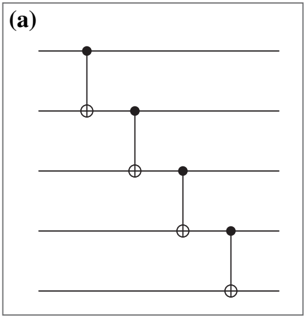
“[18], a teleportation circuit was proposed to replace the CNOT ladder, which uses Bell-state measurement between every two neighboring qubits, hence one can also get an O(N) reduction in circuit depth.”
MethodResultSelf-citationRepeat-Until-Success: Non-deterministic decomposition of single-qubit unitariesPreprint
Paetznick, A., & Svore, K. M. (2013) · arXiv (Cornell University) · doi:10.48550/arxiv.1311.1074 · Cited by 20
Modeling Heterogeneous Catalysis Using Quantum Computers: An Academic and Industry Perspective
Hariharan, S., Kinge, S., & Visscher, L. (2024) · Journal of Chemical Information and Modeling · doi:10.1021/acs.jcim.4c01212 · Cited by 31
Analyzing Many-Body Localization with a Quantum Computer
Bauer, B., & Nayak, C. (2014) · Physical Review X · doi:10.1103/physrevx.4.041021 · Cited by 22
“If the original Hamiltonian is fermionic then, for dimensions d > 1, there will be additional Jordan-Wigner strings, but their overhead can be greatly reduced [32,43,44].”
BackgroundFault-tolerant fermionic quantum computation based on color code
Li, Y. (2018) · Physical Review A · doi:10.1103/physreva.98.012336 · Cited by 27
“Although these gates can be implemented in a constant time by using ancillary qubits [20], any other operation on fermionic modes from i to j cannot be performed in parallel with Ui,j , because corresponding qubits are in use.”
BackgroundT-Count Optimized Wallace Tree Integer Multiplier for Quantum Computing
Gayathri, S. S., Kumar, R., Dhanalakshmi, S., Kaushik, B. K., & Haghparast, M. (2021) · International Journal of Theoretical Physics · doi:10.1007/s10773-021-04864-3 · Cited by 20
Magic state distillation and gate compilation in quantum algorithms for quantum chemistry
Trout, C. J., & Brown, K. R. (2015) · International Journal of Quantum Chemistry · doi:10.1002/qua.24856 · Cited by 17
Quantum algorithms for the generalized eigenvalue problem
Liang, J., Shen, S., Li, M., & Fei, S.-M. (2021) · Quantum Information Processing · doi:10.1007/s11128-021-03370-z · Cited by 20
Quantum Information and Computation for Chemistry
Olson, J., Cao, Y., Romero, J., Johnson, P., Dallaire-Demers, P.-L., Sawaya, N., Narang, P., Kivlichan, I., Wasielewski, M., & Aspuru-Guzik, A. (2017) · arXiv · doi:10.48550/arxiv.1706.05413 · Cited by 15
“Error correction for quantum algorithms for quantum chemistry has also been investigated (Jones et al., 2012).”
BackgroundSelf-citationHolmes, A. A., Ding, Y., Javadi-Abhari, A., Franklin, D. M., Martonosi, M., & Chong, F. T. (2019) · Microprocessors and Microsystems · doi:10.1016/j.micpro.2019.02.007 · Cited by 22
“This is achieved through procedures known as distillation protocols.”
MethodSugisaki, K., Nakazawa, S., Toyota, K., Sato, K., Shiomi, D., & Takui, T. (2019) · Physical Chemistry Chemical Physics · doi:10.1039/c9cp02546d · Cited by 13
Computational chemistry on quantum computers: Ground state estimation
Armaos, V., Badounas, D. A., Deligiannis, P., & Lianos, K. (2020) · Applied Physics A · doi:10.1007/s00339-020-03755-4 · Cited by 19
Chaotic Image Encryption Based on Boson Sampling
Shi, J., Zhao, T., Wang, Y., Feng, Y., & Wu, J. (2022) · Advanced Quantum Technologies · doi:10.1002/qute.202200104 · Cited by 14
Chen, Q., Du, Y., Jiao, Y., Lu, X., Wu, X., & Zhao, Q. (2024) · Quantum Science and Technology · doi:10.1088/2058-9565/ad420a · Cited by 12
“[43] N Cody Jones, James D Whitfield, Peter L McMahon, Man-Hong Yung, Rodney Van Meter, Alán AspuruGuzik, and Yoshihisa Yamamoto.”
From Ansätze to Z-Gates: A NASA View of Quantum Computing
Rieffel, E. G., Hadfield, S., Hogg, T., Mandrà, S., Marshall, J., Mossi, G., O’Gorman, B., Plamadeala, E., Tubman, N. M., Venturelli, D., et al. (2019) · Advances in parallel computing · doi:10.3233/apc190010 · Cited by 19
Metadata
- Authors
- Cody Jones, N., Whitfield, J. D., McMahon, P. L., Yung, M.-H., Meter, R. V., Aspuru-Guzik, A., & Yamamoto, Y.
- Affiliations
- Harvard University (US)
- Stanford University (US)
- Keio University (JP)
- National Institute of Informatics (JP)
- Venue
- New Journal of Physics
- Publisher
- IOP Publishing
- Published
- 2012-11-27
- Volume
- 14
- Issue
- 11
- Pages
- 115023
- ISSN
- 1367-2630 (ISSN-L)
- OpenAlex
- W2100129648
- Cited by
- 145
- References
- 97
- Citations by year
- 2026: 8 · 2025: 6 · 2024: 12 · 2023: 9 · 2022: 10 · 2021: 5 · 2020: 11 · 2019: 14 · 2018: 15 · 2017: 4 · 2016: 11 · 2015: 15 · 2014: 12 · 2013: 10 · 2012: 3
- FWCI
- 12.60
- Type
- journal article
- Language
- en
- Open access
- gold
- doi.org
- Licence
- cc-by-nc-sa
- Locations
- New Journal of Physics (publishedVersion, cc-by-nc-sa)
- arXiv (Cornell University) (submittedVersion)
- Digital Access to Scholarship at Harvard (DASH) (Harvard University) (submittedVersion, cc-by)
- DOAJ (DOAJ: Directory of Open Access Journals) (submittedVersion)
- arXiv (Cornell University)
- Funders
- National Science Foundation (0829694, FA8721-05-C-0002, 1017244)
- Alfred P. Sloan Foundation
- Camille and Henry Dreyfus Foundation
- Japan Society for the Promotion of Science
- National Institute of Information and Communications Technology
- Topics
- Physical Sciences › Computer Science › Artificial Intelligence › Quantum Computing Algorithms and Architecture
- Physical Sciences › Physics and Astronomy › Atomic and Molecular Physics, and Optics › Quantum Information and Cryptography
- Physical Sciences › Physics and Astronomy › Atomic and Molecular Physics, and Optics › Quantum many-body systems
- Keywords
- quantum chemistry simulation, fault-tolerant quantum computing, ab initio quantum chemistry, quantum teleportation, gate construction, quantum circuit optimization, execution time
About these checks
Registry, retraction, Cites and statistics results are computed, not judged, with one exception: a printed reference that no index lists is read once by a model before it counts as a citation error. Claims are extracted by a model and kept only when their quote appears verbatim in the text; each cited source is then checked, with a model’s help, for whether it says what the claim relies on. Those verdicts can be wrong — read the claim’s quote and the cited source before relying on one.
Statistics and arithmetic are recomputed, not judged.
Confidence bands are shown only for fields calibrated on our annotated test set. None is calibrated yet, so no band is shown.
What counts as a claim ›How we measure confidence ›How we check this ›
Are you an author, or do you see a problem with this page? Request a review
Data sources
Bibliographic data: Semantic Scholar, OpenAlex, Crossref.
Contains information from the Semantic Scholar Academic Graph Datasets, made available under the ODC Attribution License (ODC-BY 1.0).
Semantic Scholar’s data is described in: Kinney, R., et al. (2023). The Semantic Scholar Open Data Platform. arXiv:2301.10140.
