

Gauge color codes: optimal transversal gates and gauge fixing in topological stabilizer codes
Open accessThe DOI matches its Crossref record; 31 of the 31 references it cites were found in a registry or an index.
Abstract
Color codes are topological stabilizer codes with unusual transversality properties. Here I show that their group of transversal gates is optimal and only depends on the spatial dimension, not the local geometry. I also introduce a generalized, subsystem version of color codes. In 3D they allow the transversal implementation of a universal set of gates by gauge fixing, while error-dectecting measurements involve only four or six qubits.
Overview
The claims and statistics of this paper haven’t been checked yet.
Free: it reads the open-access text and checks the first 5 claims that cite a source we can check. Create a free account to check every claim.
Integrity signals
Registry
Cites
Statistics
Figures
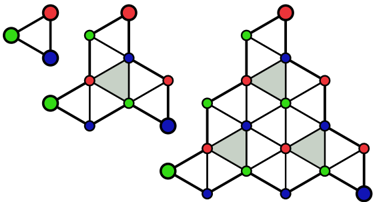
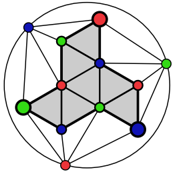
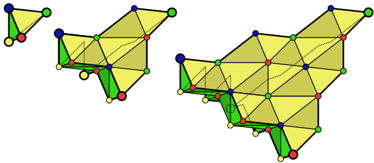
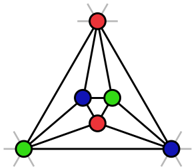
Verification
Claims the paper makes
The claims and statistics of this paper haven’t been checked yet.
Free: it reads the open-access text and checks the first 5 claims that cite a source we can check. Create a free account to check every claim.
Claims other papers make about this one
Each is checked against this paper’s own text: does it say what the citing paper says it does?
The source backs part of the claim, not all of it — or backs it for a different population, condition or comparison.
In the citing paper
“By contrast, 3D codes can transversally realize non-Clifford operations, but lose the transversal H (ref. 37).”
From Logical quantum processor based on reconfigurable atom arrays (2024) · cites this paper as [37]
Experimental — accuracy not yet measuredThe cited source says what the claim attributes to it.
In the citing paper
“We use 2D d = 3 colour codes3,37, which are topological codes akin to the surface code, but with the useful capability of transversal operations of the full Clifford group: Hadamard (H), π/2 phase (S) gate and CNOT (ref. 37).”
From Logical quantum processor based on reconfigurable atom arrays (2024) · cites this paper as [37]
The cited source says what the claim attributes to it.
In the citing paper
“For instance, when using 2D codes such as the surface code, non-Clifford operations cannot be easily performed37, and relatively expensive techniques are required for nontrivial computation24,43, as Clifford circuits can be easily simulated44.”
From Logical quantum processor based on reconfigurable atom arrays (2024) · cites this paper as [37]
Experimental — accuracy not yet measured
Self-check
Percentages, sums and reported differences re-computed from the paper’s own numbers.
The self-check needs the paper’s full text.
Citations
Cites
Fault-tolerant quantum computation by anyons
Kitaev, A. Y. (2003) · Annals of Physics · doi:10.1016/s0003-4916(02)00018-0 · Cited by 7,238
Good quantum error-correcting codes exist
Calderbank, A. R., & Shor, P. W. (1996) · Physical Review A · doi:10.1103/physreva.54.1098 · Cited by 2,516
Gottesman, D., & Chuang, I. L. (1999) · Nature · doi:10.1038/46503 · Cited by 1,860
Dennis, E., Kitaev, A., Landahl, A., & Preskill, J. (2002) · Journal of Mathematical Physics · doi:10.1063/1.1499754 · Cited by 1,768
Universal quantum computation with ideal Clifford gates and noisy ancillas
Bravyi, S., & Kitaev, A. (2005) · Physical Review A · doi:10.1103/physreva.71.022316 · Cited by 1,525
Dennis, E., Kitaev, A., Landahl, A., & Preskill, J. (2001) · CERN Document Server (European Organization for Nuclear Research) · Cited by 1,485
Multiple-particle interference and quantum error correction
(1996) · Proceedings of the Royal Society of London. Series A: Mathematical, Physical and Engineering Sciences · doi:10.1098/rspa.1996.0136 · Cited by 1,284
Class of quantum error-correcting codes saturating the quantum Hamming bound
Gottesman, D. (1996) · Physical Review A · doi:10.1103/physreva.54.1862 · Cited by 1,227
Multiple particle interference and quantum error correction
Steane, A. M. (1996) · Cited by 871
Quantum Error Correction and Orthogonal Geometry
Calderbank, A. R., Rains, E. M., Shor, P. W., & Sloane, N. J. A. (1997) · Physical Review Letters · doi:10.1103/physrevlett.78.405 · Cited by 811
Cited by
Quantum error correction for quantum memories
Terhal, B. M. (2015) · Reviews of Modern Physics · doi:10.1103/revmodphys.87.307 · Cited by 1,354
“A possibly even more attractive family of 3D codes are the gauge color codes (Bombin, 2013) for which the Hadamard gate is transversal.”
Logical quantum processor based on reconfigurable atom arrays
Bluvstein, D., Evered, S. J., Geim, A. A., Li, S. H., Zhou, H., Manovitz, T., Ebadi, S., Cain, M., Kalinowski, M., Hangleiter, D., et al. (2024) · Nature · doi:10.1038/s41586-023-06927-3 · Cited by 1,119
“This transversal gate set can realize any Clifford circuit fault-tolerantly.”
BackgroundMethodK S, U. (2025) · Zenodo (CERN European Organization for Nuclear Research) · doi:10.5281/zenodo.18067974 · Cited by 733
Roads towards fault-tolerant universal quantum computation
Campbell, E. T., Terhal, B. M., & Vuillot, C. (2017) · Nature · doi:10.1038/nature23460 · Cited by 596
Noise tailoring for scalable quantum computation via randomized compiling
Wallman, J. J., & Emerson, J. (2016) · Physical Review A · doi:10.1103/physreva.94.052325 · Cited by 535
“However, recent ‘nogo’ theorems establish that for any fault-tolerant scheme, there exist some operations that cannot be performed in such a manner [30, 31] and so must be implemented via other means, such as magic-state injection [32] or gauge fixing [33].”
BackgroundQuantum advantage with shallow circuits
Bravyi, S., Gosset, D., & König, R. (2018) · Science · doi:10.1126/science.aar3106 · Cited by 406
“⊥ Then for any valid secret string z , and any y ∈ L q , z ⊕ y is also a valid secret string (since 2( z ⊕ y ) T x = 2 z T x + 2 y T x = 2 z T x for x ∈ L q ).”
BackgroundQuantum Algorithms: A Survey of Applications and End-to-end Complexities
Dalzell, A. M., McArdle, S., Berta, M., Bienias, P., Chen, C.-F., Gilyén, A., Hann, C. T., Kastoryano, M. J., Khabiboulline, E. T., Kubica, A., et al. (2023) · RWTH Publications (RWTH Aachen) · doi:10.18154/rwth-2026-02888 · Cited by 363
Brun, T. A. (2020) · Oxford Research Encyclopedia of Physics · doi:10.1093/acrefore/9780190871994.013.35 · Cited by 243
“…the surface code (Bravyi, Suchara and Vargo, 2014; Fowler, Stephens and Groszkowski, 2009; Fowler, Wang and Hollenberg, 2011; Fowler et al., 2012), but also color codes, among others (Bombin, 2015; Brown, Nickerson and Browne, 2016; Kubica and Beverland, 2015; Landahl, Anderson and Rice, 2011).”
A crossbar network for silicon quantum dot qubits
Li, R., Petit, L., Franke, D. P., Dehollain, J. P., Helsen, J., Steudtner, M., Thomas, N. K., Yoscovits, Z. R., Singh, K. J., Wehner, S., et al. (2018) · Science Advances · doi:10.1126/sciadv.aar3960 · Cited by 274
Constant-overhead fault-tolerant quantum computation with reconfigurable atom arrays
Xu, Q., Bonilla Ataides, J. P., Pattison, C. A., Raveendran, N., Bluvstein, D., Wurtz, J., Vasić, B., Lukin, M. D., Jiang, L., & Zhou, H. (2024) · Nature Physics · doi:10.1038/s41567-024-02479-z · Cited by 157
“…QEC constructions used here, including alternative qLDPC code constructions with better properties 49–52 , single-shot logical gate constructions 20,21 , as well as the use of other types of computational logical qubits that may support transversal non-Clifford gates 53 or have a lower overhead.”
Quantum memories at finite temperature
Brown, B. J., Loss, D., Pachos, J. K., Self, C. N., & Wootton, J. R. (2016) · Reviews of Modern Physics · doi:10.1103/revmodphys.88.045005 · Cited by 231
Co-designing a scalable quantum computer with trapped atomic ions
Brown, K. R., Kim, J., & Monroe, C. (2016) · npj Quantum Information · doi:10.1038/npjqi.2016.34 · Cited by 250
Kubica, A., Yoshida, B., & Pastawski, F. (2015) · New Journal of Physics · doi:10.1088/1367-2630/17/8/083026 · Cited by 148
Topological phases with generalized global symmetries
Yoshida, B. (2016) · Physical review. B./Physical review. B · doi:10.1103/physrevb.93.155131 · Cited by 220
Single-Shot Fault-Tolerant Quantum Error Correction
Bombín, H. (2015) · Physical Review X · doi:10.1103/physrevx.5.031043 · Cited by 161
“Once the gauge fixing is completed, a transversal gate can be applied that completes the universal gate set together with the Hadamard and CNOT [14].”
BackgroundMethodInfluentialSelf-citationFault-Tolerant Conversion between the Steane and Reed-Muller Quantum Codes
Anderson, J. T., Duclos-Cianci, G., & Poulin, D. (2014) · Physical Review Letters · doi:10.1103/physrevlett.113.080501 · Cited by 161
On the robustness of bucket brigade quantum RAM
Arunachalam, S., Gheorghiu, V., Jochym-O’Connor, T., Mosca, M., & Srinivasan, P. V. (2015) · New Journal of Physics · doi:10.1088/1367-2630/17/12/123010 · Cited by 122
Poking Holes and Cutting Corners to Achieve Clifford Gates with the Surface Code
Brown, B. J., Laubscher, K., Kesselring, M. S., & Wootton, J. R. (2017) · Physical Review X · doi:10.1103/physrevx.7.021029 · Cited by 121
“It is also worth mentioning the gauge color code [28], which, notably, performs a universal transversal gate set via gauge fixing [48,49] and may thus offer a reduction in”
BackgroundQuantum computation with realistic magic-state factories
O'Gorman, J., & Campbell, E. T. (2017) · Physical Review A · doi:10.1103/physreva.95.032338 · Cited by 158
Universal transversal gates with color codes: A simplified approach
Kubica, A., & Beverland, M. E. (2015) · Physical Review A · doi:10.1103/physreva.91.032330 · Cited by 128
Focus beyond Quadratic Speedups for Error-Corrected Quantum Advantage
Babbush, R., McClean, J. R., Newman, M., Gidney, C., Boixo, S., & Neven, H. (2021) · PRX Quantum · doi:10.1103/prxquantum.2.010103 · Cited by 148
“Fixing the gauge of subsystem codes, where different gauges admit different transverse gates [72,73] 4.”
BackgroundFactoring 2048-bit RSA Integers in 177 Days with 13 436 Qubits and a Multimode Memory
Gouzien, É., & Sangouard, N. (2021) · Physical Review Letters · doi:10.1103/physrevlett.127.140503 · Cited by 172
Coherent spin qubit transport in silicon
Yoneda, J., Huang, W., Feng, M., Yang, C. H., Chan, K. W., Tanttu, T., Gilbert, W., Leon, R. C. C., Hudson, F. E., Itoh, K. M., et al. (2021) · Nature Communications · doi:10.1038/s41467-021-24371-7 · Cited by 163
Experimental demonstration of logical magic state distillation
Rodriguez, P. S., Robinson, J. M., Jepsen, N., He, Z., Duckering, C., Zhao, C., Wu, K.-H., Campo, J., Bagnall, K. R., Kwon, M., et al. (2025) · Nature · doi:10.1038/s41586-025-09367-3 · Cited by 243
“These include the use of QEC codes with transversal non-Clifford gates [43, 44], as well as advanced flag protocols [25, 27, 28, 45–47] and the recently proposed magic state cultivation [29] schemes.”
Yoder, T. J., & Kim, I. H. (2017) · Quantum · doi:10.22331/q-2017-04-25-2 · Cited by 98
“other example, color codes [13] can implement Clifford gates transversally [14, 15] and thus more efficiently than the surface code, even if they fail to achieve as large a threshold [16].”
BackgroundA theory of single-shot error correction for adversarial noise
Campbell, E. T. (2019) · Quantum Science and Technology · doi:10.1088/2058-9565/aafc8f · Cited by 95
Quantum computing by color-code lattice surgery
Landahl, A. J., & Ryan-Anderson, C. (2014) · arXiv (Cornell University) · doi:10.48550/arxiv.1407.5103 · Cited by 32
Low-overhead transversal fault tolerance for universal quantum computation
Zhou, H., Zhao, C., Cain, M., Bluvstein, D., Maskara, N., Duckering, C., Hu, H.-Y., Wang, S.-T., Kubica, A., & Lukin, M. D. (2025) · Nature · doi:10.1038/s41586-025-09543-5 · Cited by 197
“Asymptotically, this may be necessary for both our scheme and for computation schemes based on single-shot QEC 22,93 , unless O (1)-time classical decoding is possible.”
Fault-tolerant error correction with the gauge color code
Brown, B. J., Nickerson, N. H., & Browne, D. E. (2016) · Nature Communications · doi:10.1038/ncomms12302 · Cited by 104
Anyon Condensation and the Color Code
Kesselring, M. S., Magdalena de la Fuente, J. C., Thomsen, F., Eisert, J., Bartlett, S. D., & Brown, B. J. (2024) · PRX Quantum · doi:10.1103/prxquantum.5.010342 · Cited by 62
Encoding a magic state with beyond break-even fidelity
Gupta, R. S., Sundaresan, N., Alexander, T., Wood, C. J., Merkel, S. T., Healy, M. B., Hillenbrand, M., Jochym-O’Connor, T., Wootton, J. R., Yoder, T. J., et al. (2024) · Nature · doi:10.1038/s41586-023-06846-3 · Cited by 115
A magic state’s fidelity can be superior to the operations that created it
Li, Y. (2015) · New Journal of Physics · doi:10.1088/1367-2630/17/2/023037 · Cited by 88
Gapped boundaries, group cohomology and fault-tolerant logical gates
Yoshida, B. (2016) · Annals of Physics · doi:10.1016/j.aop.2016.12.014 · Cited by 133
Fault-tolerant logical gates in quantum error-correcting codes
Pastawski, F., & Yoshida, B. (2015) · Physical Review A · doi:10.1103/physreva.91.012305 · Cited by 102
Campbell, E. T., & Howard, M. (2017) · Physical Review A · doi:10.1103/physreva.95.022316 · Cited by 91
Continuous Symmetries and Approximate Quantum Error Correction
Faist, P., Nezami, S., Albert, V. V., Salton, G., Pastawski, F., Hayden, P., & Preskill, J. (2020) · Physical Review X · doi:10.1103/physrevx.10.041018 · Cited by 107
Triangular color codes on trivalent graphs with flag qubits
Chamberland, C., Kubica, A., Yoder, T. J., & Zhu, G. (2020) · New Journal of Physics · doi:10.1088/1367-2630/ab68fd · Cited by 105
“The color code is distinguished in this latter sense since, unlike for the toric code, all logical Clifford gates can be implemented transversally [14–17].”
BackgroundUniversal Fault-Tolerant Gates on Concatenated Stabilizer Codes
Yoder, T. J., Takagi, R., & Chuang, I. L. (2016) · Physical Review X · doi:10.1103/physrevx.6.031039 · Cited by 73
“Related gauge-fixing techniques are employed in topological color codes [12], where getting locally implementable nonClifford gates requires jumping up a dimension to 3D [13].”
MethodTopological color code and symmetry-protected topological phases
Yoshida, B. (2015) · Physical Review B · doi:10.1103/physrevb.91.245131 · Cited by 115
Three-dimensional surface codes: Transversal gates and fault-tolerant architectures
Vasmer, M., & Browne, D. E. (2019) · Physical Review A · doi:10.1103/physreva.100.012312 · Cited by 76
Logical Qubit in a Linear Array of Semiconductor Quantum Dots
Jones, C., Fogarty, M. A., Morello, A., Gyure, M. F., Dzurak, A. S., & Ladd, T. D. (2018) · Physical Review X · doi:10.1103/physrevx.8.021058 · Cited by 115
Chamberland, C., & Noh, K. (2020) · npj Quantum Information · doi:10.1038/s41534-020-00319-5 · Cited by 71
Magic state distillation with low space overhead and optimal asymptotic input count
Haah, J., Hastings, M. B., Poulin, D., & Wecker, D. (2017) · Quantum · doi:10.22331/q-2017-10-03-31 · Cited by 62
“The code [[20, 2, 6]] can be constructed from the five-qubit code [[5, 1, 3]] by going through the Majorana operators [35], while the others cannot be constructed in this way.”
MethodKesselring, M. S., Pastawski, F., Eisert, J., & Brown, B. J. (2018) · Quantum · doi:10.22331/q-2018-10-19-101 · Cited by 58
Low-overhead fault-tolerant quantum computation by gauging logical operators
Williamson, D. J., & Yoder, T. J. (2026) · Nature Physics · doi:10.1038/s41567-026-03220-8 · Cited by 139
Neural network decoder for topological color codes with circuit level noise
Baireuther, P., Caio, M. D., Criger, B., Beenakker, C. W. J., & O’Brien, T. E. (2019) · New Journal of Physics · doi:10.1088/1367-2630/aaf29e · Cited by 65
“While the threshold error rate is smaller than for surface codes [10, 11], the advantage of color codes is that they allow for the transversal implementation of the full Clifford group of quantum gates (with Hadamard, π/4 phase gate, and cnot gate as generators) [12, 13].”
BackgroundDimensional jump in quantum error correction
Bombín, H. (2016) · New Journal of Physics · doi:10.1088/1367-2630/18/4/043038 · Cited by 67
Self-citationBeverland, M. E., Kubica, A., & Svore, K. M. (2021) · PRX Quantum · doi:10.1103/prxquantum.2.020341 · Cited by 82
Floquet Codes without Parent Subsystem Codes
Davydova, M. D., Tantivasadakarn, N., & Balasubramanian, S. (2023) · PRX Quantum · doi:10.1103/prxquantum.4.020341 · Cited by 114
Quantum Algorithms: A Survey of Applications and End-to-end Complexities
Dalzell, A. M., McArdle, S., Berta, M., Bienias, P., Chen, C.-F., Gilyén, A., Hann, C. T., Kastoryano, M. J., Khabiboulline, E. T., Kubica, A., et al. (2025) · Cambridge University Press eBooks · doi:10.1017/9781009639651 · Cited by 147
A fault-tolerant non-Clifford gate for the surface code in two dimensions
Brown, B. J. (2020) · Science Advances · doi:10.1126/sciadv.aay4929 · Cited by 77
Efficient color code decoders in d≥2 dimensions from toric code decoders
Kubica, A., & Delfosse, N. (2023) · Quantum · doi:10.22331/q-2023-02-21-929 · Cited by 29
Universal fault-tolerant measurement-based quantum computation
Brown, B. J., & Roberts, S. (2020) · Physical Review Research · doi:10.1103/physrevresearch.2.033305 · Cited by 89
Zhu, G., Sikander, S., Portnoy, E., Cross, A. W., & Brown, B. J. (2025) · PRX Quantum · doi:10.1103/wcxs-w69t · Cited by 82
“The invertible codimension-k defects corresponding to logical CCZ and CZ operators [19, 20, 46, 47] are so-called gauged symmetry-protected topological (SPT) defects [32, 40–42, 48, 49], which can be obtained from gauging a trivial phase with a SPT phase decorated on a codimension-( k − 1)…”
Symmetry-protected topological order at nonzero temperature
Roberts, S., Yoshida, B., Kubica, A., & Bartlett, S. D. (2017) · Physical Review A · doi:10.1103/physreva.96.022306 · Cited by 74
Magic state cultivation on a superconducting quantum processor
Rosenfeld, E., Gidney, C., Roberts, G., Morvan, A., Lacroix, N., Kafri, D., Marshall, J., Li, M., Sivak, V., Abanin, D. A., et al. (2026) · Science · doi:10.1126/science.aee7961 · Cited by 75
“The 2D surface [2, 11–14] and color codes [3, 15–18] are favorable for their planar geometry and high thresholds, but non-Clifford gates are not native.”
Single-shot quantum error correction with the three-dimensional subsystem toric code
Kubica, A., & Vasmer, M. (2022) · Nature Communications · doi:10.1038/s41467-022-33923-4 · Cited by 94
Three-Dimensional Color Code Thresholds via Statistical-Mechanical Mapping
Kubica, A., Beverland, M. E., Brandão, F. G. S. L., Preskill, J. P., & Svore, K. M. (2018) · Physical Review Letters · doi:10.1103/physrevlett.120.180501 · Cited by 84
Fast and Parallelizable Logical Computation with Homological Product Codes
Xu, Q., Zhou, H., Zheng, G., Bluvstein, D., Ataides, J. P. B., Lukin, M. D., & Jiang, L. (2025) · Physical Review X · doi:10.1103/physrevx.15.021065 · Cited by 93
“Some of these higher-dimensional codes, e.g. the 3D surface code [66–68], also support transversal non-Clifford gates.”
BackgroundLi, M., Miller, D., Newman, M., Wu, Y., & Brown, K. R. (2019) · Physical Review X · doi:10.1103/physrevx.9.021041 · Cited by 48
Characterization of solvable spin models via graph invariants
Chapman, A., & Flammia, S. T. (2020) · Quantum · doi:10.22331/q-2020-06-04-278 · Cited by 88
Fault-tolerant interface between quantum memories and quantum processors
Poulsen Nautrup, H., Friis, N., & Briegel, H. J. (2017) · Nature Communications · doi:10.1038/s41467-017-01418-2 · Cited by 40
Unifying Gate Synthesis and Magic State Distillation
Campbell, E. T., & Howard, M. (2017) · Physical Review Letters · doi:10.1103/physrevlett.118.060501 · Cited by 53
Disjointness of Stabilizer Codes and Limitations on Fault-Tolerant Logical Gates
Jochym-O’Connor, T., Kubica, A., & Yoder, T. J. (2018) · Physical Review X · doi:10.1103/physrevx.8.021047 · Cited by 48
“Asymmetry of logical operators appears in our bounds as a necessary condition for possessing constant depth circuits for nonClifford gates, such as those on 3D color and toric codes [15, 16] and on asymmetric 2D Bacon-Shor codes [17].”
BackgroundFault-tolerant quantum computing in the Pauli or Clifford frame with slow error diagnostics
Chamberland, C., Iyer, P., & Poulin, D. (2018) · Quantum · doi:10.22331/q-2018-01-04-43 · Cited by 53
“We point out that 2-D color codes [13] admit transversal realizations of all gates in P((2)) 1 .”
BackgroundSingle-Shot Decoding of Good Quantum LDPC Codes
Gu, S., Tang, E., Caha, L., Choe, S. H., He, Z., & Kubica, A. (2024) · Communications in Mathematical Physics · doi:10.1007/s00220-024-04951-6 · Cited by 83
“Examples of such structure include sufficiently high expansion in the associated factor graphs, e.g., quantum expander codes [25]; or the presence of geometrically local redundancies among constant-weight parity checks, e.g., the 3D subsystem toric code [26, 27] and the gauge color code [28].”
BackgroundCups and Gates I: Cohomology Invariants and Logical Quantum Operations
Breuckmann, N. P., Davydova, M. D., Eberhardt, J. N., & Tantivasadakarn, N. (2026) · Communications in Mathematical Physics · doi:10.1007/s00220-026-05570-z · Cited by 63
Error rates and resource overheads of repetition cat qubits
Guillaud, J., & Mirrahimi, M. (2021) · Physical Review A · doi:10.1103/physreva.103.042413 · Cited by 55
Sparse Quantum Codes From Quantum Circuits
Bacon, D., Flammia, S. T., Harrow, A. W., & Shi, J. (2017) · IEEE Transactions on Information Theory · doi:10.1109/tit.2017.2663199 · Cited by 37
Universal Fault-Tolerant Quantum Computation in 2D without Getting Tied in Knots
Davydova, M. D., Bauer, A., de la Fuente, J. C. M., Webster, M., Williamson, D. J., & Brown, B. J. (2026) · Physical Review X · doi:10.1103/vrty-qs5h · Cited by 63
Stacked codes: Universal fault-tolerant quantum computation in a two-dimensional layout
Jochym-O'Connor, T., & Bartlett, S. D. (2016) · Physical Review A · doi:10.1103/physreva.93.022323 · Cited by 46
Woods, M. P., & Alhambra, A. M. (2020) · Quantum · doi:10.22331/q-2020-03-23-245 · Cited by 66
Quantum computation from dynamic automorphism codes
Davydova, M. D., Tantivasadakarn, N., Balasubramanian, S., & Aasen, D. (2024) · Quantum · doi:10.22331/q-2024-08-27-1448 · Cited by 73
Kubica, A., & Demkowicz-Dobrzański, R. (2021) · Physical Review Letters · doi:10.1103/physrevlett.126.150503 · Cited by 71
SSIP: automated surgery with quantum LDPC codesPreprint
Cowtan, A. (2024) · arXiv (Cornell University) · doi:10.48550/arxiv.2407.09423 · Cited by 52
“The QRM code is a small example of a 3D colour code [4], and the merging protocol scales to arbitrary distance d 3D colour codes and surface codes, using only d − 1 additional qubits to perform the injection.”
MethodResultQuantifying the effects of local many-qubit errors and nonlocal two-qubit errors on the surface code
Fowler, A. G., & Martinis, J. M. (2014) · Physical Review A · doi:10.1103/physreva.89.032316 · Cited by 49
Pauli topological subsystem codes from Abelian anyon theories
Ellison, T. D., Chen, Y.-A., Dua, A., Shirley, W. E., Tantivasadakarn, N., & Williamson, D. J. (2023) · Quantum · doi:10.22331/q-2023-10-12-1137 · Cited by 65
Data-driven decoding of quantum error correcting codes using graph neural networks
Lange, M., Havström, P., Srivastava, B., Bengtsson, I., Bergentall, V., Hammar, K., Heuts, O., van Nieuwenburg, E., & Granath, M. (2025) · Physical Review Research · doi:10.1103/physrevresearch.7.023181 · Cited by 76
“[107] Héctor Bombín, “Gauge color codes: optimal transversal gates and gauge fixing in topological stabilizer codes,” New Journal of Physics 17, 083002 (2015).”
Optimal universal quantum error correction via bounded reference frames
Yang, Y., Mo, Y., Renes, J. M., Chiribella, G., & Woods, M. P. (2022) · Physical Review Research · doi:10.1103/physrevresearch.4.023107 · Cited by 55
Subsystem codes with high thresholds by gauge fixing and reduced qubit overhead
Higgott, O., & Breuckmann, N. P. (2021) · Physical Review X · doi:10.1103/physrevx.11.031039 · Cited by 48
Symmetry-Protected Self-Correcting Quantum Memories
Roberts, S., & Bartlett, S. D. (2020) · Physical Review X · doi:10.1103/physrevx.10.031041 · Cited by 59
“[62] that the 3D gauge color code is self-correcting.”
BackgroundMethodInfluentialTopological Order, Quantum Codes, and Quantum Computation on Fractal Geometries
Zhu, G., Jochym-O’Connor, T., & Dua, A. (2022) · PRX Quantum · doi:10.1103/prxquantum.3.030338 · Cited by 59
Liu, L., & Dou, X. (2024) · ACM Transactions on Architecture and Code Optimization · doi:10.1145/3631525 · Cited by 53
“Some studies [8,14,19,58] show that quantum computing benefits from the quantum chip topology with a higher dimension, e.”
BackgroundCellular automaton decoders for topological quantum codes with noisy measurements and beyond
Vasmer, M., Browne, D. E., & Kubica, A. (2021) · Scientific Reports · doi:10.1038/s41598-021-81138-2 · Cited by 53
Qudit color codes and gauge color codes in all spatial dimensions
Watson, F. H. E., Campbell, E. T., Anwar, H., & Browne, D. E. (2015) · Physical Review A · doi:10.1103/physreva.92.022312 · Cited by 55
Generalized Toric Codes on Twisted Tori for Quantum Error Correction
Liang, Z., Liu, K., Song, H., & Chen, Y.-A. (2025) · PRX Quantum · doi:10.1103/rmy6-9n89 · Cited by 76
Real-time processing of stabilizer measurements in a bit-flip code
Ristè, D., Govia, L. C. G., Donovan, B., Fallek, S. D., Kalfus, W. D., Brink, M., Bronn, N. T., & Ohki, T. (2020) · npj Quantum Information · doi:10.1038/s41534-020-00304-y · Cited by 47
An efficient magic state approach to small angle rotations
Campbell, E. T., & O’Gorman, J. (2016) · Quantum Science and Technology · doi:10.1088/2058-9565/1/1/015007 · Cited by 38
Limitations on transversal computation through quantum homomorphic encryption
Newman, M., & Shi, Y. (2018) · Quantum Information and Computation · doi:10.26421/qic18.11-12-3 · Cited by 48
Vasmer, M., & Kubica, A. (2022) · PRX Quantum · doi:10.1103/prxquantum.3.030319 · Cited by 39
“, the gauge color code [46,47], in order to define a HCT-code family interpolating between the gauge color code and the recently introduced 3D subsystem toric code [74].”
BackgroundMethodDecoder for the Triangular Color Code by Matching on a Möbius Strip
Sahay, K., & Brown, B. J. (2022) · PRX Quantum · doi:10.1103/prxquantum.3.010310 · Cited by 38
Quantum Circuit Discovery for Fault-Tolerant Logical State Preparation with Reinforcement Learning
Zen, R. A. M., Ollé, J., Colmenárez, L., Puviani, M. B., Müller, M., & Marquardt, F. (2025) · Physical Review X · doi:10.1103/gqpr-dgz7 · Cited by 58
“Finally, we consider the smallest error-correcting 3D color code, the [[15 , 1 , 3]] Reed-Muller code [69, 105].”
BackgroundMethodInfluentialBuilding models of topological quantum criticality from pivot Hamiltonians
Tantivasadakarn, N., Thorngren, R., Vishwanath, A., & Verresen, R. (2023) · SciPost Physics · doi:10.21468/scipostphys.14.2.013 · Cited by 43
“The ground state is that of the 3D color code[89, 104], which is in the same topological order as three toric codes.”
BackgroundFault-Tolerant Code-Switching Protocols for Near-Term Quantum Processors
Butt, F., Heußen, S., Rispler, M., & Müller, M. (2024) · PRX Quantum · doi:10.1103/prxquantum.5.020345 · Cited by 41
“An alternative to magic state injection is to complete a FT universal gate set using code switching between codes with complementary transversal gate sets [44–46].”
MethodHigh-Threshold, Low-Overhead and Single-Shot Decodable Fault-Tolerant Quantum Memory
Scruby, T. R., Hillmann, T., & Roffe, J. (2026) · PRX Quantum · doi:10.1103/67xf-zdjb · Cited by 48
“Such a strategy may work well in codes such as the 3D gauge colour code [24] or 3D subsystem toric code [25] which use matching decoders, but will work very poorly for de-coders such as BP which are highly dependent on the details of the graph. which a correction for the syndrome data from the…”
Transforming graph states to Bell-pairs is NP-Complete
Dahlberg, A., Helsen, J., & Wehner, S. (2020) · Quantum · doi:10.22331/q-2020-10-22-348 · Cited by 37
Gauge color codes in two dimensions
Jones, C., Brooks, P., & Harrington, J. (2016) · Physical Review A · doi:10.1103/physreva.93.052332 · Cited by 33
“The two doubly-even code blocks are fused using gauge fixing [12, 26], which teleports the logical qubit of the original doubly-even code into a triply-even code of order t.”
BackgroundProgrammable photonic integrated meshes for modular generation of optical entanglement links
Dong, M., Zimmermann, M., Heim, D., Choi, H., Clark, G., Leenheer, A. J., Palm, K. J., Witte, A., Dominguez, D., Gilbert, G. N., et al. (2023) · npj Quantum Information · doi:10.1038/s41534-023-00708-6 · Cited by 43
Fault-tolerant quantum computation with polylogarithmic time and constant space overheads
Tamiya, S., Koashi, M., & Yamasaki, H. (2025) · Nature Physics · doi:10.1038/s41567-025-03102-5 · Cited by 50
Correcting non-independent and non-identically distributed errors with surface codes
Tiurev, K., Derks, P.-J. H. S., Roffe, J., Eisert, J., & Reiner, J.-M. (2023) · Quantum · doi:10.22331/q-2023-09-26-1123 · Cited by 47
Metadata
- Authors
- Bombín, H.
- Affiliations
- University of Copenhagen (DK)
- Corresponding author
- Bombín, Héctor
- ORCID
- Bombín, Héctor
- Venue
- New Journal of Physics
- Publisher
- IOP Publishing
- Published
- 2015-08-03
- Volume
- 17
- Issue
- 8
- Pages
- 083002
- ISSN
- 1367-2630 (ISSN-L)
- OpenAlex
- W2963760674
- Cited by
- 217
- References
- 30
- Citations by year
- 2026: 13 · 2025: 29 · 2024: 26 · 2023: 21 · 2022: 25 · 2021: 19 · 2020: 19 · 2019: 15 · 2018: 17 · 2017: 16 · 2016: 14 · 2015: 3
- FWCI
- 16.34
- Type
- journal article
- Language
- en
- Open access
- gold
- doi.org
- Licence
- cc-by
- iopscience.iop.org/info/page/text-and-data-mining (tdm)
- creativecommons.org/licenses/by/3.0/ (vor)
- Locations
- New Journal of Physics (publishedVersion, cc-by)
- Research at the University of Copenhagen (University of Copenhagen) (publishedVersion, other-oa)
- arXiv (Cornell University) (submittedVersion)
- DOAJ (DOAJ: Directory of Open Access Journals) (submittedVersion)
- arXiv (Cornell University)
- Funders
- Industry Canada
- Danmarks Frie Forskningsfond
- Institut Périmètre de physique théorique
- CHIST-ERA
- Topics
- Physical Sciences › Computer Science › Artificial Intelligence › Quantum Computing Algorithms and Architecture
- Physical Sciences › Physics and Astronomy › Atomic and Molecular Physics, and Optics › Quantum many-body systems
- Physical Sciences › Physics and Astronomy › Atomic and Molecular Physics, and Optics › Quantum Information and Cryptography
- Keywords
- color codes, transversal gates, gauge fixing, universal gate set, error detection, spatial dimension, quantum error correction
About these checks
Registry, retraction, Cites and statistics results are computed, not judged, with one exception: a printed reference that no index lists is read once by a model before it counts as a citation error. Claims are extracted by a model and kept only when their quote appears verbatim in the text; each cited source is then checked, with a model’s help, for whether it says what the claim relies on. Those verdicts can be wrong — read the claim’s quote and the cited source before relying on one.
Statistics and arithmetic are recomputed, not judged.
Confidence bands are shown only for fields calibrated on our annotated test set. None is calibrated yet, so no band is shown.
What counts as a claim ›How we measure confidence ›How we check this ›
Are you an author, or do you see a problem with this page? Request a review
Data sources
Bibliographic data: Semantic Scholar, OpenAlex, Crossref.
Contains information from the Semantic Scholar Academic Graph Datasets, made available under the ODC Attribution License (ODC-BY 1.0).
Semantic Scholar’s data is described in: Kinney, R., et al. (2023). The Semantic Scholar Open Data Platform. arXiv:2301.10140.
