

A non-orthogonal variational quantum eigensolver
Open accessThe DOI matches its Crossref record; 65 of the 65 references it cites were found in a registry or an index.
Abstract
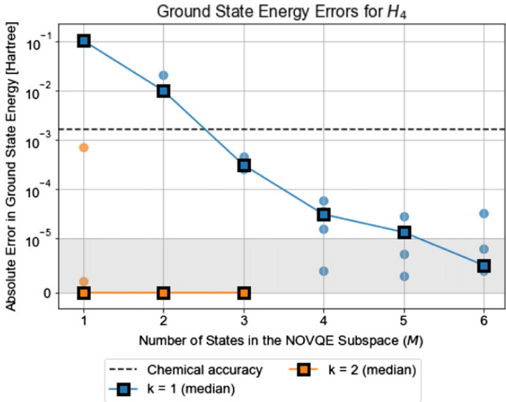
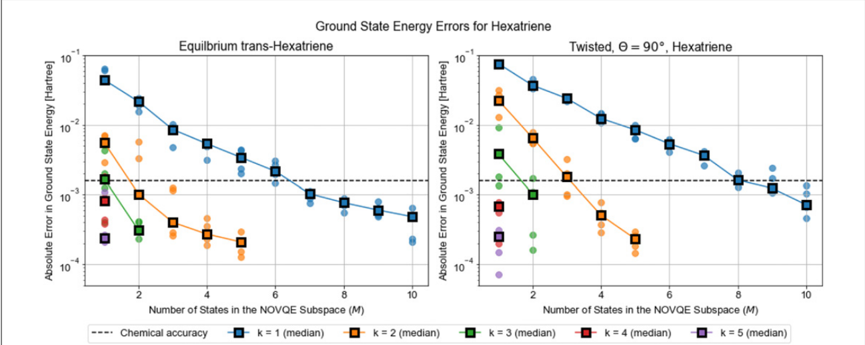
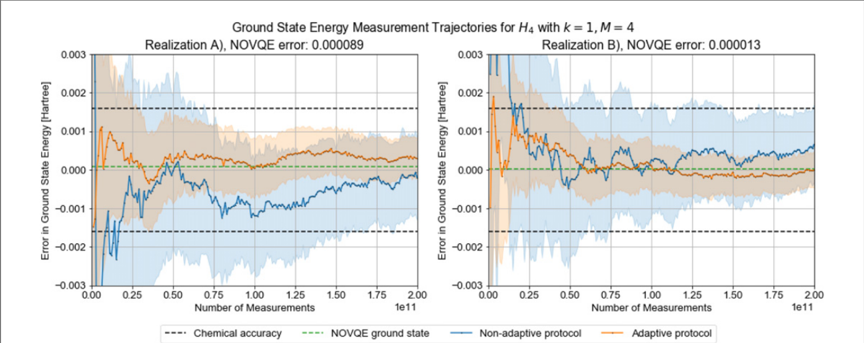
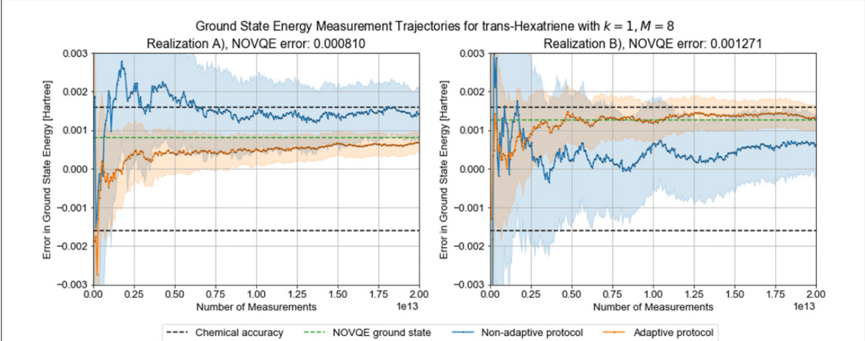
Variational algorithms for strongly correlated chemical and materials systems are one of the most promising applications of near-term quantum computers. We present an extension to the variational quantum eigensolver that approximates the ground state of a system by solving a generalized eigenvalue problem in a subspace spanned by a collection of parametrized quantum states. This allows for the systematic improvement of a logical wavefunction ansatz without a significant increase in circuit complexity. To minimize the circuit complexity of this approach, we propose a strategy for efficiently measuring the Hamiltonian and overlap matrix elements between states parametrized by circuits that commute with the total particle number operator. This strategy doubles the size of the state preparation circuits but not their depth, while adding a small number of additional two-qubit gates relative to standard variational quantum eigensolver. We also propose a classical Monte Carlo scheme to estimate the uncertainty in the ground state energy caused by a finite number of measurements of the matrix elements. We explain how this Monte Carlo procedure can be extended to adaptively schedule the required measurements, reducing the number of circuit executions necessary for a given accuracy. We apply these ideas to two model strongly correlated systems, a square configuration of H 4 and the π -system of hexatriene (C 6 H 8 ).
Overview
The claims and statistics of this paper haven’t been checked yet.
Free: it reads the open-access text and checks the first 5 claims that cite a source we can check. Create a free account to check every claim.
Integrity signals
Registry
Cites
Statistics
Figures
Verification
Claims the paper makes
The claims and statistics of this paper haven’t been checked yet.
Free: it reads the open-access text and checks the first 5 claims that cite a source we can check. Create a free account to check every claim.
Self-check
Percentages, sums and reported differences re-computed from the paper’s own numbers.
The self-check needs the paper’s full text.
Citations
Cites
SciPy 1.0: fundamental algorithms for scientific computing in Python
Virtanen, P., Gommers, R., Oliphant, T. E., Haberland, M., Reddy, T., Cournapeau, D., Burovski, E., Peterson, P., Weckesser, W., Bright, J., et al. (2020) · Nature Methods · doi:10.1038/s41592-019-0686-2 · Cited by 38,430
Dunning, T. H. (1989) · The Journal of Chemical Physics · doi:10.1063/1.456153 · Cited by 31,648
Long-range corrected hybrid density functionals with damped atom–atom dispersion corrections
Chai, J.-D., & Head-Gordon, M. (2008) · Physical Chemistry Chemical Physics · doi:10.1039/b810189b · Cited by 14,648 · cited 1×
“The equilibrium geometry was obtained from the geometry optimization with ωB97X-D [70] and cc-pVTZ [71] using a development version of Q-chem [72].”
TensorFlow: A system for large-scale machine learning
Abadi, M., Barham, P., Chen, J., Chen, Z., Davis, A., Dean, J., Devin, M., Ghemawat, S., Irving, G., Isard, M., et al. (2016) · arXiv (Cornell University) · doi:10.48550/arxiv.1605.08695 · Cited by 11,822
SciPy 1.0: fundamental algorithms for scientific computing in Python
Virtanen, P., Gommers, R., Oliphant, T. E., Haberland, M., Reddy, T., Cournapeau, D., Burovski, E., Peterson, P., Weckesser, W., Bright, J., et al. (2019) · Apollo - University of Cambridge Repository · doi:10.17863/cam.64134 · Cited by 10,460
A variational eigenvalue solver on a photonic quantum processor
Peruzzo, A., McClean, J., Shadbolt, P., Yung, M.-H., Zhou, X.-Q., Love, P. J., Aspuru-Guzik, A., & O’Brien, J. L. (2014) · Nature Communications · doi:10.1038/ncomms5213 · Cited by 4,552 · cited 1×
“One appealing strategy, the variational quantum eigensolver (VQE) [3, 4], uses a potentially noisy quantum computer as a black box to prepare parametrized wavefunctions and measure their energy.”
MethodAlgorithm 778: L-BFGS-B: Fortran subroutines for large-scale bound-constrained optimization
Zhu, C., Byrd, R. H., Lu, P., & Nocedal, J. (1997) · ACM Transactions on Mathematical Software · doi:10.1145/279232.279236 · Cited by 3,462
Lloyd, S. (1996) · Science · doi:10.1126/science.273.5278.1073 · Cited by 3,088 · cited 1×
“For example, such devices will be able to efficiently simulate long-time dynamics [1], and through phase estimation, measure the energy of a trial wavefunction while projecting it into the eigen-basis of the Hamiltonian [2].”
BackgroundAdvances in molecular quantum chemistry contained in the Q-Chem 4 program package
Shao, Y., Gan, Z., Epifanovsky, E., Gilbert, A. T. B., Wormit, M., Kussmann, J., Lange, A. W., Behn, A., Deng, J., Feng, X., et al. (2015) · Molecular Physics · doi:10.1080/00268976.2014.952696 · Cited by 3,000
Hardware-efficient variational quantum eigensolver for small molecules and quantum magnets
Kandala, A., Mezzacapo, A., Temme, K., Takita, M., Brink, M., Chow, J. M., & Gambetta, J. M. (2017) · Nature · doi:10.1038/nature23879 · Cited by 2,982
Research works printed but not linked: 7
- Huggins W J, McClean J, Rubin N and Jiang Z et al 2019 Efficient and noise resilient measurements for quantum chemistry on near-term quantum computers arXiv:1907.13117 [quant-ph] · arXiv
- Sagastizabal R et al 2019 Error mitigation by symmetry verification on a variational quantum eigensolver arXiv:1902.11258 [quant-ph] · arXiv
- Condon E U, Condon E U and Shortley G H 1951 The Theory of Atomic Spectra (Cambridge: Cambridge University Press)
- Kitaev A Y 1995 Quantum measurements and the abelian stabilizer problem arXiv:quant-ph/9511026 · arXiv
- Szabo A and Ostlund N S 2012 Modern Quantum Chemistry: Introduction to Advanced Electronic Structure Theory (Mineola, NY: Dover)
- McClean J R et al 2017 OpenFermion: the electronic structure package for quantum computers arXiv:1710.07629 [quant-ph] · arXiv
- Eric J S and Head-Gordon M 2014 Non-orthogonal configuration interaction for the calculation of multielectron excited states J. Chem. Phys. 140 114103 · DOI
Cited by
Variational quantum algorithms
Cerezo, M., Arrasmith, A., Babbush, R., Benjamin, S. C., Endo, S., Fujii, K., McClean, J. R., Mitarai, K., Yuan, X., Cincio, L., et al. (2021) · Nature Reviews Physics · doi:10.1038/s42254-021-00348-9 · Cited by 3,385
“A different approach is to use as ansatz a trainable linear combination of parametrized states |ψ({cμ},θ)〉 = ∑ μ cμ|ψμ(θμ)〉 with {cμ} classically optimizable coefficient [44–50].”
Noisy intermediate-scale quantum algorithms
Bharti, K., Cervera-Lierta, A., Kyaw, T. H., Haug, T., Alperin-Lea, S., Anand, A., Degroote, M., Heimonen, H., Kottmann, J. S., Menke, T., et al. (2022) · Reviews of Modern Physics · doi:10.1103/revmodphys.94.015004 · Cited by 2,231
The Variational Quantum Eigensolver: A review of methods and best practices
Tilly, J., Chen, H., Cao, S., Picozzi, D., Setia, K., Li, Y., Grant, E., Wossnig, L., Rungger, I., Booth, G. H., et al. (2022) · Physics Reports · doi:10.1016/j.physrep.2022.08.003 · Cited by 1,031
Efficient and noise resilient measurements for quantum chemistry on near-term quantum computers
Huggins, W. J., McClean, J. R., Rubin, N. C., Jiang, Z., Wiebe, N., Whaley, K. B., & Babbush, R. (2021) · npj Quantum Information · doi:10.1038/s41534-020-00341-7 · Cited by 256
Self-citationA quantum computing view on unitary coupled cluster theory
Anand, A., Schleich, P., Alperin-Lea, S., Jensen, P. W. K., Sim, S., Díaz-Tinoco, M., Kottmann, J. S., Degroote, M., Izmaylov, A. F., & Aspuru-Guzik, A. (2022) · Chemical Society Reviews · doi:10.1039/d1cs00932j · Cited by 223
Metadata
- Authors
- Huggins, W. J., Lee, J., Baek, U., O’Gorman, B., & Whaley, K. B.
- Affiliations
- Lawrence Berkeley National Laboratory (US)
- Corresponding author
- Huggins, William J
- Venue
- New Journal of Physics
- Publisher
- IOP Publishing
- Published
- 2020-07-13
- Volume
- 22
- Issue
- 7
- Pages
- 073009
- ISSN
- 1367-2630 (ISSN-L)
- OpenAlex
- W2974445049
- Cited by
- 148
- References
- 57
- Citations by year
- 2026: 8 · 2025: 36 · 2024: 25 · 2023: 29 · 2022: 24 · 2021: 20 · 2020: 6
- FWCI
- 7.75
- Type
- journal article
- Language
- en
- Open access
- gold
- doi.org
- Licence
- cc-by
- iopscience.iop.org/info/page/text-and-data-mining (tdm)
- creativecommons.org/licenses/by/4.0/ (vor)
- Locations
- New Journal of Physics (publishedVersion, cc-by)
- arXiv (Cornell University) (submittedVersion)
- OSTI OAI (U.S. Department of Energy Office of Scientific and Technical Information) (submittedVersion)
- DOAJ (DOAJ: Directory of Open Access Journals) (submittedVersion)
- Funders
- Google (Quantum Algorithms Focused Award)
- U.S. Department of Energy, Office of Science, Office of Advanced Scientific Computing Research, Quantum Algorithm Teams Program (DE-AC02-05CH11231)
- Topics
- Physical Sciences › Computer Science › Artificial Intelligence › Quantum Computing Algorithms and Architecture
- Physical Sciences › Physics and Astronomy › Atomic and Molecular Physics, and Optics › Quantum many-body systems
- Physical Sciences › Physics and Astronomy › Atomic and Molecular Physics, and Optics › Advanced Chemical Physics Studies
- Keywords
- variational quantum eigensolver, generalized eigenvalue problem, ground state energy, strongly correlated systems, circuit complexity, Monte Carlo uncertainty analysis, molecular hydrogen
About these checks
Registry, retraction, Cites and statistics results are computed, not judged, with one exception: a printed reference that no index lists is read once by a model before it counts as a citation error. Claims are extracted by a model and kept only when their quote appears verbatim in the text; each cited source is then checked, with a model’s help, for whether it says what the claim relies on. Those verdicts can be wrong — read the claim’s quote and the cited source before relying on one.
Statistics and arithmetic are recomputed, not judged.
Confidence bands are shown only for fields calibrated on our annotated test set. None is calibrated yet, so no band is shown.
What counts as a claim ›How we measure confidence ›How we check this ›
Are you an author, or do you see a problem with this page? Request a review
How to cite
Cite CoChat for the checks on this page, and the paper for its own findings.
- This page
- CoChat. (2026). Citation check: A non-orthogonal variational quantum eigensolver. https://app.cochat.ai/papers/10.1088/1367-2630/ab867b
- The paper
- Huggins, W. J., Lee, J., Baek, U., O’Gorman, B., & Whaley, K. B. (2020). A non-orthogonal variational quantum eigensolver. New Journal of Physics. https://doi.org/10.1088/1367-2630/ab867b
Data sources
Bibliographic data: Semantic Scholar, OpenAlex, Crossref.
Contains information from the Semantic Scholar Academic Graph Datasets, made available under the ODC Attribution License (ODC-BY 1.0).
Semantic Scholar’s data is described in: Kinney, R., et al. (2023). The Semantic Scholar Open Data Platform. arXiv:2301.10140.
