

A non-orthogonal variational quantum eigensolver
Open accessThe DOI matches its Crossref record; 65 of the 65 references it cites were found in a registry or an index.
Abstract
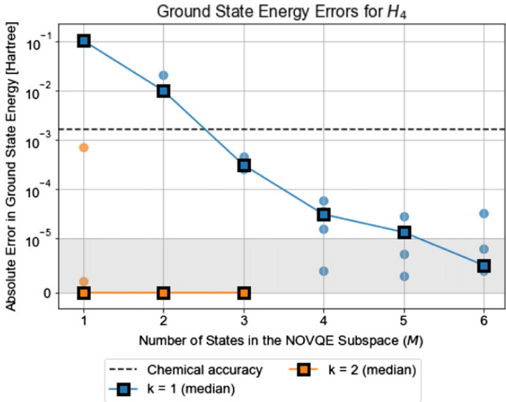
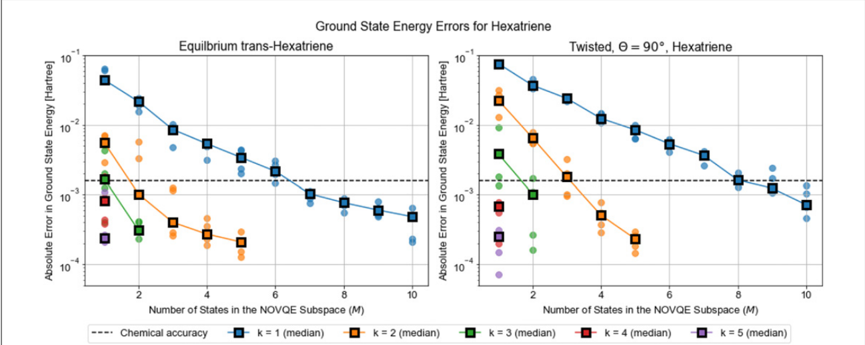
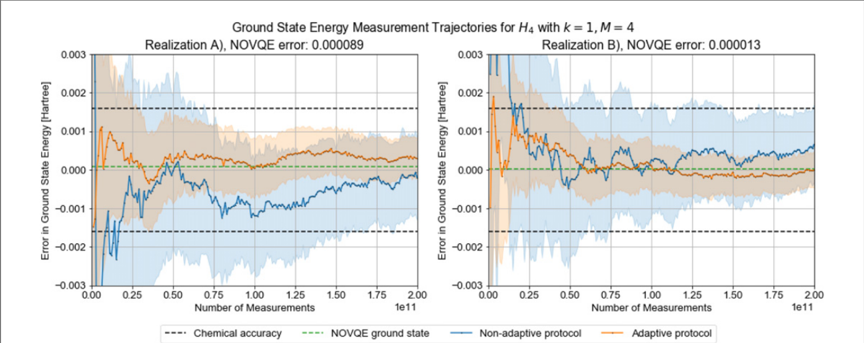
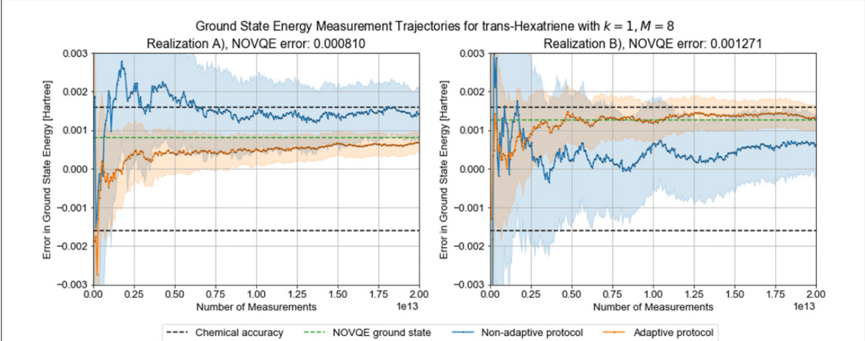
Variational algorithms for strongly correlated chemical and materials systems are one of the most promising applications of near-term quantum computers. We present an extension to the variational quantum eigensolver that approximates the ground state of a system by solving a generalized eigenvalue problem in a subspace spanned by a collection of parametrized quantum states. This allows for the systematic improvement of a logical wavefunction ansatz without a significant increase in circuit complexity. To minimize the circuit complexity of this approach, we propose a strategy for efficiently measuring the Hamiltonian and overlap matrix elements between states parametrized by circuits that commute with the total particle number operator. This strategy doubles the size of the state preparation circuits but not their depth, while adding a small number of additional two-qubit gates relative to standard variational quantum eigensolver. We also propose a classical Monte Carlo scheme to estimate the uncertainty in the ground state energy caused by a finite number of measurements of the matrix elements. We explain how this Monte Carlo procedure can be extended to adaptively schedule the required measurements, reducing the number of circuit executions necessary for a given accuracy. We apply these ideas to two model strongly correlated systems, a square configuration of H 4 and the π -system of hexatriene (C 6 H 8 ).
Overview
The claims and statistics of this paper haven’t been checked yet.
Free: it reads the open-access text and checks the first 5 claims that cite a source we can check. Create a free account to check every claim.
Integrity signals
Registry
Cites
Statistics
Figures
Verification
Claims the paper makes
The claims and statistics of this paper haven’t been checked yet.
Free: it reads the open-access text and checks the first 5 claims that cite a source we can check. Create a free account to check every claim.
Self-check
Percentages, sums and reported differences re-computed from the paper’s own numbers.
The self-check needs the paper’s full text.
Citations
Cites
SciPy 1.0: fundamental algorithms for scientific computing in Python
Virtanen, P., Gommers, R., Oliphant, T. E., Haberland, M., Reddy, T., Cournapeau, D., Burovski, E., Peterson, P., Weckesser, W., Bright, J., et al. (2020) · Nature Methods · doi:10.1038/s41592-019-0686-2 · Cited by 38,430
Dunning, T. H. (1989) · The Journal of Chemical Physics · doi:10.1063/1.456153 · Cited by 31,648
Long-range corrected hybrid density functionals with damped atom–atom dispersion corrections
Chai, J.-D., & Head-Gordon, M. (2008) · Physical Chemistry Chemical Physics · doi:10.1039/b810189b · Cited by 14,648 · cited 1×
“The equilibrium geometry was obtained from the geometry optimization with ωB97X-D [70] and cc-pVTZ [71] using a development version of Q-chem [72].”
TensorFlow: A system for large-scale machine learning
Abadi, M., Barham, P., Chen, J., Chen, Z., Davis, A., Dean, J., Devin, M., Ghemawat, S., Irving, G., Isard, M., et al. (2016) · arXiv (Cornell University) · doi:10.48550/arxiv.1605.08695 · Cited by 11,822
SciPy 1.0: fundamental algorithms for scientific computing in Python
Virtanen, P., Gommers, R., Oliphant, T. E., Haberland, M., Reddy, T., Cournapeau, D., Burovski, E., Peterson, P., Weckesser, W., Bright, J., et al. (2019) · Apollo - University of Cambridge Repository · doi:10.17863/cam.64134 · Cited by 10,460
A variational eigenvalue solver on a photonic quantum processor
Peruzzo, A., McClean, J., Shadbolt, P., Yung, M.-H., Zhou, X.-Q., Love, P. J., Aspuru-Guzik, A., & O’Brien, J. L. (2014) · Nature Communications · doi:10.1038/ncomms5213 · Cited by 4,552 · cited 1×
“One appealing strategy, the variational quantum eigensolver (VQE) [3, 4], uses a potentially noisy quantum computer as a black box to prepare parametrized wavefunctions and measure their energy.”
MethodAlgorithm 778: L-BFGS-B: Fortran subroutines for large-scale bound-constrained optimization
Zhu, C., Byrd, R. H., Lu, P., & Nocedal, J. (1997) · ACM Transactions on Mathematical Software · doi:10.1145/279232.279236 · Cited by 3,462
Lloyd, S. (1996) · Science · doi:10.1126/science.273.5278.1073 · Cited by 3,088 · cited 1×
“For example, such devices will be able to efficiently simulate long-time dynamics [1], and through phase estimation, measure the energy of a trial wavefunction while projecting it into the eigen-basis of the Hamiltonian [2].”
BackgroundAdvances in molecular quantum chemistry contained in the Q-Chem 4 program package
Shao, Y., Gan, Z., Epifanovsky, E., Gilbert, A. T. B., Wormit, M., Kussmann, J., Lange, A. W., Behn, A., Deng, J., Feng, X., et al. (2015) · Molecular Physics · doi:10.1080/00268976.2014.952696 · Cited by 3,000
Hardware-efficient variational quantum eigensolver for small molecules and quantum magnets
Kandala, A., Mezzacapo, A., Temme, K., Takita, M., Brink, M., Chow, J. M., & Gambetta, J. M. (2017) · Nature · doi:10.1038/nature23879 · Cited by 2,982
Barren plateaus in quantum neural network training landscapes
McClean, J. R., Boixo, S., Smelyanskiy, V. N., Babbush, R., & Neven, H. (2018) · Nature Communications · doi:10.1038/s41467-018-07090-4 · Cited by 2,329
The theory of variational hybrid quantum-classical algorithms
McClean, J. R., Romero, J., Babbush, R., & Aspuru-Guzik, A. (2016) · New Journal of Physics · doi:10.1088/1367-2630/18/2/023023 · Cited by 2,227
Simulated Quantum Computation of Molecular Energies
Aspuru-Guzik, A., Dutoi, A. D., Love, P. J., & Head-Gordon, M. (2005) · Science · doi:10.1126/science.1113479 · Cited by 1,418
Error Mitigation for Short-Depth Quantum Circuits
Temme, K., Bravyi, S., & Gambetta, J. M. (2017) · Physical Review Letters · doi:10.1103/physrevlett.119.180509 · Cited by 1,379
Parrish, R. M., Burns, L. A., Smith, D. G. A., Simmonett, A. C., DePrince, A. E., Hohenstein, E. G., Bozkaya, U., Sokolov, A. Y., Di Remigio, R., Richard, R. M., et al. (2017) · Journal of Chemical Theory and Computation · doi:10.1021/acs.jctc.7b00174 · Cited by 1,249
Characterizing quantum supremacy in near-term devices
Boixo, S., Isakov, S. V., Smelyanskiy, V. N., Babbush, R., Ding, N., Jiang, Z., Bremner, M. J., Martinis, J. M., & Neven, H. (2018) · Nature Physics · doi:10.1038/s41567-018-0124-x · Cited by 1,175 · cited 1×
“While it is believed that even a noisy, modestly-sized quantum computer can prepare and measure states that are out of reach for a classical computer [5], it will still likely be difficult to take advantage of this fact to surpass the capabilities of classical variational methods [6–9].”
BackgroundEvaluating analytic gradients on quantum hardware
Schuld, M., Bergholm, V., Gogolin, C., Izaac, J., & Killoran, N. (2019) · Physical Review A · doi:10.1103/physreva.99.032331 · Cited by 1,072 · cited 1×
“We combine ideas from recent proposals for measuring off-diagonal matrix elements that appear in other contexts [28, 29] with a trick inspired by the literature on the impossibility of black box protocols for adding controls to arbitrary unitaries [30].”
MethodAn adaptive variational algorithm for exact molecular simulations on a quantum computer
Grimsley, H. R., Economou, S. E., Barnes, E., & Mayhall, N. J. (2019) · Nature Communications · doi:10.1038/s41467-019-10988-2 · Cited by 1,033 · cited 1×
“A complementary body of research has focused on developing new variational ans¨atze that use fewer gates and thus offer less opportunity for errors to occur [19–21].”
BackgroundCoupled-cluster method for multideterminantal reference states
Jeziorski, B., & Monkhorst, H. J. (1981) · Physical Review A · doi:10.1103/physreva.24.1668 · Cited by 873
Error mitigation extends the computational reach of a noisy quantum processor
Kandala, A., Temme, K., Córcoles, A. D., Mezzacapo, A., Chow, J. M., & Gambetta, J. M. (2019) · Nature · doi:10.1038/s41586-019-1040-7 · Cited by 871
Progress towards practical quantum variational algorithms
Wecker, D., Hastings, M. B., & Troyer, M. (2015) · Physical Review A · doi:10.1103/physreva.92.042303 · Cited by 716 · cited 1×
“While it is believed that even a noisy, modestly-sized quantum computer can prepare and measure states that are out of reach for a classical computer [5], it will still likely be difficult to take advantage of this fact to surpass the capabilities of classical variational methods [6–9].”
BackgroundMotta, M., Sun, C., Tan, A. T. K., O’Rourke, M. J., Ye, E., Minnich, A. J., Brandão, F. G. S. L., & Chan, G. K.-L. (2020) · Nature Physics · doi:10.1038/s41567-019-0704-4 · Cited by 709
Hybrid quantum-classical hierarchy for mitigation of decoherence and determination of excited states
McClean, J. R., Kimchi-Schwartz, M. E., Carter, J., & de Jong, W. A. (2017) · Physical Review A · doi:10.1103/physreva.95.042308 · Cited by 516
Computation of Molecular Spectra on a Quantum Processor with an Error-Resilient Algorithm
Colless, J. I., Ramasesh, V. V., Dahlen, D., Blok, M. S., Kimchi-Schwartz, M. E., McClean, J. R., Carter, J., de Jong, W. A., & Siddiqi, I. (2018) · Physical Review X · doi:10.1103/physrevx.8.011021 · Cited by 460
Generalized Unitary Coupled Cluster Wave functions for Quantum Computation
Lee, J., Huggins, W. J., Head-Gordon, M., & Whaley, K. B. (2019) · Journal of Chemical Theory and Computation · doi:10.1021/acs.jctc.8b01004 · Cited by 432 · cited 1×
“For our numerical experiments, we shall focus on a particular class of wavefunctions known as k -fold products of u nitary p aired c oupled c luster with g eneralized s ingle and d ouble excitations [20] ( k - UpCCGSD).”
MethodSelf-citationQuantum Simulation of Electronic Structure with Linear Depth and Connectivity
Kivlichan, I. D., McClean, J., Wiebe, N., Gidney, C., Aspuru-Guzik, A., Chan, G. K.-L., & Babbush, R. (2018) · Physical Review Letters · doi:10.1103/physrevlett.120.110501 · Cited by 431
The self-consistent electron pairs method for multiconfiguration reference state functions
Werner, H.-J., & Reinsch, E.-A. (1982) · The Journal of Chemical Physics · doi:10.1063/1.443357 · Cited by 426
Mahapatra, U. S., Datta, B., & Mukherjee, D. (1999) · The Journal of Chemical Physics · doi:10.1063/1.478523 · Cited by 425
Tang, H. L., Shkolnikov, V. O., Barron, G. S., Grimsley, H. R., Mayhall, N. J., Barnes, E., & Economou, S. E. (2019) · arXiv · doi:10.48550/arxiv.1911.10205 · Cited by 408
Calculation of transition density matrices by nonunitary orbital transformations
Malmqvist, P. Å. (1986) · International Journal of Quantum Chemistry · doi:10.1002/qua.560300404 · Cited by 388
Applicability of coupled‐pair theories to quasidegenerate electronic states: A model study
Jankowski, K., & Paldus, J. (1980) · International Journal of Quantum Chemistry · doi:10.1002/qua.560180511 · Cited by 335
Quantum Computation of Electronic Transitions Using a Variational Quantum Eigensolver
Parrish, R. M., Hohenstein, E. G., McMahon, P. L., & Martínez, T. J. (2019) · Physical Review Letters · doi:10.1103/physrevlett.122.230401 · Cited by 282 · cited 1×
“In the context of quantum algorithms, prior work has assumed that these wavefunctions are generated by excitations from a fixed reference state [16], by real or imaginary time evolution [22, 24–26], or by the simultaneous rotation of a set of orthogonal reference wavefunctions [23].”
BackgroundApplication of Hilbert-space coupled-cluster theory to simple (H2)2model systems: Planar models
Paldus, J., Piecuch, P., Pylypow, L., & Jeziorski, B. (1993) · Physical Review A · doi:10.1103/physreva.47.2738 · Cited by 266
Random matrix theory for modeling uncertainties in computational mechanics
Soize, C. (2005) · Computer Methods in Applied Mechanics and Engineering · doi:10.1016/j.cma.2004.06.038 · Cited by 265
Low-cost error mitigation by symmetry verification
Bonet-Monroig, X., Sagastizabal, R., Singh, M., & O'Brien, T. E. (2018) · Physical Review A · doi:10.1103/physreva.98.062339 · Cited by 250 · cited 2×
“…works have presented a variety of approaches to overcoming this difficulty, including combining error detection schemes with postselection [10–12], extrapolating to the zero-noise limit [13–15], and using additional measurements and post-processing to construct better energy estimators [12, 16–18].”
MethodError-Mitigated Digital Quantum Simulation
McArdle, S., Yuan, X., & Benjamin, S. (2019) · Physical Review Letters · doi:10.1103/physrevlett.122.180501 · Cited by 245
Evangelista, F. A., Allen, W. D., & Schaefer, H. F. (2006) · The Journal of Chemical Physics · doi:10.1063/1.2357923 · Cited by 219
Seniority zero pair coupled cluster doubles theory
Stein, T., Henderson, T. M., & Scuseria, G. E. (2014) · The Journal of Chemical Physics · doi:10.1063/1.4880819 · Cited by 208
Random Eigenvalue Problems in Structural Analysis
SHINOZUKA, M., & ASTILL, C. J. (1972) · AIAA Journal · doi:10.2514/3.50119 · Cited by 204
A Multireference Quantum Krylov Algorithm for Strongly Correlated Electrons
Stair, N. H., Huang, R., & Evangelista, F. A. (2020) · Journal of Chemical Theory and Computation · doi:10.1021/acs.jctc.9b01125 · Cited by 183 · cited 6×
“Our approach shares certain features with a variety of recent proposals for quantum algorithms that involve solving generalized eigenvalue problems [16, 22–26].”
BackgroundResultInfluentialIzmaylov, A. F., Yen, T.-C., Lang, R. A., & Verteletskyi, V. (2020) · Journal of Chemical Theory and Computation · doi:10.1021/acs.jctc.9b00791 · Cited by 171 · cited 1×
“In the more general case, the usual Hamiltonian averaging approach of grouping the terms into multiple sets that are each simultaneously measurable and measuring the sets separately can be applied without modification [4, 8, 39, 41].”
BackgroundIterative Qubit Coupled Cluster Approach with Efficient Screening of Generators
Ryabinkin, I. G., Lang, R. A., Genin, S. N., & Izmaylov, A. F. (2020) · Journal of Chemical Theory and Computation · doi:10.1021/acs.jctc.9b01084 · Cited by 170
Is the Trotterized UCCSD Ansatz Chemically Well-Defined?
Grimsley, H. R., Claudino, D., Economou, S. E., Barnes, E., & Mayhall, N. J. (2020) · Journal of Chemical Theory and Computation · doi:10.1021/acs.jctc.9b01083 · Cited by 157
Application of fermionic marginal constraints to hybrid quantum algorithms
Rubin, N. C., Babbush, R., & McClean, J. (2018) · New Journal of Physics · doi:10.1088/1367-2630/aab919 · Cited by 152 · cited 6×
“For the purposes of this investigation we approximated the variance of the individual matrix element measurements using the bounds described in references [4] and [41].”
BackgroundMethodResultInfluentialHartree–Fock solutions as a quasidiabatic basis for nonorthogonal configuration interaction
Thom, A. J. W., & Head‐Gordon, M. (2009) · The Journal of Chemical Physics · doi:10.1063/1.3236841 · Cited by 143
Structure of the exact wave function
Nakatsuji, H. (2000) · The Journal of Chemical Physics · doi:10.1063/1.1287275 · Cited by 128
Decoding quantum errors with subspace expansions
McClean, J. R., Jiang, Z., Rubin, N. C., Babbush, R., & Neven, H. (2020) · Nature Communications · doi:10.1038/s41467-020-14341-w · Cited by 126
Quantum circuits cannot control unknown operations
Araújo, M., Feix, A., Costa, F., & Brukner, Č. (2014) · New Journal of Physics · doi:10.1088/1367-2630/16/9/093026 · Cited by 119
Complete set of solutions of multireference coupled-cluster equations: The state-universal formalism
Kowalski, K., & Piecuch, P. (2000) · Physical Review A · doi:10.1103/physreva.61.052506 · Cited by 103
Nooijen, M. (2000) · Physical Review Letters · doi:10.1103/physrevlett.84.2108 · Cited by 102
Jastrow-type Decomposition in Quantum Chemistry for Low-Depth Quantum Circuits
Matsuzawa, Y., & Kurashige, Y. (2020) · Journal of Chemical Theory and Computation · doi:10.1021/acs.jctc.9b00963 · Cited by 97
Non-orthogonal configuration interaction for the calculation of multielectron excited states
Sundstrom, E. J., & Head‐Gordon, M. (2014) · The Journal of Chemical Physics · doi:10.1063/1.4868120 · Cited by 94
Quantum inverse iteration algorithm for programmable quantum simulators
Kyriienko, O. (2020) · npj Quantum Information · doi:10.1038/s41534-019-0239-7 · Cited by 86
Near-term quantum algorithms for linear systems of equations
Huang, H.-Y., Bharti, K., & Rebentrost, P. (2019) · arXiv · doi:10.48550/arxiv.1909.07344 · Cited by 62
Quantum Filter Diagonalization: Quantum Eigendecomposition without Full Quantum Phase Estimation
Parrish, R. M., & McMahon, P. L. (2019) · arXiv (Cornell University) · doi:10.48550/arxiv.1909.08925 · Cited by 62
Multi-component symmetry-projected approach for molecular ground state correlations
Jiménez-Hoyos, C. A., Rodríguez-Guzmán, R. R., & Scuseria, G. E. (2013) · The Journal of Chemical Physics · doi:10.1063/1.4832476 · Cited by 60
Generalized swap networks for near-term quantum computing
O’Gorman, B., Huggins, W. J., Rieffel, E. G., & Whaley, K. B. (2019) · arXiv (Cornell University) · doi:10.48550/arxiv.1905.05118 · Cited by 55
Self-citationProperties of coupled-cluster equations originating in excitation sub-algebras
Kowalski, K. (2018) · The Journal of Chemical Physics · doi:10.1063/1.5010693 · Cited by 53
Random eigenvalues, algebraic methods and structural dynamic models
Benaroya, H. (1992) · Applied Mathematics and Computation · doi:10.1016/0096-3003(92)90097-k · Cited by 45
Accounting for errors in quantum algorithms via individual error reduction
Otten, M., & Gray, S. K. (2019) · npj Quantum Information · doi:10.1038/s41534-019-0125-3 · Cited by 43
Non-orthogonal multi-Slater determinant expansions in auxiliary field quantum Monte Carlo
Borda, E. J. L., Gomez, J. A., & Morales, M. A. (2019) · The Journal of Chemical Physics · doi:10.1063/1.5049143 · Cited by 43
Compact wavefunctions from compressed imaginary time evolution
McClean, J. R., & Aspuru‐Guzik, A. (2015) · RSC Advances · doi:10.1039/c5ra23047k · Cited by 30
Linear superposition of optimized non-orthogonal Slater determinants for singlet states
Koch, H., & Dalgaard, E. (1993) · Chemical Physics Letters · doi:10.1016/0009-2614(93)87129-q · Cited by 27
Lee, J., Malone, F. D., & Morales, M. A. (2019) · The Journal of Chemical Physics · doi:10.1063/1.5109572 · Cited by 26
Self-citationOn the CNOT-cost of TOFFOLI gatesPreprint
Shende, V., & Markov, I. L. (2008) · arXiv (Cornell University) · doi:10.48550/arxiv.0803.2316 · Cited by 7
Research works printed but not linked: 7
- Huggins W J, McClean J, Rubin N and Jiang Z et al 2019 Efficient and noise resilient measurements for quantum chemistry on near-term quantum computers arXiv:1907.13117 [quant-ph] · arXiv
- Sagastizabal R et al 2019 Error mitigation by symmetry verification on a variational quantum eigensolver arXiv:1902.11258 [quant-ph] · arXiv
- Condon E U, Condon E U and Shortley G H 1951 The Theory of Atomic Spectra (Cambridge: Cambridge University Press)
- Kitaev A Y 1995 Quantum measurements and the abelian stabilizer problem arXiv:quant-ph/9511026 · arXiv
- Szabo A and Ostlund N S 2012 Modern Quantum Chemistry: Introduction to Advanced Electronic Structure Theory (Mineola, NY: Dover)
- McClean J R et al 2017 OpenFermion: the electronic structure package for quantum computers arXiv:1710.07629 [quant-ph] · arXiv
- Eric J S and Head-Gordon M 2014 Non-orthogonal configuration interaction for the calculation of multielectron excited states J. Chem. Phys. 140 114103 · DOI
Cited by
Variational quantum algorithms
Cerezo, M., Arrasmith, A., Babbush, R., Benjamin, S. C., Endo, S., Fujii, K., McClean, J. R., Mitarai, K., Yuan, X., Cincio, L., et al. (2021) · Nature Reviews Physics · doi:10.1038/s42254-021-00348-9 · Cited by 3,385
“A different approach is to use as ansatz a trainable linear combination of parametrized states |ψ({cμ},θ)〉 = ∑ μ cμ|ψμ(θμ)〉 with {cμ} classically optimizable coefficient [44–50].”
Noisy intermediate-scale quantum algorithms
Bharti, K., Cervera-Lierta, A., Kyaw, T. H., Haug, T., Alperin-Lea, S., Anand, A., Degroote, M., Heimonen, H., Kottmann, J. S., Menke, T., et al. (2022) · Reviews of Modern Physics · doi:10.1103/revmodphys.94.015004 · Cited by 2,231
The Variational Quantum Eigensolver: A review of methods and best practices
Tilly, J., Chen, H., Cao, S., Picozzi, D., Setia, K., Li, Y., Grant, E., Wossnig, L., Rungger, I., Booth, G. H., et al. (2022) · Physics Reports · doi:10.1016/j.physrep.2022.08.003 · Cited by 1,031
Efficient and noise resilient measurements for quantum chemistry on near-term quantum computers
Huggins, W. J., McClean, J. R., Rubin, N. C., Jiang, Z., Wiebe, N., Whaley, K. B., & Babbush, R. (2021) · npj Quantum Information · doi:10.1038/s41534-020-00341-7 · Cited by 256
Self-citationA quantum computing view on unitary coupled cluster theory
Anand, A., Schleich, P., Alperin-Lea, S., Jensen, P. W. K., Sim, S., Díaz-Tinoco, M., Kottmann, J. S., Degroote, M., Izmaylov, A. F., & Aspuru-Guzik, A. (2022) · Chemical Society Reviews · doi:10.1039/d1cs00932j · Cited by 223
Metadata
- Authors
- Huggins, W. J., Lee, J., Baek, U., O’Gorman, B., & Whaley, K. B.
- Affiliations
- Lawrence Berkeley National Laboratory (US)
- Corresponding author
- Huggins, William J
- Venue
- New Journal of Physics
- Publisher
- IOP Publishing
- Published
- 2020-07-13
- Volume
- 22
- Issue
- 7
- Pages
- 073009
- ISSN
- 1367-2630 (ISSN-L)
- OpenAlex
- W2974445049
- Cited by
- 148
- References
- 57
- Citations by year
- 2026: 8 · 2025: 36 · 2024: 25 · 2023: 29 · 2022: 24 · 2021: 20 · 2020: 6
- FWCI
- 7.75
- Type
- journal article
- Language
- en
- Open access
- gold
- doi.org
- Licence
- cc-by
- iopscience.iop.org/info/page/text-and-data-mining (tdm)
- creativecommons.org/licenses/by/4.0/ (vor)
- Locations
- New Journal of Physics (publishedVersion, cc-by)
- arXiv (Cornell University) (submittedVersion)
- OSTI OAI (U.S. Department of Energy Office of Scientific and Technical Information) (submittedVersion)
- DOAJ (DOAJ: Directory of Open Access Journals) (submittedVersion)
- Funders
- Google (Quantum Algorithms Focused Award)
- U.S. Department of Energy, Office of Science, Office of Advanced Scientific Computing Research, Quantum Algorithm Teams Program (DE-AC02-05CH11231)
- Topics
- Physical Sciences › Computer Science › Artificial Intelligence › Quantum Computing Algorithms and Architecture
- Physical Sciences › Physics and Astronomy › Atomic and Molecular Physics, and Optics › Quantum many-body systems
- Physical Sciences › Physics and Astronomy › Atomic and Molecular Physics, and Optics › Advanced Chemical Physics Studies
- Keywords
- variational quantum eigensolver, generalized eigenvalue problem, ground state energy, strongly correlated systems, circuit complexity, Monte Carlo uncertainty analysis, molecular hydrogen
About these checks
Registry, retraction, Cites and statistics results are computed, not judged, with one exception: a printed reference that no index lists is read once by a model before it counts as a citation error. Claims are extracted by a model and kept only when their quote appears verbatim in the text; each cited source is then checked, with a model’s help, for whether it says what the claim relies on. Those verdicts can be wrong — read the claim’s quote and the cited source before relying on one.
Statistics and arithmetic are recomputed, not judged.
Confidence bands are shown only for fields calibrated on our annotated test set. None is calibrated yet, so no band is shown.
What counts as a claim ›How we measure confidence ›How we check this ›
Are you an author, or do you see a problem with this page? Request a review
Data sources
Bibliographic data: Semantic Scholar, OpenAlex, Crossref.
Contains information from the Semantic Scholar Academic Graph Datasets, made available under the ODC Attribution License (ODC-BY 1.0).
Semantic Scholar’s data is described in: Kinney, R., et al. (2023). The Semantic Scholar Open Data Platform. arXiv:2301.10140.
