

A conceptual framework for the evolutionary origins of multicellularity
Open accessThe DOI matches its Crossref record; 39 of the 39 references it cites were found in a registry or an index.
Abstract
The evolution of multicellular organisms from unicellular counterparts involved a transition in Darwinian individuality from single cells to groups. A particular challenge is to understand the nature of the earliest groups, the causes of their evolution, and the opportunities for emergence of Darwinian properties. Here we outline a conceptual framework based on a logical set of possible pathways for evolution of the simplest self-replicating groups. Central to these pathways is the recognition of a finite number of routes by which genetic information can be transmitted between individual cells and groups. We describe the form and organization of each primordial group state and consider factors affecting persistence and evolution of the nascent multicellular forms. Implications arising from our conceptual framework become apparent when attempting to partition fitness effects at individual and group levels. These are discussed with reference to the evolutionary emergence of individuality and its manifestation in extant multicellular life-including those of marginal Darwinian status.
Overview
The claims and statistics of this paper haven’t been checked yet.
Free: it reads the open-access text and checks the first 5 claims that cite a source we can check. Create a free account to check every claim.
Integrity signals
Registry
Cites
Statistics
Figures
Verification
Claims the paper makes
The claims and statistics of this paper haven’t been checked yet.
Free: it reads the open-access text and checks the first 5 claims that cite a source we can check. Create a free account to check every claim.
Self-check
Percentages, sums and reported differences re-computed from the paper’s own numbers.
The self-check needs the paper’s full text.
Citations
Cites
Developmental Plasticity and Evolution
West-Eberhard, M. J. (2003) · doi:10.1093/oso/9780195122343.001.0001 · Cited by 6,115
Five Rules for the Evolution of Cooperation
Nowak, M. A. (2006) · Science · doi:10.1126/science.1133755 · Cited by 5,894 · cited 1×
“This same challenge is present in explanations for the evolution of public goods, cooperation, altruism, and germ line sequestration [19, 30].”
BackgroundTHE MAJOR TRANSITIONS OF EVOLUTION
Leigh, E. G. (1995) · Evolution · doi:10.1111/j.1558-5646.1995.tb04464.x · Cited by 3,410
The Major Transitions in Evolution
Maynard Smith, J., & Szathmary, E. (1997) · Oxford University Press eBooks · doi:10.1093/oso/9780198502944.001.0001 · Cited by 2,551 · cited 2×
“S Online supplementary data available from stacks.iop.org/PhysBio/10/035001/mmedia”
BackgroundThe growth of biological thought. Diversity, evolution, and inheritance
Farner, D. S. (1983) · The Auk · doi:10.1093/auk/100.2.507 · Cited by 2,490 · cited 1×
“The selective conditions necessary to maintain type 1 multicellularity are analogous to those required for any newly evolved species [29].”
BackgroundThe Growth of Biological Thought: Diversity, Evolution, and Inheritance
Mayr, E. (1982) · CERN Document Server (European Organization for Nuclear Research) · Cited by 2,295
Lewontin, R. C. (1970) · Annual Review of Ecology and Systematics · doi:10.1146/annurev.es.01.110170.000245 · Cited by 1,924
Evolution and the Levels of Selection
Okasha, S. (2006) · Oxford University Press eBooks · doi:10.1093/acprof:oso/9780199267972.001.0001 · Cited by 1,472 · cited 3×
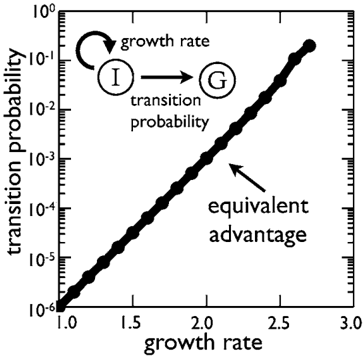
“Thus, for a group G to survive it must reliably produce I cells that in turn reliably produce g cells.”
BackgroundThe Evolution of Individuality
Buss, L. W. (1988) · Princeton University Press eBooks · doi:10.1515/9781400858712 · Cited by 1,368 · cited 2×
“Furthermore, this selection on transition probability is likely to lead to fitness decoupling.”
BackgroundGenome evolution and adaptation in a long-term experiment with Escherichia coli
Barrick, J. E., Yu, D. S., Yoon, S. H., Jeong, H., Oh, T. K., Schneider, D., Lenski, R. E., & Kim, J. F. (2009) · Nature · doi:10.1038/nature08480 · Cited by 1,184
Cited by
Life cycles, fitness decoupling and the evolution of multicellularity
Hammerschmidt, K., Rose, C. J., Kerr, B., & Rainey, P. B. (2014) · Nature · doi:10.1038/nature13884 · Cited by 213
Origins of multicellular evolvability in snowflake yeast
Ratcliff, W. C., Fankhauser, J. D., Rogers, D. W., Greig, D., & Travisano, M. (2015) · Nature Communications · doi:10.1038/ncomms7102 · Cited by 203
The evolutionary‐developmental origins of multicellularity
Niklas, K. J. (2014) · American Journal of Botany · doi:10.3732/ajb.1300314 · Cited by 155
Hanschen, E. R., Marriage, T. N., Ferris, P. J., Hamaji, T., Toyoda, A., Fujiyama, A., Neme, R., Noguchi, H., Minakuchi, Y., Suzuki, M., et al. (2016) · Nature Communications · doi:10.1038/ncomms11370 · Cited by 151
Ecological scaffolding and the evolution of individuality
Black, A. J., Bourrat, P., & Rainey, P. B. (2020) · Nature Ecology & Evolution · doi:10.1038/s41559-019-1086-9 · Cited by 122
De novo evolution of macroscopic multicellularity
Bozdag, G. O., Zamani-Dahaj, S. A., Day, T. C., Kahn, P. C., Burnetti, A., Lac, D. T., Tong, K., Conlin, P. L., Balwani, A., Dyer, E. L., et al. (2023) · Nature · doi:10.1038/s41586-023-06052-1 · Cited by 107
On the origin of biological construction, with a focus on multicellularity
van Gestel, J., & Tarnita, C. E. (2017) · Proceedings of the National Academy of Sciences · doi:10.1073/pnas.1704631114 · Cited by 98
Origins of evolutionary transitions
Clarke, E. (2014) · Journal of Biosciences · doi:10.1007/s12038-013-9375-y · Cited by 86
“In addition to the concerns over ‘cross-level by-products’, which I have already addressed, some people complain that MLS1 analysis fails to delineate ‘real’ higher-level selection, because there is no emergence of true higher-level reproduction (‘export of fitness’) (Michod 1999; 2005; Simon et al. 2012; Libby and Ra…”
BackgroundEmergence of diverse life cycles and life histories at the origin of multicellularity
Staps, M., van Gestel, J., & Tarnita, C. E. (2019) · Nature Ecology & Evolution · doi:10.1038/s41559-019-0940-0 · Cited by 78
Programmed Cell Death and Complexity in Microbial Systems
Durand, P. M., Sym, S. D., & Michod, R. E. (2016) · Current Biology · doi:10.1016/j.cub.2016.05.057 · Cited by 80
Ecological Advantages and Evolutionary Limitations of Aggregative Multicellular Development
Pentz, J. T., Márquez-Zacarías, P., Bozdag, G. O., Burnetti, A., Yunker, P. J., Libby, E., & Ratcliff, W. C. (2020) · Current Biology · doi:10.1016/j.cub.2020.08.006 · Cited by 64
Self-citationGeometry Shapes Evolution of Early Multicellularity
Libby, E., Ratcliff, W., Travisano, M., & Kerr, B. (2014) · PLoS Computational Biology · doi:10.1371/journal.pcbi.1003803 · Cited by 58
“However, for groups to qualify as units of selection, they must also possess the capacity to beget group offspring [27,34,35].”
BackgroundSelf-citationDarwin was right: where now for experimental evolution?
Rainey, P. B., Remigi, P., Farr, A. D., & Lind, P. A. (2017) · Current Opinion in Genetics & Development · doi:10.1016/j.gde.2017.09.003 · Cited by 64
Stabilizing multicellularity through ratcheting
Libby, E., Conlin, P. L., Kerr, B., & Ratcliff, W. C. (2016) · Philosophical Transactions of the Royal Society B: Biological Sciences · doi:10.1098/rstb.2015.0444 · Cited by 58
Self-citationResolving Conflicts During the Evolutionary Transition to Multicellular Life
Rainey, P. B., & Monte, S. D. (2014) · Annual Review of Ecology Evolution and Systematics · doi:10.1146/annurev-ecolsys-120213-091740 · Cited by 54
Nascent multicellular life and the emergence of individuality
Monte, S. D., & Rainey, P. B. (2014) · Journal of Biosciences · doi:10.1007/s12038-014-9420-5 · Cited by 55
“…cycles that proceed via single-cell bottlenecks have been instrumental in driving the evolution of development – development itself driven by the selective advantage of reconstituting the collective phase following transition through a single-cell stage (Griesemer 2000; Libby and Rainey 2013b).”
BackgroundInfluentialSynthetic transitions: towards a new synthesis
Solé, R. (2016) · Philosophical Transactions of the Royal Society B: Biological Sciences · doi:10.1098/rstb.2015.0438 · Cited by 46
Shelton, D. E., & Michod, R. E. (2020) · Philosophical Transactions of the Royal Society B Biological Sciences · doi:10.1098/rstb.2019.0364 · Cited by 44
Kutschera, U., & Niklas, K. J. (2014) · Plant Biology · doi:10.1111/plb.12171 · Cited by 55
“It should be noted that, regardless of an organism’s body plan, every genome is capable of multiple gene expression patterns that can produce different cellular functionalities (Laurent & Kellershohn 1999; Libby & Rainey 2013).”
BackgroundFragmentation modes and the evolution of life cycles
Pichugin, Y., Peña, J., Rainey, P. B., & Traulsen, A. (2017) · PLoS Computational Biology · doi:10.1371/journal.pcbi.1005860 · Cited by 45
“A requirement for evolution – and a defining feature of life – is reproduction [1, 2, 3, 4].”
BackgroundMeta‐population structure and the evolutionary transition to multicellularity
Rose, C. J., Hammerschmidt, K., Pichugin, Y., & Rainey, P. B. (2020) · Ecology Letters · doi:10.1111/ele.13570 · Cited by 39
Evolution of multicellularity: cheating done right
Veit, W. (2019) · Biology & Philosophy · doi:10.1007/s10539-019-9688-9 · Cited by 42
Fundamental constraints to the logic of living systems
Solé, R., Kempes, C. P., Corominas-Murtra, B., De Domenico, M., Kolchinsky, A., Lachmann, M., Libby, E., Saavedra, S., Smith, E., & Wolpert, D. (2024) · Interface Focus · doi:10.1098/rsfs.2024.0010 · Cited by 34
Self-citationNiklas, K. J., Cobb, E. D., & Crawford, D. R. (2013) · Evolution & Development · doi:10.1111/ede.12055 · Cited by 34
“All that is theoretically required is the evolution of one or more multistable gene regulatory networks (MGRP) capable of producing different cellular/nuclear functionalities (Laurent and Kellershohn 1999; Libby and Rainey 2013), e.”
BackgroundExperimental Evolution of Multicellular Complexity in Saccharomyces cerevisiae
Ratcliff, W. C., & Travisano, M. (2014) · BioScience · doi:10.1093/biosci/biu045 · Cited by 35
Operationalizing evolutionary transitions in individuality
Carmel, Y., & Shavit, A. (2020) · Proceedings of the Royal Society B Biological Sciences · doi:10.1098/rspb.2019.2805 · Cited by 33
“For example, multi-cellular organisms comprise cells whose ancestors were individual unicellular organisms [3,9,10].”
BackgroundMajor evolutionary transitions in individuality between humans and AI
Rainey, P. B. (2023) · Philosophical Transactions of the Royal Society B Biological Sciences · doi:10.1098/rstb.2021.0408 · Cited by 35
“This typically requires the evolution of life cycles such as those involving sequential alternations between soma-like mat cells and germ-like dispersing cells [30,32,33].”
BackgroundThe general entity of life: a cybernetic approach
Bielecki, A. (2015) · Biological Cybernetics · doi:10.1007/s00422-015-0652-8 · Cited by 27
“The proposed approach can be also helpful in the studies that concern evolutionary transitions [26,73].”
BackgroundTransitions in Brain Evolution: Space, Time and Entropy
Jeffery, K. J., & Rovelli, C. (2020) · Trends in Neurosciences · doi:10.1016/j.tins.2020.04.008 · Cited by 27
“Evolution then discovered that extensive nonsexual interaction between cells also confers significant fitness benefits, and multicellular organisms began to appear [12].”
BackgroundThe major synthetic evolutionary transitions
Solé, R. V. (2016) · Philosophical Transactions of the Royal Society B Biological Sciences · doi:10.1098/rstb.2016.0175 · Cited by 26
Evolutionary Transitions in Individuality and Recent Models of Multicellularity
Hanschen, E. R., Shelton, D. E., & Michod, R. E. (2015) · Advances in marine genomics · doi:10.1007/978-94-017-9642-2_9 · Cited by 43
“2012, 2013), conceptual (Libby and Rainey 2013) and theoretical work (Shelton 2013; Shelton and Michod 2014) studying the evolution of group life cycles will provide ideas for this future work to address.”
BackgroundHuman societal development: is it an evolutionary transition in individuality?
Carmel, Y. (2023) · Philosophical Transactions of the Royal Society B Biological Sciences · doi:10.1098/rstb.2021.0409 · Cited by 25
“In earliest multicellular organisms, the first differentiation between cell types is between somaticand reproductive cells [5,6]; similarly, the first differentiation in eusocial insect communities is between queen and sterile workers [7].”
BackgroundThe road to synthetic multicellularity
Solé, R., Ollé-Vila, A., Vidiella, B., Duran-Nebreda, S., & Conde-Pueyo, N. (2018) · Current Opinion in Systems Biology · doi:10.1016/j.coisb.2017.11.007 · Cited by 19
Open problems in synthetic multicellularity
Solé, R. V., Pueyo, N. C., Pla, J., García‐Ojalvo, J., Montserrat, N., & Levin, M. G. (2024) · npj Systems Biology and Applications · doi:10.1038/s41540-024-00477-8 · Cited by 25
Spontaneous Emergence of Multicellular Heritability
Zamani-Dahaj, S. A., Burnetti, A., Day, T. C., Yunker, P. J., Ratcliff, W. C., & Herron, M. D. (2023) · Genes · doi:10.3390/genes14081635 · Cited by 17
“The origin of multicellular heritability has widely been viewed as a problem for evolutionary 46 transitions to multicellular life (Libby and Rainey 2013; Michod 2000; Michod and Roze 2001; 47 Roze and Michod 2001; Simpson 2011; Watson et al. 2016).”
BackgroundEvolutionary consequences of nascent multicellular life cycles
Pentz, J. T., MacGillivray, K. A., DuBose, J. G., Conlin, P. L., Reinhardt, E. M., Libby, E., & Ratcliff, W. C. (2023) · eLife · doi:10.7554/elife.84336 · Cited by 15
“…groups of cells become Darwinian individuals, capable of reproducing and possessing heritable variation in multicellular traits that affect fitness ( Buss, 2014 ; Godfrey-Smith et al., 2013 ; Clarke, 2014 ; van Gestel and Tarnita, 2017 ; Libby and Rainey, 2013 ; Rainey and De Monte, 2014 ).”
BackgroundSelf-citationBodine, S. C., Brooks, H. L., Bunnett, N. W., Coller, H. A., Frey, M. R., Joe, B., Kleyman, T. R., Lindsey, M. L., Marette, A., Morty, R. E., et al. (2021) · American Journal of Physiology-Lung Cellular and Molecular Physiology · doi:10.1152/ajplung.00209.2021 · Cited by 16
Lichens and microbial syntrophies offer models for an interdependent route to multicellularity
Libby, E., & Ratcliff, W. C. (2021) · The Lichenologist · doi:10.1017/s0024282921000256 · Cited by 13
Self-citationApoptosis in snowflake yeast: novel trait, or side effect of toxic waste?
Pentz, J. T., Taylor, B. P., & Ratcliff, W. C. (2016) · Journal of The Royal Society Interface · doi:10.1098/rsif.2016.0121 · Cited by 13
“Such selection underpins the evolution of cellular division of labor (Bourke, 2011; Fisher et al., 2013; Hammerschmidt et al., 2014; Libby & Rainey, 2013; Michod et al., 2006; Ratcliff et al., 2012; Shelton & Michod, 2014; Smith & Szathmáry, 1995), and is thus of fundamental importance for…”
BackgroundMethodModes of migration and multilevel selection in evolutionary multiplayer games
Pichugin, Y., Gokhale, C. S., García, J., Traulsen, A., & Rainey, P. B. (2015) · Journal of Theoretical Biology · doi:10.1016/j.jtbi.2015.09.027 · Cited by 11
Scaffolds and scaffolding: an explanatory strategy in evolutionary biology
Neto, C., Meynell, L., & Jones, C. T. (2023) · Biology & Philosophy · doi:10.1007/s10539-023-09897-y · Cited by 10
Demographic noise and cost of greenbeard can facilitate greenbeard cooperation
Joshi, J., & Guttal, V. (2018) · Evolution · doi:10.1111/evo.13615 · Cited by 8
Black, A. J., Bourrat, P., & Rainey, P. B. (2019) · bioRxiv (Cold Spring Harbor Laboratory) · doi:10.1101/656660 · Cited by 9
Baselga‐Cervera, B., Jacobsen, K. A., Denison, R. F., & Travisano, M. (2023) · Evolution · doi:10.1093/evolut/qpad037 · Cited by 7
The Impact of Population Bottlenecks on the Social Lives of Microbes
Pedroso, M. (2018) · Biological Theory · doi:10.1007/s13752-018-0298-6 · Cited by 8
Isaksson, H., Conlin, P. L., Kerr, B., Ratcliff, W. C., & Libby, E. (2021) · Genes · doi:10.3390/genes12050661 · Cited by 8
Self-citationCryptic surface-associated multicellularity emerges through cell adhesion and its regulation
van Gestel, J., & Wagner, A. (2021) · PLoS Biology · doi:10.1371/journal.pbio.3001250 · Cited by 8
“In contrast to surface growth, which relies on adhesion, collective reproduction depends on a loss of adhesion and can take several forms [28,29].”
BackgroundGerm lines and extended selection during the evolutionary transition to multicellularity
Rose, C. J. (2020) · Journal of Experimental Zoology Part B Molecular and Developmental Evolution · doi:10.1002/jez.b.22985 · Cited by 7
The Units of Life: Kinds of Individual in Biology
Clarke, E. (2025) · doi:10.1093/9780191948008.001.0001 · Cited by 7
Rose, C. J., Hammerschmidt, K., & Rainey, P. B. (2020) · bioRxiv (Cold Spring Harbor Laboratory) · doi:10.1101/2020.03.02.973792 · Cited by 7
Zhang, F., Wu, L.-B., Hu, L., Wu, Z., Shuai, C. U. I., Yu, Q., & Cai, R.-L. (2022) · PLoS ONE · doi:10.1371/journal.pone.0277644 · Cited by 5
“The acquisition of multicellular bodies leads to a higher level of order in the evolution of cells, tissues and organs [1, 2], which necessitates a parallel development communication systems between these organs-organs (anatomical entities) [3].”
BackgroundMinor variations in multicellular life cycles have major effects on adaptation
Isaksson, H., Brännström, Å., & Libby, E. (2023) · PLoS Computational Biology · doi:10.1371/journal.pcbi.1010698 · Cited by 4
Self-citationAlvi, S., Mondelo, V. D., Boyle, J., Buck, A., Gejo, J., Mason, M., Matta, S., Sheridan, A., Kreutzberger, M. A. B., Egelman, E. H., et al. (2024) · Journal of Bacteriology · doi:10.1128/jb.00199-24 · Cited by 4
“Evolutionary biologists have postulated that multicellularity required as a “founding state” cells that were clearly identifiable as a group and that groups must be able to specifically share heritable information (47, 48).”
BackgroundThe emergence of group fitness
Clejan, I., Congleton, C. D., & Lerch, B. A. (2022) · Evolution · doi:10.1111/evo.14549 · Cited by 4
“Evolution 76-8: 1689–1705 (Michod 2006; Libby and Rainey 2013).”
The Mosaic Theory of Natural Complexity: A scientific and philosophical approach
Chapouthier, G. (2018) · Éditions des maisons des sciences de l’homme associées eBooks · doi:10.4000/books.emsha.200 · Cited by 4
Pentz, J. T., Travisano, M., & Ratcliff, W. C. (2014) · Conference on Artificial Life (ALIFE) · doi:10.1162/978-0-262-32621-6-ch088 · Cited by 5
Autogenic transitions in individuality
Rainey, P. B. (2026) · Comptes Rendus Biologies · doi:10.5802/crbiol.198 · Cited by 3
“This possibility was anticipated by theoretical frameworks in which multicellular life cycles arise through the early emergence of a reproductive lineage that generates multicellular groups (40–42), and later realised in microbial populations evolving de novo multicellular life cycles (43–45).”
Special section dedicated to The Sixth q-bio Conference: meeting report and preface
Nemenman, I. M., Gnanakaran, S., Munsky, B. E., Wall, M. E., Jiang, Y., Hlavacek, W. S., & Faeder, J. R. (2013) · Physical Biology · doi:10.1088/1478-3975/10/3/030301 · Cited by 2
On the subject part I: what is the subject?Preprint
Frauen, J.-B. (2023) · Qeios · doi:10.32388/kudu3x · Cited by 2
Overcoming key challenges in the evolutionary transition to multicellularity
Bozdag, G. O., Tong, K., Yunker, P. J., Herron, M. D., & Ratcliff, W. C. (2026) · Nature · doi:10.1038/s41586-026-11038-w · Cited by 1
“But in extant multicellular organisms, developmental programs that regulate these life cycles are themselves multicellular adaptations—creating a chicken-and-egg problem that has long puzzled evolutionary biologists 55 .”
From Living to Thinking: Mosaic Architecture
Chapouthier, G. (2021) · Wiley eBooks · doi:10.1002/9781119818441.ch12 · Cited by 1
On the Evolution of the Biological Framework for Insight
Neidhöfer, C. (2021) · Philosophies · doi:10.3390/philosophies6020043 · Cited by 1
Experimental evolution of increased size and complexity in Anabaena variabilis
Jacobsen, K. A. (2014) · University of Minnesota Digital Conservancy (University of Minnesota) · Cited by 1
Pandorina morum genome assembly, annotation, and analysis
Heffel, M. G. (2020) · K-State Research Exchange (Kansas State University) · Cited by 1
Biological evolution, sociocultural evolution, cosmological evolution: the search for linksPreprint
Frauen, J.-B. (2023) · Qeios · doi:10.32388/n3ew60
Chapouthier, G. (2018) · Éditions des maisons des sciences de l’homme associées eBooks · doi:10.4000/books.emsha.214
Clarke, E. (2025) · Oxford University Press eBooks · doi:10.1093/9780191948008.005.0001
Clarke, E. (2025) · Oxford University Press eBooks · doi:10.1093/9780191948008.002.0005
Clarke, E. (2025) · Oxford University Press eBooks · doi:10.1093/9780191948008.002.0004
Clarke, E. (2025) · Oxford University Press eBooks · doi:10.1093/9780191948008.003.0005
Clarke, E. (2025) · Oxford University Press eBooks · doi:10.1093/9780191948008.003.0010
Clarke, E. (2025) · Oxford University Press eBooks · doi:10.1093/9780191948008.003.0002
Other Kinds of Biological Individual
Clarke, E. (2025) · Oxford University Press eBooks · doi:10.1093/9780191948008.003.0007
Clarke, E. (2025) · Oxford University Press eBooks · doi:10.1093/9780191948008.003.0011
Clarke, E. (2025) · Oxford University Press eBooks · doi:10.1093/9780191948008.002.0006
Biological Identity and Other Metaphysical Issues
Clarke, E. (2025) · Oxford University Press eBooks · doi:10.1093/9780191948008.003.0009
Clarke, E. (2025) · Oxford University Press eBooks · doi:10.1093/9780191948008.003.0006
Clarke, E. (2025) · Oxford University Press eBooks · doi:10.1093/9780191948008.003.0003
Genetic and environmental determinants of multicellular-like phenotypes in fission yeast
Kövér, B., Cohen, C. E., Seres, L., Raut, S., Ralser, M., Heineike, B. M., & Bähler, J. (2026) · Genetics · doi:10.1093/genetics/iyag064
“As such, these structures might constitute a level at which natural selection can act (Libby and Rainey 2013).”
Phenotypic variation across the first steps of experimentally evolved multicellularity
Baselga‐Cervera, B., Gettle, N., & Travisano, M. (2026) · The American Naturalist · doi:10.1086/744242
Metadata
- Authors
- Libby, E., & B Rainey, P.
- Affiliations
- Massey University (NZ)
- Corresponding author
- Libby, Eric
- ORCID
- Libby, Eric
- Venue
- Physical Biology
- Publisher
- IOP Publishing
- Published
- 2013-06-04
- Volume
- 10
- Issue
- 3
- Pages
- 035001
- ISSN
- 1478-3967 (ISSN-L)
- 1478-3975
- OpenAlex
- W2143468579
- Semantic Scholar
- 10e95135b4023d027c492080eba76a475a2f32f4
- Cited by
- 81
- References
- 38
- Citations by year
- 2026: 4 · 2025: 13 · 2024: 3 · 2023: 10 · 2022: 2 · 2021: 8 · 2020: 8 · 2019: 3 · 2018: 5 · 2017: 3 · 2016: 6 · 2015: 4 · 2014: 9 · 2013: 3
- FWCI
- 4.86
- Type
- journal article
- Language
- en
- Open access
- hybrid
- doi.org
- Licence
- cc-by-nc-sa
- iopscience.iop.org/info/page/text-and-data-mining (tdm)
- creativecommons.org/licenses/by-nc-sa/3.0/ (vor)
- Locations
- Physical Biology (publishedVersion, cc-by-nc-sa)
- PubMed (publishedVersion)
- MPG.PuRe (Max Planck Society) (submittedVersion, cc-by-nc-sa)
- Funders
- Royal Society
- Royal Society Te Apārangi
- Marsden Fund
- Topics
- Life Sciences › Biochemistry, Genetics and Molecular Biology › Genetics › Evolution and Genetic Dynamics
- Physical Sciences › Physics and Astronomy › Astronomy and Astrophysics › Origins and Evolution of Life
- Social Sciences › Arts and Humanities › History and Philosophy of Science › Philosophy of Biology and Scientific Explanation
- Keywords
- evolution of multicellularity, genetic information transfer, group selection, conceptual framework, unicellular to multicellular transition
- MeSH terms
- Animals, Cell Biology, Biological Evolution, Humans, Models, Genetic, Selection, Genetic, Evolution, Molecular
About these checks
Registry, retraction, Cites and statistics results are computed, not judged, with one exception: a printed reference that no index lists is read once by a model before it counts as a citation error. Claims are extracted by a model and kept only when their quote appears verbatim in the text; each cited source is then checked, with a model’s help, for whether it says what the claim relies on. Those verdicts can be wrong — read the claim’s quote and the cited source before relying on one.
Statistics and arithmetic are recomputed, not judged.
Confidence bands are shown only for fields calibrated on our annotated test set. None is calibrated yet, so no band is shown.
What counts as a claim ›How we measure confidence ›How we check this ›
Are you an author, or do you see a problem with this page? Request a review
Data sources
Bibliographic data: Semantic Scholar, OpenAlex, Crossref.
Contains information from the Semantic Scholar Academic Graph Datasets, made available under the ODC Attribution License (ODC-BY 1.0).
Semantic Scholar’s data is described in: Kinney, R., et al. (2023). The Semantic Scholar Open Data Platform. arXiv:2301.10140.
