

Known unknowns: indirect energy effects of information and communication technology
Open accessThe DOI matches its Crossref record; 93 of the 94 references it cites were found in a registry or an index.
Abstract
Background. There has been sustained and growing interest in characterizing the net energy impact of information and communication technology (ICT), which results from indirect effects offsetting (or amplifying) the energy directly consumed by ICT equipment. These indirect effects may be either positive or negative, and there is considerable disagreement as to the direction of this sign as well as the effect magnitude. Literature in this area ranges from studies focused on a single service (such as e-commerce versus traditional retail) to macroeconomic studies attempting to characterize the overall impact of ICT. Methods. We review the literature on the indirect energy effect of ICT found via Google Scholar, our own research, and input from other researchers in the field. The various studies are linked to an effect taxonomy, which is synthesized from several different hierarchies present in the literature. References are further grouped according to ICT service (e.g., e-commerce, telework) and summarized by scope, method, and quantitative and qualitative findings. Review results. Uncertainty persists in understanding the net energy effects of ICT. Results of indirect energy effect studies are highly sensitive to scoping decisions and assumptions made by the analyst. Uncertainty increases as the impact scope broadens, due to complex and interconnected effects. However, there is general agreement that ICT has large energy savings potential, but that the realization of this potential is highly dependent on deployment details and user behavior. Discussion. While the overall net effect of ICT is likely to remain unknown, this review suggests several guidelines for improving research quality in this area, including increased data collection, enhancing traditional modeling studies with sensitivity analysis, greater care in scoping, less confidence in characterizing aggregate impacts, more effort on understanding user behavior, and more contextual integration across the different levels of the effect taxonomy.
Overview
The claims and statistics of this paper haven’t been checked yet.
Free: it reads the open-access text and checks the first 5 claims that cite a source we can check. Create a free account to check every claim.
Integrity signals
Registry
Cites
Statistics
Figures
Verification
Claims the paper makes
The claims and statistics of this paper haven’t been checked yet.
Free: it reads the open-access text and checks the first 5 claims that cite a source we can check. Create a free account to check every claim.
Claims other papers make about this one
Each is checked against this paper’s own text: does it say what the citing paper says it does?
The source backs part of the claim, not all of it — or backs it for a different population, condition or comparison.
In the citing paper
“Given that AI pervades many different areas of society and economic sectors, it is more difficult to enumerate all of the possible indirect impacts and rebound effects that it can have, which would involve considering the different interactions at play within every sector and between them [23, 53].”
From From Efficiency Gains to Rebound Effects: The Problem of Jevons' Paradox in AI's Polarized Environmental Debate (2025) · cites this paper as [53]
Experimental — accuracy not yet measuredThe cited source says what the claim attributes to it.
In the citing paper
“Other studies on energy savings in e-commerce also show ambiguities, e.g., [144-146].”
From Digitalization and the Decoupling Debate: Can ICT Help to Reduce Environmental Impacts While the Economy Keeps Growing? (2020) · cites this paper as [144]
Self-check
Percentages, sums and reported differences re-computed from the paper’s own numbers.
The self-check needs the paper’s full text.
Citations
Cites
Demand Side Management: Demand Response, Intelligent Energy Systems, and Smart Loads
Palensky, P., & Dietrich, D. (2011) · IEEE Transactions on Industrial Informatics · doi:10.1109/tii.2011.2158841 · Cited by 2,927
Energy efficiency and consumption—The rebound effect—A survey
A. Greening, L., Greene, D. L., & Difiglio, C. (2000) · Energy Policy · doi:10.1016/s0301-4215(00)00021-5 · Cited by 2,077 · cited 1×
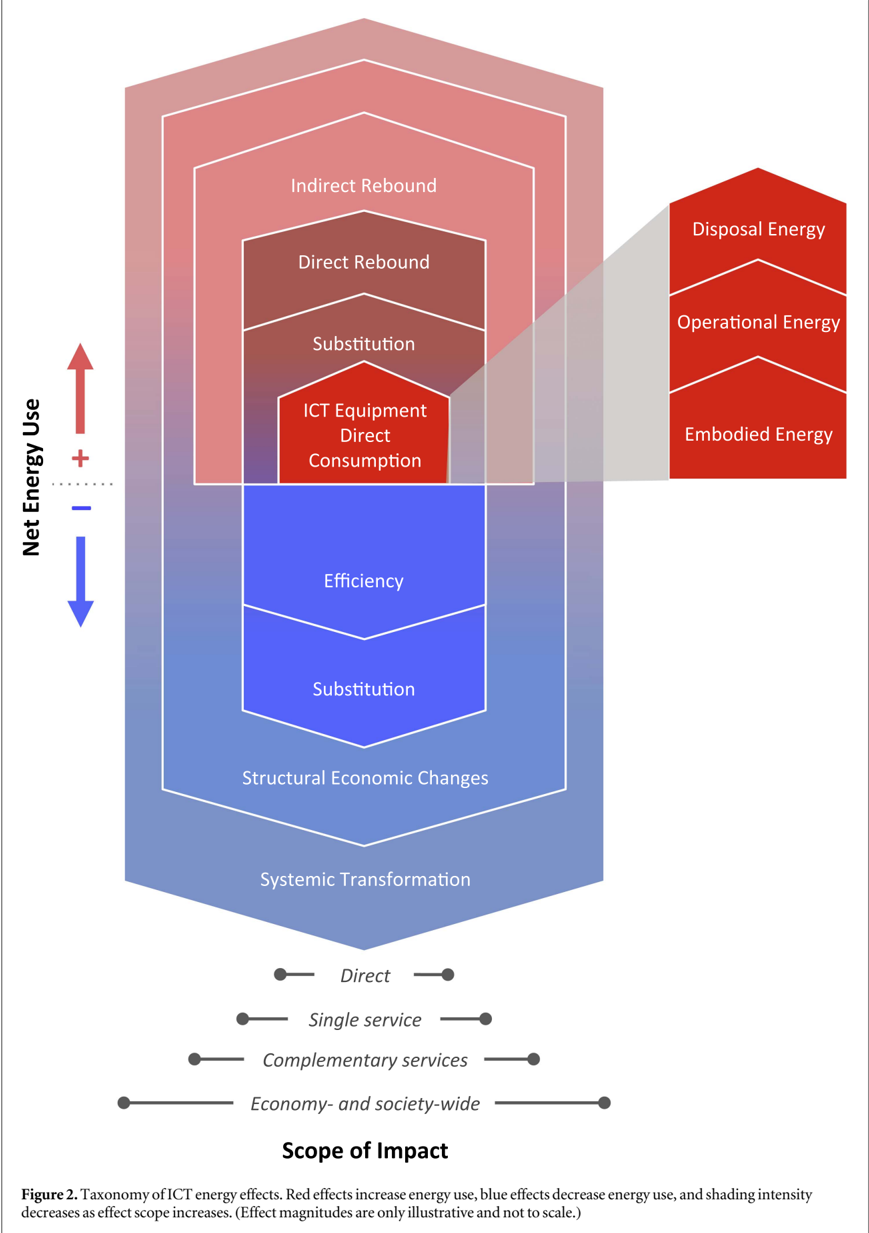
“Finally, transformational effects refer to the altering of human preferences and economic and social institutions caused in part by the development of ICT (Greening et al 2000, Plepys 2002).”
BackgroundTowards energy and resource efficient manufacturing: A processes and systems approach
Duflou, J. R., Sutherland, J. W., Dornfeld, D., Herrmann, C., Jeswiet, J., Kara, S., Hauschild, M., & Kellens, K. (2012) · CIRP Annals · doi:10.1016/j.cirp.2012.05.002 · Cited by 1,164
Multidisciplinary aerospace design optimization: survey of recent developments
Sobieszczanski-Sobieski, J., & Haftka, R. T. (1997) · Structural Optimization · doi:10.1007/bf01197554 · Cited by 1,052
Worldwide electricity used in data centers
Koomey, J. G. (2008) · Environmental Research Letters · doi:10.1088/1748-9326/3/3/034008 · Cited by 972
Jevons’ Paradox revisited: The evidence for backfire from improved energy efficiency
Sorrell, S. (2009) · Energy Policy · doi:10.1016/j.enpol.2008.12.003 · Cited by 801 · cited 1×
“Themodel in Erdmann et al (2004) presumes a priori that this phenomenon of actually increasing energy use via large rebound—known as backfire (Sorrell 2009)— will exist for intelligent transportation systems.”
BackgroundSmart manufacturing, manufacturing intelligence and demand-dynamic performance
Davis, J., Edgar, T., Porter, J., Bernaden, J., & Sarli, M. (2012) · Computers & Chemical Engineering · doi:10.1016/j.compchemeng.2012.06.037 · Cited by 762
Bunse, K., Vodicka, M., Schönsleben, P., Brülhart, M., & Ernst, F. O. (2011) · Journal of Cleaner Production · doi:10.1016/j.jclepro.2010.11.011 · Cited by 748
Basbagill, J., Flager, F., Lepech, M., & Fischer, M. (2013) · Building and Environment · doi:10.1016/j.buildenv.2012.11.009 · Cited by 615
Occupancy-driven energy management for smart building automation
Agarwal, Y., Balaji, B., Gupta, R., Lyles, J., Wei, M., & Weng, T. (2010) · Proceedings of the 2nd ACM Workshop on Embedded Sensing Systems for Energy-Efficiency in Building · doi:10.1145/1878431.1878433 · Cited by 570
Research works printed but not linked: 9
- Gillingham K, Rapson D and Wagner G 2015 The rebound effect and energy efficiency policy (http://papers.ssrn.com/sol3/ papers.cfm?abstract_id=2550710)
- Green K P and Mathur A 2008 Measuring and reducing Americans' indirect energy use AEI Energy and Environment Outlook (http://aei.org/wp-content/uploads/2011/10/20081204_ EEONo2g.pdf)
- Henderson P and Waitner M 2013 Real-Time Energy Management: A Case Study of Three Large Commercial Buildings in Washington, D.C. (Washington, DC: Natural Resources Defense Council) (http://nrdc.org/business/casestudies/ files/tower-companies-case-study.pdf)
- Koomey J G 2011 Growth in Data Center Electricity Use 2005 to 2010 (Oakland, CA: Analytics) (http://mediafire.com/file/ zzqna34282frr2f/koomeydatacenterelectuse2011finalve rsion.pdf)
- Rejeski D W 1999 Electronic impact Environ. Forum 16 32-8 (https://www.eli.org/the-environmental-forum/ electronic-impact)
- Roberts S 2009 Measuring the Relationship between ICT and the Environment (http://oecd-ilibrary.org/science-and- technology/measuring-the-relationship-between-ict-and- the-environment_221687775423)
- Roth K W, Goldstein F and Kleinman J 2002 Energy Consumption by Office and Telecommunications Equipment in Commercial Buildings Volume I: Energy Consumption Baseline (Cambridge, MA: Arthur D. Little, Inc.) (http://biblioite. ethz.ch/downloads/Roth_ADL_1.pdf)
- Schmidt J H and Pizzol M 2014 Critical Review of Four Comparative Lifecycle Assessments of Printed and Electronic Communication Aolborg, Denmark (http://lca-net.com/files/Review_of_ four_LCAs_on_printed_versus_electronic_media.pdf)
- Smart Manufacturing Leadership Coalition 2011 Implementing 21st Century Smart Manufacturing, Workshop Summary Report (Smart Manufacturing Leadership Coalition) (https:// smartmanufacturingcoalition.org/sites/default/files/ implementing_21st_century_smart_manufacturing_report_ 2011_0.pdf)
Cited by
Items 101–200 of 238
Interlinkages between the Just Ecological Transition and the Digital TransformationPreprint
Verdolini, V. (2023) · SSRN Electronic Journal · doi:10.2139/ssrn.4329226 · Cited by 17
Can digital trade promote the low-carbon development of China’s transport sector
Wen, H., & Zhu, K. (2024) · Clean Technologies and Environmental Policy · doi:10.1007/s10098-024-02781-7 · Cited by 16
Fundamentals of AI and NLP in Environmental Analysis
Chikkudu, S., & Annamalai, S. (2025) · Wiley eBooks · doi:10.1002/9781394270392.ch2 · Cited by 15
Green light for bidirectional charging? Unveiling grid repercussions and life cycle impacts
Wohlschlager, D., Reinhard, J., Stierlen, I., Regett, A., & Fröhling, M. (2024) · Advances in Applied Energy · doi:10.1016/j.adapen.2024.100195 · Cited by 14
Rong, J., Wang, W., & Zhang, H. (2023) · Energy & Environment · doi:10.1177/0958305x231177732 · Cited by 14
Bieser, J. C. T., Coroamă, V. C., Bergmark, P., & Stuermer, M. (2024) · Journal of Industrial Ecology · doi:10.1111/jiec.13524 · Cited by 14
Rugeviciute, A., Courboulay, V., & Hilty, L. M. (2023) · International Conference on ICT for Sustainability (ICT4S) · doi:10.1109/ict4s58814.2023.00019 · Cited by 13
Zhu, S., Huang, J., Li, Y., Maneejuk, P., & Liu, J. (2024) · Agriculture · doi:10.3390/agriculture14122245 · Cited by 13
INFORMATION AND COMMUNICATION TECHNOLOGY AND ELECTRICITY CONSUMPTION IN TRANSITIONAL ECONOMIES
Chimbo, B. (2020) · International Journal of Energy Economics and Policy · doi:10.32479/ijeep.8143 · Cited by 13
Comparative eco-efficiency assessment of cybersecurity solutions
Akana, J., Islam, B. M., Patel, K., Saini, I., Chhipi‐Shrestha, G., & Ruparathna, R. (2023) · Environmental Impact Assessment Review · doi:10.1016/j.eiar.2023.107096 · Cited by 12
Briglauer, W., Köppl–Turyna, M., Schwarzbauer, W., & Bittó, V. (2023) · International Review of Environmental and Resource Economics · doi:10.1561/101.00000154 · Cited by 12
Disentangling the carbon emissions impact of digital consumer innovations
Pettifor, H., Agnew, M. D., Wilson, C., & Niamir, L. (2024) · Journal of Cleaner Production · doi:10.1016/j.jclepro.2024.144412 · Cited by 11
Supply Chain Deep Uncertainties and Risks: The ‘New Normal’
Friday, D., Ryan, S., Melnyk, S. A., & Proulx, D. (2023) · Flexible systems management · doi:10.1007/978-981-99-2629-9_3 · Cited by 12
Wilson, C., Grubler, A., Nemet, G., Pachauri, S., Pauliuk, S., & Wiedenhofer, D. (2023) · IIASA PURE (International Institute of Applied Systems Analysis) · Cited by 11
Evidence Synthesis of Indirect Impacts of Digitalisation on Energy and Emissions
Wilson, C., Agnew, M. D., Amanta, F., Fan, Y. V., Kumar, P., & Seger, M. (2024) · International Conference on ICT for Sustainability (ICT4S) · doi:10.1109/ict4s64576.2024.00021 · Cited by 11
Eri, A. O. K. I., Hiramatsu, A., & Hanaki, K. (2025) · Frontiers in Sociology · doi:10.3389/fsoc.2025.1534548 · Cited by 10
Teletrabajo y sus impactos: una revisión y análisis bibliométrico
González-Mendoza, J. A., & Calderón-Contreras, M. D. M. (2022) · Aibi revista de investigación administración e ingeniería · doi:10.15649/2346030x.2437 · Cited by 10
Zhao, B., & Hu, H. (2024) · Energy Policy · doi:10.1016/j.enpol.2024.114417 · Cited by 10
Design sull’esperienza dell’utente e sostenibilità degli oggetti con intelligenza artificiale
Arquilla, V., & Paracolli, A. (2023) · Agathón · doi:10.19229/2464-9309/13222023 · Cited by 10
Alsabhan, T. H., & Anas, M. (2025) · Sustainable Futures · doi:10.1016/j.sftr.2025.100630 · Cited by 9
The Induced Effects of Carbon Emissions for China’s Industry Digital Transformation
Jia, X., Liu, Q., Feng, J., Li, Y., & Zhang, L. (2023) · Sustainability · doi:10.3390/su151612170 · Cited by 9
Pihkola, H., Hongisto, M., Apilo, O., Lasanen, M., & Vatanen, S. (2018) · EPiC series in computing · doi:10.29007/ddrc · Cited by 10
How does technology adoption affect energy intensity? Evidence from a meta-analysis
Vu, T. T.-T., & Demena, B. A. (2025) · Applied Energy · doi:10.1016/j.apenergy.2025.126439 · Cited by 9
Bieser, J. C. T. (2024) · International Conference on ICT for Sustainability (ICT4S) · doi:10.1109/ict4s64576.2024.00010 · Cited by 8
Bieser, J. C. T. (2020) · Zurich Open Repository and Archive (University of Zurich) · doi:10.5167/uzh-191486 · Cited by 8
Chen, C., & Wei-ping, W. (2024) · Polish Journal of Environmental Studies · doi:10.15244/pjoes/185543 · Cited by 8
Temiz, M., & Dinçer, İ. (2025) · Thermal Science and Engineering Progress · doi:10.1016/j.tsep.2025.103561 · Cited by 8
Almeida, D. T. L., Weidema, B. P., & Godin, A. (2022) · Cleaner Environmental Systems · doi:10.1016/j.cesys.2022.100072 · Cited by 8
Digitisation and Low-Carbon Energy Transitions
Müller, K., & Sareen, S. (2022) · Springer eBooks · doi:10.1007/978-3-031-16708-9_1 · Cited by 8
Zhitao, Z., Khan, A. A., Khan, S. U., Ali, M. A. S., Wang, Z., & Luo, J. (2023) · Environmental Science and Pollution Research · doi:10.1007/s11356-023-29175-4 · Cited by 8
Paved with good intentions: From digitalization to carbon neutrality
Callegari, B., Misganaw, B. A., & Bagherzadeh, M. (2024) · Journal of Environmental Management · doi:10.1016/j.jenvman.2024.122956 · Cited by 7
Saidani, M., Bolowich, A. F., Bednářová, S., Gutiérrez, T. N., & Benetto, E. (2024) · Procedia CIRP · doi:10.1016/j.procir.2024.01.066 · Cited by 7
Resolving Energy Consumption Issues and Spectrum Allocation for Future Broadband Networks
Azzah, S. N., Din, S., Ilyas, M., Ashraf, I., & Choi, G. S. (2021) · IEEE Access · doi:10.1109/access.2021.3135934 · Cited by 6
Fine-grained methodology to assess environmental impact of a set of digital servicesPreprint
Berthelot, A., Caron, E., de Laage, R., Lefèvre, L., & Nicolás, A. (2024) · doi:10.36227/techrxiv.173273484.41918649/v1 · Cited by 6
Carbon lock-in and resource lock-in effects of machine substitution: Evidence from 54 countries
Hao, X., Chen, L., Wang, S., Li, Y., Wu, H., & Li, P. (2025) · Energy Economics · doi:10.1016/j.eneco.2025.108940 · Cited by 5
Opportunities of 5G Mobile Technology for Climate Protection in Switzerland
Bieser, J. C. T., Salieri, B., Hischier, R., & Hilty, L. M. (2022) · Progress in IS · doi:10.1007/978-3-031-18311-9_13 · Cited by 6
Sun, H., & Gao, G. (2024) · The Annals of Regional Science · doi:10.1007/s00168-024-01275-0 · Cited by 5
Impact of information and communication technology development on China’s carbon emissions
Zheng, X., Liu, T., & Xu, W. (2025) · Journal of Innovation & Knowledge · doi:10.1016/j.jik.2025.100769 · Cited by 5
Research on the impact of China’s digitalization on the green total factor productivity of grain
Zhao, L., Li, P., Hu, D., & Jiang, Y. (2025) · China Agricultural Economic Review · doi:10.1108/caer-09-2024-0328 · Cited by 5
Beyond Counting Carbon: AI Environmental Assessments Struggle to Inform Net Impact DecisionsPreprint
Cook, J., Jacob, R., Lindsay Walton, J., Berthelot, A., Hussain, A., & Schien, D. (2025) · Bristol Research (University of Bristol) · doi:10.3929/ethz-c-000789254 · Cited by 5
Jäger, J., & Federau, M. (2025) · Sustainable Development · doi:10.1002/sd.70155 · Cited by 4
Towards sustainable logistics: Investigating the role of digitalisation in improving eco-efficiency
pi, X., & Tang, C. F. (2025) · Research in Transportation Economics · doi:10.1016/j.retrec.2025.101665 · Cited by 4
Wang, F., Li, W., Xue, Q.-L., & Zhan, Y. (2025) · Journal of Manufacturing Technology Management · doi:10.1108/jmtm-01-2025-0043 · Cited by 4
Urban Advantage? Sustainability Trade-Offs Across and Within the Intra-Urban Space
Lerpold, L., Sjöberg, Ö., & Tang, W. (2021) · Springer eBooks · doi:10.1007/978-3-030-56371-4_15 · Cited by 4
Ihayere, O. B., Alege, P. O., Gershon, O., Ejemeyovwi, J. O., & Daramola, P. (2021) · IOP Conference Series Earth and Environmental Science · doi:10.1088/1755-1315/665/1/012039 · Cited by 4
Ihayere, O. B., Alege, P. O., Gershon, O., Ejemeyovwi, J. O., & Daramola, P. (2020) · International Journal of Energy Economics and Policy · doi:10.32479/ijeep.9990 · Cited by 4
Can Service Trade Effectively Promote Carbon Emission Reduction?—Evidence from China
Liang, H., & Hao, X. (2023) · Sustainability · doi:10.3390/su151712807 · Cited by 4
Vrain, E., Bieser, J. C. T., & Wilson, C. (2025) · Energy and Buildings · doi:10.1016/j.enbuild.2025.116920 · Cited by 3
Grigorescu, A., Lincaru, C., & Pîrciog, S. C. (2025) · Processes · doi:10.3390/pr13061808 · Cited by 3
Digitale Konferenzformate – Auf dem steinigen Weg zu mehr Nachhaltigkeit
Drengner, J. (2022) · Markenkommunikation und Beziehungsmarketing · doi:10.1007/978-3-658-38366-4_7 · Cited by 3
Teleworking and the Challenges of Digitalization: The Role of Human Resource Managers
Pompa, L., Pretis, F. D., Cambrea, D. R., & Garzia, C. (2025) · Corporate Social Responsibility and Environmental Management · doi:10.1002/csr.3124 · Cited by 3
Dai, H., Hu, L., Zhu, X., Zhang, P., Wang, Y., & Guo, X. (2025) · Environmental and Sustainability Indicators · doi:10.1016/j.indic.2025.101104 · Cited by 3
INFLUENCE OF DIGITAL TECHNOLOGIES AND DIGITALIZATION IN THE SECTORS OF ENERGY DEMAND AND SUPPLY
Bobrov, Y. (2018) · Scientific notes of the UniversityKROK · doi:10.31732/2663-2209-2018-52-222-230 · Cited by 3
Bornes, L. (2024) · theses.fr (ABES) · doi:10.70675/fed8a7f7zda58z43adzaeb2z96f0f4194861 · Cited by 3
Berthelot, A. (2024) · theses.fr (ABES) · doi:10.70675/588a337ez33c3z4ab6z9354z0d717f1bc868 · Cited by 3
Guo, T., Bai, L., Chen, H., & Luo, K. (2023) · Environmental Science and Pollution Research · doi:10.1007/s11356-023-30104-8 · Cited by 3
Rasoldier, A. (2024) · theses.fr (ABES) · doi:10.70675/2d792ee9z9a3cz4887za019z90b0117d829a · Cited by 3
Digitalisation and AI impacts on energy transitions and climate targetsPreprint
Wilson, C., Krey, V., Maczek, F., Fan, Y. V., Zakeri, B., Javaid, A., Mastrucci, A., Paccou, R., Beath, H., Bieser, J. C. T., et al. (2026) · Research Square · doi:10.21203/rs.3.rs-8941019/v1 · Cited by 3
The Impacts of Digitalised Daily Life on Climate Change
Amanta, F., Kumar, P., Seger, M., & Vrain, E. (2024) · doi:10.5871/digital-society/9780856726880.001 · Cited by 3
Bornes, L., Smith, M. T., Bates, O., Blair, G. S., Letondal, C., & Vingerhoeds, R. A. (2024) · HAL · Cited by 3
Sustainable Technology and Technology for Sustainability: The Paths Towards Eco-Innovation
Sandionigi, C., Berrée, J.-F., Peralta, M., Piel, A., & Robin, B. (2024) · Electronics Goes Green · doi:10.23919/egg62010.2024.10631189 · Cited by 3
Haidar, A. (2024) · theses.fr (ABES) · doi:10.70675/bee40239z04e9z4bedz9dafz562ce0fcc4c1 · Cited by 2
Fast could be green? The carbon emission effect of large computing clusters in China
Yang, H., Chen, W., & Gaofeng, W. (2025) · Environment Development and Sustainability · doi:10.1007/s10668-025-06960-4 · Cited by 2
Kirchengast, G., Kromp-Kolb, H., Steininger, K. W., Stagl, S., Kirchner, M., Ambach, C., Grohs, J., Gutsohn, A., Peisker, J., & Strunk, B. (2020) · doi:10.1553/0x003b72a1 · Cited by 2
EKCHAJZER, D., Gossart, C., MONTCEL, B. T. D., & Combaz, J. (2025) · Terminal · doi:10.4000/13vhx · Cited by 2
Low carbon energy transition and digital infrastructure from the Global South: A review
Adom, P. K., Amuakwa‐Mensah, F., & Karimu, A. (2025) · Environment and Development Economics · doi:10.1017/s1355770x25100132 · Cited by 2
Do teleworking arrangements reduce CO2eq emissions? Effects on commuting, housing space and ICT use
Z'Rotz, J., Ohnmacht, T., & Rérat, P. (2026) · PLOS Climate · doi:10.1371/journal.pclm.0000979 · Cited by 2
Analyse et modélisation de l’impact environnemental du système d’information
Bourgeois, G. (2023) · theses.fr (ABES) · doi:10.70675/9334021az1681z459ez9c87zf0db1ca9396a · Cited by 2
Climate Change, Health and Informatics: a Narrative Review
Santos-Olmo, R. M. T., Revilla, A. A., Dagliati, A., Pala, D., Bellazzi, R., & Martin-Sanchez, F. J. (2025) · Yearbook of Medical Informatics · doi:10.1055/s-0046-1816685 · Cited by 2
Effets environnementaux de la 5G (partie 3)
Ciblat, P., Combaz, J., Coupechoux, M., Marquet, K., & Orgerie, A. (2026) · Bulletin 1024 · doi:10.48556/sif.1024.27.85 · Cited by 2
Impact of the rural digital economy on livestock carbon emissions and pollution mitigation in China
Ruirui, D. U., Liuyang, Y. A. O., Yu, L. A. I., & Minjuan, Z. H. A. O. (2025) · Frontiers of Agricultural Science and Engineering · doi:10.15302/j-fase-2025649 · Cited by 2
The Role of Digital Technology in Climate Technology Innovation
Jo, K. (2023) · RePEc: Research Papers in Economics · doi:10.23895/kdijep.2023.45.2.21 · Cited by 2
Galperova, E. (2019) · Информационные и математические технологии в науке и управлении · doi:10.25729/2413-0133-2019-4-02 · Cited by 2
Bluhm, H. (2025) · IOP Conference Series Earth and Environmental Science · doi:10.1088/1755-1315/1532/1/012032 · Cited by 2
Demeter: An Architecture for Long-Term Monitoring of Software Power Consumption
Siffre, L., Breuil, G., Noureddine, A., & Pawlak, R. (2024) · Lecture notes in computer science · doi:10.1007/978-3-031-66326-0_25 · Cited by 2
Heimgartner, D., & Axhausen, K. W. (2025) · Transportation · doi:10.1007/s11116-025-10653-2 · Cited by 1
Beaulieu, A. (2026) · Bristol University Press eBooks · doi:10.51952/9781529231540.ch005 · Cited by 1
Jeong, H.-J., Boo, H., Bae, J., Jeon, M., & Huh, E. (2024) · International Conference on Intelligent Information Technology (ICIIT) · doi:10.1145/3654522.3654596 · Cited by 1
HU, Y., Zheng, H., Cai, J., & Ding, H. (2023) · The Singapore Economic Review · doi:10.1142/s0217590823470021 · Cited by 1
Energy Consumption Between Routing and Bridging Protocol for Eco-Friendly Wireless Networks
Alhamri, R. Z., Cinderatama, T. A., Heriadi, A., & Pradana, A. K. A. (2019) · Kinetik Game Technology Information System Computer Network Computing Electronics and Control · doi:10.22219/kinetik.v4i3.800 · Cited by 1
Can Sustainable Shopping Recommendations in Online Retail Help Reduce Global Warming?
Hoffmann, M. L., Nanevski, I., Gossen, M., Bergener, J., Flick, A., Santarius, T., & Biessmann, F. (2024) · Weizenbaum Journal of the Digital Society · doi:10.34669/wi.wjds/4.1.2 · Cited by 1
Kunkel, S. (2023) · Publication Database IASS (Institute for Advanced Sustainability Studies (IASS)) · doi:10.25932/publishup-61395 · Cited by 1
The Case for Greener Biomedical Data Science and How to Get There
Samuel, G. N., & Lannelongue, L. (2026) · Annual Review of Biomedical Data Science · doi:10.1146/annurev-biodatasci-092724-015338 · Cited by 1
Absorption virtuelle microonde pour l'allumage de décharges plasma sans réflexion
Delage, T. (2023) · theses.fr (ABES) · doi:10.70675/0fd79c10zc90az46b9zaac6z89d0e5c0fd45 · Cited by 1
Environmental Footprint of GenAI Research: Insights from the Moshi Foundation Model
López-Rauhut, M., Landrieu, L., Aubry, M., & Ligozat, A. (2026) · Transactions on machine learning research · doi:10.48550/arxiv.2604.11154 · Cited by 2
Xie, J., & Wu, Z. (2026) · Socio-Economic Planning Sciences · doi:10.1016/j.seps.2026.102575 · Cited by 1
Exploring the Role of Digital Interventions in Realising Energy Savings
Bremer, C. (2024) · Lancaster EPrints (Lancaster University) · doi:10.17635/lancaster/thesis/2319 · Cited by 1
Liu, Y., Miao, L., & Wang, Z. (2025) · Data Science and Informetrics · doi:10.1016/j.dsim.2025.12.001 · Cited by 1
ESTIMATING THE EFFECT OF REDUCING CO2 EMISSIONS THROUGH TELEWORK IN THE COVID-19 PANDEMIC.
Eri, A. O. K. I., Hiramatsu, A., & Hanaki, K. (2023) · Japanese Journal of JSCE · doi:10.2208/jscejj.23-26002 · Cited by 1
Review: The environmental impact of data-driven precision medicine initiatives — R0/PR3
(2022) · Cambridge Prisms Precision Medicine · doi:10.1017/pcm.2022.1.pr3
Kumar, M., Patouillard, L., Donaldson, A., Cornago, S., Bartocci, P., Tu, Q., Wachter, H. D., Hübner, N., Dumont, M., Coroamă, V. C., et al. (2026) · The International Journal of Life Cycle Assessment · doi:10.21203/rs.3.rs-9984806/v1
Review: The environmental impact of data-driven precision medicine initiatives — R0/PR2
(2022) · Cambridge Prisms Precision Medicine · doi:10.1017/pcm.2022.1.pr2
Recommendation: The environmental impact of data-driven precision medicine initiatives — R0/PR4
(2022) · Cambridge Prisms Precision Medicine · doi:10.1017/pcm.2022.1.pr4
Author comment: The environmental impact of data-driven precision medicine initiatives — R0/PR1
Kassim, A. A. (2022) · Cambridge Prisms Precision Medicine · doi:10.1017/pcm.2022.1.pr1
Decision: The environmental impact of data-driven precision medicine initiatives — R0/PR5
(2022) · Cambridge Prisms Precision Medicine · doi:10.1017/pcm.2022.1.pr5
EKCHAJZER, D., Gossart, C., MONTCEL, B. T. D., & Combaz, J. (2025) · Tic & société · doi:10.4000/13vho
Beaulieu, A. (2026) · Bristol University Press eBooks · doi:10.51952/9781529231540.fm002
Revealing Relations: Knowledge Infrastructures for Liveable Futures
Beaulieu, A. (2026) · Bristol University Press eBooks · doi:10.51952/9781529231540
Beaulieu, A. (2026) · Bristol University Press eBooks · doi:10.51952/9781529231540.bm002
6 Working Towards Change: Transformation, Strategy and Hope
Beaulieu, A. (2026) · Bristol University Press eBooks · doi:10.51952/9781529231540.ch006
Metadata
- Authors
- Horner, N. C., Shehabi, A., & Azevedo, I. L.
- Affiliations
- Carnegie Mellon University (US)
- Lawrence Berkeley National Laboratory (US)
- Venue
- Environmental Research Letters
- Publisher
- IOP Publishing
- Published
- 2016-10-01
- Volume
- 11
- Issue
- 10
- Pages
- 103001
- ISSN
- 1748-9326 (ISSN-L)
- OpenAlex
- W2528922409
- Semantic Scholar
- 0a4fd940579f439d9d0674fbfb7f24bfba174a55
- Cited by
- 177
- References
- 94
- Citations by year
- 2026: 7 · 2025: 28 · 2024: 35 · 2023: 38 · 2022: 31 · 2021: 9 · 2020: 14 · 2019: 4 · 2018: 10 · 2016: 1
- FWCI
- 2.30
- Type
- journal article
- Language
- en
- Open access
- gold
- doi.org
- Licence
- cc-by
- iopscience.iop.org/info/page/text-and-data-mining (tdm, 4 d)
- creativecommons.org/licenses/by/3.0/ (vor, 4 d)
- Locations
- Environmental Research Letters (publishedVersion, cc-by)
- eScholarship (California Digital Library) (submittedVersion)
- OSTI OAI (U.S. Department of Energy Office of Scientific and Technical Information) (submittedVersion)
- DOAJ (DOAJ: Directory of Open Access Journals) (submittedVersion)
- Funders
- National Science Foundation (1463492, DEAC02-05CH11231, 0949710)
- U.S. Department of Energy (-AC02-05CH11231, 05CH11231, DE AC02 05CH11231, DE-AC02-)
- Carnegie Mellon University (SES-0949710, SES–1463492)
- Lawrence Berkeley National Laboratory (AC02‐05CH11231, DE-AC02-05CH11231, 05CH11231)
- Topics
- Physical Sciences › Engineering › Electrical and Electronic Engineering › Green IT and Sustainability
- Physical Sciences › Environmental Science › Environmental Engineering › Environmental Impact and Sustainability
- Physical Sciences › Computer Science › Hardware and Architecture › Energy Efficiency in Computing
- Keywords
- information and communication technologies, e-commerce, remote work, energy saving potential, user behavior, uncertainty, ICT energy consumption
About these checks
Registry, retraction, Cites and statistics results are computed, not judged, with one exception: a printed reference that no index lists is read once by a model before it counts as a citation error. Claims are extracted by a model and kept only when their quote appears verbatim in the text; each cited source is then checked, with a model’s help, for whether it says what the claim relies on. Those verdicts can be wrong — read the claim’s quote and the cited source before relying on one.
Statistics and arithmetic are recomputed, not judged.
Confidence bands are shown only for fields calibrated on our annotated test set. None is calibrated yet, so no band is shown.
What counts as a claim ›How we measure confidence ›How we check this ›
Are you an author, or do you see a problem with this page? Request a review
Data sources
Bibliographic data: Semantic Scholar, OpenAlex, Crossref.
Contains information from the Semantic Scholar Academic Graph Datasets, made available under the ODC Attribution License (ODC-BY 1.0).
Semantic Scholar’s data is described in: Kinney, R., et al. (2023). The Semantic Scholar Open Data Platform. arXiv:2301.10140.
