

Known unknowns: indirect energy effects of information and communication technology
Open accessThe DOI matches its Crossref record; 93 of the 94 references it cites were found in a registry or an index.
Abstract
Background. There has been sustained and growing interest in characterizing the net energy impact of information and communication technology (ICT), which results from indirect effects offsetting (or amplifying) the energy directly consumed by ICT equipment. These indirect effects may be either positive or negative, and there is considerable disagreement as to the direction of this sign as well as the effect magnitude. Literature in this area ranges from studies focused on a single service (such as e-commerce versus traditional retail) to macroeconomic studies attempting to characterize the overall impact of ICT. Methods. We review the literature on the indirect energy effect of ICT found via Google Scholar, our own research, and input from other researchers in the field. The various studies are linked to an effect taxonomy, which is synthesized from several different hierarchies present in the literature. References are further grouped according to ICT service (e.g., e-commerce, telework) and summarized by scope, method, and quantitative and qualitative findings. Review results. Uncertainty persists in understanding the net energy effects of ICT. Results of indirect energy effect studies are highly sensitive to scoping decisions and assumptions made by the analyst. Uncertainty increases as the impact scope broadens, due to complex and interconnected effects. However, there is general agreement that ICT has large energy savings potential, but that the realization of this potential is highly dependent on deployment details and user behavior. Discussion. While the overall net effect of ICT is likely to remain unknown, this review suggests several guidelines for improving research quality in this area, including increased data collection, enhancing traditional modeling studies with sensitivity analysis, greater care in scoping, less confidence in characterizing aggregate impacts, more effort on understanding user behavior, and more contextual integration across the different levels of the effect taxonomy.
Overview
The claims and statistics of this paper haven’t been checked yet.
Free: it reads the open-access text and checks the first 5 claims that cite a source we can check. Create a free account to check every claim.
Integrity signals
Registry
Cites
Statistics
Figures
Verification
Claims the paper makes
The claims and statistics of this paper haven’t been checked yet.
Free: it reads the open-access text and checks the first 5 claims that cite a source we can check. Create a free account to check every claim.
Claims other papers make about this one
Each is checked against this paper’s own text: does it say what the citing paper says it does?
The source backs part of the claim, not all of it — or backs it for a different population, condition or comparison.
In the citing paper
“Given that AI pervades many different areas of society and economic sectors, it is more difficult to enumerate all of the possible indirect impacts and rebound effects that it can have, which would involve considering the different interactions at play within every sector and between them [23, 53].”
From From Efficiency Gains to Rebound Effects: The Problem of Jevons' Paradox in AI's Polarized Environmental Debate (2025) · cites this paper as [53]
Experimental — accuracy not yet measuredThe cited source says what the claim attributes to it.
In the citing paper
“Other studies on energy savings in e-commerce also show ambiguities, e.g., [144-146].”
From Digitalization and the Decoupling Debate: Can ICT Help to Reduce Environmental Impacts While the Economy Keeps Growing? (2020) · cites this paper as [144]
Self-check
Percentages, sums and reported differences re-computed from the paper’s own numbers.
The self-check needs the paper’s full text.
Citations
Cites
Demand Side Management: Demand Response, Intelligent Energy Systems, and Smart Loads
Palensky, P., & Dietrich, D. (2011) · IEEE Transactions on Industrial Informatics · doi:10.1109/tii.2011.2158841 · Cited by 2,927
Energy efficiency and consumption—The rebound effect—A survey
A. Greening, L., Greene, D. L., & Difiglio, C. (2000) · Energy Policy · doi:10.1016/s0301-4215(00)00021-5 · Cited by 2,077 · cited 1×
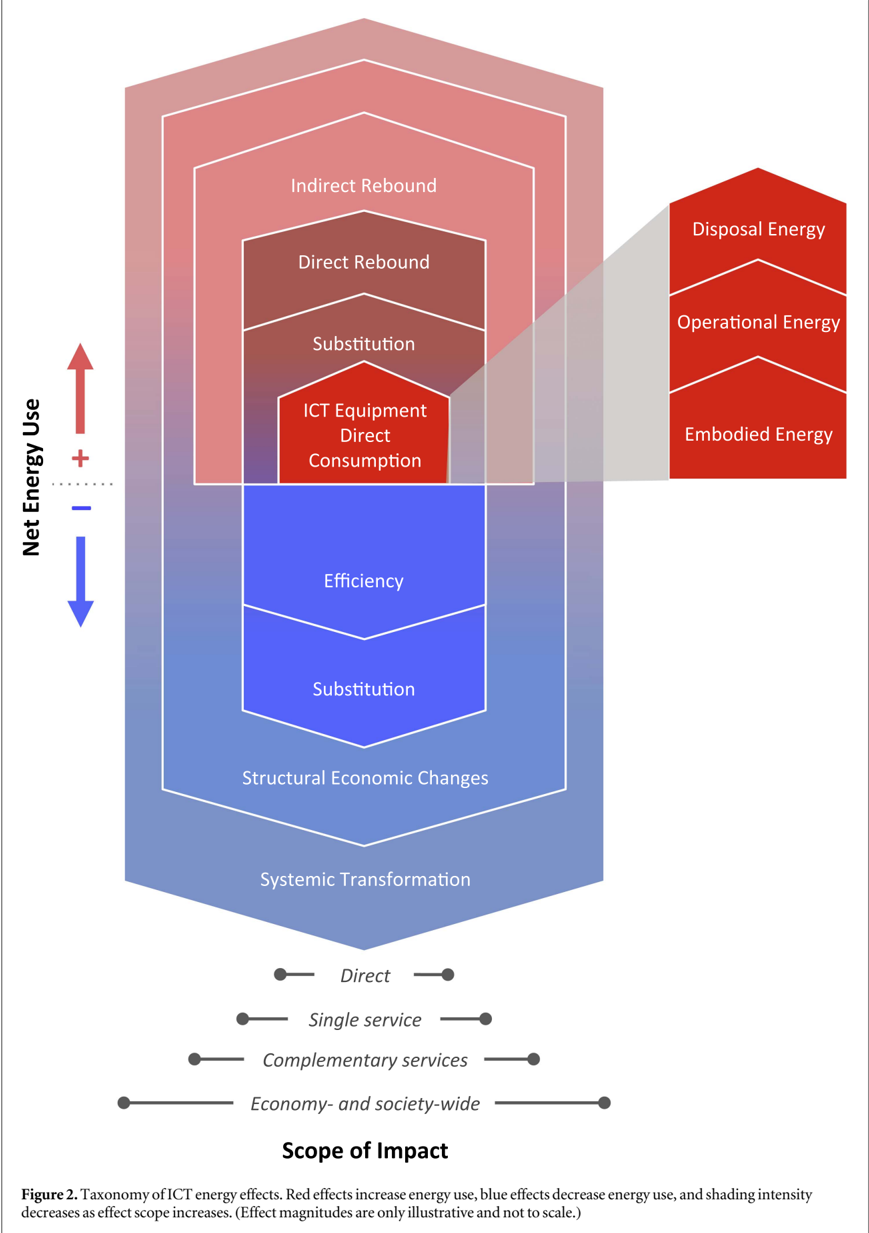
“Finally, transformational effects refer to the altering of human preferences and economic and social institutions caused in part by the development of ICT (Greening et al 2000, Plepys 2002).”
BackgroundTowards energy and resource efficient manufacturing: A processes and systems approach
Duflou, J. R., Sutherland, J. W., Dornfeld, D., Herrmann, C., Jeswiet, J., Kara, S., Hauschild, M., & Kellens, K. (2012) · CIRP Annals · doi:10.1016/j.cirp.2012.05.002 · Cited by 1,164
Multidisciplinary aerospace design optimization: survey of recent developments
Sobieszczanski-Sobieski, J., & Haftka, R. T. (1997) · Structural Optimization · doi:10.1007/bf01197554 · Cited by 1,052
Worldwide electricity used in data centers
Koomey, J. G. (2008) · Environmental Research Letters · doi:10.1088/1748-9326/3/3/034008 · Cited by 972
Jevons’ Paradox revisited: The evidence for backfire from improved energy efficiency
Sorrell, S. (2009) · Energy Policy · doi:10.1016/j.enpol.2008.12.003 · Cited by 801 · cited 1×
“Themodel in Erdmann et al (2004) presumes a priori that this phenomenon of actually increasing energy use via large rebound—known as backfire (Sorrell 2009)— will exist for intelligent transportation systems.”
BackgroundSmart manufacturing, manufacturing intelligence and demand-dynamic performance
Davis, J., Edgar, T., Porter, J., Bernaden, J., & Sarli, M. (2012) · Computers & Chemical Engineering · doi:10.1016/j.compchemeng.2012.06.037 · Cited by 762
Bunse, K., Vodicka, M., Schönsleben, P., Brülhart, M., & Ernst, F. O. (2011) · Journal of Cleaner Production · doi:10.1016/j.jclepro.2010.11.011 · Cited by 748
Basbagill, J., Flager, F., Lepech, M., & Fischer, M. (2013) · Building and Environment · doi:10.1016/j.buildenv.2012.11.009 · Cited by 615
Occupancy-driven energy management for smart building automation
Agarwal, Y., Balaji, B., Gupta, R., Lyles, J., Wei, M., & Weng, T. (2010) · Proceedings of the 2nd ACM Workshop on Embedded Sensing Systems for Energy-Efficiency in Building · doi:10.1145/1878431.1878433 · Cited by 570
Research works printed but not linked: 9
- Gillingham K, Rapson D and Wagner G 2015 The rebound effect and energy efficiency policy (http://papers.ssrn.com/sol3/ papers.cfm?abstract_id=2550710)
- Green K P and Mathur A 2008 Measuring and reducing Americans' indirect energy use AEI Energy and Environment Outlook (http://aei.org/wp-content/uploads/2011/10/20081204_ EEONo2g.pdf)
- Henderson P and Waitner M 2013 Real-Time Energy Management: A Case Study of Three Large Commercial Buildings in Washington, D.C. (Washington, DC: Natural Resources Defense Council) (http://nrdc.org/business/casestudies/ files/tower-companies-case-study.pdf)
- Koomey J G 2011 Growth in Data Center Electricity Use 2005 to 2010 (Oakland, CA: Analytics) (http://mediafire.com/file/ zzqna34282frr2f/koomeydatacenterelectuse2011finalve rsion.pdf)
- Rejeski D W 1999 Electronic impact Environ. Forum 16 32-8 (https://www.eli.org/the-environmental-forum/ electronic-impact)
- Roberts S 2009 Measuring the Relationship between ICT and the Environment (http://oecd-ilibrary.org/science-and- technology/measuring-the-relationship-between-ict-and- the-environment_221687775423)
- Roth K W, Goldstein F and Kleinman J 2002 Energy Consumption by Office and Telecommunications Equipment in Commercial Buildings Volume I: Energy Consumption Baseline (Cambridge, MA: Arthur D. Little, Inc.) (http://biblioite. ethz.ch/downloads/Roth_ADL_1.pdf)
- Schmidt J H and Pizzol M 2014 Critical Review of Four Comparative Lifecycle Assessments of Printed and Electronic Communication Aolborg, Denmark (http://lca-net.com/files/Review_of_ four_LCAs_on_printed_versus_electronic_media.pdf)
- Smart Manufacturing Leadership Coalition 2011 Implementing 21st Century Smart Manufacturing, Workshop Summary Report (Smart Manufacturing Leadership Coalition) (https:// smartmanufacturingcoalition.org/sites/default/files/ implementing_21st_century_smart_manufacturing_report_ 2011_0.pdf)
Cited by
Items 201–238 of 238
4 Careful Relations: Transformative Encounters, Arts of Noticing and Discernment
Beaulieu, A., Eren, S., & Stevens, M. (2026) · Bristol University Press eBooks · doi:10.51952/9781529231540.ch004
Knowledge Infrastructures for Liveable Futures
Beaulieu, A. (2026) · Bristol University Press eBooks · doi:10.51952/9781529231540.ch001
Growth, Materiality and Infrastructured Life
Beaulieu, A. (2026) · Bristol University Press eBooks · doi:10.51952/9781529231540.ch003
Beaulieu, A. (2026) · Bristol University Press eBooks · doi:10.51952/9781529231540.bm001
Beaulieu, A. (2026) · Bristol University Press eBooks · doi:10.51952/9781529231540.fm001
Beaulieu, A. (2026) · Bristol University Press eBooks · doi:10.51952/9781529231540.bm003
Hiding and Revealing Relations
Beaulieu, A. (2026) · Bristol University Press eBooks · doi:10.51952/9781529231540.ch002
Zhang, W., Selishcheva, T., Дятлов, С. А., 林巧丹, Wee, H. J., & Lee, C. (2026) · SSRN Electronic Journal · doi:10.2139/ssrn.7662408
Aleyasin, S. M. A., & Mozayani, A. H. (2024) · International Symposium on Telecommunications · doi:10.1109/ist64061.2024.10843463
A synthesis of the systemic impact of remote work on greenhouse gas emissions and health
de Villafranca, A. E. M., Ivanova, O., Viitanen, A., & Taylor, J. (2026) · Sustainable Cities and Society · doi:10.1016/j.scs.2026.107782
Jia, S., Chen, X., & Jin, J. (2023) · SSRN Electronic Journal · doi:10.2139/ssrn.4602631
Jia, S., Chen, X., & Jin, J. (2023) · SSRN Electronic Journal · doi:10.2139/ssrn.4639814
How ICT Contributes to Carbon Neutrality
Zhang, X., Shinozuka, M., & Hara, M. (2022) · NTT technical review · doi:10.53829/ntr202206ra1
A Taxonomy for the Digital, Environmental, and Socially Just Transition
Castro, G. D. R. (2025) · UPM Digital Archive (Technical University of Madrid) · doi:10.20868/upm.thesis.88337
Linking AI to the environment: from attributional to consequential assessmentPreprint
EKCHAJZER, D., Berthelot, A., Combaz, J., & Schien, D. (2026) · HAL
How Interface Design Choices Lead to Indirect Environmental Impacts Through Use Intensification
Beignon, A., Tabard, A., & Maudet, N. (2026) · CHI Conference on Human Factors in Computing Systems · doi:10.1145/3772318.3790305
López, J. G. (2024) · Digital Repository (Polytechnic University of Cartagena) · doi:10.31428/10317/17324
The Economics of Technological Change and Decoupling
Lange, S. (2026) · doi:10.18452/36825
GVCs, digitalisation and services in Africa: What we know and what we would like to know
Ariu, A., de Mélo, J., & Solleder, J. (2026) · Archivio Istituzionale della Ricerca (Universita Degli Studi Di Milano)
From cookstoves to smart homes: examining the social dynamics of household energy behaviour
Rio, D. D. F. D. (2020) · Spiral (Imperial College London) · doi:10.25560/82180
Data concerns undermine AI applications for climate
Vrain, E., & Wilson, C. (2026) · npj Climate Action · doi:10.1038/s44168-026-00390-2
Carbon emission and health impacts of remote working: A case study of the Helsinki capital region
de Villafranca, A. E. M., Anashin, P., Nagakamkanamge, B., Phil, S., & Taylor, J. (2026) · Environment and Planning B Urban Analytics and City Science · doi:10.1177/23998083261500928
Getting the Best from Life Cycle Analysis Studies of ICT ServicesPreprint
Berthelot, A., Caron, E., Lefèvre, L., & Nicolás, A. (2023) · SSRN Electronic Journal · doi:10.2139/ssrn.4485672
Wohlschlager, D., Fröhling, M., & München, T. U. (2024)
Integrating ethical, societal and environmental issues into algorithm design coursesPreprint
Bellenguez‐Morineau, O., Brauner, N., Solnon, C., & Tsoukiàs, A. (2025) · arXiv (Cornell University) · doi:10.48550/arxiv.2512.13216
Bellenguez‐Morineau, O., Brauner, N., Solnon, C., & Tsoukiàs, A. (2026) · HAL
Mapping and quantifying the impacts of digital applications on energy use
Wilson, C., Pettifor, H., Agnew, M., & Coroama, V. (2024) · Oxford University Research Archive (ORA) (University of Oxford)
Matérialité de l'IA générative et impact environnementalPreprint
Gangloff, H., & Schbath, S. (2026) · HAL
A carbon footprint reduction model in the cloud for large language model (LLM) inference services
Torres, J. D. C. (2026) · Repositorio Universidad Distrital
RAQAMLASHTIRISH VA BARQAROR TARAQQIYOT: RAQAMLI YASHIL BITIM TARAFDORLARI UCHUN MUROJAAT
qizi, I. S. S. F. Y. (2025) · International journal of scientific researchers ( IJSR ) INDEXING
Mutchinick, J. (2020) · Trópos. Rivista di ermeneutica e critica filosofica · doi:10.13135/2036-542x/8089
Home, family and climate change
Abdelmonem, M. G., Home Renaissance Foundation, University of York, & Nottingham Trent University (2024) · White Rose Research Online (University of Leeds, The University of Sheffield, University of York) · doi:10.15124/yao-fr8k-7t57
Judijanto, L., Arini, R. E., & Pahrijal, R. (2025) · West Science Social and Humanities Studies · doi:10.58812/wsshs.v3i05.1916
Magnet, M. (2025) · NOV AE - Ingénierie et savoir-faire innovants · doi:10.20870/revue-novae.2025.9681
Energy efficiency or energy demand?
(2019) · Sussex Research Online (University of Sussex)
The Environmental Footprint of AI Computing: Energy Challenges and Sustainable Solutions
Gadireddy, V. K. (2025) · European Modern Studies Journal · doi:10.59573/emsj.9(5).2025.34
Li, R., Duan, P., Yin, P., & Liu, Y. (2026) · Sustainability · doi:10.3390/su18125935
Metadata
- Authors
- Horner, N. C., Shehabi, A., & Azevedo, I. L.
- Affiliations
- Carnegie Mellon University (US)
- Lawrence Berkeley National Laboratory (US)
- Venue
- Environmental Research Letters
- Publisher
- IOP Publishing
- Published
- 2016-10-01
- Volume
- 11
- Issue
- 10
- Pages
- 103001
- ISSN
- 1748-9326 (ISSN-L)
- OpenAlex
- W2528922409
- Semantic Scholar
- 0a4fd940579f439d9d0674fbfb7f24bfba174a55
- Cited by
- 177
- References
- 94
- Citations by year
- 2026: 7 · 2025: 28 · 2024: 35 · 2023: 38 · 2022: 31 · 2021: 9 · 2020: 14 · 2019: 4 · 2018: 10 · 2016: 1
- FWCI
- 2.30
- Type
- journal article
- Language
- en
- Open access
- gold
- doi.org
- Licence
- cc-by
- iopscience.iop.org/info/page/text-and-data-mining (tdm, 4 d)
- creativecommons.org/licenses/by/3.0/ (vor, 4 d)
- Locations
- Environmental Research Letters (publishedVersion, cc-by)
- eScholarship (California Digital Library) (submittedVersion)
- OSTI OAI (U.S. Department of Energy Office of Scientific and Technical Information) (submittedVersion)
- DOAJ (DOAJ: Directory of Open Access Journals) (submittedVersion)
- Funders
- National Science Foundation (1463492, DEAC02-05CH11231, 0949710)
- U.S. Department of Energy (-AC02-05CH11231, 05CH11231, DE AC02 05CH11231, DE-AC02-)
- Carnegie Mellon University (SES-0949710, SES–1463492)
- Lawrence Berkeley National Laboratory (AC02‐05CH11231, DE-AC02-05CH11231, 05CH11231)
- Topics
- Physical Sciences › Engineering › Electrical and Electronic Engineering › Green IT and Sustainability
- Physical Sciences › Environmental Science › Environmental Engineering › Environmental Impact and Sustainability
- Physical Sciences › Computer Science › Hardware and Architecture › Energy Efficiency in Computing
- Keywords
- information and communication technologies, e-commerce, remote work, energy saving potential, user behavior, uncertainty, ICT energy consumption
About these checks
Registry, retraction, Cites and statistics results are computed, not judged, with one exception: a printed reference that no index lists is read once by a model before it counts as a citation error. Claims are extracted by a model and kept only when their quote appears verbatim in the text; each cited source is then checked, with a model’s help, for whether it says what the claim relies on. Those verdicts can be wrong — read the claim’s quote and the cited source before relying on one.
Statistics and arithmetic are recomputed, not judged.
Confidence bands are shown only for fields calibrated on our annotated test set. None is calibrated yet, so no band is shown.
What counts as a claim ›How we measure confidence ›How we check this ›
Are you an author, or do you see a problem with this page? Request a review
Data sources
Bibliographic data: Semantic Scholar, OpenAlex, Crossref.
Contains information from the Semantic Scholar Academic Graph Datasets, made available under the ODC Attribution License (ODC-BY 1.0).
Semantic Scholar’s data is described in: Kinney, R., et al. (2023). The Semantic Scholar Open Data Platform. arXiv:2301.10140.
