

Do insect outbreaks reduce the severity of subsequent forest fires?
Open accessThe DOI matches its Crossref record; 46 of the 46 references it cites were found in a registry or an index.
Abstract
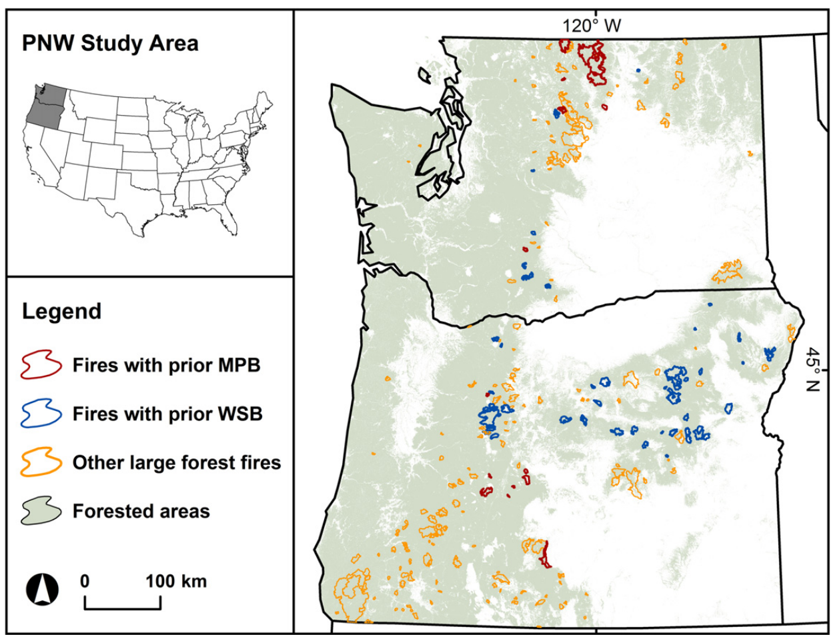
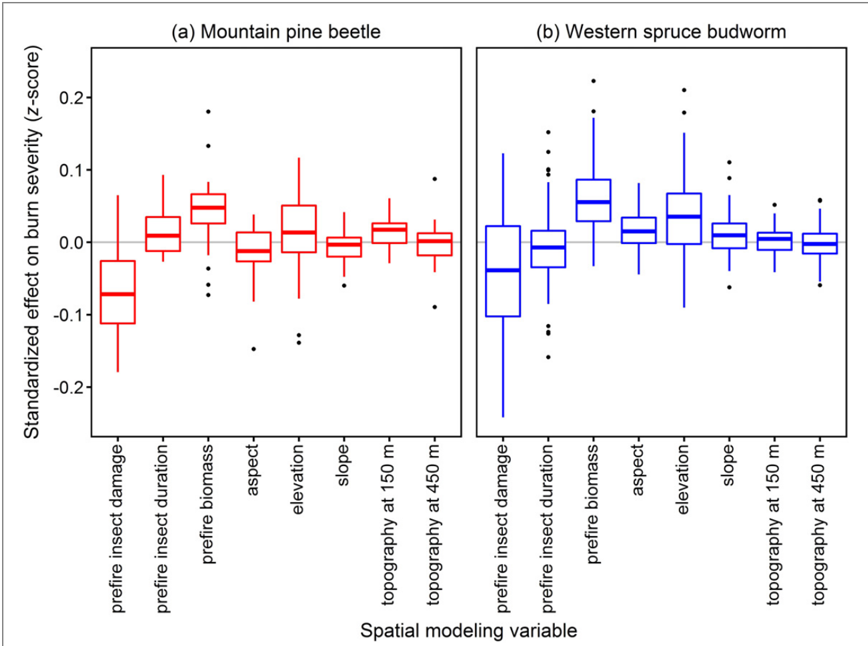
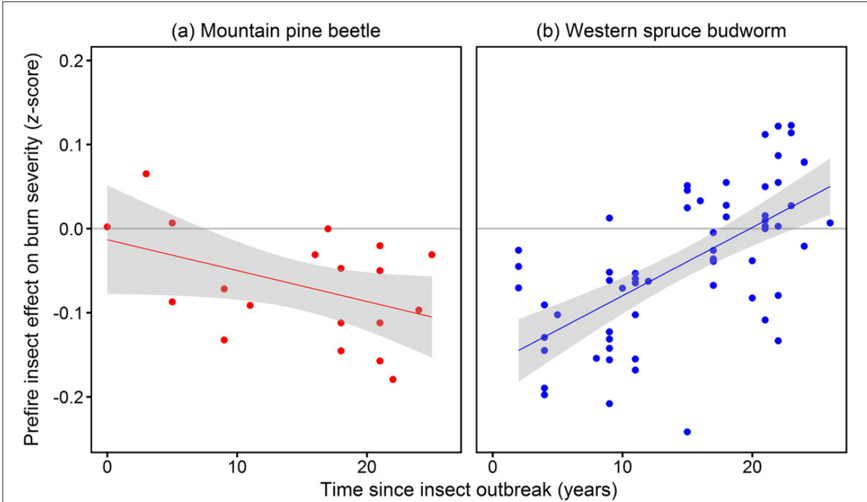
Understanding the causes and consequences of rapid environmental change is an essential scientific frontier, particularly given the threat of climate- and land use-induced changes in disturbance regimes. In western North America, recent widespread insect outbreaks and wildfires have sparked acute concerns about potential insect–fire interactions. Although previous research shows that insect activity typically does not increase wildfire likelihood, key uncertainties remain regarding insect effects on wildfire severity (i.e., ecological impact). Recent assessments indicate that outbreak severity and burn severity are not strongly associated, but these studies have been limited to specific insect or fire events. Here, we present a regional census of large wildfire severity following outbreaks of two prevalent bark beetle and defoliator species, mountain pine beetle ( Dendroctonus ponderosae ) and western spruce budworm ( Choristoneura freemani ), across the US Pacific Northwest. We first quantify insect effects on burn severity with spatial modeling at the fire event scale and then evaluate how these effects vary across the full population of insect–fire events ( n = 81 spanning 1987–2011). In contrast to common assumptions of positive feedbacks, we find that insects generally reduce the severity of subsequent wildfires. Specific effects vary with insect type and timing, but both insects decrease the abundance of live vegetation susceptible to wildfire at multiple time lags. By dampening subsequent burn severity, native insects could buffer rather than exacerbate fire regime changes expected due to land use and climate change. In light of these findings, we recommend a precautionary approach when designing and implementing forest management policies intended to reduce wildfire hazard and increase resilience to global change.
Overview
The claims and statistics of this paper haven’t been checked yet.
Free: it reads the open-access text and checks the first 5 claims that cite a source we can check. Create a free account to check every claim.
Integrity signals
Registry
Cites
Statistics
Figures



Verification
Claims the paper makes
The claims and statistics of this paper haven’t been checked yet.
Free: it reads the open-access text and checks the first 5 claims that cite a source we can check. Create a free account to check every claim.
Claims other papers make about this one
Each is checked against this paper’s own text: does it say what the citing paper says it does?
The source backs part of the claim, not all of it — or backs it for a different population, condition or comparison.
In the citing paper
“However, observations of total burned area and remotely sensed fire severity from fires across the western US do not universally support the assertion that bark beetle outbreaks lead to increased fire severity (e.g., Meigs et al. 2016).”
From Drought, Tree Mortality, and Wildfire in Forests Adapted to Frequent Fire (2018) · cites this paper as Meigs et al. 2016
Experimental — accuracy not yet measuredThe source backs part of the claim, not all of it — or backs it for a different population, condition or comparison.
In the citing paper
“In the latter forest types, it is likely that beyond early stages of mortality, fire behavior could be reduced because of the “thinning” of the canopy and associated reduction and continuity of canopy fuels (Hicke et al. 2012, Meigs et al. 2016).”
From Drought, Tree Mortality, and Wildfire in Forests Adapted to Frequent Fire (2018) · cites this paper as Meigs et al. 2016
Experimental — accuracy not yet measured
Self-check
Percentages, sums and reported differences re-computed from the paper’s own numbers.
The self-check needs the paper’s full text.
Citations
Cites
R: A Language and Environment for Statistical Computing
R Core Team (2025) · doi:10.32614/r.manuals · Cited by 352,181
Warming and earlier spring increase western U.S. forest wildfire activity.
Westerling, A. L., Hidalgo, H. G., Cayan, D. R., & Swetnam, T. W. (2006) · Science · doi:10.1126/science.1128834 · Cited by 5,176 · cited 3×
“In western North America, insect outbreaks and wildfires are the twomost ecologically and economically significant natural forest disturbances (Westerling et al 2006, Kurz et al 2008, Hicke et al 2013).”
BackgroundNatural vegetation of Oregon and Washington
Franklin, J. F., & Dyrness, C. T. (1988) · Cited by 1,921
Development of gridded surface meteorological data for ecological applications and modelling
Abatzoglou, J. T. (2013) · International Journal of Climatology · doi:10.1002/joc.3413 · Cited by 1,916 · cited 1×
“Recent advances in the development of gridded meteorological data (e.g., Abatzoglou 2013) have great potential for such analysis but must be combined with accurate fire progression maps to assign fire weather conditions to each pixel for the day it burned.”
BackgroundKennedy, R. E., Yang, Z., & Cohen, W. B. (2010) · Remote Sensing of Environment · doi:10.1016/j.rse.2010.07.008 · Cited by 1,842 · cited 11×
“Insect andfire census data Recent advances in remote sensing of forest dynamics across the PNW (Kennedy et al 2010, Meigs et al 2015b) provide an unprecedented opportunity to investigate relationships between insect outbreaks and wildfire severity in a retrospective, empirical, censusbased framework.”
BackgroundMethodInfluentialSelf-citationRaffa, K. F., Aukema, B. H., Bentz, B. J., Carroll, A. L., Hicke, J. A., Turner, M. G., & Romme, W. H. (2008) · BioScience · doi:10.1641/b580607 · Cited by 1,780 · cited 5×
“MPB adults attack pine tree stems [Pinus spp., particularly mature lodgepole pine (Pinus contorta Douglas ex Louden)], inducing variable but relatively rapid tree mortality during major outbreaks (Raffa et al 2008, Meigs et al 2011).”
BackgroundInfluentialMiller, J. D., & Thode, A. E. (2007) · Remote Sensing of Environment · doi:10.1016/j.rse.2006.12.006 · Cited by 1,431 · cited 3×
“We then computed the relative differenced normalized burn ratio (RdNBR (Miller and Thode 2007)) in two-year intervals to ensure pre- and post-fire coverage for all pixels within a given fire event.”
BackgroundMethodInfluentialClimate Change and Bark Beetles of the Western United States and Canada: Direct and Indirect Effects
Bentz, B. J., Régnière, J., Fettig, C. J., Hansen, E. M., Hayes, J. L., Hicke, J. A., Kelsey, R. G., Negrón, J. F., & Seybold, S. J. (2010) · BioScience · doi:10.1525/bio.2010.60.8.6 · Cited by 1,287 · cited 3×
“Bark beetles, especially MPB outbreaks, have altered forest composition and structure across tens of millions of hectares of North American forests in recent decades (Raffa et al 2008, Bentz et al 2010).”
BackgroundCompounded Perturbations Yield Ecological Surprises
Paine, R. T., Tegner, M. J., & Johnson, E. A. (1998) · Ecosystems · doi:10.1007/s100219900049 · Cited by 1,063 · cited 1×
“Disturbance interactions—when one disturbance influences the likelihood, extent, or severity of another (Paine et al 1998, Simard et al 2011, Buma 2015, Meigs et al 2015a)—are a particularly important example of feedbacks that could be reinforced under novel climatic conditions (e.g., persistent…”
BackgroundSpatial data analysis in the social and environmental sciences
(1991) · Environment International · doi:10.1016/0160-4120(91)90185-s · Cited by 852
Cited by
Halofsky, J. E., Peterson, D. L., & Harvey, B. J. (2020) · Fire Ecology · doi:10.1186/s42408-019-0062-8 · Cited by 640
Drought, Tree Mortality, and Wildfire in Forests Adapted to Frequent Fire
Stephens, S. L., Collins, B. M., Fettig, C. J., Finney, M. A., Hoffman, C. M., Knapp, E. E., North, M. P., Safford, H., & Wayman, R. B. (2018) · BioScience · doi:10.1093/biosci/bix146 · Cited by 407
Forest Insects and Climate Change
Pureswaran, D. S., Roques, A., & Battisti, A. (2018) · Current Forestry Reports · doi:10.1007/s40725-018-0075-6 · Cited by 407
Emergent vulnerability to climate-driven disturbances in European forests
Forzieri, G., Girardello, M., Ceccherini, G., Spinoni, J., Feyen, L., Hartmann, H., Beck, P. S. A., Camps-Valls, G., Chirici, G., Mauri, A., et al. (2021) · Nature Communications · doi:10.1038/s41467-021-21399-7 · Cited by 373
Towards a comprehensive look at global drivers of novel extreme wildfire events
Duane, A., Castellnou, M., & Brotons, L. (2021) · Climatic Change · doi:10.1007/s10584-021-03066-4 · Cited by 329
Focus on changing fire regimes: interactions with climate, ecosystems, and society
Rogers, B. M., Balch, J. K., Goetz, S. J., Lehmann, C. E. R., & Turetsky, M. (2020) · Environmental Research Letters · doi:10.1088/1748-9326/ab6d3a · Cited by 236
The Ecology of Disturbance Interactions
Burton, P. J., Jentsch, A., & Walker, L. R. (2020) · BioScience · doi:10.1093/biosci/biaa088 · Cited by 199
Effects of Climate Change on Invasive Species
Finch, D. M., Butler, J., Runyon, J. B., Fettig, C. J., Kilkenny, F. F., Jose, S., Frankel, S. J., Cushman, S. A., Cobb, R. C., Dukes, J. S., et al. (2021) · Springer eBooks · doi:10.1007/978-3-030-45367-1_4 · Cited by 236
Zald, H. S. J., & Dunn, C. J. (2018) · Ecological Applications · doi:10.1002/eap.1710 · Cited by 181
“…rely on spatially coarse climatic data (Dillon et al. 2011, Miller et al. 2012, Cansler and McKenzie 2014, Kane et al. 2015, Harvey et al. 2016, Meigs et al. 2016, Reilly et al. 2017), rather than local fire weather that can be a significant driver of fire area and severity (Flannigan et al.…”
BackgroundSelf-citationPicotte, J. J., Bhattarai, K., Howard, D., Lecker, J., Epting, J., Quayle, B., Benson, N., & Nelson, K. J. (2020) · Fire Ecology · doi:10.1186/s42408-020-00076-y · Cited by 172
Linking Forest Flammability and Plant Vulnerability to Drought
Nolan, R. H., Blackman, C. J., de Dios, V. R., Choat, B., Medlyn, B. E., Li, X., Bradstock, R. A., & Boer, M. M. (2020) · Forests · doi:10.3390/f11070779 · Cited by 149
“, fuel consumed) due to decreased canopy fuel loads [63].”
BackgroundGlobal review on interactions between insect pests and other forest disturbances
Canelles, Q., Aquilué, N., James, P. M. A., Lawler, J. J., & Brotons, L. (2021) · Landscape Ecology · doi:10.1007/s10980-021-01209-7 · Cited by 147
“This is the case that Meigs (2015, 2016) and Harvey (2013, 2014) presented when they reported that insect attacks did not increase fire likelihood but altered its severity and spread.”
BackgroundMulti-temporal LiDAR and Landsat quantification of fire-induced changes to forest structure
McCarley, T. R., Kolden, C. A., Vaillant, N. M., Hudak, A. T., Smith, A. M. S., Wing, B. M., Kellogg, B. S., & Kreitler, J. R. (2017) · Remote Sensing of Environment · doi:10.1016/j.rse.2016.12.022 · Cited by 128
Berner, L. T., Law, B. E., Meddens, A. J. H., & Hicke, J. A. (2017) · Environmental Research Letters · doi:10.1088/1748-9326/aa6f94 · Cited by 125
“…parts of the region that beetle-killed trees increase subsequent risk of fire (Heller 2017), yet recent studies indicate that beetle outbreaks have not increased burn area (Hart et al 2015, Meigs et al 2015a) or fire severity in the region (Bond et al 2009, Meigs et al 2016, Reilly and Spies 2016).”
BackgroundBark beetles as agents of change in social–ecological systems
Morris, J. L., Cottrell, S. P., Fettig, C. J., DeRose, R. J., Mattor, K. M., Carter, V. A., Clear, J. L., Clement, J., Hansen, W. D., Hicke, J. A., et al. (2018) · Frontiers in Ecology and the Environment · doi:10.1002/fee.1754 · Cited by 115
“In some instances, outbreaks may have reduced the severity of wildfires, as recently observed in the US Pacific Northwest (Meigs et al .”
BackgroundGlobal pattern of forest disturbances and its shift under climate change
Altman, J., Fibich, P., Trotsiuk, V., & Altmanová, N. (2024) · The Science of The Total Environment · doi:10.1016/j.scitotenv.2024.170117 · Cited by 104
Kane, J. M., Varner, J. M., Metz, M. R., & van Mantgem, P. J. (2017) · Forest Ecology and Management · doi:10.1016/j.foreco.2017.09.037 · Cited by 95
The ghosts of ecosystem engineers: Legacy effects of biogenic modifications
Albertson, L. K., Sklar, L. S., Tumolo, B. B., Cross, W. F., Collins, S. F., & Woods, H. A. (2022) · Functional Ecology · doi:10.1111/1365-2435.14222 · Cited by 77
Meigs, G. W., Dunn, C. J., Parks, S. A., & Krawchuk, M. A. (2020) · Canadian Journal of Forest Research · doi:10.1139/cjfr-2019-0406 · Cited by 81
“We then computed RdNBR using 2-year intervals to ensure consistent preand postfire coverage for all pixels within each fire event (Meigs et al. 2016).”
MethodSelf-citationDellaSala, D. A., Baker, B. C., Hanson, C. T., Ruediger, L., & Baker, W. L. (2022) · Biological Conservation · doi:10.1016/j.biocon.2022.109499 · Cited by 73
“Consequently, Black et al. (2013) and Meigs et al. (2016) recommended a precautionary approach in forest management intended to reduce wildfire hazard and increase adaptation to climate change.”
BackgroundSieg, C. H., Linn, R., Pimont, F., Hoffman, C. M., McMillin, J. D., Winterkamp, J., & Baggett, L. S. (2017) · Fire Ecology · doi:10.4996/fireecology.130300123 · Cited by 72
Rodman, K. C., Andrus, R. A., Veblen, T. T., & Hart, S. J. (2020) · Remote Sensing of Environment · doi:10.1016/j.rse.2020.112244 · Cited by 66
Dye, A. W., Houtman, R. M., Gao, P., Anderegg, W. R. L., Fettig, C. J., Hicke, J. A., Kim, J. B., Still, C. J., Young, K. A., & Riley, K. L. (2024) · Carbon Balance and Management · doi:10.1186/s13021-024-00282-0 · Cited by 83
“…defined by surface fuel spread, mortality may increase fire severity in the short term by creating greater surface loads and fuel continuity [197], whereas in fire regimes defined by spread in canopy fuels, mortality may mimic thinning processes by decreasing the continuity of canopy fuels [199].”
BackgroundLagged cumulative spruce budworm defoliation affects the risk of fire ignition in Ontario, Canada
James, P. M. A., Robert, L., Wotton, B. M., Martell, D. L., & Fleming, R. A. (2016) · Ecological Applications · doi:10.1002/eap.1463 · Cited by 63
Bright, B. C., Hudak, A. T., Meddens, A. J. H., Hawbaker, T. J., Briggs, J. S., & Kennedy, R. E. (2017) · Forests · doi:10.3390/f8090322 · Cited by 61
Self-citationFire and Insect Interactions in North American Forests
Fettig, C. J., Runyon, J. B., Homicz, C. S., James, P. M. A., & Ulyshen, M. D. (2022) · Current Forestry Reports · doi:10.1007/s40725-022-00170-1 · Cited by 68
Harvey, B. J., Andrus, R. A., & Anderson, S. C. (2019) · Ecosphere · doi:10.1002/ecs2.2600 · Cited by 57
“This suggests that, at least for the fi ve fi eld measures of burn severity that we included in our study, the effects of pre-fi re beetle outbreak severity on subsequent burn severity may be more negative in sign than has been interpreted (Prichard and Kennedy 2014, Meigs et al. 2016).”
Meigs, G. W., & Krawchuk, M. A. (2018) · Forests · doi:10.3390/f9050243 · Cited by 49
Self-citationCours, J., Bouget, C., Barsoum, N., Horák, J., Souchu, E. L., Leverkus, A. B., Pincebourde, S., Thorn, S., & Sallé, A. (2023) · Current Forestry Reports · doi:10.1007/s40725-023-00187-0 · Cited by 46
Information Needs of Next-Generation Forest Carbon Models: Opportunities for Remote Sensing Science
Boisvenue, C., & White, J. C. (2019) · Remote Sensing · doi:10.3390/rs11040463 · Cited by 47
The Database of European Forest Insect and Disease Disturbances: DEFID2
Forzieri, G., Dutrieux, L. P., Elia, A., Eckhardt, B., Caudullo, G., Taboada, M. F. Á., Andriolo, A., Bălăcenoiu, F., Bastos, A., Buzatu, A., et al. (2023) · Global Change Biology · doi:10.1111/gcb.16912 · Cited by 46
“In turn, insect outbreaks, and specifically the trees they kill, can increase the severity and spread of subsequent forest fires by increasing flammability and fuel (Meigs et al., 2016 ).”
BackgroundA method for creating a burn severity atlas: an example from Alberta, Canada
Whitman, E., Parisien, M., Holsinger, L. M., Park, J., & Parks, S. A. (2020) · International Journal of Wildland Fire · doi:10.1071/wf19177 · Cited by 43
Carlson, A. R., Sibold, J. S., Assal, T. J., & Negrón, J. F. (2017) · PLoS ONE · doi:10.1371/journal.pone.0181778 · Cited by 49
Talucci, A. C., & Krawchuk, M. A. (2019) · Ecosphere · doi:10.1002/ecs2.2744 · Cited by 45
Dong, C., MacDonald, G. M. S. D., Okin, G. S., & Gillespie, T. W. (2019) · Remote Sensing · doi:10.3390/rs11242902 · Cited by 43
Wayman, R. B., & Safford, H. D. (2021) · Ecological Applications · doi:10.1002/eap.2287 · Cited by 42
Liu, W., Guan, H., Hesp, P. A., & Batelaan, O. (2023) · Ecological Informatics · doi:10.1016/j.ecoinf.2023.102304 · Cited by 35
Ecosystem heterogeneity is key to limiting the increasing climate-driven risks to European forests
Forzieri, G., Jactel, H., Bianchi, A., Jonathan, S., Somasundaram, D., Feyen, L., & Cescatti, A. (2024) · One Earth · doi:10.1016/j.oneear.2024.10.005 · Cited by 33
McCarley, T. R., Kolden, C. A., Vaillant, N. M., Hudak, A. T., Smith, A. M. S., & Kreitler, J. R. (2017) · Forest Ecology and Management · doi:10.1016/j.foreco.2017.02.015 · Cited by 32
Rhoades, C. C., Pelz, K. A., Fornwalt, P. J., Wolk, B. H., & Cheng, A. S. (2018) · Forests · doi:10.3390/f9030101 · Cited by 31
Insect Community Response Following Wildfire in an Eastern North American Pine Barrens
Thompson, H. M., Lesser, M. R., Myers, L., & Mihuc, T. B. (2022) · Forests · doi:10.3390/f13010066 · Cited by 28
Cannon, J. B., Henderson, S. K., Bailey, M. H., & Peterson, C. J. (2019) · Forest Ecology and Management · doi:10.1016/j.foreco.2019.01.015 · Cited by 29
Fifth Oregon climate assessment
Dalton, M. M., & Fleishman, E. (2021) · Oregon State University · doi:10.5399/osu/1160 · Cited by 38
Maxwell, C. J., Scheller, R. M., Wilson, K. N., & Manley, P. N. (2022) · Frontiers in Forests and Global Change · doi:10.3389/ffgc.2022.740869 · Cited by 25
“Meigs et al. (2016) found that fire mortality eventually declined due to reductions in the live vegetation that was susceptible to fire, though this effect was most pronounced several years after fire, while Hart et al. (2015) found negligible links between insect mortality and fire area.”
BackgroundMaxwell, C. J., Scheller, R. M., Long, J. W., & Manley, P. N. (2022) · Ecology and Society · doi:10.5751/es-13278-270215 · Cited by 25
“Disturbances do not necessarily compound; there can be negative feedbacks among disturbances that tend to reduce the magnitude (i.e., tree mortality) of subsequent disturbances such as with insects and high severity fire where fire risk is reduced after needle drop (Meigs et al. 2016).”
BackgroundMietkiewicz, N. P., & Kulakowski, D. (2016) · Ecological Applications · doi:10.1002/eap.1400 · Cited by 28
Fire and Bark Beetle Interactions
Hood, S. M. (2019) · Springer eBooks · doi:10.1007/978-3-319-51727-8_251-1 · Cited by 24
Wildfire evacuation patterns and syndromes across Canada's forested regions
Tepley, A. J., Parisien, M., Wang, X., Oliver, J. A., & Flannigan, M. (2022) · Ecosphere · doi:10.1002/ecs2.4255 · Cited by 26
Hart, S. J., & Preston, D. L. (2020) · Environmental Research Letters · doi:10.1088/1748-9326/ab7953 · Cited by 25
On the limited consensus of mountain pine beetle impacts on wildfire
Romualdi, D. C., WILKINSON, S., & James, P. M. A. (2023) · Landscape Ecology · doi:10.1007/s10980-023-01720-z · Cited by 23
Reed, C. C., Hood, S. M., Cluck, D. R., & Smith, S. L. (2023) · Fire Ecology · doi:10.1186/s42408-023-00175-6 · Cited by 23
“Studies have shown fire severity, measured as change in vegetation, is highest in the red phase (Prich-ard and Kennedy 2014), decreases with time since out-break (Meigs et al. 2016), or may be largely unrelated to bark beetle attack severity in both red and gray phase (Harvey et al. 2014).”
Beagle, E. A., & Belmont, E. L. (2016) · Energy Policy · doi:10.1016/j.enpol.2016.07.053 · Cited by 21
Does conserving roadless wildland increase wildfire activity in western US national forests?
Johnston, J. D., Kilbride, J. B., Meigs, G. W., Dunn, C. J., & Kennedy, R. E. (2021) · Environmental Research Letters · doi:10.1088/1748-9326/ac13ee · Cited by 21
Self-citationSquires, J. R., Holbrook, J. D., Olson, L. E., Ivan, J. S., Ghormley, R. W., & Lawrence, R. L. (2020) · Forest Ecology and Management · doi:10.1016/j.foreco.2020.118400 · Cited by 17
Future projections of Siberian wildfire and aerosol emissions
Nurrohman, R. K., Kato, T., Ninomiya, H., Végh, L., Delbart, N., Miyauchi, T., Sato, H., Shiraishi, T., & Hirata, R. (2024) · Biogeosciences · doi:10.5194/bg-21-4195-2024 · Cited by 19
Talucci, A. C., Meigs, G. W., Knudby, A. J., & Krawchuk, M. A. (2022) · Environmental Research Letters · doi:10.1088/1748-9326/aca2c1 · Cited by 17
Self-citationShaw, D. C., Beedlow, P. A., Lee, E., Woodruff, D. R., Meigs, G. W., Calkins, S. J., Reilly, M. J., Merschel, A. G., Cline, S. P., & Comeleo, R. L. (2022) · Forest Ecology and Management · doi:10.1016/j.foreco.2022.120572 · Cited by 15
Self-citationBeetz, K., Marrs, C., Busse, A., Poděbradská, M., Kinalczyk, D., Kranz, J., & Forkel, M. (2024) · Forestry An International Journal of Forest Research · doi:10.1093/forestry/cpae024 · Cited by 19
Leonardos, L., Gnilke, A., Sanders, T., Shatto, C., Stadelmann, C., Beierkuhnlein, C., & Jentsch, A. (2024) · Fire · doi:10.3390/fire7120470 · Cited by 16
Millar, C. I., & Delany, D. L. (2019) · Forest Ecology and Management · doi:10.1016/j.foreco.2019.05.052 · Cited by 15
The importance of natural forest stewardship in adaptation planning in the United States
Faison, E. K., Masino, S. A., & Moomaw, W. R. (2023) · Conservation Science and Practice · doi:10.1111/csp2.12935 · Cited by 16
“While often perceived as catastrophic, severe insect outbreaks can result in a decline in subsequent insect attacks for 60 years and result in a decreased (or lack of increased) risk of subsequent fire (Hart et al., 2015; Meigs et al., 2016).”
BackgroundHotter Drought Escalates Tree Cover Declines in Blue Oak Woodlands of California
Dwomoh, F. K., Brown, J. F., Tollerud, H. J., & Auch, R. F. (2021) · Frontiers in Climate · doi:10.3389/fclim.2021.689945 · Cited by 13
“It has been reported in some other ecosystems that non-fire tree mortality, such as those from insect outbreaks, do not necessary increase fire hazard (Hart et al., 2015; Meigs et al., 2016).”
BackgroundFire mitigates bark beetle outbreaks in serotinous forests
Jentsch, P. C., Bauch, C. T., & Anand, M. (2021) · Theoretical Ecology · doi:10.1007/s12080-021-00520-y · Cited by 12
Frequency of disturbance mitigates high-severity fire in the Lake Tahoe Basin, California and Nevada
Maxwell, C. J., Scheller, R. M., Long, J. W., & Manley, P. N. (2022) · Ecology and Society · doi:10.5751/es-12954-270121 · Cited by 12
Mietkiewicz, N. P., Kulakowski, D., & Veblen, T. T. (2018) · Ecological Applications · doi:10.1002/eap.1661 · Cited by 10
Is “Fuel Reduction” Justified as Fire Management in Spotted Owl Habitat?
Hanson, C. T. (2021) · Birds · doi:10.3390/birds2040029 · Cited by 9
“This result is broadly consistent with region-wide, field-based research finding overall lower fire severity in forests with high levels of snags from previous drought and bark beetle occurrence [32].”
ResultTsinnajinnie, L. M., Frisbee, M. D., & Wilson, J. L. (2020) · Journal of Hydrology · doi:10.1016/j.jhydrol.2020.125701 · Cited by 11
Canelles, Q., Aquilué, N., & Brotons, L. (2021) · The Science of The Total Environment · doi:10.1016/j.scitotenv.2021.151331 · Cited by 11
The third Oregon climate assessment report : January 2017
Dalton, M. M., Dello, K. D., Hawkins, L., Mote, P. W., & Rupp, D. E. (2017) · Oregon State University · doi:10.5399/osu/1158 · Cited by 34
On the causes of the summer 2015 Eastern Washington wildfires
Engel, R. A., Marlier, M. E., & Lettenmaier, D. P. (2019) · Environmental Research Communications · doi:10.1088/2515-7620/ab082e · Cited by 6
“Recent research has shown that, over a 25-year record, insect damage has no correlation to burned area, and in factmay have a dampening effect onfire severity (Meigs et al 2015, 2016).”
BackgroundLynch, A. M. (2018) · Journal of Forestry · doi:10.1093/jofore/fvy039 · Cited by 5
A Review of the Literature on Wildfires in the Context of Climate Change
Curt, C., & Curt, T. (2026) · Fire · doi:10.3390/fire9020052 · Cited by 4
“Several studies have explored how insect infestations, particularly bark beetles and defo-liators, influence the severity of forest fires [124–126].”
Understanding fire regimes: A biogeographical perspective
Boshoff, D. S. (2024) · Jàmbá Journal of Disaster Risk Studies · doi:10.4102/jamba.v16i1.1673 · Cited by 3
Howell, A., Bretfeld, M., & Belmont, E. L. (2020) · The Science of The Total Environment · doi:10.1016/j.scitotenv.2020.144149 · Cited by 3
Bark Beetle Effects on Fire Regimes Depend on Underlying Fuel Modifications in Semiarid Systems
Ren, J., Hanan, E. J., Hicke, J. A., Kolden, C. A., Abatzoglou, J. T., Tague, C., Bart, R. R., Kennedy, M. C., Liu, M., & Adam, J. C. (2023) · Journal of Advances in Modeling Earth Systems · doi:10.1029/2022ms003073 · Cited by 3
“Decreases in fire severity may occur because there is less live vegetation after beetle outbreak (Meigs et al., 2016), but this relationship may be complicated by other factors, such as fire weather, local fuel gradients, mixed beetle-caused mortality, and difficulties in sampling (Ager et al.”
BackgroundEco-Evolutionary Interactions Between Pines, Fire, and Herbivorous Insects
Gandhi, K. J. K., & Hood, S. M. (2026) · Tree physiology/Tree physiology (Dordrecht) · doi:10.1007/978-3-032-23001-0_4 · Cited by 2
Mapping dead understoreyBuxus hyrcana Pojarkusing Sentinel-2 and Sentinel-1 data
Saba, F., Latifi, H., Zoej, M. J. V., & Esmaili, R. (2022) · Forestry An International Journal of Forest Research · doi:10.1093/forestry/cpac049 · Cited by 4
Morris, J. E., Buonanduci, M. S., Agne, M. C., Battaglia, M. A., Donato, D. C., & Harvey, B. J. (2023) · Ecosystems · doi:10.1007/s10021-023-00833-5 · Cited by 2
DellaSala, D. A., Africanis, K., Baker, B. C., & Koopman, M. E. (2024) · Land · doi:10.3390/land13091432 · Cited by 3
Interesting species of beetles (Coleoptera) in burnt part of the Augustów Forest (NE Poland)
Gutowski, J. M., Sućko, K., Borowski, J., Byk, A., Gazurek, T., Greń, C., Jędryczkowski, W. B., Komosiński, K., Konwerski, S., Królik, R., et al. (2024) · Polskie Pismo Entomologiczne · doi:10.5604/01.3001.0054.7999 · Cited by 2
A Decade of Change in the Sierra Nevada: Conservation Implications
Hanson, C. T. (2022) · Elsevier eBooks · doi:10.1016/b978-0-12-821139-7.00230-0 · Cited by 1
Fire and Bark Beetle Interactions
Hood, S. M. (2020) · Springer eBooks · doi:10.1007/978-3-319-52090-2_251 · Cited by 2
Thermal remote sensing of mountain pine beetle green attack
Mckeeman, T. (2022) · doi:10.11575/prism/39676 · Cited by 1
Gill, N. S., Jarvis, D., Rogan, J. S., Williams, C. A., & Kulakowski, D. (2022) · SSRN Electronic Journal · doi:10.2139/ssrn.4104345
Bark Beetles and High-Severity Fires in Rocky Mountain Subalpine Forests
Kulakowski, D., & Veblen, T. T. (2024) · Elsevier eBooks · doi:10.1016/b978-0-443-13790-7.00001-6
Climate Projection Models and Data
Giovannettone, J., AghaKouchak, A., Ayyub, B. M., Chen, Z., Devineni, N., Lader, R. T., Sun, F., Tye, M. R., & Wu, T. (2024) · American Society of Civil Engineers eBooks · doi:10.1061/9780784485804.ch2
Anti-racist reorientations to land through gardening with newcomer youth of color
Lognon, R., Khandelwal, C., Sanyal, M., Dutta, S., Banerjee, P., & Sengupta, P. (2025) · Frontiers in Climate · doi:10.3389/fclim.2025.1639059 · Cited by 1
Consequences of dieback in temperate forests on habitat structure and biodiversity
Cours, J. (2022) · theses.fr (ABES) · doi:10.70675/2b7bfefbzec2fz4c4bz8a23z1a66efb6a410
Insectes xylophages des forêts de pins d'Alep du Nord-Est Algérien et leurs symbiotes fongiques
Moumeni, L. (2024) · theses.fr (ABES) · doi:10.70675/3bd501c5z0cfaz442eza3d4z64b325e5df95
Deep Learning for Satellite‐Based Forest Disturbance Monitoring: Recent Advances and Challenges
de Moura, C. N., Molnar, C., Dalagnol, R., & Nowack, P. J. (2026) · Wiley Interdisciplinary Reviews Data Mining and Knowledge Discovery · doi:10.1002/widm.70096
“…insect-induced changes in fuel structure can either increase or decrease fire burn severity depending on outbreak timing and characteristics (Meigs et al. 2016), and salvage logging may reduce fuel loads and lower fire intensity, though effects vary with management practices (Kleinman et…”
Tian, Q., Peris-Llopis, M., Selkimäki, M., & Mola‐Yudego, B. (2026) · Forest Ecology and Management · doi:10.1016/j.foreco.2026.124074
Wildfire smoke exposure impacts wing development of two pest outbreaking moths in boreal forests
Noor, S., Salazar, R. A. C., Girona, M. M., & Despland, E. (2026) · Environmental Science and Pollution Research · doi:10.1007/s11356-026-38023-0
“Conversely, fire increases the risk of bark beetle outbreaks as it increases the proportion of dead and damaged trees on the landscape (Meigs et al. 2015, 2016) .”
Goldman, J. A. (2026) · TSpace (University of Toronto)
Post-fire effects of an experimental surface fire on soil methane and nitrous oxide fluxes
Oranen, H. (2022) · UEF eRepo (University of Eastern Finland)
Maxwell, C. J., Scheller, R. M., Wilson, K. N., & Manley, P. N. (2022) · doi:10.3389/ffgc.2022.740869.s001
Metadata
- Authors
- Meigs, G. W., Zald, H. S. J., Campbell, J. L., Keeton, W. S., & Kennedy, R. E.
- Affiliations
- University of Vermont (US)
- Oregon State University (US)
- Corresponding author
- Meigs, Garrett W
- Venue
- Environmental Research Letters
- Publisher
- IOP Publishing
- Published
- 2016-04-01
- Volume
- 11
- Issue
- 4
- Pages
- 045008
- ISSN
- 1748-9326 (ISSN-L)
- OpenAlex
- W2340633650
- Semantic Scholar
- 9445f308b9a4fff3247f413d98230a09e183af1f
- Cited by
- 90
- References
- 46
- Citations by year
- 2026: 4 · 2025: 1 · 2024: 12 · 2023: 8 · 2022: 14 · 2021: 10 · 2020: 13 · 2019: 8 · 2018: 7 · 2017: 9 · 2016: 3
- FWCI
- 6.67
- Type
- journal article
- Language
- en
- Open access
- gold
- doi.org
- Licence
- cc-by
- iopscience.iop.org/info/page/text-and-data-mining (tdm, 20 d)
- creativecommons.org/licenses/by/3.0/ (vor, 20 d)
- Locations
- Environmental Research Letters (publishedVersion, cc-by)
- ScholarWorks -A service of University of Vermont Libraries (University of Vermont) (submittedVersion, cc-by)
- DOAJ (DOAJ: Directory of Open Access Journals) (submittedVersion)
- Funders
- U.S. Forest Service (WC-F-09-2)
- National Aeronautics and Space Administration (NNX11AM01H)
- National Institute of Food and Agriculture (McIntire Forest Research Program)
- Topics
- Physical Sciences › Environmental Science › Global and Planetary Change › Fire effects on ecosystems
- Physical Sciences › Environmental Science › Ecology › Forest Insect Ecology and Management
- Life Sciences › Agricultural and Biological Sciences › Forestry › Forest Management and Policy
- Keywords
- insect outbreaks, wildfire severity, burn severity, mountain pine beetle, western spruce budworm, bark beetles, defoliators, forest disturbance regimes, fire regime change, forest management, Pacific Northwest forests, climate change
About these checks
Registry, retraction, Cites and statistics results are computed, not judged, with one exception: a printed reference that no index lists is read once by a model before it counts as a citation error. Claims are extracted by a model and kept only when their quote appears verbatim in the text; each cited source is then checked, with a model’s help, for whether it says what the claim relies on. Those verdicts can be wrong — read the claim’s quote and the cited source before relying on one.
Statistics and arithmetic are recomputed, not judged.
Confidence bands are shown only for fields calibrated on our annotated test set. None is calibrated yet, so no band is shown.
What counts as a claim ›How we measure confidence ›How we check this ›
Are you an author, or do you see a problem with this page? Request a review
Data sources
Bibliographic data: Semantic Scholar, OpenAlex, Crossref.
Contains information from the Semantic Scholar Academic Graph Datasets, made available under the ODC Attribution License (ODC-BY 1.0).
Semantic Scholar’s data is described in: Kinney, R., et al. (2023). The Semantic Scholar Open Data Platform. arXiv:2301.10140.
