

Do insect outbreaks reduce the severity of subsequent forest fires?
Open accessThe DOI matches its Crossref record; 46 of the 46 references it cites were found in a registry or an index.
Abstract
Understanding the causes and consequences of rapid environmental change is an essential scientific frontier, particularly given the threat of climate- and land use-induced changes in disturbance regimes. In western North America, recent widespread insect outbreaks and wildfires have sparked acute concerns about potential insect–fire interactions. Although previous research shows that insect activity typically does not increase wildfire likelihood, key uncertainties remain regarding insect effects on wildfire severity (i.e., ecological impact). Recent assessments indicate that outbreak severity and burn severity are not strongly associated, but these studies have been limited to specific insect or fire events. Here, we present a regional census of large wildfire severity following outbreaks of two prevalent bark beetle and defoliator species, mountain pine beetle ( Dendroctonus ponderosae ) and western spruce budworm ( Choristoneura freemani ), across the US Pacific Northwest. We first quantify insect effects on burn severity with spatial modeling at the fire event scale and then evaluate how these effects vary across the full population of insect–fire events ( n = 81 spanning 1987–2011). In contrast to common assumptions of positive feedbacks, we find that insects generally reduce the severity of subsequent wildfires. Specific effects vary with insect type and timing, but both insects decrease the abundance of live vegetation susceptible to wildfire at multiple time lags. By dampening subsequent burn severity, native insects could buffer rather than exacerbate fire regime changes expected due to land use and climate change. In light of these findings, we recommend a precautionary approach when designing and implementing forest management policies intended to reduce wildfire hazard and increase resilience to global change.
Overview
The claims and statistics of this paper haven’t been checked yet.
Free: it reads the open-access text and checks the first 5 claims that cite a source we can check. Create a free account to check every claim.
Integrity signals
Registry
Cites
Statistics
Figures



Verification
Claims the paper makes
The claims and statistics of this paper haven’t been checked yet.
Free: it reads the open-access text and checks the first 5 claims that cite a source we can check. Create a free account to check every claim.
Claims other papers make about this one
Each is checked against this paper’s own text: does it say what the citing paper says it does?
The source backs part of the claim, not all of it — or backs it for a different population, condition or comparison.
In the citing paper
“However, observations of total burned area and remotely sensed fire severity from fires across the western US do not universally support the assertion that bark beetle outbreaks lead to increased fire severity (e.g., Meigs et al. 2016).”
From Drought, Tree Mortality, and Wildfire in Forests Adapted to Frequent Fire (2018) · cites this paper as Meigs et al. 2016
Experimental — accuracy not yet measuredThe source backs part of the claim, not all of it — or backs it for a different population, condition or comparison.
In the citing paper
“In the latter forest types, it is likely that beyond early stages of mortality, fire behavior could be reduced because of the “thinning” of the canopy and associated reduction and continuity of canopy fuels (Hicke et al. 2012, Meigs et al. 2016).”
From Drought, Tree Mortality, and Wildfire in Forests Adapted to Frequent Fire (2018) · cites this paper as Meigs et al. 2016
Experimental — accuracy not yet measured
Self-check
Percentages, sums and reported differences re-computed from the paper’s own numbers.
The self-check needs the paper’s full text.
Citations
Cites
R: A Language and Environment for Statistical Computing
R Core Team (2025) · doi:10.32614/r.manuals · Cited by 352,181
Warming and earlier spring increase western U.S. forest wildfire activity.
Westerling, A. L., Hidalgo, H. G., Cayan, D. R., & Swetnam, T. W. (2006) · Science · doi:10.1126/science.1128834 · Cited by 5,176 · cited 3×
“In western North America, insect outbreaks and wildfires are the twomost ecologically and economically significant natural forest disturbances (Westerling et al 2006, Kurz et al 2008, Hicke et al 2013).”
BackgroundNatural vegetation of Oregon and Washington
Franklin, J. F., & Dyrness, C. T. (1988) · Cited by 1,921
Development of gridded surface meteorological data for ecological applications and modelling
Abatzoglou, J. T. (2013) · International Journal of Climatology · doi:10.1002/joc.3413 · Cited by 1,916 · cited 1×
“Recent advances in the development of gridded meteorological data (e.g., Abatzoglou 2013) have great potential for such analysis but must be combined with accurate fire progression maps to assign fire weather conditions to each pixel for the day it burned.”
BackgroundKennedy, R. E., Yang, Z., & Cohen, W. B. (2010) · Remote Sensing of Environment · doi:10.1016/j.rse.2010.07.008 · Cited by 1,842 · cited 11×
“Insect andfire census data Recent advances in remote sensing of forest dynamics across the PNW (Kennedy et al 2010, Meigs et al 2015b) provide an unprecedented opportunity to investigate relationships between insect outbreaks and wildfire severity in a retrospective, empirical, censusbased framework.”
BackgroundMethodInfluentialSelf-citationRaffa, K. F., Aukema, B. H., Bentz, B. J., Carroll, A. L., Hicke, J. A., Turner, M. G., & Romme, W. H. (2008) · BioScience · doi:10.1641/b580607 · Cited by 1,780 · cited 5×
“MPB adults attack pine tree stems [Pinus spp., particularly mature lodgepole pine (Pinus contorta Douglas ex Louden)], inducing variable but relatively rapid tree mortality during major outbreaks (Raffa et al 2008, Meigs et al 2011).”
BackgroundInfluentialMiller, J. D., & Thode, A. E. (2007) · Remote Sensing of Environment · doi:10.1016/j.rse.2006.12.006 · Cited by 1,431 · cited 3×
“We then computed the relative differenced normalized burn ratio (RdNBR (Miller and Thode 2007)) in two-year intervals to ensure pre- and post-fire coverage for all pixels within a given fire event.”
BackgroundMethodInfluentialClimate Change and Bark Beetles of the Western United States and Canada: Direct and Indirect Effects
Bentz, B. J., Régnière, J., Fettig, C. J., Hansen, E. M., Hayes, J. L., Hicke, J. A., Kelsey, R. G., Negrón, J. F., & Seybold, S. J. (2010) · BioScience · doi:10.1525/bio.2010.60.8.6 · Cited by 1,287 · cited 3×
“Bark beetles, especially MPB outbreaks, have altered forest composition and structure across tens of millions of hectares of North American forests in recent decades (Raffa et al 2008, Bentz et al 2010).”
BackgroundCompounded Perturbations Yield Ecological Surprises
Paine, R. T., Tegner, M. J., & Johnson, E. A. (1998) · Ecosystems · doi:10.1007/s100219900049 · Cited by 1,063 · cited 1×
“Disturbance interactions—when one disturbance influences the likelihood, extent, or severity of another (Paine et al 1998, Simard et al 2011, Buma 2015, Meigs et al 2015a)—are a particularly important example of feedbacks that could be reinforced under novel climatic conditions (e.g., persistent…”
BackgroundSpatial data analysis in the social and environmental sciences
(1991) · Environment International · doi:10.1016/0160-4120(91)90185-s · Cited by 852
Spatial autocorrelation and the selection of simultaneous autoregressive models
Kissling, W. D., & Carl, G. (2008) · Global Ecology and Biogeography · doi:10.1111/j.1466-8238.2007.00334.x · Cited by 751
Unraveling the drivers of intensifying forest disturbance regimes in Europe
SEIDL, R., SCHELHAAS, M., & LEXER, M. J. (2011) · Global Change Biology · doi:10.1111/j.1365-2486.2011.02452.x · Cited by 598 · cited 1×
“Forest ecosystems play a vital role in the biosphere, but anthropogenic climate change and shifting disturbance regimes threaten to destabilize the ecosystem services that forests provide from local to global scales (Kurz et al 2008, Littell et al 2010, Seidl et al 2011, Turner et al 2013).”
BackgroundKurz, W. A., Stinson, G., Rampley, G. J., Dymond, C. C., & Neilson, E. T. (2008) · Proceedings of the National Academy of Sciences · doi:10.1073/pnas.0708133105 · Cited by 545 · cited 3×
“In western North America, insect outbreaks and wildfires are the twomost ecologically and economically significant natural forest disturbances (Westerling et al 2006, Kurz et al 2008, Hicke et al 2013).”
BackgroundDisturbance interactions: characterization, prediction, and the potential for cascading effects
Buma, B. (2015) · Ecosphere · doi:10.1890/es15-00058.1 · Cited by 386 · cited 1×
“Disturbance interactions—when one disturbance influences the likelihood, extent, or severity of another (Paine et al 1998, Simard et al 2011, Buma 2015, Meigs et al 2015a)—are a particularly important example of feedbacks that could be reinforced under novel climatic conditions (e.g., persistent…”
BackgroundDillon, G. K., Holden, Z. A., Morgan, P., Crimmins, M. A., Heyerdahl, E. K., & Luce, C. H. (2011) · Ecosphere · doi:10.1890/es11-00271.1 · Cited by 385 · cited 2×
“We thus included a set offive topographic variables (aspect, elevation, slope, and topographic position index at 150 and 450 m; derived from a 30 m digital elevation model) associated with burn severity in the region (Thompson et al 2007, Dillon et al 2011, Prichard and Kennedy 2014).”
BackgroundMethodTurner, M. G., Donato, D. C., & Romme, W. H. (2013) · Landscape Ecology · doi:10.1007/s10980-012-9741-4 · Cited by 333 · cited 2×
“Forest ecosystems play a vital role in the biosphere, but anthropogenic climate change and shifting disturbance regimes threaten to destabilize the ecosystem services that forests provide from local to global scales (Kurz et al 2008, Littell et al 2010, Seidl et al 2011, Turner et al 2013).”
BackgroundSimard, M., Romme, W. H., Griffin, J. M., & Turner, M. G. (2011) · Ecological Monographs · doi:10.1890/10-1176.1 · Cited by 327 · cited 2×
“…the abundance of live vegetation susceptible to wildfire while altering vertical and horizontal fuel distributions, particularly as trees defoliate, die, and transition from canopy to surface fuels (Hummel and Agee 2003, Simard et al 2011, Hicke et al 2012, Cohn et al 2014,Harvey et al 2014a).”
BackgroundEffects of bark beetle–caused tree mortality on wildfire
Hicke, J. A., Johnson, M. C., Hayes, J. L., & Preisler, H. K. (2012) · Forest Ecology and Management · doi:10.1016/j.foreco.2012.02.005 · Cited by 317 · cited 3×
“…the abundance of live vegetation susceptible to wildfire while altering vertical and horizontal fuel distributions, particularly as trees defoliate, die, and transition from canopy to surface fuels (Hummel and Agee 2003, Simard et al 2011, Hicke et al 2012, Cohn et al 2014,Harvey et al 2014a).”
BackgroundForest ecosystems, disturbance, and climatic change in Washington State, USA
Littell, J. S., Oneil, E. E., McKenzie, D., Hicke, J. A., Lutz, J. A., Norheim, R. A., & Elsner, M. M. (2010) · Climatic Change · doi:10.1007/s10584-010-9858-x · Cited by 306 · cited 4×
“…could buffer rather than exacerbate some fire regime changes expected due to global change (e.g., climate warming, drought, invasive species (Littell et al 2010, Ayres et al 2014)) and forest response to land use (e.g., fire exclusion, timber harvest, livestock grazing (Hessburg et al…”
BackgroundInfluentialReburn severity in managed and unmanaged vegetation in a large wildfire
Thompson, J. R., Spies, T. A., & Ganio, L. M. (2007) · Proceedings of the National Academy of Sciences · doi:10.1073/pnas.0700229104 · Cited by 291 · cited 2×
“We thus included a set offive topographic variables (aspect, elevation, slope, and topographic position index at 150 and 450 m; derived from a 30 m digital elevation model) associated with burn severity in the region (Thompson et al 2007, Dillon et al 2011, Prichard and Kennedy 2014).”
BackgroundMethodCansler, C. A., & McKenzie, D. (2014) · Ecological Applications · doi:10.1890/13-1077.1 · Cited by 230 · cited 1×
“…in dominant forest vegetation, RdNBR enables the assessment of burn severity across numerous fire events spanning heterogeneous vegetation (Miller and Thode 2007, Cansler and McKenzie 2014) or variable prefire disturbances (including insect outbreaks (Harvey et al 2013, Prichard andKennedy 2014)).”
BackgroundSpatial Data Analysis: Theory and Practice
Haining, R. (2003) · Cambridge University Press eBooks · doi:10.1017/cbo9780511754944 · Cited by 226
Meigs, G. W., Kennedy, R. E., & Cohen, W. B. (2011) · Remote Sensing of Environment · doi:10.1016/j.rse.2011.09.009 · Cited by 226 · cited 3×
“MPB adults attack pine tree stems [Pinus spp., particularly mature lodgepole pine (Pinus contorta Douglas ex Louden)], inducing variable but relatively rapid tree mortality during major outbreaks (Raffa et al 2008, Meigs et al 2011).”
BackgroundSelf-citationSpatial autocorrelation and the scaling of species–environment relationships
de Knegt, H. J., van Langevelde, F., Coughenour, M. B., Skidmore, A. K., de Boer, W. F., Heitkönig, I. M. A., Knox, N. M., Slotow, R., van der Waal, C., & Prins, H. H. T. (2010) · Ecology · doi:10.1890/09-1359.1 · Cited by 187
Interactions among the Mountain Pine Beetle, Fires, and Fuels
Jenkins, M. J., Runyon, J. B., Fettig, C. J., Page, W. G., & Bentz, B. J. (2014) · Forest Science · doi:10.5849/forsci.13-017 · Cited by 167
Recent changes (1930s–1990s) in spatial patterns of interior northwest forests, USA
Hessburg, P. F., Smith, B. G., Salter, R. B., Ottmar, R. D., & Alvarado, E. (2000) · Forest Ecology and Management · doi:10.1016/s0378-1127(99)00263-7 · Cited by 167
Climate drivers of regionally synchronous fires in the inland Northwest (1651–1900)
Heyerdahl, E. K., McKenzie, D., Daniels, L. D., Hessl, A. E., Littell, J. S., & Mantua, N. J. (2008) · International Journal of Wildland Fire · doi:10.1071/wf07024 · Cited by 148 · cited 1×
“We derived these predictor variables from the insect and fire census data described above, with the exception of state-level PDSI values (available online: http://www.wrcc.dri.edu/ wwdt/time/), which we assigned to each fire, averaging June–August after Heyerdahl et al (2008).”
MethodJolly, W. M., Parsons, R. A., Hadlow, A. M., Cohn, G. M., McAllister, S. S., Popp, J. B., Hubbard, R. M., & Negron, J. F. (2012) · Forest Ecology and Management · doi:10.1016/j.foreco.2011.12.022 · Cited by 143
Fuel treatments and landform modify landscape patterns of burn severity in an extreme fire event
Prichard, S. J., & Kennedy, M. C. (2014) · Ecological Applications · doi:10.1890/13-0343.1 · Cited by 140 · cited 10×
“…Moran’s I of the SAR residual values (moran.test function in Bivand et al 2013), which indicated an optimal neighborhood distance of 30 m, consistent with previous SAR burn severitymodeling in the study area (Prichard and Kennedy 2014) and typical for a spreading disturbance phenomenon such asfire.”
BackgroundMethodResultInfluentialHarvey, B. J., Donato, D. C., & Turner, M. G. (2014) · Proceedings of the National Academy of Sciences · doi:10.1073/pnas.1411346111 · Cited by 135 · cited 10×
“…of lower burn severity following outbreaks of both bark beetles and defoliators, in contrast to recent findings that burn severity is either unaffected by or weakly positively associated with outbreak severity (e.g., Crickmore 2011, Harvey et al 2013, 2014a, 2014b, Prichard and Kennedy 2014).”
BackgroundResultInfluentialArea burned in the western United States is unaffected by recent mountain pine beetle outbreaks
Hart, S. J., Schoennagel, T., Veblen, T. T., & Chapman, T. B. (2015) · Proceedings of the National Academy of Sciences · doi:10.1073/pnas.1424037112 · Cited by 128 · cited 7×
“…fine-scale ecological impacts and responses (e.g., soil heating, tree regeneration), fire behavior (e.g., fire intensity, crowning), or operational fire management (e.g., firefighter safety, suppression tactics) (Thompson et al 2007, Harvey et al 2014b, Jenkins et al 2014, Hart et al 2015).”
BackgroundInfluentialCarbon stocks of trees killed by bark beetles and wildfire in the western United States
Hicke, J. A., Meddens, A. J. H., Allen, C. D., & Kolden, C. A. (2013) · Environmental Research Letters · doi:10.1088/1748-9326/8/3/035032 · Cited by 109 · cited 2×
“In western North America, insect outbreaks and wildfires are the twomost ecologically and economically significant natural forest disturbances (Westerling et al 2006, Kurz et al 2008, Hicke et al 2013).”
BackgroundHarvey, B. J., Donato, D. C., Romme, W. H., & Turner, M. G. (2013) · Ecology · doi:10.1890/13-0188.1 · Cited by 107 · cited 3×
“…of lower burn severity following outbreaks of both bark beetles and defoliators, in contrast to recent findings that burn severity is either unaffected by or weakly positively associated with outbreak severity (e.g., Crickmore 2011, Harvey et al 2013, 2014a, 2014b, Prichard and Kennedy 2014).”
BackgroundResultMeigs, G. W., Kennedy, R. E., Gray, A. N., & Gregory, M. J. (2014) · Forest Ecology and Management · doi:10.1016/j.foreco.2014.11.030 · Cited by 102 · cited 19×
“…lower burn severity in forests affected by MPB outbreaks—as well as the relative rarity of redstage fire events in recent decades despite major beetle outbreaks in the study region (Meigs et al 2015b)— highlights the need for discretion in forest and fuel management following beetle outbreaks.”
BackgroundMethodInfluentialSelf-citationAssessing fuel treatment effectiveness using satellite imagery and spatial statistics
Wimberly, M. C., Cochrane, M. A., Baer, A. D., & Pabst, K. (2009) · Ecological Applications · doi:10.1890/08-1685.1 · Cited by 95
Harvey, B. J., Donato, D. C., Romme, W. H., & Turner, M. G. (2014) · Ecological Applications · doi:10.1890/13-1851.1 · Cited by 91
Kulakowski, D., & Jarvis, D. (2011) · Forest Ecology and Management · doi:10.1016/j.foreco.2011.07.016 · Cited by 80 · cited 1×
“Despite concerns about altered fire regimes and insect–fire interactions, recent studies indicate that insect outbreaks generally do not increase wildfire likelihood (Lynch and Moorcroft 2008, Kulakowski and Jarvis 2011, Flower et al 2014, Hart et al 2015, Meigs et al 2015a).”
BackgroundDoes wildfire likelihood increase following insect outbreaks in conifer forests?
Meigs, G. W., Campbell, J. L., Zald, H. S. J., Bailey, J. D., Shaw, D. C., & Kennedy, R. E. (2015) · Ecosphere · doi:10.1890/es15-00037.1 · Cited by 67 · cited 19×
“…lower burn severity in forests affected by MPB outbreaks—as well as the relative rarity of redstage fire events in recent decades despite major beetle outbreaks in the study region (Meigs et al 2015b)— highlights the need for discretion in forest and fuel management following beetle outbreaks.”
BackgroundMethodInfluentialSelf-citationSpatial Data Analysis in the Social and Environmental Sciences.
Zimmerman, D. L., & Haining, R. (1992) · Journal of the American Statistical Association · doi:10.2307/2290307 · Cited by 66
Lynch, H. J., & Moorcroft, P. R. (2008) · Canadian Journal of Forest Research · doi:10.1139/x08-143 · Cited by 60 · cited 2×
“Furthermore, given that insects also can reduce wildfire likelihood (Lynch and Moorcroft 2008, Meigs et al 2015a), these findings illustrate the role that a biotic disturbance (i.e., insect outbreak) can play in limiting both the occurrence and impacts of an abiotic disturbance (i.e., wildfire).”
BackgroundMapping change of older forest with nearest-neighbor imputation and Landsat time-series
Ohmann, J. L., Gregory, M. J., Roberts, H. M., Cohen, W. B., Kennedy, R. E., & Yang, Z. (2011) · Forest Ecology and Management · doi:10.1016/j.foreco.2011.09.021 · Cited by 60 · cited 1×
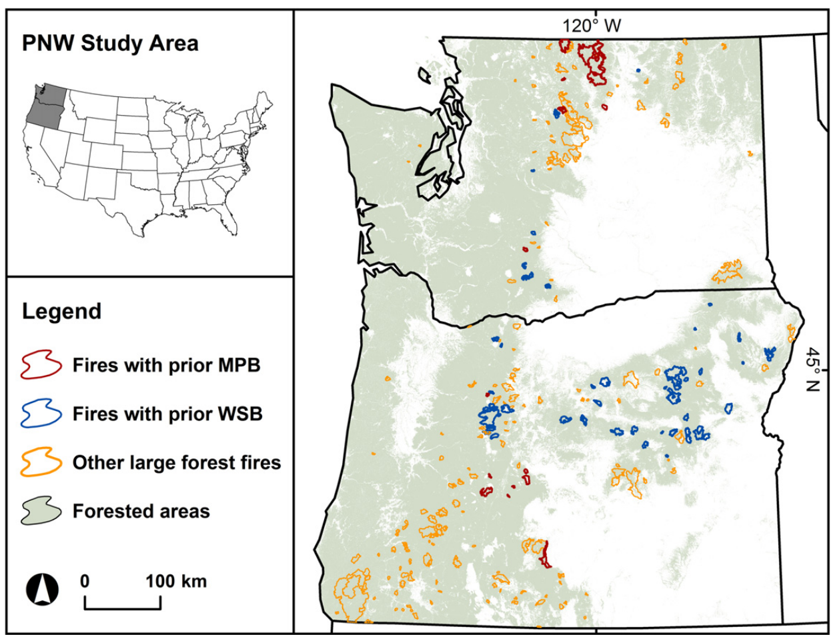
“We conducted a regional insect–fire severity census by focusing on large fire events with the following characteristics: total fire extent 400 ha; 10% of fire extent affected by prefire insect outbreaks (eitherMPB or WSB); 50% forest cover (30 m resolution (Ohmann et al 2012)).”
MethodSelf-citationWestern spruce budworm defoliation effects on forest structure and potential fire behavior
Hummel, S. S., & Agee, J. K. (2003) · Research Exchange (Washington State University) · Cited by 57
Flower, A., Gavin, D. G., Heyerdahl, E. K., Parsons, R. A., & Cohn, G. (2014) · PLoS ONE · doi:10.1371/journal.pone.0114282 · Cited by 32 · cited 3×
“Future studies also could combine our spatially extensive methods with the temporally rich insights provided by tree ring analysis (e.g., Flower et al 2014).”
BackgroundMethodDisturbance Regimes and Stressors
Ayres, M. P., Hicke, J. A., Kerns, B. K., McKenzie, D., Littell, J. S., Band, L. E., Luce, C. H., Weed, A. S., & Raymond, C. L. (2013) · Advances in global change research · doi:10.1007/978-94-007-7515-2_4 · Cited by 18 · cited 3×
“Indeed, the indirect effects of climate change on forests via disturbances (including wildfires, insect outbreaks, introduced species, and pathogens) are expected to exceed the direct but more gradual effects of warmer temperatures (Ayres et al 2014,Hart et al 2015).”
BackgroundCohn, G., Parsons, R. A., Heyerdahl, E. K., Gavin, D. G., & Flower, A. (2014) · International Journal of Wildland Fire · doi:10.1071/wf13074 · Cited by 13 · cited 2×
“…the abundance of live vegetation susceptible to wildfire while altering vertical and horizontal fuel distributions, particularly as trees defoliate, die, and transition from canopy to surface fuels (Hummel and Agee 2003, Simard et al 2011, Hicke et al 2012, Cohn et al 2014,Harvey et al 2014a).”
BackgroundCrickmore, I. D. M. (2011) · Scholars' Bank (University of Oregon) · Cited by 6
Cited by
Halofsky, J. E., Peterson, D. L., & Harvey, B. J. (2020) · Fire Ecology · doi:10.1186/s42408-019-0062-8 · Cited by 640
Drought, Tree Mortality, and Wildfire in Forests Adapted to Frequent Fire
Stephens, S. L., Collins, B. M., Fettig, C. J., Finney, M. A., Hoffman, C. M., Knapp, E. E., North, M. P., Safford, H., & Wayman, R. B. (2018) · BioScience · doi:10.1093/biosci/bix146 · Cited by 407
Forest Insects and Climate Change
Pureswaran, D. S., Roques, A., & Battisti, A. (2018) · Current Forestry Reports · doi:10.1007/s40725-018-0075-6 · Cited by 407
Emergent vulnerability to climate-driven disturbances in European forests
Forzieri, G., Girardello, M., Ceccherini, G., Spinoni, J., Feyen, L., Hartmann, H., Beck, P. S. A., Camps-Valls, G., Chirici, G., Mauri, A., et al. (2021) · Nature Communications · doi:10.1038/s41467-021-21399-7 · Cited by 373
Towards a comprehensive look at global drivers of novel extreme wildfire events
Duane, A., Castellnou, M., & Brotons, L. (2021) · Climatic Change · doi:10.1007/s10584-021-03066-4 · Cited by 329
Metadata
- Authors
- Meigs, G. W., Zald, H. S. J., Campbell, J. L., Keeton, W. S., & Kennedy, R. E.
- Affiliations
- University of Vermont (US)
- Oregon State University (US)
- Corresponding author
- Meigs, Garrett W
- Venue
- Environmental Research Letters
- Publisher
- IOP Publishing
- Published
- 2016-04-01
- Volume
- 11
- Issue
- 4
- Pages
- 045008
- ISSN
- 1748-9326 (ISSN-L)
- OpenAlex
- W2340633650
- Semantic Scholar
- 9445f308b9a4fff3247f413d98230a09e183af1f
- Cited by
- 90
- References
- 46
- Citations by year
- 2026: 4 · 2025: 1 · 2024: 12 · 2023: 8 · 2022: 14 · 2021: 10 · 2020: 13 · 2019: 8 · 2018: 7 · 2017: 9 · 2016: 3
- FWCI
- 6.67
- Type
- journal article
- Language
- en
- Open access
- gold
- doi.org
- Licence
- cc-by
- iopscience.iop.org/info/page/text-and-data-mining (tdm, 20 d)
- creativecommons.org/licenses/by/3.0/ (vor, 20 d)
- Locations
- Environmental Research Letters (publishedVersion, cc-by)
- ScholarWorks -A service of University of Vermont Libraries (University of Vermont) (submittedVersion, cc-by)
- DOAJ (DOAJ: Directory of Open Access Journals) (submittedVersion)
- Funders
- U.S. Forest Service (WC-F-09-2)
- National Aeronautics and Space Administration (NNX11AM01H)
- National Institute of Food and Agriculture (McIntire Forest Research Program)
- Topics
- Physical Sciences › Environmental Science › Global and Planetary Change › Fire effects on ecosystems
- Physical Sciences › Environmental Science › Ecology › Forest Insect Ecology and Management
- Life Sciences › Agricultural and Biological Sciences › Forestry › Forest Management and Policy
- Keywords
- insect outbreaks, wildfire severity, burn severity, mountain pine beetle, western spruce budworm, bark beetles, defoliators, forest disturbance regimes, fire regime change, forest management, Pacific Northwest forests, climate change
About these checks
Registry, retraction, Cites and statistics results are computed, not judged, with one exception: a printed reference that no index lists is read once by a model before it counts as a citation error. Claims are extracted by a model and kept only when their quote appears verbatim in the text; each cited source is then checked, with a model’s help, for whether it says what the claim relies on. Those verdicts can be wrong — read the claim’s quote and the cited source before relying on one.
Statistics and arithmetic are recomputed, not judged.
Confidence bands are shown only for fields calibrated on our annotated test set. None is calibrated yet, so no band is shown.
What counts as a claim ›How we measure confidence ›How we check this ›
Are you an author, or do you see a problem with this page? Request a review
Data sources
Bibliographic data: Semantic Scholar, OpenAlex, Crossref.
Contains information from the Semantic Scholar Academic Graph Datasets, made available under the ODC Attribution License (ODC-BY 1.0).
Semantic Scholar’s data is described in: Kinney, R., et al. (2023). The Semantic Scholar Open Data Platform. arXiv:2301.10140.
