

The size and range effect: lifecycle greenhouse gas emissions of electric vehicles
Open accessThe DOI matches its Crossref record; 16 of the 16 references it cites were found in a registry or an index.
Abstract
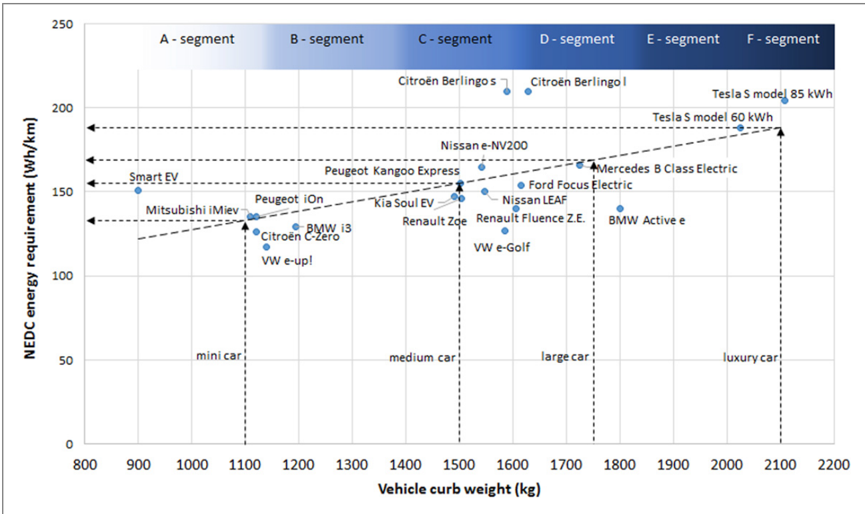
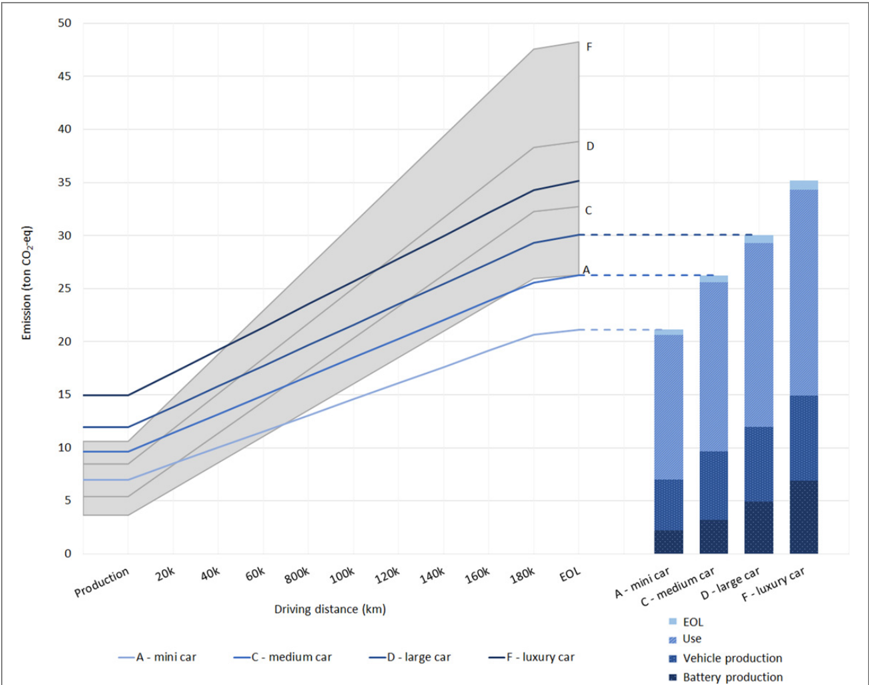
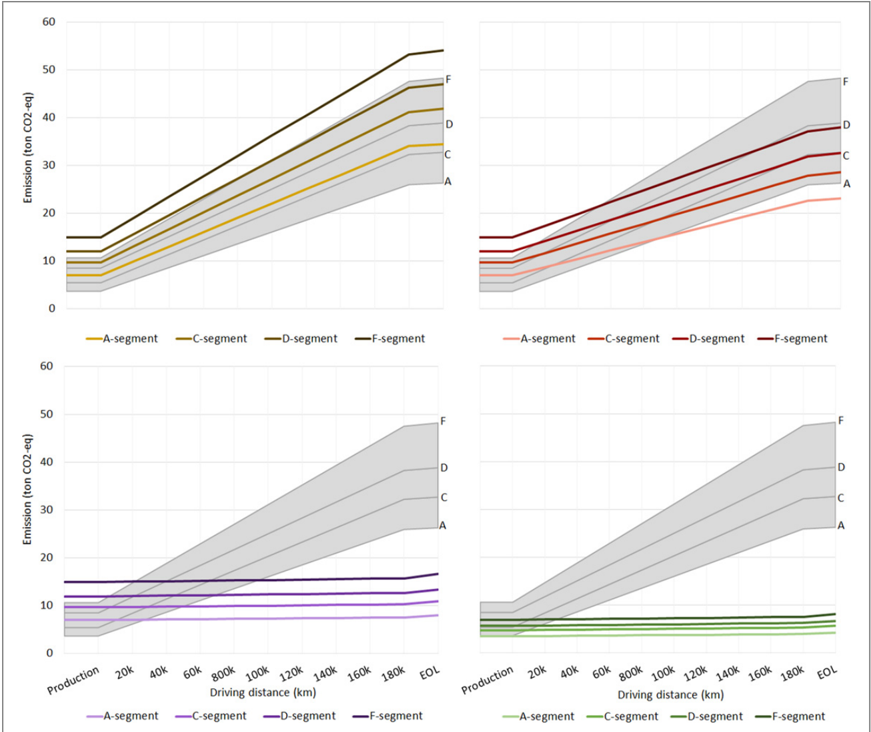
The primary goal of this study is to investigate the effect of increasing battery size and driving range to the environmental impact of electric vehicles (EVs). To this end, we compile cradle-to-grave inventories for EVs in four size segments to determine their climate change potential. A second objective is to compare the lifecycle emissions of EVs to those of conventional vehicles. For this purpose, we collect lifecycle emissions for conventional vehicles reported by automobile manufacturers. The lifecycle greenhouse gas emissions are calculated per vehicle and over a total driving range of 180 000 km using the average European electricity mix. Process-based attributional LCA and the ReCiPe characterisation method are used to estimate the climate change potential from the hierarchical perspective. The differently sized EVs are compared to one another to find the effect of increasing the size and range of EVs. We also point out the sources of differences in lifecycle emissions between conventional- and electric vehicles. Furthermore, a sensitivity analysis assesses the change in lifecycle emissions when electricity with various energy sources power the EVs. The sensitivity analysis also examines how the use phase electricity sources influences the size and range effect.
Overview
The claims and statistics of this paper haven’t been checked yet.
Free: it reads the open-access text and checks the first 5 claims that cite a source we can check. Create a free account to check every claim.
Integrity signals
Registry
Cites
Statistics
Figures



Verification
Claims the paper makes
The claims and statistics of this paper haven’t been checked yet.
Free: it reads the open-access text and checks the first 5 claims that cite a source we can check. Create a free account to check every claim.
Claims other papers make about this one
Each is checked against this paper’s own text: does it say what the citing paper says it does?
The cited source says what the claim attributes to it.
In the citing paper
“Previous studies have shown that while EVs typically outperform ICEVs in terms of life cycle GHGs [37,38]”
From A National and Regional Greenhouse Gas Breakeven Assessment of EVs across North America (2023) · cites this paper as [38]
The cited source says what the claim attributes to it.
In the citing paper
“This matches results from several previous studies [38,39,41], all of which found GHG emissions from EVs to be lower in areas with strong renewable energy infrastructure”
From A National and Regional Greenhouse Gas Breakeven Assessment of EVs across North America (2023) · cites this paper as [38]
The cited source says what the claim attributes to it.
In the citing paper
“Regarding lithium-ion batteries, there are already studies that systematize LCA inventories, or analyses of 'cradle-to-grave' impacts (Ager-Wick Ellingsen et al. 2016; Richa 2016; Tagliaferri et al. 2016).”
From The arid Andean plateau waterscapes and the lithium triangle: flamingos as flagships for conservation of high-altitude wetlands under pressure from mining development (2022) · cites this paper as Ager-Wick Ellingsen et al. 2016
Self-check
Percentages, sums and reported differences re-computed from the paper’s own numbers.
The self-check needs the paper’s full text.
Citations
Cites
Comparative Environmental Life Cycle Assessment of Conventional and Electric Vehicles
Hawkins, T. R., Singh, B., Majeau‐Bettez, G., & Strømman, A. H. (2013) · Journal of Industrial Ecology · doi:10.1111/j.1530-9290.2012.00532.x · Cited by 1,670
Self-citationEdenhofer, O. (2015) · Intergovernmental Panel on Climate Change eBooks · Cited by 835
Contribution of Li-Ion Batteries to the Environmental Impact of Electric Vehicles
Notter, D. A., Gauch, M., Widmer, R., Wäger, P., Stamp, A., Zah, R., & Althaus, H.-J. (2010) · Environmental Science & Technology · doi:10.1021/es903729a · Cited by 833
Life cycle assessment of a lithium-ion battery vehicle pack
Ellingsen, L. A., Majeau‐Bettez, G., Singh, B., Srivastava, A. K., Valøen, L. O., & Strømman, A. H. (2014) · Journal of Industrial Ecology · doi:10.1111/jiec.12072 · Cited by 665 · cited 4×
“…are limited to small to medium sized EVs and batteries (Bauer 2010, Notter et al 2010, Zackrisson et al 2010, Majeau-Bettez et al 2011, Dunn et al 2012, Faria et al 2012, Hawkins et al 2012, Ellingsen et al 2014, United States Environmental Protection Agency 2013, Dunn et al 2015, Li et al 2014).”
BackgroundMethodInfluentialSelf-citationMajeau-Bettez, G., Hawkins, T. R., & Strømman, A. H. (2011) · Environmental Science & Technology · doi:10.1021/es103607c · Cited by 662 · cited 1×
“…and Li-ion batteries, the assessments are limited to small to medium sized EVs and batteries (Bauer 2010, Notter et al 2010, Zackrisson et al 2010, Majeau-Bettez et al 2011, Dunn et al 2012, Faria et al 2012, Hawkins et al 2012, Ellingsen et al 2014, United States Environmental Protection Agency…”
BackgroundSelf-citationDunn, J. B., Gaines, L., Kelly, J. C., James, C., & Gallagher, K. G. (2015) · Energy & Environmental Science · doi:10.1039/c4ee03029j · Cited by 561
Life cycle assessment of lithium-ion batteries for plug-in hybrid electric vehicles–Critical issues
Zackrisson, M., Avellán, L., & Orlenius, J. (2010) · Journal of Cleaner Production · doi:10.1016/j.jclepro.2010.06.004 · Cited by 551 · cited 2×
“…have assessed EVs and Li-ion batteries, the assessments are limited to small to medium sized EVs and batteries (Bauer 2010, Notter et al 2010, Zackrisson et al 2010, Majeau-Bettez et al 2011, Dunn et al 2012, Faria et al 2012, Hawkins et al 2012, Ellingsen et al 2014, United States…”
BackgroundDunn, J. B., Gaines, L., Sullivan, J., & Wang, M. Q. (2012) · Environmental Science & Technology · doi:10.1021/es302420z · Cited by 457
Recycling rechargeable lithium ion batteries: Critical analysis of natural resource savings
Dewulf, J., Van der Vorst, G., Denturck, K., Van Langenhove, H., Ghyoot, W., Tytgat, J., & Vandeputte, K. (2010) · Resources, Conservation and Recycling · doi:10.1016/j.resconrec.2009.08.004 · Cited by 348 · cited 2×
“To model EOL treatment of the battery, an inventory was compiled based on the pyrometallurgical treatment described by Dewulf et al (2010).”
MethodA sustainability assessment of electric vehicles as a personal mobility system
Faria, R., Moura, P., Delgado, J., & de Almeida, A. T. (2012) · Energy Conversion and Management · doi:10.1016/j.enconman.2012.02.023 · Cited by 327 · cited 4×
“…are limited to small to medium sized EVs and batteries (Bauer 2010, Notter et al 2010, Zackrisson et al 2010, Majeau-Bettez et al 2011, Dunn et al 2012, Faria et al 2012, Hawkins et al 2012, Ellingsen et al 2014, United States Environmental Protection Agency 2013, Dunn et al 2015, Li et al 2014).”
BackgroundMethodResultInfluential
Research works printed but not linked: 7
- Carranza F 2013 Electric vehicle 2nd life batteries for static applications SOMABAT Project Workshop, Valencia Daimler AG 2012 Envrionmental Brochure: Smart Fortwo Electric Drive (Stuttgart: Daimler AG, Mercedes-Benz Technology Center) (http://cms.daimler.com/Projects/c2c/channel/documents/ 2243139_Environmental_brochure_smart_fortwo_electric_d- rive.pdf)
- Daimler AG, 2012, Envrionmental Brochure: Smart Fortwo Electric Drive
- Daimler AG 2014 Environmental Certificate Mercedes-Benz B-Class Electric Drive (Stuttgart: Daimler AG, Mercedes-Benz Technology Center) (http://media.daimler.com/Projects/c2c/channel/ documents/2582749_final_UZ_B_Kl_ED_engl_15_12.pdf)
- Meskers C E, Hagelüken C and Van Damme G 2009 Green recycling of EEE: special and precious metal recovery from EEE ed S M Howard EPD Congress TMS 2009 Annual Meeting & Exhibition((San Francisco)) pp 1131-6
- Sims R et al 2014 Transport Climate Change 2014: Mitigation of Climate Change. Contribution of Working Group III to the Fifth Assessment Report of the Intergovernmental Panel on Climate Change ed O Edenhofer et al (Cambridge: Cambridge University Press)pp 1-115
- Tesla Motors 2014 Planned 2020 Gigafactory Production Exceeds 2013 Global Production pp 0-5 (http://teslamotors.com/ sites/default/files/blog_attachments/gigafactory.pdf)
- The Norwegian Consumer Council 2014 Nyttig info når du skal kjøpe elbil pp 1-4 (http://forbrukerradet.no/annet/tester- og-kjøpetips/kjøpetips/_attachment/1177130? _ts=146bib38bib9bib08)
Cited by
Items 101–200 of 410
Bejigo, K. S., Bhunia, K., Kim, J., Lee, C., Back, S., & Kim, S. (2023) · Journal of Energy Chemistry · doi:10.1016/j.jechem.2023.03.042 · Cited by 50
Schwarz, M., Auzépy, Q., & Knoeri, C. (2020) · Applied Energy · doi:10.1016/j.apenergy.2020.115548 · Cited by 55
Impact of large‐scale EV integration and fast chargers in a Norwegian LV grid
Lillebo, M., Zaferanlouei, S., Zecchino, A., & Farahmand, H. (2019) · The Journal of Engineering · doi:10.1049/joe.2018.9318 · Cited by 49
“When driven on electricity with a low carbon footprint, most electric vehicles (EVs) cause less greenhouse gas emissions over the course of their life cycle than similar cars with internal combustion engine [1].”
BackgroundGheidan, A. A. S., Wahid, M. B. A., Opia, A. C., & Yasin, M. F. M. (2022) · Evergreen · doi:10.5109/4843114 · Cited by 53
Liu, J., Daigo, I., Panasiuk, D., Dunuwila, P., Hamada, K., & Hoshino, T. (2022) · Journal of Cleaner Production · doi:10.1016/j.jclepro.2022.131317 · Cited by 51
Naor, M., Druehl, C. T., & Bernardes, E. S. (2017) · Journal of Cleaner Production · doi:10.1016/j.jclepro.2017.09.221 · Cited by 58
Sobol, Ł., & Dyjakon, A. (2020) · Energies · doi:10.3390/en13164267 · Cited by 50
The Role of Pickup Truck Electrification in the Decarbonization of Light-Duty Vehicles
Woody, M., Vaishnav, P., Keoleian, G. A., De Kleine, R., Kim, H. C., Anderson, J. E., & Wallington, T. J. (2022) · Environmental Research Letters · doi:10.1088/1748-9326/ac5142 · Cited by 46
Chandrasekharam, D., Şener, M. F., Recepoğlu, Y. K., Isık, T., Demir, M. M., & Baba, A. (2024) · Geothermics · doi:10.1016/j.geothermics.2024.102959 · Cited by 45
Mastoi, M. S., Wang, D., Zhou, X., He, X., Hassan, M., Ali, A., & Rehman, A. (2025) · Renewable and Sustainable Energy Reviews · doi:10.1016/j.rser.2025.116072 · Cited by 52
Berg, H., & Zackrisson, M. (2019) · Journal of Power Sources · doi:10.1016/j.jpowsour.2019.01.047 · Cited by 47
“This comparative insignificance of the recycling phase is confirmed by other studies [36].”
ResultWilliams, I. D., & Blyth, M. (2022) · The Science of The Total Environment · doi:10.1016/j.scitotenv.2022.159987 · Cited by 51
Nazari, S., Li, J., Khoshdast, H., Li, J., Ye, C., He, Y., & Hassanzadeh, A. (2023) · Journal of Materials Research and Technology · doi:10.1016/j.jmrt.2023.03.133 · Cited by 44
Life cycle assessment of lithium ion battery from water-based manufacturing for electric vehicles
Shen, K., Zhai, Q., Gu, Y., Wang, W., Cao, H., Hauschild, M. Z., & Yuan, C. Y. (2023) · Resources Conservation and Recycling · doi:10.1016/j.resconrec.2023.107152 · Cited by 44
Forecasting the EU recycling potential for batteries from electric vehicles
Abdelbaky, M., Peeters, J. R., Duflou, J. R., & Dewulf, W. (2020) · Procedia CIRP · doi:10.1016/j.procir.2020.01.109 · Cited by 46
Serrano, J. R., García, A., Serrano, J. M., & Martínez-Boggio, S. (2020) · Applied Energy · doi:10.1016/j.apenergy.2020.116078 · Cited by 44
“Battery manufacturing and disposal-recycling are considered by [36].”
BackgroundMethodInfluentialFelice, L. J. D., Renner, A., & Giampietro, M. (2021) · Environmental Science & Policy · doi:10.1016/j.envsci.2021.05.002 · Cited by 46
da Costa, V. B. F., Bitencourt, L., Dias, B. H., Soares, T., de Andrade, J. V. B., & Bonatto, B. D. (2025) · Renewable and Sustainable Energy Reviews · doi:10.1016/j.rser.2024.114988 · Cited by 53
Hopeful Extinctions? Tesla, Technological Solutionism and the Anthropocene
Taffel, S. (2018) · Culture Unbound Journal of Current Cultural Research · doi:10.3384/cu.2000.1525.2018102163 · Cited by 53
Potential and Limitations of Battery-Powered All-Electric Regional Flights—A Norwegian Case Study
Bærheim, T., Lamb, J. J., Nøland, J. K., & Burheim, O. S. (2022) · IEEE Transactions on Transportation Electrification · doi:10.1109/tte.2022.3200089 · Cited by 48
“In addition, by exploiting the available renewable energy, the goal is to produce batteries with a much lower CO2 footprint than what is being done in existing factories [21].”
BackgroundAn Updated Review and Outlook on Electric Vehicle Aggregators in Electric Energy Networks
Nazari‐Heris, M., Abapour, M., & Mohammadi‐Ivatloo, B. (2022) · Sustainability · doi:10.3390/su142315747 · Cited by 48
“Modern transportation systems all over the world face considerable and substantial challenges due to climate change and limited sources of fossil fuels because of environmental and economic issues [1,2].”
BackgroundQuantifying electric vehicle mileage in the United States
Zhao, L., Ottinger, E. R., Yip, A., & Helveston, J. P. (2023) · Joule · doi:10.1016/j.joule.2023.09.015 · Cited by 48
Lijewski, P., Kozak, M., Fuć, P., Rymaniak, Ł., & Ziółkowski, A. (2019) · Transportation Research Part D Transport and Environment · doi:10.1016/j.trd.2019.11.012 · Cited by 43
Abdul-Manan, A. F. N., Won, H. W., Li, Y., Sarathy, S. M., Xie, X., & Amer, A. A. (2020) · Applied Energy · doi:10.1016/j.apenergy.2020.114936 · Cited by 44
Hinnüber, F., Szarucki, M., & Szopik‐Depczyńska, K. (2019) · Sustainability · doi:10.3390/su11247034 · Cited by 43
Kapetanović, M., Vajihi, M., & Goverde, R. M. P. (2021) · Energies · doi:10.3390/en14185920 · Cited by 44
“For instance, recent studies estimated GHG emissions from battery production for electric cars to be in the span of 150–200 kgCO 2 e per kWh of battery capacity [90], contributing 31–46% to the total GHG impact from vehicle production [91].”
BackgroundLife-cycle analysis of last-mile parcel delivery using autonomous delivery robots
Lemardelé, C., Melo, S. P., Cerdas, F., Herrmann, C. A., & Estrada, M. (2023) · Transportation Research Part D Transport and Environment · doi:10.1016/j.trd.2023.103842 · Cited by 41
Ambient temperature impacts on real-world electric vehicle efficiency & range
Taggart, J. (2017) · 2017 IEEE Transportation Electrification Conference and Expo (ITEC) · doi:10.1109/itec.2017.7993269 · Cited by 37
“Many studies have examined one or several components of this question, broadly finding benefits in most circumstances [4][5][6].”
BackgroundBaars, J., Cerdas, F., & Heidrich, O. (2023) · Environmental Science & Technology · doi:10.1021/acs.est.2c04080 · Cited by 38
Yowtak, K., Imiola, J., Andrews, M., Cardillo, K., & Skerlos, S. J. (2020) · Procedia CIRP · doi:10.1016/j.procir.2020.02.003 · Cited by 38
A bibliometric review on electric vehicle (EV) energy efficiency and emission effect research
Yao, S., Bian, Z., Hasan, M. K., Ding, R., Li, S., Wang, Y., & Song, S. (2023) · Environmental Science and Pollution Research · doi:10.1007/s11356-023-29143-y · Cited by 42
Khanna, D., Gemechu, E. D., Mahbub, N., Joy, J., & Kumar, A. (2024) · Environmental Impact Assessment Review · doi:10.1016/j.eiar.2024.107680 · Cited by 37
Holzer, A., Wiszniewski, L., Windisch, S., & Raupenstrauch, H. (2022) · Metals · doi:10.3390/met12101642 · Cited by 38
Puma-Benavides, D. S., Cevallos-Carvajal, A. S., Yanzapanta, Á. G. M., Quinga-Morales, M. I., Pallares, R. R. M., Usca-Gomez, H. G., & Murillo, F. A. (2024) · World Electric Vehicle Journal · doi:10.3390/wevj15080355 · Cited by 35
Review of Economic, Technical and Environmental Aspects of Electric Vehicles
Koniak, M., Jaskowski, P., & Tomczuk, K. (2024) · Sustainability · doi:10.3390/su16229849 · Cited by 42
Exploring the freight transportation transitions for mitigation and development pathways of India
Gupta, D., & Dhar, S. (2022) · Transport Policy · doi:10.1016/j.tranpol.2022.10.013 · Cited by 39
The progress toward the transition to electromobility in Africa
Ayetor, G. K., Mashele, J., & Mbonigaba, I. (2023) · Renewable and Sustainable Energy Reviews · doi:10.1016/j.rser.2023.113533 · Cited by 34
Electric Vehicle Range Estimation Using Regression Techniques
Ahmed, M., Mao, Z., Zheng, Y., Chen, T., & Chen, Z. (2022) · World Electric Vehicle Journal · doi:10.3390/wevj13060105 · Cited by 34
Impacts of electric vehicle policy on the New Zealand energy system: A retro-analysis
Williams, B., Gallardo, P., Bishop, D., & Chase, J. G. (2023) · Energy Reports · doi:10.1016/j.egyr.2023.02.080 · Cited by 40
Nurturing a Regime Shift Toward Electro-mobility in Norway
Ryghaug, M., & Skjølsvold, T. M. (2018) · The urban book series · doi:10.1007/978-3-319-96526-0_8 · Cited by 41
Electric Vehicle (EV) Market Penetration in Countries with Rising Motorization Rates
Dalkic-Melek, G., Saltık, E. C., & Tüydeş-Yaman, H. (2024) · International Journal of Civil Engineering · doi:10.1007/s40999-024-01039-z · Cited by 38
“EV market penetration, however, differs between developed and developing countries: MR reaches a saturation level in developed countries, while it continues to rise in the latter as GDP increases [20, 21].”
The Carbon Footprint of Electrified City Buses: A Case Study in Trondheim, Norway
Lie, K., Synnevåg, T. A., Lamb, J. J., & Lien, K. M. (2021) · Energies · doi:10.3390/en14030770 · Cited by 40
“This is in-line with the earlier studies [60,61,87,93] on battery production emissions, but contradicts recent findings [75,88], suggesting the upstream material production is a significant contributor to the emissions, and the difference in the material emissions should be higher than documented.”
BackgroundResultInfluentialReducing Greenhouse Gas Emissions from U.S. Light-Duty Transport in Line with the 2 °C Target
Zhu, Y., Skerlos, S. J., Xu, M., & Cooper, D. (2021) · Environmental Science & Technology · doi:10.1021/acs.est.1c00816 · Cited by 36
Haugen, M. J., Flynn, D., Greening, P., Tichler, J., Blythe, P. T., & Boies, A. (2022) · Energy Sustainable Development/Energy for sustainable development · doi:10.1016/j.esd.2022.03.011 · Cited by 37
Transitioning to low-carbon suburbs in hot-arid regions: A case-study of Emirati villas in Abu Dhabi
Birge, D. P., & Berger, A. (2018) · Building and Environment · doi:10.1016/j.buildenv.2018.09.013 · Cited by 37
“Embodied carbon (EC) from house construction [8,122–126], transportation infrastructure construction [127–130], and both gasoline and electric car manufacturing [114,117,118,131] can constitute a significant portion of total life-cycle emissions (LCE) [132].”
BackgroundPeshin, T., Sengupta, S., & Azevedo, I. M. L. (2022) · Environmental Science & Technology · doi:10.1021/acs.est.1c07718 · Cited by 32
Meta-analysis of life cycle assessments for Li-ion batteries production emissions
Clemente, M., Maharjan, P., Salazar, M., & Hofman, T. (2025) · The International Journal of Life Cycle Assessment · doi:10.1007/s11367-025-02541-9 · Cited by 51
“In general, many studies highlight cathode production, battery management systems, and structural materials like aluminum and copper as significant contributions due to material extraction and energy intense processing (Ellingsen et al. 2016; Notter et al. 2010; Hao et al. 2017).”
Assessing the impact of Autonomous Vehicles on urban noise pollution
Patella, S. M., Aletta, F., & Mannini, L. (2019) · Noise Mapping · doi:10.1515/noise-2019-0006 · Cited by 30
Probing mass transport processes in Li-ion batteries using electrochemical impedance spectroscopy
Perry, D., & Mamlouk, M. (2021) · Journal of Power Sources · doi:10.1016/j.jpowsour.2021.230577 · Cited by 32
Prospective Life Cycle Assessment of a Structural Battery
Zackrisson, M., Jönsson, C., Johannisson, W., Fransson, K., Posner, S., Zenkert, D., & Lindbergh, G. (2019) · Sustainability · doi:10.3390/su11205679 · Cited by 31
Ankathi, S. K., Bouchard, J., & He, X. (2024) · World Electric Vehicle Journal · doi:10.3390/wevj15060245 · Cited by 35
“Numerous studies unequivocally attest to the superior environmental advantage of battery electric vehicles (BEVs) in comparison to their counterpart—the internal combustion engine vehicles (ICEVs) [4–8].”
BackgroundSovacool, B. K. (2024) · Risk Analysis · doi:10.1111/risa.14667 · Cited by 32
Bryntesen, S. N., Tolstorebrov, I., Svensson, A. M., Shearing, P. R., Lamb, J. J., & Burheim, O. S. (2022) · Materials Advances · doi:10.1039/d2ma00850e · Cited by 28
Tarabay, B., Milovanoff, A., Abdul-Manan, A. F. N., McKechnie, J., MacLean, H. L., & Posen, I. D. (2023) · Resources Conservation and Recycling · doi:10.1016/j.resconrec.2023.107028 · Cited by 31
Regional energy policies for electrifying car fleets
Rovai, F. F., Seixas, S. R. D. C., & Mady, C. E. K. (2023) · Energy · doi:10.1016/j.energy.2023.127908 · Cited by 32
Exploring the applicability of circular design criteria for electric vehicle batteries
Picatoste, A., Justel, D., & Mendoza, J. M. F. (2022) · Procedia CIRP · doi:10.1016/j.procir.2022.05.222 · Cited by 27
Second-Life Batteries Modeling for Performance Tracking in a Mobile Charging Station
Hassini, M., Redondo-Iglesias, E., & Venet, P. (2023) · World Electric Vehicle Journal · doi:10.3390/wevj14040094 · Cited by 27
Techno-economic analysis of the adoption of electric vehicles
Kennedy, D., & Philbin, S. P. (2019) · Frontiers of Engineering Management · doi:10.1007/s42524-019-0048-x · Cited by 30
Feasibility and impact of a Swedish fuel cell-powered rescue boat
Chiche, A., Andruetto, C., Lagergren, C., Lindbergh, G., Stenius, I., & Peretti, L. (2021) · Ocean Engineering · doi:10.1016/j.oceaneng.2021.109259 · Cited by 30
Watabe, A., & Leaver, J. D. (2023) · Journal of Cleaner Production · doi:10.1016/j.jclepro.2023.139680 · Cited by 26
Concurrent design optimization of powertrain component modules in a family of electric vehicles
Clemente, M., Salazar, M., & Hofman, T. (2024) · Applied Energy · doi:10.1016/j.apenergy.2024.124840 · Cited by 25
“Yet, the major contribution in the battery life-cycle emissions is not the production process, but, the electricity consumption during the battery’s life inside the vehicle [72–74].”
Light-duty electric vehicles in the gulf? Techno-economic assessment and policy implications
Sgouridis, S. P., Helmers, E., & Hadhrami, M. A. (2017) · International Journal of Sustainable Transportation · doi:10.1080/15568318.2017.1332256 · Cited by 25
“Data sources: The current New European Driving Cycle (NEDC) estimate for this vehicle type is 17 kWh/100km (Ellingsen et al., 2016) conservatively adjusted for the empirical observations (Zerfass, 2014).”
BackgroundEfficient DC–DC power converters for fuel‐cell electric vehicle: A qualitative assessment
Kumar, S., Jammeh, S., Samb, R., & Singh, A. P. (2024) · IET Power Electronics · doi:10.1049/pel2.12819 · Cited by 25
“According to recent studies, the CO 2 emissions from the production of an electric car, particularly battery manufacturing, account for around one-third of the emissions throughout its lifetime [18].”
Environmental implications of the ongoing electrification of the UK light duty vehicle fleet
Raugei, M., Kamran, M., & Hutchinson, A. R. (2021) · Resources Conservation and Recycling · doi:10.1016/j.resconrec.2021.105818 · Cited by 27
Lausselet, C., & Brattebø, H. (2021) · The International Journal of Life Cycle Assessment · doi:10.1007/s11367-021-01973-3 · Cited by 26
Molnár, P., Suta, A., & Tóth, Á. (2023) · Clean Technologies and Environmental Policy · doi:10.1007/s10098-023-02588-y · Cited by 30
“For example, emissions of toxic materials dur‑ ing battery production can account for around 23–34% of the total harmful emissions over the life cycle of a BEV (Ellingsen et al. 2016).”
Sovacool, B. K., Kester, J., & Heida, V. (2019) · Technological Forecasting and Social Change · doi:10.1016/j.techfore.2019.04.006 · Cited by 25
Synthetic Fuels in a Transport Transition: Fuels to Prevent a Transport Underclass
Styring, P., Duckworth, E. L., & Platt, E. G. (2021) · Frontiers in Energy Research · doi:10.3389/fenrg.2021.707867 · Cited by 23
“Ellingsen et al. (2016) stated the true emissions of a BEV over the cradle-to-grave analysis, which means that to meet net zero criteria, a mediumsize car needs to drive 70,000 km before tailpipe emission reduction is met.”
BackgroundSocial and Technological Impact of Businesses Surrounding Electric Vehicles
Vidhi, R., Shrivastava, P., & Parikh, A. S. (2021) · Clean Technologies · doi:10.3390/cleantechnol3010006 · Cited by 23
“The lifecycle impact of battery manufacturing depends on aspects such as battery size and life [41], which are determined by customer requirements and design decisions such as battery chemistry and the type of solvent used in the battery [42,43].”
BackgroundPush and pull strategies to increase the uptake of small electric vehicles
Hoerler, R., Stoiber, T., & Duce, A. D. (2023) · Transportation Research Part D Transport and Environment · doi:10.1016/j.trd.2023.103638 · Cited by 24
Latha, B., Irfan, M. M., & Reddy, B. K. (2024) · Results in Engineering · doi:10.1016/j.rineng.2024.102463 · Cited by 23
Charging Strategies to Minimize Greenhouse Gas Emissions of Electrified Delivery Vehicles
Woody, M., Vaishnav, P., Craig, M., Lewis, G. M., & Keoleian, G. A. (2021) · Environmental Science & Technology · doi:10.1021/acs.est.1c03483 · Cited by 28
Mårtensson, H. B., Höjer, M., & Åkerman, J. (2023) · International Journal of Sustainable Transportation · doi:10.1080/15568318.2023.2248049 · Cited by 28
“The carbon-intensive battery production is a key reason for this shift (Ellingsen et al., 2016; Emilsson & Dahll € of, 2019; Hawkins et al., 2013).”
BackgroundLiu, F., Shafique, M., & Luo, X. (2024) · Sustainable Production and Consumption · doi:10.1016/j.spc.2024.06.001 · Cited by 23
Huo, D., Davies, B., Li, J., Alzaghrini, N., Sun, X., Meng, F., Abdul-Manan, A. F. N., McKechnie, J., Posen, I. D., & MacLean, H. L. (2024) · Energy Policy · doi:10.1016/j.enpol.2024.114390 · Cited by 24
Optimizing future cost and emissions of electric delivery vehicles
Woody, M., Craig, M., Vaishnav, P., Lewis, G. M., & Keoleian, G. A. (2022) · Journal of Industrial Ecology · doi:10.1111/jiec.13263 · Cited by 25
“The use phase makes up themajority of a vehicle’s total emissions, especially in carbon-intensive grids (Ellingsen et al., 2016; Hawkins et al., 2013), andwe are comparing the emissions from charging at different times and in different places.”
BackgroundStyring, P., McCord, S., & Rackley, S. (2023) · Elsevier eBooks · doi:10.1016/b978-0-12-819663-2.00005-8 · Cited by 21
Electric or internal combustion vehicles? A Life Cycle Assessment in São Paulo
Maselli, M., Pelegrina, J., de Mello, A. M., de Souza, J. V. R., Marx, R., & Priarone, P. C. (2025) · Renewable and Sustainable Energy Reviews · doi:10.1016/j.rser.2025.115431 · Cited by 21
Arsad, S. R., Hannan, M. A., Ker, P. J., Wong, R. T. K., Begum, R. A., Hossain, M. J., & Jang, G. (2025) · Journal of Energy Storage · doi:10.1016/j.est.2025.117551 · Cited by 23
Bryntesen, S. N., Kahrom, A., Lamb, J. J., Tolstorebrov, I., & Burheim, O. S. (2023) · Batteries · doi:10.3390/batteries9020096 · Cited by 19
Katona, M., & Orosz, T. (2024) · Energies · doi:10.3390/en17061408 · Cited by 24
Examining the cost-effectiveness of electric vehicle policy in India
Ghosh, S., & Sarkar, B. (2022) · Transportation Planning and Technology · doi:10.1080/03081060.2022.2132948 · Cited by 18
“In the last several years, electric vehicles (EVs) have gained great attention from policymakers, industry, and consumers as a measure to curb greenhouse gas (GHG) emissions (Ellingsen, Singh, and Strømman 2016).”
BackgroundPoschmann, J., Bach, V., & Finkbeiner, M. (2023) · Sustainability · doi:10.3390/su151511795 · Cited by 21
Hellier, P., Jamil, F., Zaglis-Tyraskis, E., Al-Muhtaseb, A. H., Al‐Haj, L., & Ladommatos, N. (2019) · Fuel · doi:10.1016/j.fuel.2019.01.022 · Cited by 21
The emission reduction potential of electric transport modes in Finland
Jenu, S., Baumeister, S., Pippuri-Mäkeläinen, J., Manninen, A., & Paakkinen, M. (2021) · Environmental Research Letters · doi:10.1088/1748-9326/ac2440 · Cited by 23
“…show that the carbon intensity of the electricity grid greatly influences the total use phase emissions of the electric transport modes, which is in line with the results of the sensitivity analysis by Ellingsen et al (2016) on the effect of electricity carbon intensity on EV lifecycle emissions.”
ResultHamurcu, M., & Eren, T. (2022) · Environment Systems & Decisions · doi:10.1007/s10669-022-09878-8 · Cited by 21
A National and Regional Greenhouse Gas Breakeven Assessment of EVs across North America
Rasbash, D., Dillman, K. J., Heinonen, J., & Ásgeirsson, E. I. (2023) · Sustainability · doi:10.3390/su15032181 · Cited by 17
Life Cycle Analysis Comparison of Electric and Internal Combustion Engine Based Mobility
Boretti, A. A. (2018) · SAE technical papers on CD-ROM/SAE technical paper series · doi:10.4271/2018-28-0037 · Cited by 17
External costs of the Dieselgate – Peccadillo or substantial consequences?
Baumgärtner, F., & Letmathe, P. (2020) · Transportation Research Part D Transport and Environment · doi:10.1016/j.trd.2020.102501 · Cited by 18
If Electric Cars Are Good for Reducing Emissions, They Could Be Even Better with Electric Roads
Morfeldt, J., Shoman, W., Johansson, D. J. A., Yeh, S., & Karlsson, S. (2022) · Environmental Science & Technology · doi:10.1021/acs.est.2c00018 · Cited by 17
Narayanamoorthi, R., Shanmugam, Y., Jayaraman, R., Petrov, J., Vavra, L., & Goňo, R. (2024) · Energies · doi:10.3390/en17153858 · Cited by 19
“Secondary side rectifiers can be either regulated or unregulated on the need for power flow regulation [16,17].”
BackgroundA Bibliometric Survey of Research Output on Wireless Charging for Electric Vehicles
Gbey, E., Turkson, R. F., & Lee, S. (2022) · World Electric Vehicle Journal · doi:10.3390/wevj13020037 · Cited by 19
Carbon, C., & Gebauer, F. (2017) · Transportation Research Part F Traffic Psychology and Behaviour · doi:10.1016/j.trf.2017.04.011 · Cited by 16
Zhao, Q. L., Huang, W., Hu, M., Xu, X., & Wen-lin, W. (2021) · Sustainability · doi:10.3390/su132413522 · Cited by 16
“While electric vehicles have advantages in environmental protection, due to their significant reduction of emissions per kilometer traveled as compared with conventional vehicles, they are only suitable for light-duty vehicles [14,15].”
BackgroundPicatoste, A., Justel, D., & Mendoza, J. M. F. (2025) · Sustainable Production and Consumption · doi:10.1016/j.spc.2025.02.013 · Cited by 18
What is the value of swappable batteries for a shared e-scooter service?
Leurent, F. M. (2022) · Research in Transportation Business & Management · doi:10.1016/j.rtbm.2022.100843 · Cited by 15
Prospective life cycle assessment of an electric vehicle equipped with a model magnesium battery
Bautista, S. P., Baumann, M., & Weil, M. (2024) · Energy Sustainability and Society · doi:10.1186/s13705-024-00475-y · Cited by 16
From research to roadmaps: Electric vehicle studies driving sustainable policy frameworks
Tahir, H., Ferik, S. E., & Tayyab, M. A. (2025) · Transportation Research Part D Transport and Environment · doi:10.1016/j.trd.2025.104645 · Cited by 16
Pérez-Sánchez, L. À., Fishman, T., & Behrens, P. (2024) · Journal of Cleaner Production · doi:10.1016/j.jclepro.2024.141954 · Cited by 14
The Collapse of the Global Consumption Model: in Search of Sustainability
Бобылев, С. Н., Solovyeva, S., & Kiryushin, P. (2022) · World Economy and International Relations · doi:10.20542/0131-2227-2022-66-11-92-100 · Cited by 16
Metadata
- Authors
- Ellingsen, L. A.-W., Singh, B., & Strømman, A. H.
- Affiliations
- Norwegian University of Science and Technology (NO)
- Corresponding author
- Ellingsen, Linda Ager-Wick
- Venue
- Environmental Research Letters
- Publisher
- IOP Publishing
- Published
- 2016-05-01
- Volume
- 11
- Issue
- 5
- Pages
- 054010
- ISSN
- 1748-9326 (ISSN-L)
- OpenAlex
- W2346055596
- Semantic Scholar
- bd172fca2b88b90405fc9d27e7b8662876c26e3d
- Cited by
- 363
- References
- 16
- Citations by year
- 2026: 41 · 2025: 40 · 2024: 41 · 2023: 43 · 2022: 64 · 2021: 40 · 2020: 26 · 2019: 34 · 2018: 19 · 2017: 12 · 2016: 3
- FWCI
- 10.46
- Type
- journal article
- Language
- en
- Open access
- gold
- doi.org
- Licence
- cc-by
- iopscience.iop.org/info/page/text-and-data-mining (tdm, 5 d)
- creativecommons.org/licenses/by/3.0/ (vor, 5 d)
- Locations
- Environmental Research Letters (publishedVersion, cc-by)
- BIBSYS Brage (BIBSYS (Norway)) (submittedVersion, cc-by)
- DOAJ (DOAJ: Directory of Open Access Journals) (submittedVersion)
- NORA - Norwegian Open Research Archives (submittedVersion, other-oa)
- Funders
- CenSes
- Topics
- Physical Sciences › Engineering › Electrical and Electronic Engineering › Electric Vehicles and Infrastructure
- Physical Sciences › Environmental Science › Environmental Engineering › Environmental Impact and Sustainability
- Physical Sciences › Engineering › Automotive Engineering › Vehicle emissions and performance
- Keywords
- electric vehicles, battery size, driving range, life cycle greenhouse gas emissions, climate change potential, internal combustion engine vehicles, electricity mix, use phase emissions, sensitivity analysis
About these checks
Registry, retraction, Cites and statistics results are computed, not judged, with one exception: a printed reference that no index lists is read once by a model before it counts as a citation error. Claims are extracted by a model and kept only when their quote appears verbatim in the text; each cited source is then checked, with a model’s help, for whether it says what the claim relies on. Those verdicts can be wrong — read the claim’s quote and the cited source before relying on one.
Statistics and arithmetic are recomputed, not judged.
Confidence bands are shown only for fields calibrated on our annotated test set. None is calibrated yet, so no band is shown.
What counts as a claim ›How we measure confidence ›How we check this ›
Are you an author, or do you see a problem with this page? Request a review
Data sources
Bibliographic data: Semantic Scholar, OpenAlex, Crossref.
Contains information from the Semantic Scholar Academic Graph Datasets, made available under the ODC Attribution License (ODC-BY 1.0).
Semantic Scholar’s data is described in: Kinney, R., et al. (2023). The Semantic Scholar Open Data Platform. arXiv:2301.10140.
