

The topology of non-linear global carbon dynamics: from tipping points to planetary boundaries
Open accessThe DOI matches its Crossref record; 38 of the 38 references it cites were found in a registry or an index.
Abstract
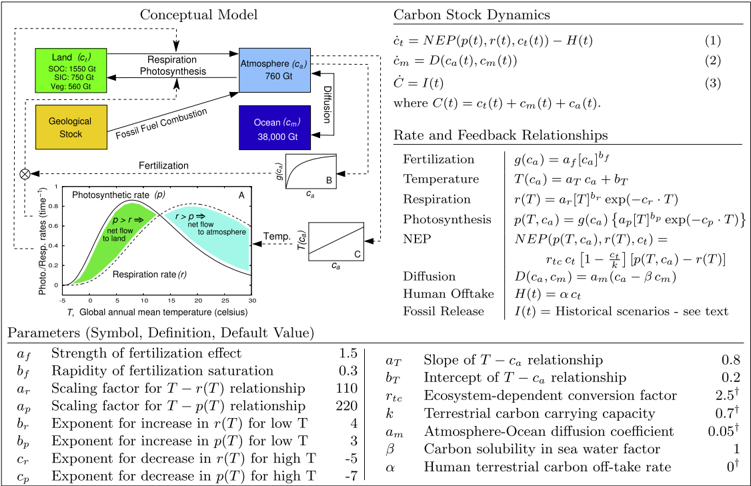
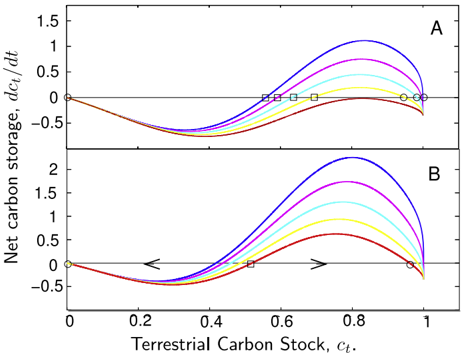
In figure 1 of the original paper, the parameters c r and c p were incorrectly specified as -5 and -7, respectively.The correct values are c r = 5 and c p = 7.Because the correct values were used in the analysis, this typographical error does not affect our results, overall findings, interpretations or conclusions in any way.
Overview
The claims and statistics of this paper haven’t been checked yet.
Free: it reads the open-access text and checks the first 5 claims that cite a source we can check. Create a free account to check every claim.
Integrity signals
Registry
Cites
Statistics
Figures
Verification
Claims the paper makes
The claims and statistics of this paper haven’t been checked yet.
Free: it reads the open-access text and checks the first 5 claims that cite a source we can check. Create a free account to check every claim.
Claims other papers make about this one
Each is checked against this paper’s own text: does it say what the citing paper says it does?
The source backs part of the claim, not all of it — or backs it for a different population, condition or comparison.
In the citing paper
“For example, there is increasing evidence to suggest that transgressing either the climate change or biosphere integrity planetary boundary can potentially lead to more steeply increasing risk in the other (21).”
From Earth beyond six of nine planetary boundaries (2023) · cites this paper as [21]
Experimental — accuracy not yet measuredThe cited source says what the claim attributes to it.
In the citing paper
“Recent studies (13, 14, 21, 22) have shown that additional or more extensive transgression of one planetary boundary can change risk gradients for other boundaries.”
From Earth beyond six of nine planetary boundaries (2023) · cites this paper as [21]
Self-check
Percentages, sums and reported differences re-computed from the paper’s own numbers.
The self-check needs the paper’s full text.
Citations
Cites
A safe operating space for humanity
Rockström, J., Steffen, W., Noone, K., Persson, Å., Chapin, F. S., Lambin, E. F., Lenton, T. M., Scheffer, M., Folke, C., Schellnhuber, H. J., et al. (2009) · Nature · doi:10.1038/461472a · Cited by 13,333 · cited 4×
“In the seminal treatment of Rockström et al [5], the planetary”
BackgroundMethodInfluentialSelf-citationSolomon, S. (2007) · Medical Entomology and Zoology · Cited by 4,149
Tipping elements in the Earth’s climate system
Lenton, T. M., Held, H., Kriegler, E., Hall, J. W., Lucht, W., Rahmstorf, S., & Schellnhuber, H. J. (2008) · Proceedings of the National Academy of Sciences · doi:10.1073/pnas.0705414105 · Cited by 3,982 · cited 2×
“Note, however, that there are many other non-linear processes and potential tipping points [Lenton et al., 2008].”
BackgroundClimate–Carbon Cycle Feedback Analysis: Results from the C4MIP Model Intercomparison
Friedlingstein, P., Cox, P., Betts, R., Bopp, L., von Bloh, W., Brovkin, V., Cadule, P., Doney, S., Eby, M., Fung, I., et al. (2006) · Journal of Climate · doi:10.1175/jcli3800.1 · Cited by 2,902 · cited 1×
“We conclude with the suggestion that future research employ an iterative process using a combination of simple models like that presented here to identify key feedbacks that impact boundaries followed by the use of more complex models to explore these and related feedbacks in more detail to improve the robustness of t…”
MethodTrends in the sources and sinks of carbon dioxide
Le Quéré, C., Raupach, M. R., Canadell, J. G., Marland, G., Bopp, L., Ciais, P., Conway, T. J., Doney, S. C., Feely, R. A., Foster, P., et al. (2009) · Nature Geoscience · doi:10.1038/ngeo689 · Cited by 2,096 · cited 1×
“[24]) and develop a better understanding of the long-term capacity of the ocean carbon sink to keep up with the rising rate of human emissions.”
BackgroundCramer, W., Bondeau, A., Woodward, F. I., Prentice, I. C., Betts, R. A., Brovkin, V., Cox, P. M., Fisher, V., Foley, J. A., Friend, A. D., et al. (2001) · Global Change Biology · doi:10.1046/j.1365-2486.2001.00383.x · Cited by 2,002
Approaching a state shift in Earth’s biosphere
Barnosky, A. D., Hadly, E. A., Bascompte, J., Berlow, E. L., Brown, J. H., Fortelius, M., Getz, W. M., Harte, J., Hastings, A., Marquet, P. A., et al. (2012) · Nature · doi:10.1038/nature11018 · Cited by 1,966
Climate models and their evaluation
Randall, D. A., & Fichefet, T. (2007) · MPG.PuRe (Max Planck Society) · Cited by 1,728
Soil erosion and the global carbon budget
Lal, R. (2003) · Environment International · doi:10.1016/s0160-4120(02)00192-7 · Cited by 1,661 · cited 2×
“We rescale C so that its default value of ‘1’ corresponds to roughly 4500 Gt of carbon with 750, 2850, and 900 in the atmosphere, terrestrial systems, and surface ocean, respectively [6, 16].”
BackgroundCritical Transitions in Nature and Society
Scheffer, M. (2009) · doi:10.1515/9781400833276 · Cited by 1,394
Research works printed but not linked: 2
- 32. Forward D F 1960 Effect of temperature on respiration Encyclopedia Plant Physiol. 12 234-58 (part 2)
- 33. James W O 1953 Plant Respiration (Oxford: Clarendon)
Cited by
Planetary boundaries: Guiding human development on a changing planet
Steffen, W., Richardson, K., Rockström, J., Cornell, S. E., Fetzer, I., Bennett, E. M., Biggs, R., Carpenter, S. R., de Vries, W., de Wit, C. A., et al. (2015) · Science · doi:10.1126/science.1259855 · Cited by 12,527
Self-citationEarth beyond six of nine planetary boundaries
Richardson, K., Steffen, W., Lucht, W., Bendtsen, J., Cornell, S. E., Donges, J. F., Drüke, M., Fetzer, I., Bala, G., von Bloh, W., et al. (2023) · Science Advances · doi:10.1126/sciadv.adh2458 · Cited by 3,311
“For example, there is increasing evidence to suggest that transgressing either the climate change or biosphere integrity planetary boundary can potentially lead to more steeply increasing risk in the other ( 21 ).”
Self-citationOur future in the Anthropocene biosphere
Folke, C., Polasky, S., Rockström, J., Galaz, V., Westley, F., Lamont, M., Scheffer, M., Österblom, H., Carpenter, S. R., Chapin, F. S., et al. (2021) · Ambio · doi:10.1007/s13280-021-01544-8 · Cited by 696
Self-citationHuman impacts on planetary boundaries amplified by Earth system interactions
Lade, S. J., Steffen, W., de Vries, W., Carpenter, S. R., Donges, J. F., Gerten, D., Hoff, H., Newbold, T., Richardson, K., & Rockström, J. (2019) · Nature Sustainability · doi:10.1038/s41893-019-0454-4 · Cited by 431
Self-citationAchieving the 17 Sustainable Development Goals within 9 planetary boundaries
Randers, J., Rockström, J., Stoknes, P.-E., Goluke, U., Collste, D., Cornell, S. E., & Donges, J. (2019) · Global Sustainability · doi:10.1017/sus.2019.22 · Cited by 324
“Other examples of simple models related to planetary boundaries include Anderies et al. (2013) on land/ocean/atmosphere carbon dynamics; Heck et al. (2016) whose study linked carbon cycle dynamics with societal land management to explore climate engineering options; and Nitzbon et al. (2017) who…”
BackgroundSelf-citationBiermann, F., & Kim, R. E. (2020) · Annual Review of Environment and Resources · doi:10.1146/annurev-environ-012320-080337 · Cited by 238
Planetary boundaries for a blue planet
Nash, K. L., Cvitanovic, C., Fulton, E. A., Halpern, B. S., Milner-Gulland, E. J., Watson, R. A., & Blanchard, J. L. (2017) · Nature Ecology & Evolution · doi:10.1038/s41559-017-0319-z · Cited by 219
Planetary Boundaries guide humanity’s future on Earth
Rockström, J., Donges, J. F., Fetzer, I., Martin, M. A., Wang-Erlandsson, L., & Richardson, K. (2024) · Nature Reviews Earth & Environment · doi:10.1038/s43017-024-00597-z · Cited by 197
Self-citationEcosystem-based fisheries management forestalls climate-driven collapse
Holsman, K. K., Haynie, A. C., Hollowed, A. B., Reum, J. C. P., Aydin, K., Hermann, A. J., Cheng, W., Faig, A., Ianelli, J. N., Kearney, K. A., et al. (2020) · Nature Communications · doi:10.1038/s41467-020-18300-3 · Cited by 185
Allowing variance may enlarge the safe operating space for exploited ecosystems
Carpenter, S. R., Brock, W. A., Folke, C., van Nes, E. H., & Scheffer, M. (2015) · Proceedings of the National Academy of Sciences · doi:10.1073/pnas.1511804112 · Cited by 159
“Thus, management for resilience includes close attention to the boundaries of SOS and their changes over time (7, 12, 13).”
BackgroundSelf-citationHow to conceptualize and operationalize resilience in socio-ecological systems?
Sterk, M., van de Leemput, I. A., & Peeters, E. T. H. M. (2017) · Current Opinion in Environmental Sustainability · doi:10.1016/j.cosust.2017.09.003 · Cited by 151
Quinn, J. D., Reed, P. M., & Keller, K. M. (2017) · Environmental Modelling & Software · doi:10.1016/j.envsoft.2017.02.017 · Cited by 100
“The behavior of this stylized model of lake eutrophication is representative of many socio-ecological systems with tipping points, such as harvested fish populations, grasslands consumed by cattle on rangelands, and global carbon cycle dynamics (Carpenter et al., 2015; Anderies et al., 2013).”
BackgroundMatching scope, purpose and uses of planetary boundaries science
Downing, A. S., Bhowmik, A. K., Collste, D., Cornell, S., Donges, J. F., Fetzer, I., Häyhä, T., Hinton, J. B., Lade, S. J., & Mooij, W. M. (2019) · Environmental Research Letters · doi:10.1088/1748-9326/ab22c9 · Cited by 87
“The third line of development of the concept focuses on understanding interactions between Earth system processes or between Earth system states (Anderies et al 2013, Larsen et al 2014, Heitzig et al 2016, Hellmann et al 2016), which serves as a preamble to reassessing boundary values by accounting…”
BackgroundSurvivability of Deterministic Dynamical Systems
Hellmann, F., Schultz, P., Grabow, C., Heitzig, J., & Kurths, J. (2016) · Scientific Reports · doi:10.1038/srep29654 · Cited by 92
Survivability : A Unifiying Concept for the Transient Resilience of Deterministic Dynamical Systems
Hellmann, F., Schultz, P., Grabow, C., Heitzig, J., & Kurths, J. (2015) · Publication Database PIK (Potsdam Institute for Climate Impact Research (PIK)) · Cited by 75
Donges, J. F., Heitzig, J., Barfuss, W., Wiedermann, M., Kassel, J. A., Kittel, T., Kolb, J. J., Kolster, T., Müller-Hansen, F., Otto, I. M., et al. (2020) · Earth System Dynamics · doi:10.5194/esd-11-395-2020 · Cited by 69
“Our carbon cycle follows a simplified version of Anderies et al. (2013) (processes of type ‘ODE’), with a diffusion rate d = 0 .”
Donges, J., Heitzig, J., Barfuss, W., Wiedermann, M., Kassel, J., Kittel, T., Kolb, J., Kolster, T., Müller-Hansen, F., Otto, I., et al. (2020) · Publication Database PIK (Potsdam Institute for Climate Impact Research (PIK)) · Cited by 52
Macroscopic description of complex adaptive networks coevolving with dynamic node states
Wiedermann, M., Donges, J. F., Heitzig, J., Lucht, W., & Kurths, J. (2015) · Physical Review E · doi:10.1103/physreve.91.052801 · Cited by 54
“It complements conceptual studies on the effects of economic growth on the ecospheric state [20,21] as well as work on resource exploitation models that take into account the coevolution of stylized resource dynamics with a similarly paradigmatic population growth model [22,23].”
BackgroundDonges, J. F., Lucht, W., Cornell, S., Heitzig, J., Barfuß, W., Lade, S. J., & Schlüter, M. (2021) · Earth System Dynamics · doi:10.5194/esd-12-1115-2021 · Cited by 79
“The latter two key processes are also frequently included in emerging studies of planetary social– ecological dynamics using stylised models (Kellie-Smith and Cox, 2011; Anderies et al., 2013; Heck et al., 2016; Heitzig et al., 2016; Lade et al., 2017a; Nitzbon et al., 2017).”
BackgroundHeitzig, J., Kittel, T., Donges, J. F., & Molkenthin, N. (2016) · Earth System Dynamics · doi:10.5194/esd-7-21-2016 · Cited by 49
(IPCC), I. P. O. C. C. (2023) · Cambridge University Press eBooks · doi:10.1017/9781009325844.016 · Cited by 76
Bjørn, A., Sim, S., King, H., Keys, P. W., Wang‐Erlandsson, L., Cornell, S., Margni, M. D., & Bulle, C. (2019) · The Science of The Total Environment · doi:10.1016/j.scitotenv.2019.133964 · Cited by 39
Sustainability, collapse and oscillations in a simple World-Earth model
Nitzbon, J., Heitzig, J., & Parlitz, U. (2017) · Environmental Research Letters · doi:10.1088/1748-9326/aa7581 · Cited by 43
Stochastic basins of attraction and generalized committor functions
Lindner, M., & Hellmann, F. (2019) · Physical review. E · doi:10.1103/physreve.100.022124 · Cited by 33
Anticipation-induced social tipping: can the environment be stabilised by social dynamics?
Müller, P., Heitzig, J., Kurths, J., Lüdge, K., & Wiedermann, M. (2021) · Publication Database PIK (Potsdam Institute for Climate Impact Research (PIK)) · Cited by 28
Heck, V., Donges, J. F., & Lucht, W. (2016) · Earth System Dynamics · doi:10.5194/esd-7-783-2016 · Cited by 32
Constrained basin stability for studying transient phenomena in dynamical systems
van Kan, A., Jegminat, J., Donges, J. F., & Kurths, J. (2016) · Physical review. E · doi:10.1103/physreve.93.042205 · Cited by 31
Thresholds of biodiversity and ecosystem function in a forest ecosystem undergoing dieback
Evans, P. M., Newton, A. C., Cantarello, E., Martin, P. A., Sanderson, N. K., Jones, D. L., Barsoum, N., Cottrell, J., A'Hara, S. W., & Fuller, L. (2017) · Scientific Reports · doi:10.1038/s41598-017-06082-6 · Cited by 50
Ding, A., Daugaard, D., & Linnenluecke, M. K. (2020) · Accounting and Finance · doi:10.1111/acfi.12599 · Cited by 30
Strnad, F., Barfuß, W., Donges, J. F., & Heitzig, J. (2019) · Chaos An Interdisciplinary Journal of Nonlinear Science · doi:10.1063/1.5124673 · Cited by 35
Eppinga, M. B., de Boer, H. J., Reader, M. O., Anderies, J. M., & Santos, M. J. (2023) · Ecological Economics · doi:10.1016/j.ecolecon.2023.107861 · Cited by 23
Self-citationPotential feedbacks between loss of biosphere integrity and climate change
Lade, S. J., Norberg, J., Anderies, J. M., Beer, C., Cornell, S. E., Donges, J. F., Fetzer, I., Gasser, T., Richardson, K., Rockström, J., et al. (2019) · Global Sustainability · doi:10.1017/sus.2019.18 · Cited by 20
“There are many simple models that are used to gain a deeper understanding of climate–carbon cycle feedbacks and that can even emulate the outputs of comprehensive coupled atmosphere– ocean and carbon cycle models (Anderies et al., 2013; Gasser et al., 2017; Gregory et al., 2009; Joos et al., 1996; Meinshausen et al.,…”
Self-citationTiming of transients: quantifying reaching times and transient behavior in complex systems
Kittel, T., Heitzig, J., Webster, K. N., & Kurths, J. (2017) · New Journal of Physics · doi:10.1088/1367-2630/aa7b61 · Cited by 31
Anthropocene: The Challenges for a New World
da Silva, C. M., & Arbilla, G. (2018) · Revista Virtual de Química · doi:10.21577/1984-6835.20180111 · Cited by 56
Timing of transients: quantifying reaching times and transient behavior in complex systems
Kittel, T., Heitzig, J., Webster, K., & Kurths, J. (2017) · Publication Database PIK (Potsdam Institute for Climate Impact Research (PIK)) · Cited by 18
Singh, S., & Bakshi, B. R. (2015) · Ecological Indicators · doi:10.1016/j.ecolind.2015.01.001 · Cited by 18
Flourishing Sustainably in the Anthropocene? Known Possibilities and Unknown Probabilities
Totten, M. P. (2018) · Elsevier eBooks · doi:10.1016/b978-0-12-409548-9.10910-8 · Cited by 18
Anticipation-induced social tipping: can the environment be stabilised by social dynamics?
Müller, P. M., Heitzig, J., Kurths, J., Lüdge, K., & Wiedermann, M. (2021) · The European Physical Journal Special Topics · doi:10.1140/epjs/s11734-021-00011-5 · Cited by 39
Analytically tractable climate–carbon cycle feedbacks under 21st century anthropogenic forcing
Lade, S. J., Donges, J. F., Fetzer, I., Anderies, J. M., Beer, C., Cornell, S., Gasser, T., Norberg, J., Richardson, K., Rockström, J., et al. (2018) · Earth System Dynamics · doi:10.5194/esd-9-507-2018 · Cited by 16
Self-citationRobustness in Power-Law Kinetic Systems with Reactant-Determined Interactions
Fortun, N. T., Lao, A. R., Razón, L. F., & Mendoza, E. (2021) · Lecture notes in computer science · doi:10.1007/978-3-030-90048-9_9 · Cited by 13
“[1].”
Xian-peng, C., Kai, F., Peng, J., & Ai-yuan, L. (2020) · 自然资源学报 · doi:10.31497/zrzyxb.20200302 · Cited by 19
Long-term transients help explain regime shifts in consumer-renewable resource systems
Eppinga, M. B., Siteur, K., Baudena, M., Reader, M. O., Veen, H. V. ’., Anderies, J. M., & Santos, M. J. (2021) · Communications Earth & Environment · doi:10.1038/s43247-021-00112-y · Cited by 16
Self-citationTipping points and business-as-usual in a global commons
Harrison, R., & Lagunoff, R. (2019) · Journal of Economic Behavior & Organization · doi:10.1016/j.jebo.2019.05.015 · Cited by 12
A Deficiency-One Algorithm for power-law kinetic systems with reactant-determined interactions
Fortun, N. T., Mendoza, E., Razón, L. F., & Lao, A. R. (2018) · Journal of Mathematical Chemistry · doi:10.1007/s10910-018-0925-2 · Cited by 12
“For reference, Table 2 presents the parameters used in the model with their respective values, which were taken verbatim from [1].”
BackgroundMethodInfluentialA computational approach to multistationarity of power-law kinetic systems
Hernandez, B., Mendoza, E., & de los Reyes V, A. (2020) · MPG.PuRe (Max Planck Society) · Cited by 12
Planetary Health: Focusing on the Intersection of Human Health and the Earth System
Guzmán, C., Redvers, N., Ji, J. S., Lacey-Hall, O., Mahmood, J., Masztalerz, O., Phelan, A., Rockström, J., & Myers, S. S. (2025) · Annual Review of Environment and Resources · doi:10.1146/annurev-environ-111523-102309 · Cited by 13
“However, the nonlinear dynamics complicate predictability but signify that relatively small changes can trigger disproportionately large outcomes (80).”
Self-citationComparative analysis of carbon cycle models via kinetic representations
Fortun, N. T., & Mendoza, E. (2023) · Journal of Mathematical Chemistry · doi:10.1007/s10910-022-01442-8 · Cited by 11
Drüke, M., Lucht, W., von Bloh, W., Petri, S., Sakschewski, B., Tobian, A., Loriani, S., Schaphoff, S., Feulner, G., & Thonicke, K. (2024) · Earth System Dynamics · doi:10.5194/esd-15-467-2024 · Cited by 15
“…are globally defined and are fixed and constant values, the repercussions of breaching these thresholds have predominantly been studied for periods spanning the next few decades or have leaned towards expert elicita-365 tion (Chrysafi et al., 2022) and conceptual models (Anderies et al., 2013).”
BackgroundA computational approach to multistationarity of power-law kinetic systems
Hernandez, B. S., Mendoza, E. R., & Reyes, A. A. D. L., V (2019) · Journal of Mathematical Chemistry · doi:10.1007/s10910-019-01072-7 · Cited by 8
“e apply the HDA to the GMA model of anaerobic fermentation pathway of Saccharomyces cerevisiae in Chapter 8 of [18], and to the example given in [9] from Anderies et al.’s pre-industrial carbon cycle [1]. We also highlight the advantage of HDA for reaction networks with deficiency one which are not “regular” since this…”
MethodInfluentialAbsolute concentration robustness in power law kinetic systemsPreprint
Fortun, N. T., & Mendoza, E. (2020) · arXiv (Cornell University) · doi:10.48550/arxiv.2004.00429 · Cited by 11
“[1] , and thus it exhibits ACR in a species.”
BackgroundLinking plant and microbial traits to soil organic carbon dynamics: A functional approach
Raffa, D. W., Ros, M., Testani, E., Carrascosa-Robles, Á., Ciaccia, C., Toma, A. D., Fontaine, S., Piton, G., Supronienė, S., Kadžienė, G., et al. (2025) · Applied Soil Ecology · doi:10.1016/j.apsoil.2025.106308 · Cited by 4
Kittel, T., Müller-Hansen, F., Koch, R., Heitzig, J., Deffuant, G., Mathias, J., & Kurths, J. (2021) · The European Physical Journal Special Topics · doi:10.1140/epjs/s11734-021-00262-2 · Cited by 11
A network-based parametrization of positive steady states of power-law kinetic systems
Hernandez, B. S., & Buendicho, K. D. E. (2023) · Journal of Mathematical Chemistry · doi:10.1007/s10910-023-01505-4 · Cited by 3
“Then, the equivalence classes are [1] = {1}, [2] = {2, 3}, and [4] = {4}.”
Donges, J. F., Heitzig, J., Barfuß, W., Kassel, J. A., Kittel, T., Kolb, J. J., Kolster, T., Müller-Hansen, F., Otto, I. M., Wiedermann, M., et al. (2018) · doi:10.5194/esd-2017-126-supplement · Cited by 3
Sparse representation of big climate data
Zhang, Z., & Li, J. (2019) · Elsevier eBooks · doi:10.1016/b978-0-12-818703-6.00013-1 · Cited by 2
How Does a Divided Population Respond to Change?
Qubbaj, M. R., Muneepeerakul, R., Aggarwal, R., & Anderies, J. M. (2015) · PLoS ONE · doi:10.1371/journal.pone.0128121 · Cited by 2
“[9] showed that the long run equilibrium state (habitable earth versus global desert) depends not only on the ultimate negotiated carbon stock target but how soon that target is achieved.”
BackgroundSelf-citationPositive steady states of a class of power law systems with independent decompositions
Alamin, A. J. L. J., & Hernandez, B. S. (2024) · Journal of Mathematical Chemistry · doi:10.1007/s10910-024-01622-8 · Cited by 1
A Reaction Network Approach to Modeling Carbon Dioxide Removal Systems
Fortun, N. T., Gaspar, P., Jose, E. C., Lao, A. R., Mendoza, E., & Razón, L. F. (2025) · Process Integration and Optimization for Sustainability · doi:10.1007/s41660-025-00624-6 · Cited by 1
“The carbon stock dynamics and feedback mechanisms presented by Anderies et al. (2013) does not obey the law of mass action, which means that the components of the Earth sys-tem model are heterogenous and species overcrowding is evident.”
InfluentialThe Long-Term Impact of Direct Capture Approaches to Carbon Dioxide Removal
Alamin, A. J. L. J., Cruz, M. J. T., Hernandez, B. S., & Mendoza, E. (2026) · match Communications in Mathematical and in Computer Chemistry · doi:10.46793/match.96-1.27725 · Cited by 1
“…system The Direct Ocean Capture (DOC) system is based on a three-compartment biochemical framework of the pre-industrial model of Anderies et al. [2], which describes the carbon cycle interactions through the transfer of carbon between the land ( A 1 ), atmosphere ( A 2 ), and ocean ( A 3 ).”
Cooper, N. (2016) · White Rose eTheses Online (University of Leeds, The University of Sheffield, University of York)
(2019) · Elsevier eBooks · doi:10.1016/b978-0-12-820244-9.16001-9
(2023) · Elsevier eBooks · doi:10.1016/b978-0-443-18775-9.16001-2
A stable hothouse triggered by a tipping mechanism
Chavez, E., Rombouts, J., & Ghil, M. (2026) · Philosophical Transactions of the Royal Society A Mathematical Physical and Engineering Sciences · doi:10.1098/rsta.2024.0489 · Cited by 2
“Accordingly, two-[42], three-[43], four-[40, 44, 45] or even eight-box models [46] have been proposed.”
Tröger, D., & Braun, A. (2025) · Land Use Policy · doi:10.1016/j.landusepol.2025.107663 · Cited by 1
Choose, then choose again: Navigating desirability sets in social–ecological systems management
Vu, X. T., Huet, S., & Mathias, J. (2026) · Ecological Modelling · doi:10.1016/j.ecolmodel.2026.111738
Reconciling AI, Gen Z, and "Just Pricing" for Planetary Bioeconomic GovernancePreprint
Albiero, D. (2026) · SSRN Electronic Journal · doi:10.2139/ssrn.7391580
Evolution of planetary boundaries research: A bibliometric analysis and exploration
Zhang, S., & Ye, C. (2026) · Mitigation and Adaptation Strategies for Global Change · doi:10.1007/s11027-026-10355-9
“Building on the established recognition that PBs are interlinked, Anderies et al. (2013) advance this understanding by presenting a minimal model of land use and global carbon cycle dynamics to reveal the dynamic interactions between three PBs (climate change, land use change, and ocean…”
Assessing tipping-point risk in carbon dioxide removal with a network-based framework
Candido, J. L. U., Aguilar, C. J. M., Aquino, S. A. L., Pelagio, M. E. D., Fortun, N. T., Nocum, K. P., Catibog, J. M., Magpantay, D. M., Lao, A. R., Razón, L. F., et al. (2026) · Carbon Footprints · doi:10.20517/cf.2026.70
Metadata
- Authors
- Anderies, J. M., Carpenter, S. R., Steffen, W., & Rockström, J.
- Affiliations
- Arizona State University (US)
- University of Wisconsin–Madison (US)
- Australian National University (AU)
- Stockholm Resilience Centre (SE)
- Venue
- Environmental Research Letters
- Publisher
- IOP Publishing
- Published
- 2013-12-01
- Volume
- 8
- Issue
- 4
- Pages
- 044048
- ISSN
- 1748-9326 (ISSN-L)
- OpenAlex
- W2065278359
- Semantic Scholar
- b2ebe51844aa015a25de2e450b77bf458de68bb7
- Cited by
- 68
- References
- 38
- Citations by year
- 2026: 6 · 2025: 4 · 2024: 3 · 2023: 6 · 2021: 7 · 2020: 8 · 2019: 11 · 2018: 5 · 2017: 7 · 2016: 5 · 2015: 6
- FWCI
- 2.78
- Type
- journal article
- Language
- en
- Open access
- gold
- doi.org
- Licence
- cc-by
- iopscience.iop.org/info/page/text-and-data-mining (tdm, 15 d)
- creativecommons.org/licenses/by/3.0/ (vor, 15 d)
- Locations
- Environmental Research Letters (publishedVersion, cc-by)
- DOAJ (DOAJ: Directory of Open Access Journals) (submittedVersion)
- ANU Open Research (Australian National University) (submittedVersion)
- Funders
- National Science Foundation (1115054)
- Topics
- Physical Sciences › Environmental Science › Global and Planetary Change › Ecosystem dynamics and resilience
- Physical Sciences › Environmental Science › Global and Planetary Change › Climate variability and models
- Physical Sciences › Environmental Science › Global and Planetary Change › Earth Systems and Cosmic Evolution
- Keywords
- nonlinear dynamics, tipping points, planetary boundaries, carbon cycle, climate tipping points
About these checks
Registry, retraction, Cites and statistics results are computed, not judged, with one exception: a printed reference that no index lists is read once by a model before it counts as a citation error. Claims are extracted by a model and kept only when their quote appears verbatim in the text; each cited source is then checked, with a model’s help, for whether it says what the claim relies on. Those verdicts can be wrong — read the claim’s quote and the cited source before relying on one.
Statistics and arithmetic are recomputed, not judged.
Confidence bands are shown only for fields calibrated on our annotated test set. None is calibrated yet, so no band is shown.
What counts as a claim ›How we measure confidence ›How we check this ›
Are you an author, or do you see a problem with this page? Request a review
Data sources
Bibliographic data: Semantic Scholar, OpenAlex, Crossref.
Contains information from the Semantic Scholar Academic Graph Datasets, made available under the ODC Attribution License (ODC-BY 1.0).
Semantic Scholar’s data is described in: Kinney, R., et al. (2023). The Semantic Scholar Open Data Platform. arXiv:2301.10140.
