

The topology of non-linear global carbon dynamics: from tipping points to planetary boundaries
Open accessThe DOI matches its Crossref record; 38 of the 38 references it cites were found in a registry or an index.
Abstract
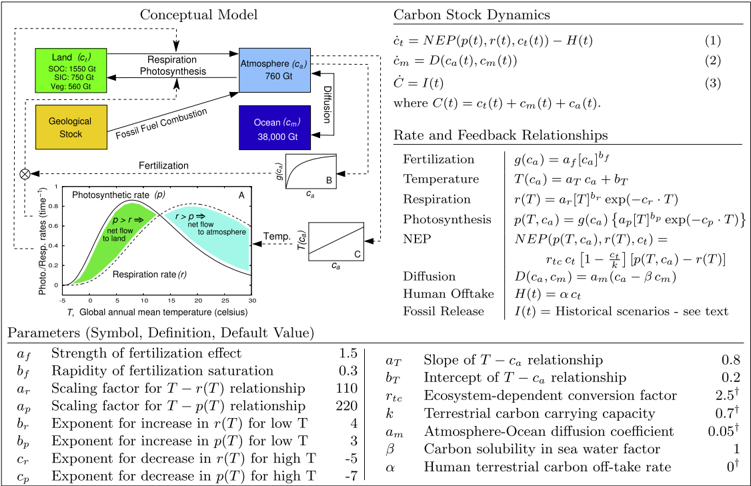
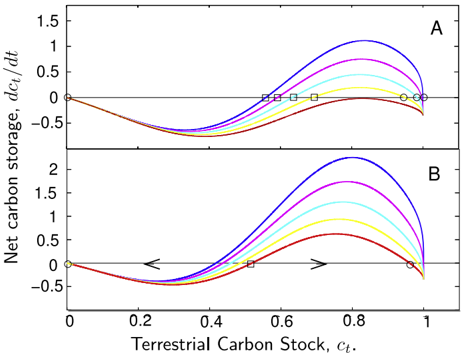
In figure 1 of the original paper, the parameters c r and c p were incorrectly specified as -5 and -7, respectively.The correct values are c r = 5 and c p = 7.Because the correct values were used in the analysis, this typographical error does not affect our results, overall findings, interpretations or conclusions in any way.
Overview
The claims and statistics of this paper haven’t been checked yet.
Free: it reads the open-access text and checks the first 5 claims that cite a source we can check. Create a free account to check every claim.
Integrity signals
Registry
Cites
Statistics
Figures
Verification
Claims the paper makes
The claims and statistics of this paper haven’t been checked yet.
Free: it reads the open-access text and checks the first 5 claims that cite a source we can check. Create a free account to check every claim.
Claims other papers make about this one
Each is checked against this paper’s own text: does it say what the citing paper says it does?
The source backs part of the claim, not all of it — or backs it for a different population, condition or comparison.
In the citing paper
“For example, there is increasing evidence to suggest that transgressing either the climate change or biosphere integrity planetary boundary can potentially lead to more steeply increasing risk in the other (21).”
From Earth beyond six of nine planetary boundaries (2023) · cites this paper as [21]
Experimental — accuracy not yet measuredThe cited source says what the claim attributes to it.
In the citing paper
“Recent studies (13, 14, 21, 22) have shown that additional or more extensive transgression of one planetary boundary can change risk gradients for other boundaries.”
From Earth beyond six of nine planetary boundaries (2023) · cites this paper as [21]
Self-check
Percentages, sums and reported differences re-computed from the paper’s own numbers.
The self-check needs the paper’s full text.
Citations
Cites
A safe operating space for humanity
Rockström, J., Steffen, W., Noone, K., Persson, Å., Chapin, F. S., Lambin, E. F., Lenton, T. M., Scheffer, M., Folke, C., Schellnhuber, H. J., et al. (2009) · Nature · doi:10.1038/461472a · Cited by 13,333 · cited 4×
“In the seminal treatment of Rockström et al [5], the planetary”
BackgroundMethodInfluentialSelf-citationSolomon, S. (2007) · Medical Entomology and Zoology · Cited by 4,149
Tipping elements in the Earth’s climate system
Lenton, T. M., Held, H., Kriegler, E., Hall, J. W., Lucht, W., Rahmstorf, S., & Schellnhuber, H. J. (2008) · Proceedings of the National Academy of Sciences · doi:10.1073/pnas.0705414105 · Cited by 3,982 · cited 2×
“Note, however, that there are many other non-linear processes and potential tipping points [Lenton et al., 2008].”
BackgroundClimate–Carbon Cycle Feedback Analysis: Results from the C4MIP Model Intercomparison
Friedlingstein, P., Cox, P., Betts, R., Bopp, L., von Bloh, W., Brovkin, V., Cadule, P., Doney, S., Eby, M., Fung, I., et al. (2006) · Journal of Climate · doi:10.1175/jcli3800.1 · Cited by 2,902 · cited 1×
“We conclude with the suggestion that future research employ an iterative process using a combination of simple models like that presented here to identify key feedbacks that impact boundaries followed by the use of more complex models to explore these and related feedbacks in more detail to improve the robustness of t…”
MethodTrends in the sources and sinks of carbon dioxide
Le Quéré, C., Raupach, M. R., Canadell, J. G., Marland, G., Bopp, L., Ciais, P., Conway, T. J., Doney, S. C., Feely, R. A., Foster, P., et al. (2009) · Nature Geoscience · doi:10.1038/ngeo689 · Cited by 2,096 · cited 1×
“[24]) and develop a better understanding of the long-term capacity of the ocean carbon sink to keep up with the rising rate of human emissions.”
BackgroundCramer, W., Bondeau, A., Woodward, F. I., Prentice, I. C., Betts, R. A., Brovkin, V., Cox, P. M., Fisher, V., Foley, J. A., Friend, A. D., et al. (2001) · Global Change Biology · doi:10.1046/j.1365-2486.2001.00383.x · Cited by 2,002
Approaching a state shift in Earth’s biosphere
Barnosky, A. D., Hadly, E. A., Bascompte, J., Berlow, E. L., Brown, J. H., Fortelius, M., Getz, W. M., Harte, J., Hastings, A., Marquet, P. A., et al. (2012) · Nature · doi:10.1038/nature11018 · Cited by 1,966
Climate models and their evaluation
Randall, D. A., & Fichefet, T. (2007) · MPG.PuRe (Max Planck Society) · Cited by 1,728
Soil erosion and the global carbon budget
Lal, R. (2003) · Environment International · doi:10.1016/s0160-4120(02)00192-7 · Cited by 1,661 · cited 2×
“We rescale C so that its default value of ‘1’ corresponds to roughly 4500 Gt of carbon with 750, 2850, and 900 in the atmosphere, terrestrial systems, and surface ocean, respectively [6, 16].”
BackgroundCritical Transitions in Nature and Society
Scheffer, M. (2009) · doi:10.1515/9781400833276 · Cited by 1,394
Thermal acclimation and the dynamic response of plant respiration to temperature
Atkin, O. K., & Tjoelker, M. G. (2003) · Trends in Plant Science · doi:10.1016/s1360-1385(03)00136-5 · Cited by 1,304
The Carbon Cycle and Atmospheric Carbon Dioxide
Prentice, I. C., Farquhar, G. D., Fasham, M. J. R., GOULDEN, M. L., Heimann, M., Jaramillo, V. J., Kheshgi, H. S., Quéré, C. L., Scholes, R. J., Wallace, D. W. R., et al. (2001) · HAL · Cited by 1,193
A Global Climatic Model Based on the Energy Balance of the Earth-Atmosphere System
Sellers, W. D. (1969) · Journal of Applied Meteorology · doi:10.1175/1520-0450(1969)008<0392:agcmbo>2.0.co;2 · Cited by 1,124
The effect of solar radiation variations on the climate of the Earth
Budyko, M. I. (1969) · Tellus A: Dynamic Meteorology and Oceanography · doi:10.3402/tellusa.v21i5.10109 · Cited by 984
Rahmstorf, S. (1995) · Nature · doi:10.1038/378145a0 · Cited by 844
Belowground Carbon Allocation in Forest Ecosystems: Global Trends
Raich, J. W., & Nadelhoffer, K. J. (1989) · Ecology · doi:10.2307/1938194 · Cited by 796
Critical transitions in nature and society
(2009) · Choice Reviews Online · doi:10.5860/choice.47-1380 · Cited by 759
Why Is Climate Sensitivity So Unpredictable?
Roe, G. H., & Baker, M. B. (2007) · Science · doi:10.1126/science.1144735 · Cited by 605
North, G. R., Cahalan, R. F., & Coakley, J. A. (1981) · Reviews of Geophysics · doi:10.1029/rg019i001p00091 · Cited by 572
Modelling respiration of vegetation: evidence for a general temperature‐dependent Q10
Tjoelker, M. G., Oleksyn, J., & Reich, P. B. (2001) · Global Change Biology · doi:10.1046/j.1365-2486.2001.00397.x · Cited by 542
Global Convergence in the Temperature Sensitivity of Respiration at Ecosystem Level
Mahecha, M. D., Reichstein, M., Carvalhais, N., Lasslop, G., Lange, H., Seneviratne, S. I., Vargas, R., Ammann, C., Arain, M. A., Cescatti, A., et al. (2010) · Science · doi:10.1126/science.1189587 · Cited by 541
‘Earth system’ analysis and the second Copernican revolution
Schellnhuber, H. J. (1999) · Nature · doi:10.1038/35011515 · Cited by 496 · cited 2×
“Rather, we use the model to conduct Earth System analysis sensu Schellnhuber [12, 13] to understand some general features of the boundaries of the SOS related to land-use change (percentage of global net ecosystem production appropriated for human use), climate change (atmospheric carbon dioxide concentration), and oc…”
MethodNorth, G. R., & Kim, K. (2017) · Wiley eBooks · doi:10.1002/9783527698844 · Cited by 489
Petoukhov, V., Ganopolski, A., Brovkin, V., Claussen, M., Eliseev, A., Kubatzki, C., & Rahmstorf, S. (2000) · Climate Dynamics · doi:10.1007/pl00007919 · Cited by 454
Schuur, E. A. G., & Abbott, B. (2011) · Nature · doi:10.1038/480032a · Cited by 343
Bunce, J. A. (2000) · Photosynthesis Research · doi:10.1023/a:1006325724086 · Cited by 160
Land and ocean carbon cycle feedback effects on global warming in a simple Earth system model
LENTON, T. M. (2000) · Tellus B · doi:10.1034/j.1600-0889.2000.01104.x · Cited by 146 · cited 2×
“In such situations, simple heuristic models can help organize questions and explore interactions that can eventually be addressed using large data sets or more realistic models [Lenton, 2000; Petoukhov et al., 2000; Randall et al., 2007].”
BackgroundResultRedefinition and global estimation of basal ecosystem respiration rate
Yuan, W., Luo, Y., Li, X., Liu, S., Yu, G., Zhou, T., Bahn, M., Black, A. T., Desai, A. R., Cescatti, A., et al. (2011) · Global Biogeochemical Cycles · doi:10.1029/2011gb004150 · Cited by 126
Wenzel, V., & Schellnhuber, H.-J. (1998) · Springer eBooks · doi:10.1007/978-3-642-52354-0 · Cited by 105
Climate change : observed impacts on planet Earth
(2016) · Choice Reviews Online · doi:10.5860/choice.47-2012 · Cited by 104
Discourse: Earth System Analysis — The Scope of the Challenge
Schellnhuber, H. J. (1998) · Springer eBooks · doi:10.1007/978-3-642-52354-0_1 · Cited by 98
MURATA, Y., & IYAMA, J. (1963) · Japanese Journal of Crop Science · doi:10.1626/jcs.31.315 · Cited by 77 · cited 2×
“[29]).”
BackgroundCabrera, H. M., Rada, F., & Cavieres, L. A. (1998) · Oecologia · doi:10.1007/s004420050430 · Cited by 72
Biotic feedback extends the life span of the biosphere
Lenton, T. M., & von Bloh, W. (2001) · Geophysical Research Letters · doi:10.1029/2000gl012198 · Cited by 71 · cited 2×
“Although the equilibria and processes that generate them are different than those in the models of Lenton et al [18] and von Bloh [19], our model will also converge to one of two attractors of interest: ct = k (desirable) and ct = 0 (an undesirable, global desert state) that depend on choices of parameter values and i…”
BackgroundA Geological History of Climate Change
Zalasiewicz, J., & Williams, M. (2009) · Elsevier eBooks · doi:10.1016/b978-0-444-53301-2.00006-3 · Cited by 18
Biogenic Enhancement of Weathering and the Stability of the Ecosphere
von Bloh, W., Franck, S., Bounama, C., & Schellnhuber, H. J. (2003) · Geomicrobiology Journal · doi:10.1080/713851130 · Cited by 17
Climate Tipping Points Come In From the Cold
Kerr, R. A. (2008) · Science · doi:10.1126/science.319.5860.153b · Cited by 12 · cited 1×
“[1, 2].”
Getting a Quick Read on the Biggest Tsunami Earthquakes
Kerr, R. A. (2008) · Science · doi:10.1126/science.319.5860.153a · Cited by 11
Research works printed but not linked: 2
- 32. Forward D F 1960 Effect of temperature on respiration Encyclopedia Plant Physiol. 12 234-58 (part 2)
- 33. James W O 1953 Plant Respiration (Oxford: Clarendon)
Cited by
Planetary boundaries: Guiding human development on a changing planet
Steffen, W., Richardson, K., Rockström, J., Cornell, S. E., Fetzer, I., Bennett, E. M., Biggs, R., Carpenter, S. R., de Vries, W., de Wit, C. A., et al. (2015) · Science · doi:10.1126/science.1259855 · Cited by 12,527
Self-citationEarth beyond six of nine planetary boundaries
Richardson, K., Steffen, W., Lucht, W., Bendtsen, J., Cornell, S. E., Donges, J. F., Drüke, M., Fetzer, I., Bala, G., von Bloh, W., et al. (2023) · Science Advances · doi:10.1126/sciadv.adh2458 · Cited by 3,311
“For example, there is increasing evidence to suggest that transgressing either the climate change or biosphere integrity planetary boundary can potentially lead to more steeply increasing risk in the other ( 21 ).”
Self-citationOur future in the Anthropocene biosphere
Folke, C., Polasky, S., Rockström, J., Galaz, V., Westley, F., Lamont, M., Scheffer, M., Österblom, H., Carpenter, S. R., Chapin, F. S., et al. (2021) · Ambio · doi:10.1007/s13280-021-01544-8 · Cited by 696
Self-citationHuman impacts on planetary boundaries amplified by Earth system interactions
Lade, S. J., Steffen, W., de Vries, W., Carpenter, S. R., Donges, J. F., Gerten, D., Hoff, H., Newbold, T., Richardson, K., & Rockström, J. (2019) · Nature Sustainability · doi:10.1038/s41893-019-0454-4 · Cited by 431
Self-citationAchieving the 17 Sustainable Development Goals within 9 planetary boundaries
Randers, J., Rockström, J., Stoknes, P.-E., Goluke, U., Collste, D., Cornell, S. E., & Donges, J. (2019) · Global Sustainability · doi:10.1017/sus.2019.22 · Cited by 324
“Other examples of simple models related to planetary boundaries include Anderies et al. (2013) on land/ocean/atmosphere carbon dynamics; Heck et al. (2016) whose study linked carbon cycle dynamics with societal land management to explore climate engineering options; and Nitzbon et al. (2017) who…”
BackgroundSelf-citation
Metadata
- Authors
- Anderies, J. M., Carpenter, S. R., Steffen, W., & Rockström, J.
- Affiliations
- Arizona State University (US)
- University of Wisconsin–Madison (US)
- Australian National University (AU)
- Stockholm Resilience Centre (SE)
- Venue
- Environmental Research Letters
- Publisher
- IOP Publishing
- Published
- 2013-12-01
- Volume
- 8
- Issue
- 4
- Pages
- 044048
- ISSN
- 1748-9326 (ISSN-L)
- OpenAlex
- W2065278359
- Semantic Scholar
- b2ebe51844aa015a25de2e450b77bf458de68bb7
- Cited by
- 68
- References
- 38
- Citations by year
- 2026: 6 · 2025: 4 · 2024: 3 · 2023: 6 · 2021: 7 · 2020: 8 · 2019: 11 · 2018: 5 · 2017: 7 · 2016: 5 · 2015: 6
- FWCI
- 2.78
- Type
- journal article
- Language
- en
- Open access
- gold
- doi.org
- Licence
- cc-by
- iopscience.iop.org/info/page/text-and-data-mining (tdm, 15 d)
- creativecommons.org/licenses/by/3.0/ (vor, 15 d)
- Locations
- Environmental Research Letters (publishedVersion, cc-by)
- DOAJ (DOAJ: Directory of Open Access Journals) (submittedVersion)
- ANU Open Research (Australian National University) (submittedVersion)
- Funders
- National Science Foundation (1115054)
- Topics
- Physical Sciences › Environmental Science › Global and Planetary Change › Ecosystem dynamics and resilience
- Physical Sciences › Environmental Science › Global and Planetary Change › Climate variability and models
- Physical Sciences › Environmental Science › Global and Planetary Change › Earth Systems and Cosmic Evolution
- Keywords
- nonlinear dynamics, tipping points, planetary boundaries, carbon cycle, climate tipping points
About these checks
Registry, retraction, Cites and statistics results are computed, not judged, with one exception: a printed reference that no index lists is read once by a model before it counts as a citation error. Claims are extracted by a model and kept only when their quote appears verbatim in the text; each cited source is then checked, with a model’s help, for whether it says what the claim relies on. Those verdicts can be wrong — read the claim’s quote and the cited source before relying on one.
Statistics and arithmetic are recomputed, not judged.
Confidence bands are shown only for fields calibrated on our annotated test set. None is calibrated yet, so no band is shown.
What counts as a claim ›How we measure confidence ›How we check this ›
Are you an author, or do you see a problem with this page? Request a review
Data sources
Bibliographic data: Semantic Scholar, OpenAlex, Crossref.
Contains information from the Semantic Scholar Academic Graph Datasets, made available under the ODC Attribution License (ODC-BY 1.0).
Semantic Scholar’s data is described in: Kinney, R., et al. (2023). The Semantic Scholar Open Data Platform. arXiv:2301.10140.
