

The energy and greenhouse-gas implications of internet video streaming in the United States
Open accessThe DOI matches its Crossref record; 26 of the 26 references it cites were found in a registry or an index.
Abstract
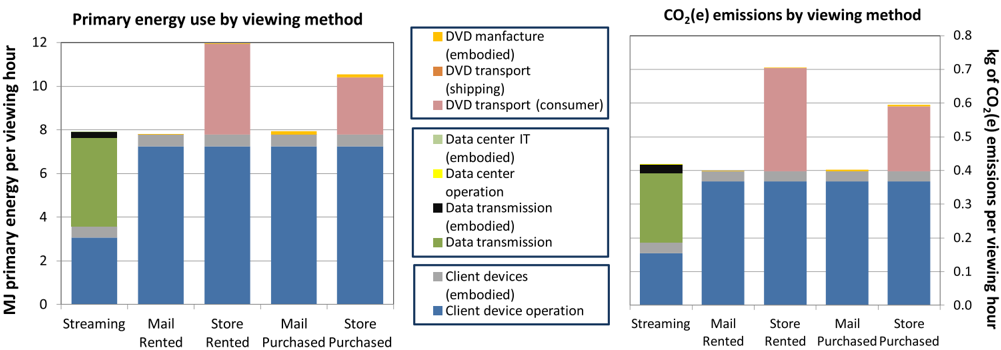
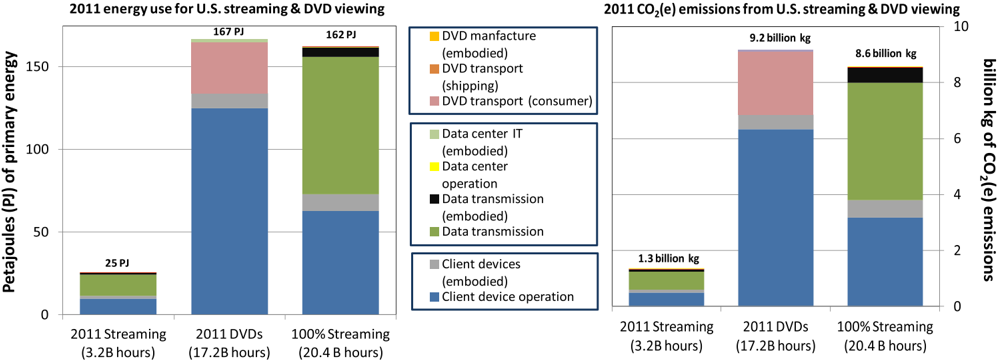
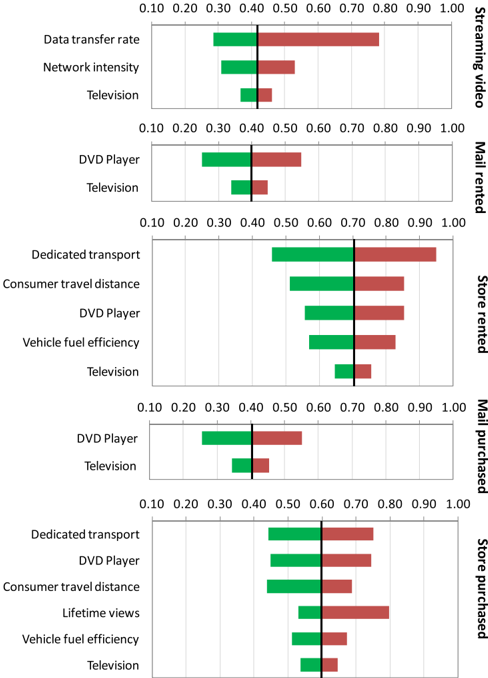
The rapid growth of streaming video entertainment has recently received attention as a possibly less energy intensive alternative to the manufacturing and transportation of digital video discs (DVDs). This study utilizes a life-cycle assessment approach to estimate the primary energy use and greenhouse-gas emissions associated with video viewing through both traditional DVD methods and online video streaming. Base-case estimates for 2011 video viewing energy and CO 2 (e) emission intensities indicate video streaming can be more efficient than DVDs, depending on DVD viewing method. Video streaming benefits from relatively more efficient end-user devices than DVD viewing, though much of that savings is lost when accounting for the additional energy from network data transmission. Video streaming appears distinctly favorable when compared against any DVD viewing that includes consumer driving, which significantly increases the energy and CO 2 (e) emissions per viewing hour. Total US 2011 video viewing required about 192 PJ of primary energy and emitted about 10.5 billion kg of CO 2 (e). Shifting all 2011 DVD viewing to video streaming reduces the total primary energy use to about 162 PJ and the CO 2 (e) emissions to about 8.6 billion kg, representing a savings equivalent to the primary energy used to meet the electricity demand of nearly 200 000 US households each year. Sensitivity analysis indicates that results are most influenced by the end-user DVD player power demand, data transmission energy, and consumer travel for store DVDs. Data center energy use—both operational and embodied within the IT equipment—account for <1% of the total video streaming energy use. Results from this study indicate that designers and policy makers should focus on the efficiency of end-user devices and network transmission energy to curb future increases in energy use from the proliferation of video streaming.
Overview
The claims and statistics of this paper haven’t been checked yet.
Free: it reads the open-access text and checks the first 5 claims that cite a source we can check. Create a free account to check every claim.
Integrity signals
Registry
Cites
Statistics
Figures
Verification
Claims the paper makes
The claims and statistics of this paper haven’t been checked yet.
Free: it reads the open-access text and checks the first 5 claims that cite a source we can check. Create a free account to check every claim.
Claims other papers make about this one
Each is checked against this paper’s own text: does it say what the citing paper says it does?
The cited source says what the claim attributes to it.
In the citing paper
“Other studies highlight the potentials savings from streaming videos versus DVD rental when driving to the rental outlet by car [140,141].”
From Digitalization and the Decoupling Debate: Can ICT Help to Reduce Environmental Impacts While the Economy Keeps Growing? (2020) · cites this paper as [141]
Self-check
Percentages, sums and reported differences re-computed from the paper’s own numbers.
The self-check needs the paper’s full text.
Citations
Cites
Frictionless commerce? A comparison of Internet and conventional retailers
Brynjolfsson, E., & Smith, M. D. (2000) · Management Science · doi:10.1287/mnsc.46.4.563.12061 · Cited by 2,498 · cited 3×
“Also consistent with [24], 50% of the trip is apportioned to the DVD transport to account for multiple purchases and errands per trip in the base-case, while 90% and 10% are used in the high and low cases, respectively.”
BackgroundWorldwide electricity used in data centers
Koomey, J. G. (2008) · Environmental Research Letters · doi:10.1088/1748-9326/3/3/034008 · Cited by 972
Energy Consumption in Optical IP Networks
Baliga, J., Ayre, R., Hinton, K., Sorin, W. V., & Tucker, R. S. (2009) · Journal of Lightwave Technology · doi:10.1109/jlt.2008.2010142 · Cited by 484
Environmental effects of information and communications technologies
Williams, E. (2011) · Nature · doi:10.1038/nature10682 · Cited by 304 · cited 1×
“Furthermore, ICT services may also yield net reductions in societal energy use and environmental impacts as these services augment or replace traditionally non-ICT activities [6, 7], such as utilizing teleconferencing to reduce business travel [8].”
BackgroundRethinking energy efficiency models of cellular networks with embodied energy
Humar, I., Ge, X., Xiang, L., Jo, M., Chen, M., & Zhang, J. (2011) · IEEE Network · doi:10.1109/mnet.2011.5730527 · Cited by 220 · cited 1×
“3MJ and 30 g CO2(e) per GB transferred, again based on literature values utilized in the CLEER model [36, 40, 43] and presented in the SOM.”
MethodAntenna–load interactions at optical frequencies: impedance matching to quantum systems
Olmon, R. L., & Raschke, M. B. (2012) · Nanotechnology · doi:10.1088/0957-4484/23/44/444001 · Cited by 220
Power consumption in telecommunication networks: overview and reduction strategies
Vereecken, W., Heddeghem, W., Deruyck, M., Puype, B., Lannoo, B., Joseph, W., Colle, D., Martens, L., & Demeester, P. (2011) · IEEE Communications Magazine · doi:10.1109/mcom.2011.5783986 · Cited by 212
Erdmann, L., & Hilty, L. M. (2010) · Journal of Industrial Ecology · doi:10.1111/j.1530-9290.2010.00277.x · Cited by 183
Environmental Implications of Wireless Technologies: News Delivery and Business Meetings
Toffel, M. W., & Horvath, A. (2004) · Environmental Science & Technology · doi:10.1021/es035035o · Cited by 176
The Energy and Climate Change Implications of Different Music Delivery Methods
Weber, C. L., Koomey, J. G., & Matthews, H. S. (2010) · Journal of Industrial Ecology · doi:10.1111/j.1530-9290.2010.00269.x · Cited by 141
Research works printed but not linked: 7
- Greenpeace 2011 How Dirty is Your Data? A Look at the Energy Choices that Power Cloud Computing (Amsterdam: Greenpeace International)
- Koomey J G 2011 Growth in data center electricity use 2005 to 2010 (Oakland, CA: Analytics Press)
- Bach D 2012 The Dark Side of the Tune: The Hidden Energy Cost of Digital Music Consumption (London: MusicTank: University of Westminster)
- Malmodin J, Lundén D, Moberg Å, Andersson G and Nilsson M 2014 Life cycle assessment of ICT networks-carbon footprint and operational electricity use from the operator, national and subscriber perspective. J. Ind. Ecol. in press
- United States Department of Energy, 2012, Building Energy Data Book
- Teehan P 2013 The need for consumption-based impact estimation of ICT-based behaviors Int. Symp. on Sustainable Systems & Technologies (Cincinnati, OH)
- Roth K, Tiefenbeck V and Urban B 2011 Energy consumption of consumer electronics in US homes in 2010 (Cambridge, MA: Fraunhofer)
Cited by
On Global Electricity Usage of Communication Technology: Trends to 2030
Andrae, A., & Edler, T. (2015) · Challenges · doi:10.3390/challe6010117 · Cited by 1,334
“For a study on the primary energy demand of video streaming in the United States, Shehabi et al . concluded that the data centers were negligible, and the use of networks and consumer devices were the main contributors [189].”
BackgroundZink, T., & Geyer, R. (2017) · Journal of Industrial Ecology · doi:10.1111/jiec.12545 · Cited by 1,210
“For instance, video-on-demand, which is a virtualization of media delivery, often has lower per-use impacts than physical video delivery, that is, er /e p < 1 (Shehabi et al. 2014; Weber et al. 2008).”
BackgroundDigitalization and energy consumption. Does ICT reduce energy demand?
Lange, S., Pohl, J., & Santarius, T. (2020) · Ecological Economics · doi:10.1016/j.ecolecon.2020.106760 · Cited by 1,132
“Video streaming can save energy compared to DVD purchases or rentals from stores (Shehabi et al., 2014), but the steep rise of hours streamed and of data traffic associated with video streaming will likely outplay such savings potentials (Cisco, 2019).”
BackgroundUnited States Data Center Energy Usage Report
Lawrence Berkeley National Laboratory (LBNL), B., Shehabi, A., USDOE, Smith, S., Sartor, D., Brown, R., Herrlin, M., Koomey, J., Masanet, E., Horner, N., et al. (2016) · doi:10.2172/1372902 · Cited by 1,040
Self-citationElectricity Intensity of Internet Data Transmission: Untangling the Estimates
Aslan, J., Mayers, K., Koomey, J. G., & France, C. (2018) · Journal of Industrial Ecology · doi:10.1111/jiec.12630 · Cited by 212
“Notes: a) Calculated based on assumptions used in Koomey and colleagues (2004), see the Supporting Information available on the Journal’s website; b) calculated based on assumptions used in Taylor and Koomey (2008), see the Supporting Information on the Web; c) estimate for low access rates; d) estimate for high acces…”
Madurai Elavarasan, R., Pugazhendhi, R., Irfan, M., Mihet-Popa, L., Khan, I. A., & Campana, P. E. (2022) · Renewable and Sustainable Energy Reviews · doi:10.1016/j.rser.2022.112204 · Cited by 202
Known unknowns: Indirect energy effects of information and communication technology
Horner, N. C., Shehabi, A., & Azevedo, I. L. (2016) · Environmental Research Letters · doi:10.1088/1748-9326/11/10/103001 · Cited by 177
“…Waste Air emissions Energy Low High Qualitative conclusion Seetharam et al (2010) Video delivery US + + + + + + + + + + 21% 70% # LCA (Process) Shehabi et al (2014) Video delivery US + + + + + + + + + −1% ♢ LCA (Process) Weber et al (2010) Music delivery US + + + + + + + + + −30% 90% # LCA…”
Self-citationPohl, J., Hilty, L. M., & Finkbeiner, M. (2019) · Journal of Cleaner Production · doi:10.1016/j.jclepro.2019.02.018 · Cited by 164
Bieser, J. C. T., & Hilty, L. M. (2018) · Sustainability · doi:10.3390/su10082662 · Cited by 152
Santarius, T., Pohl, J., & Lange, S. (2020) · Sustainability · doi:10.3390/su12187496 · Cited by 132
“Other studies highlight the potentials savings from streaming videos versus DVD rental when driving to the rental outlet by car [140,141].”
BackgroundCourt, V., & Sorrell, S. (2020) · Environmental Research Letters · doi:10.1088/1748-9326/ab6788 · Cited by 112
The environmental sustainability of digital content consumption
Istrate, R., Tulus, V., Grass, R. N., Vanbever, L., Stark, W. J., & Guillén-Gosálbez, G. (2024) · Nature Communications · doi:10.1038/s41467-024-47621-w · Cited by 103
“…components (data centres 16 – 18 , data transmission 19 , and end-user devices 20,21 ), as well as the provided digital services (e.g., social media 22 , video streaming 23 – 26 , virtual conferences 27 – 31 , arti fi cial inteligence 32 , cryptocurrencies 33 – 35 , and online advertising 36 ).”
Wang, L., Wang, H., Cao, Z., He, Y., Dong, Z., & Wang, S. (2022) · Technological Forecasting and Social Change · doi:10.1016/j.techfore.2022.121969 · Cited by 96
Moving academic conferences online: Aids and barriers to delegate participation
Raby, C. L., & Madden, J. R. (2021) · Ecology and Evolution · doi:10.1002/ece3.7376 · Cited by 96
“Comparatively, we calculated the carbon footprint of the online conference based on 2011 technologies suggesting a cost of streaming video of 0.42 kgCO2/hour (likely now far more efficient) (Shehabi et al., 2014), assuming that all delegates engaged in all online activities.”
MethodInfluentialBieser, J. C. T., Hintemann, R., Hilty, L. M., & Beucker, S. (2023) · Environmental Impact Assessment Review · doi:10.1016/j.eiar.2022.107033 · Cited by 113
Recent Trends in Energy-Efficient Cloud Computing
Mastelić, T., & Brandić, I. (2015) · IEEE Cloud Computing · doi:10.1109/mcc.2015.15 · Cited by 60
The climate impact of ICT: A review of estimates, trends and regulationsPreprint
Freitag, C., Berners-Lee, M., Widdicks, K., Knowles, B., Blair, G. S., & Friday, A. (2021) · arXiv (Cornell University) · doi:10.48550/arxiv.2102.02622 · Cited by 60
“…have come under scrutiny [Kamiya 2020] due to arguments that they were based on old data, that energy impacts of the internet are much lower [cf. Shehabi et al. 2014] and that energy intensities of data transmissions are halving every two years [cf. Aslan et al. 2017] – following the…”
BackgroundMadlener, R., Sheykhha, S., & Briglauer, W. (2021) · Energy Policy · doi:10.1016/j.enpol.2021.112716 · Cited by 59
A digital-twin and machine-learning framework for precise heat and energy management of data-centers
Zohdi, T. I. (2022) · Computational Mechanics · doi:10.1007/s00466-022-02152-3 · Cited by 50
The Ecological Criteria of Circular Growth and the Rebound Risk of Closed Loops
Horváth, B., Bahna, M., & Fogarassy, C. (2019) · Sustainability · doi:10.3390/su11102961 · Cited by 46
“, recycling [64,65], virtualization [66,67]) which cannot be taken for granted in a general sense.”
BackgroundSuski, P., Pohl, J., & Frick, V. (2020) · International Conference on ICT for Sustainability (ICT4S) · doi:10.1145/3401335.3401709 · Cited by 48
“These findings are supported by Shehabi et al. [19] , who recommend to increase the energy efficiency of user devices and networks in order to limit the increase in energy consumption from online video streaming.”
The Carbon Footprint of Streaming Media: Problems, Calculations, Solutions
Marks, L. U., & Przedpełski, R. (2022) · Palgrave studies in media and environmental communication · doi:10.1007/978-3-030-98120-4_10 · Cited by 41
Isley, S., Stern, P. C., Carmichael, S. P., Joseph, K. M., & Arent, D. J. (2016) · Proceedings of the National Academy of Sciences · doi:10.1073/pnas.1522211113 · Cited by 28
Schien, D., Shabajee, P., Chandaria, J., Williams, D., & Preist, C. (2021) · Environmental Impact Assessment Review · doi:10.1016/j.eiar.2021.106661 · Cited by 32
“It has also been used to assess digital services and the associated greenhouse gas (GHG) emissions from electricity used to provide those services (Moberg et al., 2010; Weber et al., 2010; Moberg et al., 2011; Coroama et al., 2012; Schien et al., 2013b; Hischier et al., 2014; Shehabi et al., 2014; Mayers et al., 2015).”
BackgroundThe net climate effect of digitalization, differentiating between firms and households
Kopp, T., Nabernegg, M., & Lange, S. (2023) · Energy Economics · doi:10.1016/j.eneco.2023.106941 · Cited by 25
Life Cycle Assessment of CO2 Emissions of Online Music and Videos Streaming in Japan
Tabata, T., & Wang, T. Y. (2021) · Applied Sciences · doi:10.3390/app11093992 · Cited by 28
Uddin, M., Hamdi, M., Alghamdi, A., Alrizq, M., Memon, M. S., Abdelhaq, M., & Alsaqour, R. A. (2021) · International Journal of Distributed Sensor Networks · doi:10.1177/1550147721997218 · Cited by 19
Calculating the Carbon Footprint of Streaming Media: Beyond the Myth of Efficiency
Makonin, S., Marks, L. U., Przedpełski, R., Rodriquez-Silva, A., & ElMallah, R. (2022) · Workshop on Computing within Limits (LIMITS) · doi:10.21428/bf6fb269.7625cc76 · Cited by 45
“[61] assumed that a consumer watches only five hours of movies per month.”
BackgroundThe Climate Effect of Digitalization in Production and Consumption in OECD Countries.
Lange, S., & Kopp, T. (2019) · Cited by 20
Viana, L. R., Cheriet, M., Nguyen, K.-K., Marchenko, D., & Boucher, J. (2022) · Sustainable Production and Consumption · doi:10.1016/j.spc.2022.09.025 · Cited by 22
Trends in home computing and energy demand
Terry, N., & Palmer, J. A. (2015) · Building Research & Information · doi:10.1080/09613218.2015.1040284 · Cited by 13
“However, Shehabi, Walker, and Masanet (2014) looked specifically at video streaming and found that the server energy use is just 0.001 kWh/GB and the network uses a further 0.15–0.43 kWh/GB.”
BackgroundInfluentialTowards a Sustainable Internet of Sounds
Gabrielli, L., & Turchet, L. (2022) · Audio Mostly Conference (AM) · doi:10.1145/3561212.3561246 · Cited by 24
“With video data being the most bandwidth-intensive activity on the network, several works investigated the impact of watching various aspects of movie streaming [31, 48, 55].”
BackgroundSeger, B. T., Burkhardt, J., Straub, F., Scherz, S., & Nieding, G. (2023) · Journal of Consumer Policy · doi:10.1007/s10603-023-09536-9 · Cited by 16
Ankrah, I., Appiah-Kubi, M. A., Twumasi-Ankrah, S., Sackey, F. G., Asravor, R. K., Brenya, B., Donkor, D. O., Arthur, L., Lamptey, C., & Mochiah, E. E.-A. (2024) · Technology in Society · doi:10.1016/j.techsoc.2024.102759 · Cited by 12
Nair, A., Auerbach, G., & Skerlos, S. J. (2019) · Procedia CIRP · doi:10.1016/j.procir.2019.01.102 · Cited by 10
Dekoninck, E. A., & Barbaccia, F. (2019) · Proceedings of the ... International Conference on Engineering Design · doi:10.1017/dsi.2019.379 · Cited by 19
“Studies by Malmodin et al. (2010, 2012 and 2014) and Shehabi et al. (2014) were used to find the impact of the network connection, for both the use of the smartphone app in the store and the fridge connection in the home.”
MethodEmission-smart advertising: Balancing performance with CO2 emissions in digital advertising
Hana, N. E., Kondrateva, G., & Martin, S. L. (2024) · Technological Forecasting and Social Change · doi:10.1016/j.techfore.2024.123818 · Cited by 9
Client-Side Energy Costs of Video Streaming
Ejembi, O., & Bhatti, S. N. (2015) · IEEE International Conference on Data Science and Data Intensive Systems · doi:10.1109/dsdis.2015.49 · Cited by 7
Modeling Data-Plane Power Consumption of Future Internet Architectures
Chen, C., Barrera, D., & Perrig, A. (2016) · IEEE International Conference on Collaboration and Internet Computing (CIC) · doi:10.1109/cic.2016.031 · Cited by 7
“Increased power consumption not only implies greater monetary cost, but also exerts an expanding environmental impact such as carbon footprint [1], [36] and pollution [8].”
BackgroundAssessing the Carbon Reduction Potential for Video Streaming from Short-Term Coding Changes
Schien, D., Shabajee, P., Akyol, H. B., Benson, L. R., & Katsenou, A. (2024) · International Conference on Quality of Multimedia Experience (QoMEX) · doi:10.1109/qomex61742.2024.10598286 · Cited by 10
“Shehabi et al. [11] compared the carbon emissions of US video consumption between streaming and physical DVD shipping and find that streaming is substantially less carbon intense.”
BackgroundHüppauff, T. L., Richter, N., & Hunecke, M. (2022) · Current Research in Ecological and Social Psychology · doi:10.1016/j.cresp.2022.100045 · Cited by 11
Taylor, A. R. E., & Vai, E. (2025) · Springer eBooks · doi:10.1007/978-3-031-88173-2_9 · Cited by 8
Bridging the Gap: A Debate on Sustainability Aspects of Digital Media in Education
Spangenberger, P., & Söbke, H. (2025) · Education Sciences · doi:10.3390/educsci15020241 · Cited by 11
LCAart: Communicating industrial ecology at a human scale
Eckelman, M. J., & Laboy, M. M. (2020) · Journal of Industrial Ecology · doi:10.1111/jiec.12978 · Cited by 7
“Similarly Petrotini (Figure 1j) tells the story of energy use in cloud services such as streaming video, estimated by Shehabi, Walker, and Masanet (2014) as 7.9MJ/hr of streaming, approximately equivalent to an 8-oz. martini glass of gasoline—yum!”
Somerville, L., Stucki, M., & Keller, R. (2024) · International Journal of Sustainability in Higher Education · doi:10.1108/ijshe-04-2023-0125 · Cited by 4
Energy‐Efficient Cloud Computing Techniques for Next Generation
Mishra, P. K., Sivaram, M., Arvindhan, M., Daniel, A., & Ranjan, R. (2022) · Wiley eBooks · doi:10.1002/9781119821878.ch3 · Cited by 4
Klimas, C. A., & Shaffer, B. (2019) · Sustainable Production and Consumption · doi:10.1016/j.spc.2019.02.004 · Cited by 5
Sustainable Cloud Encoding for Adaptive Bitrate Streaming over CDNs
Wang, C., & Zink, M. (2019) · IEEE International Symposium on Local and Metropolitan Area Networks (LANMAN) · doi:10.1109/lanman.2019.8847134 · Cited by 4
“3 billion kilograms of carbon dioxide [18].”
A Plug-Loads Game Changer: Computer Gaming Energy Efficiency without Performance Compromise
Mills, E., Bourassa, N. J., Rainer, L., Mai, J., Vaino, I., Curtin, C., Shehabi, A., Desroches, L., & Mills, N. (2019) · Lawrence Berkeley National Laboratory · doi:10.2172/2274683 · Cited by 3
Self-citationStreaming the Future of Sustainability
Lewis, R. H., & Conway, A. (2024) · ACM SIGEnergy Energy Informatics Review · doi:10.1145/3727200.3727225 · Cited by 3
“Historically, the energy and material footprint of video distribution has been high, whether in the form of physical media like DVDs and the devices to play them, or in the embodied emissions of powerful user devices needed to decode compressed video [43].”
On the energy consumption of online and on-site lectures
Holas, A., Koch, C. Y., Leibold, J. P., Prendi, A., Schlachta, T. P., Schmid, A. S., & Schmitt, L. (2022) · Environmental Research Communications · doi:10.1088/2515-7620/ac77df · Cited by 3
Life Cycle Assessment of Four Different Sweaters
Nolimal, S. (2018) · Digital Commons-DePaul (DePaul University) · Cited by 2
The dark side of companies’ digital transformation: the carbon footprint of online activities
Μαγρίζος, Σ. (2025) · International Marketing Review · doi:10.1108/imr-10-2024-0398 · Cited by 2
Die Energiewende im Spannungsfeld von Gesellschaft und Politik
Luczak, A. (2020) · Springer eBooks · doi:10.1007/978-3-658-30277-1_5 · Cited by 1
Datenwert und Datenminimalismus: Wege zu nachhaltiger künstlicher Intelligenz
Regneri, M. (2021) · Management-Reihe Corporate Social Responsibility · doi:10.1007/978-3-662-63223-9_10 · Cited by 1
Video on demand in a high bandwidth world
Machanick, P. (2017) · South African Institute of Computer Scientists and Information Technologists · doi:10.1145/3129416.3129424
On the Performance of Adaptive Bitrate Streaming and Parallel Cloud Applications
Wang, C. (2018) · ScholarWorks@UMassAmherst (University of Massachusetts Amherst) · doi:10.7275/11237617.0
A Physical Theory of WealthPreprint
Luke, P. (2023) · doi:10.14293/pr2199.000471.v1
Ankrah, I., Appiah-Kubi, M. A., Twumasi-Ankrah, S., Sackey, F. G., Asravor, R. K., Brenya, B., Donkor, D. O., Arthur, L., Lamptey, C., & Mochiah, E. E.-A. (2023) · SSRN Electronic Journal · doi:10.2139/ssrn.4678514
Die Energiewende im Spannungsfeld von Gesellschaft und Politik
Luczak, A. (2024) · Springer eBooks · doi:10.1007/978-3-658-45008-3_5
Towards Estimating the Carbon Footprint of Video Streaming
Urvoy-Keller, G., Mouliérac, J., Dinuzzi, M., & Ma, Z. (2025) · International Symposium on Networks, Computers and Communications (ISNCC) · doi:10.1109/isncc66965.2025.11250443
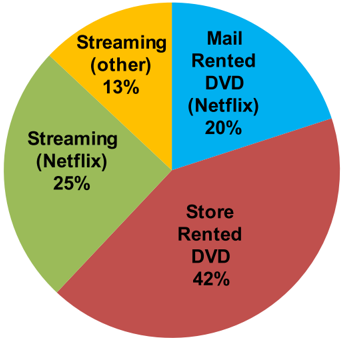
“While a bit older, [21] compares, for the US case in 2011, the CO 2 emissions for different means of vieweing a video: video streaming, mail or store renting.”
Low-carbon solutions for energy-intensive live-streaming commerce
Sun, L., Tian, X., & You, F. (2026) · Energy · doi:10.1016/j.energy.2026.140686
Standardisation Supporting Sustainability Objectives
Mueck, M., Gorini, B., Claesen, K., & du Boispéan, S. (2026) · Advances in sustainability science and technology · doi:10.1007/978-981-92-0458-8_4
Metadata
- Authors
- Shehabi, A., Walker, B., & Masanet, E.
- Affiliations
- Lawrence Berkeley National Laboratory (US)
- Northwestern University (US)
- Corresponding author
- Shehabi, Arman
- Venue
- Environmental Research Letters
- Publisher
- IOP Publishing
- Published
- 2014-05-01
- Volume
- 9
- Issue
- 5
- Pages
- 054007
- ISSN
- 1748-9326 (ISSN-L)
- OpenAlex
- W2012139708
- Cited by
- 63
- References
- 26
- Citations by year
- 2026: 2 · 2025: 4 · 2024: 7 · 2023: 5 · 2022: 10 · 2021: 8 · 2020: 6 · 2019: 8 · 2018: 2 · 2017: 3 · 2016: 4 · 2015: 4
- FWCI
- 1.95
- Type
- journal article
- Language
- en
- Open access
- gold
- doi.org
- Licence
- cc-by
- iopscience.iop.org/info/page/text-and-data-mining (tdm, 27 d)
- creativecommons.org/licenses/by/3.0/ (vor, 27 d)
- Locations
- Environmental Research Letters (publishedVersion, cc-by)
- DOAJ (DOAJ: Directory of Open Access Journals) (submittedVersion)
- Funders
- U.S. Department of Energy (-AC02-05CH11231, 05CH11231, DE AC02 05CH11231, DE-AC02-)
- Office of Science (DEAC02–05CH11231, AC02-05CH11231, DE-AC02, 05CH11231)
- Lawrence Berkeley National Laboratory (AC02‐05CH11231, DE-AC02-05CH11231, 05CH11231)
- Topics
- Physical Sciences › Engineering › Electrical and Electronic Engineering › Green IT and Sustainability
- Physical Sciences › Environmental Science › Environmental Engineering › Environmental Impact and Sustainability
- Social Sciences › Business, Management and Accounting › Strategy and Management › Legal Systems and Institutions
- Keywords
- internet video streaming, primary energy consumption, greenhouse gas emissions, CO2 emissions, data centers, energy efficiency, life cycle assessment
About these checks
Registry, retraction, Cites and statistics results are computed, not judged, with one exception: a printed reference that no index lists is read once by a model before it counts as a citation error. Claims are extracted by a model and kept only when their quote appears verbatim in the text; each cited source is then checked, with a model’s help, for whether it says what the claim relies on. Those verdicts can be wrong — read the claim’s quote and the cited source before relying on one.
Statistics and arithmetic are recomputed, not judged.
Confidence bands are shown only for fields calibrated on our annotated test set. None is calibrated yet, so no band is shown.
What counts as a claim ›How we measure confidence ›How we check this ›
Are you an author, or do you see a problem with this page? Request a review
Data sources
Bibliographic data: Semantic Scholar, OpenAlex, Crossref.
Contains information from the Semantic Scholar Academic Graph Datasets, made available under the ODC Attribution License (ODC-BY 1.0).
Semantic Scholar’s data is described in: Kinney, R., et al. (2023). The Semantic Scholar Open Data Platform. arXiv:2301.10140.
