

Perceived heat stress increases with population density in urban Philippines
Open accessThe DOI matches its Crossref record; 59 of the 59 references it cites were found in a registry or an index.
Abstract
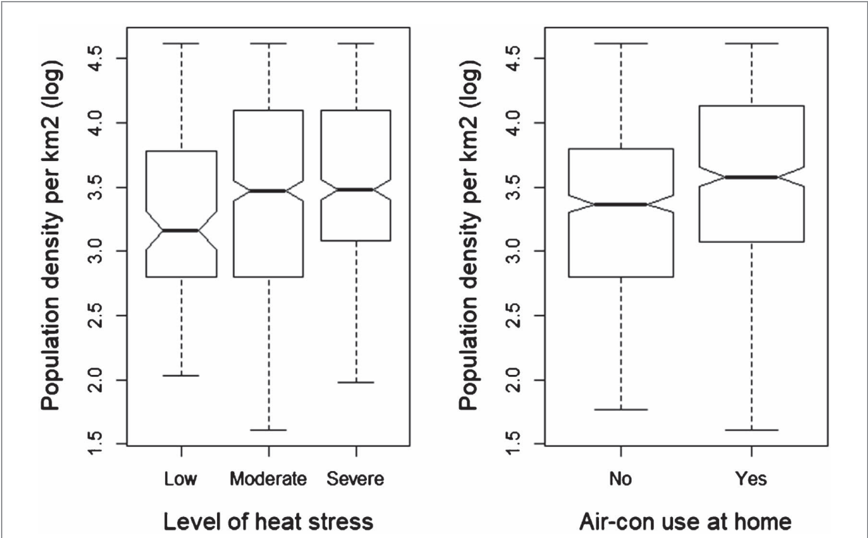
The world's population is increasingly urban, with more than half the global population already living in cities. The urban population is particularly affected by increasing temperatures because of the urban heat island (UHI) effect. Increasing temperatures cause heat stress in people, even when not directly exposed to heat, since outdoor meteorological conditions also affect conditions inside, particularly in non-air-conditioned environments. Heat stress harms people's health, can impair their well-being and productivity, and may cause substantial economic losses. In this study, we investigate how people in urban areas across the Philippines are affected by heat, using data from 1161 responses obtained through an online survey. We found that almost all respondents (91%) are already experiencing heat stress quite severely and that the level of heat stress is correlated with population density. Controlling, in a multiple log it model, for variables commonly associated with heat stress, such as age, health, physical exertion and climate, we found that those least likely to be severely affected by heat live in areas with fewer than ∼7000 people per km 2 . Air-conditioning use at home relieved heat stress mostly for people in low-density areas but not where population density was high. The results provide evidence for the social impacts of increasing heat in urban areas, complementing understanding of well-known physical impacts such as the UHI effect.
Overview
The claims and statistics of this paper haven’t been checked yet.
Free: it reads the open-access text and checks the first 5 claims that cite a source we can check. Create a free account to check every claim.
Integrity signals
Registry
Cites
Statistics
Figures
Verification
Claims the paper makes
The claims and statistics of this paper haven’t been checked yet.
Free: it reads the open-access text and checks the first 5 claims that cite a source we can check. Create a free account to check every claim.
Claims other papers make about this one
Each is checked against this paper’s own text: does it say what the citing paper says it does?
The check wasn’t confident either way, so it gives no verdict — never disputed.
In the citing paper
“Without good planning, squatters may increase, resulting in inconvenient housing and a lack of necessary services [107].”
From Assessing the Spatial Mapping of Heat Vulnerability under Urban Heat Island (UHI) Effect in the Dhaka Metropolitan Area (2022) · cites this paper as [107]
Experimental — accuracy not yet measured
Self-check
Percentages, sums and reported differences re-computed from the paper’s own numbers.
The self-check needs the paper’s full text.
Citations
Cites
R: A Language and Environment for Statistical Computing
R Core Team (2025) · doi:10.32614/r.manuals · Cited by 352,181
Updated world map of the Köppen-Geiger climate classification
(2007) · doi:10.5194/hess-11-1633-2007 · Cited by 13,640
Global non-linear effect of temperature on economic production
Burke, M., Hsiang, S. M., & Miguel, E. (2015) · Nature · doi:10.1038/nature15725 · Cited by 2,913
Impact of urbanization and land-use change on climate
Kalnay, E., & Cai, M. (2003) · Nature · doi:10.1038/nature01675 · Cited by 2,370
Mora, C., Dousset, B., Caldwell, I. R., Powell, F. E., Geronimo, R. C., Bielecki, C. R., Counsell, C. W. W., Dietrich, B. S., Johnston, E. T., Louis, L. V., et al. (2017) · Nature Climate Change · doi:10.1038/nclimate3322 · Cited by 1,746
Utilising green and bluespace to mitigate urban heat island intensity
Gunawardena, K. R., Wells, M. J., & Kershaw, T. (2017) · Science of The Total Environment · doi:10.1016/j.scitotenv.2017.01.158 · Cited by 1,433
The sleep-deprived human brain
Krause, A. J., Simon, E. B., Mander, B. A., Greer, S. M., Saletin, J. M., Goldstein-Piekarski, A. N., & Walker, M. P. (2017) · Nature Reviews Neuroscience · doi:10.1038/nrn.2017.55 · Cited by 1,200
Increasing frequency, intensity and duration of observed global heatwaves and warm spells
Perkins, S. E., Alexander, L. V., & Nairn, J. R. (2012) · Geophysical Research Letters · doi:10.1029/2012gl053361 · Cited by 1,153
High ambient temperature and mortality: a review of epidemiologic studies from 2001 to 2008
Basu, R. (2009) · Environmental Health · doi:10.1186/1476-069x-8-40 · Cited by 1,135
Santamouris, M., Cartalis, C., Synnefa, A., & Kolokotsa, D. (2015) · Energy and Buildings · doi:10.1016/j.enbuild.2014.09.052 · Cited by 1,063
Research works printed but not linked: 11
- Philippine Atmospheric Geophysical Astronomical Services Administration PAGASA 2018 Observed Climate Trends and Projected Climate Change for Metro Manila-Climate Information Risk Analysis Matrix (CLIRAM) (Quezon City: DOST-PAGASA)
- Villarin J T et al 2016 Philippine Climate Change Assessment (PhilCCA): The Physical Science Basis (Pasig City: Oscar M Lopez Center for Climate Change Adaptation and Disaster Risk Management Foundation)
- Kjellstrom T, Kovats R S, Lloyd S J, Holt T and Tol R S 2015 Climate Change and Increasing Heat Impacts on Labor Productivity (Neslon: Ruby Coast Research Centre)
- Philippine Statistics Authority PSA 2017 Annual Labor and Employment Status (Manila: Preliminary Results of the 2017 Annual Estimates of Labor Force Survey)
- Philippine Atmospheric Geophysical Astronomical Services Administration PAGASA 2018 Observed Climate Trends and Projected Climate Change for Metro Manila -Climate Information Risk Analysis Matrix (CLIRAM) (Quezon: DOST-PAGASA)
- Wei T, Simko V, Levy M, Xie Y, Jin Y and Zemla J 2017 Package 'Corrplot': Visualization of a Correlation Matrix (Vienna: CRAN)
- Ripley V N and Venables B D 2016 Package 'NNET': Feed-Forward Neural Networks and Multinomial Log-Linear Models (Vienna: CRAN)
- Mijares A C, Regmi M B and Yai T 2014 Enhancing the sustainability and inclusiveness of the Metro Manila's urban transportation systems: proposed fare and policy reforms Trans. Commun. Bull. Asia Pacific 84 28-40
- Asian Development Bank 2012 Philippines: Transport Sector Assessment, Strategy, and Road Map Manila
- O'Neill M 2003 Air conditioning and heat-related health effects Appl. Environ. Sci. Publ. Health 1 9-12
- Pisaniello J, Bi P, Hansen D and Sullivan T 2014 Association between high temperature and work-related injuries in Adelaide, South Australia, 2001-2010 Occup. Environ. Med. 71 246-52 · DOI · Paper page
Cited by
Estoque, R. C., Ooba, M., Seposo, X. T., Togawa, T., Hijioka, Y., Takahashi, K., & Nakamura, S. (2020) · Nature Communications · doi:10.1038/s41467-020-15218-8 · Cited by 346
Socioeconomic drivers of urban heat island effect: Empirical evidence from major Chinese cities
Li, Y., Sun, Y., Li, J., & Gao, C. (2020) · Sustainable Cities and Society · doi:10.1016/j.scs.2020.102425 · Cited by 190
Urban heat stress and human health in Bangkok, Thailand
Arifwidodo, S. D., & Chandrasiri, O. (2020) · Environmental Research · doi:10.1016/j.envres.2020.109398 · Cited by 169
Zhang, M., Tan, S., Zhang, Y., He, J. L., & Ni, Q. (2022) · Ecological Indicators · doi:10.1016/j.ecolind.2022.108705 · Cited by 127
Human mobility intentions in response to heat in urban South East Asia
Zander, K. K., Richerzhagen, C., & Garnett, S. T. (2019) · Global Environmental Change · doi:10.1016/j.gloenvcha.2019.03.004 · Cited by 106
Self-citation
Metadata
- Authors
- Zander, K. K., Cadag, J. R., Escarcha, J., & Garnett, S. T.
- Affiliations
- German Institute of Development and Sustainability (DE)
- University of the Philippines Diliman (PH)
- Charles Darwin University (AU)
- Corresponding author
- Zander, Kerstin K
- Venue
- Environmental Research Letters
- Publisher
- IOP Publishing
- Published
- 2018-07-27
- Volume
- 13
- Issue
- 8
- Pages
- 084009
- ISSN
- 1748-9326 (ISSN-L)
- OpenAlex
- W2819971063
- Cited by
- 73
- References
- 59
- Citations by year
- 2026: 9 · 2025: 8 · 2024: 9 · 2023: 17 · 2022: 11 · 2021: 7 · 2020: 8 · 2019: 4
- FWCI
- 2.39
- Type
- journal article
- Language
- en
- Open access
- gold
- doi.org
- Licence
- cc-by
- iopscience.iop.org/info/page/text-and-data-mining (tdm)
- creativecommons.org/licenses/by/3.0/ (vor)
- Locations
- Environmental Research Letters (publishedVersion, cc-by)
- DOAJ (DOAJ: Directory of Open Access Journals) (submittedVersion)
- Greater South Information System
- Funders
- Charles Darwin University
- Topics
- Physical Sciences › Environmental Science › Environmental Engineering › Urban Heat Island Mitigation
- Physical Sciences › Environmental Science › Health, Toxicology and Mutagenesis › Climate Change and Health Impacts
- Health Sciences › Medicine › Physiology (medical) › Thermoregulation and physiological responses
- Keywords
- heat stress, urban heat island, population density, urban heat, air conditioning use, urban climate, Philippines
About these checks
Registry, retraction, Cites and statistics results are computed, not judged, with one exception: a printed reference that no index lists is read once by a model before it counts as a citation error. Claims are extracted by a model and kept only when their quote appears verbatim in the text; each cited source is then checked, with a model’s help, for whether it says what the claim relies on. Those verdicts can be wrong — read the claim’s quote and the cited source before relying on one.
Statistics and arithmetic are recomputed, not judged.
Confidence bands are shown only for fields calibrated on our annotated test set. None is calibrated yet, so no band is shown.
What counts as a claim ›How we measure confidence ›How we check this ›
Are you an author, or do you see a problem with this page? Request a review
Data sources
Bibliographic data: Semantic Scholar, OpenAlex, Crossref.
Contains information from the Semantic Scholar Academic Graph Datasets, made available under the ODC Attribution License (ODC-BY 1.0).
Semantic Scholar’s data is described in: Kinney, R., et al. (2023). The Semantic Scholar Open Data Platform. arXiv:2301.10140.
