

Cleaner air has contributed one-fifth of US maize and soybean yield gains since 1999
Open accessThe DOI matches its Crossref record; 36 of the 36 references it cites were found in a registry or an index.
Abstract
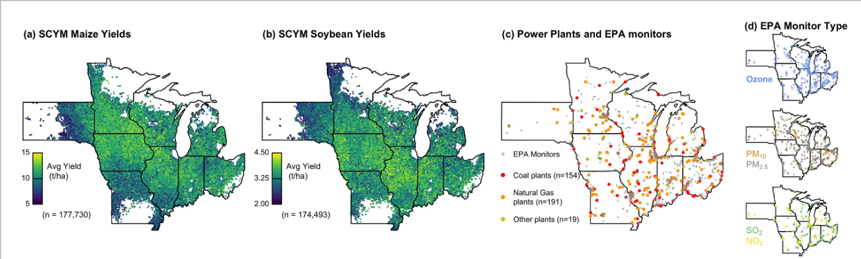
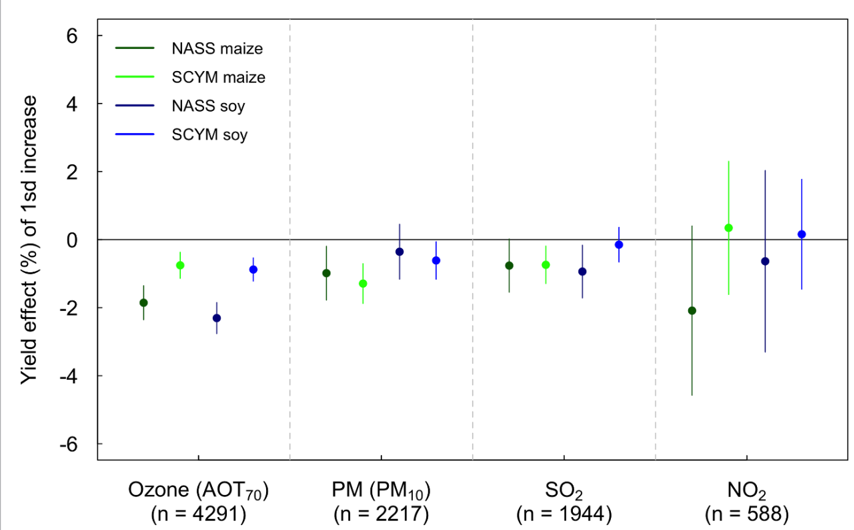
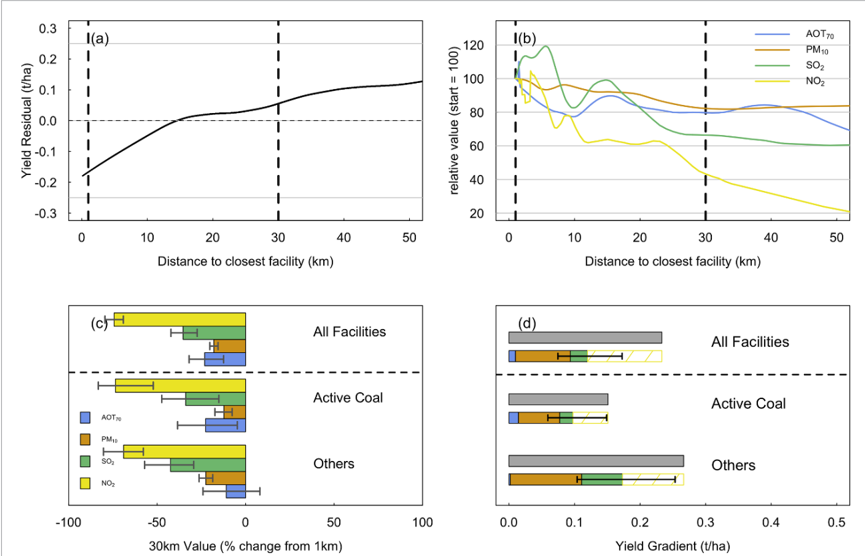
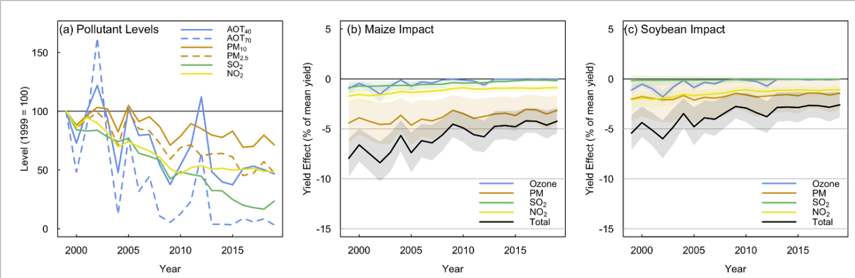
Crop productivity is potentially affected by several air pollutants, although these are usually studied in isolation. A significant challenge to understanding the effects of multiple pollutants in many regions is the dearth of air quality data near agricultural fields. Here we empirically estimate the effect of four key pollutants (ozone (O 3), particulate matter (PM), sulfur dioxide (SO 2), and nitrogen dioxide (NO 2)) on maize and soybean yields in the United States using a combination of administrative data and satellite-derived yield estimates. We identify clear negative effects of exposure to O 3, PM, and SO 2 in both crops, using yields measured in the vicinity of monitoring stations. We also show that while stations measuring NO 2 are too sparse to reliably estimate a yield effect, the strong gradient of NO 2 concentrations near power plants allows us to more precisely estimate NO 2 effects using satellite measured yield gradients. The presence of some powerplants that turn on and others that shut down during the study period are particularly useful for attributing yield gradients to pollution. We estimate that total yield losses from these pollutants averaged roughly 5% for both maize and soybean over the past two decades. While all four pollutants have statistically significant effects, PM and NO 2 appear more damaging to crops at current levels than O 3 and SO 2. Finally, we find that the significant improvement in air quality since 1999 has halved the impact of poor air quality on major crops and contributed to yield increases that represent roughly 20% of overall yield gains over that period.
Overview
The claims and statistics of this paper haven’t been checked yet.
Free: it reads the open-access text and checks the first 5 claims that cite a source we can check. Create a free account to check every claim.
Integrity signals
Registry
Cites
Statistics
Figures
Verification
Claims the paper makes
The claims and statistics of this paper haven’t been checked yet.
Free: it reads the open-access text and checks the first 5 claims that cite a source we can check. Create a free account to check every claim.
Claims other papers make about this one
Each is checked against this paper’s own text: does it say what the citing paper says it does?
In the citing paper
“A study on the historical losses to air pollutants in maize and soybean grown in the United States showed that improvements in the control of O3, SO2, PM, and NO2 have improved yields by an average of 20% [121].”
From Changes in tropospheric air quality related to the protection of stratospheric ozone in a changing climate (2023) · cites this paper as [121]
In the citing paper
“Overall, the improvement in yields was equivalent to ca US$ 5 billion.”
From Changes in tropospheric air quality related to the protection of stratospheric ozone in a changing climate (2023) · cites this paper as [121]
In the citing paper
“Of these pollutants, PM and NO2 appeared to cause more damage than O3 and SO2.”
From Changes in tropospheric air quality related to the protection of stratospheric ozone in a changing climate (2023) · cites this paper as [121]
Self-check
Percentages, sums and reported differences re-computed from the paper’s own numbers.
The self-check needs the paper’s full text.
Citations
Cites
Google Earth Engine: Planetary-scale geospatial analysis for everyone
Gorelick, N., Hancher, M., Dixon, M., Ilyushchenko, S., Thau, D., & Moore, R. (2017) · Remote Sensing of Environment · doi:10.1016/j.rse.2017.06.031 · Cited by 14,719
Daly, C., Halbleib, M., Smith, J. I., Gibson, W. P., Doggett, M. K., Taylor, G. H., Curtis, J., & Pasteris, P. P. (2008) · International Journal of Climatology · doi:10.1002/joc.1688 · Cited by 3,100
Development of gridded surface meteorological data for ecological applications and modelling
Abatzoglou, J. T. (2013) · International Journal of Climatology · doi:10.1002/joc.3413 · Cited by 1,916 · cited 1×
“In addition, for testing whether EPA monitoring stations (and, by inference, agricultural fields) upwind and downwind of power plants experienced significantly different pollution levels, we obtained daily wind speeds for each power plant facility from the University of Idaho Gridded Surface Meteorological Dataset [28…”
MethodSimultaneously Mitigating Near-Term Climate Change and Improving Human Health and Food Security
Shindell, D., Kuylenstierna, J. C. I., Vignati, E., van Dingenen, R., Amann, M., Klimont, Z., Anenberg, S. C., Muller, N., Janssens-Maenhout, G., Raes, F., et al. (2012) · Science · doi:10.1126/science.1210026 · Cited by 1,382 · cited 1×
“These uncertainties limit our ability to identify the potential benefits for agriculture from air quality improvements associated with technology or policy changes [10], as well as which pollutants deserve the most scrutiny.”
BackgroundBoryan, C., Yang, Z., Mueller, R., & Craig, M. (2011) · Geocarto International · doi:10.1080/10106049.2011.562309 · Cited by 1,212
The critical role of extreme heat for maize production in the United States
Lobell, D. B., Hammer, G. L., McLean, G., Messina, C., Roberts, M. J., & Schlenker, W. (2013) · Nature Climate Change · doi:10.1038/nclimate1832 · Cited by 1,026 · cited 1×
“Although one could argue that some of the effects attributed to extreme heat are in fact fromO3, several lines of evidence indicate a strong impact of extreme heat even in the absence of O3: extreme heat has similar effects in recent decades with much lower O3 than prior decades [38]; crop model simulations can reprod…”
BackgroundSelf-citationThe Mortality and Medical Costs of Air Pollution: Evidence from Changes in Wind Direction
Deryugina, T., Heutel, G., Miller, N. H., Molitor, D., & Reif, J. (2019) · American Economic Review · doi:10.1257/aer.20180279 · Cited by 771
Van Dingenen, R., Dentener, F. J., Raes, F., Krol, M. C., Emberson, L., & Cofala, J. (2009) · Atmospheric Environment · doi:10.1016/j.atmosenv.2008.10.033 · Cited by 719 · cited 3×
“Given the emphasis of much of the literature on O3 impacts [3, 5, 6, 34], it is somewhat surprising that bothNO2 and PMemerge asmore important thanO3 in most of our specifications.”
BackgroundA scalable satellite-based crop yield mapper
Lobell, D. B., Thau, D., Seifert, C., Engle, E., & Little, B. (2015) · Remote Sensing of Environment · doi:10.1016/j.rse.2015.04.021 · Cited by 602 · cited 10×
“SCYM estimates have been validated for both crops against county and field level data in the region [17, 18].”
BackgroundMethodSelf-citationAvnery, S., Mauzerall, D. L., Liu, J., & Horowitz, L. W. (2011) · Atmospheric Environment · doi:10.1016/j.atmosenv.2010.11.045 · Cited by 596 · cited 3×
“Given the emphasis of much of the literature on O3 impacts [3, 5, 6, 34], it is somewhat surprising that bothNO2 and PMemerge asmore important thanO3 in most of our specifications.”
Background
Cited by
Climate change exacerbates the environmental impacts of agriculture
Yang, Y., Tilman, D., Jin, Z., Smith, P., Barrett, C. B., Zhu, Y.-G., Burney, J., D’Odorico, P., Fantke, P., Fargione, J., et al. (2024) · Science · doi:10.1126/science.adn3747 · Cited by 547
“In the US, for example, pollutants such as O 3 , NO x , SO 2 , and PM 2.5 (fine particulate matter) are estimated to have caused ~5% yield loss in maize and soybean yields over the past two decades ( 22 ).”
BackgroundInfluentialSelf-citationThe EAT–Lancet Commission on healthy, sustainable, and just food systems
Rockström, J., Thilsted, S. H., Willett, W. C., Gordon, L. J., Herrero, M., Hicks, C. C., Mason-D'Croz, D., Rao, N., Springmann, M., Wright, E. C., et al. (2025) · The Lancet · doi:10.1016/s0140-6736(25)01201-2 · Cited by 475
Hu, T., Zhang, X., Khanal, S., Wilson, R., Leng, G., Toman, E. M., Wang, X., Li, Y., & Zhao, K. (2024) · Environmental Modelling & Software · doi:10.1016/j.envsoft.2024.106119 · Cited by 168
“…the crop modeling literature, the distinction between predictive and explanatory models are not always articulated, but the difference is apparent (Lobell and Burney, 2021; Shook et al., 2021): When using machine learning to estimate crop yields in the future, modelers emphasize predictive power;…”
Globally ubiquitous negative effects of nitrogen dioxide on crop growth
Lobell, D. B., Tommaso, S. D., & Burney, J. A. (2022) · Science Advances · doi:10.1126/sciadv.abm9909 · Cited by 136
“For example, the World Health Organization guidelines state a “no effect” level for vegetation of 15 to 20 g/m3 for annual average NO2 [roughly 8 to 11 parts per billion (ppb)] (25), whereas reported NO2 levels in most regions commonly exceed these values (4, 7, 19).”
BackgroundSelf-citationWheat as a Nutritional Powerhouse: Shaping Global Food Security
Sharma, K., & Sharma, P. K. (2025) · Agricultural sciences. · doi:10.5772/intechopen.1009499 · Cited by 84
Metadata
- Authors
- Lobell, D. B., & Burney, J. A.
- Affiliations
- Stanford University (US)
- University of California San Diego (US)
- Corresponding author
- Lobell, David B
- Venue
- Environmental Research Letters
- Publisher
- IOP Publishing
- Published
- 2021-07-01
- Volume
- 16
- Issue
- 7
- Pages
- 074049
- ISSN
- 1748-9326 (ISSN-L)
- OpenAlex
- W3176851564
- Cited by
- 45
- References
- 36
- Citations by year
- 2026: 6 · 2025: 11 · 2024: 10 · 2023: 8 · 2022: 6 · 2021: 4
- FWCI
- 4.20
- Type
- journal article
- Language
- en
- Open access
- gold
- doi.org
- Licence
- cc-by
- creativecommons.org/licenses/by/4.0 (vor, 13 d)
- iopscience.iop.org/info/page/text-and-data-mining (tdm, 13 d)
- Locations
- Environmental Research Letters (publishedVersion, cc-by)
- DOAJ (DOAJ: Directory of Open Access Journals) (submittedVersion)
- Funders
- National Science Foundation (1639318, 1715557)
- National Aeronautics and Space Administration (80NSSC17K0652, 54308-Z6059203)
- U.S. Department of Agriculture
- NASA Harvest (80NSSC17K0652)
- National Institute of Food and Agriculture
- Topics
- Life Sciences › Agricultural and Biological Sciences › Plant Science › Plant responses to elevated CO2
- Life Sciences › Agricultural and Biological Sciences › Agronomy and Crop Science › Climate change impacts on agriculture
- Physical Sciences › Environmental Science › Health, Toxicology and Mutagenesis › Air Quality and Health Impacts
- Keywords
- air pollution, crop yield, maize, soybean, ozone, particulate matter, sulfur dioxide, nitrogen dioxide, power plants, air quality improvement, yield loss, United States
About these checks
Registry, retraction, Cites and statistics results are computed, not judged, with one exception: a printed reference that no index lists is read once by a model before it counts as a citation error. Claims are extracted by a model and kept only when their quote appears verbatim in the text; each cited source is then checked, with a model’s help, for whether it says what the claim relies on. Those verdicts can be wrong — read the claim’s quote and the cited source before relying on one.
Statistics and arithmetic are recomputed, not judged.
Confidence bands are shown only for fields calibrated on our annotated test set. None is calibrated yet, so no band is shown.
What counts as a claim ›How we measure confidence ›How we check this ›
Are you an author, or do you see a problem with this page? Request a review
How to cite
Cite CoChat for the checks on this page, and the paper for its own findings.
- This page
- CoChat. (2026). Citation check: Cleaner air has contributed one-fifth of US maize and soybean yield gains since 1999. https://app.cochat.ai/papers/10.1088/1748-9326/ac0fa4
- The paper
- Lobell, D. B., & Burney, J. A. (2021). Cleaner air has contributed one-fifth of US maize and soybean yield gains since 1999. Environmental Research Letters. https://doi.org/10.1088/1748-9326/ac0fa4
Data sources
Bibliographic data: Semantic Scholar, OpenAlex, Crossref.
Contains information from the Semantic Scholar Academic Graph Datasets, made available under the ODC Attribution License (ODC-BY 1.0).
Semantic Scholar’s data is described in: Kinney, R., et al. (2023). The Semantic Scholar Open Data Platform. arXiv:2301.10140.
