

The DOI matches its Crossref record; 2 of the 2 references it cites were found in a registry or an index.
Comprehensiveness of circular economy assessments of regions: a systematic review at the macro-level
Abstract
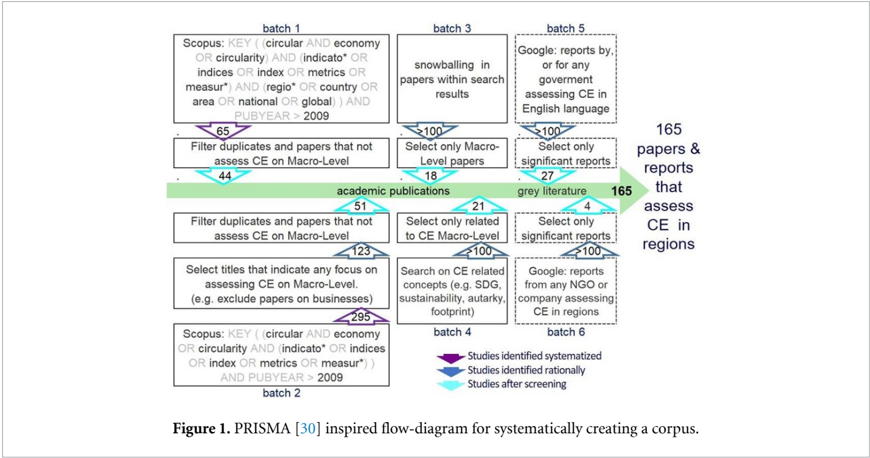
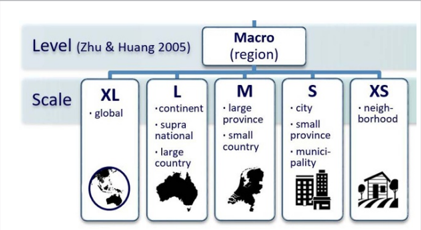
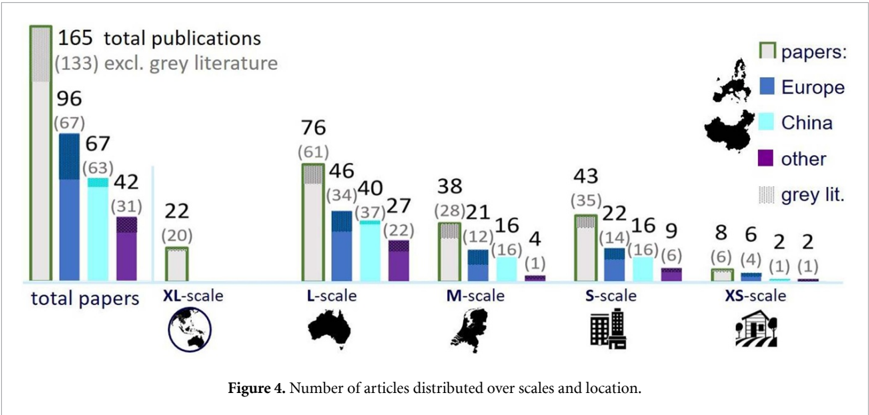
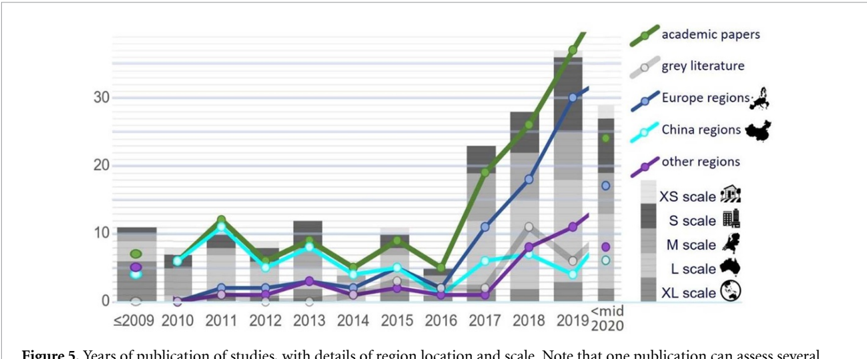
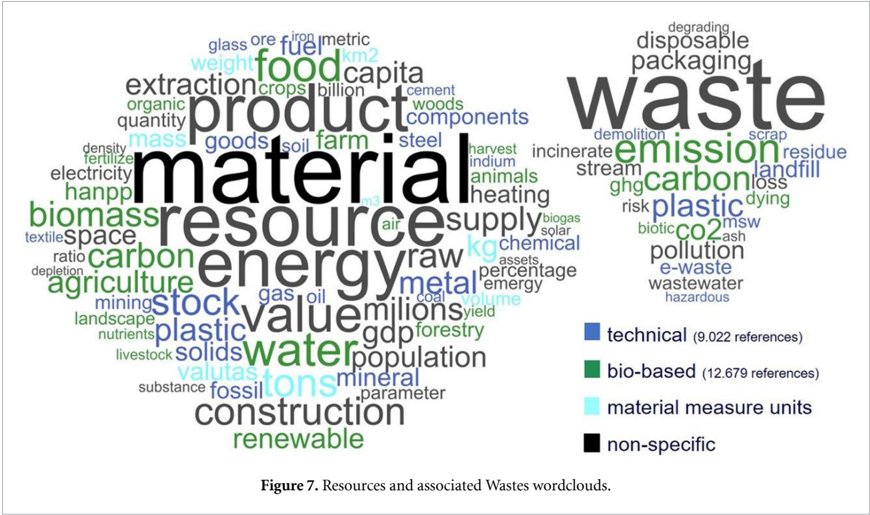
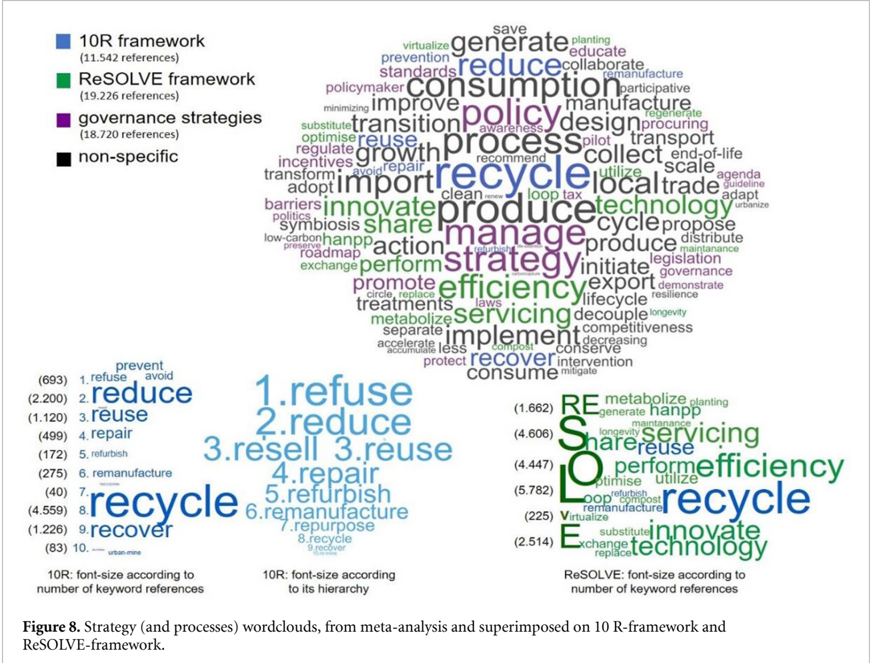
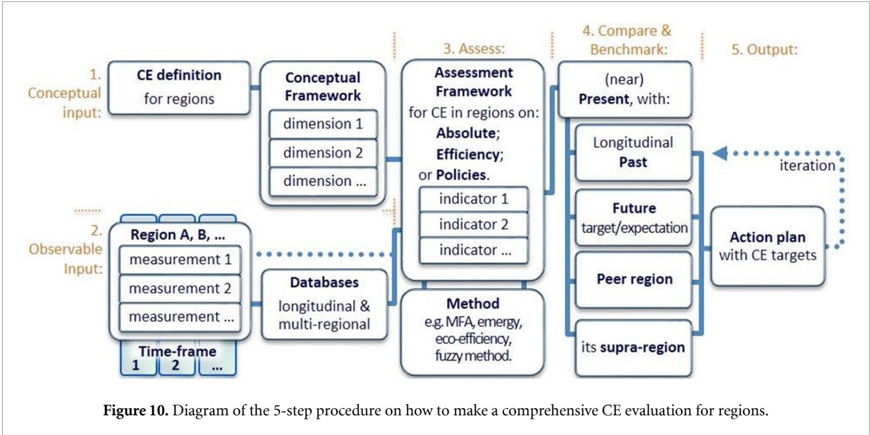
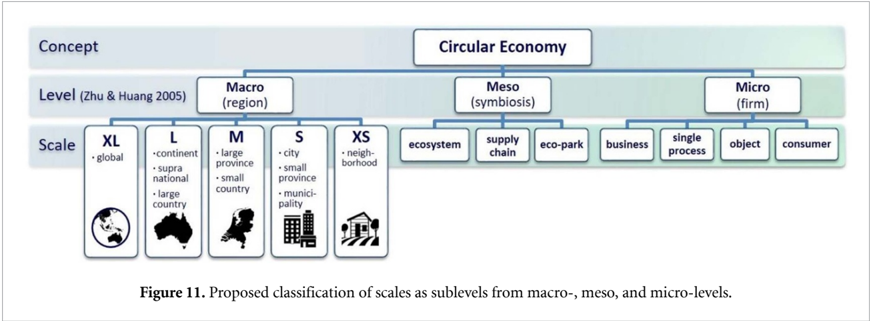
The circular economy (CE) is emerging as a solution for a thriving economy within regional and planetary boundaries for environment and social justice. CE is multifaceted with interconnected processes and therefore rather difficult to assess comprehensively. This paper reviewed the corpus of macro-level CE assessments, to find the best practices in CE assessments of regions scaling from neighborhoods to planetary. The extensive content analysis on the corpus of 165 studies used a novel mixed methods of meta-analysis, taxonomy and integrative review. This review investigates the comprehensiveness of CE assessments. Findings include three types of CE performance monitoring, four types of resource clustering, five scales, and a 5-step procedure to evaluate CE. CE can be monitored on: (a) absolute performance, quantifying economic resource-input, stock and waste-output; (b) efficiency performance, monitoring the optimization of CE processes similar to recycling, reuse, or even sharing and virtualizing; (c) policy performance to monitor strategies from regional stakeholders. Resource clustering can create hierarchies by metrics, uses, system-boundaries, or emergy. Identified scales are: XL for the planet; L for continents; M for large provinces, states and smaller countries; S for cities; and, XS for neighborhoods. Scales assist in comparing and benchmarking, but are also required for a proposed policy of localizing CE. This review found the ReSOLVE-framework as relatively comprehensive on CE processes. Also, multiple knowledge gaps were identified among resources, processes and regions. This review aids CE knowledge accumulation across regions and scales, to accelerate implementing the CE.
Overview
The claims and statistics of this paper haven’t been checked yet.
Run the check — free, no account needed. It reads the open-access text and checks the sources it cites.
Integrity signals
Registry
Cites
Statistics
Figures
Verification
Claims the paper makes
The claims and statistics of this paper haven’t been checked yet.
Run the check — free, no account needed. It reads the open-access text and checks the sources it cites.
Claims other papers make about this one
Each is checked against this paper’s own text: does it say what the citing paper says it does?
The cited source says what the claim attributes to it.
In the citing paper
“it is challenging to characterize polycentric waste governance for different regions, although current work has systematically compiled the methods for evaluating the circular economy 26 .”
From Characterizing the polycentricity in waste governance: a comparative study on Shanghai, Tokyo, and Hong Kong (2024) · cites this paper as [26]
Self-check
Percentages, sums and reported differences re-computed from the paper’s own numbers.
The self-check needs the paper’s full text.
Citations
Cites
Wohlin, C. (2014) · Proceedings of the 18th International Conference on Evaluation and Assessment in Software Engineering · doi:10.1145/2601248.2601268 · Cited by 4,234 · cited 1×
“Batch 3 extends the corpus via snowballing by checking citations in papers from the search results to identify additional papers [31].”
BackgroundWriting Integrative Literature Reviews: Guidelines and Examples
Torraco, R. J. (2005) · Human Resource Development Review · doi:10.1177/1534484305278283 · Cited by 3,534 · cited 1×
“An integrative approach ‘reviews, critiques, and synthesizes representative literature on a topic in an integrated way such that new frameworks and perspectives on the topic are generated’ [29].”
Background
Research works printed but not linked: 67
- Geng, 2012, Towards a national circular economy indicator system in China: an evaluation and critical analysis, J. Clean. Prod., 23, 216, 10.1016/j.jclepro.2011.07.005 · DOI
- Kirchherr, 2017, Conceptualizing the circular economy: an analysis of 114 definitions, Resour. Conserv. Recycl., 127, 221, 10.1016/j.resconrec.2017.09.005 · DOI · Paper page
- Geissdoerfer, 2017, The circular economy -a new sustainability paradigm?, J. Clean. Prod., 143, 757, 10.1016/j.jclepro.2016.12.048 · DOI · Paper page
- Paiho, 2020, Towards circular cities -conceptualizing core aspects, Sustain. Cities Soc., 59, 10.1016/j.scs.2020.102143 · DOI
- Webster, 2013, What might we say about a circular economy? Some temptations to avoid if possible, World Futures, 69, 542, 10.1080/02604027.2013.835977 · DOI
- Korhonen, 2004, Industrial ecology in the strategic sustainable development model: strategic applications of industrial ecology, J. Clean. Prod., 12, 809, 10.1016/j.jclepro.2004.02.026 · DOI
- Bhutta, 1999, Benchmarking Best Practices: An Integrated Approach, Benchmarking, 6, 3, 10.1108/14635779910289261 · DOI
- Drucker, 1999, Knowledge-worker productivity: the biggest challenge, Calif. Manage. Rev., 41, 79, 10.2307/41165987 · DOI
- Zhu, 2005, Building up a model for circular economy based on object, main body, policy, Naikai Acad. J., 4, 86e93
- Geng, 2008, Developing the circular economy in China: challenges and opportunities for achieving ‘leapfrog development’, Int. J. Sustain. Dev. World Ecol., 15, 231, 10.3843/SusDev.15.3:6 · DOI
- Geng, 2019, How to globalize the circular economy, Nature, 565, 153, 10.1038/d41586-019-00017-z · DOI
- Ghisellini, 2016, A review on circular economy: the expected transition to a balanced interplay of environmental and economic systems, J. Clean. Prod., 114, 11, 10.1016/j.jclepro.2015.09.007 · DOI · Paper page
- Haupt, 2017, Do we have the right performance indicators for the circular economy?: insight into the Swiss waste management system, J. Ind. Ecol., 21, 615, 10.1111/jiec.12506 · DOI
- Milios, 2018, Advancing to a circular economy: three essential ingredients for a comprehensive policy mix, Sustainability Science, 13, 861, 10.1007/s11625-017-0502-9 · DOI · Paper page
- Silvestri, 2020, Regional development of circular economy in the European Union: a multidimensional analysis, J. Clean. Prod., 255, 10.1016/j.jclepro.2020.120218 · DOI
- Jiao, 2014, Toward a research agenda for policy intervention and facilitation to enhance industrial symbiosis based on a comprehensive literature review, J. Clean. Prod., 67, 14, 10.1016/j.jclepro.2013.12.050 · DOI
- Saidani, 2019, A taxonomy of circular economy indicators, J. Clean. Prod., 207, 542, 10.1016/j.jclepro.2018.10.014 · DOI · Paper page
- Sassanelli, 2019, Circular economy performance assessment methods: a systematic literature review, J. Clean. Prod., 229, 440, 10.1016/j.jclepro.2019.05.019 · DOI
- Cooper, 1988, Organizing knowledge syntheses: a taxonomy of literature reviews, Knowl. Soc., 1, 104
- Humphrey, 2011, What does a great meta-analysis look like?, Organ. Psychol. Rev., 1, 99, 10.1177/2041386611401273 · DOI
- Elsbach, 2020, Creating high‐impact literature reviews: an argument for ‘integrative reviews’, J. Manage. Stud., 57, 1277, 10.1111/joms.12581 · DOI
- Moher, 2009, Preferred reporting items for systematic reviews and meta-analyses: the PRISMA-statement, PLoS Med., 6, 10.1371/journal.pmed.1000097 · DOI · Paper page
- Erb, 2009a, Analyzing the global human appropriation of net primary production—processes, trajectories, implications. An introduction, Ecol. Econ., 69, 250, 10.1016/j.ecolecon.2009.07.001 · DOI
- Erb, 2009b, Embodied HANPP: mapping the spatial disconnect between global biomass production and consumption, Ecol. Econ., 69, 328, 10.1016/j.ecolecon.2009.06.025 · DOI
- Rockström, 2009, A safe operating space for humanity, Nature, 461, 472, 10.1038/461472a · DOI · Paper page
- Krysovatyy, 2018, Preconditions for the tax environment of a alterglobal development, Comp. Econ. Res., 21, 139, 10.2478/cer-2018-0031 · DOI
- Islam, 2019, Material flow analysis (MFA) as a strategic tool in E-waste management: applications, trends and future directions, J. Environ. Manage., 244, 344, 10.1016/j.jenvman.2019.05.062 · DOI
- Smol, 2017, Circular economy indicators in relation to eco-innovation in European regions, Clean Technol. Environ. Policy, 19, 669, 10.1007/s10098-016-1323-8 · DOI
- Werner, 2018, Looking down under for a circular economy of indium, Environ. Sci. Technol., 52, 2055, 10.1021/acs.est.7b05022 · DOI
- Golev, 2014, Rare earths supply chains: current status, constraints and opportunities, Resour. Policy, 41, 52, 10.1016/j.resourpol.2014.03.004 · DOI
- Haas, 2015, How circular is the global economy?: an assessment of material flows, waste production, and recycling in the European Union and the world in 2005, J. Ind. Ecol., 19, 765, 10.1111/jiec.12244 · DOI
- Borucke, 2013, Accounting for demand and supply of the biosphere’s regenerative capacity: the National Footprint Accounts’ underlying methodology and framework, Ecol. Indic., 24, 518, 10.1016/j.ecolind.2012.08.005 · DOI
- Geng, 2009, Implementing China’s circular economy concept at the regional level: a review of progress in Dalian, China, Waste Manage., 29, 996, 10.1016/j.wasman.2008.06.036 · DOI
- Gao, 2012, The coordination development between economy and environment within whole nation and Xinjiang based on the evaluation and forecast, Adv. Mater. Res., 524–527, 3477, 10.4028/www.scientific.net/AMR.524-527.3477 · DOI
- Garcia-Bernabeu, 2020, A process oriented MCDM approach to construct a circular economy composite index, Sustainability, 12, 618, 10.3390/su12020618 · DOI
- Liu, 2014, Research on the evaluation system of circular economy development of three gorges reservoir region, Appl. Mech. Mater., 446–447, 1375, 10.4028/www.scientific.net/AMM.446-447.1375 · DOI
- Qian, 2011, Warning model system of circular economy development and its application, Xitong Gongcheng Lilun Yu Shijian/System Eng. Theory Pract., 31
- Huang, 2003, Materials flow analysis and emergy evaluation of Taipei’s urban construction, Landsc. Urban Plan., 63, 10.1016/S0169-2046(02)00152-4 · DOI
- Santagata, 2020, Assessing the sustainability of urban eco-systems through Emergy-based circular economy indicators, Ecol. Indic., 109, 10.1016/j.ecolind.2019.105859 · DOI
- Sun, 2017, Eco-benefits assessment on urban industrial symbiosis based on material flows analysis and emergy evaluation approach: a case of Liuzhou city, China, Resour. Conserv. Recycl., 119, 78, 10.1016/j.resconrec.2016.06.007 · DOI
- Geng, 2013, Measuring China’s circular economy, Science, 340, 10.1126/science.1227059 · DOI
- Haberl, 2013, Using embodied HANPP to analyze teleconnections in the global land system: conceptual considerations, Geogr. Tidsskr., 109, 10.1080/00167223.2009.10649602 · DOI
- Haberl, 2007, Quantifying and mapping the human appropriation of net primary production in earth’s terrestrial ecosystems, 104, 10.1073/pnas.0704243104 · DOI · Paper page
- Haberl, 2012, Natural and socioeconomic determinants of the embodied human appropriation of net primary production and its relation to other resource use indicators, Ecol. Indic., 23, 222, 10.1016/j.ecolind.2012.03.027 · DOI
- Guo, 2017, Comparative assessment of circular economy development in China’s four megacities: the case of Beijing, Chongqing, Shanghai and Urumqi, J. Clean. Prod., 162, 234, 10.1016/j.jclepro.2017.06.061 · DOI
- Salguero-Puerta, 2019, Sustainability indicators concerning waste management for implementation of the circular economy model on the University of Lome (Togo) campus, Int. J. Environ. Res. Public Health, 16, 2234, 10.3390/ijerph16122234 · DOI
- Wang, 2018, Evaluation of Urban circular economy development: an empirical research of 40 cities in China, J. Clean. Prod., 180, 876, 10.1016/j.jclepro.2018.01.089 · DOI
- Christis, 2019, Implementation at a city level of circular economy strategies and climate change mitigation—the case of Brussels, J. Clean. Prod., 218, 511, 10.1016/j.jclepro.2019.01.180 · DOI
- de Ferreira, 2019, A framework for implementing and tracking circular economy in cities: the case of Porto, Sustainability, 11, 1813, 10.3390/su11061813 · DOI
- Prendeville, 2018, Circular cities: mapping six cities in transition, Environ. Innov. Soc. Transit., 26, 171, 10.1016/j.eist.2017.03.002 · DOI · Paper page
- Reike, 2018, The circular economy: new or refurbished as CE 3.0? -Exploring controversies in the conceptualization of the circular economy through a focus on history and resource value retention options, Resour. Conserv. Recycl., 135, 246, 10.1016/j.resconrec.2017.08.027 · DOI
- Korhonen, 2018, Circular economy: the concept and its limitations, Ecol. Econ., 143, 37, 10.1016/j.ecolecon.2017.06.041 · DOI · Paper page
- Morseletto, 2020, Targets for a circular economy, Resour. Conserv. Recycl., 153, 10.1016/j.resconrec.2019.104553 · DOI
- Wang, 2020, Measuring progress of China’s circular economy, Resour. Conserv. Recycl., 163, 10.1016/j.resconrec.2020.105070 · DOI
- Avdiushchenko, 2019, Circular economy indicators as a supporting tool for European regional development policies, Sustainability, 11, 3025, 10.3390/su11113025 · DOI
- Gao, 2020, Pathways towards regional circular economy evaluated using material flow analysis and system dynamics, Resour. Conserv. Recycl., 154, 10.1016/j.resconrec.2019.104527 · DOI
- Scarpellini, 2019, Definition and measurement of the circular economy’s regional impact, J. Environ. Plan. Manage., 62, 2211, 10.1080/09640568.2018.1537974 · DOI
- Tang, 2010, Material flow analysis on venous industrial park -taking tianjin ziya circular economy park for examplep, 1828, 10.1109/ICIEEM.2010.5645913 · DOI
- Boulding, 1966, The economics of the coming spaceship earth, 10.1177/002200275700100203 · DOI
- Wilts, 2016, From waste management to resource efficiency -the need for policy mixes, Sustainability, 8, 622, 10.3390/su8070622 · DOI
- Marsden, 2011, How do cities approach policy innovation and policy learning? A study of 30 policies in Northern Europe and North America, Transp. Policy, 18, 501, 10.1016/j.tranpol.2010.10.006 · DOI
- Bagozzi, 2011, Measurement and meaning in information systems and organizational research: methodological and philosophical foundations, MIS Q., 35, 261, 10.2307/23044044 · DOI
- Ravallion, 2010, Mashup indices of development. The World Bank, World Bank Research Observer, 27, 1
- Fernandez-Mena, 2020, Flows in Agro-food networks (FAN): an agent-based model to simulate local agricultural material flows, Agric. Syst., 180, 10.1016/j.agsy.2019.102718 · DOI
- Lenzen, 2012, International trade drives biodiversity threats in developing nations, Nature, 486, 109, 10.1038/nature11145 · DOI
- Notarnicola, 2017, Environmental impacts of food consumption in Europe, J. Clean. Prod., 140, 753, 10.1016/j.jclepro.2016.06.080 · DOI
- Franklin-Johnson, 2016, Resource duration as a managerial indicator for circular economy performance, J. Clean. Prod., 133, 589, 10.1016/j.jclepro.2016.05.023 · DOI · Paper page
Cited by
Sorted by citations
Hao, X., Dong, L., Qian, X., Benjamin, S., Wang, H., Chen, P., Wang, X., Ma, W., Li, J., Tong, X., et al. (2024) · npj Urban Sustainability · doi:10.1038/s42949-024-00179-4 · Cited by 8
Metadata
- Authors
- Van Bueren, B. J. A., Iyer-Raniga, U., Leenders, M. A. A. M., & Argus, K.
- Venue
- Environmental Research Letters
- Publisher
- IOP Publishing
- Published
- 2021-09-16
- Volume
- 16
- Issue
- 10
- Pages
- 103001
- ISSN
- 1748-9326
- Cited by
- 30
- References
- 2
About these checks
Registry, retraction, Cites and statistics results are computed, not judged, with one exception: a printed reference that no index lists is read once by a model before it counts as a citation error. Claims are extracted by a model and kept only when their quote appears verbatim in the text; each cited source is then checked, with a model’s help, for whether it says what the claim relies on. Those verdicts can be wrong — read the claim’s quote and the cited source before relying on one.
Statistics and arithmetic are recomputed, not judged.
Confidence bands are shown only for fields calibrated on our annotated test set. None is calibrated yet, so no band is shown.
What counts as a claim ›How we measure confidence ›How we check this ›
Are you an author, or do you see a problem with this page? Request a review
