

β-Catenin and Smad3 regulate the activity and stability of myocardin-related transcription factor during epithelial–myofibroblast transition
Open accessThe DOI matches its Crossref record; 65 of the 65 references it cites were found in a registry or an index.
Abstract
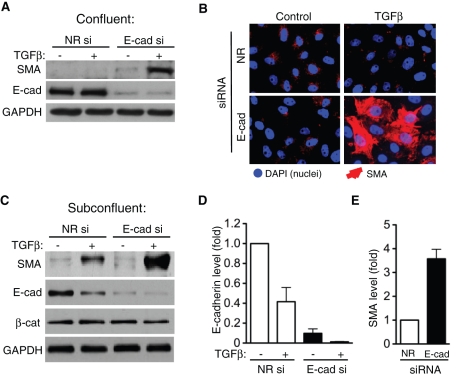
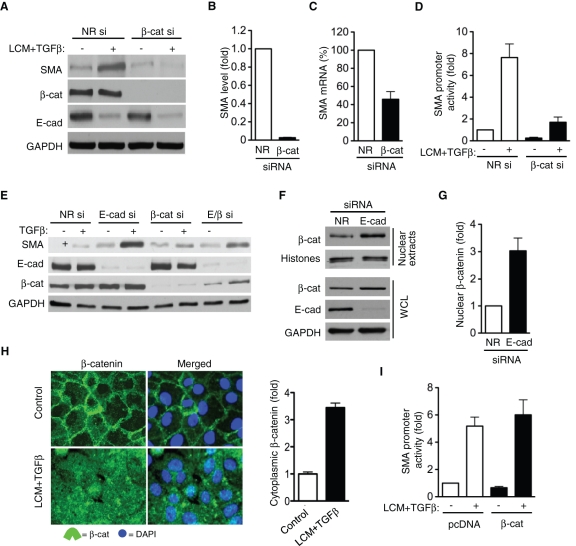
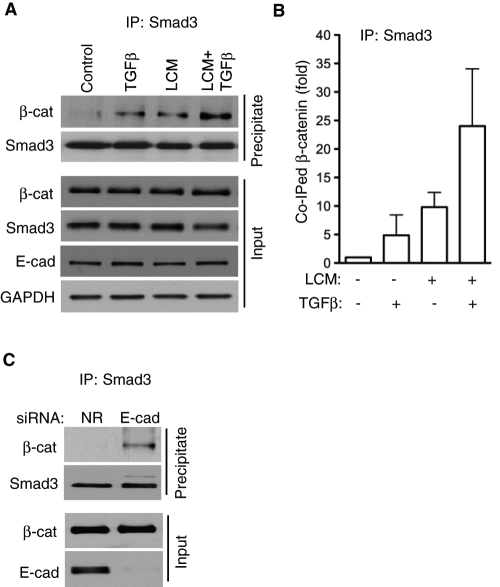
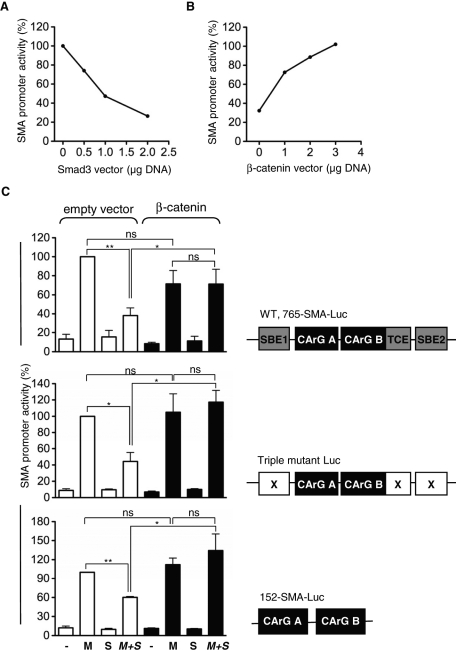
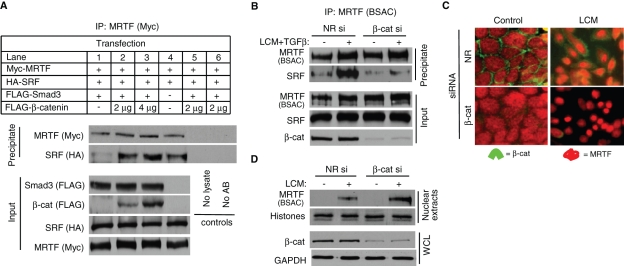
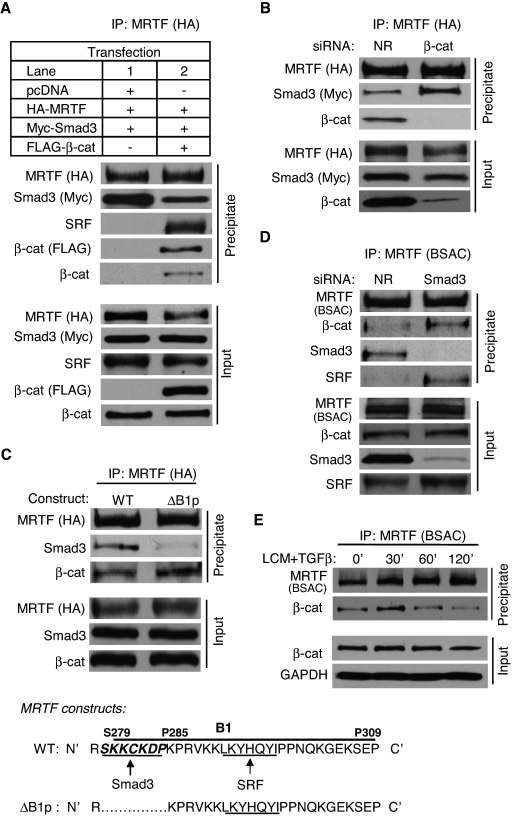
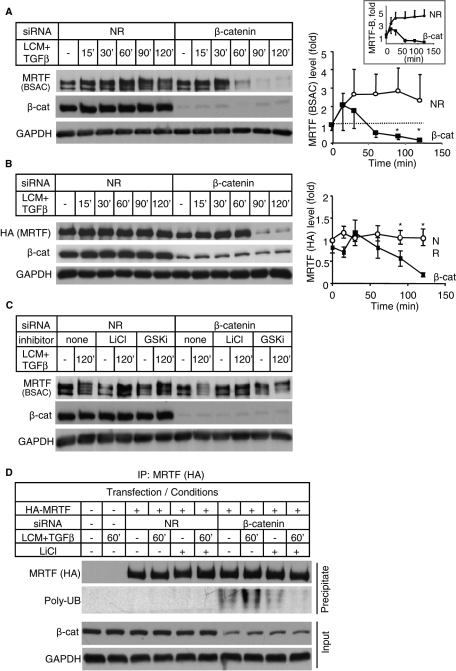
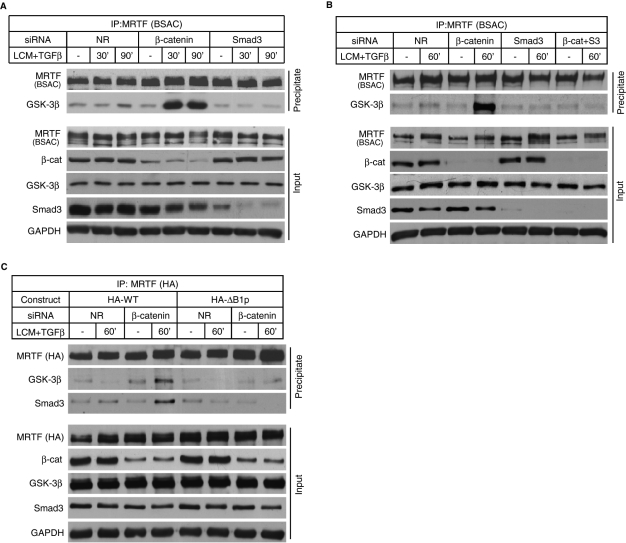
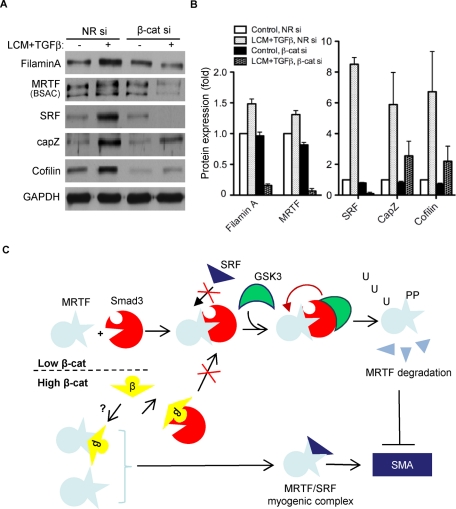
Injury to the adherens junctions (AJs) synergizes with transforming growth factor-β1 (TGFβ) to activate a myogenic program (α-smooth muscle actin [SMA] expression) in the epithelium during epithelial–myofibroblast transition (EMyT). Although this synergy plays a key role in organ fibrosis, the underlying mechanisms have not been fully defined. Because we recently showed that Smad3 inhibits myocardin-related transcription factor (MRTF), the driver of the SMA promoter and many other CC(A/T)-rich GG element (CArG) box–dependent cytoskeletal genes, we asked whether AJ components might affect SMA expression through interfering with Smad3. We demonstrate that E-cadherin down-regulation potentiates, whereas β-catenin knockdown inhibits, SMA expression. Contact injury and TGFβ enhance the binding of β-catenin to Smad3, and this interaction facilitates MRTF signaling by two novel mechanisms. First, it inhibits the Smad3/MRTF association and thereby allows the binding of MRTF to its myogenic partner, serum response factor (SRF). Accordingly, β-catenin down-regulation disrupts the SRF/MRTF complex. Second, β-catenin maintains the stability of MRTF by suppressing the Smad3-mediated recruitment of glycogen synthase kinase-3β to MRTF, an event that otherwise leads to MRTF ubiquitination and degradation and the consequent loss of SRF/MRTF–dependent proteins. Thus β-catenin controls MRTF-dependent transcription and emerges as a critical regulator of an array of cytoskeletal genes, the “CArGome.”
Overview
The claims and statistics of this paper haven’t been checked yet.
Free: it reads the open-access text and checks the first 5 claims that cite a source we can check. Create a free account to check every claim.
Integrity signals
Registry
Cites
Statistics
Figures
Verification
Claims the paper makes
The claims and statistics of this paper haven’t been checked yet.
Free: it reads the open-access text and checks the first 5 claims that cite a source we can check. Create a free account to check every claim.
Claims other papers make about this one
Each is checked against this paper’s own text: does it say what the citing paper says it does?
The source backs part of the claim, not all of it — or backs it for a different population, condition or comparison.
In the citing paper
“Both MKL-1 and YAP/TAZ directly regulate myofibroblast phenotype.”
From Unraveling SSc Pathophysiology; The Myofibroblast (2018) · cites this paper as [72]
Experimental — accuracy not yet measuredThe source backs part of the claim, not all of it — or backs it for a different population, condition or comparison.
In the citing paper
“it has been reported that TGF‐β regulates the stability of TAZ and MRTFs [41, 42].”
From Mechanical stiffness orchestrates distinct regulation of MRTFs and YAP / TAZ transcriptional cofactors in hepatocytes (2026) · cites this paper as [42]
Experimental — accuracy not yet measured
Self-check
Percentages, sums and reported differences re-computed from the paper’s own numbers.
The self-check needs the paper’s full text.
Citations
Cites
2 retracted
Kapoor, M., Liu, S., Shi-wen, X., Huh, K., McCann, M., Denton, C. P., Woodgett, J. R., Abraham, D. J., & Leask, A. (2008) · Journal of Clinical Investigation · doi:10.1172/jci35381 · Cited by 66 · cited 2×
“Consistent with our proposal that GSK-3β is a key determinant of MRTF stability, deletion of GSK-3β facilitates SMA expression in fibroblasts (Kapoor et al., 2008); GSK-3β has been shown to phosphorylate myocardin, thereby reducing its transcriptional activity (Badorff et al.”
BackgroundRetractedKapoor, M., Liu, S., Shiwen, X., Huh, K., McCann, M. R., Denton, C. P., Woodgett, J. R., Abraham, D., & Leask, A. (2008) · Journal of Clinical Investigation · doi:10.1172/jci35381r1 · Cited by 51
RetractedThe basics of epithelial-mesenchymal transition
Kalluri, R., & Weinberg, R. A. (2009) · Journal of Clinical Investigation · doi:10.1172/jci39104 · Cited by 10,196
Biomarkers for epithelial-mesenchymal transitions
Zeisberg, M., & Neilson, E. G. (2009) · Journal of Clinical Investigation · doi:10.1172/jci36183 · Cited by 2,299 · cited 1×
“During fibrogenic (type 2) EMT, epithelial cells lose their strong intercellular contacts and apicobasal polarity and acquire fibroblast-like features, such as elongated shape, increased extracellular matrix (ECM) production, and motility (Zeisberg and Neilson, 2009).”
BackgroundGSK-3: tricks of the trade for a multi-tasking kinase
Doble, B. W., & Woodgett, J. R. (2003) · Journal of Cell Science · doi:10.1242/jcs.00384 · Cited by 2,084 · cited 1×
“Beside the possibility of increased β-catenin availability, C-terminal or linker-region phosphorylation of Smad3 (Kamaraju and Roberts, 2005) and/or serine dephosphorylation or tyrosine phosphorylation of β-catenin (Doble and Woodgett, 2003) might also contribute.”
BackgroundLoss of E-Cadherin Promotes Metastasis via Multiple Downstream Transcriptional Pathways
Onder, T. T., Gupta, P. B., Mani, S. A., Yang, J., Lander, E. S., & Weinberg, R. A. (2008) · Cancer Research · doi:10.1158/0008-5472.can-07-2938 · Cited by 1,522 · cited 4×
“These observations are congruent with data obtained during tumor EMT, showing that elimination of E-cadherin stabilizes free β-catenin and increases the SMA message (Onder et al., 2008).”
BackgroundResultInfluentialEpithelial-mesenchymal transitions: the importance of changing cell state in development and disease
Acloque, H., Adams, M. S., Fishwick, K., Bronner-Fraser, M., & Nieto, M. A. (2009) · Journal of Clinical Investigation · doi:10.1172/jci38019 · Cited by 1,370 · cited 2×
“INTRODUCTION Epithelial–mesenchymal transition (EMT), a process characterized by cytoskeletal remodeling and transcriptional reprogramming, has long been known to play a key role in development and carcinogenesis (Acloque et al., 2009).”
BackgroundActin dynamics control SRF activity by regulation of its coactivator MAL
Miralles, F., Posern, G., Zaromytidou, A.-I., & Treisman, R. (2003) · Cell · doi:10.1016/s0092-8674(03)00278-2 · Cited by 1,327 · cited 1×
“On Factin polymerization (induced by various stimuli and mediated predominantly by Rho family GTPases), G-actin dissociates from MRTF, which results in nuclear translocation of MRTF (Miralles et al., 2003; Vartiainen et al., 2007).”
BackgroundLinking actin dynamics and gene transcription to drive cellular motile functions
Olson, E. N., & Nordheim, A. (2010) · Nature Reviews Molecular Cell Biology · doi:10.1038/nrm2890 · Cited by 958 · cited 1×
“The first mechanism involves myocardin-related transcription factor (MRTF), a recently discovered activator of serum response factor (SRF) that links cytoskeleton remodeling and the transcriptional control of cytoskeletal components (Wang et al., 2002; Olson and Nordheim, 2010).”
BackgroundNew Insights into Epithelial-Mesenchymal Transition in Kidney Fibrosis
Liu, Y. (2010) · Journal of the American Society of Nephrology · doi:10.1681/asn.2008121226 · Cited by 870 · cited 2×
“Volume 22 December 1, 2011 β-catenin in EMyT | 4473 protein-1 or SMA (Wendt et al., 2009; Liu, 2010).”
Cited by
Molecular mechanisms of epithelial–mesenchymal transition
Lamouille, S., Xu, J., & Derynck, R. (2014) · Nature Reviews Molecular Cell Biology · doi:10.1038/nrm3758 · Cited by 8,091
Signaling in Fibrosis: TGF-β, WNT, and YAP/TAZ Converge
Piersma, B., Bank, R. A., & Boersema, M. (2015) · Frontiers in Medicine · doi:10.3389/fmed.2015.00059 · Cited by 442
“Other reports contradict these findings and propose that β -catenin induces the expression of α SMA through interaction with myocardin-related transcription factor (MRTF), a process inhibited by Smad3 (52, 137).”
ResultInfluentialMechanisms of TGFβ-Induced Epithelial–Mesenchymal Transition
Moustakas, A., & Heldin, C.-H. (2016) · Journal of Clinical Medicine · doi:10.3390/jcm5070063 · Cited by 267
Van De Water, L., Varney, S., & Tomasek, J. J. (2013) · Advances in Wound Care · doi:10.1089/wound.2012.0393 · Cited by 251
“This inhibition by SMAD3 can be tempered by b-catenin.(146) Taken together, these findings support a model in which MRTF-A is central to establishing and maintaining the myofibroblast phenotype in response to mechanical tension (Figs.”
ResultThe Role of Myofibroblasts in Physiological and Pathological Tissue Repair
Schuster, R., Younesi, F., Ezzo, M., & Hinz, B. (2023) · Cold Spring Harbor Perspectives in Biology · doi:10.1101/cshperspect.a041231 · Cited by 232
Cellular mechanosensing: Getting to the nucleus of it all
Fedorchak, G. R., Kaminski, A., & Lammerding, J. (2014) · Progress in Biophysics and Molecular Biology · doi:10.1016/j.pbiomolbio.2014.06.009 · Cited by 191
“Attesting to the intricacy of mechanosingaling, MKL1 also interacts with β-catenin (Wnt pathway) and Smads (TGF-β pathway) which may have implications in cell differentiation, migration and cell cycle regulation (Charbonney et al., 2011; Scharenberg et al., 2014).”
BackgroundEMT and interstitial lung disease: a mysterious relationship
Kage, H., & Borok, Z. (2012) · Current Opinion in Pulmonary Medicine · doi:10.1097/mcp.0b013e3283566721 · Cited by 165
Entanglement of GSK-3β, β-catenin and TGF-β1 signaling network to regulate myocardial fibrosis
Guo, Y., Gupte, M., Umbarkar, P., Singh, A. P., Sui, J. Y., Force, T. L., & Lal, H. (2017) · Journal of Molecular and Cellular Cardiology · doi:10.1016/j.yjmcc.2017.07.011 · Cited by 172
Unraveling SSc Pathophysiology; The Myofibroblast
van Caam, A., Vonk, M., van den Hoogen, F., van Lent, P., & van der Kraan, P. (2018) · Frontiers in Immunology · doi:10.3389/fimmu.2018.02452 · Cited by 153
The Actin–MRTF–SRF Gene Regulatory Axis and Myofibroblast Differentiation
Small, E. M. (2012) · Journal of Cardiovascular Translational Research · doi:10.1007/s12265-012-9397-0 · Cited by 166
Induction of epithelial–mesenchymal transition by transforming growth factor β
Moustakas, A., & Heldin, C. (2012) · Seminars in Cancer Biology · doi:10.1016/j.semcancer.2012.04.002 · Cited by 182
Speight, P., Kofler, M., Szászi, K., & Kapus, A. (2016) · Nature Communications · doi:10.1038/ncomms11642 · Cited by 144
Self-citationTranscriptional control of cardiac fibroblast plasticity
Lighthouse, J. K., & Small, E. M. (2016) · Journal of Molecular and Cellular Cardiology · doi:10.1016/j.yjmcc.2015.12.016 · Cited by 129
“Cytoplasmic β-catenin may indirectly promote nuclear localization of MRTFs by competing for GSK3β-mediated ubiquitination [145, 146].”
BackgroundMechanobiology of myofibroblast adhesion in fibrotic cardiac disease
Schroer, A. K., & Merryman, W. D. (2015) · Journal of Cell Science · doi:10.1242/jcs.162891 · Cited by 127
Matrix Biology of Idiopathic Pulmonary Fibrosis
Thannickal, V. J., Henke, C. A., Horowitz, J. C., Noble, P. W., Roman, J., Sime, P. J., Zhou, Y., Wells, R. G., White, E. S., & Tschumperlin, D. J. (2014) · The American Journal of Pathology · doi:10.1016/j.ajpath.2014.02.003 · Cited by 117
Signaling Mechanisms of Myofibroblastic Activation: Outside-in and Inside-Out
Zent, J., & Guo, L.-W. (2018) · Cellular Physiology and Biochemistry · doi:10.1159/000493217 · Cited by 115
Miranda, M. Z., Bialik, J. F., Speight, P., Dan, Q., Yeung, T., Szászi, K., Pedersen, S. F., & Kapus, A. (2017) · Journal of Biological Chemistry · doi:10.1074/jbc.m117.780502 · Cited by 103
“The following plasmid concentrations were used: HA-TAZ (0.5 g/ml), GFP-MRTF (1 g/ml), FLAG-MRTF5 (1 g/ml), and HA-MRTF (3 g/ml) or HA-SRF (0.2– 0.5 g/ml) to yield similar protein expression from the various constructs.”
MethodInfluentialSelf-citationSRF'ing and SAP'ing – the role of MRTF proteins in cell migration
Gau, D., & Roy, P. (2018) · Journal of Cell Science · doi:10.1242/jcs.218222 · Cited by 103
“Finally, there is evidence of a synergy between TAZ and SMAD3 in gene regulation as these transcription factors can bind to adjacent cis-elements in the promoters of certain genes (Hiemer et al., 2014), as well as of mutual dependence between MRTFA-SRF and Yes-associated protein (YAP)–TAZ signaling.”
BackgroundInfluentialGumede, D. B., Abrahamse, H., & Houreld, N. N. (2024) · Cell Communication and Signaling · doi:10.1186/s12964-024-01623-9 · Cited by 121
“A study by Charbonney et al. [97] showed that treatment with TGF-β induced epithelial-myofibroblast transition by increasing α-SMA levels in the presence of β-catenin, however, knockdown of β-catenin prevented the epithe-lial-to myofibroblast-transition (EMyT) switch in tubular epithelial cells.”
Framework to function: mechanosensitive regulators of gene transcription
Finch-Edmondson, M., & Sudol, M. (2016) · Cellular & Molecular Biology Letters · doi:10.1186/s11658-016-0028-7 · Cited by 93
“As another example of crosstalk between mechanosensing pathways, β-catenin was identified to be a positive regulator of MRTF signaling by alleviation of Smad3 inhibition via two mechanisms [133] (Fig.”
BackgroundTGF-β-induced differentiation into myofibroblasts involves specific regulation of two MKL1 isoforms
Scharenberg, M. A., Pippenger, B. E., Sack, R., Zingg, D., Ferralli, J., Schenk, S., Martin, I., & Chiquet-Ehrismann, R. (2014) · Journal of Cell Science · doi:10.1242/jcs.142075 · Cited by 93
“Current models suggest a complex interplay between TGF-b/Smad3 and the Rho–actin–MKL1 signaling pathways during myofibroblast differentiation (Charbonney et al., 2011; Masszi et al., 2010; Small, 2012).”
BackgroundO’Connor, J. W., & Gomez, E. W. (2013) · PLoS ONE · doi:10.1371/journal.pone.0083188 · Cited by 92
Stromal-derived IGF2 promotes colon cancer progression via paracrine and autocrine mechanisms
Unger, C., Kramer, N., Unterleuthner, D., Scherzer, M., Burian, A., Rudisch, A., Stadler, M., Schlederer, M., Lenhardt, D., Riedl, A., et al. (2017) · Oncogene · doi:10.1038/onc.2017.116 · Cited by 92
Panayiotou, R., Miralles, F., Pawlowski, R., Diring, J., Flynn, H. R., Skehel, M., & Treisman, R. (2016) · eLife · doi:10.7554/elife.15460 · Cited by 79
“, 2005), conserved across the Myocardin family, possibly by controlling its degradation (Charbonney et al., 2011; Xie et al., 2009).”
BackgroundResultInfluentialRegulation and Relevance of Myofibroblast Responses in Idiopathic Pulmonary Fibrosis
Moore, M. W., & Herzog, E. L. (2013) · Current Pathobiology Reports · doi:10.1007/s40139-013-0017-8 · Cited by 90
Marcellini, S., Henríquez, J. P., & Bertin, A. (2012) · BioEssays · doi:10.1002/bies.201200061 · Cited by 83
In vitro loading models for tendon mechanobiology
Wang, T., Chen, P., Zheng, M., Wang, A. W., Lloyd, D. G., Leys, T., Zheng, Q., & Zheng, M. (2017) · Journal of Orthopaedic Research® · doi:10.1002/jor.23752 · Cited by 78
“Nevertheless, MKL1 is shown to interact with b-catenin (Wnt pathway) and Smads (TGF-b pathway), which may have implications on cell differentiation, migration, and cell cycle regulation.(39,40) Force transmitted through the cortical cytoskeleton to the nucleus resulting in both cytoskeletal and nuclear deformations ha…”
BackgroundBiomechanical regulation of mesenchymal cell function
Tschumperlin, D. J., Liu, F., & Tager, A. M. (2013) · Current Opinion in Rheumatology · doi:10.1097/bor.0b013e32835b13cd · Cited by 71
“For instance, b-catenin appears to interface with additional mechanically activated pathways, including a critical role in TGF-b-induced myofibroblast differentiation of aortic valve interstitial cells [6], and a collaborative role with MRTF in promoting TGF-b-dependent epithelial-mesenchymal transition [48].”
BackgroundLoss of SMAD3 Promotes Vascular Remodeling in Pulmonary Arterial Hypertension via MRTF Disinhibition
Zabini, D., Granton, E., Hu, Y., Miranda, M. Z., Weichelt, U., Bonnet, S. B., Bonnet, S., Morrell, N. W., Connelly, K. A., Provencher, S., et al. (2017) · American Journal of Respiratory and Critical Care Medicine · doi:10.1164/rccm.201702-0386oc · Cited by 70
Snail1-driven plasticity of epithelial and mesenchymal cells sustains cancer malignancy
Baulida, J., & de Herreros, A. G. (2015) · Biochimica et Biophysica Acta (BBA) - Reviews on Cancer · doi:10.1016/j.bbcan.2015.05.005 · Cited by 68
“Both a complete disruption of the apical epithelial contacts [43] and extracellular rigidity [41] promote αSMA transcription due to an increase of myocardin-related transcription factor (MRTF).”
BackgroundTaiyab, A., Holms, J., & West‐Mays, J. A. (2019) · International Journal of Molecular Sciences · doi:10.3390/ijms20092078 · Cited by 58
“The interaction of Smad3 with MRTF-A, an actin-binding protein and a downstream regulator of Rho/ROCK signaling, has been shown to be critical during EMT-induced fibrosis of the lungs and kidneys [33,35].”
BackgroundMethodResultInfluentialVarney, S. D., Betts, C. B., Zheng, R., Wu, L., Hinz, B., Zhou, J., & Van De Water, L. (2016) · Journal of Cell Science · doi:10.1242/jcs.170589 · Cited by 58
“Indeed, it has been suggested that myofibroblast differentiation is biphasic with an early SMADdependent phase that induces genes, which aid in stress fiber growth (Sandbo et al., 2011), and then a later contractile phase governed by MRTF-A and SRF (Charbonney et al., 2011; Masszi et al., 2010).”
BackgroundInfluentialCytoskeletal signaling in TGF β‐induced epithelial–mesenchymal transition
Nalluri, S. M., O’Connor, J. W., & Gomez, E. W. (2015) · Cytoskeleton · doi:10.1002/cm.21263 · Cited by 64
“…that TGFb-induced EMT and the expression of cytoskeletal proteins including aSMA depends on the concerted signaling of b-catenin, Smad3, and MRTF [Charbonney et al., 2011]. b-catenin has been found to regulate the expression of cytoskeletal genes through controlling the interaction between MRTF…”
BackgroundSpeight, P., Nakano, H., Kelley, T. J., Hinz, B., & Kapus, A. (2013) · Molecular Biology of the Cell · doi:10.1091/mbc.e13-04-0220 · Cited by 54
“Because we proposed that Smad3 is a negative, whereas β-catenin is a positive, regulator of MRTF-induced SMA expression (Masszi et al., 2010; Charbonney et al., 2011), we plotted the Smad3/β-catenin mRNA ratio as observed under the various conditions against the corresponding SMA mRNA.”
BackgroundResultInfluentialSelf-citationMarconi, G. D., Fonticoli, L., Rajan, T. S., Lanuti, P., Rocca, Y. D., Pierdomenico, S. D., Trubiani, O., Pizzicannella, J., & Diomede, F. (2021) · Frontiers in Physiology · doi:10.3389/fphys.2021.676512 · Cited by 65
The fate of the primary cilium during myofibroblast transition
Rozycki, M., Lodyga, M., Lam, J., Miranda, M. Z., Fátyol, K., Speight, P., & Kapùs, A. (2014) · Molecular Biology of the Cell · doi:10.1091/mbc.e13-07-0429 · Cited by 56
“Luciferase reporter assays were completed similar to our previous studies (Masszi et al., 2010; Charbonney et al., 2011).”
BackgroundMethodResultInfluentialSelf-citationTaiyab, A., Korol, A. S., Deschamps, P. A., & West‐Mays, J. A. (2016) · Investigative Ophthalmology & Visual Science · doi:10.1167/iovs.16-20162 · Cited by 47
SRF: a seriously responsible factor in cardiac development and disease
Deshpande, A., Shetty, P. M. V., Frey, N., & Rangrez, A. Y. (2022) · Journal of Biomedical Science · doi:10.1186/s12929-022-00820-3 · Cited by 48
Cell confluence regulates claudin-2 expression: possible role for ZO-1 and Rac
Amoozadeh, Y., Anwer, S., Dan, Q., Venugopal, S., Shi, Y., Branchard, E., Liedtke, E., Ailenberg, M., Rotstein, O. D., Kapùs, A., et al. (2017) · American Journal of Physiology-Cell Physiology · doi:10.1152/ajpcell.00234.2017 · Cited by 46
“2: GGUGAACACACAGGAUUUCUU (43); Rac1/2: UCGAGAAACUGAAGGAGAA (75); E-cadherin: CTCTGCTGGTGTTTGATTATT (16).”
Profibrotic epithelial phenotype: a central role for MRTF and TAZ
Bialik, J. F., Ding, M., Speight, P., Dan, Q., Miranda, M. Z., Di Ciano-Oliveira, C., Kofler, M. M., Rotstein, O. D., Pedersen, S. F., Szászi, K., et al. (2019) · Scientific Reports · doi:10.1038/s41598-019-40764-7 · Cited by 41
Self-citationMRTF: Basic Biology and Role in Kidney Disease
Miranda, M. Z., Lichner, Z., Szászi, K., & Kapùs, A. (2021) · International Journal of Molecular Sciences · doi:10.3390/ijms22116040 · Cited by 43
Gupta, M., Korol, A. S., & West‐Mays, J. A. (2013) · PubMed Central · Cited by 46
O’Connor, J. W., Mistry, K., Detweiler, D., Wang, C., & Gomez, E. W. (2016) · Scientific Reports · doi:10.1038/srep26226 · Cited by 48
Ly, D. L., Waheed, F., Lodyga, M., Speight, P., Masszi, A., Nakano, H., Hersom, M., Pedersen, S. F., Szászi, K., & Kapus, A. (2013) · American Journal of Physiology-Cell Physiology · doi:10.1152/ajpcell.00290.2012 · Cited by 39
Self-citationTRIM27/MRTF-B-Dependent Integrin β1 Expression Defines Leading Cells in Cancer Cell Collectives
Kato, T., Enomoto, A., Watanabe, T., Haga, H., Ishida‐Ishihara, S., Kondo, Y., Furukawa, K., Urano, T., Mii, S., Weng, L., et al. (2014) · Cell Reports · doi:10.1016/j.celrep.2014.03.068 · Cited by 42
MRTFs‐ master regulators of EMT
Gasparics, Á., & Sebe, A. (2017) · Developmental Dynamics · doi:10.1002/dvdy.24544 · Cited by 47
“…MRTF signaling by two mechanisms: b-catenin inhibits the association of Smad3 and MRTF allowing the complexing of SRF and MRTF, and b-catenin maintains the stability of MRTF by suppressing the Smad3-mediated recruitment of glycogen synthase kinase-3b (GSK-3b) to MRTF (Charbonney et al., 2011).”
BackgroundThe Cellular Mastermind(?)—Mechanotransduction and the Nucleus
Kaminski, A., Fedorchak, G. R., & Lammerding, J. (2014) · Progress in molecular biology and translational science · doi:10.1016/b978-0-12-394624-9.00007-5 · Cited by 49
“On the other hand, β-catenin binds both Smad3 and MKL1, but without disrupting the MKL1/SRF complex.(168) Regardless of the many remaining questions, the SRF pathway has already immerged as an important link between”
Acute Lung Injury and Fibrosis in a Baboon Model of Escherichia coli Sepsis
Keshari, R. S., Silasi‐Mansat, R., Zhu, H., Popescu, N. I., Peer, G. T., Chaaban, H., Lambris, J. D., Polf, H. D., Lupu, C., Kinasewitz, G. T., et al. (2013) · American Journal of Respiratory Cell and Molecular Biology · doi:10.1165/rcmb.2013-0219oc · Cited by 36
Myocardin-related Transcription Factor Regulates Nox4 Protein Expression
Rozycki, M., Bialik, J. F., Speight, P., Dan, Q., Knudsen, T. E. T., Szeto, S. G., Yuen, D. A., Szászi, K., Pedersen, S. F., & Kapus, A. (2016) · Journal of Biological Chemistry · doi:10.1074/jbc.m115.674606 · Cited by 35
“Previously, our group has explored the mechanisms through which kidney tubular cells transform to myofibroblasts, a process termed epithelial-myofibroblast transition (EMyT).”
BackgroundMethodInfluentialSelf-citationMechanical Strain Regulates Myofibroblast Differentiation of Human Scleral Fibroblasts by YAP
Hu, D., Jiang, J., Ding, B., Xue, K., Sun, X., & Qian, S. (2021) · Frontiers in Physiology · doi:10.3389/fphys.2021.712509 · Cited by 38
“SIS3, a selective inhibitor of Smad3 phosphorylation (Jinnin et al., 2006; Charbonney et al., 2011), was added to HSFs before they were subjected to mechanical strain.”
MethodYAP/TAZ regulates the expression of proteoglycan 4 and tenascin C in superficial-zone chondrocytes
Delve, E., Co, V., Regmi, S., Parreno, J., Schmidt, T., & Kandel, R. (2020) · European Cells and Materials · doi:10.22203/ecm.v039a03 · Cited by 37
Umbarkar, P., Ramirez, S. Y. R., Cora, A. T., Tousif, S., & Lal, H. (2023) · Biochimica et Biophysica Acta (BBA) - Molecular Basis of Disease · doi:10.1016/j.bbadis.2023.166724 · Cited by 33
Role of Actin-Binding Proteins in Skeletal Myogenesis
Nguyen, M. T., Dash, R., Jeong, K., & Lee, W. (2023) · Cells · doi:10.3390/cells12212523 · Cited by 30
Nuclear actin and Mrtfs control disuse muscle atrophy via Srf activity regulation
Collard, L., Herledan, G., Pincini, A., Randrianarison-Huetz, V., Guerci, A., & Sotiropoulos, A. (2014) · Journal of Cell Science · doi:10.1242/jcs.155911 · Cited by 38
“Mrtfs have been shown to interact with other transcription regulators, such as Smads (Charbonney et al., 2011; Wang et al., 2012).”
BackgroundLiu, G., Wang, Y., Yang, L., Zou, B., Gao, S., Song, Z., & Lin, Z. (2019) · Journal of Cellular and Molecular Medicine · doi:10.1111/jcmm.14258 · Cited by 24
He, H., Du, F., He, Y., Wei, Z., Meng, C., Xu, Y., Zhou, H., Wang, N., Luo, X., Ma, W., et al. (2018) · Oncotarget · doi:10.18632/oncotarget.23961 · Cited by 20
Delve, E., Parreno, J., Co, V., Wu, P., Chong, J., Scipio, M. D., & Kandel, R. A. (2018) · Journal of Orthopaedic Research® · doi:10.1002/jor.23892 · Cited by 21
“Studies have shown that beta-catenin plays a role in stabilizing MRTF-A protein levels preventing the ubiquitination and degradation via smad3-mediated recruitment of glycogen synthase kinase-3b during the epithelial-mesenchymal transition of LLC-PK1 (Cl4) cells.(43) In osteoblasts, beta-catenin signaling induced by s…”
BackgroundPharmacological and Genetic Inhibition of HDAC4 Alleviates Renal Injury and Fibrosis in Mice
Shen, F., Hou, X., Li, T., Yu, J., Chen, H., Liu, N., Qiu, A., & Zhuang, S. (2022) · Frontiers in Pharmacology · doi:10.3389/fphar.2022.929334 · Cited by 20
Hariharan, S., Kelm, R. J., & Strauch, A. R. (2014) · Journal of Cellular Physiology · doi:10.1002/jcp.24564 · Cited by 23
“…nuclear Smad3 acts as a timer wherein it sequesters MRTF-A until a time when the cells acquire sufficient mesenchymal characteristics such as migratory ability, have populated sites of tissue injury, and are ready to fully differentiate into contractile myofibroblasts (Charbonney et al., 2011).”
BackgroundMorita, T., & Hayashi, K. (2013) · Biochemical and Biophysical Research Communications · doi:10.1016/j.bbrc.2013.06.069 · Cited by 21
MicroRNA‑182 promotes epithelial‑mesenchymal transition by targeting FOXN3 in gallbladder cancer
Zhang, J., Hu, Z., Wen, C., Liao, Q., He, B., Peng, J., Tang, X., Chen, Z., & Xie, Y. (2021) · Oncology Letters · doi:10.3892/ol.2021.12461 · Cited by 17
“β‐catenin interacts with SMAD3 and promotes TGF‐β‐regulated EMT in lens epithe‐ lial cells (25).”
Introducing STRaNDs: shuttling transcriptional regulators that are non-DNA binding
Lu, M. M., Muers, M. R., & Lü, X. (2016) · Nature Reviews Molecular Cell Biology · doi:10.1038/nrm.2016.41 · Cited by 19
Strauch, A. R., & Hariharan, S. (2013) · Biology · doi:10.3390/biology2020555 · Cited by 19
Smads and cell fate: Distinct roles in specification, development, and tumorigenesis in the testis
Itman, C., & Loveland, K. L. (2013) · IUBMB Life · doi:10.1002/iub.1115 · Cited by 15
Majolo, F., da Silva, G. L., Vieira, L., Timmers, L. F. S. M., Laufer, S., & Goettert, M. I. (2020) · Stem Cell Reviews and Reports · doi:10.1007/s12015-020-10033-6 · Cited by 14
Elagib, K. E., Brock, A. T., Clementelli, C., Mosoyan, G., Delehanty, L. L., Sahu, R. K., Pacheco-Benichou, A., Fruit, C., Besson, T., Morris, S. W., et al. (2022) · Journal of Clinical Investigation · doi:10.1172/jci154839 · Cited by 16
“To determine whether a strategy of functional enhancement could compensate for this deficiency, neonatal progenitors consisting of umbilical cord blood CD34+ cells underwent screening with inhibitors of kinases reported to restrain MKL1 activity (32-36).”
BackgroundEnzo, M. V., Cattelan, P., Rastrelli, M., Tosi, A. L., Rossi, C. R., Hladnik, U., & Segat, D. (2018) · Histochemistry and Cell Biology · doi:10.1007/s00418-018-1718-1 · Cited by 12
Zhou, Y., Shi, Z., Singh, P., Yin, H. R., Yu, Y., Li, L., Walsh, M. P., Gui, Y., & Zheng, X. (2015) · Journal of Cellular Physiology · doi:10.1002/jcp.25084 · Cited by 10
“…found to inhibit SM a-actin expression through disrupting the complex of SRF/MRTF (myocardin-related transcription factor) (Charbonney et al., 2011). b-Catenin also suppresses the Smad3-mediated recruitment of GSK-3b MRTF and reduces MRTF ubiquitylation and degradation (Charbonney et al., 2011).”
BackgroundHuo, D., Bi, X.-Y., Zeng, J.-L., Dai, D., & Dong, X. (2023) · Molecular and Cellular Biochemistry · doi:10.1007/s11010-023-04912-y · Cited by 7
“In addition, Smad3 could modify the stability of myocardin-related transcription factor in epithelial cells [43].”
Zhou, J., Sun, X., Chen, X., Liu, H., Miao, X., Guo, Y., Fan, Z., Li, J., Xu, Y., & Li, Z. (2023) · Acta Pharmaceutica Sinica B · doi:10.1016/j.apsb.2023.10.011 · Cited by 6
Huang, J., Chen, Z., Lai, Z., Liu, Y., Yu, D., Wu, L., & Zhou, X. (2021) · Future Medicinal Chemistry · doi:10.4155/fmc-2020-0381 · Cited by 5
Khan, A. U., Qu, R., Yang, Y., Fan, T., Peng, Y., Sun, B., Qiu, X., Wu, S., Wang, Z., Zhou, Z., et al. (2021) · Cells · doi:10.3390/cells10123518 · Cited by 5
Hu, J., Singh, P., Li, J., Zhang, J., Li, F., Zhang, H., & Xie, J. (2023) · Biomedicines · doi:10.3390/biomedicines11092351 · Cited by 5
Mechanotransduction in fibrosis: Mechanisms and treatment targets
Yeh, C., Chou, C. E. N., & Yang, K. (2021) · Current topics in membranes · doi:10.1016/bs.ctm.2021.07.004 · Cited by 11
Chen, Z., Liu, J., Quan, L., Wu, L., & Xu, Q. (2026) · Frontiers in Immunology · doi:10.3389/fimmu.2026.1774802 · Cited by 4
Rzepka, M. F., Raschzok, S., Lee, X., Yazaki, K., Dauz, J. D., Sun, M., Meister, T. A., Nghiem, L., Kabir, G., Desjardins, J., et al. (2025) · American Journal of Respiratory Cell and Molecular Biology · doi:10.1165/rcmb.2023-0465oc · Cited by 4
How do your contacts (or their absence) shape your fate?
Charbonney, E., Speight, P., & Kapùs, A. (2013) · Tissue Barriers · doi:10.4161/tisb.23699 · Cited by 1
“Indeed, we and others have shown that β-catenin regulates SMA expression.(1,17,37-39) Both the two hit condition-induced and the E-cadherin downregulation-promoted SMA expression are strongly mitigated by β-catenin-silencing.”
BackgroundSelf-citationLiu, S., Jin, R., Zheng, G., Wang, Y., Li, Q., Jin, F., Li, Y., Li, T. X., Mao, N., Wei, Z., et al. (2023) · Biomedicine & Pharmacotherapy · doi:10.1016/j.biopha.2023.115411 · Cited by 1
Torres‐Ortiz, B. S., Pérez‐Calixto, D., Carretero‐Ortega, J., Guzman‐López, A. G., Pinto‐Dueñas, D. C., Hernández‐Juárez, M., Jiménez‐Escobar, A., Rodríguez‐Hernández, A., Díaz‐Bello, B., Serna‐Márquez, N., et al. (2026) · The FEBS Journal · doi:10.1111/febs.70570
“S6C); it has been reported that TGF-β regulates the stability of TAZ and MRTFs [41,42].”
Potential Mechanistic Links Between Aging and IPF
Pan, H., Gulati, M., & Herzog, E. L. (2015) · WORLD SCIENTIFIC eBooks · doi:10.1142/9789814635011_0016
Rozycki, M. (2015) · TSpace (University of Toronto)
Studies of Protein Function by Liquid Chromatography-Mass Spectrometry
Williams, D. (2014)
Vascular Aging: from Smooth Muscle Cell Differentiation to Polyploidization
Zhan, S. (2016) · Libraries and Cultural Resources (University of Calgary) · doi:10.11575/prism/28633
Ciblage de régulateurs du cytosquelette d'actine pour le traitement de la fibrose pulmonaire
Mergault, C. (2022) · theses.fr (ABES) · doi:10.70675/8c5fc5c2zab24z4a0dzac04z416d07499048
Metadata
- Authors
- Charbonney, E., Speight, P., Masszi, A., Nakano, H., & Kapus, A.
- Affiliations
- St. Michael's Hospital (CA)
- Juntendo University (JP)
- Keenan Research Centre, Li Ka Shing Knowledge Institute, St. Michael's Hospital, and Department of Surgery, University of Toronto, Toronto, ON M5B 1W8, Canada
- Venue
- Molecular Biology of the Cell
- Published
- 2011-12
- Volume
- 22
- Issue
- 23
- Pages
- 4472-4485
- ISSN
- 1059-1524 (ISSN-L)
- 1939-4586
- PMC
- PMC3226468
- OpenAlex
- W2129055432
- Cited by
- 84
- References
- 65
- Citations by year
- 2026: 2 · 2024: 2 · 2023: 6 · 2022: 5 · 2021: 7 · 2020: 2 · 2019: 3 · 2018: 6 · 2017: 7 · 2016: 9 · 2015: 9 · 2014: 10 · 2013: 10 · 2012: 6
- FWCI
- 3.37
- Type
- journal article
- Language
- en
- Open access
- green
- www.ncbi.nlm.nih.gov
- Licence
- cc-by-nc-sa
- Locations
- Molecular Biology of the Cell (publishedVersion)
- Europe PMC (PubMed Central) (publishedVersion, cc-by-nc-sa)
- PubMed Central (publishedVersion, cc-by-nc-sa)
- PubMed (publishedVersion)
- Funders
- Kidney Foundation of Canada
- Canadian Institutes of Health Research (MOP- 106625, 86535_1, TGF-53877)
- Japan Society for the Promotion of Science (23659404)
- Topics
- Life Sciences › Biochemistry, Genetics and Molecular Biology › Molecular Biology › TGF-β signaling in diseases
- Life Sciences › Biochemistry, Genetics and Molecular Biology › Molecular Biology › Signaling Pathways in Disease
- Life Sciences › Biochemistry, Genetics and Molecular Biology › Cell Biology › Hippo pathway signaling and YAP/TAZ
- Keywords
- β-catenin, Smad3, MRTF, adherens junctions, E-cadherin, TGF-β1, serum response factor, glycogen synthase kinase-3β, protein stability, ubiquitination, alpha-smooth muscle actin, organ fibrosis, CArG box
- MeSH terms
- Glycogen Synthase Kinase 3 beta, Actins, Animals, Cells, Cultured, Epithelial Cells, Gene Expression Regulation, Promoter Regions, Genetic, Swine, Transcription Factors, Cadherins, Transforming Growth Factor beta, Adherens Junctions, Serum Response Factor, Glycogen Synthase Kinase 3, beta Catenin, Rats, Smad3 Protein, Protein Stability, Myofibroblasts, Epithelial-Mesenchymal Transition
About these checks
Registry, retraction, Cites and statistics results are computed, not judged, with one exception: a printed reference that no index lists is read once by a model before it counts as a citation error. Claims are extracted by a model and kept only when their quote appears verbatim in the text; each cited source is then checked, with a model’s help, for whether it says what the claim relies on. Those verdicts can be wrong — read the claim’s quote and the cited source before relying on one.
Statistics and arithmetic are recomputed, not judged.
Confidence bands are shown only for fields calibrated on our annotated test set. None is calibrated yet, so no band is shown.
What counts as a claim ›How we measure confidence ›How we check this ›
Are you an author, or do you see a problem with this page? Request a review
Data sources
Bibliographic data: Semantic Scholar, OpenAlex, Crossref.
Contains information from the Semantic Scholar Academic Graph Datasets, made available under the ODC Attribution License (ODC-BY 1.0).
Semantic Scholar’s data is described in: Kinney, R., et al. (2023). The Semantic Scholar Open Data Platform. arXiv:2301.10140.
