

CRISPR/Cas9-based gene targeting using synthetic guide RNAs enables robust cell biological analyses
The DOI matches its Crossref record; 5 of the 5 references it cites were found in a registry or an index.
Abstract
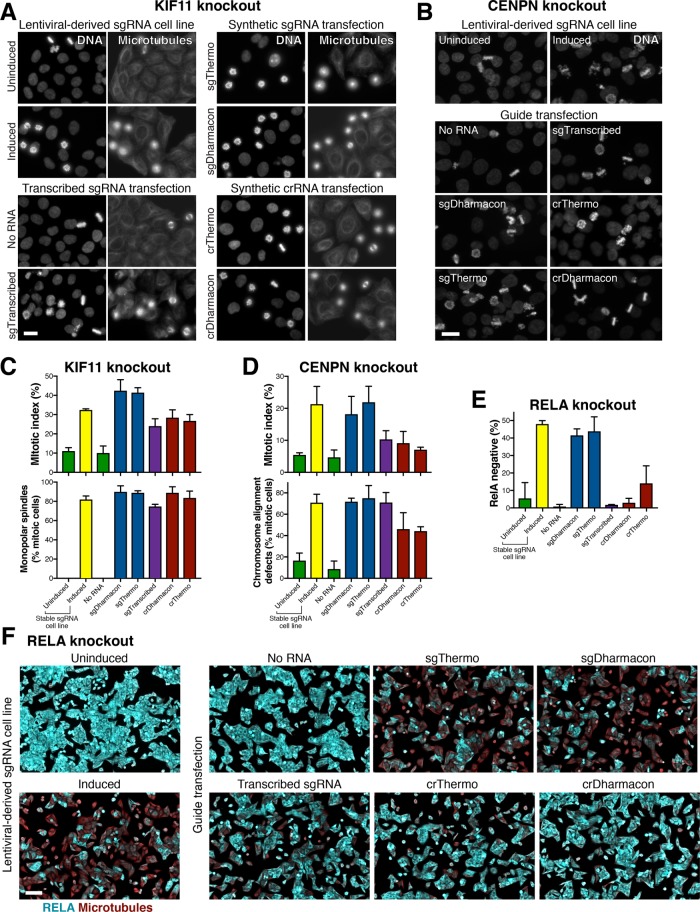
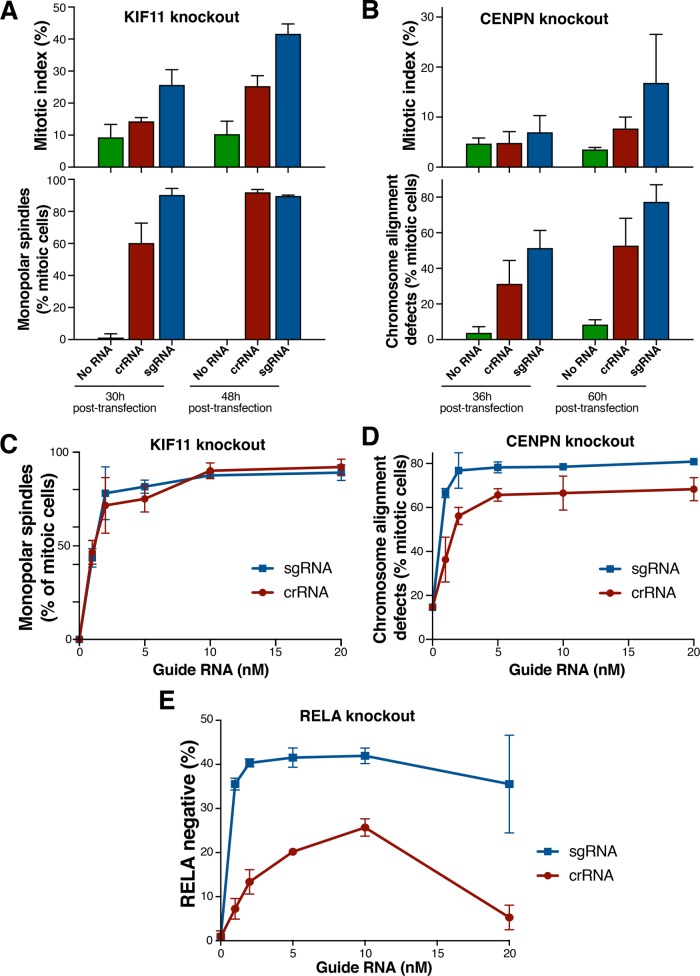
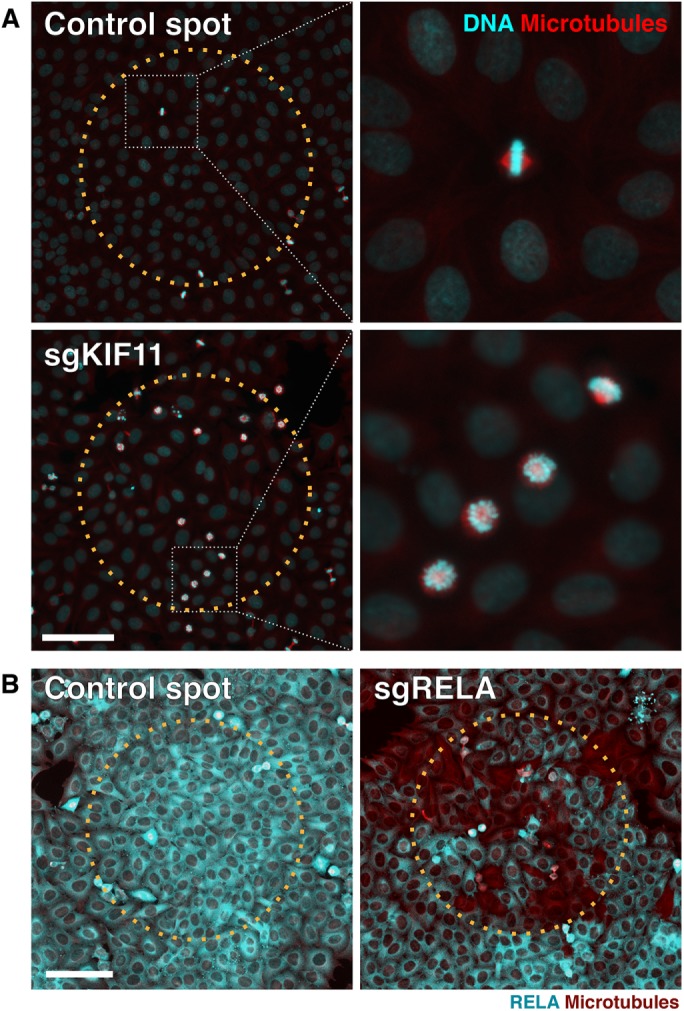
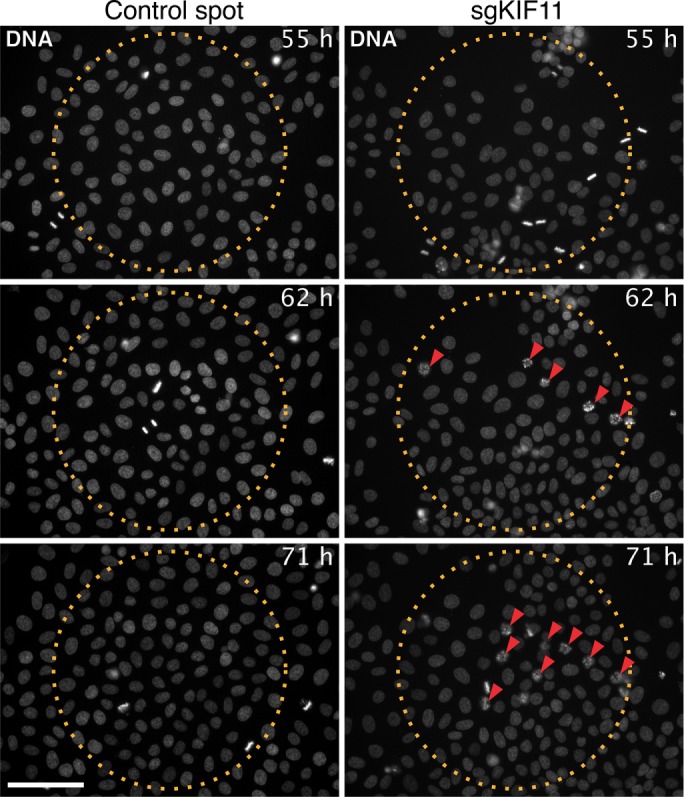
A key goal for cell biological analyses is to assess the phenotypes that result from eliminating a target gene. Since the early 1990s, the predominant strategy utilized in human tissue culture cells has been RNA interference (RNAi)-mediated protein depletion. However, RNAi suffers well-documented off-target effects as well as incomplete and reversible protein depletion. The implementation of CRISPR/Cas9-based DNA cleavage has revolutionized the capacity to conduct functional studies in human cells. However, this approach is still underutilized for conducting visual phenotypic analyses, particularly for essential genes that require conditional strategies to eliminate their gene products. Optimizing this strategy requires effective and streamlined approaches to introduce the Cas9 guide RNA into target cells. Here we assess the efficacy of synthetic guide RNA transfection to eliminate gene products for cell biological studies. On the basis of three representative gene targets (KIF11, CENPN, and RELA), we demonstrate that transfection of synthetic single guide RNA (sgRNA) and CRISPR RNA (crRNA) guides works comparably for protein depletion as cell lines stably expressing lentiviral-delivered RNA guides. We additionally demonstrate that synthetic sgRNAs can be introduced by reverse transfection on an array. Together, these strategies provide a robust, flexible, and scalable approach for conducting functional studies in human cells.
Overview
The claims and statistics of this paper haven’t been checked yet.
Free: it reads the open-access text and checks the first 5 claims that cite a source we can check. Create a free account to check every claim.
Integrity signals
Registry
Cites
Statistics
Figures
Verification
Claims the paper makes
The claims and statistics of this paper haven’t been checked yet.
Free: it reads the open-access text and checks the first 5 claims that cite a source we can check. Create a free account to check every claim.
Claims other papers make about this one
Each is checked against this paper’s own text: does it say what the citing paper says it does?
The cited source says what the claim attributes to it.
In the citing paper
“CRISPR/Cas9‐based gene‐editing by utilizing synthetic guide RNAs in the Cas9‐expressing cells can produce results similar to those obtained with the stably expressed sgRNAs introduced by viral transduction.12, 13, 14”
Self-check
Percentages, sums and reported differences re-computed from the paper’s own numbers.
The self-check needs the paper’s full text.
Citations
Cites
Identification and characterization of essential genes in the human genome
Wang, T., Birsoy, K., Hughes, N. W., Krupczak, K. M., Post, Y., Wei, J. J., Lander, E. S., & Sabatini, D. M. (2015) · Science · doi:10.1126/science.aac7041 · Cited by 1,617 · cited 2×
“…McKinley and Cheeseman, 2017) or to conduct large-scale functional analyses to define factors required for optimal cell growth under specific conditions based on guide barcode enrichment or depletion (Shalem et al., 2014; Wang et al., 2014, 2015, 2017; Morgens et al., 2016; Tzelepis et al., 2016).”
High-throughput functional genomics using CRISPR-Cas9
Shalem, O., Sanjana, N. E., & Zhang, F. (2015) · Nature Reviews Genetics · doi:10.1038/nrg3899 · Cited by 1,233
Tzelepis, K., Koike-Yusa, H., De Braekeleer, E., Li, Y., Metzakopian, E., Dovey, O. M., Mupo, A., Grinkevich, V., Li, M., Mazan, M., et al. (2016) · Cell Reports · doi:10.1016/j.celrep.2016.09.079 · Cited by 761
Wang, T., Yu, H., Hughes, N. W., Liu, B., Kendirli, A., Klein, K., Chen, W. W., Lander, E. S., & Sabatini, D. M. (2017) · Cell · doi:10.1016/j.cell.2017.01.013 · Cited by 632
Systematic comparison of CRISPR/Cas9 and RNAi screens for essential genes
Morgens, D. W., Deans, R. M., Li, A., & Bassik, M. C. (2016) · Nature Biotechnology · doi:10.1038/nbt.3567 · Cited by 401
Research works printed but not linked: 18
- Cho SW Kim S Kim JM Kim JS (2013). Targeted genome engineering in human cells with the Cas9 RNA-guided endonuclease. Nat Biotechnol, 230– 232. 23360966 · DOI · Paper page
- Cong L Ran FA Cox D Lin S Barretto R Habib N Hsu PD Wu X Jiang W Marraffini LA Zhang F (2013). Multiplex genome engineering using CRISPR/Cas systems. Science, 819– 823. 23287718 PMC3795411 · DOI · Paper page
- Deltcheva E Chylinski K Sharma CM Gonzales K Chao Y Pirzada ZA Eckert MR Vogel J Charpentier E (2011). CRISPR RNA maturation by trans-encoded small RNA and host factor RNase III. Nature, 602– 607. 21455174 PMC3070239 · DOI · Paper page
- Erard N Knott SRV Hannon GJ (2017). A CRISPR resource for individual, combinatorial, or multiplexed gene knockout. Mol Cell, 1080. 28938093 PMC5612766 · DOI
- Genovesio A Giardini MA Kwon YJ de Macedo Dossin F Choi SY Kim NY Kim HC Jung SY Schenkman S Almeida IC, et al (2011a). Visual genome-wide RNAi screening to identify human host factors required for Trypanosoma cruzi infection. PLoS One, e19733. 21625474 PMC3098829 · DOI
- Genovesio A Kwon YJ Windisch MP Kim NY Choi SY Kim HC Jung S Mammano F Perrin V Boese AS, et al (2011b). Automated genome-wide visual profiling of cellular proteins involved in HIV infection. J Biomol Screen, 945– 958. 21841144 · DOI · Paper page
- Jinek M Chylinski K Fonfara I Hauer M Doudna JA Charpentier E (2012). A programmable dual-RNA-guided DNA endonuclease in adaptive bacterial immunity. Science, 816– 821. PMC6286148 22745249 · DOI · Paper page
- Jost M Chen Y Gilbert LA Horlbeck MA Krenning L Menchon G Rai A Cho MY Stern JJ Prota AE, et al (2017). Combined CRISPRi/a-based chemical genetic screens reveal that rigosertib is a microtubule-destabilizing agent. Mol Cell, 210– 223. e216. 28985505 PMC5640507 · DOI · Paper page
- Mali P Yang L Esvelt KM Aach J Guell M DiCarlo JE Norville JE Church GM (2013). RNA-guided human genome engineering via Cas9. Science, 823– 826. PMC3712628 23287722 · DOI · Paper page
- Mayer TU Kapoor TM Haggarty SJ King RW Schreiber SL Mitchison TJ (1999). Small molecule inhibitor of mitotic spindle bipolarity identified in a phenotype-based screen. Science, 971– 974. 10542155 · DOI · Paper page
- McKinley KL Cheeseman IM (2017). Large-scale analysis of CRISPR/Cas9 cell-cycle knockouts reveals the diversity of p53-dependent responses to cell-cycle defects. Dev Cell, 405– 420. 28216383 PMC5345124 · DOI · Paper page
- McKinley KL Sekulic N Guo LY Tsinman T Black BE Cheeseman IM (2015). The CENP-LN complex forms a critical node in an integrated meshwork of interactions at the centromere-kinetochore interface. Mol Cell, 886– 898. PMC4690846 26698661 · DOI · Paper page
- Ruben SM Dillon PJ Schreck R Henkel T Chen CH Maher M Baeuerle PA Rosen CA (1991). Isolation of a rel-related human cDNA that potentially encodes the 65-kD subunit of NF-kappa B. Science, 1490– 1493. 2006423 · DOI · Paper page
- Schmid RM Perkins ND Duckett CS Andrews PC Nabel GJ (1991). Cloning of an NF-kappa B subunit which stimulates HIV transcription in synergy with p65. Nature, 733– 736. 1876189 · DOI · Paper page
- Shalem O Sanjana NE Hartenian E Shi X Scott DA Mikkelsen TS Heckl D Ebert BL Root DE Doench JG Zhang F (2014). Genome-scale CRISPR-Cas9 knockout screening in human cells. Science, 84– 87. PMC4089965 24336571 · DOI · Paper page
- Wang T Wei JJ Sabatini DM Lander ES (2014). Genetic screens in human cells using the CRISPR-Cas9 system. Science, 80– 84. PMC3972032 24336569 · DOI · Paper page
- Ziauddin J Sabatini DM (2001). Microarrays of cells expressing defined cDNAs. Nature, 107– 110. 11333987 · DOI · Paper page
- Zimmermann M Murina O Reijns MAM Agathanggelou A Challis R Tarnauskaite Z Muir M Fluteau A Aregger M McEwan A, et al (2018). CRISPR screens identify genomic ribonucleotides as a source of PARP-trapping lesions. Nature, 285– 289. PMC6071917 29973717 · DOI · Paper page
Cited by
Zhou, L., Li, R., Zhang, R., Peng, R., Chen, K., Gao, P., Zhang, J., Zhang, R., & Li, J. (2020) · Journal of Clinical Laboratory Analysis · doi:10.1002/jcla.23256 · Cited by 4
Metadata
- Authors
- Su, K.-C., Tsang, M.-J., Emans, N., & Cheeseman, I. M.
- Affiliations
- Whitehead Institute for Biomedical Research, Cambridge, MA 02142
- Persomics USA, Weston, MA 02493
- Venue
- Molecular Biology of the Cell
- Published
- 2018-10
- Volume
- 29
- Issue
- 20
- Pages
- 2370-2377
- ISSN
- 1059-1524
- 1939-4586
- PMC
- PMC6233062
- Cited by
- 17
- References
- 5
- Language
- en
About these checks
Registry, retraction, Cites and statistics results are computed, not judged, with one exception: a printed reference that no index lists is read once by a model before it counts as a citation error. Claims are extracted by a model and kept only when their quote appears verbatim in the text; each cited source is then checked, with a model’s help, for whether it says what the claim relies on. Those verdicts can be wrong — read the claim’s quote and the cited source before relying on one.
Statistics and arithmetic are recomputed, not judged.
Confidence bands are shown only for fields calibrated on our annotated test set. None is calibrated yet, so no band is shown.
What counts as a claim ›How we measure confidence ›How we check this ›
Are you an author, or do you see a problem with this page? Request a review
How to cite
Cite CoChat for the checks on this page, and the paper for its own findings.
- This page
- CoChat. (2026). Citation check: CRISPR/Cas9-based gene targeting using synthetic guide RNAs enables robust cell biological analyses. https://app.cochat.ai/papers/10.1091/mbc.e18-04-0214
- The paper
- Su, K.-C., Tsang, M.-J., Emans, N., & Cheeseman, I. M. (2018). CRISPR/Cas9-based gene targeting using synthetic guide RNAs enables robust cell biological analyses. Molecular Biology of the Cell. https://doi.org/10.1091/mbc.e18-04-0214
Data sources
Bibliographic data: Semantic Scholar, OpenAlex, Crossref.
Contains information from the Semantic Scholar Academic Graph Datasets, made available under the ODC Attribution License (ODC-BY 1.0).
Semantic Scholar’s data is described in: Kinney, R., et al. (2023). The Semantic Scholar Open Data Platform. arXiv:2301.10140.
