

The DOI matches its Crossref record; 25 of the 26 references it cites were found in a registry or an index; none of the 41 sources its claims cite is checked for support yet.
Measurements of airborne asbestos fibres during refurbishing
Open accessAbstract
Although the use of asbestos fibres in building materials has been prohibited in Norway since 1985, asbestos-containing materials (ACMs) are still found in many buildings. Lack of knowledge and awareness of these materials may lead to exposure during refurbishing. The aim of this study was to investigate the airborne fibre concentration and classify fibres found during the abatement of various ACMs. The release of fibres during short-term work tasks, such as drilling and sawing, was also investigated. Parallel air samples were collected during asbestos abetment of different building materials and analysed with scanning electron microscope (SEM) and phase-contrast microscope (PCM), respectively. Material samples were analysed with SEM. A real-time fibre monitor was used to measure asbestos during short-term work. The highest fibre concentrations were measured for samples collected during the removal of asbestos insulating boards (1.5–4.5 fibres/cm3 [f/cm3]), and the numbers were relatively similar for SEM and PCM. A large difference in asbestos concentrations was found between SEM and PCM when analysing floor materials, which were probably caused by a high number of gypsum fibres that the PCM operator counted. Thin fibres (<0.2 µm in width) were included in the SEM count and constituted up to 50% of the total fibre concentration for the asbestos cement materials. The presence of other inorganic and organic fibres on these samples probably led to similar results between SEM and PCM. Short-term work led to peak concentrations above 30 f/cm3.
Overview
AI snapshot
Written from the paper’s full text.
TL;DR
This study measured airborne asbestos fibres during refurbishing/abatement of various asbestos-containing materials using parallel SEM and PCM sampling, plus a real-time fibre monitor for short-term tasks. The highest concentrations occurred during removal of asbestos insulating boards, and thin fibres (<0.2 µm) made up a large share of asbestos cement releases.
Key findings
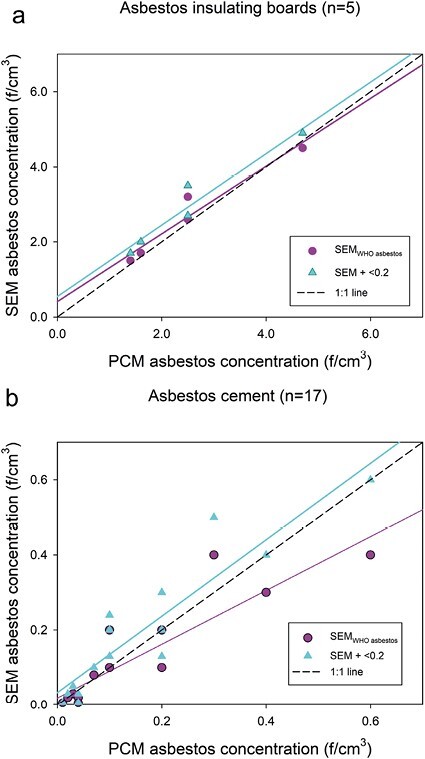
- Removal of asbestos insulating boards produced the highest personal asbestos concentrations: median 2.6 f/cm³, range 1.5–4.5 f/cm³; SEM and PCM results were relatively similar (R² = 0.94 for SEM:PCM and 0.93 for SEM+<0.2:PCM).
- For asbestos cement exterior wall/roof removal, personal asbestos medians ranged from 0.01 to 0.2 f/cm³; thin fibres (<0.2 µm) constituted up to 50% of the total fibre concentration, and the SEM+<0.2 vs PCM slope was 1.0 versus 0.72 for SEM vs PCM.
- During indoor floor removal, all SEM asbestos samples were below LOD (0.04 f/cm³), while parallel PCM samples ranged from 0.4 to 2.1 f/cm³, probably because gypsum/calcium sulphate fibres were counted by the PCM operator.
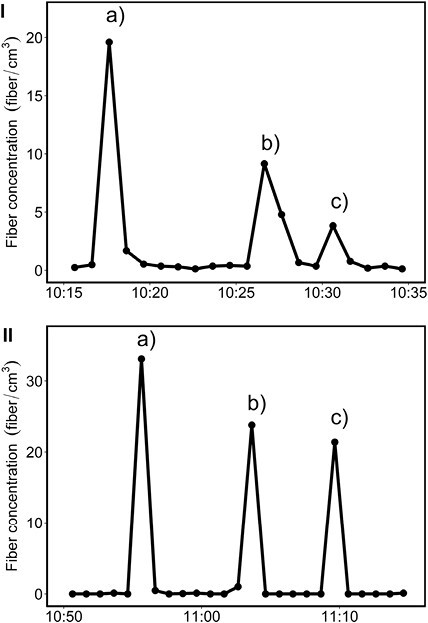
- Short-term drilling or bayonet sawing on roof slate shingles and other ACMs produced peak real-time fibre concentrations above 30 f/cm³; breaking or friction tasks gave peaks around 1.0 f/cm³.
Methods
- Personal and stationary air samples were collected during abatement of interior ACMs (asbestos insulating boards, pipe insulation, vinyl tiles, corkboard) and exterior asbestos cement materials (wall shingles, corrugated roof sheets, slate shingles). A total of 57 SEM air samples were collected (41 personal, 16 stationary); 11 were rejected for overloading, leaving 35 personal and 11 stationary samples, with 27 parallel SEM/PCM samples.
- SEM-EDX followed ISO 14966:2019 at 2000×, counting fibres >5 µm, diameter ≥0.2 µm, and length/diameter ≥3; thin fibres (<0.2 µm) were counted separately. PCM samples were analysed by NIOSH 7400. Material samples were analysed by SEM-EDX, and a real-time Fibre Monitor 7400 calibrated for chrysotile measured short-term work tasks.
Limitations
- Stated: enclosed negative-pressure areas may underestimate fibre concentrations, especially stationary samples collected 2–3 m from the activity; the fibre monitor was calibrated for chrysotile and may have counted non-asbestos fibres; SEM at 2000× may miss short fibres <0.5 µm if covered by particles; several floor and corkboard samples were rejected due to overloading; material fibre content was not quantified.
- Evident: several exposure categories had very small sample sizes (e.g., n = 1 for pipe removal, cleaning, and grinding; n = 2–3 for some floor/cork tasks), and no TEM confirmation was used, while organic fibres were removed by ashing and therefore not characterized in the SEM counts.
Model-written summary. Check it against the paper before relying on it.
Integrity signals
Registry
Cites
Statistics
Figures
Verification
Claims the paper makes
47 Own result · 32 Own interpretation · 13 Own method · 11 Sources not found · 10 No full text of the sources · 9 No basis given · 7 Check pending · 3 Not checked yet
A result the paper reports from its own data — it cites no other source for it, so there is none to check. The quote shows it is in the paper.
In the paper
“One of the samples was collected during the grinding of asbestos-containing mastics. However, this sample was also below LOD (0.04 f/cm3).”
§ Measurements of airborne asbestos fibres during refurbishing > Results and discussion > Interior floor—Vinyl asbestos tiles and corkboard
plainSingle case- Asserted: passes — The authors put it forward as true.
- Checkable: passes — It can be checked against evidence.
- Load-bearing: unclear — It is unclear whether the paper’s conclusions depend on it.
- Based: passes — The paper gives a reason why it holds.
A result the paper reports from its own data — it cites no other source for it, so there is none to check. The quote shows it is in the paper.
In the paper
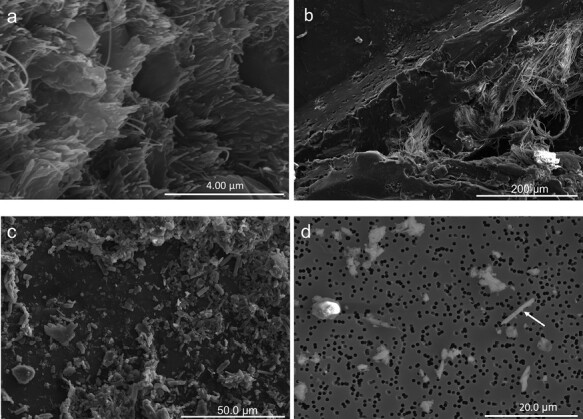
“In addition, chrysotile fibres were observed in the adhering mastics on some of these floor materials (Fig. 2b).”
§ Measurements of airborne asbestos fibres during refurbishing > Results and discussion > Interior floor—Vinyl asbestos tiles and corkboard
plain- Asserted: passes — The authors put it forward as true.
- Checkable: passes — It can be checked against evidence.
- Load-bearing: unclear — It is unclear whether the paper’s conclusions depend on it.
- Based: passes — The paper gives a reason why it holds.
The paper states this without a source or data behind it here, so there is nothing to check it against. The quote shows it is in the paper.
In the paper
“During the SEM counting analysis, a high number of calcium sulphate fibres, presumably gypsum, was observed even though the material itself did not contain gypsum fibres.”
§ Measurements of airborne asbestos fibres during refurbishing > Results and discussion > Interior floor—Vinyl asbestos tiles and corkboard
hedged- Asserted: passes — The authors put it forward as true.
- Checkable: passes — It can be checked against evidence.
- Load-bearing: unclear — It is unclear whether the paper’s conclusions depend on it.
- Based: passes — The paper gives a reason why it holds.
The paper states this without a source or data behind it here, so there is nothing to check it against. The quote shows it is in the paper.
In the paper
“Asbestos fibres were identified in all ACM material samples collected at the asbestos abatement sites.”
§ Measurements of airborne asbestos fibres during refurbishing > Results and discussion
plain- Asserted: passes — The authors put it forward as true.
- Checkable: passes — It can be checked against evidence.
- Load-bearing: unclear — It is unclear whether the paper’s conclusions depend on it.
- Based: passes — The paper gives a reason why it holds.
A result the paper reports from its own data — it cites no other source for it, so there is none to check. The quote shows it is in the paper.
In the paper
“a chorine peak in the EDX spectrum proved that the tiles consisted of a polyvinyl chloride matrix.”
§ Measurements of airborne asbestos fibres during refurbishing > Results and discussion > Interior floor—Vinyl asbestos tiles and corkboard
boostedstates a cause- Asserted: passes — The authors put it forward as true.
- Checkable: passes — It can be checked against evidence.
- Load-bearing: unclear — It is unclear whether the paper’s conclusions depend on it.
- Based: passes — The paper gives a reason why it holds.
A result the paper reports from its own data — it cites no other source for it, so there is none to check. The quote shows it is in the paper.
In the paper
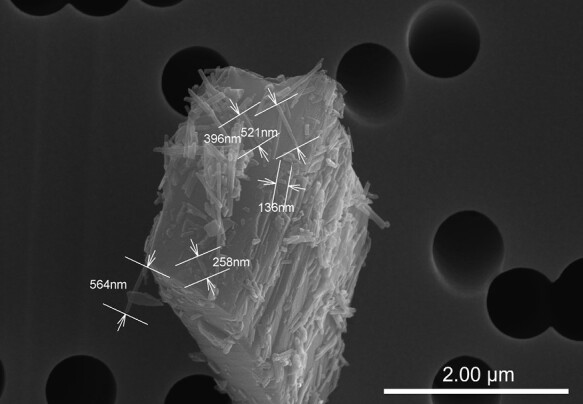
“In air samples collected from this experiment, short asbestos fibres or structures were detected lying on or within larger particles (Fig. 3).”
§ Measurements of airborne asbestos fibres during refurbishing > Results and discussion > Interior floor—Vinyl asbestos tiles and corkboard
plainSingle case- Asserted: passes — The authors put it forward as true.
- Checkable: passes — It can be checked against evidence.
- Load-bearing: unclear — It is unclear whether the paper’s conclusions depend on it.
- Based: passes — The paper gives a reason why it holds.
A result the paper reports from its own data — it cites no other source for it, so there is none to check. The quote shows it is in the paper.
In the paper
“These structures had a length in the range of 0.1–0.5 µm.”
§ Measurements of airborne asbestos fibres during refurbishing > Results and discussion > Interior floor—Vinyl asbestos tiles and corkboard
plainSingle case- Asserted: passes — The authors put it forward as true.
- Checkable: passes — It can be checked against evidence.
- Load-bearing: unclear — It is unclear whether the paper’s conclusions depend on it.
- Based: passes — The paper gives a reason why it holds.
The paper states this without a source or data behind it here, so there is nothing to check it against. The quote shows it is in the paper.
In the paper
“An important result is that comparable levels of airborne asbestos fibres were also detected during the removal of roofing felt and the roof themselves.”
§ Measurements of airborne asbestos fibres during refurbishing > Results and discussion > Asbestos cement exterior wall and roof
plain- Asserted: passes — The authors put it forward as true.
- Checkable: passes — It can be checked against evidence.
- Load-bearing: passes — The paper’s conclusions depend on it.
- Based: passes — The paper gives a reason why it holds.
A result the paper reports from its own data — it cites no other source for it, so there is none to check. The quote shows it is in the paper.
In the paper
“Short-term work led to peak concentrations above 30 f/cm3.”
§ Measurements of airborne asbestos fibres during refurbishing > Abstract
plainstates a cause- Asserted: passes — The authors put it forward as true.
- Checkable: passes — It can be checked against evidence.
- Load-bearing: passes — The paper’s conclusions depend on it.
- Based: passes — The paper gives a reason why it holds.
A result the paper reports from its own data — it cites no other source for it, so there is none to check. The quote shows it is in the paper.
In the paper
“Amosite fibres, chrysotile fibres and other inorganic fibres were observed in the material samples.”
§ Measurements of airborne asbestos fibres during refurbishing > Results and discussion > Pipe segment—thermal insulation
plainSingle case- Asserted: passes — The authors put it forward as true.
- Checkable: passes — It can be checked against evidence.
- Load-bearing: unclear — It is unclear whether the paper’s conclusions depend on it.
- Based: passes — The paper gives a reason why it holds.
- It may state two separate claims as one. 27
- Probably not a substantial claim. 30
- The quote only partly states this claim. 1
A result the paper reports from its own data — it cites no other source for it, so there is none to check. The quote shows it is in the paper.
In the paper
“These samples had a high amphibole content, and a small proportion of other inorganic fibres were observed on the filters.”
§ Measurements of airborne asbestos fibres during refurbishing > Results and discussion > Comparison between SEM and PCM
plain- Asserted: passes — The authors put it forward as true.
- Checkable: passes — It can be checked against evidence.
- Load-bearing: unclear — It is unclear whether the paper’s conclusions depend on it.
- Based: passes — The paper gives a reason why it holds.
It may state two separate claims as one.
A result the paper reports from its own data — it cites no other source for it, so there is none to check. The quote shows it is in the paper.
In the paper
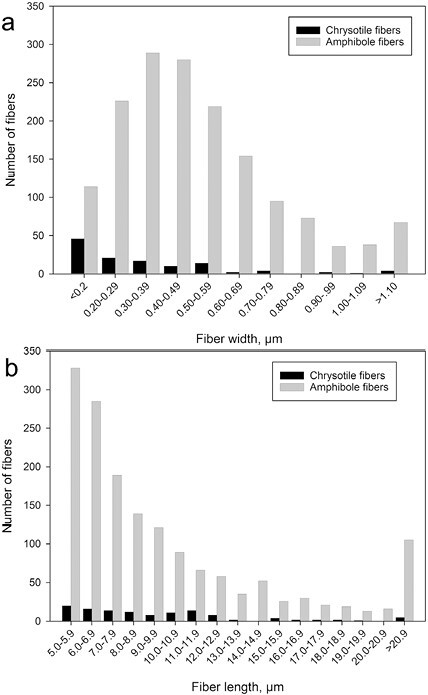
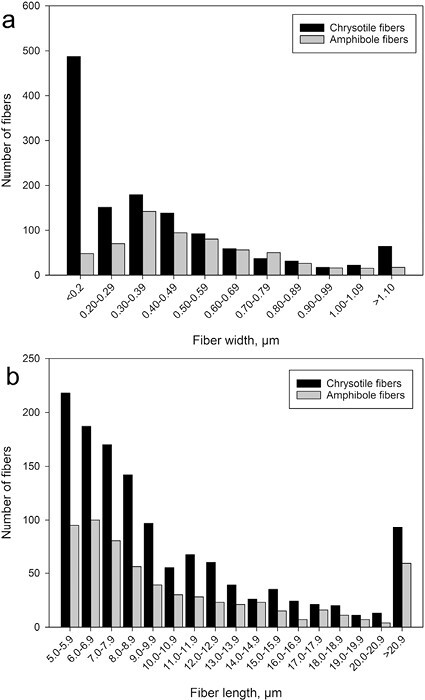
“Considering fibre width, most amphibole asbestos fibres were found to be in the size bin 0.3–0.39 µm, whereas thin fibres (<0.2 µm) dominated chrysotile.”
§ Measurements of airborne asbestos fibres during refurbishing > Results and discussion > Interior wall—asbestos insulating boards
plainstates an association- Asserted: passes — The authors put it forward as true.
- Checkable: passes — It can be checked against evidence.
- Load-bearing: unclear — It is unclear whether the paper’s conclusions depend on it.
- Based: passes — The paper gives a reason why it holds.
It may state two separate claims as one.
A result the paper reports from its own data — it cites no other source for it, so there is none to check. The quote shows it is in the paper.
In the paper
“The vinyl tile removal in our study was performed with a floor scraper, which resulted in low airborne asbestos concentrations measured with SEM.”
§ Measurements of airborne asbestos fibres during refurbishing > Results and discussion > Interior floor—Vinyl asbestos tiles and corkboard
plainstates a cause- Asserted: passes — The authors put it forward as true.
- Checkable: passes — It can be checked against evidence.
- Load-bearing: unclear — It is unclear whether the paper’s conclusions depend on it.
- Based: passes — The paper gives a reason why it holds.
It may state two separate claims as one.
A result the paper reports from its own data — it cites no other source for it, so there is none to check. The quote shows it is in the paper.
In the paper
“A high amphibole content was found in the material sample collected on site with amosite fibres as the dominant fibre type.”
§ Measurements of airborne asbestos fibres during refurbishing > Results and discussion > Interior wall—asbestos insulating boards
plainSingle case- Asserted: passes — The authors put it forward as true.
- Checkable: passes — It can be checked against evidence.
- Load-bearing: unclear — It is unclear whether the paper’s conclusions depend on it.
- Based: passes — The paper gives a reason why it holds.
It may state two separate claims as one.
A result the paper reports from its own data — it cites no other source for it, so there is none to check. The quote shows it is in the paper.
In the paper
“Thin fibres (<0.2 µm in width) were included in the SEM count and constituted up to 50% of the total fibre concentration for the asbestos cement materials.”
§ Measurements of airborne asbestos fibres during refurbishing > Abstract
plain- Asserted: passes — The authors put it forward as true.
- Checkable: passes — It can be checked against evidence.
- Load-bearing: unclear — It is unclear whether the paper’s conclusions depend on it.
- Based: passes — The paper gives a reason why it holds.
It may state two separate claims as one.
A result the paper reports from its own data — it cites no other source for it, so there is none to check. The quote shows it is in the paper.
In the paper
“The four samples analysed by PCM were all above 0.1 f/cm3, with fibre concentrations ranging from 0.4 f/cm3 to 2.1 f/cm3, whereas the corresponding SEM samples were all below LOD.”
§ Measurements of airborne asbestos fibres during refurbishing > Results and discussion > Comparison between SEM and PCM
plainn = 4- Asserted: passes — The authors put it forward as true.
- Checkable: passes — It can be checked against evidence.
- Load-bearing: passes — The paper’s conclusions depend on it.
- Based: passes — The paper gives a reason why it holds.
It may state two separate claims as one.
A result the paper reports from its own data — it cites no other source for it, so there is none to check. The quote shows it is in the paper.
In the paper
“The slope of the relationship between PCM and SEM+ <0.2 has a value of 1.0, whereas the slope of the relationship between SEM and PCM has a value of 0.72.”
§ Measurements of airborne asbestos fibres during refurbishing > Results and discussion > Comparison between SEM and PCM
plainstates an association- Asserted: passes — The authors put it forward as true.
- Checkable: passes — It can be checked against evidence.
- Load-bearing: unclear — It is unclear whether the paper’s conclusions depend on it.
- Based: passes — The paper gives a reason why it holds.
It may state two separate claims as one.
A result the paper reports from its own data — it cites no other source for it, so there is none to check. The quote shows it is in the paper.
In the paper
“and this is also observed in Fig. 1.”
§ Measurements of airborne asbestos fibres during refurbishing > Results and discussion > Comparison between SEM and PCM
plainstates an association- Asserted: passes — The authors put it forward as true.
- Checkable: passes — It can be checked against evidence.
- Load-bearing: fails — The paper’s conclusions may not depend on it.
- Based: passes — The paper gives a reason why it holds.
Probably not a substantial claim. The paper’s conclusions may not depend on it.
- Rests on an assumption: Thin fibres (<0.2 µm) are less frequent when amphibole asbestos types dominate.
A result the paper reports from its own data — it cites no other source for it, so there is none to check. The quote shows it is in the paper.
In the paper
“Removing the pipe segment with asbestos insulation led to fibre concentrations at 0.1 f/cm3 when counted with PCM, whereas the SEM count was at 0.02 f/cm3.”
§ Measurements of airborne asbestos fibres during refurbishing > Results and discussion > Comparison between SEM and PCM
plainstates a causeSingle case- Asserted: passes — The authors put it forward as true.
- Checkable: passes — It can be checked against evidence.
- Load-bearing: unclear — It is unclear whether the paper’s conclusions depend on it.
- Based: passes — The paper gives a reason why it holds.
It may state two separate claims as one.
In the paper
“Image fields and samples were rejected according to the following criteria in ISO 14966: When fibres or particles covered more than approximately one-eight of the area of an image field, the image field was rejected. The sample was rejected when more than 10% of the image fields of a filter sample were rejected (ISO 2019).”
§ Measurements of airborne asbestos fibres during refurbishing > Materials and methods > Analysis of air samples
What the sources say
- Not matchedcites ISO 2019
Couldn’t be matched to a paper in Crossref, so it can’t be checked.
plain- Asserted: passes — The authors put it forward as true.
- Checkable: passes — It can be checked against evidence.
- Load-bearing: fails — The paper’s conclusions may not depend on it.
- Based: passes — The paper gives a reason why it holds.
Probably not a substantial claim. The paper’s conclusions may not depend on it.
- Not matched
In the paper
“This is similar to the observations in Brown (1987).”
§ Measurements of airborne asbestos fibres during refurbishing > Results and discussion > Asbestos cement exterior wall and roof
What the sources say
- Not checked — no full text of the sourcecites Brown 1987 source
plainstates an association- Asserted: passes — The authors put it forward as true.
- Checkable: passes — It can be checked against evidence.
- Load-bearing: fails — The paper’s conclusions may not depend on it.
- Based: passes — The paper gives a reason why it holds.
Probably not a substantial claim. The paper’s conclusions may not depend on it.
In the paper
“These results seem to be in accordance with asbestos widths reported earlier for amosite and chrysotile from asbestos collections in ambient air and in an asbestos factory (Kohyama et al. 1996; Besson et al. 1999).”
§ Measurements of airborne asbestos fibres during refurbishing > Results and discussion > Interior wall—asbestos insulating boards
What the sources say
hedged- Asserted: passes — The authors put it forward as true.
- Checkable: passes — It can be checked against evidence.
- Load-bearing: fails — The paper’s conclusions may not depend on it.
- Based: passes — The paper gives a reason why it holds.
Probably not a substantial claim. The paper’s conclusions may not depend on it.
In the paper
“The ISO 14966:2019 method for determining the numerical concentration of inorganic fibrous particles was followed for quantification (ISO 2019).”
§ Measurements of airborne asbestos fibres during refurbishing > Materials and methods > Analysis of air samples
What the sources say
- Not matchedcites ISO 2019
Couldn’t be matched to a paper in Crossref, so it can’t be checked.
plain- Asserted: passes — The authors put it forward as true.
- Checkable: passes — It can be checked against evidence.
- Load-bearing: passes — The paper’s conclusions depend on it.
- Based: passes — The paper gives a reason why it holds.
Probably not a substantial claim.
- Not matched
In the paper
“Information on the air concentrations of the thin fibres may be important for assessing the health risks of asbestos exposure (Stanton et al. 1981; Coin et al. 1994).”
§ Measurements of airborne asbestos fibres during refurbishing > Results and discussion > Asbestos cement exterior wall and roof
What the sources say
hedged- Asserted: passes — The authors put it forward as true.
- Checkable: passes — It can be checked against evidence.
- Load-bearing: passes — The paper’s conclusions depend on it.
- Based: passes — The paper gives a reason why it holds.
Probably not a substantial claim.
What the paper did — it cites no source for this, so there is none to check. The quote shows it is in the paper.
In the paper
“This gave 27 parallel samples of SEM and PCM that could be compared.”
§ Measurements of airborne asbestos fibres during refurbishing > Results and discussion
plainn = 27- Asserted: passes — The authors put it forward as true.
- Checkable: passes — It can be checked against evidence.
- Load-bearing: fails — The paper’s conclusions may not depend on it.
- Based: passes — The paper gives a reason why it holds.
Probably not a substantial claim. The paper’s conclusions may not depend on it.
In the paper
“Other procedures or floor types may induce higher asbestos air concentrations, and variations can exist due to the technique used and/or to the floor conditions (Zichella et al. 2021).”
§ Measurements of airborne asbestos fibres during refurbishing > Results and discussion > Interior floor—Vinyl asbestos tiles and corkboard
What the sources say
- Check pendingcites Zichella et al. 2021 source
hedgedstates a possible cause- Asserted: passes — The authors put it forward as true.
- Checkable: passes — It can be checked against evidence.
- Load-bearing: unclear — It is unclear whether the paper’s conclusions depend on it.
- Based: passes — The paper gives a reason why it holds.
It may state two separate claims as one.
A conclusion the paper draws from its own results — it cites no other source for it, so there is none to check. The quote shows it is in the paper.
In the paper
“The composition of asbestos types in the building materials may depend on where and when the materials were produced.”
§ Measurements of airborne asbestos fibres during refurbishing > Results and discussion > Asbestos cement exterior wall and roof
hedgedstates a possible cause- Asserted: passes — The authors put it forward as true.
- Checkable: passes — It can be checked against evidence.
- Load-bearing: fails — The paper’s conclusions may not depend on it.
- Based: fails — The paper may give no reason why it holds.
Probably not a substantial claim. The paper’s conclusions may not depend on it. The paper may give no reason why it holds.
In the paper
“The preparation of PCM samples was performed in a commercial laboratory following the NIOSH 7400 method (NIOSH 2019).”
§ Measurements of airborne asbestos fibres during refurbishing > Materials and methods > Sample preparation of air samples
What the sources say
- Not matchedcites NIOSH 2019
Couldn’t be matched to a paper in Crossref, so it can’t be checked.
plain- Asserted: passes — The authors put it forward as true.
- Checkable: passes — It can be checked against evidence.
- Load-bearing: fails — The paper’s conclusions may not depend on it.
- Based: passes — The paper gives a reason why it holds.
Probably not a substantial claim. The paper’s conclusions may not depend on it.
- Not matched
In the paper
“Overloaded filters were rejected according to the criteria in the ISO 14966 standard (ISO 2019).”
§ Measurements of airborne asbestos fibres during refurbishing > Materials and methods > Sample preparation of air samples
What the sources say
- Not matchedcites ISO 2019
Couldn’t be matched to a paper in Crossref, so it can’t be checked.
plain- Asserted: passes — The authors put it forward as true.
- Checkable: passes — It can be checked against evidence.
- Load-bearing: fails — The paper’s conclusions may not depend on it.
- Based: passes — The paper gives a reason why it holds.
Probably not a substantial claim. The paper’s conclusions may not depend on it.
- Not matched
What the paper did — it cites no source for this, so there is none to check. The quote shows it is in the paper.
In the paper
“A real-time fibre monitor (Fibre Monitor 7400, TSI, Shoreview, MN, USA) calibrated for chrysotile fibres was applied during different work to measure the air concentration of released fibres during careless handling of ACM.”
§ Measurements of airborne asbestos fibres during refurbishing > Materials and methods > Real-time fibre monitoring
plain- Asserted: passes — The authors put it forward as true.
- Checkable: passes — It can be checked against evidence.
- Load-bearing: passes — The paper’s conclusions depend on it.
- Based: passes — The paper gives a reason why it holds.
Probably not a substantial claim.
A conclusion the paper draws from its own results — it cites no other source for it, so there is none to check. The quote shows it is in the paper.
In the paper
“The detected fibres may have been in settled dust not from the current pipe section removal.”
§ Measurements of airborne asbestos fibres during refurbishing > Results and discussion > Pipe segment—thermal insulation
hedgedstates a possible cause- Asserted: passes — The authors put it forward as true.
- Checkable: passes — It can be checked against evidence.
- Load-bearing: fails — The paper’s conclusions may not depend on it.
- Based: passes — The paper gives a reason why it holds.
Probably not a substantial claim. The paper’s conclusions may not depend on it.
None of the sources cited for this claim have been checked yet.
In the paper
“Asbestos vinyl tiles are often reported to have asbestos content of less than 10% (Kominsky et al. 1998a; Lange et al. 2000; HSE 2012), although there exist reports stating that the asbestos content may be as high as 30% (Anderson et al. 1982).”
§ Measurements of airborne asbestos fibres during refurbishing > Results and discussion > Interior floor—Vinyl asbestos tiles and corkboard
What the sources say
- Not matchedcites Kominsky et al. 1998a
Couldn’t be matched to a paper in Crossref, so it can’t be checked.
- Not checked — no full text of the sourcecites Lange et al. 2000 source
- Not matchedcites HSE 2012
Couldn’t be matched to a paper in Crossref, so it can’t be checked.
hedged- Asserted: passes — The authors put it forward as true.
- Checkable: passes — It can be checked against evidence.
- Load-bearing: fails — The paper’s conclusions may not depend on it.
- Based: passes — The paper gives a reason why it holds.
Probably not a substantial claim. The paper’s conclusions may not depend on it. It may state two separate claims as one.
- Not matched
A conclusion the paper draws from its own results — it cites no other source for it, so there is none to check. The quote shows it is in the paper.
In the paper
“This type of material is friable and crumbles easily, making fibre release likely.”
§ Measurements of airborne asbestos fibres during refurbishing > Results and discussion > Interior wall—asbestos insulating boards
hedgedstates a possible cause- Asserted: passes — The authors put it forward as true.
- Checkable: passes — It can be checked against evidence.
- Load-bearing: unclear — It is unclear whether the paper’s conclusions depend on it.
- Based: passes — The paper gives a reason why it holds.
It may state two separate claims as one.
What the paper did — it cites no source for this, so there is none to check. The quote shows it is in the paper.
In the paper
“All air concentration measurements for indoor removal of walls and floors were carried out in enclosed areas where fans provided negative pressure to limit the spread of asbestos fibres from the contaminated zone. This may result in an underestimation of the fibre concentration, especially for the stationary samples, since these were collected approximately 2–3 m from the work activity.”
§ Measurements of airborne asbestos fibres during refurbishing > Results and discussion > Indoor ACM removal
hedgedstates a possible cause- Asserted: passes — The authors put it forward as true.
- Checkable: passes — It can be checked against evidence.
- Load-bearing: unclear — It is unclear whether the paper’s conclusions depend on it.
- Based: passes — The paper gives a reason why it holds.
It may state two separate claims as one.
The paper states this without a source or data behind it here, so there is nothing to check it against. The quote shows it is in the paper.
In the paper
“Theoretically, if only asbestos fibres were present on the filters, PCM and SEM should have a 1:1 correspondence, whereas a steeper slope may be expected for the relationship between SEM + <0.2 and PCM, depending on the number of thin fibres.”
§ Measurements of airborne asbestos fibres during refurbishing > Results and discussion > Comparison between SEM and PCM
hedgedstates a possible cause- Asserted: passes — The authors put it forward as true.
- Checkable: passes — It can be checked against evidence.
- Load-bearing: passes — The paper’s conclusions depend on it.
- Based: passes — The paper gives a reason why it holds.
Probably not a substantial claim. It may state two separate claims as one.
- The authors state this as an assumption: If only asbestos fibres were present on the filters, PCM and SEM should have a 1:1 correspondence, and a steeper slope may be expected for SEM + <0.2 and PCM depending on the number of thin fibres.
In the paper
“All outdoor ACMs were asbestos cement materials products that usually contain 10–15% asbestos (HSE 2012).”
§ Measurements of airborne asbestos fibres during refurbishing > Results and discussion > Asbestos cement exterior wall and roof
What the sources say
- Not matchedcites HSE 2012
Couldn’t be matched to a paper in Crossref, so it can’t be checked.
plain- Asserted: passes — The authors put it forward as true.
- Checkable: passes — It can be checked against evidence.
- Load-bearing: unclear — It is unclear whether the paper’s conclusions depend on it.
- Based: passes — The paper gives a reason why it holds.
It may state two separate claims as one.
- Not matched
In the paper
“The detection limit (LOD) was calculated according to ISO 14966.”
§ Measurements of airborne asbestos fibres during refurbishing > Materials and methods > Analysis of air samples
What the sources say
- Not matchedcites ISO 14966
Couldn’t be matched to a paper in Crossref, so it can’t be checked.
plain- Asserted: passes — The authors put it forward as true.
- Checkable: passes — It can be checked against evidence.
- Load-bearing: fails — The paper’s conclusions may not depend on it.
- Based: passes — The paper gives a reason why it holds.
Probably not a substantial claim. The paper’s conclusions may not depend on it.
- Not matched
A conclusion the paper draws from its own results — it cites no other source for it, so there is none to check. The quote shows it is in the paper.
In the paper
“which is typically for asbestos cement materials.”
§ Measurements of airborne asbestos fibres during refurbishing > Results and discussion > Asbestos cement exterior wall and roof
plainstates an association- Asserted: passes — The authors put it forward as true.
- Checkable: passes — It can be checked against evidence.
- Load-bearing: fails — The paper’s conclusions may not depend on it.
- Based: passes — The paper gives a reason why it holds.
Probably not a substantial claim. The paper’s conclusions may not depend on it.
A conclusion the paper draws from its own results — it cites no other source for it, so there is none to check. The quote shows it is in the paper.
In the paper
“This is probably due to released asbestos fibres from the deteriorated corrugated cement roof, as the roofing felt itself did not contain any asbestos.”
§ Measurements of airborne asbestos fibres during refurbishing > Results and discussion > Asbestos cement exterior wall and roof
hedgedstates a possible cause- Asserted: passes — The authors put it forward as true.
- Checkable: passes — It can be checked against evidence.
- Load-bearing: passes — The paper’s conclusions depend on it.
- Based: passes — The paper gives a reason why it holds.
It may state two separate claims as one.
What the paper did — it cites no source for this, so there is none to check. The quote shows it is in the paper.
In the paper
“A total of 57 air samples for SEM analysis were collected during asbestos removal work of which 41 were personal samples and 16 were stationary.”
§ Measurements of airborne asbestos fibres during refurbishing > Results and discussion
plainn = 57- Asserted: passes — The authors put it forward as true.
- Checkable: passes — It can be checked against evidence.
- Load-bearing: fails — The paper’s conclusions may not depend on it.
- Based: passes — The paper gives a reason why it holds.
Probably not a substantial claim. The paper’s conclusions may not depend on it. It may state two separate claims as one.
What the paper did — it cites no source for this, so there is none to check. The quote shows it is in the paper.
In the paper
“Eleven samples were rejected due to overloading; of these, 8 samples were collected during floor removal and 3 during the removal of roof felt and batten.”
§ Measurements of airborne asbestos fibres during refurbishing > Results and discussion
plainn = 11- Asserted: passes — The authors put it forward as true.
- Checkable: passes — It can be checked against evidence.
- Load-bearing: fails — The paper’s conclusions may not depend on it.
- Based: passes — The paper gives a reason why it holds.
Probably not a substantial claim. The paper’s conclusions may not depend on it. It may state two separate claims as one.
In the paper
“As others pointed out earlier, amphibole asbestos fibres are straighter and less prone to generate fine fibrils than serpentine asbestos (Eypert-Blaison et al. 2018).”
§ Measurements of airborne asbestos fibres during refurbishing > Results and discussion > Interior wall—asbestos insulating boards
What the sources say
- Not checked — no full text of the sourcecites Eypert-Blaison et al. 2018 source
plainstates a cause- Asserted: passes — The authors put it forward as true.
- Checkable: passes — It can be checked against evidence.
- Load-bearing: fails — The paper’s conclusions may not depend on it.
- Based: passes — The paper gives a reason why it holds.
Probably not a substantial claim. The paper’s conclusions may not depend on it. It may state two separate claims as one.
What the paper did — it cites no source for this, so there is none to check. The quote shows it is in the paper.
In the paper
“The asbestos fibre concentration was quantified in only three samples, where two personal samples were collected during the packing of the corkboard material into plastic bags and one stationary sample in the contaminated zone.”
§ Measurements of airborne asbestos fibres during refurbishing > Results and discussion > Interior floor—Vinyl asbestos tiles and corkboard
plainn = 3- Asserted: passes — The authors put it forward as true.
- Checkable: passes — It can be checked against evidence.
- Load-bearing: unclear — It is unclear whether the paper’s conclusions depend on it.
- Based: passes — The paper gives a reason why it holds.
It may state two separate claims as one.
A conclusion the paper draws from its own results — it cites no other source for it, so there is none to check. The quote shows it is in the paper.
In the paper
“Nevertheless, the air concentrations measured in the plastic-covered house represent air concentrations on calm and dry days without wind or in densely populated areas where other buildings surround the abatement object.”
§ Measurements of airborne asbestos fibres during refurbishing > Results and discussion > Asbestos cement exterior wall and roof
plainSingle case- Asserted: passes — The authors put it forward as true.
- Checkable: passes — It can be checked against evidence.
- Load-bearing: unclear — It is unclear whether the paper’s conclusions depend on it.
- Based: unclear — It is unclear why the paper says it holds.
It may state two separate claims as one.
In the paper
“Some previous studies have found low levels of ambient asbestos fibres (<0.01 fibres/cm3 [f/cm3]) during the demolition of residential dwellings (Perkins et al. 2008; Neitzel et al. 2020; Stevulova et al. 2020);”
§ Measurements of airborne asbestos fibres during refurbishing > Introduction
What the sources say
hedged- Asserted: passes — The authors put it forward as true.
- Checkable: passes — It can be checked against evidence.
- Load-bearing: fails — The paper’s conclusions may not depend on it.
- Based: passes — The paper gives a reason why it holds.
Probably not a substantial claim. The paper’s conclusions may not depend on it.
What the paper did — it cites no source for this, so there is none to check. The quote shows it is in the paper.
In the paper
“In the SEM analysis, organic fibres were removed by the asher procedure, and the prevalence of such fibres is therefore not known.”
§ Measurements of airborne asbestos fibres during refurbishing > Results and discussion > Comparison between SEM and PCM
plainstates a cause- Asserted: passes — The authors put it forward as true.
- Checkable: passes — It can be checked against evidence.
- Load-bearing: unclear — It is unclear whether the paper’s conclusions depend on it.
- Based: passes — The paper gives a reason why it holds.
It may state two separate claims as one.
What the paper did — it cites no source for this, so there is none to check. The quote shows it is in the paper.
In the paper
“Only one SEM and PCM parallel sample was collected during pipe segment removal.”
§ Measurements of airborne asbestos fibres during refurbishing > Results and discussion > Comparison between SEM and PCM
plainSingle case- Asserted: passes — The authors put it forward as true.
- Checkable: passes — It can be checked against evidence.
- Load-bearing: fails — The paper’s conclusions may not depend on it.
- Based: passes — The paper gives a reason why it holds.
Probably not a substantial claim. The paper’s conclusions may not depend on it.
In the paper
“Even short-term exposure to asbestos fibres is known to increase the risk of negative health effects (Seidman et al. 1979).”
§ Measurements of airborne asbestos fibres during refurbishing > Results and discussion > Fibre release during short-term work
What the sources say
- Not checked — no full text of the sourcecites Seidman et al. 1979 source
boostedstates a cause- Asserted: passes — The authors put it forward as true.
- Checkable: passes — It can be checked against evidence.
- Load-bearing: fails — The paper’s conclusions may not depend on it.
- Based: passes — The paper gives a reason why it holds.
Probably not a substantial claim. The paper’s conclusions may not depend on it.
A conclusion the paper draws from its own results — it cites no other source for it, so there is none to check. The quote shows it is in the paper.
In the paper
“The presence of organic fibres may also depend on materials, and on season and weather conditions, especially in outdoor abatements.”
§ Measurements of airborne asbestos fibres during refurbishing > Results and discussion > Comparison between SEM and PCM
hedgedstates a possible cause- Asserted: passes — The authors put it forward as true.
- Checkable: passes — It can be checked against evidence.
- Load-bearing: fails — The paper’s conclusions may not depend on it.
- Based: fails — The paper may give no reason why it holds.
Probably not a substantial claim. The paper’s conclusions may not depend on it. The paper may give no reason why it holds. It may state two separate claims as one.
What the paper did — it cites no source for this, so there is none to check. The quote shows it is in the paper.
In the paper
“The fibre monitor was calibrated for chrysotile and the main fibre type found in these roof and wall shingles were chrysotile.”
§ Measurements of airborne asbestos fibres during refurbishing > Results and discussion > Fibre release during short-term work
plain- Asserted: passes — The authors put it forward as true.
- Checkable: passes — It can be checked against evidence.
- Load-bearing: unclear — It is unclear whether the paper’s conclusions depend on it.
- Based: passes — The paper gives a reason why it holds.
It may state two separate claims as one.
What the paper did — it cites no source for this, so there is none to check. The quote shows it is in the paper.
In the paper
“Numerous asbestos fibres were observed on these filters; however, asbestos fibres were not counted due to the very short sampling time.”
§ Measurements of airborne asbestos fibres during refurbishing > Results and discussion > Fibre release during short-term work
plainstates a cause- Asserted: passes — The authors put it forward as true.
- Checkable: passes — It can be checked against evidence.
- Load-bearing: fails — The paper’s conclusions may not depend on it.
- Based: passes — The paper gives a reason why it holds.
Probably not a substantial claim. The paper’s conclusions may not depend on it.
A conclusion the paper draws from its own results — it cites no other source for it, so there is none to check. The quote shows it is in the paper.
In the paper
“These results suggest that airborne asbestos quantification should be performed by methods capable of fibre identification and observing fibres thinner than 0.2 µm.”
§ Measurements of airborne asbestos fibres during refurbishing > Conclusion
hedged- Asserted: passes — The authors put it forward as true.
- Checkable: fails — It may be too vague to check against evidence.
- Load-bearing: passes — The paper’s conclusions depend on it.
- Based: passes — The paper gives a reason why it holds.
Probably not a substantial claim. It may be too vague to check against evidence.
A conclusion the paper draws from its own results — it cites no other source for it, so there is none to check. The quote shows it is in the paper.
In the paper
“Exposure to asbestos fibres may also occur if, for example, the dust settles and is resuspended or when handling the clothes worn during work on ACM.”
§ Measurements of airborne asbestos fibres during refurbishing > Results and discussion > Fibre release during short-term work
hedgedstates a possible cause- Asserted: passes — The authors put it forward as true.
- Checkable: passes — It can be checked against evidence.
- Load-bearing: fails — The paper’s conclusions may not depend on it.
- Based: fails — The paper may give no reason why it holds.
Probably not a substantial claim. The paper’s conclusions may not depend on it. The paper may give no reason why it holds. It may state two separate claims as one.
A conclusion the paper draws from its own results — it cites no other source for it, so there is none to check. The quote shows it is in the paper.
In the paper
“Organic fibres, such as cellulose fibres or vegetable-derived fibres, may also have contributed.”
§ Measurements of airborne asbestos fibres during refurbishing > Results and discussion > Comparison between SEM and PCM
hedgedstates a possible cause- Asserted: passes — The authors put it forward as true.
- Checkable: passes — It can be checked against evidence.
- Load-bearing: fails — The paper’s conclusions may not depend on it.
- Based: passes — The paper gives a reason why it holds.
Probably not a substantial claim. The paper’s conclusions may not depend on it.
A conclusion the paper draws from its own results — it cites no other source for it, so there is none to check. The quote shows it is in the paper.
In the paper
“The data points are seen to have a wider spread than for the asbestos insulating boards which is reasonable since these results are based on several types of asbestos cement materials, such as wall shingles, corrugated roof sheets, and slate shingles.”
- Also stated in: § Comparison between SEM and PCM · plain
“In addition, the samples were collected over several days.”
§ Measurements of airborne asbestos fibres during refurbishing > Results and discussion > Comparison between SEM and PCM
plainstates a cause- Asserted: passes — The authors put it forward as true.
- Checkable: passes — It can be checked against evidence.
- Load-bearing: passes — The paper’s conclusions depend on it.
- Based: passes — The paper gives a reason why it holds.
It may state two separate claims as one. The quote only partly states this claim.
- Also stated in: § Comparison between SEM and PCM · plain
A conclusion the paper draws from its own results — it cites no other source for it, so there is none to check. The quote shows it is in the paper.
In the paper
“Outdoor abatements may also be affected by weather conditions, although most of the asbestos cement samples were collected under a plastic cover.”
§ Measurements of airborne asbestos fibres during refurbishing > Results and discussion > Comparison between SEM and PCM
hedgedstates a possible cause- Asserted: passes — The authors put it forward as true.
- Checkable: passes — It can be checked against evidence.
- Load-bearing: fails — The paper’s conclusions may not depend on it.
- Based: passes — The paper gives a reason why it holds.
Probably not a substantial claim. The paper’s conclusions may not depend on it. It may state two separate claims as one.
A conclusion the paper draws from its own results — it cites no other source for it, so there is none to check. The quote shows it is in the paper.
In the paper
“Both inorganic and organic fibres may therefore have led to the deviation from the 1:1 line for the SEM and PCM relationship and likewise counteracted the impact from the thin fibres.”
§ Measurements of airborne asbestos fibres during refurbishing > Results and discussion > Comparison between SEM and PCM
hedgedstates a possible cause- Asserted: passes — The authors put it forward as true.
- Checkable: passes — It can be checked against evidence.
- Load-bearing: fails — The paper’s conclusions may not depend on it.
- Based: passes — The paper gives a reason why it holds.
Probably not a substantial claim. The paper’s conclusions may not depend on it. It may state two separate claims as one.
A conclusion the paper draws from its own results — it cites no other source for it, so there is none to check. The quote shows it is in the paper.
In the paper
“The existence and concentrations of inorganic fibres are material and situation dependent.”
§ Measurements of airborne asbestos fibres during refurbishing > Results and discussion > Comparison between SEM and PCM
plainstates an association- Asserted: passes — The authors put it forward as true.
- Checkable: passes — It can be checked against evidence.
- Load-bearing: passes — The paper’s conclusions depend on it.
- Based: fails — The paper may give no reason why it holds.
Probably not a substantial claim. The paper may give no reason why it holds.
The paper relies on this without support.
Asbestos-containing materials are still frequently found in buildings and houses built between the 1930s and the mid-1980s in Norway.
“ACMs are still frequently found in buildings and houses built in this period, even though it is more than 30 years since the use of these materials was prohibited in Norway.”
The paper relies on this without support.
The presence of asbestos in buildings in Norway is not fully mapped.
“As in many other countries, the presence of asbestos in buildings in Norway is not fully mapped.”
The paper relies on this without support.
Construction workers are especially at risk of exposure to asbestos during refurbishment or demolition of buildings containing asbestos-containing materials.
“Construction workers are especially at risk of exposure to asbestos in these cases.”
The paper relies on this without support.
Lack of knowledge and awareness of asbestos-containing materials may lead to exposure during refurbishing.
“Lack of knowledge and awareness of these materials may lead to exposure during refurbishing.”
The paper relies on this without support.
Little information about asbestos release from corkboard is reported in the literature.
“To our knowledge, little information about asbestos release from corkboard is reported in the literature.”
The authors state this as an assumption.
For pipe asbestos removal, asbestos fibres are not released into the workplace atmosphere since the pipe section is covered in plastic before sawing and dismantling.
“For pipe asbestos removal, it is generally assumed that asbestos fibres are not released into the workplace atmosphere since the pipe section is covered in plastic before sawing and dismantling.”
The paper relies on this without support.
Exterior asbestos abatement is usually not performed in an enclosure.
“Exterior asbestos abatement is usually not performed in an enclosure”
The paper relies on this without support.
Thin fibres (<0.2 µm) are less frequent when amphibole asbestos types dominate.
“Thin fibres (<0.2 µm) are known to be less frequent when amphibole asbestos types dominate”
The authors state this as an assumption.
If only asbestos fibres were present on the filters, PCM and SEM should have a 1:1 correspondence, and a steeper slope may be expected for SEM + <0.2 and PCM depending on the number of thin fibres.
“Theoretically, if only asbestos fibres were present on the filters, PCM and SEM should have a 1:1 correspondence, whereas a steeper slope may be expected for the relationship between SEM + <0.2 and PCM, depending on the number of thin fibres.”
Self-check
Percentages, sums and reported differences re-computed from the paper’s own numbers.
Each contradiction between two passages listed here was confirmed by an independent check.
Rated minor: it would not touch a result — a value no result rests on, a p-value that stays on the same side of the significance level, or a conflict that is clerical, resolved elsewhere in the paper, or outside its own findings.
In the paper
§ Measurements of airborne asbestos fibres during refurbishing > Materials and methods > Analysis of air samples
“The ISO 14966:2019 method for determining the numerical concentration of inorganic fibrous particles was followed for quantification (ISO 2019).”
§ Measurements of airborne asbestos fibres during refurbishing > References
“9. ISO. 14699 Ambient air- Determination of numerical concentration of inorganinc particles - Scanning electron microscopy method. Switzerland: International Standard Organization; 2019.”
Rated minor: it would not touch a result — a value no result rests on, a p-value that stays on the same side of the significance level, or a conflict that is clerical, resolved elsewhere in the paper, or outside its own findings.
In the paper
§ Measurements of airborne asbestos fibres during refurbishing > Results and discussion > Asbestos cement exterior wall and roof
“| Exterior wall and roof | Corrugated roof sheets, roof slate shingles and wall shingles | Close to activity* | 3 | 0.1 |”
§ Measurements of airborne asbestos fibres during refurbishing > Results and discussion > Asbestos cement exterior wall and roof
“| 0.02–0.08 | 0.03 | 60–70 |”
Citations
Cites
Short-term asbestos work exposure and long-term observation
Seidman, H., Selikoff, I. J., & Hammond, E. C. (1979) · Annals of the New York Academy of Sciences · doi:10.1111/j.1749-6632.1979.tb18710.x · Cited by 113
On the release of asbestos fibers from weathered and corroded asbestos cement products
Spurny, K. R. (1989) · Environmental Research · doi:10.1016/s0013-9351(89)80089-1 · Cited by 49
Asbestos Exposure During Renovation and Demolition of Asbestos-Cement Clad Buildings
BROWN, S. K. (1987) · American Industrial Hygiene Association Journal · doi:10.1080/15298668791385075 · Cited by 49
Asbestos release from whole-building demolition of buildings with asbestos-containing material
Perkins, R. A., Hargesheimer, J., & Fourie, W. (2007) · Journal of Occupational and Environmental Hygiene · doi:10.1080/15459620701691023 · Cited by 33
Measurement of asbestos emissions associated with demolition of abandoned residential dwellings
Neitzel, R. L., Sayler, S. K., Demond, A. H., d'Arcy, H., Garabrant, D. H., & Franzblau, A. (2020) · Science of The Total Environment · doi:10.1016/j.scitotenv.2020.137891 · Cited by 30
Asbestos in building and its destruction
Obmiński, A. (2020) · Construction and Building Materials · doi:10.1016/j.conbuildmat.2020.118685 · Cited by 28
Persistence of long, thin chrysotile asbestos fibers in the lungs of rats
Coin, P. G., Roggli, V. L., & Brody, A. R. (1994) · Environmental Health Perspectives · doi:10.1289/ehp.94102s5197 · Cited by 27
Mobilization of asbestos fibers by weathering of a corrugated asbestos cement roof
Ervik, T., Eriksen Hammer, S., & Graff, P. (2021) · Journal of Occupational and Environmental Hygiene · doi:10.1080/15459624.2020.1867730 · Cited by 25
Self-citationStevulova, N., Estokova, A., Holub, M., Singovszka, E., & Csach, K. (2020) · Applied Sciences · doi:10.3390/app10114048 · Cited by 22
Air Sampling During Asbestos Abatement of Floor Tile and Mastic
Lange, J. H., & Thomulka, K. W. (2000) · Bulletin of Environmental Contamination and Toxicology · doi:10.1007/s001280000031 · Cited by 18
Lange, J. H., Sites, S. L. M., Mastrangelo, G., & Thomulka, K. W. (2007) · Bulletin of Environmental Contamination and Toxicology · doi:10.1007/s00128-007-9280-x · Cited by 16
Eypert-Blaison, C., Romero-Hariot, A., Clerc, F., & Vincent, R. (2018) · Journal of Occupational and Environmental Hygiene · doi:10.1080/15459624.2017.1412583 · Cited by 14
Lange, J. H. (2001) · Indoor and Built Environment · doi:10.1177/1420326x0101000312 · Cited by 13
Perez, A. L., Nelson, M. L., Cheng, T. J., Comerford, C. E., & Scott, P. K. (2018) · International Journal of Occupational and Environmental Health · doi:10.1080/10773525.2018.1533671 · Cited by 12
KOHYAMA, N., & KURIMORI, S. (1996) · INDUSTRIAL HEALTH · doi:10.2486/indhealth.34.185 · Cited by 11
Impact of asbestos concentrations in floor tiles on exposure during removal
Lange, J. H. (2002) · International Journal of Environmental Health Research · doi:10.1080/0960312021000056401 · Cited by 10
Asbestos Exposures During Routine Floor Tile Maintenance. Part 1: Spray-Buffing and Wet-Stripping
Kominsky, J. R., Freyberg, R. W., Clark, P. J., Edwards, A., Wilmoth, R. C., & Brackett, K. A. (1998) · Applied Occupational and Environmental Hygiene · doi:10.1080/1047322x.1998.10389133 · Cited by 10
(1981) · JNCI: Journal of the National Cancer Institute · doi:10.1093/jnci/67.5.965 · Cited by 9
Vinyl-asbestos floor risk exposure in three different simulations
Zichella, L., Baudana, F., Zanetti, G., & Marini, P. (2021) · International Journal of Environmental Research and Public Health · doi:10.3390/ijerph18042073 · Cited by 9
Racine, W. P. (2010) · Journal of Environmental Management · doi:10.1016/j.jenvman.2010.02.027 · Cited by 5
Asbestos Abatement of Pipe and Floor Tile/Mastic and Comparison of Critical Plastic Barrier Controls
Lange, J. H. (2004) · Bulletin of Environmental Contamination and Toxicology · doi:10.1007/s00128-004-0278-3 · Cited by 4
Lundgren, D. A., Vanderpool, R. W., & Liu, B. Y. H. (1991) · Particle & Particle Systems Characterization · doi:10.1002/ppsc.19910080142 · Cited by 3
Kominsky, J. R., Freyberg, R. W., Clark, P. J., Hollett, B. A., Edwards, A., Wilmoth, R. C., Boiano, J. M., & Brackett, K. A. (1998) · Applied Occupational and Environmental Hygiene · doi:10.1080/1047322x.1998.10389134 · Cited by 3
Besson, P. (1999) · The Annals of Occupational Hygiene · doi:10.1016/s0003-4878(99)00041-1 · Cited by 3
(2003) · The Annals of Occupational Hygiene · doi:10.1093/annhyg/meg055 · Cited by 1
Research works printed but not linked: 8
- Anderson, 1982, Analysis of fiber release from certain asbestos products
- HSE, 2012, Asbestos: The Survey Guide HSG264,
- ISO, 2012, 22262-1 Air quality-Bulk materials- Part1: Sampling and qualitative determination of asbestos in commercial bulk materials
- ISO, 2019, 14699 Ambient air- Determination of numerical concentration of inorganinc particles - Scanning electron microscopy method
- MAK, 2005, Sampling and determining aerosols and their chemical components [Air Monitoring Methods, 2005], in The MAK-Collection for Occupational Health and Safety, 4
- NIOSH, 2019, Asbestos and other fibres by PCM
- Stanton, 1981, Relation of particle dimension to carcinogenicity in amphibole asbestoses and other fibrous minerals, J Natl Cancer Inst, 67, 965
- WHO, 1997, Determination of airborne fibre number concentrations
Cited by
Sorted by citations
Obmiński, A. (2024) · Scientific Reports · doi:10.1038/s41598-024-70631-z · Cited by 8
Asbestos fiber levels from remediation work
Brostrøm, A., Harboe, H., Fonseca, A. S., Frederiksen, M., Kines, P., Bührmann, W., Bønløkke, J. H., & Jensen, K. A. (2024) · Journal of Hazardous Materials Advances · doi:10.1016/j.hazadv.2024.100552 · Cited by 7
Franken, R., Tromp, P., Ervik, T. K., Staff, J. F., Jensen, K. A., Eypert-Blaison, C., Brostrøm, A., Cannizzaro, A., Cabo, M. T. S., Bruno, M. R., et al. (2025) · Annals of Work Exposures and Health · doi:10.1093/annweh/wxaf023 · Cited by 4
Self-citationAsbestos Cement Pipes in Water Distribution Systems: Health Risks, Regulations, and Management
Janzen, J. G. (2025) · AWWA Water Science · doi:10.1002/aws2.70043 · Cited by 2
Dehhaghi, S., & Hasankhnani, H. (2024) · Environment Development and Sustainability · doi:10.1007/s10668-024-04869-y · Cited by 2
Metadata
- Authors
- Ervik, T. K., Hammer, S. E., Skaugset, N. P., & Graff, P.
- Affiliations
- National Institute of Occupational Health (NO)
- Corresponding author
- Hammer, Stine Eriksen
- Venue
- Annals of Work Exposures and Health
- Publisher
- Oxford University Press (OUP)
- Published
- 2023-07-22
- Volume
- 67
- Issue
- 8
- Pages
- 952-964
- ISSN
- 2398-7308 (ISSN-L)
- 2398-7316
- PMC
- PMC10516614
- OpenAlex
- W4385071495
- Semantic Scholar
- 01eb08b5c03cb623627e816983c9afa090a0ef7d
- Cited by
- 14
- References
- 26
- Citations by year
- 2026: 7 · 2025: 3 · 2024: 4
- FWCI
- 2.37
- Type
- journal article
- Language
- en
- Open access
- hybrid
- doi.org
- Licence
- Locations
- Annals of Work Exposures and Health (publishedVersion, cc-by-nc)
- PubMed Central (publishedVersion, cc-by-nc)
- PubMed (publishedVersion)
- NORA - Norwegian Open Research Archives (submittedVersion, cc-by)
- Funders
- Regional Safety Representatives Foundation
- Building and Construction Industry
- Topics
- Health Sciences › Medicine › Pulmonary and Respiratory Medicine › Occupational and environmental lung diseases
- Health Sciences › Medicine › Public Health, Environmental and Occupational Health › Occupational Health and Safety in Workplaces
- Physical Sciences › Environmental Science › Health, Toxicology and Mutagenesis › Indoor Air Quality and Microbial Exposure
- Keywords
- asbestos-containing materials, building renovation, asbestos removal, fiber concentration, asbestos cement, occupational exposure, floor materials
- MeSH terms
- Asbestos, Construction Materials, Humans, Norway, Occupational Exposure
About these checks
Registry, retraction, Cites and statistics results are computed, not judged, with one exception: a printed reference that no index lists is read once by a model before it counts as a citation error. Claims are extracted by a model and kept only when their quote appears verbatim in the text; each cited source is then checked, with a model’s help, for whether it says what the claim relies on. Those verdicts can be wrong — read the claim’s quote and the cited source before relying on one.
A language model drew the claims from the paper on 2026-11-11, under version 3 of the claim definition (model deepseek-v4.1-flash, prompt extract-v3).
A second model labelled each claim on 2026-11-11 (model jev-1.13-20260917, definition revision gold-guideline-v0.2).
Statistics and arithmetic are recomputed, not judged.
Confidence bands are shown only for fields calibrated on our annotated test set. None is calibrated yet, so no band is shown.
What counts as a claim ›How we measure confidence ›How we check this ›
Are you an author, or do you see a problem with this page? Request a review
