

Mapping gene regulatory networks from single-cell omics data
Open accessThe DOI matches its Crossref record; 102 of the 102 references it cites were found in a registry or an index; 43 of the 104 sources its claims cite were checked for support.
Abstract
Single-cell techniques are advancing rapidly and are yielding unprecedented insight into cellular heterogeneity. Mapping the gene regulatory networks (GRNs) underlying cell states provides attractive opportunities to mechanistically understand this heterogeneity. In this review, we discuss recently emerging methods to map GRNs from single-cell transcriptomics data, tackling the challenge of increased noise levels and data sparsity compared with bulk data, alongside increasing data volumes. Next, we discuss how new techniques for single-cell epigenomics, such as single-cell ATAC-seq and single-cell DNA methylation profiling, can be used to decipher gene regulatory programmes. We finally look forward to the application of single-cell multi-omics and perturbation techniques that will likely play important roles for GRN inference in the future.
Overview
CoChat Summary
TL;DR
This review surveys emerging computational and experimental approaches for mapping gene regulatory networks (GRNs) from single-cell omics, focusing on scRNA-seq, single-cell epigenomics, multi-omics, and perturbation assays. It argues that single-cell data can already infer regulatory associations despite noise and sparsity, while epigenomic and multi-omics methods remain less mature.
Key findings
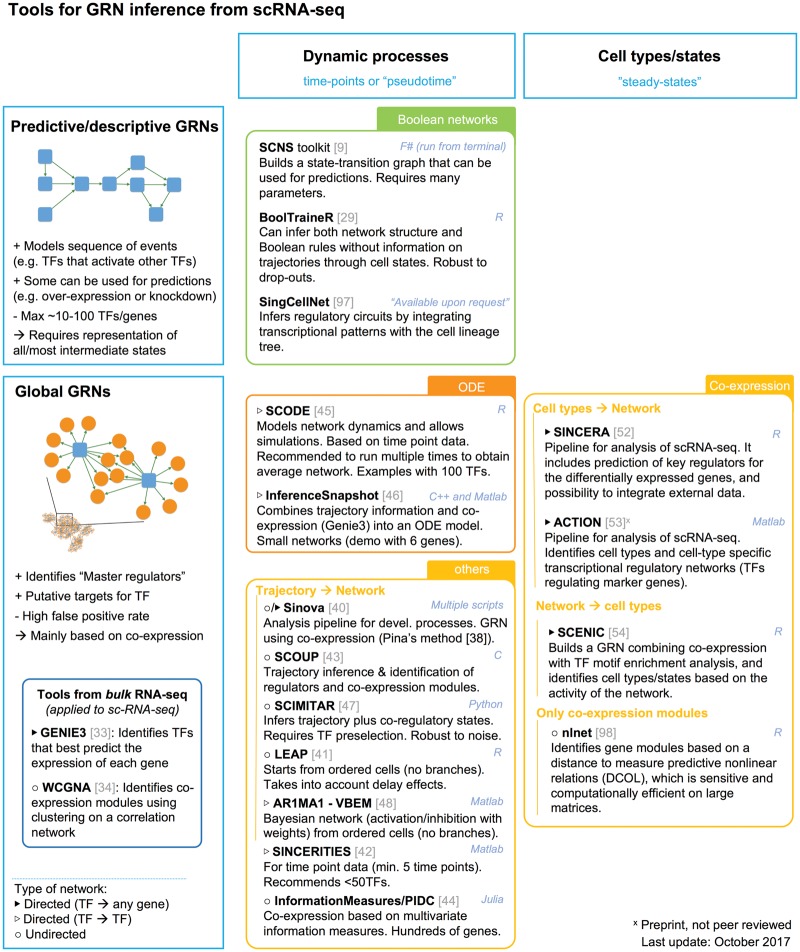
- GRN inference from scRNA-seq can identify co-regulated genes, master regulators, and dynamic state transitions; methods include Boolean networks (e.g., SCNS, BoolTraineR), co-expression-based approaches, ODE models, and SCENIC, which integrates co-expression with motif enrichment. Boolean networks can model only a small number of genes (<100).
- scATAC-seq methods differ in throughput and coverage: combinatorial indexing yields 500–1500 single cells per run versus 96 cells with microfluidics, but median reads per cell are 2503 for combinatorial indexing versus 73,000 for the microfluidic approach. Single-cell chromatin accessibility data are even sparser than scRNA-seq and require specialized methods such as chromVAR, Cicero, scABC, and latent semantic indexing.
- Single-cell methylation methods vary in coverage: scRRBS detects only 10% of all CpG sites (0.5–1.5 CpGs per single cell), scCGI-seq detects up to 76% of all CGIs on average per cell, and scBS-seq can detect up to 48% of CpG sites. DeepCpG is described as a deep neural network approach to predict missing methylation states and link methylation states to motifs.
- CRISPR-based perturbation methods (CRISP-seq, Perturb-seq, CROP-seq, Mosaic-seq) typically target 10–30 genes, TFs, or enhancers per experiment, with an average of three gRNAs per target; single-cell multi-omics techniques still have high cost per cell and limited throughput.
Methods
- Review article; no primary experimental data or new analysis are presented. It synthesizes published single-cell omics and computational GRN inference methods.
- Covers scRNA-seq, single-cell epigenomics (scATAC-seq and DNA methylation profiling), single-cell multi-omics, and CRISPR-based perturbation assays, citing examples and tools.
- No formal systematic review, meta-analysis, sample size, or statistical analysis is described.
Limitations
- Stated: single-cell transcriptomes are less sensitive and informative than bulk data because of biological variation and technical limitations, including dropouts; TFs are typically lowly expressed. scATAC-seq data are even sparser and nearly binary, and multi-omics methods have high cost and limited throughput.
- Stated: CRISPR perturbation methods face challenges with gRNA specificity and efficiency and accurate detection of gRNA barcodes; benchmarking studies are needed to determine best-performing methods.
- Evident from the text: as a review, it provides no new data or quantitative benchmarking, and its conclusions reflect the authors’ synthesis and perspective on cited literature.
Model-written summary. Check it against the paper before relying on it.
Integrity signals
Registry
Cites
Statistics
Figures

Verification
Claims the paper makes
28 Valid · 5 Not valid · 43 Not checked · 41 Own results and interpretations
Every source the paper cites for this claim was checked and supports it.
In the paper
“by Gaublomme et al. [37] to identify pathogenicity regulators that co-vary with pro-inflammatory genes”
§ Mapping gene regulatory networks from single-cell omics data > GRN inference from scRNA-seq data
What the sources say
- Supportedcites [37] Gaublomme, 2015, Single-cell genomics unveils critical regulators of Th17 cell pathogenicity, Cell source
In Results, the authors describe analyzing transcript co-variation across single Th17 cells and finding a module that co-varies with pro-inflammatory cytokines. They then use the modules to prioritize putative pathogenicity regulators for functional follow-up. (LLM, conf=0.94)
plainstates an association- Asserted: passes — The authors put it forward as true.
- Checkable: passes — It can be checked against evidence.
- Load-bearing: unclear — It is unclear whether the paper’s conclusions depend on it.
- Based: passes — The paper gives a reason why it holds.
- Rests on 2 assumptions not shown here.
- Supported
Every source the paper cites for this claim was checked and supports it.
In the paper
“In addition, these methods are sensitive to normalization and batch-effects, which may introduce artificial co-variation [39].”
§ Mapping gene regulatory networks from single-cell omics data > GRN inference from scRNA-seq data
What the sources say
- Supportedcites [39] Crow, 2016, Exploiting single-cell expression to characterize co-expression replicability, Genome Biol source
The Results and discussion section says sample-level standardization can induce artefactual co-variation and examines how co-variation across batches affects co-expression networks. The Conclusions also state that rank standardization can induce strong artefactual correlations. Page numbers are not available in our copy. (LLM, conf=0.88)
hedgedstates a possible cause- Asserted: passes — The authors put it forward as true.
- Checkable: passes — It can be checked against evidence.
- Load-bearing: unclear — It is unclear whether the paper’s conclusions depend on it.
- Based: passes — The paper gives a reason why it holds.
- Supported
Every source the paper cites for this claim was checked and supports it.
In the paper
“The activity of this GRN in each cell is then used to identify cell types/states, and key TFs that characterize each state with higher accuracy.”
§ Mapping gene regulatory networks from single-cell omics data > GRN inference from scRNA-seq data
What the sources say
- Supportedcites [54] Aibar, 2017, SCENIC: single-cell regulatory network inference and clustering, Nat Methods source
The SCENIC description says that activity of inferred regulons is scored in each cell and used to identify cell types and states. In the mouse-brain evaluation (passage 4), regulon activity revealed expected cell types and potential master regulators; clustering accuracy exceeded many dedicated methods, and transcription-factor predictions outperformed standard pipelines. (LLM, conf=0.91)
plainstates a cause- Asserted: passes — The authors put it forward as true.
- Checkable: passes — It can be checked against evidence.
- Load-bearing: passes — The paper’s conclusions depend on it.
- Based: passes — The paper gives a reason why it holds.
- Supported
Every source the paper cites for this claim was checked and supports it.
In the paper
“Finally, SCENIC [54]—developed in our laboratory—infers a GRN directly from the data, identifying direct regulatory interactions between TFs and targets by integrating co-expression with motif enrichment analysis.”
§ Mapping gene regulatory networks from single-cell omics data > GRN inference from scRNA-seq data
What the sources say
- Supportedcites [54] Aibar, 2017, SCENIC: single-cell regulatory network inference and clustering, Nat Methods source
The SCENIC workflow passage in Online Methods says GENIE3 identifies potential TF targets from co-expression and RcisTarget uses TF-motif enrichment to identify direct targets. The paper’s description of the first two workflow steps also explains that motif analysis prunes co-expression modules to remove indirect targets. (LLM, conf=0.93)
plainstates a cause- Asserted: passes — The authors put it forward as true.
- Checkable: passes — It can be checked against evidence.
- Load-bearing: passes — The paper’s conclusions depend on it.
- Based: passes — The paper gives a reason why it holds.
- Rests on 2 assumptions not shown here.
- Supported
Every source the paper cites for this claim was checked and supports it.
In the paper
“and by Pina et al. [38] to reconstruct a GRN of haematopoiesis based on pairwise associations.”
§ Mapping gene regulatory networks from single-cell omics data > GRN inference from scRNA-seq data
What the sources say
- Supportedcites [38] Pina, 2015, Single-cell network analysis identifies DDIT3 as a nodal lineage regulator in hematopoiesis, Cell Rep source
The Experimental Procedures section 'Classification and Network Inference' states that 'Single-cell transcriptional networks were inferred by calculating significant pairwise associations using both continuous (Spearman rank correlations) and binary (OR) components of linearly transformed expression data,' i.e. a co-expression-like pairwise approach. The Results (Figure 2E passage) confirm they 'combined gene associations obtained by both methodologies to infer putative regulatory networks characterizing SR states and the different modes of lineage commitment,' and the Introduction frames this as exploring 'gene expression networks around the erythroid versus myelo-monocytic lineage choice of multipotent hematopoietic progenitor cells' to gain insight into 'the evolution of GRNs relevant to lineage specification.' The only mild stretch is scope — the reconstructed network concerns the erythro-myeloid bifurcation in mouse progenitors rather than hematopoiesis as a whole — but the paper itself describes its output in GRN terms for hematopoietic lineage specification, so the attribution holds. (LLM, conf=0.86)
plainstates an association- Asserted: passes — The authors put it forward as true.
- Checkable: passes — It can be checked against evidence.
- Load-bearing: unclear — It is unclear whether the paper’s conclusions depend on it.
- Based: passes — The paper gives a reason why it holds.
- Rests on 2 assumptions not shown here.
- Supported
46 more claims · 11 with their cited sources checked
Create a free account to see all 117 claims and to verify the 61 references still open.
- Probably not a substantial claim. 37
- It may state two separate claims as one. 42
Claims other papers make about this one
Each is checked against this paper’s own text: does it say what the citing paper says it does?
The cited source says what the claim attributes to it.
In the citing paper
“In this respect, gene-regulatory network (GRN) modelling approaches are promising as they reconstruct systematic gene–gene associations from unperturbed single-cell omics data6–11.”
From Dissecting cell identity via network inference and in silico gene perturbation (2023) · cites this paper as [6]
The check wasn’t confident either way, so it gives no verdict — never disputed.
In the citing paper
“However, these methods could not be generalized to unseen perturbations.”
From A systematic comparison of single-cell perturbation response prediction models (2026) · cites this paper as [11]
Experimental — accuracy not yet measured
Self-check
Percentages, sums and reported differences re-computed from the paper’s own numbers.
Each contradiction between two passages listed here was confirmed by an independent check.
Rated minor: it would not touch a result — a value no result rests on, a p-value that stays on the same side of the significance level, or a conflict that is clerical, resolved elsewhere in the paper, or outside its own findings.
In the paper
§ Mapping gene regulatory networks from single-cell omics data > Single-cell epigenomics
“single-cell CpG island sequencing (scCGI-seq) [71]”
§ Mapping gene regulatory networks from single-cell omics data > Single-cell epigenomics
“The same is true for scGCI-seq, which combines methylation-sensitive restriction enzyme digestion and multiple displacement amplification”
Citations
Cites
WGCNA: an R package for weighted correlation network analysis
Langfelder, P., & Horvath, S. (2008) · BMC Bioinformatics · doi:10.1186/1471-2105-9-559 · Cited by 27,252
Takahashi, K., & Yamanaka, S. (2006) · Cell · doi:10.1016/j.cell.2006.07.024 · Cited by 26,673
Massively parallel digital transcriptional profiling of single cells
Zheng, G. X. Y., Terry, J. M., Belgrader, P., Ryvkin, P., Bent, Z. W., Wilson, R., Ziraldo, S. B., Wheeler, T. D., McDermott, G. P., Zhu, J., et al. (2017) · Nature Communications · doi:10.1038/ncomms14049 · Cited by 7,353
Highly parallel genome-wide expression profiling of individual cells using nanoliter droplets.
Macosko, E. Z., Basu, A., Satija, R., Nemesh, J., Shekhar, K., Goldman, M., Tirosh, I., Bialas, A. R., Kamitaki, N., Martersteck, E. M., et al. (2015) · Cell · doi:10.1016/j.cell.2015.05.002 · Cited by 7,110
Scenic: single-cell regulatory network inference and clustering.
Aibar, S., González-Blas, C. B., Moerman, T., Huynh-Thu, V. A., Imrichova, H., Hulselmans, G., Rambow, F., Marine, J.-C., Geurts, P., Aerts, J., et al. (2017) · Nature Methods · doi:10.1038/nmeth.4463 · Cited by 6,520
Self-citationFunctions of DNA methylation: islands, start sites, gene bodies and beyond
Jones, P. A. (2012) · Nature Reviews Genetics · doi:10.1038/nrg3230 · Cited by 6,061
Reversed graph embedding resolves complex single-cell trajectories
Qiu, X., Mao, Q., Tang, Y., Wang, L., Chawla, R., Pliner, H. A., & Trapnell, C. (2017) · Nature Methods · doi:10.1038/nmeth.4402 · Cited by 5,070
Single-cell RNA-seq highlights intratumoral heterogeneity in primary glioblastoma
Patel, A. P., Tirosh, I., Trombetta, J. J., Shalek, A. K., Gillespie, S. M., Wakimoto, H., Cahill, D. P., Nahed, B. V., Curry, W. T., Martuza, R. L., et al. (2014) · Science · doi:10.1126/science.1254257 · Cited by 5,063
mRNA-Seq whole-transcriptome analysis of a single cell
Tang, F., Barbacioru, C., Wang, Y., Nordman, E., Lee, C., Xu, N., Wang, X., Bodeau, J., Tuch, B. B., Siddiqui, A., et al. (2009) · Nature Methods · doi:10.1038/nmeth.1315 · Cited by 3,969
Cell types in the mouse cortex and hippocampus revealed by single-cell RNA-seq
Zeisel, A., Muñoz-Manchado, A. B., Codeluppi, S., Lönnerberg, P., La Manno, G., Juréus, A., Marques, S., Munguba, H., He, L., Betsholtz, C., et al. (2015) · Science · doi:10.1126/science.aaa1934 · Cited by 3,124
Cited by
A scalable SCENIC workflow for single-cell gene regulatory network analysis
Van de Sande, B., Flerin, C., Davie, K., De Waegeneer, M., Hulselmans, G., Aibar, S., Seurinck, R., Saelens, W., Cannoodt, R., Rouchon, Q., et al. (2020) · Nature Protocols · doi:10.1038/s41596-020-0336-2 · Cited by 1,494
Self-citationBenchmarking algorithms for gene regulatory network inference from single-cell transcriptomic data
Pratapa, A., Jalihal, A. P., Law, J. N., Bharadwaj, A., & Murali, T. M. (2020) · Nature Methods · doi:10.1038/s41592-019-0690-6 · Cited by 792
Dissecting cell identity via network inference and in silico gene perturbation
Kamimoto, K., Stringa, B., Hoffmann, C. M., Jindal, K., Solnica-Krezel, L., & Morris, S. A. (2023) · Nature · doi:10.1038/s41586-022-05688-9 · Cited by 677
Gene regulatory network inference in the era of single-cell multi-omics
Badia-i-Mompel, P., Wessels, L., Müller-Dott, S., Trimbour, R., Ramirez Flores, R. O., Argelaguet, R., & Saez-Rodriguez, J. (2023) · Nature Reviews Genetics · doi:10.1038/s41576-023-00618-5 · Cited by 469
cisTopic: cis-regulatory topic modeling on single-cell ATAC-seq data
Bravo González-Blas, C., Minnoye, L., Papasokrati, D., Aibar, S., Hulselmans, G., Christiaens, V., Davie, K., Wouters, J., & Aerts, S. (2019) · Nature Methods · doi:10.1038/s41592-019-0367-1 · Cited by 456
Self-citation
Metadata
- Authors
- Fiers, M. W. E. J., Minnoye, L., Aibar, S., Bravo González-Blas, C., Kalender Atak, Z., & Aerts, S.
- Affiliations
- VIB-KU Leuven Center for Brain & Disease Research (BE)
- VIB Center for Brain & Disease Research, Laboratory of Computational Biology, Leuven, Belgium
- Corresponding author
- Aerts, Stein
- Venue
- Briefings in Functional Genomics
- Publisher
- Oxford University Press (OUP)
- Published
- 2018-01-12
- Volume
- 17
- Issue
- 4
- Pages
- 246-254
- ISSN
- 2041-2647 (ISSN-L)
- 2041-2649
- 2041-2657
- PMC
- PMC6063279
- OpenAlex
- W2783975438
- Cited by
- 235
- References
- 99
- Citations by year
- 2026: 13 · 2025: 15 · 2024: 23 · 2023: 35 · 2022: 42 · 2021: 28 · 2020: 34 · 2019: 22 · 2018: 21
- FWCI
- 1.97
- Type
- journal article
- Language
- en
- Open access
- hybrid
- doi.org
- Licence
- Locations
- Briefings in Functional Genomics (publishedVersion, cc-by)
- Europe PMC (PubMed Central) (publishedVersion, cc-by)
- PubMed Central (publishedVersion, cc-by)
- PubMed (publishedVersion)
- Lirias (KU Leuven) (submittedVersion, other-oa)
- Funders
- The Research Foundation – Flanders (G.0640.13, G.0791.14, G092916N)
- Special Research Fund
- KU Leuven (PF/10/016, OT/13/103)
- Foundation Against Cancer (2012-F2, 2016-070, 2015-143)
- ERC Consolidator (724226_cis-CONTROL)
- Topics
- Life Sciences › Biochemistry, Genetics and Molecular Biology › Molecular Biology › Gene Regulatory Network Analysis
- Life Sciences › Biochemistry, Genetics and Molecular Biology › Molecular Biology › Single-cell and spatial transcriptomics
- Life Sciences › Biochemistry, Genetics and Molecular Biology › Molecular Biology › Genomics and Chromatin Dynamics
- Keywords
- gene regulatory networks, single-cell transcriptomics, single-cell epigenomics, single-cell ATAC-seq, cellular heterogeneity, data sparsity, single-cell multi-omics, perturbation experiments
- MeSH terms
- Sequence Analysis, RNA, Gene Expression Profiling, Gene Regulatory Networks, Epigenomics, Single-Cell Analysis
About these checks
Registry, retraction, Cites and statistics results are computed, not judged, with one exception: a printed reference that no index lists is read once by a model before it counts as a citation error. Claims are extracted by a model and kept only when their quote appears verbatim in the text; each cited source is then checked, with a model’s help, for whether it says what the claim relies on. Those verdicts can be wrong — read the claim’s quote and the cited source before relying on one.
The claim verdicts this report counts are experimental: their accuracy is not yet measured.
A language model drew the claims from the paper on 2026-10-05, under version 3 of the claim definition (model deepseek-v4.1-flash, prompt extract-v3).
A second model labelled each claim on 2026-10-05 (model jev-1.13-20260917, definition revision gold-guideline-v0.2).
Cited sources are checked with a language model’s help (gpt-6-sol and qwen3.8-omni-flash).
Statistics and arithmetic are recomputed, not judged.
Confidence bands are shown only for fields calibrated on our annotated test set. None is calibrated yet, so no band is shown.
What counts as a claim ›How we measure confidence ›How we check this ›
Are you an author, or do you see a problem with this page? Request a review
How to cite
Cite CoChat for the checks on this page, and the paper for its own findings.
- This page
- CoChat. (2026). Citation check: Mapping gene regulatory networks from single-cell omics data. https://app.cochat.ai/papers/10.1093/bfgp/elx046
- The paper
- Fiers, M. W. E. J., Minnoye, L., Aibar, S., Bravo González-Blas, C., Kalender Atak, Z., & Aerts, S. (2018). Mapping gene regulatory networks from single-cell omics data. Briefings in Functional Genomics. https://doi.org/10.1093/bfgp/elx046
Data sources
Bibliographic data: Semantic Scholar, OpenAlex, Crossref.
Contains information from the Semantic Scholar Academic Graph Datasets, made available under the ODC Attribution License (ODC-BY 1.0).
Semantic Scholar’s data is described in: Kinney, R., et al. (2023). The Semantic Scholar Open Data Platform. arXiv:2301.10140.
