

PyDESeq2: a python package for bulk RNA-seq differential expression analysis
Open accessThe DOI matches its Crossref record; 12 of the 12 references it cites were found in a registry or an index.
Abstract
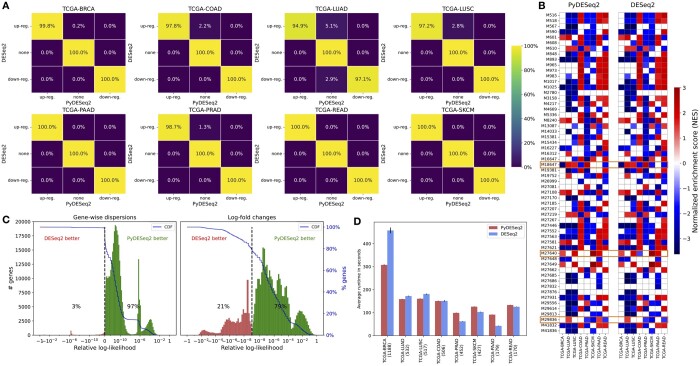
Summary: We present PyDESeq2, a python implementation of the DESeq2 workflow for differential expression analysis on bulk RNA-seq data. This re-implementation yields similar, but not identical, results: it achieves higher model likelihood, allows speed improvements on large datasets, as shown in experiments on TCGA data, and can be more easily interfaced with modern python-based data science tools. Availability and Implementation: PyDESeq2 is released as an open-source software under the MIT license. The source code is available on GitHub at https://github.com/owkin/PyDESeq2 and documented at https://pydeseq2.readthedocs.io. PyDESeq2 is part of the scverse ecosystem.
Overview
The claims and statistics of this paper haven’t been checked yet.
Free: it reads the open-access text and checks the first 5 claims that cite a source we can check. Create a free account to check every claim.
Integrity signals
Registry
Cites
Statistics
Figures
Verification
Claims the paper makes
The claims and statistics of this paper haven’t been checked yet.
Free: it reads the open-access text and checks the first 5 claims that cite a source we can check. Create a free account to check every claim.
Self-check
Percentages, sums and reported differences re-computed from the paper’s own numbers.
The self-check needs the paper’s full text.
Citations
Cites
Moderated estimation of fold change and dispersion for RNA-seq data with DESeq2
Love, M. I., Huber, W., & Anders, S. (2014) · Genome Biology · doi:10.1186/s13059-014-0550-8 · Cited by 95,106
SciPy 1.0: fundamental algorithms for scientific computing in Python
Virtanen, P., Gommers, R., Oliphant, T. E., Haberland, M., Reddy, T., Cournapeau, D., Burovski, E., Peterson, P., Weckesser, W., Bright, J., et al. (2020) · Nature Methods · doi:10.1038/s41592-019-0686-2 · Cited by 38,430 · cited 2×
“To fit GLMs, we rely on the popular scipy (Virtanen et al. , 2020) and statsmodels (Seabold and Perktold, 2010) python packages.”
MethodSciPy 1.0: fundamental algorithms for scientific computing in Python
Virtanen, P., Gommers, R., Oliphant, T. E., Haberland, M., Reddy, T., Cournapeau, D., Burovski, E., Peterson, P., Weckesser, W., Bright, J., et al. (2019) · Apollo - University of Cambridge Repository · doi:10.17863/cam.64134 · Cited by 10,460
SCANPY: large-scale single-cell gene expression data analysis
Wolf, F. A., Angerer, P., & Theis, F. J. (2018) · Genome Biology · doi:10.1186/s13059-017-1382-0 · Cited by 8,881 · cited 2×
“Examples include the scanpy suite (Wolf et al. , 2018) or the squidpy package (Palla et al. , 2022) for single-cell and spatial RNA-seq, among others.”
BackgroundStatsmodels: Econometric and Statistical Modeling with Python
Seabold, S., & Perktold, J. (2010) · Proceedings of the Python in Science Conference · doi:10.25080/majora-92bf1922-011 · Cited by 6,465 · cited 2×
“To fit GLMs, we rely on the popular scipy (Virtanen et al. , 2020) and statsmodels (Seabold and Perktold, 2010) python packages.”
MethodZhu, A., Ibrahim, J. G., & Love, M. I. (2019) · Bioinformatics · doi:10.1093/bioinformatics/bty895 · Cited by 2,072
RNA sequencing: the teenage years
Stark, R., Grzelak, M., & Hadfield, J. (2019) · Nature Reviews Genetics · doi:10.1038/s41576-019-0150-2 · Cited by 1,915 · cited 2×
“Most RNA-seq datasets are used primarily for di ↵ erential expression analysis (DEA) (Stark et al. , 2019) which provides invaluable insight on the associations between the genes’ expression and a phenotype.”
MethodRNA virus interference via CRISPR/Cas13a system in plants
Aman, R., Ali, Z., Butt, H., Mahas, A., Aljedaani, F., Khan, M. Z., Ding, S., & Mahfouz, M. (2018) · Genome Biology · doi:10.1186/s13059-017-1381-1 · Cited by 1,497
Squidpy: a scalable framework for spatial omics analysis
Palla, G., Spitzer, H., Klein, M., Fischer, D., Schaar, A. C., Kuemmerle, L. B., Rybakov, S., Ibarra, I. L., Holmberg, O., Virshup, I., et al. (2022) · Nature Methods · doi:10.1038/s41592-021-01358-2 · Cited by 1,114 · cited 2×
“, 2018) or the squidpy package (Palla et al., 2022) for single-cell and spatial RNA-seq, both of which are part of the scverse (Virshup et al.”
BackgroundThe scverse project provides a computational ecosystem for single-cell omics data analysis
Virshup, I., Bredikhin, D., Heumos, L., Palla, G., Sturm, G., Gayoso, A., Kats, I., Koutrouli, M., Community, S., Angerer, P., et al. (2023) · Nature Biotechnology · doi:10.1038/s41587-023-01733-8 · Cited by 341 · cited 1×
“, 2022) for single-cell and spatial RNA-seq, both of which are part of the scverse (Virshup et al., 2023), an ecosystem of interoperable python omics packages.”
Background
Research works printed but not linked: 1
- Sergushichev AA. An algorithm for fast preranked gene set enrichment analysis using cumulative statistic calculation. bioRxiv 2016.
Cited by
Items 101–200 of 546
Gort-Freitas, N. A., Moscvin, M., Vià, M. D., Lazzaroni, F., Nevone, A., Sadigh, S., Boullt, S., Evans, B., Chen, T., Karagiannis, T. T., et al. (2025) · Blood · doi:10.1182/blood.2024024719 · Cited by 7
Multimodal CRISPR screens uncover DDX39B as a global repressor of A-to-I RNA editing
Wei, T., Li, J., Lei, X., Lin, R., Wu, Q., Zhang, Z., Shuai, S., & Tian, R. (2025) · Cell Reports · doi:10.1016/j.celrep.2025.116009 · Cited by 8
Manso, B. A., Medina, P., Smith‐Berdan, S., y Baena, A. R., Bachinsky, E., Mok, L., Deguzman, A., Avila, S. B., Voorhis, C. V., Chattopadhyaya, S., et al. (2025) · Aging Cell · doi:10.1111/acel.70221 · Cited by 7
Human-specific SRGAP2 paralogs synchronize neotenic microglial maturation and synaptic development
Diaz-Salazar, C., Kim, J., Krzisch, M., Yoo, J., Nano, P. R., Bhaduri, A., Jaenisch, R., Paredes, M., & Polleux, F. (2026) · Neuron · doi:10.1016/j.neuron.2026.07.007 · Cited by 7
MBE: model-based enrichment estimation and prediction for differential sequencing data
Busia, A., & Listgarten, J. (2023) · Genome biology · doi:10.1186/s13059-023-03058-w · Cited by 8
“We also found that MBE consistently improved estimation accuracy compared to the LE estimates produced using cLE and DEseq2 (Fig.”
MethodInfluentialWang, S., Hu, X., & Zhang, Q. (2023) · IEEE International Conference on Bioinformatics and Biomedicine (BIBM) · doi:10.1109/bibm58861.2023.10385635 · Cited by 7
“Subsequently, we perform differential gene expression analysis using the pydeseq2 package [16] to select the genes that exhibit significant changes.”
MethodConserved phenotype and function of human brain border-associated macrophages in iPSC-derived modelsPreprint
Barr, H. J., Depp, C., Hingerl, M., Nguyen, T. T. H., Reimertz, J. M., Connolly, E., Patel, J., Doman, J. L., Marsh, S. E., & Stevens, B. (2025) · bioRxiv (Cold Spring Harbor Laboratory) · doi:10.64898/2025.12.11.693582 · Cited by 7
Differential analysis of genomics count data with edge*Preprint
Pachter, L. S. (2026) · bioRxiv (Cold Spring Harbor Laboratory) · doi:10.64898/2026.02.16.706223 · Cited by 7
“Together with DESeq2 (Love et al., 2014), it established the negative binomial frame work as the standard for count-based differential ex pression analysis.”
Bauer, M., Vaxevanis, C., Jaekel, N., Hackl, H., Wilfer, A., Zoellig, C., Hämmerle, M., Müller‐Tidow, C., Al‐Ali, H. K., Seliger, B., et al. (2025) · Leukemia · doi:10.1038/s41375-025-02706-3 · Cited by 6
“Differential gene expression of different groups (MPN versus HC or JAK2 - mutated versus no JAK2 mutation) was performed using PyDESeq2 package in Python [24].”
Artery formation in the intestinal wall and mesentery by intestine-derived Esm1+ endothelial cells
Bovay, E., Kruse, K., Watson, E. C., Mohanakrishnan, V., Stehling, M., Berkenfeld, F., Pitulescu, M. E., Kahn, M. L., & Adams, R. H. (2025) · Nature Communications · doi:10.1038/s41467-025-64047-0 · Cited by 6
DNA topoisomerase I acts as supercoiling sensor for bacterial transcription elongation
Vidmar, V., Borde, C., Bruno, L., Miropolskaya, N., Takács, M., Batisse, C., Saint-André, C., Zhu, C., Espéli, O., Lamour, V., et al. (2025) · Nature Structural & Molecular Biology · doi:10.1038/s41594-025-01703-5 · Cited by 6
“RNA-seq data were analyzed using Rockhopper v.2.0.3 software 61 and differential expression analysis was performed using PyDESeq2 62 .”
InfluentialFletcher, C. T., Mornement, A. A., Barrett, C. E., Canning, P., Rucktooa, P., Huber, S., Cooper, C. D. O., Scully, C. C. G., Dore, A. S., Rohle, D., et al. (2026) · Communications Biology · doi:10.1038/s42003-026-09584-0 · Cited by 6
A consensus spinal cord cell-type atlas across mouse, macaque, and human
Schmitz, M. T., Johansen, N., Kempynck, N., Kapen, I., Fu, Y., Hewitt, M. N., Seeman, S. C., Kussick, E., Gautier, O., Leone, M. J., et al. (2026) · Neuron · doi:10.64898/2026.02.04.703852 · Cited by 6
Wang, M., Yoneyama, K., Žedaveinytė, R., Ishikawa, J., Tang, S., Le, H. C., Wiegand, T., Ramirez, J. A. S., Nagahata, N., Ma, Y., et al. (2026) · Cell · doi:10.1016/j.cell.2026.07.012 · Cited by 6
Guo, J., Zhang, W., Chen, X., Yen, A., Chen, L. L., Shively, C. A., Li, D., Wang, T., Dougherty, J. D., & Mitra, R. D. (2024) · Bioinformatics · doi:10.1093/bioinformatics/btae070 · Cited by 6
Pareja-Lorente, E., & Aloy, P. (2025) · Genome biology · doi:10.1186/s13059-025-03677-5 · Cited by 7
“By aggregating cell expression data into “pseudo-replicates,” we applied a Python implementation of the DESeq2 method (pydeseq2), designed for bulk expression samples [43, 44].”
Sokirniy, I., Inam, H., Tomaszkiewicz, M., Reynolds, J., McCandlish, D. M., & Pritchard, J. R. (2025) · Nucleic Acids Research · doi:10.1093/nar/gkaf738 · Cited by 6
“Z-score cutoff for ABE data was based on the human targeting (AAVS1, CCR5, and ROSA26) negative control sgRNA.”
du Terrail, J. O., Klopfenstein, Q., Li, H., Mayer, I., Loiseau, N., Hallal, M., Debouver, M., Camalon, T., Fouqueray, T., Castro, J. A., et al. (2025) · Nature Communications · doi:10.1038/s41467-025-62525-z · Cited by 9
“Followingthe recent trend of switching fromR toPythonforimplementingstatisticalsoftware 93,118,119 ,wechose Python as the base language for our implementation.”
Self-citationCho, I. S., Yaghmour, A., Joshi, A., Gupta, P., Sanborn, M. A., Zappia, M. P., Wong, S. W., Cheng, G., Frolov, M. V., Rehman, J., et al. (2025) · Advanced Materials · doi:10.1002/adma.202504590 · Cited by 7
Patowary, P., Bhattacharyya, D. K., & Kalita, J. K. (2025) · Network Modeling Analysis in Health Informatics and Bioinformatics · doi:10.1007/s13721-025-00612-3 · Cited by 6
Kuehl, M. B., Wong, M. N., Wanner, N., Bonn, S., & Puelles, V. G. (2024) · Bioinformatics · doi:10.1093/bioinformatics/btae700 · Cited by 7
“Next to R, the Python programming language is widely used and counts with a growing ecosystem of RNA-seq analysis software, including Python versions of decoupleR (Badia-i-Mompel et al. 2022) and PyDESeq2 (Muzellec et al. 2023), a Python port of the widely-used DESeq2 package (Love et al. 2014).”
Organ-specific microenvironments drive divergent T cell evolution in acute graft-versus-host disease
Omdahl, K. I., Bermea, R. S., Fleming, R., Kimler, K., Kaminski, J., Hariri, L. P., Ly, A., Rui, X., Cagnin, L. S., Lane, J. F., et al. (2025) · Science Translational Medicine · doi:10.1126/scitranslmed.ads1298 · Cited by 6
MicroRNA-directed control of complex mRNA stability patterns across cell typesPreprint
Oesinghaus, L., Castillo-Hair, S. M., Bean, M., Ludwig, N., Rishik, S., Kueh, H. Y., Keller, A., & Seelig, G. (2024) · bioRxiv (Cold Spring Harbor Laboratory) · doi:10.1101/2024.10.28.620728 · Cited by 6
Haist, M., Matusiak, M., Tan, Y., Zimmer, S., Stege, H. M., Kempchen, T. N., Mitschke, S., Chu, P., Weidenthaler‐Barth, B., Barlow, G. L., et al. (2025) · bioRxiv (Cold Spring Harbor Laboratory) · doi:10.1101/2025.06.06.657162 · Cited by 8
“Differential gene expression analysis was conducted using a Wald test from the pydeseq2 and diffxpy packages 70 .”
Caicedo-Montoya, C., Cervantes, L. F. P., & Ríos‐Estepa, R. (2024) · International Journal of Molecular Sciences · doi:10.3390/ijms252413472 · Cited by 5
Habitual Exercise Modulates Neuroimmune Interaction to Mitigate Aortic Stiffness
Cho, J. M., Vu, K., Park, S., Zhu, E., Li, Y.-R., Zhao, P., Yokota, T., Yang, L., Lu, R., Xiang, Y. K., et al. (2025) · Circulation Research · doi:10.1161/circresaha.124.325656 · Cited by 5
Anh, N. V., Gil, H., Park, S., & Ryu, S. (2025) · Endocrinology and Metabolism · doi:10.3803/enm.2025.2297 · Cited by 5
“To validate the differential gene expression results between cluster 1 and the remaining clusters, we employed a bulk dataset (accession number GSE86468) and pyDESeq2 to obtain differential expression data [12,36].”
Sheyn, U., Poff, K. E., Eppley, J. M., Leu, A. O., Bryant, J. A., Li, F., Romano, A. E., Burger, A., Barone, B., & DeLong, E. F. (2025) · The ISME Journal · doi:10.1093/ismejo/wraf106 · Cited by 5
“PyDESeq2 (Python implementation of DESeq2, v 0.4.0) was used to compare the species-level-specific tr anscripts expression between the eddies and identify overexpressed transcripts using the default Wald test and Benjamini-Hochberg procedure for false detection rate and P values adjustment [76].”
InfluentialKorah, M. M., Reveron‐Thornton, R. F., Fallah, M., Xie, P. Y., Gonçalves, A. C., Guo, C., Agolia, J. P., Delitto, A. E., Flojo, R. A. B., Reddy, B., et al. (2025) · Cell Reports · doi:10.1016/j.celrep.2025.116347 · Cited by 6
Hybridization and low-light adaptability in California eelgrass (Zostera spp.)
Moore, M. L., Allsing, N. A., Hartwick, N. T., Mamerto, A., Murray, E. R., Sanders, R. D., & Michael, T. P. (2025) · Nature Plants · doi:10.1038/s41477-025-02142-2 · Cited by 5
Anwer, D., Montaldo, N. P., Novoa‐del‐Toro, E. M., Domańska, D., Nilsen, H. L., & Polster, A. V. (2025) · npj Parkinson s Disease · doi:10.1038/s41531-025-01194-7 · Cited by 5
Circuit-aligned specialization of human basal ganglia astrocytes
Fu, Y., Kempynck, N., Ding, W., Turner, M. A., Garcia, A. D., Schmitz, M. T., Close, J., Kapen, I., Hewitt, M., Seeman, S. C., et al. (2026) · Cell · doi:10.64898/2025.12.19.695583 · Cited by 9
Kumari, B., Damodaran, A. P., Guiblet, W. M., Xiao, M., Behera, A. K., On, T. A., MCINTOSH, C. E., Teszler, M., Holloway, C., Le, S. M., et al. (2026) · Nature Communications · doi:10.1038/s41467-026-68774-w · Cited by 5
“Differential expression analysis was done using a Python implementation of the DESeq2 pipeline (PyDESeq2) 81 .”
Multimodal single-cell epigenomic and 3D genome atlas of the human basal ganglia
Ding, W., Klein, A., Báez-Becerra, C. T., Rink, J. A., Bartlett, A., Wang, R., Zeng, Q., Castanon, R., Nery, J. R., Osgood, E., et al. (2026) · Cell · doi:10.64898/2026.02.12.705594 · Cited by 13
Barman, S., Räuber, S. J., Eisenhut, K., Esser, D., VanDuijn, M. M., Scharf, M., Herrera-Rivero, M., Disse, P., Preuth, L.-M., Gulyaeva, V., et al. (2026) · Proceedings of the National Academy of Sciences · doi:10.1073/pnas.2514753123 · Cited by 5
mTORC1 activity suppresses ferroptosis through a SCARB1-dependent HDL-tocopherol uptake pathway
O’Loughlin, T. A., Stiles, J. S., Acharya, P., Arab, A., Goudy, L., Dai, R., Borah, A. A., Weiss, W. A., Medoh, U. N., & Gilbert, L. A. (2026) · Molecular Cell · doi:10.1016/j.molcel.2026.03.019 · Cited by 5
“78 Analysis of RNA-seq in Figure 5 was performed by Plasmidsaurus using their standard in-house pipeline.”
TROP2 targeting reveals therapy-driven cell state dynamics in colorectal cancer
Vaquero‐Siguero, N., Georgakopoulos, N., Heinz, M. C., Chiotakakos, I., Meier, J., Fey, S. K., Diamante, G., Mastel, M., Martinez, A. G., Belthier, G., et al. (2026) · Nature · doi:10.1038/s41586-026-10705-2 · Cited by 6
Levinsohn, J., Grindel, S. H., Dumoulin, B., Abedini, A., Conte, C., Huang, A. Z., Levin-Klein, R., Weisz, B., Rabinowitz, G., Bergeson, A., et al. (2026) · Nature Genetics · doi:10.1038/s41588-026-02665-0 · Cited by 5
Pan-cancer analyses suggest kindlin-associated global mechanochemical alterations
Chowdhury, D., Mistry, A., Maity, D., Bhatia, R., Priyadarshi, S., Wadan, S., Chakraborty, S., & Haldar, S. (2024) · Communications Biology · doi:10.1038/s42003-024-06044-5 · Cited by 5
“We conducted genomic characterization by performing differential gene expression analysis and gene set enrichment analysis utilizing the PythonpackagepyDESEQ2 77 .”
PIT-1/SF-1-positive pituitary tumors in patients with acromegaly: transcriptomic perspective
Rymuza, J., Zhang, Q., & Bujko, M. (2025) · Acta Neuropathologica Communications · doi:10.1186/s40478-025-02091-z · Cited by 5
Behavioral and transcriptomic markers of susceptibility to escalate fentanyl intake
Keady, J. V., Charnigo, R. J., Shaykin, J. D., Prantzalos, E. R., Xia, M., Denehy, E. D., Bumgardner, C., Miller, J. B., Ortinski, P. I., Bardo, M. T., et al. (2026) · Translational Psychiatry · doi:10.1038/s41398-026-04034-1 · Cited by 5
“Differential RNA expression was determined using pyDESeq2 (0.4.9) at a false discovery rate (FDR) 0.05, fi ltering out genes with less than 10 total reads per row, with fentanyl escalation groups treated as the between-group comparisons [34].”
InfluentialCiernik, L., Kraft, A., Barkmann, F., Yates, J., & Boeva, V. (2023) · bioRxiv (Cold Spring Harbor Laboratory) · doi:10.1101/2023.09.20.558114 · Cited by 5
Single-cell analysis reveals transcriptional dynamics in healthy primary parathyroid tissue
Venkat, A., Carlino, M. J., Lawton, B. R., Prasad, M. L., Amodio, M., Gibson, C. E., Zeiss, C. J., Youlten, S. E., Krishnaswamy, S., & Krause, D. S. (2024) · Genome Research · doi:10.1101/gr.278215.123 · Cited by 6
Jahanifar, M., Dawood, M., Tajeddin, N. Z., Shephard, A., Chohan, B. S., Bertram, C., Wahab, N., Eastwood, M., Aubreville, M., Raza, S. E. A., et al. (2025) · medRxiv · doi:10.1101/2025.06.07.25329181 · Cited by 7
“Gene-level differential expression was assessed using the Python implementation of the DESeq2 method 108 via the “PyDESeq2” package 109 .”
Swinderman, J. T., Tung, P., Winters, A. F., Goudy, L., Wilson, C. M., Bounds, L. R., Teyssier, N., Agrawal, A., Dobin, A., Hua, T., et al. (2026) · bioRxiv (Cold Spring Harbor Laboratory) · doi:10.64898/2026.02.04.703058 · Cited by 9
“DESeq2 was used for differential expression testing using pyDESeq2 34 on count matrices pseudobulked by perturbation assignment compared to sgNeg.”
Distinct Cellular Phenotypes of Language and Executive Decline in Amyotrophic Lateral Sclerosis
Petrescu, J., Gouveia Roque, C., Jackson, C. A., Daly, A. C., Butti, Z., Kang, K., Casel, O., Leung, M., Reilly, L., Eschbach, J., et al. (2026) · Cell · doi:10.1016/j.cell.2026.07.008 · Cited by 4
Exonic enhancers are a widespread class of dual-function regulatory elements
Mouren, J.-C., Torres, M., van Ouwerkerk, A., Manosalva, I., Gallardo, F., Spicuglia, S., & Ballester, B. (2026) · Nature Communications · doi:10.1038/s41467-026-71220-6 · Cited by 4
PyEvoCell: an LLM-augmented single-cell trajectory analysis dashboard
Mathur, S., Beauvais, M., Giribet, A., Barrero, N. A., Zhang, C., Rahman, T., Wang, S., Huang, J., Nouri, N., Kurlovs, A., et al. (2025) · Bioinformatics · doi:10.1093/bioinformatics/btaf158 · Cited by 5
“The DGE and GSEA analyses are enabled by PyDeSeq2 (Muzellec et al. 2023) and GSEApy (Fang et al. 2023), respectively.”
Mahdy, A. K. H., ElAbd, H., Prinzensteiner, M., Jebens, H., Sivickis, K., Bächer, P., Vogl, T. J., Poyet, M., & Franke, A. (2026) · Journal of Crohn s and Colitis · doi:10.1093/ecco-jcc/jjag015 · Cited by 5
Kambhampati, S., D’Alessio, L., Grab, F., Fleming, S. J., Liu, S., Raichur, R., Chen, F., & Babadi, M. (2025) · Cell Systems · doi:10.1016/j.cels.2025.101394 · Cited by 4
Priyadarshi, S., Mazumder, C., Neekhra, B., Biswas, S., Chowdhury, D., Gupta, D., & Haldar, S. (2025) · Communications Biology · doi:10.1038/s42003-025-08727-z · Cited by 6
Doan, L. M. T., Verma, S., Eftekhari, N., Angione, C., & Occhipinti, A. (2025) · Computers in Biology and Medicine · doi:10.1016/j.compbiomed.2025.111195 · Cited by 5
Sherman, J. W., Rask, G. C., Xiong, B., Tokarsky, E. J., Dreher, R. D., Weinglass, A., Hayes, C., Duncan, A. D., Weerapana, E., & Theisen, E. R. (2025) · ACS Pharmacology & Translational Science · doi:10.1021/acsptsci.5c00447 · Cited by 4
Mapping NK cell diversity in response to COVID-19 and mRNA vaccination
Kishi, Y., Liu, Y.-C., Ishikawa, M., Yamashita, M., Matsumoto, H., Ogura, H., Sakakibara, S., & Okuzaki, D. (2025) · Scientific Reports · doi:10.1038/s41598-025-11575-w · Cited by 4
“Differential expression analysis was performed between the CD56 dim (canonical) and CD56 dim (adaptive) subsets using the pydeseq2.dds.DeseqDataset() class in PyDESeq2 (0.4.11) 97 .”
InfluentialHughes, J. B., Pujari, A., Sandholm, A., Croll, D., Monk, L. B., Joshua, I., Butterfield, R., Horton, C., Schneider, K., Senchyna, F., et al. (2026) · npj Aging · doi:10.1038/s41514-026-00388-4 · Cited by 4
Ni, H., Qiu, S., Wen, L., Li, W., Zhang, X., Zeng, H., & Wang, Y. (2026) · npj Science of Food · doi:10.1038/s41538-025-00676-5 · Cited by 5
Digitaria genome analyses indicate introgression may drive local adaptation and herbicide resistance
Huang, Y., Li, J., Li, Z., Zhang, S., Gao, X., Xie, L., Zhou, R., Kun, Y. Z.-X. P., Li, Z., Wu, S., et al. (2026) · Nature Communications · doi:10.1038/s41467-026-69076-x · Cited by 4
Qi, L., He, Y., Sviercovich, A., Mei, X., Chen, E. H., Xia, Y., Conboy, M. J., Conboy, I. M., & Stahl, A. (2026) · Nature Biomedical Engineering · doi:10.1038/s41551-026-01618-6 · Cited by 4
“77), a Python implementation of DESeq2.”
Xirouchaki, C. E., García-Domínguez, E., Coughlan, E., McGrath, M. J., Giri, S., Liang, S., Wiede, F., Bigot, A., Sadoshima, J., Gómez‐Cabrera, M. C., et al. (2026) · Science Advances · doi:10.1126/sciadv.adz1953 · Cited by 5
“4.2) ( 122 ), with genes with absolute logFoldChange > 0.5 and FDR 0.05 determined to be differentially expressed.”
InfluentialContraMAE: Contrastive alignment masked autoencoder framework for cancer survival prediction
Wang, S., Lai, H., Wang, S., & Zhang, Q. (2024) · IEEE International Conference on Bioinformatics and Biomedicine (BIBM) · doi:10.1109/bibm62325.2024.10821720 · Cited by 4
“After that, we perform differential gene expression analysis by Pydeseq2 [7] tool and genes importance analysis by random survival forest model (RSF) [6] to select the top 300 genes for each genomics type.”
Ji, J. D., & Jung, S. (2024) · Bioinformatics · doi:10.1093/bioinformatics/btaf020 · Cited by 4
Schmidt, T., Wiesbeck, M. F., Egert, L., Truong, T.-T., Danese, A., Voshagen, L., Imhof, S., Borgia, M. I., Deeksha, Neuner, A. M., et al. (2025) · Nucleic Acids Research · doi:10.1093/nar/gkaf235 · Cited by 4
“9.15 and the following packages decoupler 1.8.0 [ 38 ], scanpy 1.10.1 [ 39 ], anndata 0.10.7 [ 39 ], and pydeseq2 0.4.12 [ 40 ].”
InfluentialMohl, D. A., Lagies, S., Lonzer, A., Pfäffle, S. P., Groß, P. R., Benka, M., Jäger, M., Huber, M. C., Günther, S., Plattner, D. A., et al. (2025) · Cells · doi:10.3390/cells14090626 · Cited by 4
“4.12) [43].”
InfluentialHeat‐Induced Secondary Dormancy Contributes to Local Adaptation in Arabidopsis thaliana
Tran, N. L. T., Ali, T., Schmitz, G., & de Meaux, J. (2025) · Molecular Ecology · doi:10.1111/mec.70086 · Cited by 4
Fetal inflammatory signals regulate maternal investment during marsupial pregnancy
Stadtmauer, D. J., Maziarz, J. D., Griffith, O. W., & Wagner, G. P. (2026) · PLoS Biology · doi:10.1371/journal.pbio.3003670 · Cited by 4
“5.0 [65].”
InfluentialGao, W., Hu, P., Wick, B. D., Qiu, Q., Zhang, H., Li, Y., Kang, X., Bedi, K. C., Haeussler, M., Sasaki, K., et al. (2026) · Genome biology · doi:10.1186/s13059-026-04061-7 · Cited by 4
“5.2) [44], a faster and more scalable python-based implementation of DESeq2 [43], using this design matrix: expression ~ sex + age_group + disease_binary + tech_plus_study.”
InfluentialNetwork-based discovery of regulatory drivers of cognitive decline in alzheimer’s disease
Anwer, D., Arina, A., Marchi, A., Kerkhoven, E. J., & Polster, A. (2026) · npj Aging · doi:10.1038/s41514-026-00443-0 · Cited by 4
Baumgartner, A. M., Robinson, M., Ertekin‐Taner, N., Golde, T. E., Jayadev, S., Huang, S., Hadlock, J., & Funk, C. C. (2025) · Communications Biology · doi:10.1038/s42003-025-07594-y · Cited by 5
“Wethenperformedpseudobulkdifferentialexpressionanalysis using pyDESeq2 32 using an adjusted p value cutoff of 0.05 for genes expressed in at least 50% of cells in that cluster.”
InfluentialBrooks, I. A. W., Jedrasiak‐Cape, I., Rybicki-Kler, C., Ekins, T. G., & Ahmed, O. J. (2025) · Journal of Neuroscience · doi:10.1523/jneurosci.2246-24.2025 · Cited by 4
Lin, M., Chuang, C.-H., Kao, C.-H., Chen, S., Wang, S., Hsieh, P.-H., Chen, G.-Y., Mao, C.-C., Li, J.-Y., Lu, M. J., et al. (2024) · Insect Biochemistry and Molecular Biology · doi:10.1016/j.ibmb.2024.104115 · Cited by 4
du Terrail, J. O., Klopfenstein, Q., Li, H., Mayer, I., Loiseau, N., Hallal, M., Debouver, M., Camalon, T., Fouqueray, T., Castro, J. A., et al. (2023) · arXiv (Cornell University) · doi:10.48550/arxiv.2311.16984 · Cited by 4
“Followingthe recent trend of switching fromR toPythonforimplementingstatisticalsoftware 93,118,119 ,wechose Python as the base language for our implementation.”
Self-citationFedPyDESeq2: a federated framework for bulk RNA-seq differential expression analysisPreprint
Muzellec, B., Marteau-Ferey, U., & Marchand, T. (2024) · bioRxiv (Cold Spring Harbor Laboratory) · doi:10.1101/2024.12.06.627138 · Cited by 5
“From sequenced transcriptomic profiles, DEA aims to identify differentially expressed genes (DEGs) between two conditions (e.g., treated and control samples), using statistical software such as edgeR [2], limma [3] or DESeq2 [4] and its recently proposed python alternative, PyDESeq2 [5].”
Self-citationLee, J., Kim, J., Bae, H., Kim, M., Jung, B. K., Kim, J., Lee, S., & Kim, H. U. (2024) · bioRxiv (Cold Spring Harbor Laboratory) · doi:10.1101/2024.12.09.627468 · Cited by 4
Chang, A. C.-C., Schlegel, B. T., Carleton, N. M., McAuliffe, P. F., Waltermire, H., Oesterreich, S., Schwartz, R. S., & Lee, A. V. (2025) · bioRxiv (Cold Spring Harbor Laboratory) · doi:10.1101/2025.02.15.638331 · Cited by 4
“COMMOT [14], GSEAPY [15], and PyDeSeq2 [16] were used as described in their respective vignettes.”
Grouard, S., Esposito, C., Khoury, J. E., Ducret, V., Thiriez, C., Herpin, L., Chossegros, A., Hoffmann, C., Bayard, Q., Robin, G., et al. (2025) · bioRxiv (Cold Spring Harbor Laboratory) · doi:10.1101/2025.10.13.682206 · Cited by 5
Godfrey, W. H., Lee, J. J., Shanmukha, S., Cho, K., Deng, X., Ambati, C. R., Putluri, V., Kamal, A. H. M., Kim, P. M., Putluri, N., et al. (2025) · eLife · doi:10.7554/elife.104423.3 · Cited by 3
Multi-omic analysis of canine aging uncovers conserved aging pathways
Koch, Z., Graves, J., Annan, S., Frankino, P. A., Nelson, M., McMahon, J. E., Tovar, A. P., Chen, H. C., Halioua-Haubold, C.-L., & Peloquin, M. (2025) · GeroScience · doi:10.1007/s11357-025-02029-2 · Cited by 4
“The PyDESeq2 [35] implementation of the DESeq2 [31] algorithm was applied to identify age-related genes in the RNA-seq data ( n = 16,273 genes.”
Carleton, N. M., Chang, A. C., Chen, F., Puhalla, S. L., Foldi, J., Waltermire, H., Tin, A., Cowher, M. S., Lupinacci, K. M., Diego, E. J. B., et al. (2026) · Clinical Cancer Research · doi:10.1158/1078-0432.ccr-25-4079 · Cited by 3
“PyDESeq2 was run with the size factors fit type set to “poscounts” due to the sparse nature of spatial data.”
Integrating single-cell and single-nucleus datasets improves bulk RNA-seq deconvolution
Ivich, A., & Greene, C. S. (2026) · Cell Reports Methods · doi:10.1016/j.crmeth.2026.101346 · Cited by 4
Bianchi, R., Kunz, L., Hosse, R. J., Brydon, M., Amorim, A., Schwalie, P. C., Speziale, D., Varol, A., Appelt, B., Drozdowicz, E., et al. (2026) · Clinical Cancer Research · doi:10.1158/1078-0432.ccr-25-4402 · Cited by 3
Steinbinder, J., Sachslehner, A. P., Golabi, B., Carron, M., Vleminckx, K., & Eckhart, L. (2026) · Communications Biology · doi:10.1038/s42003-026-10519-y · Cited by 3
“Differential gene expression analysis of forelimb ( n = 3) versus hindlimb ( n = 3)skinof X.laevis andwild-type( n = 2) versushoxc13 knockout( n = 2) X. tropicalis forelimb toes was performed using DESeq2 implemented in Python (PyDESeq2) 50 .”
Dyckow, J., Rabitsch, A. M., Geywitz, C., Mayer, C., Lerma-Martin, C., Ludwig, N., Smith, M. D., Potschka, H., Calabresi, P. A., Nave, K., et al. (2026) · Communications Biology · doi:10.1038/s42003-026-10530-3 · Cited by 3
Wilson, C. G., Acharya, M. P., Karsch, L., Duck, L. W., Twumasi-Ankrah, N., Wang, Y., Shen, H., Frey, B. F., McKee, A. R., Oza, V. H., et al. (2026) · Nature Immunology · doi:10.1038/s41590-026-02656-7 · Cited by 3
“Differential expression analysis was performed using a pseudobulk approach with pyDESeq2 (v.0.4.12) 112,113 .”
InfluentialFunctional evaluation of TCR-pMHC pairs at scale allows in silico TCR reactivity prediction
Messemaker, M., Kwee, B. P. Y., Moravec, Ž., de Paauw, S., Urbanus, J. H. M., Salmoral, D. Á., Geerligs, J., Xie, R., Voogd, R., Morris, B., et al. (2026) · Immunity · doi:10.1016/j.immuni.2026.09.007 · Cited by 4
Dex-Benchmark: datasets and code to evaluate algorithms for transcriptomics data analysis
Xie, Z., Chen, C. C., & Ma’ayan, A. (2023) · PeerJ · doi:10.7717/peerj.16351 · Cited by 3
Gunes, B. B., Hornstein, N. J., Wang, M. L., Yousef, M., Fanaeian, M. M., Yousef, A. M. G., Chowdhury, S., Zeineddine, M. A. A., Haymaker, C., Helmink, B. A., et al. (2024) · ESMO Gastrointestinal Oncology · doi:10.1016/j.esmogo.2024.100094 · Cited by 3
mitoXplorer 3.0, A Web Tool for Exploring Mitochondrial Dynamics in Single-cell RNA-seq Data
Haering, M., Bondio, A. D., Puccio, H. M., & Habermann, B. H. (2025) · Journal of Molecular Biology · doi:10.1016/j.jmb.2025.169004 · Cited by 3
Sato, K., Tomioka, M., Akiyama, M., Matsuda, Y., Hara, H., Sasa, H., Kurashima, Y., Inoue, J., Fukuda, S., & Kim, Y. (2025) · iScience · doi:10.1016/j.isci.2025.112934 · Cited by 3
Cholinergic Waves Have a Modest Influence on the Transcriptome of Retinal Ganglion Cells
Somaiya, R. D., Po, M. A., Feller, M. B., & Shekhar, K. (2025) · Journal of Neuroscience · doi:10.1523/jneurosci.0165-25.2025 · Cited by 3
Spatiotemporal proteomics reveals dynamic antiparallel gradients shaping signalling waves
Meijer, W. H. M., Andrade, V., Stelloo, S., Thomas, W. M., van Oostrom, M. J., Srinivasan, B., Fabrèges, D., Venkataraman, S., Weterings, S. D. C., de Leede-Scheven, J.-D., et al. (2026) · Nature Communications · doi:10.1101/2025.09.05.674076 · Cited by 3
Nucleotide-resolution mapping of regulatory elements via allelic readout of tiled base editing
Becerra, B., Wittibschlager, S., Patel, Z. M., Kutschat, A. P., Delano, J., Che, E., Tauber, A., Wu, T., Starrs, M. M., Horstmann, C. S., et al. (2026) · Nature Communications · doi:10.1038/s41467-026-69918-8 · Cited by 3
Genome-wide analysis of mRNA regionalization in a giant single cell
Albright, A., Yan, C. H., Angeles-Albores, D., Hudnall, Y., Makushok, T., Allen-Henderson, J., & Marshall, W. F. (2026) · Proceedings of the National Academy of Sciences · doi:10.1073/pnas.2537760123 · Cited by 3
“…abundance ( SI Appendix , Table S1), sleuth to prepare the data (33), ComBat (34) to batch correct raw estimated counts ( SI Appendix , Table S2), and pydeseq2 (35) to perform differential enrichment analysis with a permissive q - value cutof f for significance of 0.2 ( SI Appendix , Table S3).”
InfluentialLiang, H., Berger, B., & Singh, R. (2026) · Cell Systems · doi:10.1016/j.cels.2026.101675 · Cited by 4
Abdullahi, M. S., Suratanee, A., Piro, R. M., & Plaimas, K. (2024) · Mathematics · doi:10.3390/math12050725 · Cited by 3
Nguyễn, T. Q. A., Zhang, J., Dai, H., Murat, A., Du, Y., McGrail, D. J., Meric‐Bernstam, F., & Lin, S. (2026) · Cell Reports Medicine · doi:10.1016/j.xcrm.2026.102750 · Cited by 3
Scaling deep identifiable models enables zero-shot characterization of single-cell biological statesPreprint
Dong, M., Agrawal, K., Fan, R., Sefik, E., Flavell, R. A., & Kluger, Y. (2023) · bioRxiv (Cold Spring Harbor Laboratory) · doi:10.1101/2023.11.11.566161 · Cited by 3
Rebboah, E., Rezaie, N., Williams, B. A., Weimer, A. K. K., Shi, M., Yang, X., Liang, H. Y., Dionne, L. A., Reese, F., Trout, D. E., et al. (2024) · bioRxiv (Cold Spring Harbor Laboratory) · doi:10.1101/2024.06.12.598567 · Cited by 3
“Using pydeseq2 102 , defined groups such as sex were compared within subtypes.”
Hidden immune memory niches in inflammatory skin diseasesPreprint
Steele, L., Foster, A. R., Roberts, K., Admane, C., Birk, S., Mazin, P., Akbarnejad, A., Tudor, C., Rumney, B. M., Chan, H. M., et al. (2026) · bioRxiv (Cold Spring Harbor Laboratory) · doi:10.64898/2026.03.20.713219 · Cited by 4
Liñares-Blanco, J., Schäfer, P. S. L., Zimmermann, L., Ferreira, R. M., Toro‐Domínguez, D., Carmona‐Sáez, P., Tanevski, J., Alarcón-Riquelme, M. E., Eadon, M. T., Flores, R. O. R., et al. (2026) · bioRxiv (Cold Spring Harbor Laboratory) · doi:10.64898/2026.04.28.721379 · Cited by 3
Robust and efficient annotation of cell states through gene signature scoringPreprint
Ciernik, L., Kraft, A., Barkmann, F., Yates, J., & Boeva, V. (2026) · Genome Research · doi:10.1101/gr.280926.125 · Cited by 3
Metadata
- Authors
- Muzellec, B., Teleńczuk, M., Cabeli, V., & Andreux, M.
- Affiliations
- Owkin France , Paris, 75009, France
- Corresponding author
- Muzellec, Boris
- Venue
- Bioinformatics
- Publisher
- Oxford University Press (OUP)
- Published
- 2023-09-01
- Volume
- 39
- Issue
- 9
- ISSN
- 1367-4803 (ISSN-L)
- 1367-4811
- PMC
- PMC10502239
- OpenAlex
- W4386463918
- Cited by
- 446
- References
- 11
- Citations by year
- 2026: 215 · 2025: 159 · 2024: 60 · 2023: 12
- Type
- software paper
- Language
- en
- Open access
- gold
- doi.org
- Licence
- Locations
- Bioinformatics (publishedVersion, cc-by)
- bioRxiv (Cold Spring Harbor Laboratory) (acceptedVersion, cc-by-nc-nd)
- PubMed Central (publishedVersion, cc-by)
- PubMed (publishedVersion)
- Topics
- Life Sciences › Biochemistry, Genetics and Molecular Biology › Molecular Biology › Gene expression and cancer classification
- Life Sciences › Biochemistry, Genetics and Molecular Biology › Molecular Biology › Single-cell and spatial transcriptomics
- Life Sciences › Biochemistry, Genetics and Molecular Biology › Molecular Biology › Genomics and Phylogenetic Studies
- Keywords
- DESeq2, differential expression analysis, bulk RNA-seq, Python library, re-implementation, TCGA, open source software
- MeSH terms
- Data Science, RNA-Seq, Probability, Software, Ecosystem
About these checks
Registry, retraction, Cites and statistics results are computed, not judged, with one exception: a printed reference that no index lists is read once by a model before it counts as a citation error. Claims are extracted by a model and kept only when their quote appears verbatim in the text; each cited source is then checked, with a model’s help, for whether it says what the claim relies on. Those verdicts can be wrong — read the claim’s quote and the cited source before relying on one.
Statistics and arithmetic are recomputed, not judged.
Confidence bands are shown only for fields calibrated on our annotated test set. None is calibrated yet, so no band is shown.
What counts as a claim ›How we measure confidence ›How we check this ›
Are you an author, or do you see a problem with this page? Request a review
Data sources
Bibliographic data: Semantic Scholar, OpenAlex, Crossref.
Contains information from the Semantic Scholar Academic Graph Datasets, made available under the ODC Attribution License (ODC-BY 1.0).
Semantic Scholar’s data is described in: Kinney, R., et al. (2023). The Semantic Scholar Open Data Platform. arXiv:2301.10140.
