

The DOI matches its Crossref record; 26 of the 27 references it cites were found in a registry or an index.
Improving B-cell epitope prediction and its application to global antibody–antigen docking
Open accessAbstract
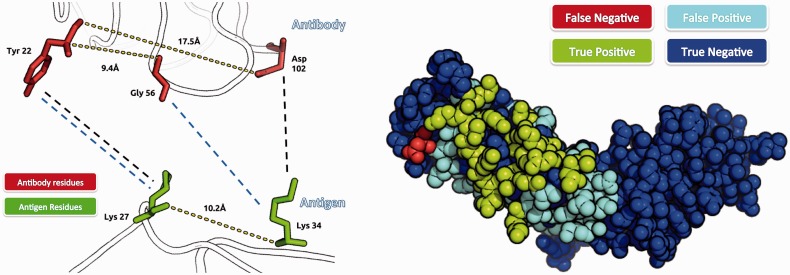
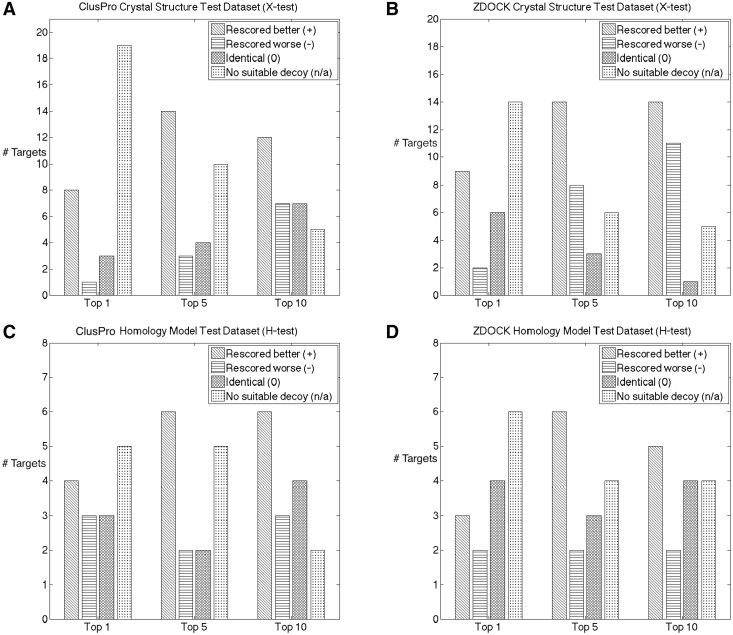
MOTIVATION: Antibodies are currently the most important class of biopharmaceuticals. Development of such antibody-based drugs depends on costly and time-consuming screening campaigns. Computational techniques such as antibody-antigen docking hold the potential to facilitate the screening process by rapidly providing a list of initial poses that approximate the native complex. RESULTS: We have developed a new method to identify the epitope region on the antigen, given the structures of the antibody and the antigen-EpiPred. The method combines conformational matching of the antibody-antigen structures and a specific antibody-antigen score. We have tested the method on both a large non-redundant set of antibody-antigen complexes and on homology models of the antibodies and/or the unbound antigen structure. On a non-redundant test set, our epitope prediction method achieves 44% recall at 14% precision against 23% recall at 14% precision for a background random distribution. We use our epitope predictions to rescore the global docking results of two rigid-body docking algorithms: ZDOCK and ClusPro. In both cases including our epitope, prediction increases the number of near-native poses found among the top decoys. AVAILABILITY AND IMPLEMENTATION: Our software is available from http://www.stats.ox.ac.uk/research/proteins/resources.
Overview
The claims and statistics of this paper haven’t been checked yet.
Run the check — free, no account needed. It reads the open-access text and checks the sources it cites.
Integrity signals
Registry
Cites
Statistics
Figures
Verification
Claims the paper makes
The claims and statistics of this paper haven’t been checked yet.
Run the check — free, no account needed. It reads the open-access text and checks the sources it cites.
Claims other papers make about this one
Each is checked against this paper’s own text: does it say what the citing paper says it does?
The cited source says what the claim attributes to it.
In the citing paper
“However, arbitrary molecular surfaces appear to be indistinguishable from epitope regions [167–169] suggesting that predictions should be performed with reference to a particular antibody [116, 118–120].”
From Computational approaches to therapeutic antibody design: established methods and emerging trends (2020) · cites this paper as [119]
In the citing paper
“Modelled structures can be used at the Lead Identification stage to select surface exposed paratope residues for mutations [110] or to characterize the binding with respect to the cognate epitope [119].”
From Computational approaches to therapeutic antibody design: established methods and emerging trends (2020) · cites this paper as [119]
Self-check
Percentages, sums and reported differences re-computed from the paper’s own numbers.
The self-check needs the paper’s full text.
Citations
Cites
Berman, H. M. (2000) · Nucleic Acids Research · doi:10.1093/nar/28.1.235 · Cited by 40,196
Cd-hit: a fast program for clustering and comparing large sets of protein or nucleotide sequences
Li, W.-Z., & Godzik, A. (2006) · Bioinform. · doi:10.1093/bioinformatics/btl158 · Cited by 10,996
Comparison of the predicted and observed secondary structure of T4 phage lysozyme
Matthews, B. W. (1975) · Biochimica et Biophysica Acta (BBA) - Protein Structure · doi:10.1016/0005-2795(75)90109-9 · Cited by 5,399 · cited 1×
“The datasets used in this study are presented in the sections below.”
MethodZDOCK: An initial‐stage protein‐docking algorithm
Chen, R., Li, L., & Weng, Z. (2003) · Proteins: Structure, Function, and Bioinformatics · doi:10.1002/prot.10389 · Cited by 1,393
Reliable B cell epitope predictions: impacts of method development and improved benchmarking
Kringelum, J. V., Lundegaard, C., Lund, O., & Nielsen, M. (2012) · PLoS Computational Biology · doi:10.1371/journal.pcbi.1002829 · Cited by 697
SAbDab: the structural antibody database
Dunbar, J., Krawczyk, K., Leem, J., Baker, T., Fuchs, A., Georges, G., Shi, J., & Deane, C. M. (2014) · Nucleic Acids Research · doi:10.1093/nar/gkt1043 · Cited by 674
The structural basis of antibody–antigen recognition
Sela-Culang, I., Kunik, V., & Ofran, Y. (2013) · Frontiers in Immunology · doi:10.3389/fimmu.2013.00302 · Cited by 530
Assessment of CAPRI predictions in rounds 3–5 shows progress in docking procedures
Méndez, R., Leplae, R., Lensink, M. F., & Wodak, S. J. (2005) · Proteins Structure Function and Bioinformatics · doi:10.1002/prot.20551 · Cited by 336
Computer-aided antibody design
Kuroda, D., Shirai, H., Jacobson, M. P., & Nakamura, H. (2012) · Protein Engineering Design and Selection · doi:10.1093/protein/gzs024 · Cited by 225
Application of asymmetric statistical potentials to antibody-protein docking
Brenke, R., Hall, D., Chuang, G., Comeau, S. R., Bohnuud, T., Beglov, D., Schueler-Furman, O., Vajda, S., & Kozakov, D. (2012) · Bioinform. · doi:10.1093/bioinformatics/bts493 · Cited by 205
Cited by
Sorted by citations
BepiPred-2.0: improving sequence-based B-cell epitope prediction using conformational epitopes
Jespersen, M. C., Peters, B., Nielsen, M., & Marcatili, P. (2017) · Nucleic Acids Research · doi:10.1093/nar/gkx346 · Cited by 1,739
Cao, Y., Su, B., Guo, X., Sun, W., Deng, Y., Bao, L., Zhu, Q., Zhang, X., Zheng, Y., Geng, C., et al. (2020) · Cell · doi:10.1016/j.cell.2020.05.025 · Cited by 1,188
Fundamentals and Methods for T- and B-Cell Epitope Prediction
Sanchez‐Trincado, J. L., Gomez‐Perosanz, M., & Reche, P. A. (2017) · Journal of Immunology Research · doi:10.1155/2017/2680160 · Cited by 675
An Introduction to B-Cell Epitope Mapping and In Silico Epitope Prediction
Potocnakova, L., Bhide, M. R., & Pulzová, L. (2016) · Journal of Immunology Research · doi:10.1155/2016/6760830 · Cited by 371
Computational approaches to therapeutic antibody design: established methods and emerging trends
Norman, R. A., Ambrosetti, F., Bonvin, A. M. J. J., Colwell, L. J., Kelm, S., Kumar, S., & Krawczyk, K. (2020) · Briefings in Bioinformatics · doi:10.1093/bib/bbz095 · Cited by 219
“We summarize the linear and conformational epitope predictors in Supplementary Information and those following the new paradigm of including antibody in providing epitope predictions (antibody-specific predictors) in Table 2C. Antibodyspecific epitope prediction was first addressed by Rapberger and co-workers in 2007…”
Method
Metadata
- Authors
- Krawczyk, K., Liu, X., Baker, T., Shi, J., & Deane, C. M.
- Affiliations
- Chinese Academy of Sciences (CN)
- Corresponding author
- Deane, Charlotte M.
- Venue
- Bioinformatics
- Publisher
- Oxford University Press (OUP)
- Published
- 2014-04-21
- Volume
- 30
- Issue
- 16
- Pages
- 2288-2294
- ISSN
- 1367-4803 (ISSN-L)
- 1367-4811
- PMC
- PMC4207425
- OpenAlex
- W2163174206
- Cited by
- 174
- References
- 27
- Citations by year
- 2026: 8 · 2025: 17 · 2024: 22 · 2023: 19 · 2022: 28 · 2021: 19 · 2020: 17 · 2019: 10 · 2018: 14 · 2017: 6 · 2016: 6 · 2015: 7 · 2014: 1
- FWCI
- 2.72
- Type
- journal article
- Language
- en
- Open access
- hybrid
- doi.org
- Locations
- Bioinformatics (publishedVersion, cc-by)
- Europe PMC (PubMed Central) (publishedVersion, cc-by)
- PubMed Central (publishedVersion, cc-by)
- PubMed (publishedVersion)
- Funders
- Engineering and Physical Sciences Research Council (EP/K032402/1)
- UCB Pharma
- Topics
- Life Sciences › Biochemistry, Genetics and Molecular Biology › Molecular Biology › vaccines and immunoinformatics approaches
- Life Sciences › Biochemistry, Genetics and Molecular Biology › Molecular Biology › Protein Structure and Dynamics
- Life Sciences › Pharmacology, Toxicology and Pharmaceutics › Drug Discovery › Computational Drug Discovery Methods
- Keywords
- B-cell epitope prediction, antibody-antigen docking, immune complexes, homology model
- MeSH terms
- Algorithms, Antigen-Antibody Complex, Humans, Software, Epitopes, B-Lymphocyte, Molecular Docking Simulation
About these checks
Registry, retraction, Cites and statistics results are computed, not judged, with one exception: a printed reference that no index lists is read once by a model before it counts as a citation error. Claims are extracted by a model and kept only when their quote appears verbatim in the text; each cited source is then checked, with a model’s help, for whether it says what the claim relies on. Those verdicts can be wrong — read the claim’s quote and the cited source before relying on one.
Statistics and arithmetic are recomputed, not judged.
Confidence bands are shown only for fields calibrated on our annotated test set. None is calibrated yet, so no band is shown.
What counts as a claim ›How we measure confidence ›How we check this ›
Are you an author, or do you see a problem with this page? Request a review
