

LD Hub: a centralized database and web interface to perform LD score regression that maximizes the potential of summary level GWAS data for SNP heritability and genetic correlation analysis
Open accessPublished version of a preprint
The DOI matches its Crossref record; 87 of the 88 references it cites were found in a registry or an index.
Abstract
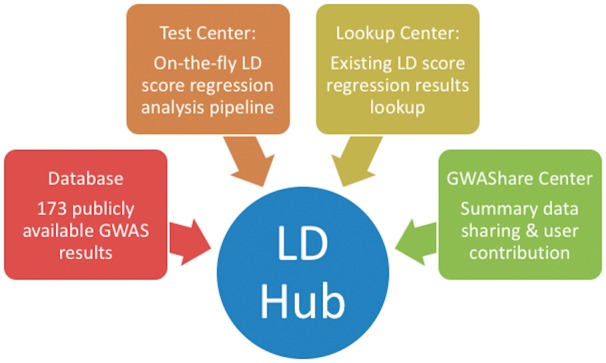
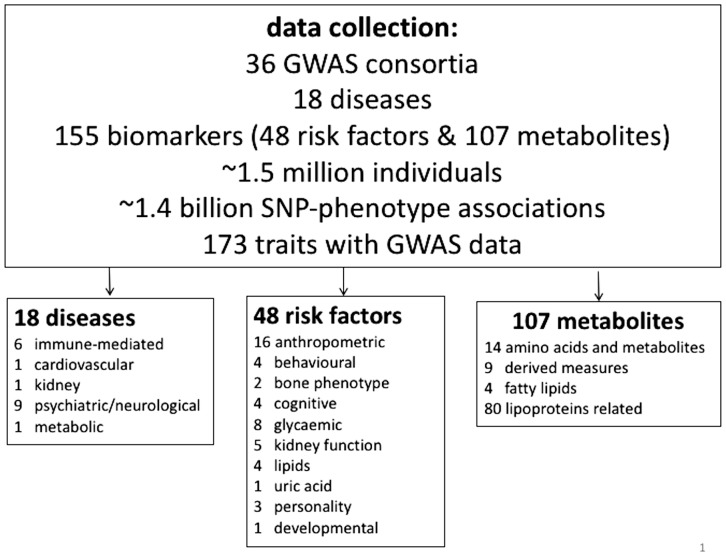
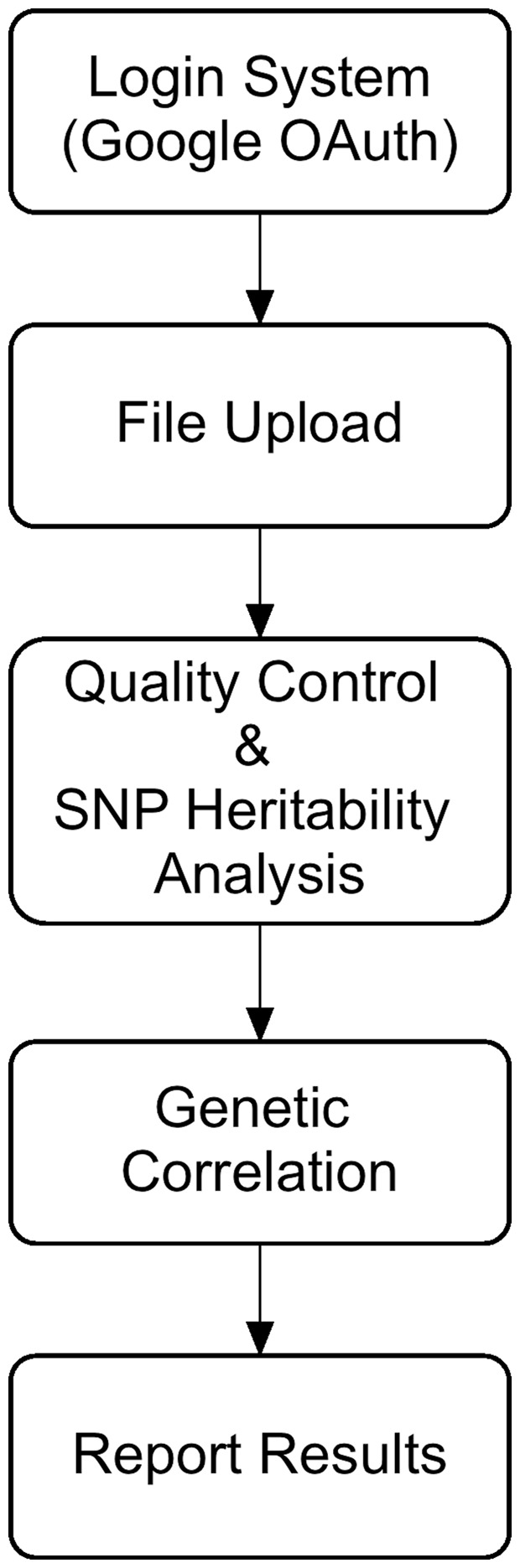
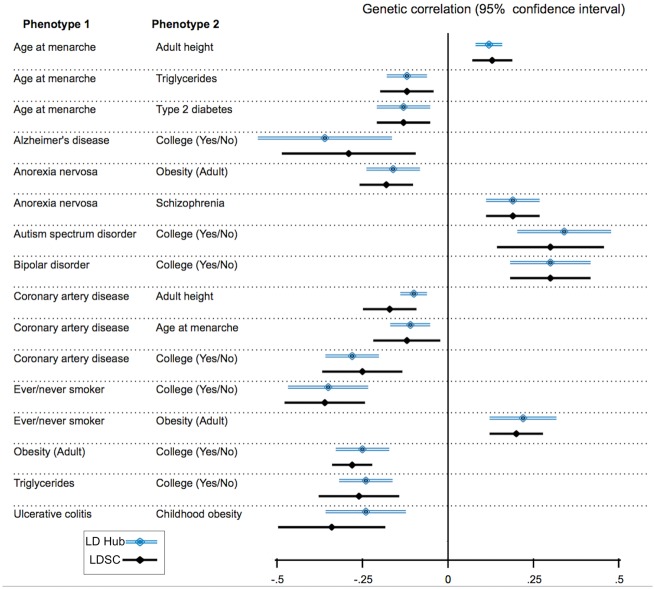
Motivation: LD score regression is a reliable and efficient method of using genome-wide association study (GWAS) summary-level results data to estimate the SNP heritability of complex traits and diseases, partition this heritability into functional categories, and estimate the genetic correlation between different phenotypes. Because the method relies on summary level results data, LD score regression is computationally tractable even for very large sample sizes. However, publicly available GWAS summary-level data are typically stored in different databases and have different formats, making it difficult to apply LD score regression to estimate genetic correlations across many different traits simultaneously. Results: In this manuscript, we describe LD Hub - a centralized database of summary-level GWAS results for 173 diseases/traits from different publicly available resources/consortia and a web interface that automates the LD score regression analysis pipeline. To demonstrate functionality and validate our software, we replicated previously reported LD score regression analyses of 49 traits/diseases using LD Hub; and estimated SNP heritability and the genetic correlation across the different phenotypes. We also present new results obtained by uploading a recent atopic dermatitis GWAS meta-analysis to examine the genetic correlation between the condition and other potentially related traits. In response to the growing availability of publicly accessible GWAS summary-level results data, our database and the accompanying web interface will ensure maximal uptake of the LD score regression methodology, provide a useful database for the public dissemination of GWAS results, and provide a method for easily screening hundreds of traits for overlapping genetic aetiologies. Availability and Implementation: The web interface and instructions for using LD Hub are available at http://ldsc.broadinstitute.org/ Supplementary information: Supplementary data are available at Bioinformatics online.
Overview
The claims and statistics of this paper haven’t been checked yet.
Free: it reads the open-access text and checks the first 5 claims that cite a source we can check. Create a free account to check every claim.
Integrity signals
Registry
Cites
Statistics
Figures
Verification
Claims the paper makes
The claims and statistics of this paper haven’t been checked yet.
Free: it reads the open-access text and checks the first 5 claims that cite a source we can check. Create a free account to check every claim.
Claims other papers make about this one
Each is checked against this paper’s own text: does it say what the citing paper says it does?
The source backs part of the claim, not all of it — or backs it for a different population, condition or comparison.
In the citing paper
“Indeed, SNP-heritability estimates are available for thousands of traits (Zheng et al., 2017).”
From Defining the genetic, genomic, cellular, and diagnostic architectures of psychiatric disorders (2019) · cites this paper as Zheng et al., 2017
Experimental — accuracy not yet measuredThe source backs part of the claim, not all of it — or backs it for a different population, condition or comparison.
In the citing paper
“consistent with estimates using individual-level data18, SNP heritabilities calculated from the largest individual contributing studies (Supplementary Table 13), and prior work19.”
From Association studies of up to 1.2 million individuals yield new insights into the genetic etiology of tobacco and alcohol use (2019) · cites this paper as [19]
Experimental — accuracy not yet measuredThe check wasn’t confident either way, so it gives no verdict — never disputed.
In the citing paper
“Significant correlations were found for several traits including schizophrenia 15 ( 𝑟 𝐺 = 0.211, p = 1.03 x 10 -5 ) and measures of cognitive ability, especially educational attainment 20 ( 𝑟 𝐺 = 0.199, p = 2.56 x 10 -9 )”
From Identification of common genetic risk variants for autism spectrum disorder (2019) · cites this paper as [20]
Experimental — accuracy not yet measuredThe check wasn’t confident either way, so it gives no verdict — never disputed.
In the citing paper
“Of the eight phenotypes we evaluated, only the cognitive phenotypes showed strong heterogeneity (educational attainment 20 P = 1.8 x 10 -8 , IQ 23 P = 3.7 x 10 -9 )”
From Identification of common genetic risk variants for autism spectrum disorder (2019) · cites this paper as [20]
Experimental — accuracy not yet measuredIn the citing paper
“The estimated h2g = 0.09 for AD in EU is only modestly lower than those recently reported for alcohol consumption (h2g = 0.13)17 and AUDIT scores (h2g = 0.12)18, and comparable to estimates derived for cigarettes-per-day25.”
From Transancestral GWAS of alcohol dependence reveals common genetic underpinnings with psychiatric disorders (2018) · cites this paper as [25]
3 more claims about this paper
Create a free account to see every claim other papers make about this one.
Self-check
Percentages, sums and reported differences re-computed from the paper’s own numbers.
The self-check needs the paper’s full text.
Citations
Cites
GCTA: a tool for genome-wide complex trait analysis
Yang, J., Lee, S. H., Goddard, M. E., & Visscher, P. M. (2011) · The American Journal of Human Genetics · doi:10.1016/j.ajhg.2010.11.011 · Cited by 8,279
An integrated map of genetic variation from 1,092 human genomes
The 1000 Genomes Project Consortium (2012) · Nature · doi:10.1038/nature11632 · Cited by 7,711
Genetics of Food Intake Self-Regulation in Childhood: Literature Review and Research Opportunities
Faith, M. S., Carnell, S., & Kral, T. V. E. (2013) · Human Heredity · doi:10.1159/000353879 · Cited by 7,601
Biological insights from 108 schizophrenia-associated genetic loci
Schizophrenia Working Group of the Psychiatric Genomics Consortium (2014) · Nature · doi:10.1038/nature13595 · Cited by 7,577
Self-citationDavey Smith, G., & Ebrahim, S. (2003) · International Journal of Epidemiology · doi:10.1093/ije/dyg070 · Cited by 5,882
LD Score regression distinguishes confounding from polygenicity in genome-wide association studies
Schizophrenia Working Group of the Psychiatric Genomics Consortium, Bulik-Sullivan, B. K., Loh, P.-R., Finucane, H. K., Ripke, S., Yang, J., Patterson, N., Daly, M. J., Price, A. L., & Neale, B. M. (2015) · Nature Genetics · doi:10.1038/ng.3211 · Cited by 5,559
Self-citationCommon polygenic variation contributes to risk of schizophrenia and bipolar disorder
The International Schizophrenia Consortium (2009) · Nature · doi:10.1038/nature08185 · Cited by 4,821
Mendelian randomization: genetic anchors for causal inference in epidemiological studies
Davey Smith, G., & Hemani, G. (2014) · Human Molecular Genetics · doi:10.1093/hmg/ddu328 · Cited by 4,677
Self-citationCommon SNPs explain a large proportion of the heritability for human height
Yang, J., Benyamin, B., McEvoy, B. P., Gordon, S., Henders, A. K., Nyholt, D. R., Madden, P. A., Heath, A. C., Martin, N. G., Montgomery, G. W., et al. (2010) · Nature Genetics · doi:10.1038/ng.608 · Cited by 4,446
XV.—The Correlation between Relatives on the Supposition of Mendelian Inheritance.
Fisher, R. A. (1919) · Transactions of the Royal Society of Edinburgh · doi:10.1017/s0080456800012163 · Cited by 4,387
Cited by
The MR-Base platform supports systematic causal inference across the human phenome
Hemani, G., Zheng, J., Elsworth, B., Wade, K. H., Haberland, V., Baird, D., Laurin, C., Burgess, S., Bowden, J., Langdon, R., et al. (2018) · eLife · doi:10.7554/elife.34408 · Cited by 7,959
Self-citation10 Years of GWAS Discovery: Biology, Function, and Translation
Visscher, P. M., Wray, N. R., Zhang, Q., Sklar, P., McCarthy, M. I., Brown, M. A., & Yang, J. (2017) · The American Journal of Human Genetics · doi:10.1016/j.ajhg.2017.06.005 · Cited by 3,719
eQTLGen, Wray, N. R., 23andMe, the Major Depressive Disorder Working Group of the Psychiatric Genomics Consortium, Ripke, S., Mattheisen, M., Trzaskowski, M., Byrne, E. M., Abdellaoui, A., Adams, M. J., et al. (2018) · Nature Genetics · doi:10.1038/s41588-018-0090-3 · Cited by 3,005
Self-citationAlzheimer Disease Genetics Consortium (ADGC), Kunkle, B. W., The European Alzheimer’s Disease Initiative (EADI), Cohorts for Heart and Aging Research in Genomic Epidemiology Consortium (CHARGE), Genetic and Environmental Risk in AD/Defining Genetic, P. A. E. R. F. A. D. C. (., Grenier-Boley, B., Sims, R., Bis, J. C., Damotte, V., Naj, A. C., et al. (2019) · Nature Genetics · doi:10.1038/s41588-019-0358-2 · Cited by 2,946
Howard, D. M., Adams, M. J., Clarke, T.-K., Hafferty, J. D., Gibson, J., Shirali, M., Coleman, J. R. I., Hagenaars, S. P., Ward, J., Wigmore, E. M., et al. (2019) · Nature Neuroscience · doi:10.1038/s41593-018-0326-7 · Cited by 2,565
Self-citation
Metadata
- Authors
- Zheng, J., Erzurumluoglu, A. M., Elsworth, B. L., Kemp, J. P., Howe, L., Haycock, P. C., Hemani, G., Tansey, K., Laurin, C., Early Genetics and Lifecourse Epidemiology (EAGLE) Eczema Consortium, Pourcain, B. S., Warrington, N. M., Finucane, H. K., Price, A. L., Bulik-Sullivan, B. K., Anttila, V., Paternoster, L., Gaunt, T. R., Evans, D. M., & Neale, B. M.
- Affiliations
- University of Bristol (GB)
- University of Leicester (GB)
- Translational Research Institute (AU)
- MRC Integrative Epidemiology Unit, University of Bristol, Oakfield House, Bristol, UK
- Harvard University (US)
- Broad Institute (US)
- Corresponding author
- Zheng, Jie
- ORCID
- Venue
- Bioinformatics
- Publisher
- Oxford University Press (OUP)
- Published
- 2016-09-22
- Volume
- 33
- Issue
- 2
- Pages
- 272-279
- ISSN
- 1367-4803 (ISSN-L)
- 1367-4811
- PMC
- PMC5542030
- OpenAlex
- W2345621280
- Cited by
- 869
- References
- 88
- Citations by year
- 2026: 22 · 2025: 50 · 2024: 59 · 2023: 62 · 2022: 115 · 2021: 135 · 2020: 116 · 2019: 147 · 2018: 102 · 2017: 52 · 2016: 7
- FWCI
- 82.85
- Type
- journal article
- Language
- en
- Open access
- hybrid
- doi.org
- Locations
- Bioinformatics (publishedVersion, cc-by)
- bioRxiv (Cold Spring Harbor Laboratory) (acceptedVersion)
- PubMed Central (publishedVersion, cc-by)
- PubMed (publishedVersion)
- Bristol Research (University of Bristol) (publishedVersion, cc-by)
- UCL Discovery (University College London) (submittedVersion)
- Figshare (submittedVersion, cc-by)
- Leicester Research Archive (University of Leicester) (submittedVersion, cc-by)
- HighWire Press Open Archive (submittedVersion)
- Site cant be reached (submittedVersion)
- PuSH - Publication Server of Helmholtz Zentrum München (submittedVersion)
- Explore Bristol Research (submittedVersion, cc-by)
- Funders
- Medical Research Council ((MC_UU_12013/4 and MC_UU_12013/8), 1R01MH101244-02, 1R01MH107649-01)
- Cancer Research UK programme (C18281/A19169)
- Cancer Research UK Population Research (C52724/A20138)
- Topics
- Life Sciences › Biochemistry, Genetics and Molecular Biology › Genetics › Genetic Associations and Epidemiology
- Life Sciences › Biochemistry, Genetics and Molecular Biology › Genetics › Genetic and phenotypic traits in livestock
- Life Sciences › Biochemistry, Genetics and Molecular Biology › Genetics › Genetic Mapping and Diversity in Plants and Animals
- Keywords
- LD score regression, centralized database, web interface, SNP heritability, genetic correlation, atopic dermatitis, complex traits, disease characteristics
- MeSH terms
- Female, Humans, Male, Phenotype, Software, Linkage Disequilibrium, Sample Size, Genetic Predisposition to Disease, Polymorphism, Single Nucleotide, Genetic Diseases, Inborn, Databases, Nucleic Acid, Genome-Wide Association Study
About these checks
Registry, retraction, Cites and statistics results are computed, not judged, with one exception: a printed reference that no index lists is read once by a model before it counts as a citation error. Claims are extracted by a model and kept only when their quote appears verbatim in the text; each cited source is then checked, with a model’s help, for whether it says what the claim relies on. Those verdicts can be wrong — read the claim’s quote and the cited source before relying on one.
Statistics and arithmetic are recomputed, not judged.
Confidence bands are shown only for fields calibrated on our annotated test set. None is calibrated yet, so no band is shown.
What counts as a claim ›How we measure confidence ›How we check this ›
Are you an author, or do you see a problem with this page? Request a review
Data sources
Bibliographic data: Semantic Scholar, OpenAlex, Crossref.
Contains information from the Semantic Scholar Academic Graph Datasets, made available under the ODC Attribution License (ODC-BY 1.0).
Semantic Scholar’s data is described in: Kinney, R., et al. (2023). The Semantic Scholar Open Data Platform. arXiv:2301.10140.
