

The DOI matches its Crossref record; 64 of the 64 references it cites were found in a registry or an index.
LinearFold: linear-time approximate RNA folding by 5'-to-3' dynamic programming and beam search
Open accessAbstract
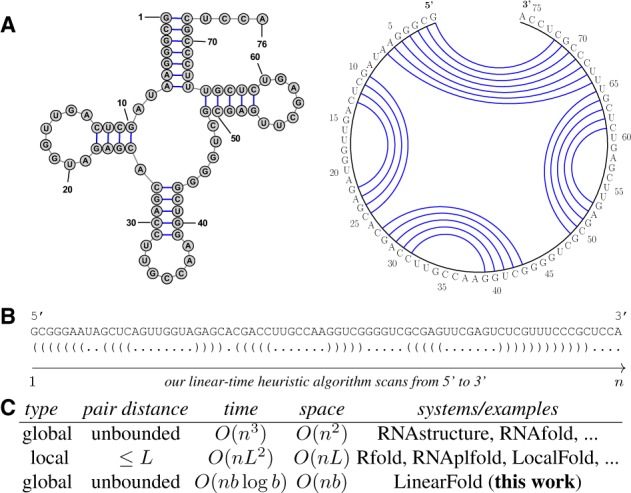
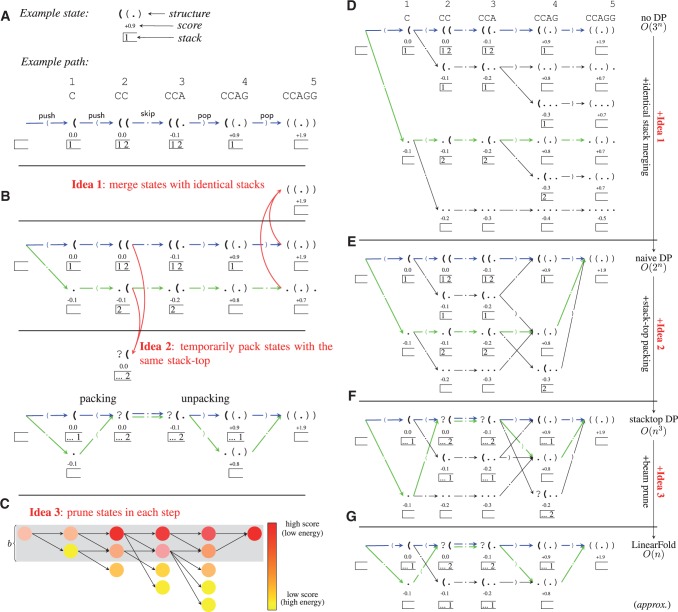
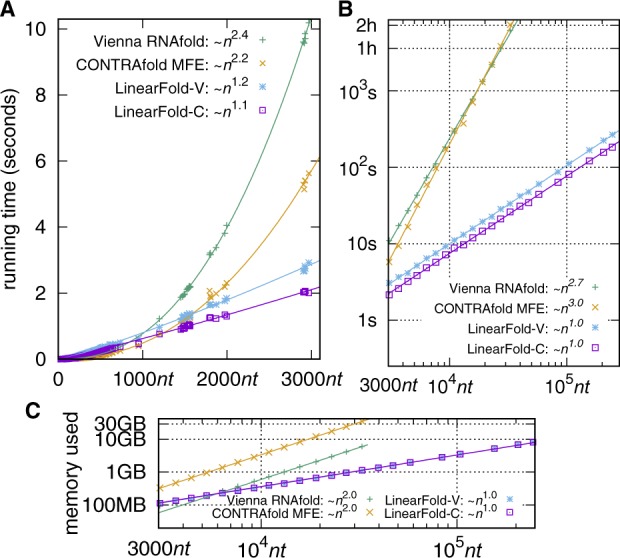
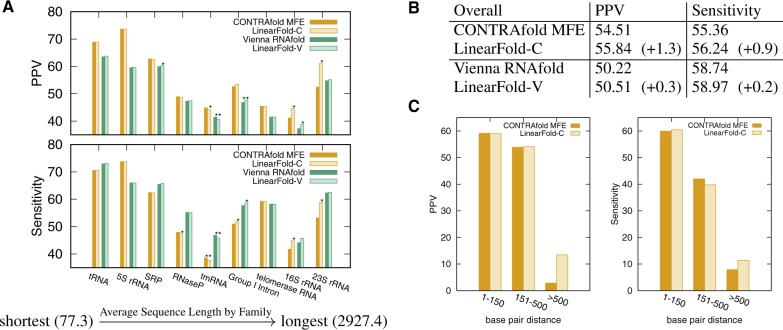
Motivation: Predicting the secondary structure of an ribonucleic acid (RNA) sequence is useful in many applications. Existing algorithms [based on dynamic programming] suffer from a major limitation: their runtimes scale cubically with the RNA length, and this slowness limits their use in genome-wide applications. Results: We present a novel alternative O(n3)-time dynamic programming algorithm for RNA folding that is amenable to heuristics that make it run in O(n) time and O(n) space, while producing a high-quality approximation to the optimal solution. Inspired by incremental parsing for context-free grammars in computational linguistics, our alternative dynamic programming algorithm scans the sequence in a left-to-right (5′-to-3′) direction rather than in a bottom-up fashion, which allows us to employ the effective beam pruning heuristic. Our work, though inexact, is the first RNA folding algorithm to achieve linear runtime (and linear space) without imposing constraints on the output structure. Surprisingly, our approximate search results in even higher overall accuracy on a diverse database of sequences with known structures. More interestingly, it leads to significantly more accurate predictions on the longest sequence families in that database (16S and 23S Ribosomal RNAs), as well as improved accuracies for long-range base pairs (500+ nucleotides apart), both of which are well known to be challenging for the current models. Availability and implementation: Our source code is available at https://github.com/LinearFold/LinearFold, and our webserver is at http://linearfold.org (sequence limit: 100 000nt). Supplementary information: Supplementary data are available at Bioinformatics online.
Overview
The claims and statistics of this paper haven’t been checked yet.
Run the check — free, no account needed. It reads the open-access text and checks the sources it cites.
Integrity signals
Registry
Cites
Statistics
Figures
Verification
Claims the paper makes
The claims and statistics of this paper haven’t been checked yet.
Run the check — free, no account needed. It reads the open-access text and checks the sources it cites.
Claims other papers make about this one
Each is checked against this paper’s own text: does it say what the citing paper says it does?
The cited source says what the claim attributes to it.
In the citing paper
“Inspired by our previous work, LinearFold21, we further developed a left-to-right dynamic programming, which is equivalent to the above bottom-up version but explores the search space incrementally from left to right”
From Algorithm for optimized mRNA design improves stability and immunogenicity (2023) · cites this paper as [21]
Self-check
Percentages, sums and reported differences re-computed from the paper’s own numbers.
The self-check needs the paper’s full text.
Citations
Cites
Lorenz, R., Bernhart, S. H., Höner zu Siederdissen, C., Tafer, H., Flamm, C., Stadler, P. F., & Hofacker, I. L. (2011) · Algorithms for Molecular Biology · doi:10.1186/1748-7188-6-26 · Cited by 5,098 · cited 4×
“Widely used systems such as RNAstructure (Mathews and Turner, 2006), Vienna RNAfold (Lorenz etal.”
MethodInfluentialMathews, D. H., Sabina, J., Zuker, M., & Turner, D. H. (1999) · Journal of Molecular Biology · doi:10.1006/jmbi.1999.2700 · Cited by 3,795 · cited 1×
“8% of the optimal structure (Zuker et al., 1991; Mathews et al., 1999).”
Self-citationOptimal computer folding of large RNA sequences using thermodynamics and auxiliary information
Zuker, M., & Stiegler, P. (1981) · Nucleic Acids Research · doi:10.1093/nar/9.1.133 · Cited by 3,604
Gilbert, W. (1986) · Nature · doi:10.1038/319618a0 · Cited by 2,721 · cited 1×
“The dual nature of RNA as both a genetic material and functional molecule led to the RNA World hypothesis, that RNA was the first moleculeoflife(Gilbert,1986), andthisdualnaturehasalsobeenutilized to develop in vitro methods to evolve functional sequences (Joyce, 1994).”
BackgroundFrazier, L., & Rayner, K. (1982) · Cognitive Psychology · doi:10.1016/0010-0285(82)90008-1 · Cited by 1,793 · cited 1×
“This is analogous to psycholinguistic evidence that humans incrementally parse a sentence before it is fully read or heard (Frazier and Rayner, 1982).”
BackgroundMathews, D. H., Disney, M. D., Childs‐Disney, J. L., Schroeder, S. J., Zuker, M., & Turner, D. H. (2004) · Proceedings of the National Academy of Sciences · doi:10.1073/pnas.0401799101 · Cited by 1,648 · cited 1×
“In particular, we demonstrate two versions of LinearFold, LinearFold-V using the thermodynamic free energy model (Mathews et al., 2004) from Vienna RNAfold (Lorenz et al.”
MethodSelf-citationNon–coding RNA genes and the modern RNA world
Eddy, S. R. (2001) · Nature Reviews Genetics · doi:10.1038/35103511 · Cited by 1,456 · cited 1×
“Ribonucleicacid(RNA)isinvolvedinnumerouscellularprocesses(Eddy, 2001).”
Big Data: Astronomical or Genomical?
Stephens, Z. D., Lee, S. Y., Faghri, F., Campbell, R. H., Zhai, C., Efron, M. J., Iyer, R., Schatz, M. C., Sinha, S., & Robinson, G. E. (2015) · PLOS Biology · doi:10.1371/journal.pbio.1002195 · Cited by 1,340 · cited 1×
“Since experimentally determining the structure is expensive and time comsuming, and given the overwhelming increase in genomic data (about 1021 base-pairs per year) (Stephens et al., 2015), computational methods have been widely used as an alternative to automatically predict the structure.”
MethodThe equilibrium partition function and base pair binding probabilities for RNA secondary structure
McCaskill, J. S. (1990) · Biopolymers · doi:10.1002/bip.360290621 · Cited by 1,288 · cited 2×
“…function and base pair probabilities for natural RNA sequences with well-defined structures, since the classical method for that task, the McCaskill (1990) algorithm, is isomorphic in structure to the cubic-time algorithms that are used as baselines in this paper.”
MethodThe promises and pitfalls of RNA-interference-based therapeutics
Castanotto, D., & Rossi, J. J. (2009) · Nature · doi:10.1038/nature07758 · Cited by 1,241
Research works printed but not linked: 4
- Amman, 2013, Proceedings of the 8th Brazilian Symposium on Bioinformatics, BSB 2013, Recife, Brazil, 1
- Hofacker, 2014, RNA Folding: Methods and Protocols. Methods in Molecular Biology 1086, 1
- Huang, 2010, Proceedings of ACL. Uppsala, Sweden, 1077
- Tomita, 1988, Proceedings of ACL, 249
Cited by
Sorted by citations
Algorithm for optimized mRNA design improves stability and immunogenicity
Zhang, H., Zhang, L., Lin, A., Xu, C., Li, Z., Liu, K., Liu, B., Ma, X., Zhao, F., Jiang, H., et al. (2023) · Nature · doi:10.1038/s41586-023-06127-z · Cited by 531
Self-citationRNA secondary structure prediction using deep learning with thermodynamic integration
Sato, K., Akiyama, M., & Sakakibara, Y. (2021) · Nature Communications · doi:10.1038/s41467-021-21194-4 · Cited by 490
UFold: fast and accurate RNA secondary structure prediction with deep learning
Fu, L., Cao, Y., Wu, J., Peng, Q., Nie, Q. H., & Xie, X. S. (2021) · Nucleic Acids Research · doi:10.1093/nar/gkab1074 · Cited by 266
Chen, J., Hu, Z., Sun, S., Tan, Q., Wang, Y., Yu, Q., Zong, L., Hong, L., Xiao, J., Shen, T., et al. (2022) · doi:10.1101/2022.08.06.503062 · Cited by 247
“In terms of RNA secondary structure prediction, RNA-FM outperforms LinearFold by up to 30% and SPOT-RNA by up to 20% in terms of F1 score on cross-dataset validation.”
MethodThe architecture of the SARS-CoV-2 RNA genome inside virion
Cao, C., Cai, Z., Xiao, X., Rao, J. Y., Chen, J., Hu, N., Yang, M., Xing, X., Wang, Y., Li, M., et al. (2021) · Nature Communications · doi:10.1038/s41467-021-22785-x · Cited by 204
Metadata
- Authors
- Huang, L., Zhang, H., Deng, D., Zhao, K., Liu, K., Hendrix, D. A., & Mathews, D. H.
- Affiliations
- Oregon State University (US)
- Baidu (China) (CN)
- University of Rochester Medicine (US)
- Corresponding author
- Huang, Liang
- Venue
- Bioinformatics
- Publisher
- Oxford University Press (OUP)
- Published
- 2019-07
- Volume
- 35
- Issue
- 14
- Pages
- i295-i304
- ISSN
- 1367-4803 (ISSN-L)
- 1367-4811
- PMC
- PMC6681470
- OpenAlex
- W2954102902
- Semantic Scholar
- 3aec8d65f4879bb9615fc09c3839036b60425b75
- Cited by
- 207
- References
- 63
- Citations by year
- 2026: 34 · 2025: 41 · 2024: 44 · 2023: 38 · 2022: 25 · 2021: 11 · 2020: 10 · 2019: 4
- FWCI
- 4.71
- Type
- journal article
- Language
- en
- Open access
- hybrid
- doi.org
- Licence
- Locations
- Bioinformatics (publishedVersion, cc-by-nc)
- PubMed Central (publishedVersion, cc-by-nc)
- PubMed (publishedVersion)
- arXiv (Cornell University) (submittedVersion)
- arXiv (Cornell University)
- Funders
- National Science Foundation (IIS-1656051, IIS-1817231)
- National Institutes of Health (R56 AG053460, R21 AG052950, R01 GM076485)
- Topics
- Life Sciences › Biochemistry, Genetics and Molecular Biology › Molecular Biology › RNA and protein synthesis mechanisms
- Life Sciences › Biochemistry, Genetics and Molecular Biology › Molecular Biology › Genomics and Phylogenetic Studies
- Physical Sciences › Mathematics › Theoretical Computer Science › Algorithms and Data Compression
- Keywords
- RNA secondary structure prediction, RNA folding, beam search, incremental parsing, context-free grammars, 16S rRNA, 23S rRNA
- MeSH terms
- Nucleic Acid Conformation, RNA, Software, Sequence Analysis, RNA, RNA Folding
About these checks
Registry, retraction, Cites and statistics results are computed, not judged, with one exception: a printed reference that no index lists is read once by a model before it counts as a citation error. Claims are extracted by a model and kept only when their quote appears verbatim in the text; each cited source is then checked, with a model’s help, for whether it says what the claim relies on. Those verdicts can be wrong — read the claim’s quote and the cited source before relying on one.
Statistics and arithmetic are recomputed, not judged.
Confidence bands are shown only for fields calibrated on our annotated test set. None is calibrated yet, so no band is shown.
What counts as a claim ›How we measure confidence ›How we check this ›
Are you an author, or do you see a problem with this page? Request a review
