

The DOI matches its Crossref record; 57 of the 57 references it cites were found in a registry or an index.
Diagnostic value of cerebrospinal fluid alpha-synuclein seed quantification in synucleinopathies
Open accessAbstract
Several studies have confirmed the α-synuclein real-time quaking-induced conversion (RT-QuIC) assay to have high sensitivity and specificity for Parkinson’s disease. However, whether the assay can be used as a robust, quantitative measure to monitor disease progression, stratify different synucleinopathies and predict disease conversion in patients with idiopathic REM sleep behaviour disorder remains undetermined. The aim of this study was to assess the diagnostic value of CSF α-synuclein RT-QuIC quantitative parameters in regard to disease progression, stratification and conversion in synucleinopathies. We performed α-synuclein RT-QuIC in the CSF samples from 74 Parkinson’s disease, 24 multiple system atrophy and 45 idiopathic REM sleep behaviour disorder patients alongside 55 healthy controls, analysing quantitative assay parameters in relation to clinical data. α-Synuclein RT-QuIC showed 89% sensitivity and 96% specificity for Parkinson’s disease. There was no correlation between RT-QuIC quantitative parameters and Parkinson’s disease clinical scores (e.g. Unified Parkinson’s Disease Rating Scale motor), but RT-QuIC positivity and some quantitative parameters (e.g. Vmax) differed across the different phenotype clusters. RT-QuIC parameters also added value alongside standard clinical data in diagnosing Parkinson’s disease. The sensitivity in multiple system atrophy was 75%, and CSF samples showed longer T50 and lower Vmax compared to Parkinson’s disease. All RT-QuIC parameters correlated with worse clinical progression of multiple system atrophy (e.g. change in Unified Multiple System Atrophy Rating Scale). The overall sensitivity in idiopathic REM sleep behaviour disorder was 64%. In three of the four longitudinally followed idiopathic REM sleep behaviour disorder cohorts, we found around 90% sensitivity, but in one sample (DeNoPa) diagnosing idiopathic REM sleep behaviour disorder earlier from the community cases, this was much lower at 39%. During follow-up, 14 of 45 (31%) idiopathic REM sleep behaviour disorder patients converted to synucleinopathy with 9/14 (64%) of convertors showing baseline RT-QuIC positivity. In summary, our results showed that α-synuclein RT-QuIC adds value in diagnosing Parkinson’s disease and may provide a way to distinguish variations within Parkinson’s disease phenotype. However, the quantitative parameters did not correlate with disease severity in Parkinson’s disease. The assay distinguished multiple system atrophy patients from Parkinson’s disease patients and in contrast to Parkinson’s disease, the quantitative parameters correlated with disease progression of multiple system atrophy. Our results also provided further evidence for α-synuclein RT-QuIC having potential as an early biomarker detecting synucleinopathy in idiopathic REM sleep behaviour disorder patients prior to conversion. Further analysis of longitudinally followed idiopathic REM sleep behaviour disorder patients is needed to better understand the relationship between α-synuclein RT-QuIC signature and the progression from prodromal to different synucleinopathies.
Overview
The claims and statistics of this paper haven’t been checked yet.
Run the check — free, no account needed. It reads the open-access text and checks the sources it cites.
Integrity signals
Registry
Cites
Statistics
Figures
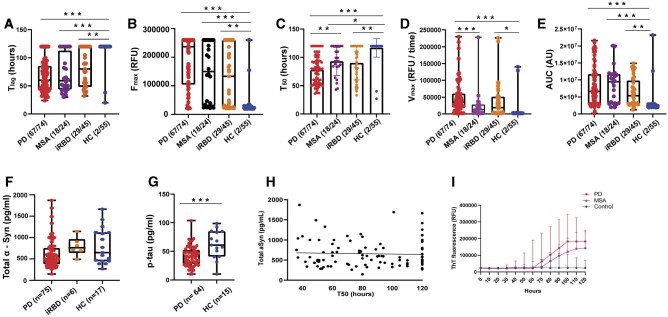
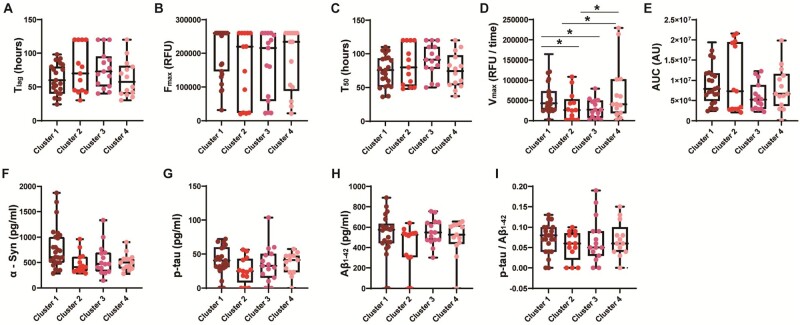
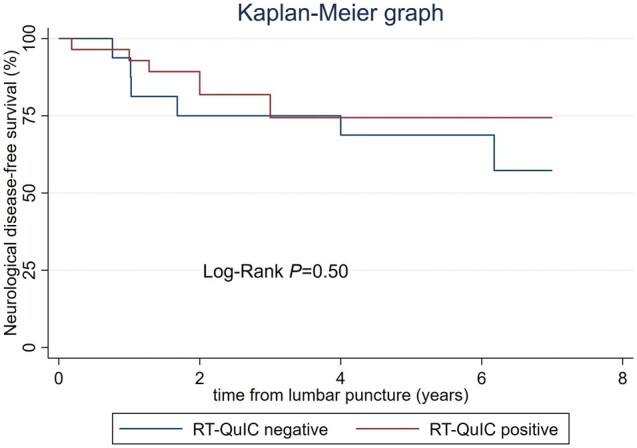
Verification
Claims the paper makes
The claims and statistics of this paper haven’t been checked yet.
Run the check — free, no account needed. It reads the open-access text and checks the sources it cites.
Claims other papers make about this one
Each is checked against this paper’s own text: does it say what the citing paper says it does?
The source backs part of the claim, not all of it — or backs it for a different population, condition or comparison.
In the citing paper
“SAA has already proven to be a robust technique for identifying pathological α-synuclein from cerebrospinal fluid sample from patients with PD and RBD [71, 72].”
From The gut–brain axis in early Parkinson’s disease: from prodrome to prevention (2025) · cites this paper as [72]
Experimental — accuracy not yet measured
Self-check
Percentages, sums and reported differences re-computed from the paper’s own numbers.
The self-check needs the paper’s full text.
Citations
Cites
Staging of brain pathology related to sporadic Parkinson’s disease
Braak, H., Tredici, K. D., Rüb, U., de Vos, R. A. I., Jansen Steur, E. N. H., & Braak, E. (2003) · Neurobiology of Aging · doi:10.1016/s0197-4580(02)00065-9 · Cited by 10,777
Hughes, A. J., Daniel, S. E., Kilford, L., & Lees, A. J. (1992) · Journal of Neurology, Neurosurgery & Psychiatry · doi:10.1136/jnnp.55.3.181 · Cited by 10,378
MDS clinical diagnostic criteria for Parkinson’s disease
Postuma, R. B., Berg, D., Stern, M., Poewe, W., Olanow, C. W., Oertel, W., Obeso, J., Marek, K., Litvan, I., Lang, A. E., et al. (2015) · Movement Disorders · doi:10.1002/mds.26424 · Cited by 7,653
Self-citationDiagnosis and management of dementia with Lewy bodies: Third report of the DLB consortium
McKeith, I. G., Dickson, D. W., Lowe, J., Emre, M., O'Brien, J. T., Feldman, H., Cummings, J., Duda, J. E., Lippa, C., Perry, E. K., et al. (2005) · Neurology · doi:10.1212/01.wnl.0000187889.17253.b1 · Cited by 5,069
Second consensus statement on the diagnosis of multiple system atrophy
Gilman, S., Wenning, G. K., Low, P. A., Brooks, D. J., Mathias, C. J., Trojanowski, J. Q., Wood, N. W., Colosimo, C., Dürr, A., Fowler, C. J., et al. (2008) · Neurology · doi:10.1212/01.wnl.0000324625.00404.15 · Cited by 3,140
The Sydney multicenter study of Parkinson's disease: The inevitability of dementia at 20 years
Hely, M. A., Reid, W. G. J., ADENA, M. A., Halliday, G. M., & Morris, J. G. (2008) · Movement Disorders · doi:10.1002/mds.21956 · Cited by 2,346
Self-propagation of pathogenic protein aggregates in neurodegenerative diseases
Jucker, M., & Walker, L. C. (2013) · Nature · doi:10.1038/nature12481 · Cited by 1,663
MDS research criteria for prodromal Parkinson's disease
Berg, D., Postuma, R. B., Adler, C. H., Bloem, B. R., Chan, P., Dubois, B., Gasser, T., Goetz, C. G., Halliday, G. M., Joseph, L., et al. (2015) · Movement Disorders · doi:10.1002/mds.26431 · Cited by 1,394
Self-citationPostuma, R. B., Iranzo, Á., Hu, M., Högl, B., Boeve, B. F., Manni, R., Oertel, W. H., Arnulf, I., Ferini‐Strambi, L., Puligheddu, M., et al. (2019) · Brain · doi:10.1093/brain/awz030 · Cited by 1,189
Self-citationChronic Behavioral Disorders of Human REM Sleep: A New Category of Parasomnia
Schenck, C. H., Bundlie, S. R., Ettinger, M. G., & Mahowald, M. W. (1986) · SLEEP · doi:10.1093/sleep/9.2.293 · Cited by 1,156
Cited by
Sorted by citations
Structures of α-synuclein filaments from human brains with Lewy pathology
Yang, Y., Shi, Y., Schweighauser, M., Zhang, X., Kotecha, A., Murzin, A. G., Garringer, H. J., Cullinane, P. W., Saito, Y., Foroud, T., et al. (2022) · Nature · doi:10.1038/s41586-022-05319-3 · Cited by 486
Propagative α-synuclein seeds as serum biomarkers for synucleinopathies
Okuzumi, A., Hatano, T., Matsumoto, G., Nojiri, S., Ueno, S., Imamichi, Y., Kimura, H., Kakuta, S., Kondo, A., Fukuhara, T., et al. (2023) · Nature Medicine · doi:10.1038/s41591-023-02358-9 · Cited by 331
Poewe, W. H., Stanković, I., Halliday, G. M., Meissner, W. G., Wenning, G. K., Pellecchia, M. T., Seppi, K., Palma, J., & Kaufmann, H. (2022) · Nature Reviews Disease Primers · doi:10.1038/s41572-022-00382-6 · Cited by 295
Self-citationα-Synuclein Seed Amplification Assays for Diagnosing Synucleinopathies
Bellomo, G., Luca, C. M. G. D., Paoletti, F. P., Gaetani, L., Moda, F., & Parnetti, L. (2022) · Neurology · doi:10.1212/wnl.0000000000200878 · Cited by 165
Magalhães, P., & Lashuel, H. A. (2022) · npj Parkinson s Disease · doi:10.1038/s41531-022-00357-0 · Cited by 167
Metadata
- Authors
- Poggiolini, I., Gupta, V., Lawton, M., Lee, S., El-Turabi, A., Querejeta-Coma, A., Trenkwalder, C., Sixel-Döring, F., Foubert-Samier, A., Pavy-Le Traon, A., Plazzi, G., Biscarini, F., Montplaisir, J., Gagnon, J.-F., Postuma, R. B., Antelmi, E., Meissner, W. G., Mollenhauer, B., Ben-Shlomo, Y., Hu, M. T., & Parkkinen, L.
- Affiliations
- University of Oxford (GB)
- University of Bristol (GB)
- Nuffield Department of Clinical Neurosciences, Oxford Parkinson’s Disease Centre, University of Oxford, UK
- Universitätsmedizin Göttingen (DE)
- Paracelsus Elena Klinik, Centre for Movement Disorders, Kassel, Germany
- French Reference Centre for MSA, University Hospital Bordeaux, Bordeaux, France
- French Reference Centre for MSA, University Hospital of Toulouse, Toulouse, France
- University of Modena and Reggio Emilia (IT)
- University of Bologna (IT)
- Hôpital du Sacré-Cœur de Montréal (CA)
- Université du Québec à Montréal (CA)
- Montreal General Hospital (CA)
- University of Verona (IT)
- Centre National de la Recherche Scientifique (FR)
- School of Social and Community Medicine, Bristol Medical School, University of Bristol, UK
- Corresponding author
- Parkkinen, Laura
- ORCID
- Venue
- Brain
- Publisher
- Oxford University Press (OUP)
- Published
- 2021-12-11
- Volume
- 145
- Issue
- 2
- Pages
- 584-595
- ISSN
- 0006-8950 (ISSN-L)
- 1460-2156
- PMC
- PMC9014737
- OpenAlex
- W4200520313
- Cited by
- 191
- References
- 57
- Citations by year
- 2026: 33 · 2025: 50 · 2024: 48 · 2023: 35 · 2022: 25
- FWCI
- 12.92
- Type
- journal article
- Language
- en
- Open access
- hybrid
- doi.org
- Licence
- Locations
- Brain (publishedVersion, cc-by-nc)
- PubMed Central (publishedVersion, cc-by-nc)
- PubMed (publishedVersion)
- Explore Bristol Research (publishedVersion, cc-by-nc)
- HAL (submittedVersion, cc-by-nc)
- Archivio istituzionale della ricerca (Alma Mater Studiorum Università di Bologna) (submittedVersion, cc-by-nc)
- IRIS UNIMORE (University of Modena and Reggio Emilia) (submittedVersion, cc-by)
- Oskar-Bordeaux (Universite de Bordeaux) (submittedVersion, cc-by-nc)
- Funders
- Biogen
- Teva Pharmaceutical Industries
- Jazz Pharmaceuticals
- Parkinson's Foundation
- UK Research and Innovation
- National Institute for Health and Care Research
- Parkinson's UK (J-1403, G‐1806, J-0901, J-2101)
- Deutsche Forschungsgemeinschaft
- Eisai
- Servier
- H. Lundbeck A/S
- Deutsche Parkinson Vereinigung
- Idorsia Pharmaceuticals
- Otsuka Pharmaceutical Development and Commercialization
- Canadian Institutes of Health Research
- Medical Research Council (MR/T046287/1)
- Engineering and Physical Sciences Research Council (EP/R013756/1)
- NIHR Oxford Biomedical Research Centre
- Topics
- Health Sciences › Medicine › Clinical Neurology › Parkinson's Disease Mechanisms and Treatments
- Health Sciences › Medicine › Psychiatry and Mental health › Dementia and Cognitive Impairment Research
- Life Sciences › Neuroscience › Neurology › Neuroinflammation and Neurodegeneration Mechanisms
- Keywords
- alpha-synuclein, cerebrospinal fluid, RT-QuIC, synucleinopathies, Parkinson's disease, multiple system atrophy, idiopathic REM sleep behavior disorder, disease progression, disease transformation, sensitivity and specificity, Vmax, T50, biomarkers, Unified Parkinson's Disease Rating Scale
- MeSH terms
- Synucleinopathies, Humans, Parkinson Disease, Disease Progression, Multiple System Atrophy, REM Sleep Behavior Disorder, alpha-Synuclein
About these checks
Registry, retraction, Cites and statistics results are computed, not judged, with one exception: a printed reference that no index lists is read once by a model before it counts as a citation error. Claims are extracted by a model and kept only when their quote appears verbatim in the text; each cited source is then checked, with a model’s help, for whether it says what the claim relies on. Those verdicts can be wrong — read the claim’s quote and the cited source before relying on one.
Statistics and arithmetic are recomputed, not judged.
Confidence bands are shown only for fields calibrated on our annotated test set. None is calibrated yet, so no band is shown.
What counts as a claim ›How we measure confidence ›How we check this ›
Are you an author, or do you see a problem with this page? Request a review
