

Stimulating at the right time: phase-specific deep brain stimulation
Open accessThe DOI matches its Crossref record; 56 of the 56 references it cites were found in a registry or an index.
Abstract
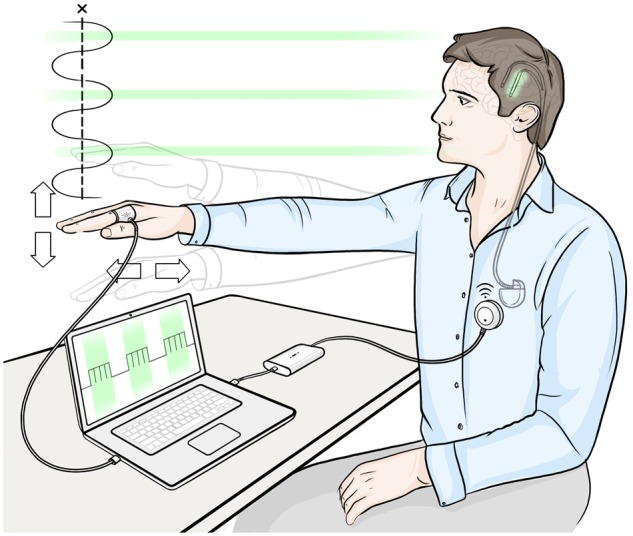
SEE MOLL AND ENGEL DOI101093/AWW308 FOR A SCIENTIFIC COMMENTARY ON THIS ARTICLE: Brain regions dynamically engage and disengage with one another to execute everyday actions from movement to decision making. Pathologies such as Parkinson's disease and tremor emerge when brain regions controlling movement cannot readily decouple, compromising motor function. Here, we propose a novel stimulation strategy that selectively regulates neural synchrony through phase-specific stimulation. We demonstrate for the first time the therapeutic potential of such a stimulation strategy for the treatment of patients with pathological tremor. Symptom suppression is achieved by delivering stimulation to the ventrolateral thalamus, timed according to the patient's tremor rhythm. Sustained locking of deep brain stimulation to a particular phase of tremor afforded clinically significant tremor relief (up to 87% tremor suppression) in selected patients with essential tremor despite delivering less than half the energy of conventional high frequency stimulation. Phase-specific stimulation efficacy depended on the resonant characteristics of the underlying tremor network. Selective regulation of neural synchrony through phase-locked stimulation has the potential to both increase the efficiency of therapy and to minimize stimulation-induced side effects.
Overview
The claims and statistics of this paper haven’t been checked yet.
Free: it reads the open-access text and checks the first 5 claims that cite a source we can check. Create a free account to check every claim.
Integrity signals
Registry
Cites
Statistics
Figures


Verification
Claims the paper makes
The claims and statistics of this paper haven’t been checked yet.
Free: it reads the open-access text and checks the first 5 claims that cite a source we can check. Create a free account to check every claim.
Claims other papers make about this one
Each is checked against this paper’s own text: does it say what the citing paper says it does?
The cited source doesn’t support the claim as written.
In the citing paper
“Some existing studies have used wearable inertial sensors [7], surface electromyography (EMG) [8], or electrocorticography (ECoG) recorded from a Neurosciences strip of intracranial electrodes implanted over the surface of the motor cortex [9] to provide feedback for the control of the stimulator in closed-loop DBS systems.”
From Closed-loop DBS triggered by real-time movement and tremor decoding based on thalamic LFPs for essential tremor (2020) · cites this paper as [7]
Checked by a reasoning model — may be wrong.
Experimental — accuracy not yet measuredThe source backs part of the claim, not all of it — or backs it for a different population, condition or comparison.
In the citing paper
“However, all these solutions require external sensors and/or additional invasive recording, which constrains their clinical application in the treatment of ET.”
From Closed-loop DBS triggered by real-time movement and tremor decoding based on thalamic LFPs for essential tremor (2020) · cites this paper as [7]
Experimental — accuracy not yet measuredThe source backs part of the claim, not all of it — or backs it for a different population, condition or comparison.
In the citing paper
“or by associating the brain stimulation to specific phases of patients’ tremor activity (Cagnan et al., 2017).”
From Toward a personalized closed-loop stimulation of the visual cortex: Advances and challenges (2022) · cites this paper as Cagnan et al., 2017
Experimental — accuracy not yet measured
Self-check
Percentages, sums and reported differences re-computed from the paper’s own numbers.
The self-check needs the paper’s full text.
Citations
Cites
The Organization of Behavior; A Neuropsychological Theory.
Attneave, F., B., M., & Hebb, D. O. (1950) · The American Journal of Psychology · doi:10.2307/1418888 · Cited by 5,146
A mechanism for cognitive dynamics: neuronal communication through neuronal coherence.
Fries, P. (2005) · Trends in Cognitive Sciences · doi:10.1016/j.tics.2005.08.011 · Cited by 4,284 · cited 3×
“Realigning median stimulation phase-amplitude relationships derived from each case such that 0 would correspond to the stimulation phase that gave rise to the greatest tremor suppression, we tested whether different stimulation phases induced the same effect on tremor severity.”
BackgroundMethodLong-term suppression of tremor by chronic stimulation of the ventral intermediate thalamic nucleus
Benabid, A. L., Pollak, P., Hoffmann, D., Gervason, C., Hommel, M., Perret, J. E., de Rougemont, J., & Gao, D. M. (1991) · The Lancet · doi:10.1016/0140-6736(91)91175-t · Cited by 1,787 · cited 3×
“…intervention, used in the treatment of debilitating neurological disorders such as advanced Parkinson’s disease, essential tremor, and dystonia (Benabid et al., 1991; Rodriguez-Oroz et al., 2005; Okun, 2012; Miocinovic et al., 2013; Ostrem et al., 2014), and its efficacy is being explored…”
BackgroundMethodAdaptive deep brain stimulation in advanced Parkinson disease.
Little, S., Pogosyan, A., Neal, S., Zavala, B., Zrinzo, L., Hariz, M., Foltynie, T., Limousin, P., Ashkan, K., FitzGerald, J., et al. (2013) · Annals of Neurology · doi:10.1002/ana.23951 · Cited by 1,374 · cited 3×
“When a certain tremor phase was detected, a TTL pulse was sent to either an externalized stimulator (for the externalized patients) (Little et al., 2013) or to the Nexus-D (for the chronically implanted patients) (Cagnan et al.”
BackgroundMethodSelf-citationModulation of Neuronal Interactions Through Neuronal Synchronization
Womelsdorf, T., Schoffelen, J.-M., Oostenveld, R., Singer, W., Desimone, R., Engel, A. K., & Fries, P. (2007) · Science · doi:10.1126/science.1139597 · Cited by 1,367
Bilateral deep brain stimulation in Parkinson's disease: a multicentre study with 4 years follow-up
Rodriguez-Oroz, M. C., Obeso, J. A., Lang, A. E., Houeto, J.-L., Pollak, P., Rehncrona, S., Kulisevsky, J., Albanese, A., Volkmann, J., Hariz, M. I., et al. (2005) · Brain · doi:10.1093/brain/awh571 · Cited by 1,057
Self-citationType I membranes, phase resetting curves, and synchrony
Ermentrout, B. (1996) · Neural Computation · doi:10.1162/neco.1996.8.5.979 · Cited by 1,001 · cited 4×
“instantaneous frequency) of an oscillator (Ermentrout, 1996; Smeal et al., 2010).”
BackgroundInfluentialStimulation of the Subthalamic Nucleus Changes the Firing Pattern of Pallidal Neurons
Hashimoto, T., Elder, C. M., Okun, M. S., Patrick, S. K., & Vitek, J. L. (2003) · The Journal of Neuroscience · doi:10.1523/jneurosci.23-05-01916.2003 · Cited by 879
Uncovering the mechanism(s) of action of deep brain stimulation: activation, inhibition, or both
McIntyre, C. C., Savasta, M., Kerkerian-Le Goff, L., & Vitek, J. L. (2004) · Clinical Neurophysiology · doi:10.1016/j.clinph.2003.12.024 · Cited by 741
Deep-Brain Stimulation for Parkinson's Disease
Okun, M. S. (2012) · New England Journal of Medicine · doi:10.1056/nejmct1208070 · Cited by 541
Cited by
Technology of deep brain stimulation: current status and future directions
Krauss, J. K., Lipsman, N., Aziz, T., Boutet, A., Brown, P., Chang, J. W., Davidson, B., Grill, W. M., Hariz, M. I., Horn, A., et al. (2021) · Nature Reviews Neurology · doi:10.1038/s41582-020-00426-z · Cited by 919
Self-citationEmerging technologies for improved deep brain stimulation
Cagnan, H., Denison, T., McIntyre, C., & Brown, P. (2019) · Nature Biotechnology · doi:10.1038/s41587-019-0244-6 · Cited by 272
Self-citationTan, H., Debarros, J., He, S., Pogosyan, A., Aziz, T. Z., Huang, Y., Wang, S., Timmermann, L., Visser-Vandewalle, V., Pedrosa, D. J., et al. (2019) · Brain Stimulation · doi:10.1016/j.brs.2019.02.011 · Cited by 83
“Prior studies of closed-loop DBS for ET have used wearable inertial sensors [12,13] and/or surface electromyography (EMG) [14] to provide feedback for the control of the stimulator.”
Self-citationHell, F., Palleis, C., Mehrkens, J. H., Koeglsperger, T., & Bötzel, K. (2019) · Frontiers in Neurology · doi:10.3389/fneur.2019.00314 · Cited by 75
Improved detection of Parkinsonian resting tremor with feature engineering and Kalman filtering
Yao, L., Brown, P., & Shoaran, M. (2020) · Clinical Neurophysiology · doi:10.1016/j.clinph.2019.09.021 · Cited by 68
Self-citationHe, S., Debarros, J., Khawaldeh, S., Pogosyan, A., Mostofi, A., Baig, F., Pereira, E., Brown, P., & Tan, H. (2020) · 2020 42nd Annual International Conference of the IEEE Engineering in Medicine & Biology Society (EMBC) · doi:10.1109/embc44109.2020.9175433 · Cited by 22
“Compared with other adaptive DBS systems developed based on external sensors or cortical strip electrodes in [7]-[9], the advantage of the method proposed here is it doesn’t require any external sensor or additional invasive electrode.”
BackgroundSelf-citationToward a personalized closed-loop stimulation of the visual cortex: Advances and challenges
Grani, F., Soto-Sánchez, C., Fimia, A., & Fernández, E. (2022) · Frontiers in Cellular Neuroscience · doi:10.3389/fncel.2022.1034270 · Cited by 16
“, 2013), or by associating the brain stimulation to specific phases of patients’ tremor activity (Cagnan et al., 2017).”
BackgroundLocal field potential phase modulates the evoked response to electrical stimulation in visual cortex
Allison-Walker, T., Hagan, M. A., Meikle, S. J., Price, N. S. C., & Wong, Y. T. (2025) · Journal of Neural Engineering · doi:10.1088/1741-2552/ada828 · Cited by 3
“Adjacent to cortical visual prostheses, some deep-brain stimulation implants for Parkinson’s disease [28–30] use the LFP to modify stimulation timing, thereby improving device performance [31, 32].”
Metadata
- Authors
- Cagnan, H., Pedrosa, D., Little, S., Pogosyan, A., Cheeran, B., Aziz, T., Green, A., Fitzgerald, J., Foltynie, T., Limousin, P., Zrinzo, L., Hariz, M., Friston, K. J., Denison, T., & Brown, P.
- Affiliations
- University of Oxford (GB)
- UCL Queen Square Institute of Neurology (GB)
- Medtronic (United States) (US)
- Corresponding author
- Cagnan, Hayriye
- ORCID
- Venue
- Brain
- Publisher
- Oxford University Press (OUP)
- Published
- 2016-12-22
- Volume
- 140
- Issue
- 1
- Pages
- 132-145
- ISSN
- 0006-8950 (ISSN-L)
- 1460-2156
- PMC
- PMC5226063
- OpenAlex
- W2563867255
- Cited by
- 270
- References
- 56
- Citations by year
- 2026: 19 · 2025: 25 · 2024: 31 · 2023: 36 · 2022: 30 · 2021: 29 · 2020: 35 · 2019: 30 · 2018: 22 · 2017: 12 · 2016: 1
- FWCI
- 16.17
- Type
- journal article
- Language
- en
- Open access
- hybrid
- doi.org
- Licence
- cc-by
- Locations
- Brain (publishedVersion, cc-by)
- PubMed Central (publishedVersion, cc-by)
- PubMed (publishedVersion)
- St George's Online Research Archive (St George's University of London) (acceptedVersion)
- UCL Discovery (University College London) (submittedVersion)
- eScholarship (California Digital Library) (submittedVersion, cc-by)
- HighWire Press Open Archive (submittedVersion)
- Funders
- Wellcome Trust (105804/Z/14/Z)
- Rosetrees Trust (M235-CD3, M526-B-CD1, M235-CD1)
- Deutsche Forschungsgemeinschaft
- Medical Research Council (MR/M014762/1, MC_UU_12024, MC_UU_12024/1)
- Topics
- Health Sciences › Medicine › Clinical Neurology › Deep Brain Stimulation and Movement Disorders
- Social Sciences › Psychology › Clinical Psychology › Obsessive-Compulsive Spectrum Disorders
- Life Sciences › Neuroscience › Neurology › Transcranial Magnetic Stimulation Studies
- Keywords
- phase-locked stimulation, essential tremor, pathological tremor, ventrolateral thalamic nucleus, neuronal synchronization, tremor suppression, Parkinson's disease
- MeSH terms
- Dystonia, Humans, Thalamus, Tremor, Essential Tremor, Deep Brain Stimulation, Accelerometry
About these checks
Registry, retraction, Cites and statistics results are computed, not judged, with one exception: a printed reference that no index lists is read once by a model before it counts as a citation error. Claims are extracted by a model and kept only when their quote appears verbatim in the text; each cited source is then checked, with a model’s help, for whether it says what the claim relies on. Those verdicts can be wrong — read the claim’s quote and the cited source before relying on one.
Statistics and arithmetic are recomputed, not judged.
Confidence bands are shown only for fields calibrated on our annotated test set. None is calibrated yet, so no band is shown.
What counts as a claim ›How we measure confidence ›How we check this ›
Are you an author, or do you see a problem with this page? Request a review
Data sources
Bibliographic data: Semantic Scholar, OpenAlex, Crossref.
Contains information from the Semantic Scholar Academic Graph Datasets, made available under the ODC Attribution License (ODC-BY 1.0).
Semantic Scholar’s data is described in: Kinney, R., et al. (2023). The Semantic Scholar Open Data Platform. arXiv:2301.10140.
