

Vitamin A Requirements in Pregnancy and Lactation
Open accessThe DOI matches its Crossref record; 217 of the 221 references it cites were found in a registry or an index.
Abstract
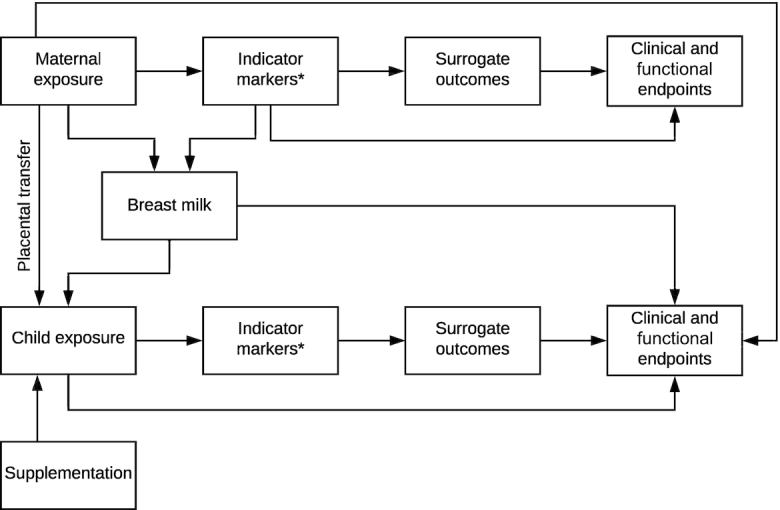
Pregnancy and lactation are critical life stages with unique nutritional requirements, including for vitamin A (VA). Current DRIs for VA were published in 2001. The objective of this review was to identify and categorize evidence related to VA requirements in pregnancy and lactation since these DRIs were formulated. We searched MEDLINE and included articles according to an analytic framework of maternal VA exposure on status and health outcomes in the mother-child dyad. Intermediate and indirect evidence supports that maternal VA intakes can impact the mother's VA status, breastmilk, and health outcomes, as well as the child's VA status and select health outcomes. Food-based approaches can lead to more sustained, sufficient VA status in mothers and children. Research needs include further study linking maternal VA intakes on maternal and child VA status, and further associations with outcomes to determine intake requirements to optimize health.
Overview
The claims and statistics of this paper haven’t been checked yet.
Free: it reads the open-access text and checks the first 5 claims that cite a source we can check. Create a free account to check every claim.
Integrity signals
Registry
Cites
Statistics
Figures
Verification
Claims the paper makes
The claims and statistics of this paper haven’t been checked yet.
Free: it reads the open-access text and checks the first 5 claims that cite a source we can check. Create a free account to check every claim.
Claims other papers make about this one
Each is checked against this paper’s own text: does it say what the citing paper says it does?
The cited source says what the claim attributes to it.
In the citing paper
“Adequate vitamin A levels are key factors for the correct development of the fetus and, later, for the correct alimentation of the newborn”
From Vitamin A Update: Forms, Sources, Kinetics, Detection, Function, Deficiency, Therapeutic Use and Toxicity (2021) · cites this paper as [326]
Self-check
Percentages, sums and reported differences re-computed from the paper’s own numbers.
The self-check needs the paper’s full text.
Citations
Cites
Trumbo (2001) · doi:10.1016/s0002-8223(01)00078-5 · Cited by 4,852
Biofortification: A New Tool to Reduce Micronutrient Malnutrition
Bouis, H. E., Hotz, C., McClafferty, B., Meenakshi, J. V., & Pfeiffer, W. H. (2011) · Food and Nutrition Bulletin · doi:10.1177/15648265110321s105 · Cited by 929 · cited 1×
“Food-based approaches can comprise dietary diversity and inclusion of VA-rich foods, food fortification, and biofortification increasing provitamin A in staple crops such as maize, sweet potato, or rice (162, 163).”
BackgroundVitamin A metabolism: An update
D’Ambrosio, D. N., Clugston, R. D., & Blaner, W. S. (2011) · Nutrients · doi:10.3390/nu3010063 · Cited by 562 · cited 2×
“Preformed VA is well absorbed regardless of dose size, and this VA is stored in the liver for recirculation and can be drawn upon in periods of low intake (6).”
BackgroundExtent of Vitamin A Deficiency among Preschool Children and Women of Reproductive Age
West, K. P. (2002) · The Journal of Nutrition · doi:10.1093/jn/132.9.2857s · Cited by 526 · cited 2×
“8% using gestational night blindness (33).”
BackgroundT HE R OLE OF V ITAMIN A IN M AMMALIAN R EPRODUCTION AND E MBRYONIC D EVELOPMENT
Clagett-Dame, M., & DeLuca, H. F. (2002) · Annual Review of Nutrition · doi:10.1146/annurev.nutr.22.010402.102745e · Cited by 461
Biomarkers of Nutrition for Development (BOND)-Vitamin A Review
Tanumihardjo, S. A., Russell, R. M., Stephensen, C. B., Gannon, B. M., Craft, N. E., Haskell, M. J., Lietz, G., Schulze, K., & Raiten, D. J. (2016) · The Journal of Nutrition · doi:10.3945/jn.115.229708 · Cited by 451 · cited 1×
“gorical estimate of VA deficiency compared with adequacy (28).”
BackgroundSelf-citationA Randomized Trial of Multivitamin Supplements and HIV Disease Progression and Mortality
Fawzi, W. W., Msamanga, G. I., Spiegelman, D., Wei, R., Kapiga, S., Villamor, E., Mwakagile, D., Mugusi, F., Hertzmark, E., Essex, M., et al. (2004) · New England Journal of Medicine · doi:10.1056/nejmoa040541 · Cited by 446 · cited 1×
“duced the benefits observed when added to a multivitamin regimen (195).”
BackgroundVitamin A in Reproduction and Development
Clagett-Dame, M., & Knutson, D. (2011) · Nutrients · doi:10.3390/nu3040385 · Cited by 439 · cited 1×
“Hypervitaminosis A has also led to altered placental morphology and agenesis (154), as well as fetal congenital malformations (15, 17).”
BackgroundThurnham, D., McCabe, G., Northrop-Clewes, C., & Nestel, P. (2003) · The Lancet · doi:10.1016/s0140-6736(03)15099-4 · Cited by 393 · cited 1×
“The value of this assessment has been questioned, because the gestational process is itself inflammatory (16), and the decreases in serum retinol that accompany inflammation (47) can cause an underestimation of dietary VA status during the end stages of pregnancy.”
BackgroundMeenakshi, J. V., Johnson, N. L., Manyong, V. M., DeGroote, H., Javelosa, J., Yanggen, D. R., Naher, F., Gonzalez, C., García, J., & Meng, E. (2010) · World Development · doi:10.1016/j.worlddev.2009.03.014 · Cited by 355 · cited 1×
“Both fortification and biofortification can be cost-effective strategies to address micronutrient intakes (179, 180), and dietary diversity is typically considered an ideal long-term solution to nutritional well-being.”
Background
Research works printed but not linked: 3
- Institute of Medicine. Dietary reference intakes: applications in dietary assessment. Washington (DC): The National Academies Press; 2000. 25057725
- WHO. WHO recommendations on antenatal care for a positive pregnancy experience. Geneva: World Health Organization; 2011. 28079998
- Kongnyuy EJ, Wiysonge CS, Shey MS A systematic review of randomized controlled trials of prenatal and postnatal vitamin A supplementation of HIV-infected women. Int J Gynaecol Obstet. 2009; 104(1): 5– 8. 18926534 · DOI
Cited by
Carazo, A., Macáková, K., Matoušová, K., Krčmová, L. K., Protti, M., & Mladěnka, P. (2021) · Nutrients · doi:10.3390/nu13051703 · Cited by 461
The Role of Vitamin A in Retinal Diseases
Sajovic, J., Meglič, A., Glavač, D., Markelj, Š., Hawlina, M., & Fakin, A. (2022) · International Journal of Molecular Sciences · doi:10.3390/ijms23031014 · Cited by 109
“The recommended daily dose of vitamin A is around 400–500 μg for children and infants, 900 μg for adult men and 700 μg for adult women [1], while lactating women require up to 1300 μg per day [11].”
BackgroundNutritional requirements in pregnancy and lactation
Talebi, S., Kianifar, H., & Mehdizadeh, A. (2024) · Clinical Nutrition ESPEN · doi:10.1016/j.clnesp.2024.10.155 · Cited by 33
Our Current Dietary Reference Intakes for Vitamin A—Now 20 Years Old
Ross, A. C., & Moran, N. E. (2020) · Current Developments in Nutrition · doi:10.1093/cdn/nzaa096 · Cited by 31
“Mehta (44) will address vitamin A requirements in pregnancy and lactation, by reviewing a variety of methods and experimental approaches that can be used to estimate the requirements for vitamin A that are”
MethodBiological evidence to define a vitamin A deficiency cutoff using total liver vitamin A reserves
Tanumihardjo, S. A. (2021) · Experimental Biology and Medicine · doi:10.1177/1535370221992731 · Cited by 25
“The effect of maternal VA status on offspring is not entirely known.(57) In piglets, retention of high dose VA supplements was lower when the mothers had a greater degree of VAD.”
Background
Metadata
- Authors
- Gannon, B. M., Jones, C., & Mehta, S.
- Affiliations
- Cornell University (US)
- Corresponding author
- Gannon, Bryan M
- Mehta, Saurabh
- Venue
- Current Developments in Nutrition
- Publisher
- Elsevier BV
- Published
- 2020-10
- Volume
- 4
- Issue
- 10
- Pages
- nzaa142
- ISSN
- 2475-2991 (ISSN-L)
- PMC
- PMC7513584
- OpenAlex
- W3080930652
- Cited by
- 33
- References
- 221
- Citations by year
- 2026: 3 · 2025: 6 · 2024: 7 · 2023: 6 · 2022: 6 · 2021: 3 · 2020: 2
- FWCI
- 0.52
- Type
- journal article
- Language
- en
- Open access
- gold
- doi.org
- Licence
- cc-by-nc-nd
- www.elsevier.com/tdm/userlicense/1.0/ (tdm)
- www.elsevier.com/legal/tdmrep-license (tdm)
- creativecommons.org/licenses/by-nc-nd/4.0/ (vor, 834 d)
- Locations
- Current Developments in Nutrition (publishedVersion, cc-by-nc-nd)
- PubMed Central (publishedVersion, cc-by)
- PubMed (publishedVersion)
- Topics
- Health Sciences › Nursing › Nutrition and Dietetics › Child Nutrition and Water Access
- Life Sciences › Biochemistry, Genetics and Molecular Biology › Molecular Biology › Retinoids in leukemia and cellular processes
- Health Sciences › Nursing › Nutrition and Dietetics › Infant Nutrition and Health
- Keywords
- vitamin A requirements, pregnancy, lactation, Dietary Reference Intakes, maternal and child health outcomes, food-based approaches, maternal nutrition
About these checks
Registry, retraction, Cites and statistics results are computed, not judged, with one exception: a printed reference that no index lists is read once by a model before it counts as a citation error. Claims are extracted by a model and kept only when their quote appears verbatim in the text; each cited source is then checked, with a model’s help, for whether it says what the claim relies on. Those verdicts can be wrong — read the claim’s quote and the cited source before relying on one.
Statistics and arithmetic are recomputed, not judged.
Confidence bands are shown only for fields calibrated on our annotated test set. None is calibrated yet, so no band is shown.
What counts as a claim ›How we measure confidence ›How we check this ›
Are you an author, or do you see a problem with this page? Request a review
Data sources
Bibliographic data: Semantic Scholar, OpenAlex, Crossref.
Contains information from the Semantic Scholar Academic Graph Datasets, made available under the ODC Attribution License (ODC-BY 1.0).
Semantic Scholar’s data is described in: Kinney, R., et al. (2023). The Semantic Scholar Open Data Platform. arXiv:2301.10140.
