

The DOI matches its Crossref record; 54 of the 54 references it cites were found in a registry or an index.
Human Amygdala Sensitivity to the Pupil Size of Others
Open accessAbstract
Stimulation of the amygdala produces pupil dilation in animal and human subjects. The present study examined whether the amygdala is sensitive to variations in the pupil size of others. Male subjects underwent event-related functional magnetic resonance imaging while passively viewing unfamiliar female faces whose pupils were either unaltered (natural variations in large and small pupils) or altered to be larger or smaller than their original size. Results revealed that the right amygdala and left amygdala/substantia innominata were sensitive to the pupil size of others, exhibiting increased activity for faces with relatively large pupils. Upon debrief, no subject reported being aware that the pupils had been manipulated. These results suggest a function for the amygdala in the detection of changes in pupil size, an index of arousal and/or interest on the part of a conspecific, even in the absence of explicit knowledge.
Overview
The claims and statistics of this paper haven’t been checked yet.
Run the check — free, no account needed. It reads the open-access text and checks the sources it cites.
Integrity signals
Registry
Cites
Statistics
Figures
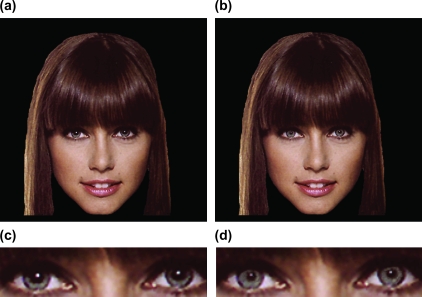
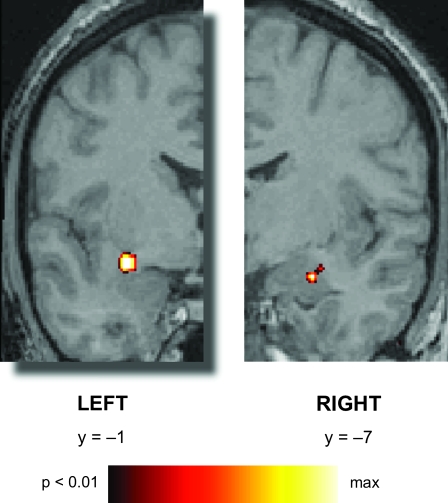
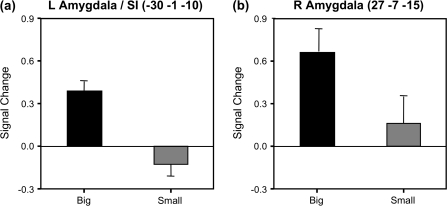
Verification
Claims the paper makes
The claims and statistics of this paper haven’t been checked yet.
Run the check — free, no account needed. It reads the open-access text and checks the sources it cites.
Claims other papers make about this one
Each is checked against this paper’s own text: does it say what the citing paper says it does?
The source backs part of the claim, not all of it — or backs it for a different population, condition or comparison.
In the citing paper
“For example, people with large pupils are commonly rated as more attractive and activate neural responses in the amygdala [35,36], and a recent study demonstrates that human participants evaluate those with dilating pupils as more friendly, attractive and trustworthy and behave more cooperatively with them in the trust game [37].”
From Are dark-eyed dogs favoured by humans? Domestication as a potential driver of iris colour difference between dogs and wolves (2023) · cites this paper as [36]
Experimental — accuracy not yet measuredThe source backs part of the claim, not all of it — or backs it for a different population, condition or comparison.
In the citing paper
“humans have a cognitive tendency to perceive emotional arousal based on iris–pupil contrast and make inferences about a person's personality [33–37].”
From Are dark-eyed dogs favoured by humans? Domestication as a potential driver of iris colour difference between dogs and wolves (2023) · cites this paper as [36]
Experimental — accuracy not yet measuredIn the citing paper
“Seeing others' dilated pupils also causes significantly higher amygdala activation than viewing undilated pupils, an effect that nonetheless appears to be unrelated to subjective reports of attractiveness (Demos et al., 2008;Amemiya and Ohtomo, 2012).”
From Oxytocin enhances pupil dilation and sensitivity to 'hidden' emotional expressions (2013) · cites this paper as Demos et al., 2008
Self-check
Percentages, sums and reported differences re-computed from the paper’s own numbers.
The self-check needs the paper’s full text.
Citations
Cites
Co-Planar Stereotaxic Atlas of the Human Brain
Talairach, J., & Tournoux, P. (1988) · Medical Entomology and Zoology · Cited by 11,798
Co-planar stereotaxic atlas of the human brain
Laitinen, L. (1989) · Clinical Neurology and Neurosurgery · doi:10.1016/0303-8467(89)90128-5 · Cited by 7,565
The amygdala: vigilance and emotion
Davis, M., & Whalen, P. J. (2001) · Molecular Psychiatry · doi:10.1038/sj.mp.4000812 · Cited by 2,882
Self-citationCohen, J., MacWhinney, B., Flatt, M., & Provost, J. (1993) · Behavior Research Methods, Instruments, & Computers · doi:10.3758/bf03204507 · Cited by 2,802
Whalen, P. J., Rauch, S. L., Etcoff, N. L., McInerney, S. C., Lee, M. B., & Jenike, M. A. (1998) · The Journal of Neuroscience · doi:10.1523/jneurosci.18-01-00411.1998 · Cited by 2,205
Self-citationA differential neural response in the human amygdala to fearful and happy facial expressions
Morris, J. S., Frith, C. D., Perrett, D. I., Rowland, D., Young, A. W., Calder, A. J., & Dolan, R. J. (1996) · Nature · doi:10.1038/383812a0 · Cited by 2,013
Emotion and Cognition: Insights from Studies of the Human Amygdala
Phelps, E. A. (2006) · Annual Review of Psychology · doi:10.1146/annurev.psych.56.091103.070234 · Cited by 1,798 · cited 2×
“In this way, amygdala activity potentiates neuronal responses in sensory cortical regions that may, in turn, facilitate subsequent information processing (Amaral et al. 1992; Kapp et al. 1992; Whalen 1998; Morris et al. 2001; Pessoa et al. 2006; Phelps 2006 ).”
BackgroundResponse and Habituation of the Human Amygdala during Visual Processing of Facial Expression
Breiter, H. C., Etcoff, N. L., Whalen, P. J., Kennedy, W. A., Rauch, S. L., Buckner, R. L., Strauss, M. M., Hyman, S. E., & Rosen, B. R. (1996) · Neuron · doi:10.1016/s0896-6273(00)80219-6 · Cited by 1,711
Self-citationThe amygdala: Neurobiological aspects of emotion, memory, and mental dysfunction.
Aggleton, J. P. (1992) · Wiley-Liss eBooks · Cited by 1,536
LaBar, K. S., Gatenby, J. C., Gore, J. C., LeDoux, J. E., & Phelps, E. A. (1998) · Neuron · doi:10.1016/s0896-6273(00)80475-4 · Cited by 1,402
A mechanism for impaired fear recognition after amygdala damage
Adolphs, R., Gosselin, F., Buchanan, T. W., Tranel, D., Schyns, P., & Damasio, A. R. (2005) · Nature · doi:10.1038/nature03086 · Cited by 1,331 · cited 2×
“…holds similarly for eye-widening, another indicator of heightened arousal, and accordingly, these data support and extend the finding that the amygdala is also sensitive to the eye-region of the face (Adolphs et al. 2005) and more specifically, eyewidening (Morris et al. 2002; Whalen et al. 2004).”
BackgroundResultThe amygdala: Neurobiological aspects of emotion, memory and mental dysfunction
Scheel-Krüger, J. (1993) · Journal of Chemical Neuroanatomy · doi:10.1016/0891-0618(93)90037-5 · Cited by 1,281
Direct hypothalamo-autonomic connections
Saper, C. B., Loewy, A. D., Swanson, L. W., & Cowan, W. M. (1976) · Brain Research · doi:10.1016/0006-8993(76)90738-1 · Cited by 1,199
Dissociated neural representations of intensity and valence in human olfaction
Anderson, A. K., Christoff, K., Stappen, I., Panitz, D., Ghahremani, D. G., Glover, G., Gabrieli, J. D. E., & Sobel, N. (2003) · Nature Neuroscience · doi:10.1038/nn1001 · Cited by 1,054
Pupil Size as Related to Interest Value of Visual Stimuli
Hess, E. H., & Polt, J. M. (1960) · Science · doi:10.1126/science.132.3423.349 · Cited by 899
Kelley, W. M., Miezin, F. M., McDermott, K. B., Buckner, R. L., Raichle, M. E., Cohen, N. J., Ollinger, J. M., Akbudak, E., Conturo, T. E., Snyder, A. Z., et al. (1998) · Neuron · doi:10.1016/s0896-6273(00)80474-2 · Cited by 823
Self-citationDissociation of Neural Representation of Intensity and Affective Valuation in Human Gustation
Small, D. M., Gregory, M. D., Mak, Y. E., Gitelman, D. R., Mesulam, M. M., & Parrish, T. B. (2003) · Neuron · doi:10.1016/s0896-6273(03)00467-7 · Cited by 812
Fear, Vigilance, and Ambiguity
Whalen, P. J. (1998) · Current Directions in Psychological Science · doi:10.1111/1467-8721.ep10836912 · Cited by 802
Self-citationHuman Amygdala Responsivity to Masked Fearful Eye Whites
Whalen, P. J., Kagan, J., Cook, R. G., Davis, F. C., Kim, H., Polis, S., McLaren, D. G., Somerville, L. H., McLean, A. A., Maxwell, J. S., et al. (2004) · Science · doi:10.1126/science.1103617 · Cited by 766
Self-citationA functional MRI study of human amygdala responses to facial expressions of fear versus anger.
Whalen, P. J., Shin, L. M., McInerney, S. C., Fischer, H., Wright, C. I., & Rauch, S. L. (2001) · Emotion · doi:10.1037/1528-3542.1.1.70 · Cited by 660
Self-citationAmygdala circuitry in attentional and representational processes
Holland, P. C., & Gallagher, M. (1999) · Trends in Cognitive Sciences · doi:10.1016/s1364-6613(98)01271-6 · Cited by 614
Afferent projections to the rat locus coeruleus as determined by a retrograde tracing technique
Cedarbaum, J. M., & Aghajanian, G. K. (1978) · The Journal of Comparative Neurology · doi:10.1002/cne.901780102 · Cited by 553
Hess, E. H. (1965) · Scientific American · doi:10.1038/scientificamerican0465-46 · Cited by 515 · cited 3×
“Pupil dilation has been interpreted as a general indicator of increased vigilance, arousal, and/or interest ( Hess 1965; Steinhauer et al. 2004), indexing behavioral responses as disparate as political interests, hunger, cognitive load, and attraction (Hess 1965; Steinhauer et al. 2004).”
BackgroundSympathetic and parasympathetic innervation of pupillary dilation during sustained processing
Steinhauer, S. R., Siegle, G. J., Condray, R., & Pless, M. L. (2004) · International Journal of Psychophysiology · doi:10.1016/j.ijpsycho.2003.12.005 · Cited by 472
Separating Processes within a Trial in Event-Related Functional MRI
Ollinger, J. M., Corbetta, M., & Shulman, G. L. (2001) · NeuroImage · doi:10.1006/nimg.2000.0711 · Cited by 445
Ecstasy and Agony: Activation of the Human Amygdala in Positive and Negative Emotion
Hamann, S. B., Ely, T. D., Hoffman, J. M., & Kilts, C. D. (2002) · Psychological Science · doi:10.1111/1467-9280.00425 · Cited by 406
The Temporal Lobe and Limbic System
GLOOR, P. (1997) · Medical Entomology and Zoology · Cited by 391
Contextual modulation of amygdala responsivity to surprised faces
Kim, H., Somerville, L. H., Johnstone, T., Polis, S., Alexander, A. L., Shin, L. M., & Whalen, P. J. (2004) · Journal of Cognitive Neuroscience · doi:10.1162/0898929042947865 · Cited by 389
Self-citationBrain systems for assessing facial attractiveness
Winston, J. S., O’Doherty, J. P., Kilner, J. M., Perrett, D. I., & Dolan, R. J. (2006) · Neuropsychologia · doi:10.1016/j.neuropsychologia.2006.05.009 · Cited by 384
Separating Processes within a Trial in Event-Related Functional MRI
Ollinger, J. M., Shulman, G. L., & Corbetta, M. (2001) · NeuroImage · doi:10.1006/nimg.2000.0710 · Cited by 381
Holstege, G. (1987) · The Journal of Comparative Neurology · doi:10.1002/cne.902600109 · Cited by 366
Chapter 26 Emotional networks and motor control: a fearful view
(1996) · Progress in brain research · doi:10.1016/s0079-6123(08)61880-4 · Cited by 364
Inverse amygdala and medial prefrontal cortex responses to surprised faces
Kim, H., Somerville, L. H., Johnstone, T., Alexander, A. L., & Whalen, P. J. (2003) · NeuroReport · doi:10.1097/00001756-200312190-00006 · Cited by 359
Self-citationThe Temporal Lobe and Limbic System
Engel, J. (1998) · Journal of Clinical Neurophysiology · doi:10.1097/00004691-199805000-00038 · Cited by 340
Functional localization within the amygdaloid complex in the cat
Ursin, H., & Kaada, B. R. (1960) · Electroencephalography and Clinical Neurophysiology · doi:10.1016/0013-4694(60)90058-4 · Cited by 318
Target Visibility and Visual Awareness Modulate Amygdala Responses to Fearful Faces
Pessoa, L., JAPEE, S. A., Sturman, D. A., & Ungerleider, L. G. (2005) · Cerebral Cortex · doi:10.1093/cercor/bhi115 · Cited by 285
Amygdaloid contributions to conditioned arousal and sensory information processing.
Kapp, B. S., Whalen, P. J., Supple, W. F., & Pascoe, J. P. (1992) · Cited by 265
Self-citationPupillary contagion: central mechanisms engaged in sadness processing
Harrison, N. A., Singer, T., Rotshtein, P., Dolan, R. J., & Critchley, H. D. (2006) · Social Cognitive and Affective Neuroscience · doi:10.1093/scan/nsl006 · Cited by 243
Morris, J. S., Büchel, C., & Dolan, R. J. (2001) · NeuroImage · doi:10.1006/nimg.2000.0721 · Cited by 212
Autonomic and somatomotor effects of amygdala central N. stimulation in awake rabbits☆
Applegate, C. D., Kapp, B. S., Underwood, M. D., & McNall, C. L. (1983) · Physiology & Behavior · doi:10.1016/0031-9384(83)90201-9 · Cited by 208
Human Amygdala Responses to Fearful Eyes
Morris, J. S., deBonis, M., & Dolan, R. J. (2002) · NeuroImage · doi:10.1006/nimg.2002.1220 · Cited by 197
Stability of amygdala BOLD response to fearful faces over multiple scan sessions
Johnstone, T., Somerville, L. H., Alexander, A. L., Oakes, T. R., Davidson, R. J., Kalin, N. H., & Whalen, P. J. (2005) · NeuroImage · doi:10.1016/j.neuroimage.2004.12.016 · Cited by 155
Self-citationKapp, B. S., Supple, W. F., & Whalen, P. J. (1994) · Behavioral Neuroscience · doi:10.1037//0735-7044.108.1.81 · Cited by 152
Self-citationKapp, B. S., Supple, W. F., & Whalen, P. J. (1994) · Behavioral Neuroscience · doi:10.1037/0735-7044.108.1.81 · Cited by 120
Self-citationBrainstem connections to the Edinger-Westphal nucleus of the cat: a retrograde tracer study
Breen, L. A., Burde, R. M., & Loewy, A. D. (1983) · Brain Research · doi:10.1016/0006-8993(83)90633-9 · Cited by 79
Pupil size and affect: A critical review of the literature since 1960.
Janisse, M. P. (1973) · The Canadian Psychologist · doi:10.1037/h0082230 · Cited by 71
Bitsios, P., Philpott, A., Langley, R. W., Bradshaw, C. M., & Szabadi, E. (1999) · Journal of Psychopharmacology · doi:10.1177/026988119901300303 · Cited by 69
Loewy, A. D., Araújo, J. C., & Kerr, F. W. L. (1973) · Brain Research · doi:10.1016/0006-8993(73)90851-2 · Cited by 64
CNS adrenergic inhibition of parasympathetic oculomotor tone
Koss, M. C., Gherezghiher, T., & Nomura, A. (1984) · Journal of the Autonomic Nervous System · doi:10.1016/0165-1838(84)90067-5 · Cited by 48
Wig, G. S., Miller, M. B., Kingstone, A. F., & Kelley, W. M. (2004) · Journal of Cognitive Neuroscience · doi:10.1162/089892904322755629 · Cited by 41
Self-citationBrainstem loci for sympathetic activation of the nictitating membrane and pupil in the cat
Koss, M., & Wang, S. (1972) · American Journal of Physiology-Legacy Content · doi:10.1152/ajplegacy.1972.222.4.900 · Cited by 31
Comparison of the effects of clonidine on tyramine‐ and methoxamine‐evoked mydriasis in man
Bitsios, P., Langley, R. W., Szabadi, E., & Bradshaw, C. M. (1996) · British Journal of Clinical Pharmacology · doi:10.1046/j.1365-2125.1996.03202.x · Cited by 14
Comparison of the effects of moclobemide and selegiline on tyramine‐evoked mydriasis in man
Bitsios, P., Langley, R. W., Tavernor, S., Pyykkö, K. A., Scheinin, M., Szabadi, E., & Bradshaw, C. M. (1998) · British Journal of Clinical Pharmacology · doi:10.1046/j.1365-2125.1998.00729.x · Cited by 10
Parametric exploration of the fear‐inhibited light reflex
Hourdaki, E., Giakoumaki, S. G., Grinakis, V., Theou, K., Karataraki, M., & Bitsios, P. (2005) · Psychophysiology · doi:10.1111/j.1469-8986.2005.00301.x · Cited by 8
Research works printed but not linked: 1
- Amaral, 1992, Anatomical organization of the primate amygdaloid complex, 1
Cited by
Sorted by citations
Fear, faces, and the human amygdala
Adolphs, R. (2008) · Current Opinion in Neurobiology · doi:10.1016/j.conb.2008.06.006 · Cited by 502
Arousal Effects on Pupil Size, Heart Rate, and Skin Conductance in an Emotional Face Task
Wang, C., Baird, T., Huang, J. C. H., Coutinho, J., Brien, D. C., & Munoz, D. P. (2018) · Frontiers in Neurology · doi:10.3389/fneur.2018.01029 · Cited by 340
Looser, C. E., & Wheatley, T. P. (2010) · Psychological Science · doi:10.1177/0956797610388044 · Cited by 233
Eye tracking and visual attention to threating stimuli in veterans of the Iraq war
Kimble, M. O., Fleming, K., Bandy, C., Kim, J., & Zambetti, A. (2010) · Journal of Anxiety Disorders · doi:10.1016/j.janxdis.2009.12.006 · Cited by 156
Oxytocin enhances pupil dilation and sensitivity to 'hidden' emotional expressions
Leknes, S., Wessberg, J., Ellingsen, D.-M., Chelnokova, O., Olausson, H., & Laeng, B. (2013) · Social Cognitive and Affective Neuroscience · doi:10.1093/scan/nss062 · Cited by 151
Metadata
- Authors
- Demos, K. E., Kelley, W. M., Ryan, S. L., Davis, F. C., & Whalen, P. J.
- Affiliations
- Dartmouth College (US)
- Corresponding author
- Demos, K.E.
- ORCID
- Demos, K.E.
- Venue
- Cerebral Cortex
- Publisher
- Oxford University Press (OUP)
- Published
- 2008-03-27
- Volume
- 18
- Issue
- 12
- Pages
- 2729-2734
- ISSN
- 1047-3211 (ISSN-L)
- 1460-2199
- PMC
- PMC2583162
- OpenAlex
- W2119582005
- Cited by
- 112
- References
- 53
- Citations by year
- 2026: 1 · 2025: 14 · 2024: 4 · 2023: 4 · 2022: 6 · 2021: 5 · 2020: 6 · 2019: 7 · 2018: 4 · 2017: 5 · 2016: 5 · 2015: 5 · 2014: 4 · 2013: 9 · 2012: 4
- FWCI
- 5.01
- Type
- journal article
- Language
- en
- Open access
- hybrid
- doi.org
- Licence
- cc-by-nc
- Locations
- Cerebral Cortex (publishedVersion, cc-by-nc)
- PubMed Central (publishedVersion, cc-by-nc)
- PubMed (publishedVersion)
- HighWire Press Open Archive (submittedVersion)
- Funders
- Dartmouth College
- U.S. Public Health Service (080716, 069315)
- National Institute of Mental Health (R01MH080716, 080716, 069315)
- Topics
- Life Sciences › Neuroscience › Cognitive Neuroscience › Face Recognition and Perception
- Social Sciences › Psychology › Experimental and Cognitive Psychology › Evolutionary Psychology and Human Behavior
- Life Sciences › Neuroscience › Cognitive Neuroscience › Memory and Neural Mechanisms
- Keywords
- amygdala, pupil size, social perception, facial expressions, arousal detection, substantia innominata, face perception, unconscious processes, pupillometry
- MeSH terms
- Adolescent, Amygdala, Arousal, Cues, Facial Expression, Female, Humans, Functional Laterality, Male, Pupil, Visual Acuity, Visual Perception, Knowledge, Young Adult
About these checks
Registry, retraction, Cites and statistics results are computed, not judged, with one exception: a printed reference that no index lists is read once by a model before it counts as a citation error. Claims are extracted by a model and kept only when their quote appears verbatim in the text; each cited source is then checked, with a model’s help, for whether it says what the claim relies on. Those verdicts can be wrong — read the claim’s quote and the cited source before relying on one.
Statistics and arithmetic are recomputed, not judged.
Confidence bands are shown only for fields calibrated on our annotated test set. None is calibrated yet, so no band is shown.
What counts as a claim ›How we measure confidence ›How we check this ›
Are you an author, or do you see a problem with this page? Request a review
