

A Dual Role for Prediction Error in Associative Learning
Open accessThe DOI matches its Crossref record; 68 of the 69 references it cites were found in a registry or an index.
Abstract
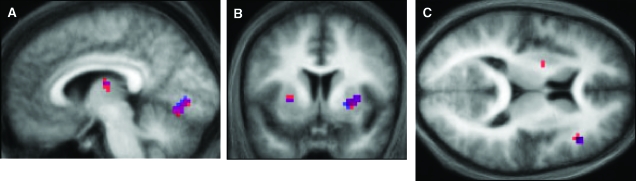
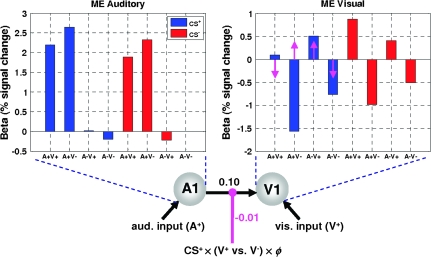
Confronted with a rich sensory environment, the brain must learn statistical regularities across sensory domains to construct causal models of the world. Here, we used functional magnetic resonance imaging and dynamic causal modeling (DCM) to furnish neurophysiological evidence that statistical associations are learnt, even when task-irrelevant. Subjects performed an audio-visual target-detection task while being exposed to distractor stimuli. Unknown to them, auditory distractors predicted the presence or absence of subsequent visual distractors. We modeled incidental learning of these associations using a Rescorla-Wagner (RW) model. Activity in primary visual cortex and putamen reflected learning-dependent surprise: these areas responded progressively more to unpredicted, and progressively less to predicted visual stimuli. Critically, this prediction-error response was observed even when the absence of a visual stimulus was surprising. We investigated the underlying mechanism by embedding the RW model into a DCM to show that auditory to visual connectivity changed significantly over time as a function of prediction error. Thus, consistent with predictive coding models of perception, associative learning is mediated by prediction-error dependent changes in connectivity. These results posit a dual role for prediction-error in encoding surprise and driving associative plasticity.
Overview
The claims and statistics of this paper haven’t been checked yet.
Free: it reads the open-access text and checks the first 5 claims that cite a source we can check. Create a free account to check every claim.
Integrity signals
Registry
Cites
Statistics
Figures
Verification
Claims the paper makes
The claims and statistics of this paper haven’t been checked yet.
Free: it reads the open-access text and checks the first 5 claims that cite a source we can check. Create a free account to check every claim.
Claims other papers make about this one
Each is checked against this paper’s own text: does it say what the citing paper says it does?
The source backs part of the claim, not all of it — or backs it for a different population, condition or comparison.
In the citing paper
“As with RS, ES has been consistently reported in human brain imaging studies across sensory modalities and noninvasive neural recording techniques 45 , 46 , 74 , 75 , 76 , 77 , 78 , 79 , 80 , 81 (but see Ref. 82)”
From Evaluating the neurophysiological evidence for predictive processing as a model of perception (2020) · cites this paper as [74]
Experimental — accuracy not yet measuredIn the citing paper
“These trial-wise prediction error estimates can be used as modulatory inputs in DCM, controlling changes in connection strength during learning (den Ouden et al., 2009).”
From Ten simple rules for dynamic causal modeling (2010) · cites this paper as den Ouden et al., 2009
Self-check
Percentages, sums and reported differences re-computed from the paper’s own numbers.
The self-check needs the paper’s full text.
Citations
Cites
Reinforcement Learning: An Introduction
Sutton, R. S., & Barto, A. G. (1998) · IEEE Transactions on Neural Networks · doi:10.1109/tnn.1998.712192 · Cited by 27,225 · cited 1×
“Cerebral Cortex May 2009;19:1175--1185 doi:10.1093/cercor/bhn161 Advance Access publication September 26, 2008”
InfluentialReinforcement Learning: An Introduction
(2005) · IEEE Transactions on Neural Networks · doi:10.1109/tnn.2004.842673 · Cited by 24,496
Rescorla, R. A. (1972) · Medical Entomology and Zoology · Cited by 9,661
A neural substrate of prediction and reward
Schultz, W., Dayan, P., & Montague, P. R. (1997) · Science · doi:10.1126/science.275.5306.1593 · Cited by 9,388 · cited 2×
“learning because they signal the need for learning in order to update predictions (Shanks 1995; Schultz et al. 1997; Schultz and Dickinson 2000).”
Rao, R. P. N., & Ballard, D. H. (1999) · Nature Neuroscience · doi:10.1038/4580 · Cited by 5,483 · cited 1×
“The total duration of the experiment was approximately 60 min per subject.”
Maldjian, J. A., Laurienti, P. J., Kraft, R. A., & Burdette, J. H. (2003) · NeuroImage · doi:10.1016/s1053-8119(03)00169-1 · Cited by 5,085 · cited 2×
“…the role of the striatum and the prefrontal cortex in associative learning (e.g., Fletcher et al. 2001; O’Doherty et al. 2004; Corlett et al. 2004), we performed an additional restricted search in these areas, using anatomical masks generated from the PickAtlas toolbox (Maldjian et al. 2003).”
Friston, K. J., Harrison, L., & Penny, W. (2003) · NeuroImage · doi:10.1016/s1053-8119(03)00202-7 · Cited by 4,583 · cited 7×
“These models were fitted separately to each subject’s data and compared using Bayesian model selection (Penny et al. 2004).”
InfluentialSelf-citationA theory of cortical responses.
Friston, K. (2005) · Philosophical Transactions of the Royal Society B: Biological Sciences · doi:10.1098/rstb.2005.1622 · Cited by 4,578 · cited 8×
“a general framework for perceptual inference and learning that is discussed in the next section (Friston 2005).”
InfluentialSelf-citationPredictive reward signal of dopamine neurons
Schultz, W. (1998) · Journal of Neurophysiology · doi:10.1152/jn.1998.80.1.1 · Cited by 4,564
Classical conditioning II: Current research and theory.
Black, A. H., & Prokasy, W. F. (1972) · Appleton-Century-Crofts eBooks · Cited by 4,449
Research works printed but not linked: 1
- Hebb DO The organisation of behaviour 1949 New York John Wiley
Cited by
Items 201–300 of 320
Preferential encoding of behaviorally relevant predictions revealed by EEG
Stokes, M. G., Myers, N. E., Turnbull, J., & Nobre, A. C. (2014) · Frontiers in Human Neuroscience · doi:10.3389/fnhum.2014.00687 · Cited by 15
“Irrelevant expected input could be suppressed to reduce redundancy in the neural code and reduce potential distractions (den Ouden et al., 2009), whereas predictions of behaviorally relevant events could be used to override expectation suppression to enhance processing in favor of likely targets.”
BackgroundResultInfluentialIs there an inferior frontal cortical network for cognitive control and inhibition?
Neubert, F.-X., Mars, R. B., & Rushworth, M. F. S. (2013) · Oxford University Press eBooks · doi:10.1093/med/9780199837755.003.0026 · Cited by 18
Psychoticism and salience network morphology
Krishnadas, R., Palaniyappan, L. K., Lang, J., McLean, J., & Cavanagh, J. (2013) · Personality and Individual Differences · doi:10.1016/j.paid.2013.09.016 · Cited by 13
Haarsma, J., Fletcher, P. C., Ziauddeen, H., Spencer, T. J., Diederen, K. M. J., & Murray, G. K. (2018) · bioRxiv (Cold Spring Harbor Laboratory) · doi:10.1101/288936 · Cited by 13
“Recent decades have witnessed an increased interest in Bayesian theories of neural function, where neural signals representing prediction errors (expected – predicted outcome) play a key role (Rao & Ballard, 1999; den Ouden et al., 2008 & 2012; Bastos et al., 2012).”
BackgroundSchema-driven prediction effects on episodic memory across the lifespan
Ortiz-Tudela, J., Turan, G., Vilas, M. G., Melloni, L., & Shing, Y. L. (2024) · Philosophical Transactions of the Royal Society B Biological Sciences · doi:10.1098/rstb.2023.0401 · Cited by 13
“It is well known that PEs trigger a myriad of cognitive and physiological responses which are immediately measurable [41–44].”
BackgroundJuan, E., Nguissi, N. A. N., Tzovara, A., Viceic, D., Rusca, M., Oddo, M., Rossetti, A. O., & Lucia, M. D. (2016) · NeuroImage · doi:10.1016/j.neuroimage.2016.07.039 · Cited by 13
“…the brain can produce an activity strongly resembling the neural response to the missing stimulus as a manifestation of its internal expectation (Chouiter et al., 2015; SanMiguel et al., 2013) even when the expectation is built upon unperceived or task-irrelevant stimuli (Den Ouden et al., 2009).”
An ERP Investigation of Object-Scene Incongruity: The Early Meeting of Knowledge and Perception
Guillaume, F., Tinard, S., Baier, S., & Dufau, S. (2016) · Journal of Psychophysiology · doi:10.1027/0269-8803/a000181 · Cited by 13
Dissociation of Prediction from Conscious Perception
Vetter, P., Sanders, L. L. O., & Muckli, L. F. (2014) · Perception · doi:10.1068/p7766 · Cited by 12
Strategic adaptation to non-reward prediction error qualities and irreducible uncertainty in fMRI
Kluger, D. S., & Schubotz, R. I. (2017) · Cortex · doi:10.1016/j.cortex.2017.09.017 · Cited by 11
Brain-correlates of processing local dependencies within a statistical learning paradigm
Tsogli, V., Skouras, S., & Koelsch, S. (2022) · Scientific Reports · doi:10.1038/s41598-022-19203-7 · Cited by 12
Bayesian Workflow for Generative Modeling in Computational Psychiatry
Hess, A. J., Iglesias, S., Köchli, L., Marino, S., Müller-Schrader, M., Rigoux, L., Mathys, C., Harrison, O. K., Heinzle, J., Frässle, S., et al. (2025) · Computational Psychiatry · doi:10.5334/cpsy.116 · Cited by 10
Self-citationFrei, N., Willinger, D., Haller, P., González, G. F., Pamplona, G. S. P., Haugg, A., Lutz, C. G., Coraj, S., Hefti, E., & Brem, S. (2025) · Journal of Neuroscience · doi:10.1523/jneurosci.1119-24.2025 · Cited by 10
“…modulation of the connection from the PAC to the STS integration region indicates that the current learning state of a LSS association is related to the synaptic strength between those regions and under-lines the striatum ’ s critical role during associative learning (den Ouden et al., 2009).”
InfluentialLimongi, R., Pérez, F. J., Modroño, C., & González–Mora, J. L. (2016) · Frontiers in Human Neuroscience · doi:10.3389/fnhum.2016.00276 · Cited by 11
“Finally, the NN model was inspired by previous results showing that behavioral prediction errors affect striatal activity (den Ouden et al., 2009, 2010; Limongi et al., 2013).”
Learning by predicting: How predictive processing informs language development
Zettersten, M. (2019) · De Gruyter eBooks · doi:10.1515/9783110596656-010 · Cited by 13
“A vast number of studies have studied cortical responses to unexpected events (e.g. den Ouden et al. 2009; Bendixen et al. 2014; Chennu et al. 2013; Wacongne et al. 2011).”
Temporal uncertainty enhances suppression of neural responses to predictable visual stimuli
Nara, S., Lizarazu, M., Richter, C. G., Dima, D. C., Cichy, R. M., Bourguignon, M., & Molinaro, N. (2021) · NeuroImage · doi:10.1016/j.neuroimage.2021.118314 · Cited by 12
Takotsubo syndrome: How the broken heart deals with negative emotions
Klein, C., Leipold, S., Ghadri, J. R., Jurisic, S., Hiestand, T., Hänggi, J., Lüscher, T. F., Jäncke, L., & Templin, C. (2019) · NeuroImage Clinical · doi:10.1016/j.nicl.2019.102124 · Cited by 11
“In addition, an association between Takotsubo syndrome and Type D personality was found (Compare et al., 2013), which is frequently observed in patients with depression or anxiety (Denollet and Kupper, 2007; Spindler et al., 2007).”
BackgroundExplaining neural signals in human visual cortex with an associative learning model.
Jiang, J., Schmajuk, N. A., & Egner, T. (2012) · Behavioral Neuroscience · doi:10.1037/a0029029 · Cited by 11
Maier, W., & Steinbach, E. G. (2010) · IEEE Transactions on Autonomous Mental Development · doi:10.1109/tamd.2010.2080272 · Cited by 12
“Neuroscientific experiments in [14] also show that there are areas in the primary visual cortex and putamen which respond progressively more to unpredicted and progressively less to predicted visual stimuli.”
BackgroundHaarsma, J., Fletcher, P. C., Griffin, J. D., Taverne, H., Ziauddeen, H., Spencer, T. J., Goodyer, I. M., Diederen, K. M. J., & Murray, G. K. (2019) · bioRxiv (Cold Spring Harbor Laboratory) · doi:10.1101/558478 · Cited by 10
Natural forgetting reversibly modulates engram expression
O’Leary, J. D., Bruckner, R., Autore, L., & Ryan, T. J. (2024) · eLife · doi:10.7554/elife.92860.3 · Cited by 16
Bratec, S. M., Xie, X., Wang, Y., Schilbach, L., Zimmer, C., Wohlschläger, A. M., Riedl, V., & Sorg, C. (2016) · NeuroImage · doi:10.1016/j.neuroimage.2016.12.078 · Cited by 9
“05, based on previous studies (Gläscher and Büchel, 2005; Ouden et al., 2009), firstly, due to the similarity of design, and secondly, because they identified this specific learning rate to be relevant for VST, the primary target region in the current study.”
BackgroundResource-rational account of sequential effects in human prediction
Prat-Carrabin, A., Meyniel, F., & da Silveira, R. A. (2024) · eLife · doi:10.7554/elife.81256 · Cited by 11
Visual Learning in Multisensory Environments
Jacobs, R. A., & Shams, L. B. (2009) · Topics in Cognitive Science · doi:10.1111/j.1756-8765.2009.01056.x · Cited by 10
Hu, Z., Tran, D. M. D., & Rideaux, R. (2025) · Imaging Neuroscience · doi:10.1162/imag.a.152 · Cited by 9
“This finding aligns with other neuroimaging evidence supporting the sharpening account ( den Ouden et al., 2008; Todorovic et al., 2011).”
Aging and retrospective revaluation of causal learning.
Mutter, S. A., Atchley, A. R., & Plumlee, L. F. (2012) · Journal of Experimental Psychology Learning Memory and Cognition · doi:10.1037/a0024851 · Cited by 11
Subjective visibility report is facilitated by conscious predictions only
Alilović, J., Slagter, H. A., & van Gaal, S. (2020) · Consciousness and Cognition · doi:10.1016/j.concog.2020.103048 · Cited by 10
Memory for Problem Solving: Comparative Studies in Attention, Working and Long-term Memory
Bobrowicz, K. (2019) · Lund University Publications (Lund University) · doi:10.13140/rg.2.2.21981.77281 · Cited by 9
Sound category habituation requires task-relevant attention
Moskowitz, H. S., & Sussman, E. S. (2023) · Frontiers in Neuroscience · doi:10.3389/fnins.2023.1228506 · Cited by 7
“Recently, the concept of predictive processing has been validated by several brain imaging studies investigating predictive feedback and the processing of prediction errors (den Ouden et al., 2009; Friston and Kiebel, 2009; Egner et al., 2010; Jiang et al., 2013; Alink and Blank, 2021).”
MethodQiao, L., Zhang, L., & Chen, A. (2022) · Cerebral Cortex · doi:10.1093/cercor/bhac187 · Cited by 7
Hodapp, A., & Rabovsky, M. (2024) · Journal of Cognitive Neuroscience · doi:10.1162/jocn_a_02145 · Cited by 7
Gorka, A. X., Philips, R. T., Torrisi, S., Manbeck, A. B., Goodwin, M., Ernst, M., & Grillon, C. (2023) · Social Cognitive and Affective Neuroscience · doi:10.1093/scan/nsad025 · Cited by 6
Baars, B. J., & Gage, N. M. (2010) · Elsevier eBooks · doi:10.1016/b978-0-12-375070-9.00003-6 · Cited by 7
Predictive coding: Neuroscience and art
Wolf, J. (2020) · Progress in brain research · doi:10.1016/bs.pbr.2020.06.018 · Cited by 6
Heil, L., Kwisthout, J., van Pelt, S., van Rooij, I., & Bekkering, H. (2018) · Quarterly Journal of Experimental Psychology · doi:10.1177/1747021817752102 · Cited by 7
Stange, L., Ossandón, J., & Röder, B. (2023) · Philosophical Transactions of the Royal Society B Biological Sciences · doi:10.1098/rstb.2022.0339 · Cited by 6
“In line with these assumptions, both brain imaging (Alink, Schwiedrzik, Kohler, Singer, & Muckli, 2010; Den Ouden et al., 2008) and electrophysiological studies (Todorovic & Lange, 2012; Wacongne et al., 2011) have revealed enhanced neural responses to unexpected compared to expected sensory…”
ResultDecoding task and stimulus representations in face-responsive cortex
Kliemann, D., Jacoby, N., Anzellotti, S., & Saxe, R. R. (2016) · Cognitive Neuropsychology · doi:10.1080/02643294.2016.1256873 · Cited by 6
Greco, A., D’Alessandro, M., Gallitto, G., Rastelli, C., Braun, C., & Carìa, A. (2024) · Biology · doi:10.3390/biology13080576 · Cited by 5
Völter, C. J., Tinklenberg, B., Call, J., & Seed, A. M. (2022) · Journal of comparative psychology · doi:10.1037/com0000313 · Cited by 6
González, G. F., Haller, P., Willinger, D., Gehrig, V., Frei, N., & Brem, S. (2025) · Imaging Neuroscience · doi:10.1162/imag_a_00439 · Cited by 5
Spatiotemporal predictability alters perceived duration of visual events: Memento effect revisited.
Meyerhoff, H. S., Vanes, L. D., & Huff, M. (2015) · Journal of Experimental Psychology Human Perception & Performance · doi:10.1037/xhp0000048 · Cited by 5
Non-spatial context-driven search
Kim, S., & Beck, M. R. (2020) · Attention Perception & Psychophysics · doi:10.3758/s13414-020-02063-6 · Cited by 5
Exploitation of local and global information in predictive processing
Kluger, D. S., Broers, N., Roehe, M. A., Wurm, M. F., Busch, N. A., & Schubotz, R. I. (2020) · PLoS ONE · doi:10.1371/journal.pone.0231021 · Cited by 4
Perceptual Inference: A Matter of Predictions and Errors
Kok, P. (2016) · Current Biology · doi:10.1016/j.cub.2016.07.061 · Cited by 4
Unimodal and cross-modal prediction is enhanced in musicians
Vassena, E., Kochman, K., Latomme, J., & Verguts, T. (2016) · Scientific Reports · doi:10.1038/srep25225 · Cited by 4
Expectation Gates Neural Facilitation of Emotional Words in Early Visual Areas
Trauer, S. M., Müller, M. M., & Kotz, S. A. (2019) · Frontiers in Human Neuroscience · doi:10.3389/fnhum.2019.00281 · Cited by 4
“Accordingly, activity in visual cortex has been found reduced for predictable stimuli (unattended: den Ouden et al., 2009; passive viewing: Alink et al., 2010; attended: Kok et al., 2012b).”
BackgroundNeural signatures of predictive coding underlying the acquisition of incidental sensory associationsPreprint
Greco, A., Rastelli, C., Bonetti, L., Braun, C., & Carìa, A. (2025) · bioRxiv (Cold Spring Harbor Laboratory) · doi:10.1101/2025.05.16.654429 · Cited by 4
“After establishing the presence of incidental associative learning at the neural level ( 82 , 85 ), we next deepened more on the neural signatures of the predictive mechanisms that underlied the acquisition of these incidental sensory associations.”
InfluentialRethinking Predictive Processing
Furutachi, S., & Hofer, S. B. (2026) · Annual Review of Neuroscience · doi:10.1146/annurev-neuro-102124-031410 · Cited by 3
Watagodakumbura, C. (2015) · World Journal of Education · doi:10.5430/wje.v5n6p23 · Cited by 3
3.9 Analyzing Functional and Effective Connectivity with fMRI
Stephan, K. E., & Friston, K. J. (2010) · Oxford University Press eBooks · doi:10.1093/acprof:oso/9780195372731.003.0016 · Cited by 5
Self-citationExpected but omitted stimuli affect crossmodal interaction
Costantini, M., Migliorati, D., Donno, B., Sirota, M., & Ferri, F. (2017) · Cognition · doi:10.1016/j.cognition.2017.10.016 · Cited by 3
Being right matters: Model-compliant events in predictive processing
Kluger, D. S., Quante, L., Kohler, A., & Schubotz, R. I. (2019) · PLoS ONE · doi:10.1371/journal.pone.0218311 · Cited by 3
de Cruys, S. V. (2014) · Lirias · Cited by 6
Subjective visibility report is facilitated by conscious predictions onlyPreprint
Alilović, J., Slagter, H. A., & van Gaal, S. (2020) · bioRxiv (Cold Spring Harbor Laboratory) · doi:10.1101/2020.07.08.193037 · Cited by 3
Natural forgetting reversibly modulates engram expressionPreprint
O’Leary, J. D., Bruckner, R., Autore, L., & Ryan, T. J. (2023) · eLife · doi:10.7554/elife.92860.1 · Cited by 6
Schmitter, C. V., & Straube, B. (2026) · Schizophrenia · doi:10.1038/s41537-025-00721-y · Cited by 2
“Similarly, activity in the putamen has been linked to the processing of prediction errors in action-outcome associations and action-related rewards 74,75 , as well as in action-independent stimulus associations 76 .”
Signaling of salience and prediction errors by anterior insula neurons
Gomez-Alatorre, L. F., Amir, A., Badawy, M., Karki, A., & Paré, D. (2026) · Biochemical and Biophysical Research Communications · doi:10.1016/j.bbrc.2026.153825 · Cited by 3
Fernández, R. S., & Allegri, R. (2019) · Neurología Argentina · doi:10.1016/j.neuarg.2019.06.002 · Cited by 2
Pérez-Bellido, A., Spaak, E., & de Lange, F. P. (2023) · Communications Biology · doi:10.1038/s42003-022-04335-3 · Cited by 2
Tracking the emergence of location-based spatial representations in human scene-selective cortexPreprint
Berens, S. C., Joensen, B. H., & Horner, A. J. (2019) · bioRxiv (Cold Spring Harbor Laboratory) · doi:10.1101/547976 · Cited by 2
Perceptual predictions track subjective, over objective, statistical structurePreprint
Clarke, J., Rittershofer, K., Ward, E. K., Yon, D., & Press, C. (2026) · eLife · doi:10.7554/elife.109690.1 · Cited by 2
Siestrup, S., Leeners, L. M., Pomp, J., Roehe, M. A., Zahedi, A., & Schubotz, R. I. (2025) · Cerebral Cortex · doi:10.1093/cercor/bhaf078 · Cited by 1
“Previous studies have shown that different prediction error signals can be identified in the brain depending on the nature of the expectation violation (Friston 2005; Den Ouden et al.2009; Keller and Mrsic-Flogel 2018).”
Chen, F., Mohan, A., Sé, C. Ó., & Vanneste, S. (2025) · Human Brain Mapping · doi:10.1002/hbm.70211 · Cited by 1
“PEs play a vital role in learning the environment (Den Ouden et al. 2009; Holland and Schiffino 2016; Behrens et al. 2007).”
Evidence of Top‐Down Sensory Prediction in Neonates Within 2 Days of Birth
Xiao, N. G., Robertson, C. E., & Emberson, L. L. (2025) · Developmental Science · doi:10.1111/desc.70114 · Cited by 1
“We hypothesized that if neonates engage in top-down sensory prediction, the visual cortex would respond to the auditory cue in the absence of the visual stimulus, similar to patterns observed in older infants and adults (e.g., Emberson et al. 2015 ; den Ouden et al. 2009 ).”
Where learning paths meet: Convergence and divergence of statistical and reinforcement learning
Ferrari, A., de Lange, F. P., & Akrami, A. (2026) · Current Opinion in Neurobiology · doi:10.1016/j.conb.2026.103181 · Cited by 2
Huang, Y., Qu, C., Gazzola, V., Garofalo, S., Starita, F., Krebs, R. M., Degni, L., Wei, J., Finotti, G., di Pellegrino, G., et al. (2026) · NeuroImage · doi:10.1016/j.neuroimage.2026.121874 · Cited by 1
“Nothing” Really Matters: What Omission Responses Reveal About the Predictive Brain
Yaron, A., Shiramatsu, T. I., Takahashi, H., & Chao, Z. C. (2026) · European Journal of Neuroscience · doi:10.1111/ejn.70566 · Cited by 1
“…violations of expected presence and expected absence both generate prediction-error signals, and these signals are expressed through changes in coupling among task-relevant sensory and association areas, even when regularities are learned incidentally (Den Ouden et al. 2009; Greco et al. 2024).”
How Visual is Visual Prediction?
Emberson, L. L., Rizzieri, A., & Aslin, R. Ν. (2017) · Infancy · doi:10.1111/infa.12188 · Cited by 1
Patt, V. M., Palombo, D. J., Esterman, M. S., & Verfaellie, M. H. (2022) · Journal of Cognitive Neuroscience · doi:10.1162/jocn_a_01873 · Cited by 1
“…of correct status whenever the “dollar bill” outcome was mentally expected, suggesting operation of a visual-perceptual prediction error similar to signals previously reported in the visual cortex and visual ventral stream (Alink et al., 2010; den Ouden et al., 2009; Turk-Browne et al., 2009).”
Multisensory perception of natural versus unnatural motion
Tsutsuse, K. S., Vibell, J. F., & Sinnett, S. (2022) · Quarterly Journal of Experimental Psychology · doi:10.1177/17470218221108251 · Cited by 1
Multisensory expectations shape olfactory input to the brainPreprint
Czarnecki, L. A. (2017) · bioRxiv (Cold Spring Harbor Laboratory) · doi:10.7282/t37p91v6 · Cited by 1
Sharpening of hierarchical visual feature representations of blurred imagesPreprint
Abdelhack, M., & Kamitani, Y. (2017) · bioRxiv (Cold Spring Harbor Laboratory) · doi:10.1101/230078 · Cited by 1
Multisensory expectations shape olfactory input to the brainPreprint
Czarnecki, L. A., Moberly, A. H., Fast, C. D., Turkel, D. J., & McGann, J. P. (2018) · bioRxiv (Cold Spring Harbor Laboratory) · doi:10.1101/283242 · Cited by 1
Natural forgetting reversibly modulates engram expressionPreprint
O’Leary, J. D., Bruckner, R., Autore, L., & Ryan, T. J. (2024) · eLife · doi:10.7554/elife.92860.2 · Cited by 3
Perceptual predictions track subjective, over objective, statistical structurePreprint
Clarke, J., Rittershofer, K., Ward, E. K., Yon, D., & Press, C. (2026) · eLife · doi:10.7554/elife.109690 · Cited by 1
Knowing what's next: The role of the cerebellum in generating predictions
Knolle, F. (2012) · MPG.PuRe (Max Planck Society)
Development and application of model selection methodsfor investigating brain function
Rosa, M. J. (2012) · UCL Discovery (University College London)
Prediction error dependent changes in brain connectivity during associative learning
den Ouden, H. E. M. (2009) · UCL Discovery (University College London) · Cited by 1
System Models for Inference on Mechanisms of Neuronal Dynamics
Stephan, K. E., & Friston, K. J. (2012) · Wiley-VCH eBooks · doi:10.1002/3527600906.mcb.201100042
Self-citationNeuroeconomic studies on personality and decision making
Hawes, D. R. (2013) · University of Minnesota Digital Conservancy (University of Minnesota) · Cited by 8
Inferring Effective Connectivity from fMRI Data
Stephan, K. E., Li, B., Iglesias, S., & Friston, K. J. (2015) · Biological magnetic resonance · doi:10.1007/978-1-4899-7591-1_13 · Cited by 2
Self-citationRabovsky, M., Sommer, W., Rahman, R. A., & Rahman (2011)
Temporal Binding of Action and its Consequences Stimulus-identity prediction and neural correlates
Sinnes, T. (2014) · NVA (Nasjonalt vitenarkiv)
The impact of prediction errors on perception and learning: a systems approach
Loof, E. D. (2016) · Ghent University Academic Bibliography (Ghent University)
Neural plasticity in decision making and memory formation
Garvert, M. M. (2016) · UCL Discovery (University College London)
The things you do: Implicit person models guide online action observation.
Schenke, K. C. (2017) · PEARL (University of Plymouth) · doi:10.24382/762 · Cited by 1
Separating Within-Trial Activities in the Stop Signal Task Using fMRI
Chevrier, A. (2016) · TSpace (University of Toronto)
Semantic richness effects in visual word processing
Rabovsky, M. (2014) · edoc Publication server (Humboldt University of Berlin) · doi:10.18452/17073
Isolating neural indices of continuous speech processing from multivariate neural data
Liberto, D., & de Marco, G. (2017) · Arrow@dit (Dublin Institute of Technology)
Contrôle, agentivité et apprentissage par renforcement
Théro, H. (2018) · theses.fr (ABES) · doi:10.70675/c40d3b5ez56aez44c2zac96zd1931c7cce39
Sensory prediction mechanisms in action
Yon, D. (2018) · Birkbeck Institutional Research Online (BiRO) - Theses · doi:10.18743/pub.00040362
Spatial attention and expectation across audition and vision
Zuanazzi, A. (2019) · University of Birmingham Institutional Research Archive (University of Birmingham)
Previous Experiences Drive Attention
Kim, S. (2020) · Louisiana State University · doi:10.31390/gradschool_dissertations.5332
Perceiving the future: Predictive processing from the eyes to the brain
He, T. (2020) · Radboud Repository (Radboud University)
Botteldooren, D. B. (2020) · Ghent University Academic Bibliography (Ghent University)
Decoding the content of cross-modal influences in the brain
Bailey, K. (2020) · UEA Digital Repository (University of East Anglia)
Cue Predictiveness and Uncertainty Determine Cue Perception During Statistical LearningPreprint
Zhang, P., Chen, H., & Tong, S. X. (2022) · PsyArXiv (OSF Preprints) · doi:10.31234/osf.io/s2qu9
Prediction of space and features in action : a psychophysical approach
Balp, R. (2019) · theses.fr (ABES) · doi:10.70675/68d85159z71c4z4d68zafafzdd61c0212471
Neural correlates of social feedback from friends and self-reported happiness in adolescence
Breiner, K., & Galván, A. (2024) · Journal of Psychology & Clinical Psychiatry · doi:10.15406/jpcpy.2024.15.00798
Perceptual predictions track subjective, over objective, statistical structurePreprint
Clarke, J., Rittershofer, K., Ward, E. K., Yon, D., & Press, C. (2025) · bioRxiv (Cold Spring Harbor Laboratory) · doi:10.1101/2025.07.30.667172
“…statistics of the external environment, such as comparing high-and low-probability events (e.g., 75% vs. 25% as in Thomas et al., 2024; see also Garlichs & Blank, 2024) or modelling trial-by-trial changes in prediction error from normative models (den Ouden et al., 2009; Dijkstra et al., 2025).”
Metadata
- Authors
- den Ouden, H. E. M., Friston, K. J., Daw, N. D., McIntosh, A. R., & Stephan, K. E.
- Affiliations
- Wellcome Centre for Human Neuroimaging (GB)
- New York University (US)
- University of Toronto (CA)
- Venue
- Cerebral Cortex
- Publisher
- Oxford University Press (OUP)
- Published
- 2008-09-26
- Volume
- 19
- Issue
- 5
- Pages
- 1175-1185
- ISSN
- 1047-3211 (ISSN-L)
- 1460-2199
- PMC
- PMC2665159
- OpenAlex
- W2125055052
- Cited by
- 306
- References
- 69
- Citations by year
- 2026: 10 · 2025: 11 · 2024: 9 · 2023: 14 · 2022: 13 · 2021: 15 · 2020: 16 · 2019: 18 · 2018: 21 · 2017: 26 · 2016: 24 · 2015: 19 · 2014: 19 · 2013: 25 · 2012: 20
- FWCI
- 20.90
- Type
- journal article
- Language
- en
- Open access
- hybrid
- doi.org
- Licence
- cc-by-nc
- Locations
- Cerebral Cortex (publishedVersion, cc-by-nc)
- Europe PMC (PubMed Central) (publishedVersion, cc-by-nc)
- PubMed Central (publishedVersion, cc-by-nc)
- PubMed (publishedVersion)
- Zurich Open Repository and Archive (University of Zurich) (acceptedVersion, other-oa)
- reroDoc Digital Library (submittedVersion)
- Radboud Repository (Radboud University) (submittedVersion)
- UCL Discovery (University College London) (submittedVersion)
- Zurich Open Repository and Archive (University of Zurich) (submittedVersion, other-oa)
- Radboud Repository (Radboud University) (submittedVersion, other-oa)
- Zurich Open Repository and Archive (University of Zurich)
- Funders
- Wellcome Trust (078047/ZS/04/Z, 0856780/Z/99/B, 078047, 088130)
- Universität Zürich
- Topics
- Social Sciences › Psychology › Experimental and Cognitive Psychology › Multisensory perception and integration
- Life Sciences › Neuroscience › Cognitive Neuroscience › Visual perception and processing mechanisms
- Life Sciences › Neuroscience › Cognitive Neuroscience › Memory and Neural Mechanisms
- Keywords
- prediction error, associative learning, incidental learning, surprise, Rescorla-Wagner model, predictive coding, dynamic causal modeling, auditory-visual association, primary visual cortex, putamen, associative plasticity, statistical learning
- MeSH terms
- Acoustic Stimulation, Adult, Association Learning, Cognition, Conditioning, Psychological, Female, Humans, Magnetic Resonance Imaging, Male, Models, Neurological, Neuronal Plasticity, Photic Stimulation, Young Adult
About these checks
Registry, retraction, Cites and statistics results are computed, not judged, with one exception: a printed reference that no index lists is read once by a model before it counts as a citation error. Claims are extracted by a model and kept only when their quote appears verbatim in the text; each cited source is then checked, with a model’s help, for whether it says what the claim relies on. Those verdicts can be wrong — read the claim’s quote and the cited source before relying on one.
Statistics and arithmetic are recomputed, not judged.
Confidence bands are shown only for fields calibrated on our annotated test set. None is calibrated yet, so no band is shown.
What counts as a claim ›How we measure confidence ›How we check this ›
Are you an author, or do you see a problem with this page? Request a review
Data sources
Bibliographic data: Semantic Scholar, OpenAlex, Crossref.
Contains information from the Semantic Scholar Academic Graph Datasets, made available under the ODC Attribution License (ODC-BY 1.0).
Semantic Scholar’s data is described in: Kinney, R., et al. (2023). The Semantic Scholar Open Data Platform. arXiv:2301.10140.
