

A Dual Role for Prediction Error in Associative Learning
Open accessThe DOI matches its Crossref record; 68 of the 69 references it cites were found in a registry or an index.
Abstract
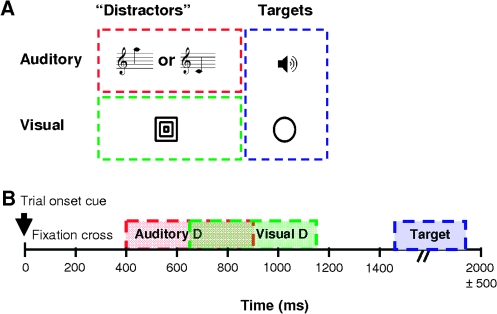
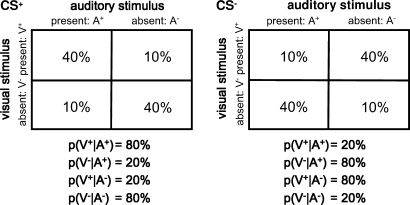
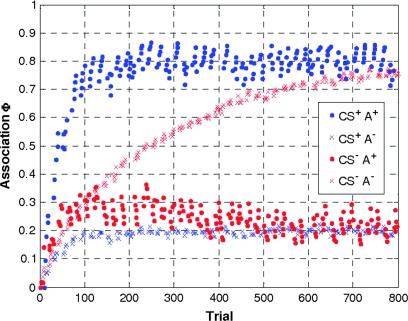
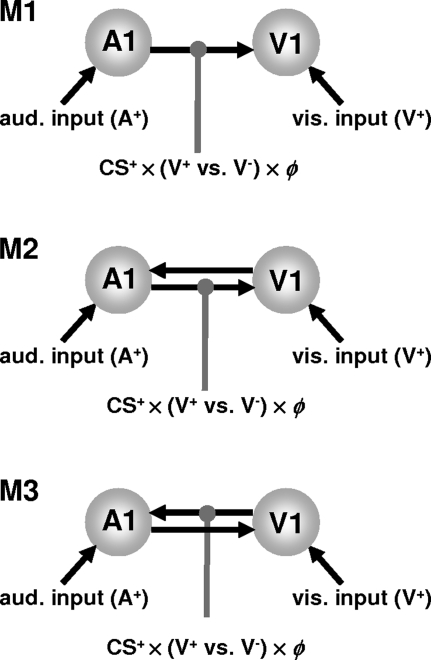
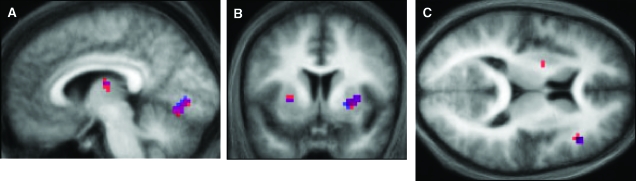
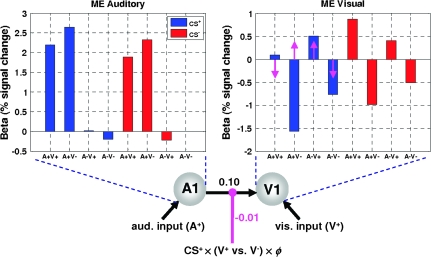
Confronted with a rich sensory environment, the brain must learn statistical regularities across sensory domains to construct causal models of the world. Here, we used functional magnetic resonance imaging and dynamic causal modeling (DCM) to furnish neurophysiological evidence that statistical associations are learnt, even when task-irrelevant. Subjects performed an audio-visual target-detection task while being exposed to distractor stimuli. Unknown to them, auditory distractors predicted the presence or absence of subsequent visual distractors. We modeled incidental learning of these associations using a Rescorla-Wagner (RW) model. Activity in primary visual cortex and putamen reflected learning-dependent surprise: these areas responded progressively more to unpredicted, and progressively less to predicted visual stimuli. Critically, this prediction-error response was observed even when the absence of a visual stimulus was surprising. We investigated the underlying mechanism by embedding the RW model into a DCM to show that auditory to visual connectivity changed significantly over time as a function of prediction error. Thus, consistent with predictive coding models of perception, associative learning is mediated by prediction-error dependent changes in connectivity. These results posit a dual role for prediction-error in encoding surprise and driving associative plasticity.
Overview
The claims and statistics of this paper haven’t been checked yet.
Free: it reads the open-access text and checks the first 5 claims that cite a source we can check. Create a free account to check every claim.
Integrity signals
Registry
Cites
Statistics
Figures
Verification
Claims the paper makes
The claims and statistics of this paper haven’t been checked yet.
Free: it reads the open-access text and checks the first 5 claims that cite a source we can check. Create a free account to check every claim.
Claims other papers make about this one
Each is checked against this paper’s own text: does it say what the citing paper says it does?
The source backs part of the claim, not all of it — or backs it for a different population, condition or comparison.
In the citing paper
“As with RS, ES has been consistently reported in human brain imaging studies across sensory modalities and noninvasive neural recording techniques 45 , 46 , 74 , 75 , 76 , 77 , 78 , 79 , 80 , 81 (but see Ref. 82)”
From Evaluating the neurophysiological evidence for predictive processing as a model of perception (2020) · cites this paper as [74]
Experimental — accuracy not yet measuredIn the citing paper
“These trial-wise prediction error estimates can be used as modulatory inputs in DCM, controlling changes in connection strength during learning (den Ouden et al., 2009).”
From Ten simple rules for dynamic causal modeling (2010) · cites this paper as den Ouden et al., 2009
Self-check
Percentages, sums and reported differences re-computed from the paper’s own numbers.
The self-check needs the paper’s full text.
Citations
Cites
Reinforcement Learning: An Introduction
Sutton, R. S., & Barto, A. G. (1998) · IEEE Transactions on Neural Networks · doi:10.1109/tnn.1998.712192 · Cited by 27,225 · cited 1×
“Cerebral Cortex May 2009;19:1175--1185 doi:10.1093/cercor/bhn161 Advance Access publication September 26, 2008”
InfluentialReinforcement Learning: An Introduction
(2005) · IEEE Transactions on Neural Networks · doi:10.1109/tnn.2004.842673 · Cited by 24,496
Rescorla, R. A. (1972) · Medical Entomology and Zoology · Cited by 9,661
A neural substrate of prediction and reward
Schultz, W., Dayan, P., & Montague, P. R. (1997) · Science · doi:10.1126/science.275.5306.1593 · Cited by 9,388 · cited 2×
“learning because they signal the need for learning in order to update predictions (Shanks 1995; Schultz et al. 1997; Schultz and Dickinson 2000).”
Rao, R. P. N., & Ballard, D. H. (1999) · Nature Neuroscience · doi:10.1038/4580 · Cited by 5,483 · cited 1×
“The total duration of the experiment was approximately 60 min per subject.”
Maldjian, J. A., Laurienti, P. J., Kraft, R. A., & Burdette, J. H. (2003) · NeuroImage · doi:10.1016/s1053-8119(03)00169-1 · Cited by 5,085 · cited 2×
“…the role of the striatum and the prefrontal cortex in associative learning (e.g., Fletcher et al. 2001; O’Doherty et al. 2004; Corlett et al. 2004), we performed an additional restricted search in these areas, using anatomical masks generated from the PickAtlas toolbox (Maldjian et al. 2003).”
Friston, K. J., Harrison, L., & Penny, W. (2003) · NeuroImage · doi:10.1016/s1053-8119(03)00202-7 · Cited by 4,583 · cited 7×
“These models were fitted separately to each subject’s data and compared using Bayesian model selection (Penny et al. 2004).”
InfluentialSelf-citationA theory of cortical responses.
Friston, K. (2005) · Philosophical Transactions of the Royal Society B: Biological Sciences · doi:10.1098/rstb.2005.1622 · Cited by 4,578 · cited 8×
“a general framework for perceptual inference and learning that is discussed in the next section (Friston 2005).”
InfluentialSelf-citationPredictive reward signal of dopamine neurons
Schultz, W. (1998) · Journal of Neurophysiology · doi:10.1152/jn.1998.80.1.1 · Cited by 4,564
Classical conditioning II: Current research and theory.
Black, A. H., & Prokasy, W. F. (1972) · Appleton-Century-Crofts eBooks · Cited by 4,449
Research works printed but not linked: 1
- Hebb DO The organisation of behaviour 1949 New York John Wiley
Cited by
Items 301–320 of 320
Frontocentral brain networks amplify action-oriented temporal prediction errorsPreprint
Sometti, D., Rossetti, I., Schwarz, C., Siegel, M., Braun, C., & Greco, A. (2025) · bioRxiv (Cold Spring Harbor Laboratory) · doi:10.1101/2025.08.07.669061
“Prior work indicates that the brain can extract sensory regularities even when they carry no immediate behavioural relevance 7,10,18 and that prediction error signals are amplified for events tied to task demands 19,20 .”
Tanaka, Y., & Myowa, M. (2025) · Frontiers in Psychology · doi:10.3389/fpsyg.2025.1603183
“Through repeated multisensory exposure, the brain learns to associate these inputs, enabling predictive processing, in which one sensory input facilitates anticipation of another (Banellis and Cruse, 2020; Den Ouden et al., 2009; Shams et al., 2011; Tanaka et al., 2018).”
Competition Between Memory Updating and Differentiation Emerges From Intrinsic Network Dynamics
Pronoza, J., Liedtke, N., Boeltzig, M., Schubotz, R. I., & Cheng, S. (2026) · Neural Computation · doi:10.1162/neco.a.1535 · Cited by 1
Extending the concept of emotion regulation with model-based fMRI
Bratec, S. M. (2016) · Electronic Theses of LMU Munich (Ludwig-Maximilians-Universität München) · doi:10.5282/edoc.20094
Erroneous sensorimotor processing as a transdiagnostic mechanism underlying functional disorders?
Regnath, F., Lehnen, N., & München, T. U. (2024)
Lober, J. (2015) · eScholarship@McGill (McGill) · doi:10.82308/7713
Temporal uncertainty enhances suppression of neural responses to predictable visual stimuliPreprint
Molinaro, N., Lizarazu, M., & Nara, S. (2021) · OSF Preprints (OSF Preprints)
On the role of prediction in visual search
Bouwkamp, F. G. (2025) · Radboud Repository (Radboud University)
Developing models for learning and exploration
Poli, F. (2024) · Radboud Repository (Radboud University) · Cited by 1
Evaluación de la conectividad cerebral efectiva en individuos sanos y con trastornos de salud mental
Maturana Quijada, P. A. (2024) · Dipòsit Digital de la Universitat de Barcelona (Universitat de Barcelona)
Kikkawa, M., Feuerriegel, D., & Garrido, M. I. (2026) · Psychophysiology · doi:10.1111/psyp.70221
“However, our hypotheses address more general theories of prediction that assert expectation effects arise automatically, regardless of behavior, as found by previous studies (den Ouden et al. 2009; Kok et al. 2012, 2017).”
Natural forgetting reversibly modulates engram expressionPreprint
Ryan, T. J., O’Leary, J. D., & Bruckner, R. (2024) · OSF Preprints (OSF Preprints)
La musique de film : introduction à l’étude des attentes musico-filmiques du spectateur
Silveira, C. H. G. (2013) · theses.fr (ABES) · doi:10.70675/bbf500e5zb190z4cafzb989z2344fb5781be
Skvortsova, V. (2015) · theses.fr (ABES) · doi:10.70675/689de32az1e54z4d0cz9034ze64320166cdf
Ekovich, M. (2014) · theses.fr (ABES) · doi:10.70675/7af7ce03za94cz480cza340zf800d08f75de
Wacongne, C. (2014) · theses.fr (ABES) · doi:10.70675/e593b2f1z6d2fz49f9za028z8e68c872239e
Anterior cingulate cortex : contributions to social cognition
Apps, M. A. J. (2012) · Royal Holloway Digital Repository (Royal Holloway University of London)
Mind the brain : The Potential of Basic Principles for Brain Function and Interaction
Sjölie, D., & Janlert, L.-E. (2013)
Metadata
- Authors
- den Ouden, H. E. M., Friston, K. J., Daw, N. D., McIntosh, A. R., & Stephan, K. E.
- Affiliations
- Wellcome Centre for Human Neuroimaging (GB)
- New York University (US)
- University of Toronto (CA)
- Venue
- Cerebral Cortex
- Publisher
- Oxford University Press (OUP)
- Published
- 2008-09-26
- Volume
- 19
- Issue
- 5
- Pages
- 1175-1185
- ISSN
- 1047-3211 (ISSN-L)
- 1460-2199
- PMC
- PMC2665159
- OpenAlex
- W2125055052
- Cited by
- 306
- References
- 69
- Citations by year
- 2026: 10 · 2025: 11 · 2024: 9 · 2023: 14 · 2022: 13 · 2021: 15 · 2020: 16 · 2019: 18 · 2018: 21 · 2017: 26 · 2016: 24 · 2015: 19 · 2014: 19 · 2013: 25 · 2012: 20
- FWCI
- 20.90
- Type
- journal article
- Language
- en
- Open access
- hybrid
- doi.org
- Licence
- cc-by-nc
- Locations
- Cerebral Cortex (publishedVersion, cc-by-nc)
- Europe PMC (PubMed Central) (publishedVersion, cc-by-nc)
- PubMed Central (publishedVersion, cc-by-nc)
- PubMed (publishedVersion)
- Zurich Open Repository and Archive (University of Zurich) (acceptedVersion, other-oa)
- reroDoc Digital Library (submittedVersion)
- Radboud Repository (Radboud University) (submittedVersion)
- UCL Discovery (University College London) (submittedVersion)
- Zurich Open Repository and Archive (University of Zurich) (submittedVersion, other-oa)
- Radboud Repository (Radboud University) (submittedVersion, other-oa)
- Zurich Open Repository and Archive (University of Zurich)
- Funders
- Wellcome Trust (078047/ZS/04/Z, 0856780/Z/99/B, 078047, 088130)
- Universität Zürich
- Topics
- Social Sciences › Psychology › Experimental and Cognitive Psychology › Multisensory perception and integration
- Life Sciences › Neuroscience › Cognitive Neuroscience › Visual perception and processing mechanisms
- Life Sciences › Neuroscience › Cognitive Neuroscience › Memory and Neural Mechanisms
- Keywords
- prediction error, associative learning, incidental learning, surprise, Rescorla-Wagner model, predictive coding, dynamic causal modeling, auditory-visual association, primary visual cortex, putamen, associative plasticity, statistical learning
- MeSH terms
- Acoustic Stimulation, Adult, Association Learning, Cognition, Conditioning, Psychological, Female, Humans, Magnetic Resonance Imaging, Male, Models, Neurological, Neuronal Plasticity, Photic Stimulation, Young Adult
About these checks
Registry, retraction, Cites and statistics results are computed, not judged, with one exception: a printed reference that no index lists is read once by a model before it counts as a citation error. Claims are extracted by a model and kept only when their quote appears verbatim in the text; each cited source is then checked, with a model’s help, for whether it says what the claim relies on. Those verdicts can be wrong — read the claim’s quote and the cited source before relying on one.
Statistics and arithmetic are recomputed, not judged.
Confidence bands are shown only for fields calibrated on our annotated test set. None is calibrated yet, so no band is shown.
What counts as a claim ›How we measure confidence ›How we check this ›
Are you an author, or do you see a problem with this page? Request a review
Data sources
Bibliographic data: Semantic Scholar, OpenAlex, Crossref.
Contains information from the Semantic Scholar Academic Graph Datasets, made available under the ODC Attribution License (ODC-BY 1.0).
Semantic Scholar’s data is described in: Kinney, R., et al. (2023). The Semantic Scholar Open Data Platform. arXiv:2301.10140.
